Tuesday, December 11, 2007

Afghanistan Update

Afghanistan is often forgotten by Americans, cast behind the controversial War in Iraq. But it is a critical ongoing conflict, and far from resolved. I offer now only a smattering of updates to help the reader get a bit more information on progress.

In general, I must first say that progress is questionable at best. In the past two years, Taliban and Al-Qaeda attacks have been up-- it is my hypothesis that their new center of gravity in Waziristan has given them a place from which to grow, and from which to attack and then escape. The elimination of the Taliban and Al Qaeda from Waziristan is probably the most critical goal in the Unite States' War on Terror, and requires not only the stabilization of Pakistan, but also increased cooperation from both Pakistani and Indian leaders (the latter helping to alleviate tensions on the Indo-Pak border and freeing up Pakistani troops). I think a full-scale assault by the Pakistani military with NATO air strikes, lasting perhaps for months, is perhaps the only way to squeeze the Taliban and Al Qaeda out of Afghanistan and Pakistan for good.

To emphasize the problem, see the map below: notice how close Waziristan is to Kabul and other large cities in Afghanistan's center of gravity.
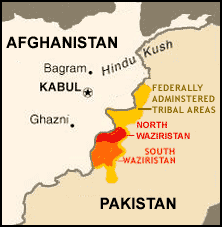


Recently, NATO forces have had to fight to drive the Taliban out of border towns near Pakistan which the Taliban had trickled into and taken over.

Many Marines in Iraq are, in fact, calling for a Marine withdrawal from Iraq so that they can go to Afghanistan and finish the job there. An increased troop presence would certainly allow the US to put more pressure on Taliban forces trying to trickle in, but again, it's only a band-aid without a full offensive in Waziristan (or so I feel).

Furthermore, Afghanistan may be short on security forces. It's current 70,000 are relatively well-armed, but Karzai is requesting more. With the Taliban a major threat from Pakistan, that's certainly a reasonable request--but his hopes for 200,000 troops may be excessive. Not only will this be tough to fund (in particular for the international community-- Afghanistan's economy certainly can't support such forces at this point), but may be unnecessary long-term if the Taliban and Al-Qaeda forces in the Waziristan area can be crushed.

Unfortunately, I've realized I'm mostly saying what I've been saying before. But in full, Afghanistan can't be forgotten. It's far from success, and more tough offensives need to occur. What's frustrating is the fate of Afghanistan may not be in NATO's hands-- NATO will require the full cooperation and help of Pakistan and its army, who must be willing to make sacrifices and investments in eliminating militants in the northwest and enforcing its security and administration there for years to come. Afghanistan and Pakistan both hang in the balance.

Tuesday, December 4, 2007

I Seem to Have Spoken Too Soon on Bush's Iran Policy

With the report that Iran had dismantled its nuclear weapons program in 2003, I figured Bush's thus-far successful Iran diplomacy would make a paradigm shift, hedging for future success. But it seems Bush is intent on reversing any progress recently made.

He's claimed that his Iran policy will stay the same, making myself (and hopefully others) grow skeptical. Bush's claim that Iran is dangerous is certainly true, but without an active nuclear weapons program, the only thing I can seem to directly fault Iran for is their meddling in Iraq. While I don't approve of such meddling in any way, it's understandable; Iran feels like the US is trying to surround it with pro-US allies and isolate it in the region, and Iran is pushing back in what ways it knows how. But Iran has neither the conventional nor nuclear capabilities to launch an offensive campaign. Iran's greatest threat lies in its ability to manipulate, from Hezbollah in Lebanon to Shiite force in Iraq.

So why the tough stance? Does "no change in policy" mean war or airstrikes are still an option? And if so, why? I can't seem to find some other imminent threat that must be stopped, so does the Bush administration simply want to take down this regime to establish US hegemony in the Middle East?

This lack of policy shift is frustrating, and is likely to frustrate the allies that Bush had successfully collected to pressure and isolate Iran. Should he frustrate them too much, he will lose their support entirely, and his outward Iran toughness may be the very force that unravels his Iran policy.

Friday, November 30, 2007

The Storm Clouds Begin to Break in Pakistan... Revealing More of the Same

Much to my surprise, Musharraf has followed through on his promise to step down from his position as head of the military, ending 8 years of military rule.

He is promising an end to emergency rule by the 16th of December. 3 weeks later, he says he plans to hold democratic parliamentary elections, "by the constitution."

Unfortunately, this won't be enough to appease much of his opposition into playing nice. Sharif is still calling for his party to boycott parliamentary elections. While I think such action is numbingly unwise (Sunni boycotts of parliamentary elections in 2004 left them without representatives in a parliament that chugged on without them; the boycott is blamed as one of the reasons anti-Shiite violence exploded in that year, and is a point of regret for many Sunnis that have since decided to work with the government), it could derail the legitimacy of a government that is already standing on shaky legs. While Sharif's political frustration is understandable, my primary concern in Pakistan is its ability to provide internal security, and the robustness of its government against extremist incursion.

Pakistan is still probably the front line in the war on terror. American front pages may not be carrying much about Waziristan, but it is currently largely under Taliban occupation (this after many elements of the Taliban fled from Tora Bora in early 2002), and Musharraf seems to have stepped up attacks against the region during Pakistan's Emergency Rule... but to questionable effect. The Taliban is trying to establish Islamic rule in the area (and probably spread it from there). But don't worry--we know how well that's working for our friends in Sudan.

I'm still not sure how the Waziristan problem can be put down for good. US airstrike-supported large-scale attacks by Pakistan's capable army could have even greater success than NATO's Afghani attacks in 2001 and 2002--the Pakistani army knows the Waziristan region better than NATO knew Afghanistan, and if the Taliban were to try and flee, they would escape into the rifles of waiting Canadian troops. I'm not sure why this option hasn't been played out, except perhaps for the political instability of the government and the stationing of so many troops in India.

Musharraf has a long way to go before Pakistan's political situation is secure. He will have to convince some of his toughest opponents to participate in parliamentary elections this January--but if his power-holding deal with pro-American Bhutto works out, they may be able to unite a large majority in Pakistan that will bring the government the stability it needs to deal with the Taliban once and for all.

Wednesday, November 28, 2007

George Bush Shows off His Diplomatic Muscles

From Israel to Germany, it seems US President George Bush has decided to stop pretending that his diplomatic skills are akin to that of a rock, and buckle down and do what needs to get done.

French President Nicolas Sarkozy visited last month to dine on American cuisine with Bush, and declared his shoulder-to-shoulder friendship with the Americans. He was welcomed warmly by Congress and Bush, and will probably be Bush's primary European ally in his last year in office.

British Prime Minister Gordon Brown has has similar cross-Atlantic warmness to Bush, but certainly not as openly so. Blair's Iraq policy got him in trouble, and Brown does not want to repeat the mistake. But he has indeed maintained that the US and UK are the closest of military allies and friends, despite disagreements.

Even German Chancellor Angela Merkel invited Bush to Germany to talk about Iraq, the Middle East, Global Climate Change, and other topics of worldwide interest. While Merkel and Bush may not be best of friends, this consultation shows that their mutual opinions still matter, and the cross-Atlantic chill seems to have largely thawed.

The Mongolians have declared the US their "third neighbor" (their only two physical neighbors are Russia and China). With the loss of many friends in the former USSR (Turkmenistan, Tajikistan, etc) to the Shanghai Five, a strong ally in Mongolia will give the US presence and flexibility in the region that China has siphoned away.

In the Middle East, Bush is shining. While many Americans and Europeans fear that Bush's sanctions on Iran will lead to war, this is quite unlikely. The administration doesn't have the political capital to try to sneak anything past Congress, nor does it have the military manpower to do much to the Iranians. Bush Administration officials, including Secretary of State Rice, have insisted that there are no war plans. Instead, Bush has united his Western allies in delivering economic sanctions to Iran, both for pushing its nuclear program without IAEA approval and oversight, and for funding the Iranian Revolutionary Guard (the Americans put the Guard on their terror list, and Bush was able to convince many of his Allies to follow). Iran faces a great deal of international and financial pressure to cooperate, and may be forced to capitulate to American demands without a shot being fired.

Most recently, Bush held an Israeli-Palestinian peace talk in Annapolis, Maryland. While many of these talks have happened, to no effect, Bush has managed to wrangle Syria, Saudi Arabia, and delegates from the Arab League to the talks. Their blessing is likely to give the talks legitimacy in the Middle East that they have previously lacked, and Israel's assurance that the Golan Heights are now under negotiation will soften Syria's line in Palestine. Hamas, of course, is protesting furiously, but President Mahmoud Abbas, of the Fatah party, has shown great cooperation. Abbas and Olmert both walked away from the talks with less than they'd hoped to get, but nonetheless signed an agreement to form a peace treaty by the end of 2008. Should it be followed through, an independent Palestinian State could well emerge, and the Americans would likely be the first to jump on recognizing it.

To be frank, I've been surprised and impressed. I never expected such skillful diplomacy from this President, particularly after the stubbornness of 2003 and Iraq. Perhaps personnel changes, or just a change of heart, have caused the behavioral change. Hopefully, this new Bush is here to stay for his last year, and can create a world much more easy to deal with for his successor.

Monday, November 19, 2007

What the Heck is Musharraf Thinking?

I kept thinking that Musharraf's emergency takeover of the Pakistani government was a last-ditch effort to secure power for as long as possible (that is, until he, himself, was bloodily couped by some radical Islamist group), knowing full well he didn't stand a chance at having his election confirmed by the Supreme Court.

But now, he's trying to pretend he's on the democracy track. He has stacked the Supreme Court with hand-picked appointees who voted to unanimously approve the election (note that those judges who were not sacked nor hand-picked refused to swear oath, presumably due to Musharraf's insistence on the oath choosing him as primary deity). Now that he has "legitimacy," he's continually promising to shed his uniform and become a civilian leader (but he'd promised, some months ago, to do this as soon as he was re-elected... we're still waiting).

All of that doesn't seem too strange, but here's the weird part: He's pushing forward parliamentary elections. Prime Ministers really don't do this unless they think they're going to win big sooner rather than later. I don't presume to know what's really going on in Musharraf's head, but could he actually think the emergency rule he's put into place has bolstered his popularity? Or is he simply worried that some other annihilations of his country's constitutions will be discovered soon, and he's going to try to get the elections over with before everyone catches on to his world domination plot?

I'm just not sure. I'm very interested to see how these elections go. From what I'm reading (not that I can find a poll anywhere), it seems Bhutto has the edge, but it's entirely plausible that the Jamat-e-Islami party could dark-horse their way into instituting Islamic rule in Pakistan. I'm not sure at this point if these guys are Taliban-friendly, but I suspect they would be significantly less willing to launch tough operations into Pakistan's northwest, and would probably mean the loss of a pro-American ally in the region.

I just hope Musharraf hasn't screwed this up too bad.

Tuesday, November 6, 2007

The Two Books That Get Me Through My Day

I hate looking through notes, and I hate looking things up. In what I do, there are two books that have consistently (especially today) helped me minimize both of these activities when I'm stumped.

1) Langenscheidt's Pocket Dictionary: Chinese (Langenscheidt Publishers, Inc. Available at Amazon for fourteen bucks)

This sucker is literally pocket-sized (maybe not for girls' pants), and has a radical chart with all of the characters in the book at the beginning. The next two (larger) parts are Chinese-English and English-Chinese, by pinyin. It uses context and sample sentences to help differentiate multiple meanings and usages, and is the darn easiest way I have used to look up Chinese.

2) Guide to Methods for Students of Political Science, by Steven Van Evera (Cornell University Press, available at Amazon for twelve bucks.)

This book is a must-have for anyone writing or reading political science papers. It helps structure one's argument, thinking, and methods to be more clear, precise, and accurate. It helps one analyze the strength of the thesis, predictions, and tests in a paper, and form strong ones when writing one's own.

I recommend both of these books. They've given me enough very wonderful mileage that I don't mind plugging for the authors at all.

Also, get the Van Evera book new. It's probably a few bucks cheaper, but the guy's a poor professor, and should be rewarded for his work.