Showing posts with label security. Show all posts

Sunday, May 25, 2014

The Ukraine Battleground, from Russia's Perspective

So some of my readers decided they wanted to hold me to a higher standard and wrenched my arm into giving the Russian perspective on the battle for Ukraine. This I shall do.

As usual, it's a story and (as usual) a tragedy of realist international politics and the security spiral. I shall tell this story today, trying to keep my biases aside.

The first and most important element of the story comes after the fall of the Soviet Union. I start here because it was a turning point: the former Soviet Union could have stuck with Russia, become neutral somehow, or leaned towards NATO in some way.

We'll talk about why the third option was essentially unavoidable, and explore how it looked from Russia's perspective.

The map below shows the eastward expansion of NATO. Note in particular everything after 1990: a whopping 12 countries were added to NATO's portfolio, doubling its Cold War number to 24. In 2004, NATO expanded enough to completely check any Russian sea action in Europe, and put troops on the borders of its closest allies (Belarus and Moldova).

Obviously from the Russian perspective, this is at-best terrifying. After defeat, one's former enemies surround Russia bit by bit--not slowing down as the memory of the Cold War started to ease, but accelerating and even bordering the country, attempting to choke it off forever.

From NATO's perspective, it was bringing into its protective (and purely defensive) umbrella eager members, whose memory of Soviet oppression was harsh and still fresh, desperate to ensure that the Russians could never come back for them, for the Russians were never kept down for long.

From the perspective of realist international relations: central and eastern Europe are a long, flat plain with essentially no protective boundaries to create natural, safe borders between countries (look at Switzerland--have they been to war any time recently?). Ultimately, these countries are vulnerable to land attack by more powerful countries at all times--end of story. It is critical for them to be under the protection of one alliance or another. Even the Warsaw Pact provided some stability for them from the possibility of more invasion, as much as it was pushed onto their shoulders.

Because these countries are not naturally protected, they were going to join an alliance of some sort. Choosing NATO was not surprising, given their history.

But for Russia, this encroachment--whether or not one understood the natural forces driving it--meant danger and a tightening of a noose.

In 2008, NATO declared that it would be working to incorporate Ukraine and Georgia into the alliance, and that was the last straw. Georgia has access to the Caucasus mountains, and Ukraine sticks like a knife into the underbelly of Russia (and also includes major gas and grain fields, crucial to support Russia in case of a breakdown of trade with NATO). It was just too dangerous, and appeared so aggressive that there was a plausible story that Bush, Blair, Sarkozy, and co. were looking to strike a killing blow. It's even possible that they were.

Russia's 2008 invasion of Georgia was meant to remind Georgia that Russia was still in charge of the area, and it would not tolerate more encirclement (imagine if Mexico became a Russian ally and would start hosting Russian troops and missile batteries).

Recently in Ukraine, the West was obviously very in support of the protesters and the change they would bring. The EU is very interested in bringing Ukraine into its fold (despite the many changes Ukraine must make to get there), and Russia looked quite fearfully at the very real possibility of losing its Sevastopol warm water port (more on that in this earlier post).

It felt it had to act, European objections be damned. So act it did. It was the forces of international security at work, as always: Russia faced a nearly existential threat if it lost its Sevastopol lease.

For Russia, as with most countries, imperialism is not motivated mostly by greed, but by a desire to strengthen, consolidate, or defend its security position. It may seem ridiculous to younger generations that Europe might descend into a land war, but peace in Europe has been a strange break from 1600 years of truly endless carnage, bloodshed, and border-shifting. To pretend that nobody should be worried about such things as the warm water port--or, for my own case, the precedent set of allowing European countries to invade each other and annex territory--enough to go to war for it, is ultimately myopic.

While I will not claim that the Russians have any moral ground for their invasion, it is always worth considering everyone's perspective: for Russia, it is safety and defense, preparing itself to never again allow the invasions of the first and second World Wars to occur. But I want to emphasize that just because we understand the motivations of countries running around annexing each other, doesn't make it any morally less terrible nor less dangerous.

Friday, March 28, 2014

Ukraine Foreign Minister Says Ukraine Will Fight if Russia Invades East

http://www.washingtonpost.com/world/europe/russia-ukraine-bars-pilots-from-leaving-aircraft/2014/03/26/cf44ee34-b4b6-11e3-bab2-b9602293021d_story.html

Thursday, March 27, 2014

With Precedent Set, the Door's Wide Open for Putin in Ukraine. What will Ukraine and the V4 Do?

So, first thing's first: I was pretty wrong. Definitely no shooting war over Crimea.

With that said, the US, Canada, and NATO are all saying Russia looks pretty poised to invade the rest of Ukraine (either to take more of Ukraine or get to Moldova), so stay tuned! There may yet be a shooting war. (The ethnic Russians live in those really red bits and would be the likely target in Ukraine.)


Ukraine up and pulled its troops out of Crimea after Russian troops smashed into the bases. In what is ultimately a complete and unlikely miracle, nobody was shot during this entire process (save for some stray sniper rifle fire from who-knows-whom.) At least the dolphins don't look like they're going to surrender.

Why surrender so quickly?

Simple: it's pretty obvious that Ukraine lacks support. The EU and US just had no interest at all in risking a war with Russia, so they weren't going to come to the aid of the Ukrainian military (which would have lost on its own). Biden may have visited Poland specifically to tell them "no-go" on getting involved in Ukraine (they seemed otherwise chomping at the bit to get in there with the Visegrad 4, which I kept believing would happen).

The US is not considering putting Ukraine under the defensive umbrella of NATO.

The biggest sign of non-support for Ukraine comes from the pretty weak sanctions against Russia. So far, it's only against individuals (travel bans, asset freezes, etc). The US and EU are considering further sanctions if Russia invades the rest of Ukraine, which basically gives Putin a hearty thumbs-up to invade the rest of Ukraine. (The Daily Show actually nails it for once, explaining that "Putin Doesn't Give a S--t.")

(So I'll have to note here that my bias in this matter is pretty obvious. I think undeterred territorial-expansion invasions in Europe are a dangerous thing and set a very bad precedent for the stability of Europe in the future.)

So  let's assume a second invasion of Ukraine is pretty likely at this point. It's not clear whether or not Ukraine is going to fight a losing war for the rest of its eastern territories. Certainly Tymoshenko--most influential leader in Ukraine right now--is ready to "wipe out" the Russians and take up arms. Highly controversial statement, but it may get her swept into power quickly if Russia invades again.

Ukraine is clearly not going to get military support if it doesn't fight. I think in Crimea it was ready to see if it could get the support it needed. Russia moved quickly and jammed through the sham-referendum, and the West balked at helping. By the time Ukraine knew what help it could get, it was just too late.

If Russia invades again, Ukraine knows it can't wait for help.If it starts fighting and its people start dying--rather than doing nothing--it is much  more likely to provoke a military response from a friendly nation. It seems somewhat Machiavellian to throw one's army into a fight one knows it will lose (on the hopes that help will come), but the pro-Western part of Ukraine very much sees itself as the Czech / Poland to Putin's Nazi Germany right now. The idea of rolling over is fairly horrifying to many.

Sadly, I just can't predict what's going to happen. They absolutely can't depend on the EU, US, or NATO--they've been quite thoroughly hung out to dry by all of them.

Once again, I turn to the Visegrad 4, the sleeping tiger in all of this (and the only ones that seem to be kicking up any serious dirt about Russia's invasion of Ukraine). It may be the very weakness of the US/EU/NATO response that kicks them into gear. The V4 was formed quite explicitly out of a lack of confidence in the rest of NATO to protect them from Russia, so they're a bit of a rogue element within NATO. To them, Russia is a very real and credible threat, and so the US/EU/NATO responding weakly is going to shake V4 confidence in that leadership. They'll be, in turn, less likely to listen to any warnings about getting involved.

So I'm still going to predict that, if Russia invades eastern Ukraine, and Ukraine fights, Poland and the V4 are going to get themselves in the fight. They won't invade Russia, but they're poised right on the western border of Ukraine and would be ready to send their battle group in to hold the line.


Once that happens, Russia will have a bit of a tough choice: either take them head on or try to avoid a fight and hold on to whatever territory it has. Normally, I'd assume that neither side wants to be seen as an aggressor, but Russia might just not care that much and try to give them enough of a bloody nose to boot them out before NATO can decide whether to back up the V4 and try to win back some shadow of a hint of relevancy in Eastern Europe.

But I'm not going to predict how that fight will go.

The big takeaway here is that the US, EU, and NATO are very quickly losing relevance in Eastern Europe, and that's where the action is. Ukraine is on its own unless the V4 jumps in. If they do, NATO as a real power in Europe is probably doomed.

So it's a pretty big deal.

Tuesday, March 18, 2014

The Shooting War May be Starting... Stay Tuned

2 Ukrainian servicemen killed in Crimea by snipers. Not yet confirmed it's Russians.

http://rt.com/news/crimea-shooting-military-center-646/

But the Russians will have to push the Ukrainians out of Crimea if they're going to legitimize themselves, and I think a hot war is coming.

Tuesday, January 31, 2012

The Syrian Uprising: Part II, "The Military Reality on the Ground"

Just to make sure I'm adequately managing expectations: the military situation on the ground in Syria is very fuzzy, and is made up of very contradictory reports of government supporters and Free Syrian Army supporters. We'll do what we can.

What we do know is that the Free Syrian Army is now capable of occasionally holding serious bits of territory. The Syrian Army recently took back a big chunk of Damascus suburbs, and the rebels seem to have taken a suburb of Homs.

That said, I don't think this is going to be a territorial war like Libya was (this is closer to "everywhere at once"), nor as much civilian terrorism as Iraq (though that certainly is happening). It is definitely a wide-ranged insurgency, designed to keep the Assad government off its toes and on the defensive. And it may be working: the anti-Assad international community is increasingly excited about supporting it, though nobody has ponied up (officially) yet. (But more on their prospects later.)

It's still tough to figure out the current size of the FSA. The Army itself says their fighters are above 40,000--and with the amount of trouble they're causing over increasingly large areas simultaneously, this may be right. But it's hard to tell. And if they do have 40,000, they won't all be armed. Many will be in support and logistics roles, coordinating ambush-style attacks. But we know that the FSA is capable of hitting and destroying Syrian tanks (which are mostly sitting ducks in city streets against insurgencies), attacking major bases (like airfields), and even setting up roadblocks in areas near Damascus.

But keep in mind: the Iraqi insurgency, which was far larger, better-funded, and better-armed, failed against the US-led coalition and the burgeoning Iraqi military. That said, the Syrian army is not equivalent of the US army, but the will to remain is incredible. Like the Ghaddafi regime, the Assad regime is very unlikely to willingly go until near the end. Assad is very likely less delusional than Ghaddafi, and will therefore call it quits before death, but a prolonged insurgency won't be enough to cause him to voluntarily leave.

In short: the rebel opposition, made up mostly of the Free Syrian Army, is vast, increasingly organized, and has a safe haven in Turkey. It has serious staying power... as long as it is funded (the Syrian army has coffers to pay their soldiers; the FSA does not). We will see many continued months of insurgent attacks against the Syrian army, likely attempting to convince rank-and-file soldiers or even entire companies to defect. The Assad regime does not have total control on the ground, and this should be a matter of serious concern for the regime.

More to come on what this means with respect to the FSA's prospects for victory, but it'll have to wait until next time.

Tuesday, March 22, 2011

Checking In on Middle East Unrest Predictions

Never let it be said that Foggofwar doesn't hold itself accountable to its predictions. Let's go back and see how we did. For now, we won't cover everything--only the interesting ones.

Libya: Certainly the most interesting case, Libya would give Foggofwar the excuse of "intervention by the world's most powerful military alliance." Ironically, we may not even need this prediction: Protests have still not reached Tripoli, and the Rebel/NATO alliance seems to be showing a serious inability to mount an assault across the long stretch of desert, and thus won't overthrow the Gaddafi regime: the West will lose interest before Gaddafi loses will or military capability. As Predicted.

Morocco and Jordan: Protests here have died down largely due to reforms enacted by the governments that have given protesters what they wanted. As Predicted.

Syria: Protests continue to rock the country, despite (or because of) Abbas' crackdowns. Abbas has the ability to keep a lid on the populous through serious security and political liberty reforms, which he may want to do in order to court the West, anyway. But Abbas has infuriated his country and squandered a strong, loyal security establishment. Increased Risk.

Yemen: Rumors fly that the Yemenese president is working with Saudi and US allies to transition out of government... and out of the country. It's been a surprisingly long, sustained fight, but it looks like this current regime is on its way out. As Predicted.

Bahrain: Bahrain has fallen out of the news sphere as of late, as the active unrest has stopped. Interestingly, the sustained crackdown continues, trying to marginalize the supporters of the protests. The regime is safe--for now. But the Shiite majority of the country has been alienated completely. Long-term, the regime will continue to face risk. As Predicted.

Briefly speaking, no other country has surprised us yet in the magnitude of risk or, more importantly, in regime change. Overall, we've done pretty well so far.

But we're happy to be proven wrong if things change.

Friday, August 14, 2009

Perils in Placing Too Much Hope in Afghan Elections

A low-order analysis of the coming Afghan election (which is about the best you'll be getting out of me today) suggests that no likely result is going to have particularly positive outcomes for the anti-Taliban coalition, despite the increasingly bulky bunch of eggs being stuffed into the election basket by the ISAF.

Recent polls put Karzai in a decisive lead with 44%, though failing to get 50% would lead to a runoff. In second is former foreign minister Abdullah Abdullah with 26%; in third, Ramazan Bashardost with 10%; and in fourth, Ashraf Ghani with 6%.

So let us first assume that the vote goes relatively smoothly, despite Taliban attempts to disrupt it. If Karzai wins, Afghanistan has a status quo problem. He is not a terrible president, but he is often arbitrary, his government is corrupt and dysfunctional, and he has apparently alienated much of his former Pashtun support in the south (he is the only all-Pashtun major candidate). Worse, he is being seen as selling out women's rights: he is executing the implementation of a law that allows Shiite men to deny food to their wives, should their wives not be satisfying them sexually (among other things). The implementation of the law is likely to boost his support among some of the 20% Shiite population of Afghanistan. Once the golden boy of the anti-Taliban movement and its Western allies, Karzai has fallen to the point of receiving but an exhausted shrug from those former allies with whom he is not currently cutting deals. Communication difficulties throughout Afghanistan and other barriers to entry for other candidates are probably large contributors to Karzai's current poll popularity.

Dr. Abdullah Abdullah is half-Pashtun, but spent the Taliban regime fighting with the Northern Alliance, and is therefore unlikely to win over many fence-sitting Taliban supporters simply by being elected. His current campaign mimics that of President Obama in rhetoric, and he has clearly set himself up as a sortof "change" candidate, with governmental corruption being his highest campaign issue ("security" is not listed as an official issue, but this may in large part be due to the fact that Abdullah knows better than to think it is a simple lack of will to fight that is keeping the Afghani security forces from winning). He is certainly likely to take Mr. Karzai to a runoff, but whether he'll win is unclear even to pollsters. And whether he can pull Afghanistan together is equally unclear. He does not have the loyalties of many tribes and warlords that Karzai does--and if they cannot be kept in line as the Afghan state develops, they will become as dangerous as the Taliban. And while a change in face might bring some temporary honeymoon to negotiations with the Taliban, they are unlikely to balk on their demand that negotiations occur only after foreign troops have left the country.

The other two candidates are very unlikely to make it to the runoff, which is a shame, because they're quite incredible men. They're both very well-educated technocrats that have detailed plans on how to create structures and incentives to eliminate corruption. Bashardost and Ghani have both won my heart: Bashardost's campaign office is a small tent outside of Kabul's parliament, and he's got a reputation as a charismatic, hot-headed crusader for transparency and political rights. Ghani is talkative and is apparently at times overbearing, but this is largely because he has so many intelligent things to say that he must say them quickly, lest he run out of time. As the former planning and finance ministers, respectively, their attention to detail grossly outstrips their more strongman-style rivals. But, again, they are very unlikely to win.

And, again, this assumes that the Taliban's relative quiet over the past few weeks has not been in preparation for a devastating and coordinated attack on the elections. Should the elections be significantly disrupted, the winner will face incredible legitimacy problems, despite the best of possible intentions. Thursday shall be a tense day. But the Taliban have largely let election commission workers set up and prepare without harassment, which means they may well not try to disrupt the elections themselves. The Taliban are more interested in gaining popularity for themselves than instilling temporary chaos. 90% of polled Afghans declared their intention to vote, which means a significant disruption would likely stir anger amongst otherwise-friendly Afghan people. The Pakistani Taliban's PR disaster has probably taught the Afghani Taliban that discretion is often a key aspect of a winning strategy.

We'll keep you updated on how things go on Thursday when we know.

Thursday, July 10, 2008

China's PR Mess

China's PR machine is struggling seriously.

China killed 5 "militants" today in Xinjiang. Now, these guys might actually be bad guys, but they were not rounded up for trial, just shot. The Chinese PR machine did not make any attempts to say that the "militants" were hurting other people or even resisting arrest when shot, just that they were shot. This makes a lot of Westerners feel queasy about the state's way of dealing with its internal problems.

Now, my Chinese friends, I know you are going to say "these are our problems! You should not care about how we deal with them!" It's true there's no cassus belli for such things, but it's the sort of thing that still makes people uncomfortable. We didn't like the Soviets for starving their own Ukranians to death or slaughtering their own political dissidents, and we're not going to like wanton killing without a justice system, and we're going to reserve that right. Anyway.

China has proudly announced, further, arrests of lots of individuals trying to sabotage the Olympics. Chinese media are very short on details of the plot, of the particular crime committed (though we can guess it's conspiracy to do something). They also announced the "three evils" of "terrorism, separatism, and extremism." Now, most Westerners don't like terrorism or even extremism, but we don't tend to think of people who want their own country (that is, separatists) as necessarily evil. Terror tactics to get it? Totally. But not just standing against the unity of a set of borders described by the government. The Chinese government and media's branding of anyone-who-wants-a-different-country alongside terrorists sounds like very crude political exploitation. Using the "terorrism" brand to win US support for something hasn't worked since 2002. Using "the Olympics" as an public excuse for human rights abuses has never worked.

So I am not sure who is orchestrating the Chinese Public Relations machine. But the Chinese government clearly is in a state of reassurance to its neighbors (along with a tough stance on what it sees as threats to its own interests), but its media blunders are not helping this policy. Further, angry reactions to Western perceptions caused largely by such media blunders make the Chinese state look aggressive and adolescent.

Here at Foggofwar, we suggest finding a new PR team. Email me if you've got an offer.

Thursday, February 14, 2008

Eastern Europe is Heating Up Again

Just when we thought that Europe was no longer a problem (perhaps we have been ignoring it due to the Middle East, Central Asia, Southeast Asia, Africa...), forces in Eastern Europe have started to turn it into a hot spot once more.

Perhaps some of these issues will fizzile, but for now, bitterness and tension are growing over events-about-to-happen, as well as a West vs. Russia proxy war over the loyalty of Eastern Europe States.


The first fight: Will the undecided factions of Eastern Europe end up pro-West or pro-Russia? Ukraine and Serbia are critical battlegrounds (where places like Poland, the Czech Republic, and Albania are clearly West-leaning, and Moldova and Belarus are Russian-leaning), where both sides are using propaganda and low-level political support (including criticism of opposition parties) to help coalitions loyal to them win. Yuschenko's victory in Ukraine two years ago scored a big win for the West, but his mandate has broken, and Ukraine is back up in the air. Pro-western forces barely won re-election in Albania. Why all the fighting over these states? The sense that a Cold War is returning is slowly and very reluctantly creeping back into foreign policy circles.

The second fight: Missile Shields. The US has made deals with Eastern states like Poland and Ukraine to provide (technologically questionable) anti-ballistic missile technology, and has been working for years to actually deliver--this shows a clear anti-Russian hostility (though the US State Department once insisted that it was to protect Europe from Iran) from both the US and these Eastern European states. The EU has been quiet on the subject, giving the US a silent mandate to continue. But the Russians are furious; enough so that Putin has threatened to target Eastern European states with its ballistic missiles if these states go ahead with US missile shield plans. I am not quite sure why the US is insisting on the shield, other than (now) to avoid looking like it will back down to Putin's demands.

The third fight: Kosovo. Elements of Serbia are strongly against the Kosovo secession, as is Russia, while the US and EU support it. The barely-majority government of Serbia has decided to let Kosovo go, despite its strong displeasure with the idea, and has told Serbia to brace for the fracture. The West will recognize Kosovo and give it the diplomatic legitimacy it needs to get on its feet, but all elements are hoping that this is the final fracture of the failed experiment of Yugoslavia.

As Russia grows, the West-Russia fight is likely to grow in magnitude, as well. The Russians are looking for, at the least, respect from the West. But until Russia is willing to play by the West's rules, the EU is unlikely to accept Russia into the fold, and high tensions will remain for a great deal of time to come.

The big losers out of all of this are, of course, the buffer states: former Soviet republics whose economies are only barely starting to recover from the Soviet planned economy can do little to stand up to Russia without Western support, and surely, many of them would rather work with all of their neighbors to improve their domestic economy, rather than engage in a faux Cold War, but they may be forced to choose a side. Should such coercion happen, they can only lose; siding with either coalition will hurt their economy if the losing coalition cuts them off, and leaning against Russia is likely to lead to very high security risk, unless the West is willing to fight for these nations (it's not). This is a classic bandwagoning problem, and we may see more of it in the future.

Thursday, December 27, 2007

Iraq Update: Picture Version

All these are taken from the DoD.

Picture the first: Overall Weekly Iraq Attacks. Dramatically down, to '04 levels. It looks, though, like attacks against Government Facilities are not down much, whereas small arms and mortar attacks are very down--this indicates to me that anti-government terror attacks (probably Al-Qaeda centered) attacks are more stubborn than sectarian militia fighting; we'll see some of this later. Another interesting thing is that violence is significantly up during Ramadan every year. Understandable: I'm homicidal when I'm too hungry, myself.


Picture the second: Ethno-sectarian deaths are down some absurd amount like 90% (or so it appears) since a peak in Dec. 2006. One simply cannot call this a civil war any longer; one can never expect ethnic deaths to reach zero, but reducing this number of ~220 by another order of magnitude would probably give the United States a run for its money in ethnic passivity.


Picture the third: total civilian, Multinational Force (MNF), and Iraqi Security Force (ISF) deaths. By both conservative and bad-scenario estimates, civilian deaths per month have dropped over 67% since their peak. Unfortunately, it's hard to look at this figure and tell how ISF and MNF deaths are doing, but the report shows that monthly averages are down about 50% from their peak.


Picture the fourth: Attacks by province. The first surprise I see is Anbar, from the last post on attacks by province I made (Feb 14 - May 4), Anbar has dropped from 25 attacks per day to five. Baghdad is down from 50 attacks per day to 27. Attacks in Ninewa have not budged over the same time, and Ninewa has made it into the "red zone" of four tough provinces that need work; but this is seems to be only because it has failed to improve, not because it has worsened. Other provinces have reduced in daily attacks by a more modest, but appreciable, rate.


Finally, picture the fifth: The Iraqi Provincial Security Transition Assessment. Self-explanatory by now, I'm sure, but I should note that the British handed over Basrah in December. Based on the previous figure, Qadisiyah and Wasit look like very reasonable choices for quick handover-- afterwards, the Polish zone would be reduced to only Babil.


In conclusion, things keep looking good. Here's to the brilliant General Petraeus keeping up the good work. If this trend keeps up, we can hope to see easy times in Iraq in another year.

Sunday, December 16, 2007

Basra Handed Over

Iraqi Security Forces and government are now in full control of the city and province of Basra. A parade was held today throughout Basra's main streets, and an impressive array of security personnel and weaponry reassured Basra's citizens that they were in good hands.

As Iraq's second-largest city, Basra is a key testing ground for two questions:
1) Can Iraqi security keep the peace that the Multi-National Forces have wrenched into some Iraqi provinces?
2) Will violence in Basra actually _drop_, as anti-Coalition forces (like those of Al-Sadr) will no longer see a military obstacle, or will such militias turn against other militias with a new hubris?

British forces will remain in the deserts outside of Basra for some time, ready to enter the city on the command of Basra's Governor, should a militia try to take control. The Iraqi forces still have some growing to do.

But the British are now all but done their obligation in Iraq, leaving the Americans mostly alone.


(if the photo looks fuzzy, just open it in a new tab)

All British Command provinces are in full Iraqi control, and British forces are being reduced to a mere 2500 troops in the next few months. American forces can only hope that the British will continue to help pay for military training and purchases by the Iraqi army, as well as help manage the sluggish development of Iraq's economy.

But if this handover goes well, it shows great promise for handovers by Polish forces in Babil, Qadisiyah, and Wasit, all of which have relatively low violence and few ethnic mixing zones. Such handovers will be particularly important for the Americans, as the new Polish leadership is itching to bring its troops home, and the Americans would prefer to not have to spread their own forces to cover any ground that the Polish abandon before a formal handover. While these three provinces are not scheduled for handover at years' end, they may well be ready for handover early in 2008.

Unfortunately, all this handing-over has little immediate effect on the Americans' abilities to consolidate their forces in hot spots, or even start drawing-down-- the only handovers so far in the American sectors have been in Kurdish areas, and American forces still remain to make sure that Turkish and Kurdish forces do not start sparring. Not surprisingly, Americans chose to govern the toughest, most ethnically divided, most violent parts of Iraq in 2003, and their obligation remains.

But places like Anbar and Tamim are starting to look increasingly safe, and American forces may try handing over some of these provinces before next summer to keep a sense of progress in the air. But this is all speculation.

Tuesday, December 11, 2007

Afghanistan Update

Afghanistan is often forgotten by Americans, cast behind the controversial War in Iraq. But it is a critical ongoing conflict, and far from resolved. I offer now only a smattering of updates to help the reader get a bit more information on progress.

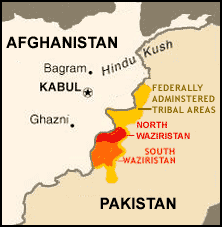
In general, I must first say that progress is questionable at best. In the past two years, Taliban and Al-Qaeda attacks have been up-- it is my hypothesis that their new center of gravity in Waziristan has given them a place from which to grow, and from which to attack and then escape. The elimination of the Taliban and Al Qaeda from Waziristan is probably the most critical goal in the Unite States' War on Terror, and requires not only the stabilization of Pakistan, but also increased cooperation from both Pakistani and Indian leaders (the latter helping to alleviate tensions on the Indo-Pak border and freeing up Pakistani troops). I think a full-scale assault by the Pakistani military with NATO air strikes, lasting perhaps for months, is perhaps the only way to squeeze the Taliban and Al Qaeda out of Afghanistan and Pakistan for good.

To emphasize the problem, see the map below: notice how close Waziristan is to Kabul and other large cities in Afghanistan's center of gravity.


Recently, NATO forces have had to fight to drive the Taliban out of border towns near Pakistan which the Taliban had trickled into and taken over.

Many Marines in Iraq are, in fact, calling for a Marine withdrawal from Iraq so that they can go to Afghanistan and finish the job there. An increased troop presence would certainly allow the US to put more pressure on Taliban forces trying to trickle in, but again, it's only a band-aid without a full offensive in Waziristan (or so I feel).

Furthermore, Afghanistan may be short on security forces. It's current 70,000 are relatively well-armed, but Karzai is requesting more. With the Taliban a major threat from Pakistan, that's certainly a reasonable request--but his hopes for 200,000 troops may be excessive. Not only will this be tough to fund (in particular for the international community-- Afghanistan's economy certainly can't support such forces at this point), but may be unnecessary long-term if the Taliban and Al-Qaeda forces in the Waziristan area can be crushed.

Unfortunately, I've realized I'm mostly saying what I've been saying before. But in full, Afghanistan can't be forgotten. It's far from success, and more tough offensives need to occur. What's frustrating is the fate of Afghanistan may not be in NATO's hands-- NATO will require the full cooperation and help of Pakistan and its army, who must be willing to make sacrifices and investments in eliminating militants in the northwest and enforcing its security and administration there for years to come. Afghanistan and Pakistan both hang in the balance.

Tuesday, December 4, 2007

I Seem to Have Spoken Too Soon on Bush's Iran Policy

With the report that Iran had dismantled its nuclear weapons program in 2003, I figured Bush's thus-far successful Iran diplomacy would make a paradigm shift, hedging for future success. But it seems Bush is intent on reversing any progress recently made.

He's claimed that his Iran policy will stay the same, making myself (and hopefully others) grow skeptical. Bush's claim that Iran is dangerous is certainly true, but without an active nuclear weapons program, the only thing I can seem to directly fault Iran for is their meddling in Iraq. While I don't approve of such meddling in any way, it's understandable; Iran feels like the US is trying to surround it with pro-US allies and isolate it in the region, and Iran is pushing back in what ways it knows how. But Iran has neither the conventional nor nuclear capabilities to launch an offensive campaign. Iran's greatest threat lies in its ability to manipulate, from Hezbollah in Lebanon to Shiite force in Iraq.

So why the tough stance? Does "no change in policy" mean war or airstrikes are still an option? And if so, why? I can't seem to find some other imminent threat that must be stopped, so does the Bush administration simply want to take down this regime to establish US hegemony in the Middle East?

This lack of policy shift is frustrating, and is likely to frustrate the allies that Bush had successfully collected to pressure and isolate Iran. Should he frustrate them too much, he will lose their support entirely, and his outward Iran toughness may be the very force that unravels his Iran policy.

Friday, November 30, 2007

The Storm Clouds Begin to Break in Pakistan... Revealing More of the Same

Much to my surprise, Musharraf has followed through on his promise to step down from his position as head of the military, ending 8 years of military rule.

He is promising an end to emergency rule by the 16th of December. 3 weeks later, he says he plans to hold democratic parliamentary elections, "by the constitution."

Unfortunately, this won't be enough to appease much of his opposition into playing nice. Sharif is still calling for his party to boycott parliamentary elections. While I think such action is numbingly unwise (Sunni boycotts of parliamentary elections in 2004 left them without representatives in a parliament that chugged on without them; the boycott is blamed as one of the reasons anti-Shiite violence exploded in that year, and is a point of regret for many Sunnis that have since decided to work with the government), it could derail the legitimacy of a government that is already standing on shaky legs. While Sharif's political frustration is understandable, my primary concern in Pakistan is its ability to provide internal security, and the robustness of its government against extremist incursion.

Pakistan is still probably the front line in the war on terror. American front pages may not be carrying much about Waziristan, but it is currently largely under Taliban occupation (this after many elements of the Taliban fled from Tora Bora in early 2002), and Musharraf seems to have stepped up attacks against the region during Pakistan's Emergency Rule... but to questionable effect. The Taliban is trying to establish Islamic rule in the area (and probably spread it from there). But don't worry--we know how well that's working for our friends in Sudan.

I'm still not sure how the Waziristan problem can be put down for good. US airstrike-supported large-scale attacks by Pakistan's capable army could have even greater success than NATO's Afghani attacks in 2001 and 2002--the Pakistani army knows the Waziristan region better than NATO knew Afghanistan, and if the Taliban were to try and flee, they would escape into the rifles of waiting Canadian troops. I'm not sure why this option hasn't been played out, except perhaps for the political instability of the government and the stationing of so many troops in India.

Musharraf has a long way to go before Pakistan's political situation is secure. He will have to convince some of his toughest opponents to participate in parliamentary elections this January--but if his power-holding deal with pro-American Bhutto works out, they may be able to unite a large majority in Pakistan that will bring the government the stability it needs to deal with the Taliban once and for all.

Tuesday, May 8, 2007

Reasserting Control

Hot off the presses, just for you, a paper I just finished for Barry Posen. It's called "Reasserting Control: Could China Conquer Taiwan?"

I decided to write it after reading a handful of academic campaign analyses on just the same thing that resoundingly concluded "no," but used a series of hogwash arguments that either lacked detail or chose assumptions and scenarios that arbitrarily favored the Taiwanese. My analysis decides that if China is able to pull off a coordinated missile, bomber, and fighter/ground-attack (FGA) attack on Taiwanese airbases and C4I centers, it can gain an advantage in the air war, and possibly establish air dominance. After that, it's a matter of using its submarines to pin Taiwanese ships in port to open up the way for an amphibious assault. Though amphibious assault landing ships are limited, China could combine its elite marines with an all-out airborne assault on a single point of attack near a port city in the north to establish a beachhead, and then reinforce the beachhead with a "Million-man swim:" an operation that would involve shipping as many as hundreds of thousands of Chinese troops on commercial fishing vessels and making them swim to shore in what amounts to a very wet airborne-style operation, which is only feasible under the protection of a secure beachhead, air superiority, and sea superiority.

After taking and reinforcing the beachhead, the Chinese would have a short march to Taipei, and with the assistance of tactical interdiction on the part of the Chinese PLA Air Force, Chinese troops could break through and race to the city, where they would fight Taiwanese troops in brutal urban warfare. The award-winning training of China's more elite small units, as well as renowned toughness and grit, would give China the advantage it needed in taking the city. With Taipei in hand, China could stop and defend its spoils, having dislodged the Republic of China government.

The full paper explains in detail each step of the hypothetical operation, and uses the conclusions of the analysis to guide future US, Taiwanese, or Chinese military policy. I encourage at least a skim-through.

http://web.mit.edu/efogg/Public/taiwan.pdf

Sunday, March 25, 2007

Iran Moves In for the Kill

Since the Islamic revolution of 1979, Iran has hated the United States. The end of the revolution wrought what was indeed a bad day for American flags in Tehran, as the American-backed government was fully overthrown. Iran's history from then is interesting, with their only significant war coming from the invasion of Hussein's Iraq in 1980. The war lasted 8 years, and Hussein's army inflicted 500,000+ casualties and USD 350 Billion in damage to the Iranians, in large part with mustard and nerve gas. The Iranians emerged from this war quite bitter, having felt teamed up against by just about everyone in the world. Iraq received weapons and support from many countries-- the highest number of weapons coming from France, China, and the Soviet Union. Even the United States provided political support and some helicopters (proving once and for all that the defeat of Iran seemed to be the only thing the Americans and Soviets could agree upon). Coming out of the war broken, but sovereign, the Iranians were rather pissed-- and bent on beefing up their military capabilities.

These days, the Iranians don't spend much on their own military, but still boast 550,000 troops, including the elite al-Quds. They have American F-14 Tomcats (provided before the revolution), as well as a large stock of Russian-provided weapons, and short-range ballistic missiles. But as the Iran-Iraq war showed us, Iran's home-field advantage would make it extremely difficult to invade. American forces' technological superiority would give them an advantage, but they're tied up with Iran's neighbors. And it's this tie-up that has given Iran the opportunity it needs to do something about being so angry at everyone all the time.

Not only is Iran angry about the United States' existence, but it is one of the few countries left in the world still trying to drive Israel into the sea (or, as it's written by President Ahmadinejad, "wipe Israel from the map." There's lots of good angry stuff at intelligence.org: http://www.intelligence.org.il/eng/sib/4_04/as_iran.htm). With the United States in Afghanistan and Iraq, (with alliances of sorts in Pakistan, Kuwait, and Saudi Arabia) Iran has been feeling a bit surrounded. Not only that, but the fundamentalist theocratic government has had an opportunity to quell a lot of old unrest by uniting its people against the Zionists and the Great Satan. Iran's reaction to the United States and Israel cramping its style has not been to cow, but to flex its muscles. And Iran's government is starting to realize it can really do whatever it wants.


On the list of Iran's diabolical plans for the Middle East:

1) Develop a nuclear weapons program. They're not fooling anyone. The wildly disparate UN Security Council continually agrees that Iran's "peaceful" nuclear power program covers a clandestine weapons program. It doesn't help that Iran's also developing "peaceful" medium range, nuclear-capable ballistic missiles. Having nuclear weapons would give Iran a leg up in its efforts in achieving objective number two...

2) Wipe Israel off the map. Nothing too new, but angrier than ever. President Ahmadinejad seems to have brought a whole new level to Iran's anti-Israeli hate. No real clashes yet... unless you count the unprovoked capture of soldiers and then rocket-bombing of civilians last summer by Iranian-trained, -funded, and -backed Hezbollah militants in southern Lebanon. But the consensus seems to be to blame Israel for that war anyway. Iran may not have driven Israel off the map with that effort, but Hezbollah emerged stronger than ever, and the Iranian government wouldn't be crazy to think that Israel lacks a great deal of political support these days, which might very well mean that Israel would think twice about a pre-emptive attack against a mobilizing Iranian army. Iran's strange alliance with Sunni-dominated Syria remains strong, perhaps only due to shared anti-Israeli sentiment. More strangely, this alliance hasn't been hampered by objective the third...

3) Win the war in Iraq and establish Shi'ite dominance in the region. Remember, Iran is a hard-line theocracy, and Sunni Muslims, while not as bad as Americans or Jews, still find a place on the hit list. Iran has clearly been funding the stronger Shi'ite militias in Iraq, hoping that they will triumph in the war and finally make Iraq a strong Iranian ally. The US invasion of Iraq has proved an opportunity for Iran to bring the only other large Shi'ite dominated country into its axis. If Iran can secure Iraq, it becomes a highly formidable force, and in time, could become an uncontested regional force. The US military and intelligence have found Iranian soldiers in Iraq, as well as evidence of their elite al-Quds infiltrating Baghdad and other hot spots.

And Iran hasn't stopped there. Until recently, they have kept to subversion and proxy fighting against the west. But now, they've taken another big step, and gotten aggressive. The capture and holding of 15 British troops has brought Iran into the war for real, as much as nobody really wants to admit it. This crisis puts Iran in a hugely advantageous position-- The Iranians understand that Britain values the lives of these 15 soldiers, and they now act as a powerful negotiating tool for the Iranians to get what they want. Britain, and the coalition in general, have been put in a very tough position.

Iran will continue its bold moves to take power in the region. It won't dismantle its nuclear program. It won't stop funding Hezbollah. It won't stop interfering in Iraq, and it won't give back British troops until it gets something very valuable in return. Iran feels emboldened, and invincible. This is mostly because no single group or alliance has both the will and the capability to invade. With the United States and Britain tied up in Afghanistan and Iraq, and their will for war depleting rapidly, Iran's two greatest enemies are all but out of the military picture. The next-largest militaries, France and Germany, surely won't consider invasion as a means for fixing Iran's behavior. Ever-confident that it can make move after move to shape the region as it wants, Iran knows that as long as none of its actions are too extreme, nobody will muster the will to do anything about it. This drip-by-drip escalation was mastered by Germany in the 1930's, and Iran may manage to stay far enough under the radar to see long-term success in its hopes for both an active nuclear weapons program and hegemonic dominance over the region.

But only if we decide to continue not to do anything about it.

Friday, February 2, 2007

China's Taiwan Dilemma

The Republic of China is a problem that the People's Republic of China government has tried to resolve since its inception in 1949. On the other hand, the People's Republic of China is a problem the Republic of China government has tried to resolve since its inception in 1949. The relationship between the two entities has varied wildly in the past 57 years, edging occasionally towards conflict and the brink of war.

Taiwan has been an incredibly complex issue for the United States, as well. From 1949 to 1971, the United States backed the Republic of China (run by the exile KMT government on Taiwan) as the legitimate government of all of China. In the 1950's and 60's, The People's Republic (headed by the CCP on the mainland) made moves towards war, using backyard iron works to produce shells designed to fly over the strait. China lacked the military material and technology to mount an offensive, but was able to solidify its threats when it tested atomic and thermonuclear bombs.

In 1971, the United States and China turned fully around. Nixon and Kissinger's various envoys to China brought recognition from the United States of the CCP as the legitimate government of all of China, and new diplomacy and trade. (Contrary to the belief of many, the United States does not officially recognize the KMT government.)The United States insisted that China's resolution with Taiwan be "peaceful," and it would not allow war. China and the US grew closer, but strains over Taiwan remained.

In the 1990's, strains over Taiwan became crises. In 1994, the Republican-majority congress put pressure on the Clinton administration to take Taiwan-friendly steps, including allowing a visit from its prime minister. In 1996 and 1998, China put forth aggressive confrontational efforts to intimidate Taiwan, firing missiles into the oceans near Taiwan's largest port cities, causing panic and economic recession. The United States twice responded by sending aircraft carrier fleets to Taiwan to assert its dedication to maintaining peaceful relations across the strait.

The People's Republic of China's policy firmly remains that Taiwan is rightfully a region of China, and that the Republic of China government of Taiwan is in exile. All but a few of the world's countries explicitly recognize the People's Republic and not the Republic of China as the legitimate ruler of China, and do not hold official diplomatic ties with Taiwan. The People's Republic has touted "one country, two systems" as a peaceful method of reuniting the two states.

Understandably, many Taiwanese are not particularly enthusiastic about the idea. The pan-green coalition currently rules Taiwan, and strongly leads towards eventually making Taiwan an independent state. Although Washington does not publicly support the idea, and Beijing has threatened invasion on multiple accounts if Taiwan were to declare indepdendence, Taiwan may have a brief window where the PRC's power position is weak.

Beijing, in striving for modernity, has sought the acceptance of the international community into great power status. Its most recent great symbol of modernity shall be the 2008 Olympics, held in Beijing. To this end, the PRC has striven to impress the international community by pouring resources into cleaning up public streets, fixing bad English on signs, etc. Statues and heavy internal advertising, touting the coming Olympic games, are all over the country. The People's Republic sees the successful operation of the 2008 Olympics to be a great symbol of China's vaulting into modernity. Anything to either hinder these Olympics or undermine the good press to come from them would likely be avoided if at all possible. The Chinese, therefore, are going to be very wary about making military action against Taiwan as those Olympics approach.

Knowing this, the Taiwanese politicians may be mulling a possible independence bid. To make matters more interesting, Taiwanese elections will likely be held in early 2008 (the Taiwanese do not set the date until late), and President Chen is a lame-duck. As such, he has some freedom to make possibly controversial measures, and he already has in the past. In 2006, he disbanded the Reunification Committee in Taiwan, symbolizing his lack of dedication in reunification. China was infuriated, but could do little in reaction. A bold Chen may try to set up Taiwan for independence before his term is done.

At the same time, US President George Bush is a late lame-duck, as well. Should Taiwan declare independence, he has the US Pacific Fleet (complete with 2 active aircraft carrier groups) to move to Taiwan and enforce its sovereignty, should he need to. His politics largely hail from the 1990's Republicans that spent many years pressuring the Clinton administration towards diplomatically friendly measures with Taiwan (like allowing the Prime Minister of the ROC to visit), and his style of "Cowboy Diplomacy" makes him unlikely to be too hesitant about deploying the US Navy to accomplish his diplomatic goals. Knowing Bush is on the way out (and suspecting a more militarily restrained executive might follow), the ROC may very well want to take advantage of his diplomatic style.

The chance that Taiwan will declare independence remains low. But parallel events are making the chance that it might happen, and work, more likely. As much as the People's Republic of China may be furious at the idea of an independent Taiwan, US help would put China in a tough place. A direct conflict with the United States would halt critical exports, and would likely bring harsh criticism of the international community. It is this, along with the PRC's deep need for international approval, that is most likely to make them helpless.

Saturday, December 23, 2006

Why and How Peace is in Iraq's Hands

This article will address two very important US national security concepts:
1) Why our assessment of the Iraqi ground situation is wrong.
2) How the Iraqis are trying to fix it (and why it might just work).

Part I: Misconceptions

First, our assessment of the ground situation. The fundamental judgments we have made (either as a government or a population) about the military and political situation in Iraq are largely wrong. Although the civilian population does not make policy, they will elect executive and legislative politicians that share their ideas, and pressure other politicians to follow their will. This is usually a good thing-- except in foreign policy, where civilians do not have access to some information, and do not pay attention to the rest.

The first fundamental assumption that many have is that we made a mistake in invading because Democracy cannot work in Islamic states. There are many examples to the contrary: Lebanon, Turkey, Egypt, Yemen, Syria, and Indonesia (the world's largest Muslim country) all have elected Republics of some sort. It can be done.

The second is that anti-Americanism is the primary problem in Iraq. It's true that two significant anti-American militia groups exist in Iraq (Cleric Al-Sadr leads one, the other is Al-Qaeda in Iraq). But the judgment that these are our biggest problem, or that our departure will cause them to stop being problems, is dangerous. The reason these militias exist is not simply due to an overwhelming hate of Americans. Because the Iraqi government is weak and unable to provide military security to its people, citizens depend on militias. The primary reason the Iraqi government is so weak is the nature of citizen's loyalties to their Sunni and Shiite sects, instead of the Iraqi state (this is covered in my previous article). Al-Sadr's militia, as well as the Al-Qaeda terrorists in the country, are likely to lose support if its citizens have a strong government that will provide them the security they need. The Iraqi people in general do not want Al-Qaeda in Iraq-- the organization attacks citizens, and is the focus of the American military. No working government, however anti-American, gives Al-Qaeda harbor or support, because the organization will bring them far too much grief from the west. The best way to get rid of these anti-American groups is to help the Iraqi government establish itself and strengthen security for the Iraqi people. The dangerous thinking that anti-Americanism is the source of Iraq's problems is that those that think it will drive the American military to leave Iraq prematurely, before helping the government establish security, and these anti-American organizations will remain.

If we do leave, and that does cause a decrease in security for the Iraqi people, the country's fighting may get worse. The Saudis have hinted that they will fund the Sunni minority militias in Iraq, and Iran is likely to support the militias of the only other major Shiite-majority country in the world. Pulling out early is likely a mistake.

Part II: Hope.

Yes, hope.

No matter how many political ideas the Untied States government or think tanks can produce, the Iraqi people and government must find a solution themselves-- Iraq is not an American puppet state. We can help, but we cannot fix this ourselves.

But it seems Iraq is about to take a subtle, but extremely important first step towards peace, independent of the Americans. One of the greatest disruptors in Iraq has been cleric Al-Sadr, his militia, and his political bloc. He is not only vehemently anti-American, but has also waged war against the Sunni militias for years. He has control of a powerful political bloc in the ruling Iraqi coalition. In fact, Maliki, the Prime Minister of Iraq, has depended on Al-Sadr's political support for his office. Maliki has refused to pressure al-Sadr's militia to halt its civilian attacks, and in doing so has shown that al-Sadr is free to do what he pleases, and free to manipulate the government.

But many Shiites, as well as Sunnis and Kurds, have grown tired of Maliki and al-Sadr, and are forming a new coalition. This coalition, unlike the current Shiite coalition, will have to cater to the needs of all three sectarian groups to stay in power, and will choose a Prime Minister that will have to enact cross-sectarian policies that may help reduced the need for a cross-sectarian power struggle. This new coalition would oust Maliki and wrest power from al-Sadr. In response, al-Sadr may lay down arms for a full month, according to anonymous close aides. If these two events happen near the same time, the government may have a brief opportunity to get itself upon its feet. It may be the beginning of a realization between many Sunnis and Shiites that cooperation in Iraq is necessary for survival.

Wednesday, December 6, 2006

Federalism in Iraq

Iraq's in civil war, and the US is bogged down in a mess. "Stay the course" has gone out the window, but few ideas have entered the political landscape to replace it. Most of these ideas are military, and include restructuring the police force, adding more US troops, removing US troops, training the Iraqi military, directly striking militia groups, etc.

The only political idea that's popularized by policy-makers is that of asking Iran and Syria for help. Let's be clear that the guys in charge of these countries are not nice guys, and are not our friends. Embracing their help will, at best, give them huge influence in Iraq, or, at worst, backfire completely. But if the situation in Iraq becomes desperate enough, an unholy alliance may look more tempting.

But for now, we explore other political options. To preface my thesis, I am going to make a few assumptions:

1) The fighting between Sunnis and Shiites is a power struggle. That is, they're not just killing each other simply because they're racists, but because each ethnic group has specific needs and political agendas, and they do not want the other ethnic group to impose conflicting political agendas upon them.

2) The key to power in Iraq is currently Baghdad, due to the central nature of the government.

The Shiites and Sunnis may very well be trapped in a cycle in which neither is secure while the other still fights, and neither will stop fighting until it is secure. It will take a drastic military or political intervention to change this. But can we do it without shedding the blood of thousands?

If the fighting really is a power struggle, then we should take away the reason for fighting: take away power from Baghdad. The American Federalist system works by giving the Federal government in Washington limited power over the states, mostly to ensure interstate commerce is smooth, that national defense is strong, and that fundamental freedoms are not infringed. If Iraqi "States," like American states, are set up, each with a large deal of autonomy, it's very possible the desperate power struggle between the Sunnis and the Shiites will decrease. It will be important to be clear that Baghdad is a city not affiliated with any state, like Washington DC.
Above is an image of a three-state Federalist system as proposed by goalsforamericans.org. They ask for a very high degree of decentralization, almost to the extent of separate countries. but I believe that maintaining a strong army run by Baghdad will decrease the incentive for the three regions to go to war.

The states would be divided up largely along ethnic lines, as it's Sunni and Shiite ethnic loyalty that seems to drive the actions of political and militia groups. By giving ethnic states a level of autonomy, they will have secure power, and will be less likely to fight to make sure that their own interests are protected.

We've seen this work in the Kurdish state already. The Kurds have had semi-autonomy for 15 years (since the first Gulf War), and have dealt with it very well. It is the Kurdish semi-autonomous state that is the most peaceful, despite being the least represented in the central government parliament, because its regional power means it does not need command of the central government to feel secure.

There are criticisms of the Federalism idea. The first criticisms are that it addresses the wrong problem; that the ethnic clashes are not politically motivated. This is just untrue. The militia sympathizers boycott elections, walk out of parliament, and make careful political assassinations to try and either protest or gain political advantage. This is not simply racial genocide and carnage.

The second criticism is that Turkey, our allies, would be very upset at the move, as it would invigorate the Kurds in eastern Turkey, and open up the possibility of the formation of a Kurdish state. I find this problem to be largely overplayed. The Kurds simply don't need more autonomy (as their region is so peaceful), and they would be unlikely to get more. In fact, the Kurdish semi-autonomous state should be used as a model for the other two.

Finally, there are fears that an Iraqi three-state program would turn into a mass migration and refugee nightmare like India and Pakistan/Bangladesh when they formed. While many people would likely move between states, this problem is also overplayed. First, American and Iraqi forces would clearly oversee state migrations in the first few months to make sure that the situation remained as peaceful as possible, and so fewer fights are likely to break out. Also, many fewer people would be moving across a border with better infrastructure, so the migration would be faster and easier. It's entirely possible that blood could be shed during this process, but we are clearly not saving lives by doing nothing at all, and the long-term benefits could be the saving grace of Iraq.

Clearly, Turkey's worries and the problems of migration and refugees should not be ignored, but they are relatively small problems compared to the civil war that rages in Iraq today, and could be managed to some degree by coalition and Iraqi forces. Once the migration has occured, the two new states could set up their own constitutions and parliaments, like American states, and begin a sense of self-rule that would bring great political security to all three regions.

Ultimately, the average Iraqi person wants peace. And if the average Iraqi person feels political and military security, he is not going to support dangerous militias that will propogate a civil war that is primarily targeting civilians. But until the Iraqi people have this security, they will fight desperately and bitterly to make sure they get it, and this civil war will rage on, no matter how many troops we have (or don't have) in Iraq.

Monday, December 4, 2006

The Chinese Nuclear Weapons Program

A paper I wrote that touches on the Chinese nuclear arsenal, China's proliferation practices, and how these threaten United States national security.

http://web.mit.edu/efogg/Public/chinanuclear.pdf

A brief summary:

The Chinese nuclear arsenal is technologically sound and very capable. The Chinese have nuclear warheads mounted on ballistic missiles capable of hitting the entire area of the United States. Also, some Chinese military personnel have implied or said explicitly that deploying nuclear weapons against the United States remains an option if the United States intervenes in a cross-strait (Taiwanese) conflict. But because of its investment in United States consumers, as well as the Asian supply line and world economy in general, the Chinese government is very likely to see the costs of nuclear warfare far too high for it to be a serious option.

But Chinese proliferation policy in the 1980's and 1990's has given ballistic missile and/or nuclear weapons technology to very dangerous states, including Iran, North Korea, and Pakistan. These countries not only pose a significant nuclear threat to the United States and its allies, but may very well further spread nuclear or ballistic missile technology to other dangerous states or terrorist organizations. This would constitute a "Cascade of Proliferation," making nuclear technology nearly democratic, and making the world a significantly more dangerous place. Although China's nuclear proliferation policy has become much more responsible with time, it's past actions have armed many states dangerous to the United States. Any damage that the Chinese nuclear program might do to the United States may now be out of Chinese control.