Showing posts with label Pakistan. Show all posts

Tuesday, April 2, 2013

Quick Guest Article from Fair Observer -- the Failure of the American Drone War

A really fascinating (if slightly depressing) article on drone strikes in Pakistan and Yemen, the nature of the Obama policy, and the growing anti-Americanism / extremism that it's causing. Very much worth a read.

http://www.fairobserver.com/article/obamas-war-the-failure-of-drone-strikes


Image: Copyright © The Bureau of Investigative Journalism.

Friday, June 10, 2011

The Changing US Strategy in the AfPak Region

There is writing that is moving from the walls directly to the Oval-Office-sealed paperwork: the United States will be removing the vast majority of its presence from Afghanistan, and soon.

A few pretty obvious signs are pointing to this:
-Defense Secretary Gates is stepping down
-The extremely popular General Petraeus has been moved to the position of CIA Director
-The President is making it clear he plans to accelerate troop withdrawal from Afghanistan
-The US and Pakistan are finally working together to hunt down a list of Al-Qaeda / Taliban leadership using CIA/ISI resources

These signs are indicative of 2 major changes:
1) The US strategy in Afghanistan is becoming one that focuses on anti-leadership attacks
2) The US has discussed this strategy with Pakistan--and finally gotten real cooperation

As we discuss this strategy, we must keep in mind the US' overall goal: to prevent jihadist groups from being able to either unite the Middle East against the West, and from being able to organize and launch coordinated trans-national attacks.

The US has largely succeeded in its first goal. The Arab Spring is (mostly) a relatively liberal-democratic movement, rather than a jihadist one. The US has won the "hearts-and-minds" campaign; al-Qaeda and its affiliates lack support from large populations, except perhaps in Yemen and Somalia.

In the second, the US has largely succeeded in all places but Yemen and the AfPak region. Yemen poses a different problem, but the AfPak region can be managed without the total collapse of the Taliban.

In fact, much of the Taliban these days consist of a Vietnam-style nationalist movement. Yes, they're still unsavory folks that want to bring a twisted form of Sharia to Afghanistan, but that is largely not the US' problem, as much as we may cringe to say it. There's little indication that much of the Pashtun Taliban know much about al-Qaeda or, if they do, care for the trans-nationalist doctrine.

On the other hand, much of the hardened leadership of the Taliban and other associated groups pose the bigger threat to the US' interests. These leaders can and sometimes will coordinate strikes, as we've seen in Pakistan and India. The new strategy calls for their systematic elimination by drones or CIA/ISI strike teams coordinating both tactics and intelligence. So far, it looks like it stands a chance at being relatively effective.

In the general push for Afghan security, a few benefits arise:
1) Focusing on the leadership hampers the Taliban's ability to coordinate, resupply, etc, when facing offensives
2) Withdrawing troops hurts the Taliban's nationalist message
3) The Taliban actually do want a negotiated settlement, and seem to be willing to do so once the US withdraws. Yes, they will have much more bargaining power then, but a negotiated settlement (at this point) is a much more palatable option than continued warfare for either side. They have reached a "painful stalemate," and are ready to talk.

Ultimately, we must remember that most of the Taliban are folks with very well-defined and limited aims, that don't include attacking the US (as angry as they may be). To a large extent, we can use the NVDA/Viet Cong as an analogy for most of these fighters, even if international interests are involved in funding them.

The most important part, though, is finally getting Pakistan's full help. Pakistan is shifting for 2 reasons:
1) US promises of quick withdrawal have now made helping the US politically palatable. The Taliban are not popular in most of Pakistan, and carry out attacks against the Pakistani people all the time. If Pakistan can help the US in a way that is politically palatable, it will--the US has just given it that opening.
2) With the US withdrawing, Pakistan is now legitimately worried about the Taliban threat growing, and is going to take higher responsibility to deal with it, and take control of the Waziristan region. The US withdrawal has been a bit of a "wake-up" moment for both the Pakistani leadership and its people.

Ultimately, total defeat of the Taliban is unlikely. Unlike Iraq, where the there was a small group of "irreconciliables" that were systematically destroyed, the Taliban represent a large group that is afraid of marginalization (much like the Sunnis in Iraq felt), and it must be negotiated with and brought into the government in some way.

Focusing on strikes against the leadership is likely the way that the US can bring this negotiation to the forefront, while keeping the Taliban as weak as possible, and ultimately preventing any transnational attacks from occuring.

Monday, October 4, 2010

The Fascinating CIA-Army Campaign in AfPak

As the US looks to spin down its campaign in Afghanistan (looking towards draw-downs in 2011), it has two current objectives towards which it is racing:

1) Eliminate and prevent the resurgence of al-Qaeda links in the AfPak region that can contribute to worldwide terror attacks.

2) Sufficiently reduce the influence of the Taliban that it cannot take hold and later become a stable harborer of terrorism / Global Jihad.

Unfortunately, these two objectives stand in some conflict, particularly where Pakistan is concerned. Pakistan largely lacks the capacity to hit al-Qaeda targets in its northwest on its own, so the United States has been sending "covert" drone attacks over the border to eliminate them. This alone seriously increases tensions, but worse was that a drone attack recently killed 3 Pakistani soldiers by mistake--US-Pakistani relations are often strained, and should they break the US would lose what intelligence and military support it has against militants in northwestern Pakistan, which serves as a "safe zone" for the Taliban to retreat, regroup, reorganize, refresh, and re-enter Afghanistan anew.

The US is pursuing its two objectives with two very interesting campaigns.

The first: Petraeus is launching a full-scale Counterinsurgency campaign, actually much different from the combined COIN/civil war stabilization/insurgent-hunting programme used in Iraq. The strategy is a full "take-and-hold" style campaign, in which the US simply "moves in" to Taliban-heavy areas and tries to install a local government and security force--area by area (rather than seeking out and killing the Taliban). The campaign has met limited force-to-force resistance so far, mostly because full battles against NATO forces fare poorly for the Taliban--they continue to use hit-and-run or booby-trap tactics to wear down NATO as NATO tries to win hearts & minds with security & handouts.

The second: The CIA (with the President's go-ahead) has stepped up drone attacks on Pakistani soil to new highs--in its most recent publicized attack, the CIA killed 5 German militants, just after news broke that European citizens were part of a planned string of Mumbai-style attacks in Europe (this particular attack not only disrupts al-Qaeda in Pakistan, but likely does well to partially shore up confidence from the US' European allies that its presence in the AfPak region has the potential to make them safer). This campaign is likely tactically very effective--it is diplomatically extremely costly, and would be an unlikely direction for the Obama administration to take if it didn't seem to have a military effect.

To be fair, Pakistan is still looking towards a full campaign into the Waziristan area (after a relatively successful campaign in the Swat area), but it is not ready. Floods throughout the country have tied up much of its military (in relief efforts) and drawn attention away from the Taliban threat. If-and-when Pakistan moves north towards the Taliban strongholds in Waziristan, the tide of the battle may turn. Sadly, I've been saying this for a long time.

Tuesday, August 10, 2010

US Flood Aid to Pakistan: PR Success.

The US continues to directly aide Pakistan's flood victims (and, by the way, is expanding the operation), just as UN officials decry the rest of the world for not helping more.

It's a crucial part of the fight against the AfPak Taliban. With the Pakistani government struggling on its own to send aide, the Taliban might well be the primary provider of aide were it not for the US intervention.

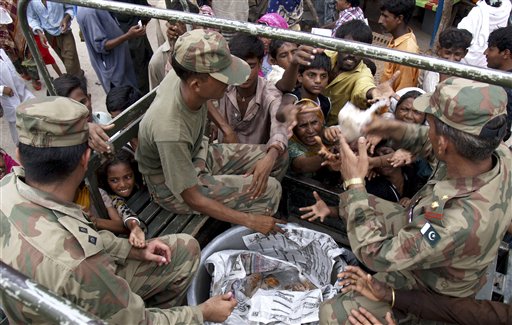
Now, many northwestern Pakistanis are seeing US troops and Pakistani government officials / Army troops distributing aid and rescuing flood victims. It's going to have huge PR impact, and reduce the legitimacy of the Taliban, and win more "swing voters" over to the pro-Government side.

It'll also help perceptions of the US, which will make it much, much easier for Washington and Islamabad to work together against the Taliban in the future.

Thursday, August 5, 2010

US Seizing an Opportunity in Pakistan

The Pakistani floods have given the US army an opportunity to counter the Taliban's influence in the Northwest (and bring increased legitimacy to US operations in the area).

US troops are dropping emergency supplies and evacuating civilians with military helicopters--with Pakistan's blessing.

It's a good PR opportunity, and a great way for the US to work together with the Pakistani Army. Furthermore, it gets US troops in the region--no doubt spies and commandoes have been dropped into the region to learn as much valuable intel as possible.

It's unlikely the US will use the opportunity for any immediate offensive or disruptive operations, but odds are good this opportunity will influence future plans for either US commando/spy forces, or for cooperation with the Pakistani Army against the Taliban.

Thursday, July 29, 2010

Frustrations of the Westphalian Model of Sovereignty

President Karzai expressed some frustrations with the Westphalian model of sovereignty in dealing with the Taliban:

"BreakingNews>
Afghan Pres. Karzai asks at news conf: Why is NATO unwilling to hit Taliban bases in Pakistan?"

In the AfPak region, Westphalian Sovereignty is, frankly, no more than an abstract concept. Tribalism, ethnic territorialism, and warlordism cut up the landscape. The line between Afghanistan and Pakistan is very arbitrary (see the ethnic map and map of "Pashtunistan").

Karzai wants NATO to take the fight to the Taliban, and believes the most effective military targets are in Pakistan (which makes sense--the Taliban keep more secure bases in the relatively safer region). Karzai is actively challenging the Westphalian model.

He's not the first to do it. Woodrow Wilson challenged the old European concept of territorial stability by suggesting that "a people" should have autonomy (though what defines "a people" is a vague concept, at best). The Israelis have constantly struggled in Lebanon where they have an enemy of extremist Hezbollah, but attacking Hezbollah in its own base means going to war with "Lebanon," where there are many neutral parties and even some allies.

Many Pashtuns want a "Pashtunistan," and many Baluchis want a "Baluchistan." Creating these areas would re-set the Westphalian territorial boundaries in the Afpak region to something more ethnically sensible, though obviously Pakistan and Afghanistan have little interest in giving up these large territories (unless they become so troublesome to hold onto that they are let go). The geopolitical need to hold onto them is relatively powerful, especially for Pakistan.

The Western dedication to the Westphalian Model may become a big contributor to the fall of the Afghan state, should it fall. But right now, the West has few alternatives. There is not another viable alternative to take Westphalia's place.

Saturday, January 23, 2010

Last Decade Series: Middle Eastern States Fall in Line

Bear with me on this one, dear readers.

I know it looks like things in the Middle East are pretty bad. No doubt, they're certainly not rosy. 2001 was the beginning of the US-Jihadist war--at least, it was the year the US acknowledged it was fighting the war in full. Jihadists had been preparing to try to boot the US out of the Middle East and create a caliphate for a long time, and were certainly at war with us in the 1990's. Nevertheless, things seem to have gone downhill in the last decade, but I argue that, for the most part, the US is much more secure in its geopolitical aspirations in the Middle East now than it was in 2000.

In general, the United States has essentially eliminated or isolate its state-side enemies, and solidified its state-side allies. It is setting up a coalition of states to take over the "front-line" management of the Middle East, so the US can do what it does best--sit back and use military/economic spending and incentives to relatively cheaply and easily pull the right levers. Let's go bit by bit.

Enemies and Former Enemies of the United States

Iran: Once a very powerful influence in the Middle East, Iran has become largely isolated. Its influence has indeed grown in Iraq, but has greatly shrunk elsewhere. Syria, once Iran's pet ally, has asserted itself as an independent force, and is leaning Westward after a diplomatic push by Bush, Blair, and Sarkozy. Iran's hand in Hezbollah is much weaker than it used to be, as much of Hezbollah turns towards legitimate government. Its control of Hamas remains relatively strong, but Hamas appears relatively deradicalized--at least for now. There is little that Iran can do to grow its influence or break the influence of the US and Israel in the region, and this is in part why it has pushed so hard for its nuclear weapons program in a short time--if it can threaten nuclear deterrence, Iran can be more aggressive about pushing outward. Ultimately, its aggressive nuclear behavior has been used by the West to isolate it in its region. Even Russia and China, who see Iran as an opportunity to irritate the US, will stop short of allowing a nuclear weapons program to arise. Further, Iran's internal unrest is growing by the month, and the regime has, as a whole, lost a great deal of influence in its own borders. Iran will retreat into the future as it turns inward or goes progressive.

Syria: Once one of the "junior members" of the Axis of Evil, Syria was heavily courted by the West (in particular by some impressive Diplomacy by President Sarkozy). While not a doll of the West, Syria has largely ceased to be a problem. The Cedar Revolution of 2005 mostly booted Syria from its control of Lebanon, creating a state that the West is trying to turn into an ally. Syria has further divorced itself from Iran, hoping to be a part of the Western economy rather than an ideological empire run by Iran. Frankly, this was not a difficult win.

Iraq: While still riddled with problems, Iraq now stands as a relatively moderate country in the Middle East that will be able to eventually play balancing games between various Middle Eastern rivals. If the next election goes well, it will be a symbol of the effectiveness of US power and determination.

Afghanistan: While certainly much farther than Iraq, the Afghani Taliban are at least destabilized and desperate; a peace deal may yet be possible. Such a deal would make Afghanistan, if far from perfect, a much more acceptable risk.

The West Bank: While not quite its own state, the West Bank has grown much more moderate over time, despite Israeli-Gaza tensions and settlement/wall building by Israel in its territory. Such a moderate takeover is a significant gift to American foreign policymakers.

Libya: Once a major nuclear arms worry, Libya has quieted down significantly, largely in the hopes of regaining Western investment and trade, but largely in the hopes of staying off the United States' radar. For all the apparent recklessness of the war in Iraq, the invasion of Baghdad showed that the United States was (at least under Bush) willing to ignore international opinion and bring down the hammer of regime change to any state regime that seriously threatened US interests, even with shaky evidence. Qaddafi, in one of his wiser decisions as Brotherly Leader and Guide of the Revolution (yes, that is his title), decided to voluntarily give up his own WMD program and welcome polite UN weapons inspectors into his country, rather than American Marines. Once a "junior member" of the Axis of Evil, Libya is working on turning into a major Western trade partner.

Friends of the United States

Turkey, Egypt, Jordan, Kuwait, Saudi Arabia, Pakistan, Yemen:
These states, while also torn internally, remain steadfastly supportive of US interests in the Middle East (though not usually out of some twisted sense of altruism). But amazingly enough, the US has managed to keep the governments of these states distinctly pro-American despite overwhelming negative attitudes among the populous towards the US. Turkey is leading negotiations with non-state actors like the Palestinians, the Taliban, and Hezbollah (and is turning into, frankly, a strange Euro-Asian state that may have influence in both areas). Egypt, additionally, is keeping a lid on Gaza while trying to help negotiate a lasting peace. Saudi Arabia has fought in Iraq and is trying to stabilize Yemen (though its pro-Sunni meddling in Iraq was quite detrimental). Pakistan is (half-heartedly, at least) fighting the more dangerous Taliban on its side of the AfPak border, eliminating key support for the Afghan insurgency. These states will continue to contribute to a regional order that will allow the United States to move further and further back from the Middle East over time.

The UAE and Qatar: Worth special mention due to their (somewhat) successful adaptations of Western-style market economies. If Dubai can pull itself out of debt, these states are likely to be shining examples of how liberalism and Islam can live side-by-side (and they are unlikely to harbor anti-US terrorists, to boot).

Trouble Remains

There are certainly states of worry for the US in the Middle East. Afghanistan, Lebanon, Palestine, Yemen, Somalia, Sudan, Iran, and Turkmenistan all have major internal issues that could lead to long-term negative consequences for the US, and they are worth keeping one's eyes on.

All in all, the United States' geopolitical position in the Middle East is far from the sour position most Americans think it is in, even if it is indeed in a rather poor public image position. But such if how these things work. The US has managed to lever government loyalty with the right incentives, even if not public opinion with the right rhetoric and sympathy.

Sunday, October 18, 2009

An Alternative Theory on the S. Waziristan Assault

So you all probably know about the recent string of attacks by the Taliban in Pakistan, against police stations, army headquarters, and random civilians, by raid or by suicide bomb, in Peshawar or Lahore or Islamabad. The Taliban has grown particularly tough and gutsy, and it's not 100% clear to what end. Certainly they have won the ire of the Pakistanis, who are (finally) launching a long-awaited operation into South Waziristan. The BBC provides an image of the approach below:

The Army is approaching from the North, East, and West, which is probably largely a courtesy to ISAF and NATO: this way, fleeing Taliban will be going south, into the waiting jaws of Pakistani reserves, rather than north and west, where they can regroup with Afghani Taliban.

The Pakistani Army is sending 30,000, backed by artillery, helicopters, and the works. Though I'm not sure whether there will be a serious commando presence. The Taliban is perhaps 10,000 strong, with some 500-5,000 Uzbek al-Qaeda affiliated allies in the area. It's a big force. The Army is pouring in and taking civilised territory pretty quickly, though they're likely to struggle significantly in the mountains.

This fight brings up two big questions: 1) Why did the Taliban provoke Pakistan? and 2) Is Pakistan's heart really in it?

1) Most analysts seem to think that the Taliban were hoping to divide Pakistani opinion with a wave of attacks, to try to dissuade the long-planned South Waziristan invasion. I think this analysis is, frankly, naive.

Frankly, I think that the Taliban has realized at this point that launching attacks, especially against civilians, will unite/enrage the country. Expensive offensives are difficult when the status quo is peaceful, but not when the status quo is hellish, at the hands of a brutal enemy. No, I believe that the Taliban knew full well that their attacks would provoke a serious counter-attack; they knew they would not cow the Pakistanis into complacency by murdering civilians. But why would they want the Pakistanis to attack?

Let us assume for a moment that the South Waziristan assault was inevitable. It probably was. The government promised to do it, the US is pressuring them to do it, and the troops were already massing all around the region. So if Meshud (the new Pakistani Taliban leader) knew they were coming, he'd want them to come on his own terms. So it is quite reasonable to believe that he has kept his troops on high alert and sent some out to perform the raids/suicide bombs to get the Army to attack both when Meshud was strong and before mobilization preparations were complete, giving Meshud as high an advantage as possible. I find this scenario far more likely than one in which the hardened Taliban fooled themselves into hoping they could break the Pakistani people into submission with a few bombs.

But this is the fourth time since 2004 alone that Pakistan has tried to regain control of South Waziristan. The first three have failed, and the Army was trying to make sure it was as prepared as possible for the fourth assault. This accelerated assault has it a bit off-kilter, whether or not the Army will admit it, and it was frankly an excellent strategic choice by Meshud--Pakistan is fickle and its opinion changes quickly. It does not--like the US or UK--have a "sunk costs" psychology, and it is not afraid to retreat and admit defeat from even its own soveriegn territory.

2) A touger question. Much tougher. Canadian intelligence certainly suggests that a large portion of Pakistani Intelligence is in favor of a strong Taliban presence in Afghanistan, and that some may have been behind coordinating the Taliban raids in Pakistan. And it's almost certainly true. One of Pakistan's toughest security risks is its own intelligence security services, and unless it can clean house and put them in line, it will never off finish the Taliban in its own country. And as long as these elements remain, much of the Pakistani efforts will continue to support the Taliban in Afghanistan. The commitment of the government as a whole is worth serious question.

If the US cannot win enough factions in the Pakistani government such that it will make genuine efforts to oust the Taliban from regions useful to the US (Khyber, Kurram, Bajur, Chitral, and especially Balochistan), then ISAF will unlikely be able to "break the back" of the Afghani Taliban--they will receive too much support from across the border.

So, we shall see. Perhaps the Taliban will be foolish enough to burn a great deal of resources in support of Waziristan, and exhaust itself. Perhaps NATO will be smart enough to take advantage of Pakistani distraction to launch a heavy assault.

But Obama has made it clear that there will not be a major Afghanistan decision until the election results are more sure (they're still being recounted). Without more troops, there will not be a major offensive. This may be a missed opportunity. But it may become academic.

If the US cannot get the Pakistani government on its side nor the Afghan government to play by the rules and attempt to win the hearts/minds of its people, then the Afghanistan war is likely all but lost.

Friday, October 2, 2009

The Middle East Wrap

You'll have to accept my apologies for not writing much lately. I'll try to make up for it today by covering just about everything worth covering in the Middle East (and on Monday I'll try to update the rest of the world).

IRAN: Iran's secret nuclear facility has been exposed by intel; Iran's attempts to minimize political losses by admitting it publicly and agreeing to talks worked better than I had anticipated. Israel is currently pulling their hair out over the issue: previously, they had been mulling an airstrike on the known above-ground Iranian facility. The second, underground one has likely ruled that option out. And, as usual, Israel is not ready to depend on Western negotiations and sanctions to solve its problems.

Iran also scored a big win in getting a 2-week "deadline" for an IAEA inspection of the facility, which should allow Iran enough time to clean it up of anything obviously bomb-related (bombs require much higher-level enrichment, for example) and be ready with smiles and open doors for the IAEA inspectors. After the Iraq debacle, the West is going to be hard-pressed to listen to a US or UK insist that it has good intel about WMD operations in a Middle Eastern country without more neutral parties willing to corroborate the story. Iran is likely to manoeuvre its way out of this with limited backlash, frustrating just about everyone (Diplomacy, they say, is a bitch).

Whether that means Iran is significantly closer to the manufacture of an atom bomb is anyone's guess from outside of classified intelligence, but a declassified British report gives them a few years, where the US published a few years ago that such activities had halted in 2005. Such a disagreement in opinion is not surprising, but it does mean that public policymaking will be marred by second-guessing.

Edit: New UN report says that Iran has the "data" to make a nuclear weapon (which is not actually all that difficult, but is a significant declaration).

AFGHANISTAN: McChrystal continues to press the point of getting more troops in Afghanistan, and Obama has continued to leave the issue on the backburner, insisting on a strategic review before going ahead with the decision. As much as it frustrates me to see little action, it's probably the right move: this is key point where Obama has to decide whether to turn Afghanistan into a major hell-raising back-breaking tax-spending mess, or a defeat. Waiting on a decision is easier than reversing one (it is very hard to declare defeat without a changing of the guard--see LBJ and Nixon), but every moment of wait erodes support, as well.

I am, personally, highly torn on the decision. While I don't think there is a "Domino" style theory to be applied here, I do think surrendering Afghanistan will put Pakistan at great risk, which will be a nightmare for India, as well as the US. They do call Afghanistan the "Graveyard of Empires," but the stakes are even higher now. Will the now-well-trained, well-funded, and very spiteful Taliban continue to foster al-Qaeda to strike at the US? The likelihood of retribution the size of 2001 will be very low if NATO walks out of Afghanistan with its tail between its legs. On the other hand, Afghanistan seems more hopeless to me than ever, in particular because NATO does not have a legitimate "good guy" government to support. NATO has resigned to supporting Karzai if he stays in power, which is looking all the more likely, if for no other reason than inertia. Given clear fraud, will his win be any more legitimate than that of Mr. Ahmedinejad in Iran? Afghanis are not dumb people, and they will know and understand, especially if they voted against him. In a normal, clean election, the losing side of the electorate can say, "well, he is not who I wanted, but he is who the majority of the country wanted." If that is not something that's believed, then the bitterness of loss becomes a force for rebellion and resistance. And do you know who's the best source for such opposition? Yeah, you guessed it.

(...if you did not guess it, I am alluding here to The Taliban).

PAKISTAN: Apparently Meshud is dead, which is pretty good news for them. (If you don't know, Meshud just recently took over as head of the Pakistani Taliban, after burning a lot of bridges to do so) Without his strong arm to keep the factions (that he exacerbated) in line, might the Pakistani Taliban begin to fracture?

Swat seems to be returning to normal, but the military has not yet moved on to Waziristan, as expected. This is almost certainly due to a hasty and significant quieting of activity from the Pakistani Taliban after the Swat operation. This was likely a strategic move, designed to give the Taliban in Pakistan time to regroup and resupply from the north, all the while avoiding giving the Pakistani military the necessary public support to act.

ISRAEL/OPT: As usual, a rather hopeless-looking mess. Obama's tripatriate talks fizzled before they were even lit. Settlements continue to be built in the West Bank, and Israel has hit some tunnels and weapons facilities with airstrikes after themselves being hit by rockets. But such activity is too normal to even seriously get international attention anymore. I expect that peace talks will not resume in earnest until the next Israeli election, if then.

IRAQ: Civilian casualty numbers continue to fluctuate, though they're lower than last year. The US is taking almost zero hits, meaning that the war/occupation in Iraq is effectively over. The Arab-Kurdish split continues to grow, though, and chaos allows al-Qaeda to operate in Kiruk and Mosul even to this day. But the Iraqi Army continues to grow in size and skill; when it is powerful enough, it will become an effective bargaining tool against the Kurds, but their most-favored-minority status by the US in particular may prompt them to call victim with some gusto before giving up their bids for autonomy, power, territory, and oil.


OBAMA (in general): He is (hopefully) finding that his personality is not enough to solve the Middle East's problems, and that some serious realpolitik must be played to convince other leaders/countries to act in ways favorable to the US. After failures of overture with Iran, Russia (how many "resets" have we had since January? Seriously!?), Pakistan, and the European partners that we so desperately hoped would love us again after ushering in the new president, we're going to have to buckle down and play the game of strongmen that we apparently so very much hate ourselves for playing.

Wednesday, July 22, 2009

US Helmand Strategy Moves Forward Without Taliban

The US leadership in Helmand has, despite frustrations, shrugged and is pressing forward with the Helmand strategy despite a lack of a decisive victory over the Taliban that once controlled the region (and are heckling US forces now).

The primary thrust of this effort involves training local security forces to take over as the US leaves. If the Taliban have indeed largely fled the areas they once controlled, a more trained Afghan force will make it significantly more difficult for the Taliban to simply show up and start running the show again. They will certainly be prey to the Afghan Taliban's advanced insurgent tactics, but the Taliban will certainly not simply be able to walk in, and any overwhelming shows of force by a Taliban offensive will attract enough American attention that it might
spell disaster. Nonetheless, the US must make sure that the Afghan soldiers trained in this initiative are confident, bold, and hard-nosed, lest they crack to the Taliban's rather infamous tactics (usually involving public listings of targets and private letters to homes threatening torture and death of family members, followed by execution of said threats).

But the US is making further progress that is likely to help its position in Helmand. While Pashtuns of the region generally growl at Western occupation, they have already seen some improvements after less than two months: bazaars and other commerce, as well as schools (especially for girls) have re-opened, and bringing some hope for increased prosperity in a region that's been held back.

If the Taliban return to find a largely unsupportive populous, Afghan and US security forces should have little trouble in driving them back out--they will not be able to become as entrenched and solidified as they once were. Furthermore, as long as US forces stay, their lives may become increasingly easier: as normal fence-sitting Pashtuns see that life might just be better under Kabul's rule, they are less likely to willingly give it all up for return of the harsh Talibani theocracy; and thus, they may be more willing to deliver information to the US.

Therefore, such trust-building measures may lead to the clues the US needs to find hidden Talibani troops in Helmand. Furthermore, intelligence from locals may allow US troops to evade roadside bombs and other improvised insurgent attacks. In particular, massive US presence means the Taliban are unlikely to find out who leaked information--and if they do, the US can protect the informants--which means information leaks are likely to increase (especially in return for monetary incentives the US has set up). Increased intelligence will mean fewer deaths and a longer stay for US troops in Helmand--and the longer they stay, the better the long-term security situation will get, no matter how many Taliban are still around.

Finally, a secure Helmand will mean that the US can start launching offensive operations from the area. Once this is ready, Pakistan should be able to effectively launch attacks into Waziristan (as Taliban will not quite so easily be able to get support from their brethren in Afghanistan, nor so easily retreat there). My personal bet is that the Helmand Taliban managed to get across the border while the US/UK invasion force was spooling up (and world media made a big deal out of the future operation. Why this was not protected intelligence, I will never know). It is possible that with US support, the Pakistani attack into Waziristan may fray the Taliban, and not simply give them the opportunity to retreat to bases across the border. If the US can secure Helmand long enough before it leaves, it should be able to support such an operation--and if my guess about the location of formerly-Helmand Taliban is right, the Waziristan operation should, within some months' time, make the situation in Helmand quite a bit more secure.

This, as usual, sounds rather optimistic. But over-arching US/Pakistani strategy is even less-publicized than US/Iraqi stragegy; and if I can think of it, surely General Petraeus can think of something at least as clever. Despite frustrations in trying to find and destroy the hardcore Taliban, prospects for US operations in Helmand look a fair bit better than they did a week ago, and are likely to improve.

(Images courtesy of Jack Hill/ The Times Online)

Tuesday, July 14, 2009

Anxiety Over Helmand Offensive

The Marines stormed into Helmand with force, speed, fury. Offensives are really the Marines' game, and the ride into Helmand was no different. Had anyone been there to fight them, it would have been quite the horror show.

But. There was nobody there to fight them. The Taliban apparently did the smart thing and disappeared when the Americans showed up, rather than stick around to try to repel them. In fact, the Taliban have fared quite poorly for the past 8 years when they have taken Americans toe-to-toe. But this is asymmetric warfare, and as long as the Taliban shows patience, they have a shot.

I wondered whether the Taliban would be wise enough to disappear, rather than fight, after their disastrous stand at Swat. These Afghan Taliban are more hardened than their Pakistani brethren, though I figured much of that hardness would have trickled south by now. More likely, these Taliban are under wiser command that heard of and learned from the Swat disaster.

After disappearing, the Taliban have picked (apparently quite well) opportunities to attack both the Americans and the British. 8 Brits have died in the past two weeks, and the British will to keep fighting is seriously starting to falter. The Taliban may be concentrating on them specifically to try to kick them out of the fight, eliminating the second-largest troop presence in Afghanistan. But the primary casualties from the last few weeks have been from bombs and traps--not head-to-head fighting. It's terrible for troop morale, and it means little is getting done. The offensive should be offense--otherwise, it's just high exposure.

There is good reason to be anxious over the Helmand offensive--so far, it looks like a failure. Are the bulk of the Taliban hiding in Pakistan? In the mountains? It is apparently somewhat unclear. Unless the US and UK can find them and hit them hard, this offensive is going to be a failure.

Sunday, July 5, 2009

Thoughts on the Helmand Offensive

It's getting... some news. Not too much.

But it's the biggest military offensive in Afghanistan since the invasion in 2001, and the stakes are high. The outcome is important. The implications will be enormous.

The whole thing smells a bit sweetly of a General Petraeus plot. Large surge of troops, offensive against the seriously bad guys, and long-term boots on the ground to provide security and institutional organization where there is a vacuum. Petraeus trained the US army in doubling as a low-level government, and those skills will be critical in winning the long-term security of the province. Hearts-and-minds.

It is very hard, to say the least, to tell how the offensive is going. Bad guys are dying, good guys are dying. The folks in Helmand aren't sure whether they're more angered by the presence of the Taliban or the presence of foreign troops.

But if US marines and UK army troops are able to achieve victory (loosely defined as restoring peace and security to the region), then a number of benefits follow:

1) Helmand and Kandahar will be more secure areas in which the US can operate and prevent Taliban from pouring across the border during the Waziristan operation in Pakistan. This is critical. If Helmand and Kandahar remain in Taliban hands, then even a successful assault in Waziristan will be worth little to the long-term war against the Taliban. On the other hand, if the US and UK can hold the area and patrol the border, then they will pinch the largest concentration of Taliban in the entire Afpak region, and have a good shot at delivering the first crushing blow in a very long time. But these Taliban are wiser, tougher, and smarter than their brethren out in Swat, and will not go down so easily.

2) Voting in the area will be secure. Giving the Pashtun majority the ability to vote in full (where currently the only secure voting areas are in northern, non-Pashtun areas) will legitimize the election and potentially prevent post-election violence.

3) The ISAF will strike a significant psychological blow to the Taliban--and bolster the confidence of anti-Taliban citizens in Afghanistan, much like the Pakistani assault in Swat did. The ISAF needs to regain the momentum of this war; the Taliban can out-wait foreigners rather indefinitely if it is not soundly beaten.

Losing, of course, means that the momentum is very squarely in the hands of the Taliban. But, frankly, the US and UK are unlikely to simply give up this fight--they will stick around and make life rather difficult for the Taliban for a long time. Total defeat seems unlikely, and they should at least be able to operate with enough presence to support the Waziristan assault in Pakistan (at which point the US should have an easier time "mopping up" Helmand and Kandahar, as the Taliban will have no safe zones). It may be messy and long, but I believe the US is likely to turn a victory here.

But if it doesn't, serious questions will be asked about whether it is worth it to stick around much longer.

Tuesday, June 30, 2009

Speculating on US-Pakistani Cooperation

The evidence that the US and Pakistan are coordinating quietly in the tribal border regions of the Pakistani state is increasing. Increased US drone attacks suggest both permission and intelligence from the Pakistani army--these attacks provide the Army with not only a great psychological advantage (previously safe spots are no longer safe for the Taliban), but a tactical one (they frequently enough kill enemy commanders). Precision strikes by the Pakistani Army suggest US aerial and satellite intelligence in real-time, allowing jets and artillery to pinpoint their attacks.

The "softening" operation has prompted the Taliban in Waziristan to abandon a peace agreement they had with the government (which, frankly, I did not know was officially in place at all). Such an abandonment will mean more attacks on civilians--and if they come quickly, the Army will be forced to act more quickly than it might otherwise like. But with the spectre of civilian deaths hanging over the Army, they will utilize their American allies more to hit the Taliban hard and keep them off-balance as the Pakistani Army prepares for its assault in Waziristan.

The Pakistani assault is not, contrary to my expectations, caused NATO casualties to go down: this month was the worst in almost a year. But I have been reminded that casualty-counting during a surge in troop activity provides a false comparison: there are more troops more actively and aggressively deployed now than before, and casualties can sometimes be a sign of intense forward activity rather than enemy success. But the real US opportunity will come after a successful Waziristan assault, and the US is going to do anything it can to help that happen.

Sunday, June 21, 2009

Pakistan Prepares to Assault Waziristan

After 8 years of absurd domestic politics that can be most briefly described as "bullshit," the past few months in Pakistan have been a dramatic and critical turnaround in the very frustrating war on the Taliban. While Swat valley is not yet a thriving pillar of liberty, justice, and security, the Taliban spine in the area has been broken (though, let me say, Taliban spines have had a very odd history of remote post-mortem reassembly). But the Pakistani army is, cleverly, recruiting former People's Militiamen and those whose lives were most thoroughly destroyed by the Taliban to become a loyal local police force that will not only keep these people fed (hearts & minds!) but, more importantly, provide a presence that will be difficult for the Taliban to overcome.

Next: Waziristan. Waziristan is a much bigger and more daunting challenge for the Pakistani Army. Waziristan serves as the primary base of operations for the Afghani Taliban--they fled after the 2001 US invasion and set up shop in this rough, tribal area; they have acted with relative impunity since. The area is full of tribalists who are quite used to their autonomy, and do not like state intervention--unlike the people of Swat, they will not be welcoming the Pakistani Army with open arms. There are many more Taliban per capita, they are more entrenched, and they know the terrain a whole lot better than the Army. And, unlike Swat, they will not give up easily--where would they go?

But here, close to the Afghani border, Pakistan has the advantage of extensive NATO intelligence, support, and firepower. NATO will almost certainly press from the north right to the border, and happily shoot across. The Taliban will need to fear drones and incoming missiles if they expose their positions in order to attack the invading Pakistani Army. The Taliban can dissolve and try to fight an insurgency, but like Swat, psychology may limit their ability to so quickly give up control of the area for a more tactically advantageous (but very, very long-term) strategy. If they hold firm, they will inflict casualties, but if the Pakistani Army can withstand those casualties, the likely-firm stance of the Taliban will shatter.

Now, it is not entirely clear this will work--the last time the Pakistani Army ventured into Waziristan, they were crushed, and left with tail between legs. But this will be different, for a number of reasons:

1) Public opinion gives the Pakistani Army the political capital it needs to both bring many troops and inflict some local civilian casualties.
2) The Pakistani Army has new leadership that is making much better use of its array of options--standard troops, paramilitary guards, commandos, airpower, etc.
3) The Pakistani Army has the political ability to cooperate with the US in this operation. That will be a huge advantage.
4) Without Swat, the Taliban is a bit off-balance. As they run out of alternative safe-havens, they have fewer places to re-group, train, supply, etc, for long-term campaigns.

The Pakistani Army is trying to soften up the positions of Talibani commander and al-Qaeda ally Meshud with airpower. Current militant casualties are estimated at about 50, which isn't many, but is enough to shake the Taliban a bit. If the Pakistani Army can continue to inflict such casualties using long-range attacks, the psychological implications (especially for a force that has enjoyed peace in its home base) will be significant.

As the Army hits the heavy enclaves of the Taliban, citizens militias are actually forming around the northwest and working with paramilitary/police to trap, separate, and kill extremists that had over-extended in attempts to push their influence further into Pakistan. Such militias may be self-propagating--stories of success may encourage otherwise fence-sitting men to take arms to help, giving them an even greater advantage. If nothing else, they will provide serious disruption to the physical network of Taliban between their strongholds, giving the Army a much-needed logistical advantage.

Saturday, May 30, 2009

Taliban Attacks Signal Desperation

The Taliban have had many recent opportunities to learn how to fight a good insurgency in both urban areas (from Baghdad/Diyala/Mosul/Basrah, etc) and rural, desert areas (Afghanistan, Anbar). There's a lot of smart stuff they've been doing in Afghanistan to keep NATO off-balance. But in Pakistan, their mistakes are starting to grow--and show.

Part of the problem is context. The Taliban are recycling some old concepts that have worked in the past, but are not particularly useful here. The two of note are its strategy in Mingora, and its attack strategy in Lahore and Peshawar.

The Taliban Mingora strategy--to sit and hold--had worked before. Ineffectual Pakistani Army attacks in the past balked at real resistance and urban warfare, dissolving before damage was seriously done. Further, such defeats crushed morale and domestic support for military operations. Doing the same seemed wise enough, but the Taliban did not estimate the ire they had caused among the Pakistani people. With domestic support, the Army was able to send a sufficiently sized and resourced force to retake Mingora rather easily (much more easily than the US took Fallujah). The Taliban were not prepared.

Perhaps as importantly, the Taliban offensive strategy is almost certainly a mistake. They're taking a few pages out of the al-Qaeda book, trying to intimidate the population into submission with attacks (although on police) in multiple cities: Lahore and Peshawar so far. Islamabad is probably next on the list of targes. The idea, of course, is to let the population know that they are not safe as long as they continue to assault--that the Taliban can hit anywhere, at any time. This isn't strictly-speaking true, but they certainly want to give off that impression.

Unfortunately for the Taliban, such attacks are likely to bolster the emerging story told in Pakistan that not only is the Taliban a major threat to Pakistan's survival, but they're an urgent threat to the individual citizens of Pakistan right now, and must be cleared sooner rather than later. When dealing with a committed enemy, minor hurts tend not to deter them--only enrage them. If the Taliban is going to try and beat Pakistan at this point, it will either require staying sufficiently below the radar that the current commitment dissolves, or require destroying their capability right now--which is highly unlikely. But after years of offensives, the Taliban may not have the patience nor the wisdom to be able to seep back into the walls and make themselves hard to hit. Hard-won territory in Swat and Waziristan will unlikely be easily given up--but by choosing to take the Pakistanis head-on and agitate their population, the Taliban show a level of desperation to keep their position that will ultimately be detrimental to their cause.

Tuesday, May 26, 2009

The Taliban Confirms Army Successes

In a very rare and politically costly concession of fact, the Taliban recently asked the Pakistani government very nicely for a return to a recent past that now seems so rosy and delightful in retrospect. The Taliban have formally sought a return to the Sharia-for-disarmament peace deal. Pakistan has rejected the deal, offering an ultimatum--leave or be arrested. Submit to arrest or be killed.

The government has also made it clear that any Sharia-style law in any province of Pakistan will necessarily submit to the Pakistani Constitution, which was violated in almost all possible ways in the few weeks that the Taliban had state-approved authority in Swat.

The Taliban surely knew that asking formally for peace would be a long-shot, at best. And if they indeed knew this to be the case, then facing the public embarrassment of begging for peace indicates incredible desperation--and desperation indicates hurting on their side. The Taliban have effectively signaled to Pakistan and to the world that the government's military actions are working, and extraordinarily well.

Such an admission is going to boost the morale of the Pakistani people, and boost their confidence in the decision by their leaders to pursue a decisive military option. It's the first really tangible sign of military results in a very, very long time by the Pakistani Army, and this admission may be a mistake that dooms the Taliban well into the future.

I've also heard from a friend that the Pakistani Ambassador to the US went on televised news and claimed that the Pakistani government only enacted the Swat peace deal to show the population that the Taliban would break it, which they they (correctly) guessed would lead to public support for decisive military action. This statement could indeed be a complete lie, though it seems intuitive enough to not be totally outrageous; indeed, it's almost certain that at least someone in the Pakistani government was convinced by his colleagues to support the deal on the prediction that it would fail miserably. So either it was dumb luck or incredibly clever planning, or a bit of both, but it's paying handsomely now.

I suppose, given Pakistani sensitivities, that it would be counter-productive to openly root for the Army, but I will say that things are looking pretty good for them right now.

Sunday, May 24, 2009

Retaking Mingora--and Pakistan

Mingora has been called "Taliban City" over the past few years. While the Taliban have a large presence in many districts of NWFP and FATA, this was their power base. But the Pakistani military offensive has proven either brilliant or lucky over the past month, leading to an increasing likelihood that the military will score a shattering victory over the Taliban in this particular offensive. I'll discuss below a few points of interest.

Taliban Hubris and Error: The Taliban grew incredibly confident in their ability to walk all over the Pakistani government over the past few years, and they reverted from their insurgent campaign to a largely-conventional stance in many areas, Mingora included (the advantage of a conventional stance is that it is easier to suppress and control the population, set up a government, costs less to operate: one does not need to hide in caves, etc). But such a stance makes the Taliban incredibly vulnerable to a better-trained conventional force. With the incoming Pakistani offensive, the clever thing to do might have been to slip out to fight another day, leaving traps to greet the incoming soldiers--Army personnel would have died (in some number) and spent a great deal of time pouring house-to-house to find nothing. It would have been tough on morale, and allowed the Taliban to regroup and re-assess. But the Taliban--many of them--chose to tough it out and fight house-to-house, and all reports indicate that they're being crushed. Those that chose to escape have a surprise in waiting...

The Commando Raid: 300 or so Commandos from the Pakistani Army raided a Taliban base located 14 miles to the north of Mingora over the past two weeks. The fighting was difficult--massive trench and tunnel networks in the mountains prevented large ammunition from having any effect, so the Commandos had to eliminate Taliban the hard way. But the Army claims that the raid was successful. In all likelihood, paramilitary and Commandos await the arrival of fleeing, disorganized Taliban that hope to seek refuge in the mountain base. If this is the case, it would be an incredibly efficient and effective use of force. The Commando raid is going to be a particularly effective bolster to domestic support: the camp was used as a training ground for forcibly recruited children to make them suicide bombers--dozens of children were rescued. PR doesn't get much better than that.

House-to-house in Mingora: There are about 10-20,000 civilians trapped in Mignora, which is making the fighting incredibly slow and deliberate. But from what little reporting I've dug up, the Army seems to be in possession of most of Mingora, having killed about 1000 militants (and having lost about 50 of its own). These numbers may be wrong, but time will tell. Nonetheless, civilian casualties seem to be extremely low, and Mingora appears to be all but captured. If civilian casualties are kept to a minimum, then the Army will have proven itself to its people as capable of dealing with the Taliban threat--and the days of ineffectual "peace" deals will be over. The Army would have the opportunity to turn on its toes and continue pursuit all the way to the Afghan border.

Pushing North:The Pakistani military has taken two significant towns to the northwest of Mingora, as well. The choice seems to be an attempt to not only isolate the Taliban in Mignora from reinforcements and resupply, but also to capture or kill any escaping militants--such a move would be a sign that Pakistan is putting as much effort as possible into making this victory as decisive as possible.

Steadfast Commitment:Maj. General Abbas, who leads the Pakistani army's PR department, has made it clear through a number of press statements that the Pakistani military is committed to continuing the campaign. The recapture of Swat will be the beginning: he has claimed that it will be a "blueprint" for other areas, specifically Khyber, North and South Waziristan. These three provinces all border Afghanistan, signaling that the Pakistani government understands the need to eliminate Taliban influence throughout the AfPak region--rather than just the buds growing near Islamabad. And if this operation ends as well as it has begun, the army will have all the political support it needs to get the job done.

Fighting for Freedom: Their confidence bolstered by the coming success of the Army's campaign, villagers in Pakistan are taking up arms against the Taliban in hopes of driving them out (knowing that reinforcements will not be coming for their regional overlords). Such a move is a bit dangerous--if it fails, it will spell disaster. But there exists a tipping point, at which if enough villagers do indeed take up arms against the Taliban, the Taliban's ability to deal with such uprisings will be overwhelmed, and their control over any area with such a critical mass will collapse. If they're thinking on their toes, Pakistan should be pushing their paramilitary forces to these areas to support and encourage disruption in the Taliban's power base, which would further degrade the Taliban's organization (and reduce support to the Afghan Taliban).

The Future: A Full Pincer Offensive? If the Pakistani military is going to push into Waziristan and Khyber, then the Afghani Taliban is certainly going to lose critical support from its rear, making it more vulnerable than it has been in years. The Afghani Taliban is much smarter and more hardened than its Pakistani brethren--it has been fighting NATO since late 2001. It remains in an "insurgent" stance, but the strength of such a stance often depends on some base from which insurgents can receive weapons and ammunition, supply, etc. With NATO in control of areas north of Taliban territory, a Pakistani Army conquering of NWFP and FATA could potentially leave the Afghani Taliban without a route through which to bring arms and ammunition, making the fight (at worst) a war of supply attrition, which NATO could easily (if slowly) win. It is unclear whether the people of Pakistan see the Taliban as a sufficiently deadly enemy that they are willing to put aside their long-standing sourness towards the United States, but if they are, the cooperation between Afghanistan, Pakistan, and NATO would likely together be enough to scatter the Taliban and finally begin to provide real security.

Wednesday, May 13, 2009

The Emerging Wisdom of Pakistan's Military Strategy

Pakistan is sending hundreds of commandos into a Taliban hideout near Mignora. And while the over-arching strategy is not announced (it's unclear whether the US administration even knows what the strategy is), there is a good story to be told in what such a strategy might be. Below I submit a proposal for what the Pakistanis might be doing, with some evidence for it.

With 5000 Taliban militants (and only 15000 military to combat them), Pakistan fell far below the "standard" 10:1 ratio of counter-insurgents to insurgents. Simply trying to stick troops in the area and hope they could provide security was foolish. So Pakistan first asked its civilians to move out of Mignora. They are now refugees, and this has made life terribly difficult for both the government and said civilians, but mixed results seem to suggest that Pakistan is up to the challenge. In doing this (and I've talked earlier about how tough it would be for the Taliban to try to sneak up with these civilians), Pakistan was largely able to turn a counter-insurgency campaign into an urban warfare campaign. But 3:1 are still pretty bad odds against a dug-in urban enemy--things would get pretty bloody, at best.

So Pakistan, possibly ready to reimburse owners of whatever houses the Taliban holed up in, decided instead to throw a bunch of explosives at them, instead. To a large extent, the Taliban broke out of their dug-in areas in fear, and fled the streets when the Army showed up to intercept them. Such a tactic was a brilliant stroke of taking advantage of the Taliban's lack of military discipline and rigor--the Taliban might have had an advantage if the fight had gone how the Taliban had prepared, but they had not prepared for how to deal with heavy bombing campaigns, and decided (wisely), not to fight the Army on the Army's terms.

And then, Pakistan gets even smarter. As the 5000 fighters retreat (after about 750 casualties), many of the slightly-less-nutty Taliban (especially the youngsters) may be rethinking their long term life plans, and deserting. The Army estimates that only about 1500 are total die-hards, and the rest are new/young/coerced recruits. This mass retreat is a good opportunity for them to run to the paramilitary (scattered all over the outskirts of the city) with their arms in the air, and get 3 squares and a cot to sleep on. Why would they surrender? Well, this is probably the hardest that the Pakistani military has hit the Taliban in many years, and many of the new recruits have likely gotten more than they bargained for.

But it gets better. There are 1500+ remaining die-hards to deal with. This is where the Commandos come in. There is a pretty big mountain base that seems an obvious retreat location for a scattered and disorganized Taliban that has no other place to go. It is apparently well-stocked, and well-guarded. But what if the Pakistani Army flew (in helicopters) ahead of the Taliban retreating on foot to this base, with hundreds of Commandoes, in order to shut it down? If these Commandoes are successful (and frankly, they likely will be), these retreating Taliban will be a long way from any friendly territory, disorganized, under-supplied, and without morale. Their capture will likely be relatively easy with the 15,000 troops sent to the area. And, voila, Mingora will be cleaned up, if all goes to plan.

But, frankly, Mingora is only the start of a much greater, more pervasive Taliban problem. It's big. The BBC provides an excellent map (shown here) of where it thinks the Taliban is in control. The Pakistani government, of course, contests the extent of alleged Taliban control, but even if it's a bit less, it's a lot. The Pakistani Army has a very long way to go if it is actually going to break Taliban control over this swath of its country.

Monday, May 11, 2009

Flushing the Taliban Out?

This will be a short blog post. I'm getting word from Al Jazeera that the Pakistani army is "flushing out" Taliban from main Swat cities, and that the Taliban are now "on the run." Apparently about 700 Taliban have been killed in Swat in the last 4 days, which is about 1/6 to 1/7 the 4000-5000 militants in the area.

But with most of these Taliban on the run, the Army may not actually be successfully accomplishing goals that lead to the long-term security of the AfPak (as it's called) region. There are benefits to routing and disorganizing an enemy force--they are less effective in future combat, they cannot launch offensives, and indeed, you take the territory. But the entire point of an insurgency is to run when the heavy weapons come, and to slowly seep and sneak back into an area being held by the government, and use terror/hit-and-run tactics to grind them down. Like Vietnam and Iraq, causing the enemy to turn tail and run is only a short-term victory. They will find refuge elsewhere (there is a great deal of space in northwest Pakistan and southeast Afghanistan in which they can take refuge) and come back to fight another day. Unfortunately, in the case of hardline militants, the only ways to achieve victory are to A) convince them not to fight (which is unlikely with a single flushing) or B) kill them all. Killing some large portion of them with a grinding and bloody operation would have certainly gotten the job done to a large extent, but it would have cost large numbers of civilian and army lives. But by not paying the price now, the Army may have to pay a greater price later in the form of a coordinated vengeance attack.

There is an alternative explanation, that I am quietly hoping that Pakistani tacticians have elected. If the Pakistani Army was not willing to deal with massive casualties in door-to-door fighting (which is understandable), then urban warfare would not be an option. There is a second option that would require more finesse and fewer casualties--though the finesse part may be tough to muster. If the Pakistani Army can effectively rout the militants and channel them (by cutting off alternative escape routes) into some relatively obvious hiding spot, then the Taliban will have lost their defensive advantage: they will be on relatively unfamiliar ground, they will be disorganized, they will have lost much of their weaponry, and they will no longer be "dug in" to an urban area, well-placed for brutal urban combat. If they enter an unfamiliar mountain range, then not only do they have less preparation and ammunition, but they also (more importantly) are no longer shielded by civilians to endless bombing and artillery. The Pakistani army can spare lives and throw metal instead at the problem, and simply surround the mountain region to catch and capture or destroy any escaping militants. Such a tactic could create Taliban casualty rates that would spiral towards 100%.

It's unclear whether that's the Pakistani Army's tactic of choice. If it was, they wouldn't be advertising it. If it's not, then they may instead try a very thorough hearts-and-minds counterinsurgency campaign in the city to win the loyalty of the population and keep the Taliban from coming back. Unfortunately, most civilians from Swat urban centers are in refugee camps that are undersupplied at best. The Army will struggle to win their loyalty to an extent that exceeded their loyalty pre-invasion.

Alternatively again, the Pakistani Army might intend to simply use a series of cheap "flushing" maneuvers on the Taliban until they retreat, in a disorganized way, into Afghani space, at which point better-trained NATO troops might be able to eliminate them. At such a juncture, the Pakistani Army would be able to close in on Taliban bases and safe zones, and eliminate the free operating area that the Taliban had in Pakistan. And frankly, this may be the only way that NATO got the Pakistani Army to agree to the operation--if NATO was willing to do the actual hard work in fighting the Taliban to the death, then the Pakistani Army would return the favor by ensuring (as best as they could) that the Taliban have no safe zones in Pakistan. While it would result in higher NATO casualties early, it would mean a significant strategic victory, and quite possibly a full turnaround in the war in the area.

If this is the case, I tip my hat to President Obama and Secretary of State Clinton for excellent strategic diplomacy. But I may be being optimistic.

Sunday, May 10, 2009

Closing In on the Taliban

The Pakistani Army is actually making a push to rid Swat Valley's major urban centers of Taliban militants, one city at a time--and starting with the biggest.

Mingora is apparently home to 4000-5000 Taliban fighters, who seem to be bent on reinforcing defensive positions rather than trying to sneak out with civilians. Sneaking out with civilians would likely require leaving behind weapons caches that the Pakistani Army would scoop up, as well as likely exposing their commanding officers (well-known to the Pakistani Army by now) to helplessness; the Taliban would probably rather take their chances fighting it out.

And there is some precedent for just that. The last major venture into Taliban territory ended in disaster for Pakistani troops: they were ambushed and torn apart. But these are not paramilitary patrolmen on the offensive. Pakistan is sending commandoes and shock troops to spearhead door-to-door fighting, and will be following up with regulars (who are surprisingly well-trained). What is likely is that the paramilitary will be surrounding the city, providing forward defense for any counter-attacks by the Taliban from elsewhere, and preventing escape. The Army probably intends to neutralize as many of these fighters as possible, rather than simply flushing them out (because, frankly, they would just pop up somewhere else).

This will be bloody. But my money's on the Pakistani army in this battle. They seem to have the will to suffer (and inflict!) the casualties necessary to get the job done. Somehow, they have either mustered courage or worked a deal on the Indian border, such that they actually have some of their best troops in the northwest rather than the southeast. And, almost certainly, they have NATO support.

A major victory here, especially one that leads to the rounding up of thousands of militants, is likely to have positive effects in the future, for a few reasons. First, morale will be high, and the will to keep fighting will remain (a major defeat may send the Pakistanis reeling into peace-seeking again, though we can hope that they've learned their lesson from the Swat deal). Second, the Army will be at a major tactical advantage (with literally 4,000 fewer militants hanging around, with weapons caches cleaned up, etc, they will have to spend less time on the defensive and can spend more hunting). Third, this may even go very far in the necessary hearts-and-minds campaign in the northwest. As the Pakistani people grow more exhausted of the Taliban, the Army has the potential to become a welcome relief. If they can root out the threat, provide security, aid resettlement of the refugees (of which there are now hundreds of thousands), and provide aid (food, water, trash pickup)--not to mention freedom from the Taliban's harsh sharia rule over the area--then they are likely to forge allies among the civilians in the area.

It's an exciting time in Pakistan. This could be the first major turnaround in the war on the Taliban since 2001. I'll keep you guys updated on it.