Showing posts with label Kim Jong Il. Show all posts

Monday, December 26, 2011

Foreign Interests in the North Korean Power Transition

Kim Jong Il is dead. His son, Kim Jong Un is taking over.

At least, we think so.

The North Korean regime is run, essentially, by a military oligarchy. Generals and other high-ranking officials tend to garner strong loyalties by their troops, and thus have the power to enforce their wishes.

It is thus possible for military leaders to try to stage a coup or otherwise disrupt the government if they are unhappy (we've discussed this before after the Cheoan incident). The danger in the death of Kim Jong Il is that North Korea's military leadership may not be happy with Kim Jong Un as the new leader of the country. He is young, untested, and apparently a bit unsocial and reclusive. In any such transition (even if not to a leader that is particularly inept), the temporary weakness of loyalty and stability could prompt a move by one of these military leaders.

This stability risk is the source of the various approaches of various major powers that have an interest in North Korea. For the most part, these countries want to avoid war and chaos. Each has its own particular stake:

China: Like in the Cheoan incident, China will be backing Kim in order to preserve stability. Its very strong, quick backing shows that it will put its weight behind Kim in order to deter actors within North Korea from attempting a coup. A war in North Korea would mean a major refugee influx into China, which it is not at all prepared to handle.

Japan & South Korea: Japan and South Korea are showing some warmth in working to keep the region stable, as well. Japan is working with China directly, highlighted by a recent high-level diplomatic visit. Japan risks being at the wrong end of ballistic missiles that North Korea has aimed at the country that could be taken over by military factions even less interested in stability than Kim was (again, see the Cheoan incident). South Korea actually sent mourners to North Korea to express regrets for Kim Jong Il's death. The move is designed to start off on the right foot with the new regime and express an interest in potentially working together. South Korea not only faces the refugee threat that North Korea does, but also potentially a direct invasion if the wrong military leaders take power. It also, long-term, seeks unification with the North, and may be testing the waters to see how Kim Jong Un responds.

Russia: Russia has been quietly supportive. It is currently looking inward at its own protests, and to its WTO ascension, and may partially be distracted. Additionally, it does not want to be too closely associated with North Korea (it gets little out of its relationship with North Korea other than North Korea can prove a useful distraction against the United States and its allies), but similarly wants stability on the peninsula.

United States: The United States sees the transition as an opportunity to resume the six-party talks aimed at dismantling the North Korean nuclear weapons program. Expect the United States to show the most aggressive posture of any of the six-party members, but it will take some time before Japan and South Korea are ready to negotiate hard with Kim. That said, the United States making its intentions clear early on can slowly and steadily build momentum.

Kim Jong Un was placed in the seat of successor very quickly, after Kim Jong Il's older two sons became politically unpopular by various means--for example, Jong Un is a 4-star general despite no military experience at all. The posturing is meant, in some ways, to project to the world that North Korea is united in its choice for successor. Some factions may be looking for an opportunity to unseat Jong Un, but so far it looks like enough military leaders of the country are behind him to give him legitimacy, and that legitimacy will grow if he plays his cards well with the great powers around him--and they'll be looking to support him unless he turns out particularly rotten.

Thursday, June 11, 2009

North Korea Boggles Me

A lot of people have been asking for an analysis on North Korea. From what I've been reading, there's a lot of half-hearted attempts to explain Kim's behavior as a strategic brinksmanship to try to extract concessions from the West. But this essentially hasn't worked for years, unless you count the South Korean "sunshine policy," which has been criticized as appearing to be in response to North Korean aggression. But this current flurry of missiles is obviously not going to lead to more money in NK's wallet, and Kim should know that.

Some have said that he's just flying off the handle. My first thought is: wrong tense. He flew off the handle years ago. It's unlikely he has gone significantly more crazy than before. And further, he is not actually all-powerful, especially in the inner military circles. He must manage a group of influential military oligarchs that spend a great deal of time creating personally-loyal cadres of crack troops. And he's doing a fine job, but he wouldn't be testing nukes and firing missiles without them.

Which brings me to my hypothesis: The very ideological/conservative factions of the military are probably twisting Kim's arm: he wants his son to take over, and needs their support. They probably want to test the international waters, as it were: how will the world respond? If North Korea can make a push to arm itself with nuclear weapons and ICBMs (though combining the two of this is much more difficult than it might seem at first--nukes are heavy and complicated), then it can not only plausibly threaten massive destruction of Seoul, but of Tokyo, and eventually Los Angeles. And if that's the case, then North Korea becomes pretty free to do a whole lot of things it would like to do--possibly including invading South Korea. Already, it's clear that North Korea likes to take risks, doesn't care about world opinion, etc. But if they had a nuclear deterrent, they'd be pretty terrifying--because they would be willing to put up with far more domestic casualties than approximately anyone else on earth, any military operation against them would be potentially disastrous.

And so, with Kim's arm possibly twisted, the hardliners in the military may simply be trying to rush through their testing and keep the world off-balance with threats of war with South Korea as they do so, so that they come out of this "crisis" much better prepared for the real crisis that at least some hardliners are surely planning.

Wednesday, April 15, 2009

Obama Should Get Tough with DPRK

The DPRK kicked out American experts and IAEA inspectors this week, promising to restart its plutonium reactor after launching a missile into the Pacific. This is not a new pattern for the DPRK--for decades, they have played brinksmanship with the rest of the world, gotten concessions in exchange for promises, only to swiftly turn 180 on those promises and start jerking the rest of the world around for more handouts.

I am typically more in favour of negotiation than many of my realist friends, mostly because I think that most concerns by most countries are relatively reasonable. But modern deterrence usually hinges on threats that are low cost to the deterrer, including sanctions or whatnot; negotiations can happen with such deterrence hanging in the background. But deterrence of DPRK will require serious threat. The DPRK won't be swayed by anything sanctions-related, as it controls the media so thoroughly that the country's people will never be angry at the state. Trying to affect public opinion is useless. Kim must actually be scared into acting straight--both carrots and some seriously heavy sticks must be presented.

Some sanctions actually have a shot at disabling the missile and nuclear programs, which is a laudible goal. China may possibly block such attempts, it's unclear--but the audacity of DPRK's continuance of nuclear refining after hard-won treaties against it will even anger the Chinese, who arguably put the most work into the negotiations in 2006 to get the North Koreans to stop refining plutonium in the first place.

The US should be prepared, at this point, to begin considering stacking South Korea with masses of anti-artillery rockets, and bring an aircraft carrier/missile destroyer to bear on North Korea, threatening to simply destroy known refining and production facilities (some of these are underground, unfortunately). The anti-artillery rockets are vital just in case the North Koreans attempt to respond by bombarding Seoul with artillery, or threaten to--Seoul is close enough to the border for the threat to be entirely real. If the US can create a strong upper-hand in negotiations, the DPRK might be more willing to ply. The Chinese will object, but are unlikely to get too involved at this point in their growth phase. The last thing the Chinese want is to give the Americans a stronger impression that the Chinese are bent on propping up rogue states--their relationship with Iran, Sudan, and North Korea as it is gives China a relatively bad impression in the US.

What cannot happen is new rounds of negotiations similar to those in 2006. Such brinksmanship on the part of North Korea is costly and, frankly, dangerous, and it would be irresponsible to encourage such brinksmanship by rewarding it with new negotiations for handouts. The long-term solution, of course, is to try and leak free information into the DPRK to push for domestic regime change. The brainwashing by the DPRK government is so thorough that any external attempts to depose the regime will be met by massive backlash (and, of course, refugees), so any attempts to oust/depose/bankrupt the DPRK will probably not go over so well (both South Korea and China virulently oppose bankrupting the DPRK, as they would have to deal with millions of starving refugees all at once--not a great plan).

So, Mr. Obama--time to get tough. Let's see if you can do it.

EDIT: I've since been informed that, should a conflict with DPRK arise in which the DPRK was sufficiently more prepared than the US/ROK, ~0.5 Million shells would land in Seoul during the first hour of the conflict--there aren't enough Patriot or Aegis batteries in existence to deal with that. Surprise operations, including airpower, commandos, etc, would be required to disrupt DPRK operations enough that those artillery batteries could not be brought to bear until enough US planes were in their air to blot out the sun.

Wednesday, September 10, 2008

Update on Kim

First things first: I was wrong about Kim having no sons; he has three (one with his estranged wife, two with a now-dead mistress).

A few readers asked questions about succession--was anyone in line to take the mantle?

It seems Kim's oldest son fell out of favor when he was caught with a fake passport in Japan in 2001, and some rumors have flown around that his second son is being groomed for the position. But they have not made public appearances with their father (unlike Kim Jong Il with his father in the late 1980's), and have remained largely in the background. At this point, with Kim probably in the hospital recovering from a stroke, North Korea's party elite may have already chosen a leader to succeed Kim when he dies.

Professors on the subject debate some between a factional internal struggle for power, and a collective ruling effort on the part of the military (which could well be one very slow and messy factional struggle for power). They agree that Kim's sons are unlikely to take the lead themselves, but may remain as a sort of British/Chinese/Japanese symbolic monarchy for the purposes of morale and legitimacy to the military rulers.

But really, little is known. Most analysts try to decipher what they can based on short clips of public footage--who is standing closest to Kim, who is talking to him, etc. South Korean intelligence agencies don't predict an imminent collapse, but the South Korean executive branch held an emergency meeting to discuss the possibility of refugees.

The worst-case scenario I could imagine is the following: the North Korean military is the fifth-largest in the world, and is very loyal to Kim. If Kim has failed to hedge their loyalty to a second person, then military regulars may default their loyalty to elite generals. If there is disagreement over the particular elite general that should take the helm, a warlord-style civil war is not impossible, and would likely lead to North Korean collapse, massive refugee flows, and Chinese occupation. The best-case scenario is probably that a reformist or realpolitik ruler is able to slide into power quite easily--someone more stable and rational than Kim would mean relaxed relations with the US, China, and South Korea, and potentially improved trade relations that could modernize the country.

Tuesday, September 9, 2008

Kim is MIA

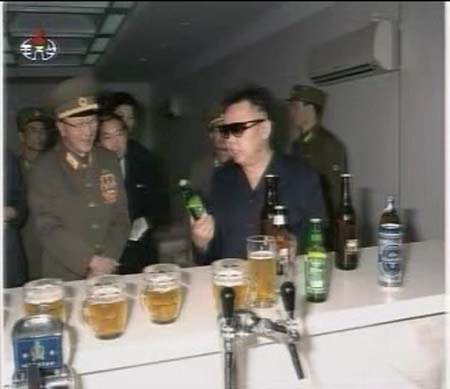
Kim Jong Il is missing in action at the moment. When not sporting his stunna shades and cracking jokes with the upper echelons of the army (see picture), Kim is often seen at parades thrown for him and/or North Korea. In fact, he never misses them. But for North Korea's 60th Anniversary--the biggest public show of military hardware in the country's history--he was a no-show.

Kim apparently has heart disease and diabetes, so at 66, this isn't terribly surprising. But he might be very sick, and maybe dead. Some think he's been dead since 2003, and body-doubles have been meeting with the heads of state of Russia, Korea, and China.

Either he or his replacement body-double (who, if he is meeting with heads of state, is functionally just as good as Kim himself) is in serious health trouble, and there aren't enough body doubles on hand to even make an appearance at the biggest military parade North Korea has ever thrown--something's wrong.

Now, it's one thing for heads of state to get old and die. Fidel Castro brilliantly left the mantle to his brother before anyone could object. Kim Jong Il took over (though not officially) for his father, Kim Il Sung, after the latter died. Despite this, mass suicides were still performed out of genuine grief for the leader whose entire legitimacy was based on his cult of personality.

Kim has no children, no brother, and no obvious successor. If he really is gone, and the State cannot continue to pretend that he's not, they may have a leadership crisis. Besides the mass suicides that would arise from his death, the state will have legitimacy issues to deal with. Nobody's sure how well the North Korean's are brainwashed, and whether they'll just start drinking a new guy's kool-aid right away.

Or maybe, with the Kims gone, a foreign-educated reformer might take the mantle and start changing things for the better. But don't get your hopes up.

Either way, right now China and South Korea are probably a bit worried--an unstable North Korea might mean refugee problems into highly populated areas of northeast China and northern South Korea. If Kim is dead, expect a tensing of military lines along the North Korean borders, but also an offer of aid (especially if the new leader is not so obsessed with nuclear brinksmanship).