Showing posts with label China. Show all posts

Tuesday, February 12, 2013

Guest Post: Economic Complications of the Senkaku Island Dispute

I get a lot of requests for guest posts and am quite picky in what I put forward--this one I like a lot.

My guest author today is from One Minute MBA, and they break down the economic complications of the Senkaku Islands dispute between Japan and China, going a bit deeper than I have in the past. They illustrate the story below, pointing out some of China's options if the US takes a stronger pro-Japan stance than it has now.


My take:
1) I think China's economic retaliatory responses are all much more painful to China than they are the US. The US does have a few options to move some of its outsourcing (to Malaysia, the Philippines, Vietnam, etc), and cheap selling of US bonds would cost the Chinese hundreds of billions--more than the damage done to Japan so far.
2) A boycott of US goods would hurt some key exporters and would likely prompt some US aid for some of the exporters if they would otherwise go under. If the US similarly boycotted Chinese goods, it would need to be selective. Consumer goods boycotts would hurt US retailers; industrial goods boycotts would hurt US manufacturers. 
3) I must admit my previous post on the Senkaku Islands, framing it as a distraction, was ultimately wrong. Whether it was originally intended as a distraction (for I'm still not sure of another good reason why the Chinese would escalate it after so many decades) or not, it has become a mainstay of Chinese foreign policy that they're not currently willing to put down.
4) The Chinese are unlikely to let the matter go entirely. As Professor M Taylor Fravel points out in "Strong Borders, Secure Nation," (a book I contributed some research to way back in the day), Chinese foreign policy is focused largely on maintaining territorial integrity, which (to Beijing, at least) requires a very consistent stance on territorial claims made at the end of the civil war, based on Ming dynasty maps of Chinese territory. In Beijing's eyes, giving up on any of these (including the Spratlys, the dispute it India, and the Senkakus) opens them up to lower bargaining power on future territorial disputes of greater import to their ultimate security.

Monday, November 26, 2012

Link: China's Foreign Policy Under Xi

Professor M. Taylor Fravel, a mentor and teacher of mine, has a great post in The Diplomat about what we can (and can't) infer about upcoming foreign policy changes from Xi's rise to lead China.

Just wanted to share.

Thursday, October 25, 2012

A Breakdown of US Presidential Candidates' Foreign Policies

This will be our second breakdown of presidential foreign policies in as many presidential elections, making the event at this point a bit of a tradition. Our aim is to keep it simple, objective, and to the point.

So what of the candidates' foreign policies? Ultimately, despite attempts to simulate wide gaps, there are few. The president has, over the past four years, moved to a more traditionally conservative foreign policy stance, and Romney has more or less given up trying to find new ways to be even more aggressive on the international stage.

There are a few key differences, but we can mostly summarize their vision for the United States as such:

Obama, channeling Teddy Roosevelt, advocates that we "speak softly and carry a big stick."
Romney, on the other hand, differs mostly on the desire to "speak loudly and carry a bigger stick."

(Bonus points to readers who caught the Looney Tunes reference, though the comparison to Sam is not meant to be derisive of the Romney approach.)

Because they're more interesting, let's highlight the differences first.

Actual Differences:

Rhetoric: This is important to highlight because you may notice some other glaring gaps in the list of differences below. Romney and Obama obviously believe in having very different rhetoric (Romney's of a "strong America" and Obama's of a more "understanding America") behind very similar policy behavior. Romney is likely genuinely concerned that soft rhetoric is going to weaken the United States' credibility of deterrence (critical in the Pax Americana state in which the US tries to keep a lid on major warfare), where Obama believes that the United States will lose its ability to lead if it is not loved.

Both approaches have flaws. Obviously opinion of the United States crashed during the Bush administration of tough-talk, but it has also gone down since Obama took office in 2009, particularly in Muslim countries where the attempts of compassionate rhetoric have been strongest.

Russia: Romney sees Russia as a long-term threat that must be contained, where Obama sees it as a nation that can be bargained with and potentially partnered with. No doubt Russia's influence and military might are growing, and the United States must address Russia (where in the '90s it was largely able to ignore Russia completely). The two questions on the table here are whether Russia is a credible future threat and whether the US should be moving to oppose it and contain it, or whether it should be working with Russia to make it part of the wider "good guy" community. 

Israel: Short version: Romney sees Israel as an ally that can take action in the Middle East that the US simply is unable to, and can serve as the bastion of force against Iran. Obama sees it as a dangerous ally that can get the US reined into unwanted conflicts. Paraphrasing Bill Clinton on Netanhayu, "he doesn't know who the superpower is." 

Priorities in US Military Spending (and Strategic Approach): Obama's priorities in US military spending have focused on the ability to execute tactical strikes to deal with terrorist threats--more funding for drone strikes and a focus on special forces has been his focus (where Navy and Air Force spending--the big ticket items--has dropped). Romney, though unlikely to decrease this, wants to beef up the size of the US Navy with two extra Aircraft Carrier Groups in order to better position the US strategically against potential threats with more credible "hard" assets like Iran, Russia, and China. These Carrier groups would be used to protect the Strait of Hormuz, Taiwan/Japan/Korea, and the Baltics, as well as generally make sure that the US controls trade sea trade routes throughout the world.

Iraq?: There's a question mark here because it's not clear whether there will be any real change in action or just rhetoric. Romney is frustrated at the lack of the Status of Forces Agreement over the past 4 years and wants to use US troops to keep influence in Iraq and serve as a second force bastion against Iran.

Key Similarities:

While the candidates share a great deal in common, we will highlight the key--and sometimes surprising--similarities between their approaches. 

American Primacy / Exceptionalism: Despite Obama's 2008 rhetoric about the United States being a bit of a bully, his rhetoric has changed to embrace US Exceptionalism and, generally, its role in the world. Romney and Obama differ on how the US should posture itself with rhetoric and "outreach," but generally they both see the US as the force that should be running around keeping a cap on bad stuff. Both believe in "Pax Americana."

Iran: Ultimately both sides see the critical need to stop Iran from developing a nuke and want to oppose Iranian influence at all turns, which is why Obama (for example) is supporting the rebels in Syria. Romney is tougher-worded but not foolish enough to want war with Iran--both will have similar policies there.

War on Terror: Both will continue the new "precision" style War on Terror that was pivoted into around 2007 as the War in Iraq started to wind down. It will be a war of precision strike from drones and special forces as the US continues to support operations by Afghanistan, Kenya, Somalia, Egypt, Iraq, etc to eliminate terrorists locally.

Afghanistan: The War in Afghanistan is unpopular and will come to an end no matter who is president. It is unpopular as well to pull out immediately (fears of a Vietnam-style collapse remain) so the 2014 departure will be stuck to by both presidents.

China: Both will be aggressive with China about trade policy and keep the implicit threat of the Mutual Defense Treaty with Japan on the table in case there is any tricky business in the Senkakus, but neither is going to either back down on Beijing nor try to incite war. 

Author's Notes: Both candidates are going to have statements on their websites different from those above. We encourage you to take a look, and we're also writing with some interpretation and analysis (rather than simple aggregation of what's already written). Our intent is to write what we believe will be actual policy enacted (or attempted) by each candidate, rather than simply what they're declaring.

We can talk at length about why they have strong incentives to say-one-thing-and-do-another--we obviously saw a great deal of this from Obama in the 2008 campaign and how much the presidency has changed its tone since coming to office--ultimately, a state's security interest generally takes over unless something very strange happens, and there's no reason for that to happen here, which is why we'll see so many similarities going forward. 

Wednesday, September 19, 2012

Senkaku Islands Dispute as a Distraction for the Chinese Public

You've probably heard about major protests, warship movements, and maybe even talk of war over a few islands between China and Japan. These are called the Senkakus (by the Japanese--"Daiyou" by the Chinese, but we're going to stick with Senkaku for simplicity and the fact that you'll hear "Senkaku" on the news. Dear Chinese readers--please note that I am not taking a side on this conflict by using the word "Senkaku."), and they're a small chain of almost entirely uninhabited rocks with very little strategic value (unlike the Spratlys, which may have all sorts of oil / gas underneath and have East Asian countries in an ongoing dispute, as well).

I wanted to take a quick moment to share my own pet theories on the conflict. First, some background:

The Senkakus were occupied by the United States after WWII until 1970, at which point they were transferred to Japan. Of course, much of Japanese territory at the end of WWII did not necessarily belong to Japan  beforehand, but most of it went right back.

The complicated part about the Senkakus is that they were uninhabited islands, so there was no really obvious indicator as to who they belonged to. If you look back over history, both Japan and China have, at different times, had official maps/documents that both claimed them as sovereign and also marked them as belonging to the other country. So both sides have fairly questionable claims on them (I won't get into the details on this because they are boring and not helpful here), but nobody else has any claim at all, so they're up in the air between the two countries. Since the 70's, there has been some tension between the two countries as to who should have them, but the Japanese have "administered" the islands for the past forty years and have occassionally

But the recent flare-up makes little sense without context. Suddenly, it seems, the Chinese have become particularly aggressive about Japan's control of the islands. Some of this is likely provoked by the Japanese government purchasing the islands to solidify its claim, but the reaction is blown somewhat out of proportion. What we're seeing in China is massive protests that have led to huge damage in Japanese buildings / businesses in China (and leading to the Japanese shutting down factories in China for protection), Chinese activists heading to the Senkakus to plant flags, Chinese government vessels and even Chinese warships going to the area.

Let me be clear here: these islands are of zero import. They are about 7km total area, devoid of natural resources, and uninhabited. On their own, it seems absurd to be upset about them. To be fair, China is obsessed with not giving any ground on its territorial claims (consistency is very important for China to have precedent in case they have major territorial disputes over places like Taiwan, Xinjiang, Tibet), but territorial claims here through the 70's have been inconsistent and China loses little by making a more strategic decision about whether to pursue or renounce the islands.
For China, the issue is almost certainly one of distraction. If we look at China internally (and China's only real focus is internal, as it has ever been), we see two things going on: first, there are economic issues bubbling up. Second, there is a power struggle in the Communist Party.

Economic issues are sufficiently obvious that they're somewhat out in the open. Even the People's Daily, a state-sanctioned paper, is writing articles about how the economy needs to change (though certainly the Party is already planning on this if it's being written about). China's wealth gap continues to grow, even as hundreds of millions are brought out of poverty, and the wealth gap is always a painful, risky thing. Inflation was high and growth slow during the past few years, and a lot of fear of a "hard landing" is still out there. Wall Street Journal says the "hard landing" has been avoided, but that doesn't mean the population is convinced of it yet. To be clear: the Communist Party's grip on power depends almost entirely on its ability to continue to drive unprecedented growth in the country, and a Japanese-style "lost decade" would be crippling to its power. It's also clear to the populace that massive corruption within the party and it's "friends" is unfair to them and potentially bad for the economy as a whole, so it will mean that the population can find ways to blame the party for their own troubles.

Second, you may have seen lots of news about Bo Xilai and the murder trials going on around him. Bo was the predicted heir apparent in China and the sudden, public scandal is clearly the result of a power struggle within the party that he lost, setting up rival factions to potentially take power at the next Congress. The use of the murder trial and other very personal charges is an attempt to take the spotlight away from the Party itself, but there is still the risk that the Party is seen as divided and weak. During this power struggle, until the dust settles, all factions in the Party have a strong incentive to make sure the public doesn't pay too much attention.

Thus, there's a lot of reason right now for a distraction to happen, and the Japanese provided just the excuse. Let me emphasize something: mass protests do not happen in China without government consent--at least not without a massive crackdown. The fact that these protests went on so long and caused so much damage before police intervention means that they were sanctioned and encouraged by the Chinese government. The government is making very sure to stoke anger about the Senkaku islands to bolster nationalism and keep frustration focused on Japan, rather than internal issues in China.

This, at least, is my own pet theory. As it turns out, we're seeing the Chinese government start to back down a bit on its rhetoric and get the protests a bit under control. This may be due in part to the US response (reaffirmation of the US-Japan Defense Treaty but non-involvement in supporting territorial claims), or the observed risk of massively damaging trade relations with Japan, which is a major source of exports for China. But as domestic politics in China settle (after the next Congress, probably), I predict we'll stop hearing about the Senkakus altogether for some time.

Monday, August 20, 2012

Some Potential Errata on Turkey & Iran

Two quick potential errata I want to point out from the past few posts I've had that relate to Turkey & Iran (I say "potential" because they are not factually wrong, but run somewhat counter to my recent predictions:)

Turkey: The Kurds of northern Syria have won a great deal of autonomy since the Syrian government has pulled back to Aleppo and Damascus. The Kurds seem less interested in being a key part of the opposition (they make up 9% of the population and likely feel that they would be marginalized in the new government), and more likely are looking to set up an autonomous zone like is found in Iraq. Lots of interesting implications if this happens, including the possibility of those two autonomous zones becoming the beginnings of a de facto Kurdish state.

There is a spike of rebel activity in southern Turkey, likely designed to take advantage of Turkish distractions in Syria and to build momentum for the development of a Greater Kurdistan. Initial thoughts suggest that this rebel activity might cause Turkey to reconsider their involvement in Syria, but they are likely "in too deep" to pull back, and may be hoping to turn a win in Syria into a means of containing the Syrian Kurds further.

Iran: I mentioned that the Arab Middle East is, in general, opposed to Iran's influence, but some recent behavior shows this isn't entirely likely:

All worth thinking about. Clearly a fairly complicated region. Looking forward to any thoughts you guys have.

Monday, December 26, 2011

Foreign Interests in the North Korean Power Transition

Kim Jong Il is dead. His son, Kim Jong Un is taking over.

At least, we think so.

The North Korean regime is run, essentially, by a military oligarchy. Generals and other high-ranking officials tend to garner strong loyalties by their troops, and thus have the power to enforce their wishes.

It is thus possible for military leaders to try to stage a coup or otherwise disrupt the government if they are unhappy (we've discussed this before after the Cheoan incident). The danger in the death of Kim Jong Il is that North Korea's military leadership may not be happy with Kim Jong Un as the new leader of the country. He is young, untested, and apparently a bit unsocial and reclusive. In any such transition (even if not to a leader that is particularly inept), the temporary weakness of loyalty and stability could prompt a move by one of these military leaders.

This stability risk is the source of the various approaches of various major powers that have an interest in North Korea. For the most part, these countries want to avoid war and chaos. Each has its own particular stake:

China: Like in the Cheoan incident, China will be backing Kim in order to preserve stability. Its very strong, quick backing shows that it will put its weight behind Kim in order to deter actors within North Korea from attempting a coup. A war in North Korea would mean a major refugee influx into China, which it is not at all prepared to handle.

Japan & South Korea: Japan and South Korea are showing some warmth in working to keep the region stable, as well. Japan is working with China directly, highlighted by a recent high-level diplomatic visit. Japan risks being at the wrong end of ballistic missiles that North Korea has aimed at the country that could be taken over by military factions even less interested in stability than Kim was (again, see the Cheoan incident). South Korea actually sent mourners to North Korea to express regrets for Kim Jong Il's death. The move is designed to start off on the right foot with the new regime and express an interest in potentially working together. South Korea not only faces the refugee threat that North Korea does, but also potentially a direct invasion if the wrong military leaders take power. It also, long-term, seeks unification with the North, and may be testing the waters to see how Kim Jong Un responds.

Russia: Russia has been quietly supportive. It is currently looking inward at its own protests, and to its WTO ascension, and may partially be distracted. Additionally, it does not want to be too closely associated with North Korea (it gets little out of its relationship with North Korea other than North Korea can prove a useful distraction against the United States and its allies), but similarly wants stability on the peninsula.

United States: The United States sees the transition as an opportunity to resume the six-party talks aimed at dismantling the North Korean nuclear weapons program. Expect the United States to show the most aggressive posture of any of the six-party members, but it will take some time before Japan and South Korea are ready to negotiate hard with Kim. That said, the United States making its intentions clear early on can slowly and steadily build momentum.

Kim Jong Un was placed in the seat of successor very quickly, after Kim Jong Il's older two sons became politically unpopular by various means--for example, Jong Un is a 4-star general despite no military experience at all. The posturing is meant, in some ways, to project to the world that North Korea is united in its choice for successor. Some factions may be looking for an opportunity to unseat Jong Un, but so far it looks like enough military leaders of the country are behind him to give him legitimacy, and that legitimacy will grow if he plays his cards well with the great powers around him--and they'll be looking to support him unless he turns out particularly rotten.

Wednesday, November 9, 2011

The Aftermath of Europe's Disintegration

Dear Readers,

I apologise for my long absence from the blog. I've been busy, but I've also been holding back and feeling out the European situation before I wanted to say anything definitive about it.

As the European Debt Crisis worsens, we are starting to see the fault lines in the "Blocanization" of Europe grow wider and deeper. The core EU is torn between total control of its periphery, and jettisoning it completely. The former Soviet bloc countries continue to huddle together, waiting to ride out the eurozone storm and hold the Russians at bay when they come to capitalize on the fracturing of the Eurozone. Turkey's previous desperate love affair with the EU has become nearly a joke.

In the end, we're seeing Europe, as a concept, fall apart. The EU still exists, but it may dissolve in the next few years. If Greece or Italy leave, it will set a precedent that countries like the Czech republic, Poland, and the United Kingdom (all of whom have grown massively Euroskeptical) may take on and jump ship. This will happen, without a doubt, before any of these countries allow themselves to be pulled down by the Eurozone's debt crisis.

Even if these countries don't leave, they'll weaken the EU and make sure they are not as dependent on the fiscal responsibility of periphery countries in the region. Nationalism is coming back in Europe, and with ferocity. This nationalism, which many thought was being eroded away by Pan-Europeanism, will lead to European countries acting, once again, as independent entities, rather than a united force.

Geopolitically, it eliminates Europe from contestants for the role of 21st century hegemony. Despite its national pessimism, the United States is once again the front-runner--it remains the center of gravity of world trade and commands the seas. A growing Russia may be able to challenge the United States over the next 50 years. China continues to focus inwardly, and risks its own end similar to the "Japanese Miracle" if it cannot navigate its way out of the toughest bubbles in world history.

Look for surges in activity and influence-building from all three of these nations in the next decade or so, as they try to feel out what the new geopolitical system is going to look like.

Monday, January 10, 2011

China Continues a Stance of "Reassurance"

In my undergraduate years, I had the pleasure of working for Prof. Taylor Fravel, MIT's local Chinese foreign policy buff. I did research for a text called "Securing China," whose primary thesis was that Chinese military development pursues a single goal: securing its resource and population base by staunchly defining and defending the borders it identified in 1949 (when the Communist Party took over).

Prof. Fravel is part of a rather non-alarmist school of thought, contradicting the tone of much of modern US news media. The non-alarmist school believes that China's at-times rough-edged stance is primarily to ward off other powers (Russia, the US, etc) from encroaching on what it has asserted to be its territory (specifically, Tibet and Taiwan). Chinese behavior in the Korean peninsula is a different matter, and complicated (and can be discussed at another time).

But to be fair, while China is at times prickly, its primary communication policy on its military is one of reassurance. China has made sure to define very carefully what its arms are for (often these arms are for a hypothetical invasion of Taiwan); it has avoided building unnecessarily provocative (or otherwise globally-relevant) weapons, like aircraft carriers (this is accentuated by a Russian aircraft carrier, purchased in the early 1990s, that currently sits as a theme park). In particular, China has recently emphasized that its military is currently "decades" behind that of the US in technology and capability.

In this case, Beijing happens to be absolutely correct. Chinese troops still lack the training and tactical intelligence technology (nor its integration) that US troops have. More importantly (as the US and China would almost certainly never meet on the ground), Chinese naval vessels and air superiority fighters are, indeed, sufficiently behind in technology that a major confrontation with the US (assuming it brought two of its twelve aircraft carrier battle groups to bear) would be swift and decisive.

In particular, Beijing is emphasizing these differences in order to release some pressure from the US about the development of anti-capital ship missiles. Sophisticated anti-capital ship missiles are currently a weak spot in US (and any) naval power. Against powers like Russia and China bearing such weapons, US ships would be sufficiently exposed that they would take significant damage and losses in a pitched naval confrontation.

Secretary of Defense Gates was in China last week in order to try to push China on construction of these missiles--China did not budge. China also failed to make the progress it wanted--the US is continuing its arms sales to Taiwan. It will continue to make such sales as long as China does not offer a sufficiently enticing chip in return (and weapons development is something that one can only tenuously and temporarily offer to delay).

China will continue its stance of "reassurance" as it grows, such that it is not faced with a serious, concerted challenge until it is sufficiently modernized that it can handle it. That said, odds are low that it will become a "revisionist" or expansionist power (unlike Russia) in the near future, even if it does "catch up" with the US--there is no evidence in particular from Beijing that it wants anything different than it did in 1949--a consolidated territorial China.

Monday, December 20, 2010

Conventional War Dominance and the Railgun

Loyal Readers,

We're taking a break from the bleak world of WikiLeaks, Afghanistan, the Korean Peninsula crisis to focus on the longer-term picture of the world's superpowers. Here's why:

1) WikiLeaks will actually blow over. Sorry, Assange: one man can't bring down the Westphalian model of international relations.

2) Afghanistan will end. Whether it goes like Iraq (with a quiet, humble, half-victory) or like Vietnam (with a humiliating defeat), it won't have a long-term impact on the behavior (or, frankly, the security--terrorist attacks just aren't a serious threat to the stability of the United States, even if people die) of the major world powers.

3) The Korean Peninsula crisis won't become a war. No country in the mix (Russia, China, North Korea, South Korea, the US, or Japan) can actually gain from the measure, and North Korea knows it won't have Chinese support, and would thus get rolled over quickly. As unpredictable as North Korea is, it's not suicidal.

Anyway, now that you're not worried about any of that anymore, I want to think about the future--the control of the world as we know it, who will hold the reins, and how.

So we'll start out small: let's talk Railguns. My first caveat is that railguns will be horrifyingly expensive for a while, at least until one finds a way to fire a railgun projectile without destroying the rail itself (keep up the good work, engineers!). Some pretty awesome technological/business developments have been afoot (I won't repeat these narratives here).

A quick technical recap (longer, more exciting technical recap by Anton here): Railguns use magnets to launch projectiles at hypervelocity (Mach 7.5 or so). The projectiles have no explosives; the kinetic impact does the damage. Direct fire will lead to a near-instant kill; indirect fire allows travel of a few hundred miles in a few short minutes (the delay being due to the projectile lifting to about 500,000 ft to avoid air drag).

Expensive as they are, they're going to change the future of warfare, in a few ways that we should think about:

1) Even when we start killing each other in space, control of the oceans will remain the ultimate factor in geopolitical strength. When one controls the oceans, one controls international trade and transport. The US currently effectively controls international waters approximately everywhere (rare exceptions include areas near China), and will continue to do so. Russia and China are its biggest competitors for regional waters in the Pacific, but they are not positioned to control the Atlantic, and will end up competing against each other for control over the Pacific (where the US will continue to keep key alliances in South Korea, Japan, and the Philippines that allow it to project significant power in the area).

2) The United States will be "in the lead" in this technology, by a significant margin. Russia and China are not yet (at least to my knowledge) doing any serious work here. Russia has the pesky "Moskito," a powerful anti-ship weapon, but it fires at slower speeds and has a shorter range than a railgun (making it easier to potentially knock out of the sky).

3) Railguns are ultimately offensive weapons. Many weapons on modern US vessels are "defensive," in that they can be launched second and still be effective (modern jet fighter, AEGIS systems, etc). The railgun would win a naval battle with a coordinated first-strike; firing first means the engagement is over early, and firing second would probably just mean mutual destruction. The incentive with a railgun is to fire it first, rather than wait--thus the "offensive" descriptor.

The result of all this is that the world will likely remain relatively US-centric for some time, as it continues to control the seas. But it also means that there will be a new, natural instability in great power confrontations. For indeed, if the first shooter should win (or, at least, if the second shooter should suffer massive losses), then trigger fingers tend to get itchier.

The best example of this is World War I. Europe thought it has offensive technology (it didn't, but that's another story), and thus rushed to mobilize and press forward during a crisis that could have otherwise been spun down. In contrast, in World War II, Europe thought it had defensive technology (except the Germans, who realized otherwise), and thus cautiously appeased Germany while building the Maginot line.

When everybody believes they have offensive technology (they will), they're more prone to attack if they think they can win.

To be fair, China and Russia are unlikely to believe they can win against the US any time soon--the US has naval power projected everywhere and still has the military-industrial capability to start pumping out war machines at a moment's notice. The lesson of Pearl Harbor has been forgotten by no-one.

So what does it mean? If Russia and China see the world accurately, they will actually be less likely to want to confront the US on the seas, as any military confrontations with them will be likely to be even shorter and more decisive than before.

Russia will continue to focus internally and in its regional periphery for some time, trying to rebuild the military-industrial infrastructure necessary to challenge the European continent (where the US has much less military advantage). China, for its sake, will likely focus on regional power and influence, ensuring strong trade relations and security at its borders. Frankly, as much as there's a great deal of Sino-phobia out there, China has so many demographic problems building up that it will be focusing on its interior for decades as it attempts to avoid a socio-economic collapse. World Domination is not in Beijing's plans (though it may be in Moscow's).

So in the long-term, the US will remain the one power that exerts influence anywhere and everywhere, as long as it wants to. It will be able to bring powerful, high-speed offensive technology to bear in a short period, and be unchallenged in open waters. It will continue to struggle on land. It will worry about a Russian "takeover" of Europe (and eventually a German one) or a Turkish "takeover" of the Middle East, rather than Russian or Chinese challenges at sea.

There's more to this prediction than the railgun, but the railgun is the piece of technology that will push the Russians and Chinese to delay any plans to expand beyond their land influence for some time.

Saturday, November 27, 2010

The American Response to the Korean Provocation

There are a few potential reasons for the North Korean artillery attack on a disputed South Korean island, and a few potential responses. Both are likely more complicated than meets the eye.

Potential Reasons for Attack
1) Kim is trying to re-set the "red line." In order to make sure it can secure a working nuclear weapons and deployment system, Kim Jong-Il might be trying to re-set what behavior actually leads to war (such that the nuclear program won't).

2) Kim Jong-Un is trying to display his power. Kim's successor may be trying to show domestic and international players that he is strong-armed and sufficiently aggressive that nobody thinks the shift in power will lead to a period of "softness" which could be taken advantage of.

3) An anti-Kim faction within the North Korean military may be trying to weaken the regime. After Kim Jong-Il came to power, a purge of military leadership struck fear into Kim's enemies, but also bolstered their sense of cohesion. Worries of another purge--or simply a sense of opportunism with the change of leadership--may be leading such a faction to provoke South Korea and the West into taking moves to weaken the Kim regime, up to war. Such a weakness or chaos might present an opportunity to stage a coup and replace the leadership.


Potential Responses by South Korean and Allies
1) The current response: the US joins South Korea's military exercises. The artillery shelling came during annual South Korean inter-service exercises in the Yellow Sea (which may tell us something about its motivations in North Korea). South Korea's response is measured, but the US has sent a carrier battle group to join the exercises. This serves both as a reaffirming of its commitment to South Korea's security, and also leaves open the option of precision air strikes against North Korea in the near future. Ths risk is that this response may look weak.

2) A tit-for-tat response. South Korea might attempt to show that it won't tolerate unprovoked attacks by reacting similarly: hitting a North Korean base. The risk is that North Korea may choose to escalate to show that it's willing to keep pushing to make sure it has the upper hand.

3) Tough sanctions. The US could rally a coalition for more sanctions against North Korea, but it's running out of options. Already, most countries avoid trading to North Korea in luxury goods (particularly those of which Kim Jong-Il is quite fond, like Mercedes cars). Broad sanctions would hurt an already-starving population, and would likely bolster North Korea's support for the regime, thus presenting a positive feedback to the North Korean military.

4) Significant escalation. South Korea could launch heavy surprise strikes against North Korea, both damaging its ability to wage war, and delivering an unambiguous message that further provocations would lead to destruction of the North Korean military (as South Korea would not make this move without US and Japanese support). The risk here is that North Korea would respond with artillery strikes against Seoul, where 25% of the South's population lives. Currently, North Korean artillery is so numerous and well-bunkered that it would be nigh-impossible to eliminate it before serious civilian tolls were suffered in Seoul.


The Chinese Response
The Chinese response has been intentionally cautious. North Korea as a tenuous ally has proven a liability, but China is largely unable to stop supporting the regime. If the regime collapses partially or entirely, China would be left with a humanitarian disaster and a refugee flood at its border (and under the Geneva conventions, it would be required to give them "reasonable" accommodation). China's current approach to North Korea is to make sure that the regime in power--whatever it may be--is stable. Unfortunately for China, this means supporting a temperamental and unpredictable Kim. At the same time, China will try to keep Kim in line as much as possible.

But Kim knows China is unable to stop its support, so China cannot use it as a serious threat (much like Israel knows the US is unwilling to drop its support entirely, and therefore the US cannot use it as a bargaining chip). China will need to find a way to temper North Korea's behaviour if it is going to be able to keep South Korea as a friend and trading partner (lest it lose South Korea to US/Japanese influence entirely).

Wisdom in the US Response
The US response shows strength and initiative to not only North Korea and China, but to the entire world. This is particularly important in a time when countries like Iran and Russia might see the US as exhausted or resource-drained from its commitments in Iraq and Afghanistan. The movement of its carrier battle group reminds potential rivals that its sea and air forces--the primary implements it would bring to bear in any engagement that wasn't a full-scale invasion--are still free, well-funded, and willing to move.

It also shores up South Korea's confidence in the US, which has balked at supporting countries like Georgia, Poland, and the Czech Republic against growing Russian influence and assertiveness. The move has marginally damaged relations with China, but the United States is showing South Korea that such damage is worth it in order to stick to its obligations.

Sunday, July 25, 2010

North Korean Nuclear Brinksmanship

North Korea threatened nuclear war over US/South Korea wargames off the Korean peninsula. A few readers asked if this was at all legitimate.

The threats are vacuous--North Korea doesn't have any serious deployment capability. Their nuclear testing in the past has been technically successful, but not particularly impressive.

Frankly, the most damage they can currently do is rolling out a bunch of artillery and shelling Seoul into the ground. It would take a few hours at most.

This new brinksmanship is two things:
1) A litmus test to see if the US/South Korea will play more cautiously than North Korea. Turns out the answer is no, which is probably a good thing (or the precedent will be set that the US/ South Korea will retreat at threats).
2) Pump up domestic support for the nuclear program as North Koreans starve.

More interesting is the fact that Beijing's protests to wargames in the Yellow Sea caused the US & South Korea to move to the eastern shores of the peninsula. China is being particularly tough-nosed about the South Korean response to the sinking of the Cheonan, and I'm not yet sure why (unless, again, it is a part of propping up the Kim regime to keep stability strong).

Ultimately, North Korean brinksmanship will push the US and South Korea closer together. Any threats to North Korea's stability will push China and North Korea closer together. It may be the biggest foreign policy area over which China and the US will spar (barring, perhaps, American trade protectionism) now that Taiwan's Ma has taken the middle road approach to China.

Tuesday, May 25, 2010

Untangling the Korean Peninsula Conflict


Mystery shrouds the current Korean Peninsula conflict about as much as it shrouds the North Korean government itself. A few readers have asked me, "what the heck is going on up there? Why the heck did North Korea attack South Korea?" Good question! It had me thinking & reading for a bit.

Why did the North Koreans sink the Cheoan?

There's no clear answer for this. The government officially denies doing it (which is not surprising), but it seems a relatively irrational thing to do. To understand the most likely possibility, one must understand the politics of North Korea. At least a bit.

Like most dictatorships, North Korea's government is propped up by elites (in this case, primarily military elites). And, like all governments, they faction. Long story short, Kim is old & frail, he's picked a potentially weak successor, and an opposition faction is likely trying to make a play for power. If South Korea had retaliated, chaos would ensue (North Korea would be caught unprepared for a war), and an opposition faction would have a much stronger opportunity to seize power from Kim (and likely quickly declare an end to the war by being a new regime).


As such, the coup likely failed. Whether there has been a purge is probably going to be unclear, but North Korea's lack of followup to the attack (and lack of military readiness at the time of the attack) both indicate that it was not an order from the top, but rather an order from much lower on the chain of command--likely meaning some attempt at insubordination.

What the heck are the Chinese doing in response?

Another good question! China's response seems to be arbitrarily contradictory. By inviting Kim to Beijing (and leaning towards "no" on international reprimand in the UN Security Council), China is taking a major international hit... in particular with South Korea and the United States, two of its biggest trading partners. China seems to be encouraging North Korean aggression.

But after a conference with China, Secretary of State Clinton came out speaking surprisingly rosy about China. Why?

Again, we must think of Chinese politics. In a Korean Peninsula war, what does China have to lose? It cannot and will not send troops or supplies to assist North Korea, and with the help of Japan and the United States, South Korea would rout the North Korean army (though Seoul would likely take serious damage in the meantime). China would be stuck with a collapsed North Korea, and an angry (and rather economically devastated) South Korea. The collapsed North Korea would send millions of starving, brainwashed refugees into northern China--a disaster that China is not prepared to face.

China's greatest concern in Korea is stability. It cannot afford a collapsed regime. This explains its stance--first, by inviting Kim to Beijing, China makes it clear to any opposition that Beijing will back Kim's faction, and help it keep power. Beijing was also likely able to get reassurances from Kim that he will purge the aggressive opposition, and also refrain from further provocations of South Korea... at least for the time being. China must also restrain from doing too much to anger Kim, lest Kim feel isolated and threatened. By befriending Kim, China gives Kim some security, allowing Kim to refrain from any foolish lashings out. Secretary Clinton understands this position, and thus was able to express confidence that China would effectively help prevent war in the Koreas.

What will happen from here?
South Korea cut off trade with North Korea, and North Korea followed by severing all diplomatic and communication ties with South Korea, and put its army on full readiness. South Korea further retaliated by opening up propaganda messaging into North Korea, and participating in anti-submarine drills with the United States. The Sunshine Policy is over.

For now, the conflict will drive South Korea (to some extent) away from China and towards the US/Japan. South Korea will seek stability in US strength. China will show North Korea that it is ready to defend North Korea from internal threats, but will not support it in a war against South Korea--North Korea's only rational recourse would be peace.

North Korea will desperately attempt to retain face by growing increasingly perturbed over accusations that it carried out the attack. It will accuse the South Koreans of setting up the attack themselves to provoke a war (sounds far fetched as an accusation, but many Americans think the same of the 9/11 attacks).

As far as war, I think it is unlikely. Neither country has a serious interest in it. Sino-American relations will not be particularly strained by this, but China will see any actions against North Korea as being a favor to the US (stacked on top of any favors that China does for the US with respect to Iran).

The Peninsula's best hope of a reemergence of peace might, unfortunately, be the death of Kim and a new regime leader.

Tuesday, January 19, 2010

Last Decade Series: The Taiwan Strait

The United States has been arbiter of the Taiwan Strait since the final retreat from the Chinese mainland of the Guomindang (KMT or GMD). It was not until 1971 that the United States even recognized the Communist government in Beijing as the government of China (previously, the KMT government on Taiwan was recognized as government of the entire country).

To be short, we've come a long way since then. And I believe the last decade marked what was, ultimately, the end of inter-Strait tensions as we know it. And the US has had a major hand in that.

For Taiwan to ease up to China, a few things had to happen. One was obviously the rather overwhelming economic benefits of opening up to the Mainland. But the United States had to carefully wean Taiwan off its own dependence into an economic autonomy that drove it towards China.

Similarly, the United States had to slowly decrease its military support for Taiwan, balancing a need to not scare the Taiwanese into believing they were abandoned military. And, surely, they have not been. The United States would still respond militarily to Mainland aggression across the Strait, that is clear. But the fact that Taiwan is becoming a decreasingly effective regional power has helped to assure the Mainland of its position as arbiter of all of China, whether in name or not.

Cross-strait integration may not seem like a major positive, but it is, and it has been executed well. Taiwan has moved towards the Mainland of its own accord, giving no diplomatic or political bending on the part of the United States in its stance towards China in general. The US remained firm on key issues with respect to China, including trade, human rights, spying, etc. And certainly, there is no doubt that Beijing has done little to please Washington, but I intend to drive the following point: relations with China could have been very poor, and could have dominated much of US foreign policy.

The defusing of the Taiwan strait tensions--probably for good--have led to a rather dramatic decline in hype over the Chinese military. Taiwan as a strategic stronghold for US naval power proved to be more a liability than an asset by the 2000s, and the gradual nudging towards the Mainland that the US encouraged proved a very long and elegant diplomatic maneuver that has saved, and will save, many headaches into the future as the US continues to deal with Russia and the Middle East as primary strategic threats.

Friday, December 18, 2009

Geopolitical Complications at Copenhagen

The problems at the various climate summits are economically quite simple--there is both a tragedy of the commons problem (in the emitting of carbon dioxide) and a freerider problem (in the halting thereof). Even Europe has has largely decided that the moral payoff for "leading the way" in CO2 control is not sufficient to break its back alone, especially if it enables other economies to slurp up the CO2 "availability," as it were, that they create.

This, of course, is why anyone trying to control global CO2 output needs a treaty. But it is not so simple to simply forge a treaty on this and tell everyone to stop producing. Should all countries cut a portion of their CO2? Should we create a baseline CO2/capita standard which countries must meet? What, instead, of a CO2/GDP/capita standard? These different standards can be abstractly debated on their own merits, but each representative at Copenhagen is undoubtedly going to support the one that best suits their own self-interest.

Right now, one of the big hang-ups seems to be the US-Chinese rivalry, which stems far beyond simple fairness, egalitarianism, equity, whatever, into rather unsubtle geopolitical/economic warfare. The Chinese want to walk away with a "promise" to reduce CO2 output by a certain percentage, but do not want any oversight into their own in-house emissions reporting. The US, of course, is unwilling to sign anything that lets the Chinese get away with zero transparency, while the US gets constant comb-overs by the EU to make sure that it is putting in sufficient efforts to curb CO2.

And again, this goes beyond fairness, or effectiveness. Could the world at large reduce CO2 production to whatever reasonable levels it sets for itself without the Chinese getting on board until some years from now? Certainly. China may be a big contributor to world CO2 emissions, but it is not yet so big to single-handedly destroy any attempts to put caps on world emissions (where the US is certainly that big, as is the EU). This is, as usual, about long-term and arcane calculations about the relative power of the two perceived titans of world politics, the US and the People's Republic of China.

My own opinions about where the US should be aiming its sights aside (hint: Russia and Iran), the US sees a great threat to its pacific hegemony in the Chinese, and the Chinese probably see a great opportunity in this treaty, if it should come out the right way. Further, the Chinese have an advantage--for years, the Chinese have denied any aspirations of being a "world leader" or any of that claptrap. While they are concerned about their reputation in order to open trade and assuade the military fears of their neighbors, the Chinese lack the desire to be loved, admired, and followed that the US became addicted to in the Second World War (and not for entirely sentimental reasons. The relative love affair that the Western World has had for the US over the past sixty years has allowed the US to make bold moves in its own geopolitical favor and receive backing in legitimacy, money, manpower, military base placement, etc. It's been a very powerful tool, and it's far from lost, all the Bush-era apocalyptic soothsayers' opinions to the contrary. But I digress). The Chinese can legitimately look Copenhagen dead in the eye and say, "we don't care if you approve of our economic or environmental practices," as long as such disapproval
does not grow so large as to threaten boycott (which would certainly be difficult to legitimately threaten, although it would damage the Chinese and Southeast Asian economies far, far more than the economies of the US or EU, under-read cocktail-sipping fatalists' opinions to the contrary. But I digress). It's not an enviable position for the United States.

For the United States has a reputation to uphold, and it may be in a position where it is making a value judgment about that geopolitically powerful reputation and its geopoltically powerful manufacturing industry (which is still the largest and most formiddable in the world, a fact that would be more widely known if we were not so obsessed with predicting our own demise. But I digress). Should the US walk away and say, "no deal without China breaking its back as much as we do," its European allies will grow increasingly impatient and disillusioned about American exceptionalism, altruism, leadership ability, what have you. But should the US say, "the Chinese be damned, we're going to do the right thing," then it will quite disproportionately and quite significantly load a disadvantage onto its own manufacturing industry, its war machine, its economy in general--and ultimately its ability to project power into the pacific.

Manufacturing is a CO2-heavy process, even when it's not a coal-fired steel plant (of which we have precious few these days). You'd probably have nightmares over how much CO2 went into the air to make that brand new Prius you're so proud of buying (and re-buying after a mere 3 years to get the "higher effiency" model, in a misguided attempt to save the earth. But I digress). Military manufacturing is much, much worse. Military manufacturing puts a much higher emphasis on performance over price, to the point that it hits some seriously diminishing returns (to whit, the military often picks some very odd opportunities to say "only the best for our boys!" and "we need to save money," but I digress). And, until renewable technology really picks up, manufacturing price is often fairly well-correlated to CO2 usage to make it (of course, in the case of military hardware, the CO2/price ratio is higher than for most goods).

The short of it is this: A major carbon tax or cap-and-trade will be a disaster for the US military's already- enormous budget, in a country whose debt is already so horrifyingly large that both parties are balking at spending more (and the Greek debt crisis is hopefully teaching a lesson about the limits of the power of borrowing. But perhaps not. I digress). Additionally, the US will simply flat-out lose more manufacturing to China if it should impose limits on its CO2 production and China doesn't. While the US will make sure to subsidize its arms manufacturers, many other industry's won't be so lucky. The US would have to (until renewable technologies mature) be incredibly picky about just which manufacturing sectors are "Critical to national security," or it would annihilate its economy just to keep them all afloat.

And, of course, for every manufacturing plant the US loses, it's one China gains. China's ability to compete, in particular, in high-precision manufacturing would increase significantly--a prospect that US security advisors (for better or for worse) shudder to think about (the US still has rather obnoxious export limits on high-precision manufacturing equipment to China, as well as other "dual-use technology" that the US and EU currently specialise in making. But I digress). This manufacturing would, of course, make China's economic position more powerful in the Pacific, and enable its indigenous military hardware industry (which has been crawling obediently towards independence from Russian supply).

Increased tax revenues, increased manufacturing capacity, and increased trade partnerships in the Pacific would greatly increase China's geopolitical and military position in the region, where the opposite would apply to the US. This is one of the big reasons the US is so very obsessive about making sure the Treaty (that it's actually considering signing) is "fair" in the sense that it hurts the US and China equally.

I doubt, though, that the US is going to get its wish in that particular field until Chinese GDP growth starts to peter out. And if it can handle its looming demographic crisis, China is unlikely to see GDP grwoth slow for some years to come.

Wednesday, March 25, 2009

Obama's Economic Policies Alienate Rest of World

As much as Obama's domestic critics may be criticizing his policies for having a European socialist tone, it is becoming increasingly clear that the road that Mr. Obama is marching down seems so destructive that the rest of the world--socialist and communist alike--is rallying to criticize it, perhaps in the dim hopes of reversing it.

Obviously, China is not thrilled. China worries that the massive static reserves built up by panicked money-printing by the US Treasury, bailout-tossing by Congress, and Stimulating by the President, will lead to enormous inflation once US money velocity increases. Enormous inflation will gravely devalue the US dollar, giving China two serious problems: first, its large reserves of US bonds will be worthless. Second, it will become extremely difficult to export anything to the US if the dollar is weak against the yuan. There are people that would tell you this is a good thing, but these people would be wrong. In response to the spendthrift policies of the new administration, China has called for a "global super-currency" to replace the dodgy dollar. And before you give China a hard time for being simply selfish, note that the United Nations is making a report recommending that the entire world ditch the dollar, too.

Even Europe is fed up with US spending. EU (and Czech) President Topolanek called US spending a "road to hell," saying that bailouts and obsessive stimulating will nuke the world economy. Frankly, he's probably right. The Japanese are trying to quietly remind the United States about Japan's lost two decades, where they tried time and time again with no avail to stimulate their way out of recession and stagnancy.

Why is US spending bad for Europe? There are a few reasons. First, the state propping up broken financial companies with money that does not exist is a bold form of anti-competition. Europe is resisting the temptation to dump tons of money into most of its sectors, financial and auto-making sectors included. But European companies that were otherwise able to weather the storm will suffer if they are not able to compete with US companies that are receiving subsidies that are nearing 10% of the US GDP. It goes without saying that such propping-up decreases market growth opportunities for companies that managed to not drop the ball; it creates perverse incentives for American business executives (because currently, the way to make lots of money quick is to make your company look like it's broken and needy, rather than strong and efficient); it will lead to horrifying inflation down the line; and, of course, "buy American" policies sprinkled all over the stimulus plan will grossly damage developing nations and anyone that depends on exports, as well as generally shrink the world economy.

So, the President's (and Congress', to be fair) policies are doing very little to improve the US image abroad--and very little to help the world economy. As much as promises of free money now are keeping Obama's US constituency opiated and placated for now, those abroad that are not receiving these checks are much more cognisant of the terrible consequences of reckless spending and panicked economic intervention. When socialists and communists around the world are uniting to tell you to free your markets, perhaps it is time to consider that you're doing something wrong.

Saturday, November 22, 2008

China's Recession Crisis

While Western powers are worrying about a six-month recession and the belt-tightening it entails, the Chinese are worrying about much greater consequences. Rather than simple approval ratings declines, the Chinese are facing a crisis of legitimacy that may undermine the very fabric of the Communist Party's authority.

For decades, the Communists have been terrified of large-scale unrest and demonstration. They frequently underplay the number of local demonstrations in the country and tightly control information to prevent potential dissenters from hearing that there is momentum. When times are good, there are hundreds of large protests in China per year, according to the CIA. Even if it's significantly fewer than hundreds (only dozens), it's still more than Beijing admits, and still more than they're comfortable with.

The Chinese diaspora tends to be highly nationalistic and defensive of their nation of heritage, and many wealthy Chinese are happy to protest against the Japanese when the state tells them to. But in this very group-oriented country, the state has not managed to make itself the only source of authority, as much as it has tried to do so.

With a global economic slowdown, China is going to get hit hard. Its wealthy customers--the US, Canada, the EU, Japan, Australia, etc--are going to trim their budgets down to essentials, and many Chinese products are going to be the first to go. Exports are already falling, and factories in China are already closing their doors. Luckily, oil is cheap--otherwise, imports from China would be so expensive that production would re-localize, and that's a trend the Chinese can't afford.

The world may be impressed with China's 8% sustained growth, but Chinese economists see it as a bare minimum to sustain. Beijing's biggest worry is unemployment, and extremely rapid growth is necessary to prevent it from shooting up--as technology, supply chain efficiency, and competition from Latin America and Southeast Asia make Chinese labor obsolete, the Chinese government tries to expand its economy laterally (that is, with simply more factories) to incorporate laborers. It has kept the official rate down to 4%, but this only includes registered workers--hundreds of millions of rural farmers and migrant laborers are underemployed and unemployed, and the Chinese cannot currently afford an extensive welfare program to keep these people sated in bad times.

Worse, the Chinese have continued to rely on expanding export production to keep the economy going--it's quick-and-dirty, but inefficient, and discourages sustainable national consumption-based economies, skilled labor, etc. It also leaves the economy very vulnerable to fluctuations in spending by Westerners and oil prices--both of which have been extremely vulnerable in the past few months. Beijing has been sweating.

But news for them is getting worse. Nation-wide taxi cab driver protests have taken hold, and while they are unlikely to become a nationwide uprising, it's a sign that the Chinese are starting to lose control over the population. The official unemployment rate has gone above 4.5%, and the minimum wage has not increased in years--fine during good times, but bad when costs of living stop decreasing, as they're doing. There are a whole lot of people that might latch onto a movement by taxi cab drivers, or day laborers, or factory workers, or textile makers, or all sorts of people, if they manage to get organized. Unemployed and underpaid labor is a serious threat to the Chinese government as a potential source of mass dissent.

The Chinese Communist Party retains its legitimacy through promising economic growth and a better tomorrow for China. "Don't change horses when you're winning the race" has been a fine line to repeat since 1979, but what happens if China's unemployment goes up and its GDP growth slows too much? Dissent that starts by calling for reform may start calling for new leadership if the current leadership cannot deliver. The earthquake-Olympic honeymoon of the summer faded faster than Beijing would like, and they need to keep reform and growth chugging along to hold on.

China's economy has been zooming along a teetering precipice for years, and Chinese economists have had to manipulate with pure genius to keep its export-led plan from crashing. But if the world economic slowdown deepens, there will be nothing even they can do. To achieve sustainable, hands-off growth and economic stability, the answer is to follow the West--liberalized, privatized economies that increase efficiency with domestic consumption and comparative advantage will keep the GDP growing on its very own. But China can't easily switch into such an economic stance. Decades of kicking the economy into an export-on-steroids stance have created massive inequalities between the coast and the west, creating huge demographic pressures that would turn into chaos if Beijing took the lid off. The transition to a liberal domestic consumption economy would mean a temporary closing of many factories that are literally exporting at a loss and subsidized by the government, the temporary unemployment of those workers, and a decrease in the minimum wage to try to encourage investors to sop up the newly unemployed. It would be a mess, but Chinese state controls have set up the economy for a transitional disaster unless the transition occurs during an economic boom.

But these are not good economic times, and massive economic liberalization would likely lead to enough temporary chaos to lead to an unseating of the CPP's monopoly--if not a revolution. China faces a serious crisis if its economy gets a lot worse, and there is little Beijing can do to satiate its population. Its economic controllers have set it up for failure in this kind of market.

What this means for the US--Chinese GDP growth is not going to be sustained. The Chinese economy will not overtake the US economy in the next 20 or 30 years, as many pro-protectionist policymakers in the US suggest. Either the Chinese will successfully bounce out of this crisis and continue down the road of WTO integration (whence their GDP growth will slow into a more sustainable, free, labor-inclusive, and income-equalized market with lots of domestic consumption), or the Chinese economic controllers will falter, leading to a short chaos followed by a new regime (with a honeymoon and new mandate to make tough changes).

The former is very good for the US--Chinese domestic consumption and a lowering of import tariffs will mean that, as the Chinese grow, they will be able to afford American exports. A China of free trade and liberal policy will be one that US labor interests should encourage to grow, such that it becomes a market of high-quality US goods.

The latter is bad for everyone (besides, perhaps, the Tibetans). A collapse of the 4th-largest economy in the world will lead to a deep global depression, particularly in East Asia. The US can almost afford to live without Chinese imports (though many US manufacturers, construction firms, retailers, and financial institutions will dry up), but much of the rest of the world is likely to go down with China.

Therefore, the likely consequences of all this is that the EU and US may have to work to bail the Chinese out--they will try to crank up imports of Chinese goods with "stimulus" packages and consumer support, but hopefully in return for concessions by China to reform in the medium-term.

Tuesday, November 11, 2008

Taiwan's Independence Movement Takes a Blow

Chen Shui-Bian, former Taiwanese president and proponent of independence from China, has been jailed on charges of embezzlement of millions of dollars of public funds. His anti-corruption credit (and his survival of a possibly-staged assassination plot) was a big reason his party won elections in the 1990s--but along with pro-Chinese sentiment, these charges (especially if they lead to a conviction) will cast a dark spectre over the DPP for many years to come--and give the KMT enough seats to act as they please.

In short, these corruption charges are the final blow to an already-sick and weakened DPP. KMT hegemony--and a slow leaning back towards China--will dominate the next many years of Taiwanese politics. Luckily, it is likely to make US-Chinese relations a whole heck of a lot easier for an inexperienced Mr. Obama.

Monday, October 6, 2008

The Humbling of China

China in the last few years has gotten some bad publicity from exports: milk, toothpaste, dogfood, Barbie Dolls--all tainted and dangerous in some way. For most of it, one simply has to admit that sometimes things go wrong in the sheer mass of exports that China puts out each year. The milk was the boulder that broke the camel's back--when your government has crafted an export-dependent economy, your international image is critical. 54,000 babies sickened by melanine in milk, and some dead--Western and even wealthy Chinese families don't trust the safety and efficacy of Chinese products. If nobody trusts your products, nobody will buy them.

This is very bad news for China. It's brought a very large magnifying glass to the export control machinery in its government--and that glass has found little. The term "crisis in confidence"--being tossed around about US financial markets--is surprisingly relevant here. China is overhauling its entire milk industry and oversight bureaucracy to try and restore confidence in its already-strained exports. With oil prices high and real disposable income down, its ships crossing the pacific aren't making as much money as they used to be. The last thing the Chinese Communist Party--which bases its legitimacy in growth--needs is a recession, and it's willing to do anything it can to try to boost buyer confidence in its products. The Chinese government has rounded up 32 people allegedly involved, and whether or not they are is largely inconsequential--they need a scapegoat, they need to be able to say "we got the bad guys, they're gone now."

But China did something strange. This crisis has been so bad that the Chinese government called its own industry "chaotic." It has admitted something is wrong with the way that its country is currently doing things. This is a rare sort of admission that is the closest thing to an apology one is ever going to get out of the Chinese government. They are clearly embarrassed, and a bit humbled: they are not perfect.

Chinese humbling has to come from within. Strong nationalism means that criticism from without will be met with significant backlash, and will feed such nationalism. Trying to shake one's finger at China is seen as insulting and petty, and won't "socialize" the Chinese government, as the US and the West hope to do. China has to learn from its own mistakes the hard way; it must see the consequences of them.

Personally, I would cite the biggest mistake here as the one in which the Chinese government tried to build an export-dependent economy--when you make exports the backbone of your wealth, then drops in exports lead to disaster. But despite the fact that I think the Chinese reaction is not fully economically optimal, it is a good political sign--the Chinese export economy does indeed require China to keep a good reputation abroad. As long as it does not try to overhaul its entire economy to something more mixed or "independent," it will depend on its reputation to keep a strong economy--and the Party needs a strong economy to maintain its one-party legitimacy. If the economy is good, don't shake things up, they say. But if it's bad... why not?

So the Party will continue behaving in the future. A humble China is a peaceful China, and a peaceful China is a wonderful partner for the future, even if it will disagree with the West.

Wednesday, September 10, 2008

Update on Kim

First things first: I was wrong about Kim having no sons; he has three (one with his estranged wife, two with a now-dead mistress).

A few readers asked questions about succession--was anyone in line to take the mantle?

It seems Kim's oldest son fell out of favor when he was caught with a fake passport in Japan in 2001, and some rumors have flown around that his second son is being groomed for the position. But they have not made public appearances with their father (unlike Kim Jong Il with his father in the late 1980's), and have remained largely in the background. At this point, with Kim probably in the hospital recovering from a stroke, North Korea's party elite may have already chosen a leader to succeed Kim when he dies.

Professors on the subject debate some between a factional internal struggle for power, and a collective ruling effort on the part of the military (which could well be one very slow and messy factional struggle for power). They agree that Kim's sons are unlikely to take the lead themselves, but may remain as a sort of British/Chinese/Japanese symbolic monarchy for the purposes of morale and legitimacy to the military rulers.

But really, little is known. Most analysts try to decipher what they can based on short clips of public footage--who is standing closest to Kim, who is talking to him, etc. South Korean intelligence agencies don't predict an imminent collapse, but the South Korean executive branch held an emergency meeting to discuss the possibility of refugees.

The worst-case scenario I could imagine is the following: the North Korean military is the fifth-largest in the world, and is very loyal to Kim. If Kim has failed to hedge their loyalty to a second person, then military regulars may default their loyalty to elite generals. If there is disagreement over the particular elite general that should take the helm, a warlord-style civil war is not impossible, and would likely lead to North Korean collapse, massive refugee flows, and Chinese occupation. The best-case scenario is probably that a reformist or realpolitik ruler is able to slide into power quite easily--someone more stable and rational than Kim would mean relaxed relations with the US, China, and South Korea, and potentially improved trade relations that could modernize the country.

Tuesday, September 9, 2008

Kim is MIA

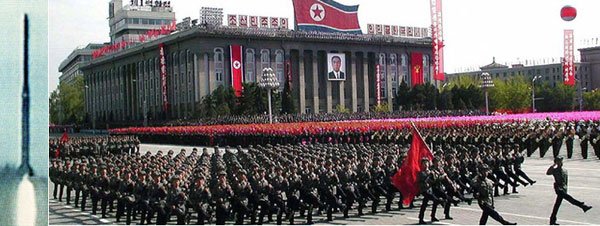
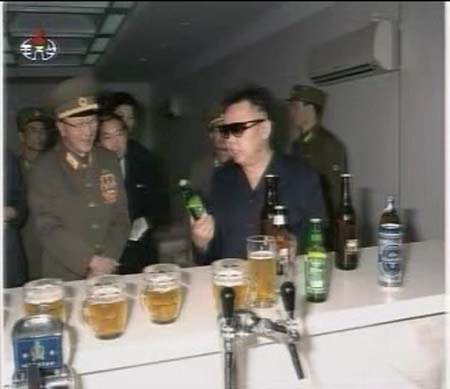
Kim Jong Il is missing in action at the moment. When not sporting his stunna shades and cracking jokes with the upper echelons of the army (see picture), Kim is often seen at parades thrown for him and/or North Korea. In fact, he never misses them. But for North Korea's 60th Anniversary--the biggest public show of military hardware in the country's history--he was a no-show.

Kim apparently has heart disease and diabetes, so at 66, this isn't terribly surprising. But he might be very sick, and maybe dead. Some think he's been dead since 2003, and body-doubles have been meeting with the heads of state of Russia, Korea, and China.

Either he or his replacement body-double (who, if he is meeting with heads of state, is functionally just as good as Kim himself) is in serious health trouble, and there aren't enough body doubles on hand to even make an appearance at the biggest military parade North Korea has ever thrown--something's wrong.

Now, it's one thing for heads of state to get old and die. Fidel Castro brilliantly left the mantle to his brother before anyone could object. Kim Jong Il took over (though not officially) for his father, Kim Il Sung, after the latter died. Despite this, mass suicides were still performed out of genuine grief for the leader whose entire legitimacy was based on his cult of personality.

Kim has no children, no brother, and no obvious successor. If he really is gone, and the State cannot continue to pretend that he's not, they may have a leadership crisis. Besides the mass suicides that would arise from his death, the state will have legitimacy issues to deal with. Nobody's sure how well the North Korean's are brainwashed, and whether they'll just start drinking a new guy's kool-aid right away.

Or maybe, with the Kims gone, a foreign-educated reformer might take the mantle and start changing things for the better. But don't get your hopes up.

Either way, right now China and South Korea are probably a bit worried--an unstable North Korea might mean refugee problems into highly populated areas of northeast China and northern South Korea. If Kim is dead, expect a tensing of military lines along the North Korean borders, but also an offer of aid (especially if the new leader is not so obsessed with nuclear brinksmanship).