Over the past few days, dozens of members of Iraq's interior ministry have been arrested by an elite Iraqi counter-terrorism unit that reports directly to Prime Minister Maliki. The claim by counter-terrorism and intelligence officials is that many of these officials were part of a resurgent Ba'ath party (called Al Awda, or "the Return") that was quietly trying to coup Maliki's government. Apparently huge sums of cash for bribes were found, as well as documents.
If these allegations are true, then Maliki faces a very tough political struggle in the next few years. It means factions within Iraq are still quite dedicated to returning the Old Order, or some different one (like an Islamic fundamentalist state, etc)--they have not yet given up. Any sign of weakness on the federal government's part may open up Ba'ath or Sadrist coups, a declaration of independence by Kurdistan, or all sorts of other problems that would undermine the Iraqi state.
Maliki has few strong allies in politics--he was a bit of a compromise candidate. His list, the United Iraqi Alliance, includes Sadrites, the Supreme Council for the Islamic Revolution in Iraq, the al-Dawa party, Hezbollah in Iraq, the Badr organization, and a number of other relatively radical and unpredictable characters that do not have a great deal of loyalty for Mr. Maliki. He's become more popular since coming into office, and a fair bit more powerful, and he's able to keep everyone together. But everyone's grumbling as they behave.
But what he does have on his side are an impressive counterterrorism and intelligence unit (that seems to have caught some serious coup-planners early in the game) and a very professional military. The military is not completely competent yet--it will require the help of the United States to train and provide logistics until (hopefully) the US leaves. But it has done a relatively excellent job of not falling apart and fighting itself as it has attacked Sunni and Shiite militias alike. It is gaining a reputation for non-partisan and non-secular dedication to duty, and this will allow Maliki to combat most coup attempts that do not directly assassinate him.
The other possibility remains that there is no coup. Provincial elections are coming up, and the US--Maliki's biggest backer--has one foot out the door. Maliki may be legitimately concerned about his ability to continue holding onto power. The US may be legitimately concerned with what will happen as it pulls out--and any groups looking for their last chance to jump and try to shake things up pull their big stunts at the same time. But, when trying to make a democracy work, using authoritarian and underhanded police-state tactics to hold it together undermines the entire ideal being sought. We must hope that Maliki is not letting the ends justify his means.
But it's unlikely he is so foolish as to make blind attacks on political rivals. More than likely, his organization has found good evidence of some sort of bribery, corruption, etc. How much of an all-seeing eye Maliki has over his government is tough to say--probably not too keen one, given the state of the government in Iraq. But the arrests do mean one of two things: either high-level ministers are trying to bring back Hussein's regime, or Maliki is on the path of slowly becoming it in order to prevent it. The next 2 years in Iraq may be more formative than previously thought.
Showing posts with label Maliki. Show all posts
Showing posts with label Maliki. Show all posts
Thursday, December 18, 2008


Thursday, December 11, 2008
Iraq's Kurd Problem
 When the Coalition invaded Iraq, it didn't bring much in the way of troops. This much we know. When looting and mayhem broke out after the invasion, the Coalition was quite relieved to not have to worry about one part of Iraq--the Kurdish north. And worry about it they did not. The Kurds, a long-time ally of the US against the Hussein regime (and target of much US sympathy) were happy to salute the US and say "don't worry, no anti-US activity will happen here." And happen it did not.
So the over-taxed, frazzled, and exhausted coalition said, "thank goodness," and let the Kurdish Peshmerga police its own territory. In the meantime, the US started taking shots at Sunni Arabs that were causing trouble (and some that weren't). Not only did this occupy many Sunni forces, but it chewed them up. This will become important.
The Kurds are a proud people that have faced a long history of oppression. After the First World War, they received vague promises from European powers that they would get a state. In the shuffle of great power politics, they managed to get themselves swept under the rug--Kurdistan never became a state. Instead, the region in which Kurds lived was broken up into parts of four countries: Syria, Turkey, Iran, and Iraq. Kurds found themselves ruled by Persians, Arabs, and Turks--none of which spoke their language and shared their culture. Attempts to gain full autonomy in one country met backlash from all four--Kurdish land is fertile and full of oil, and all four countries that contained Kurdistan knew that successful Kurdish independence from one state would lead to instability and increased nationalism at best, and momentum for a war of independence at worst. Hussein launched a war of genocidal terror against his Kurds after the Persian Gulf war, killing hundreds of thousands and prompting the US-led Operation Provide Comfort, which kept Iraqi troops from setting foot in Kurdsitan for years.

Provide Comfort was a defining moment in the history of Iraq's Kurds. Because Iraqi forces could not set foot in Kurdish areas, the Kurds had to look after themselves. Iraqi Kurdistan had actually gained official autonomy in 1970, but its parliament was under Hussein's control until the aftermath of Provide Comfort, when Iraqi forces left the area. Official autonomy had put most of the mechanisms in place necessary for real autonomy--without Iraqi troops (and with an economic blockade by Hussein), Iraqi Kurdistan had achieved de facto autonomy. The Peshmerga, a paramilitary force of the Kurdish region, policed the region. Two opposing factions ruled. It acted much like it's own country--similar to a Taiwan or South Ossetia situation. The Kurdish autonomous region is defined in figure 2 below; some Kurds lived outside the region, and a few Arabs lived within it.

The green areas represent Kurdish populations, but those blobs were certainly not static. In addition to genocide by murder, Hussein made attempts to consolidate Ba'ath control of Kirkuk and Mosul, the 5th and 2nd largest cities in Iraq (and quite wealthy) by a process of "Arabization:" moving Arabs into and around the cities, something reflecting "Hanization" by the Chinese in Tibet and Xinjiang. This process will also end up being quite important.
In the 12 years between Provide Comfort and the US-led invasion, the Kurdish population became quite used to its autonomy. The Peshmerga, a paramilitary force on the autonomous region's budget, kept the peace. The new generation of Kurds mostly doesn't speak Arabic, and largely does not have much interest in the Iraqi state as a whole--they see themselves as citizens of Kurdistan.
Enter again the Americans. During the Coalition's Invasion of Iraq, troops found themselves quickly overwhelmed with looting, murders, and then an insurgency. US troops, in charge of the northern zone of Iraq, asked the Kurds to keep the peace. And keep the peace they did--Kurdish troops marched south into areas they considered "Arabized" Kurdish territory, and a bit more. The US did show up in Kurdistan eventually, but not until the violence in Baghdad and Anbar started to fall. In the four years' meantime, the Kurds ruled. Their holdings have extended to those of the figure below.
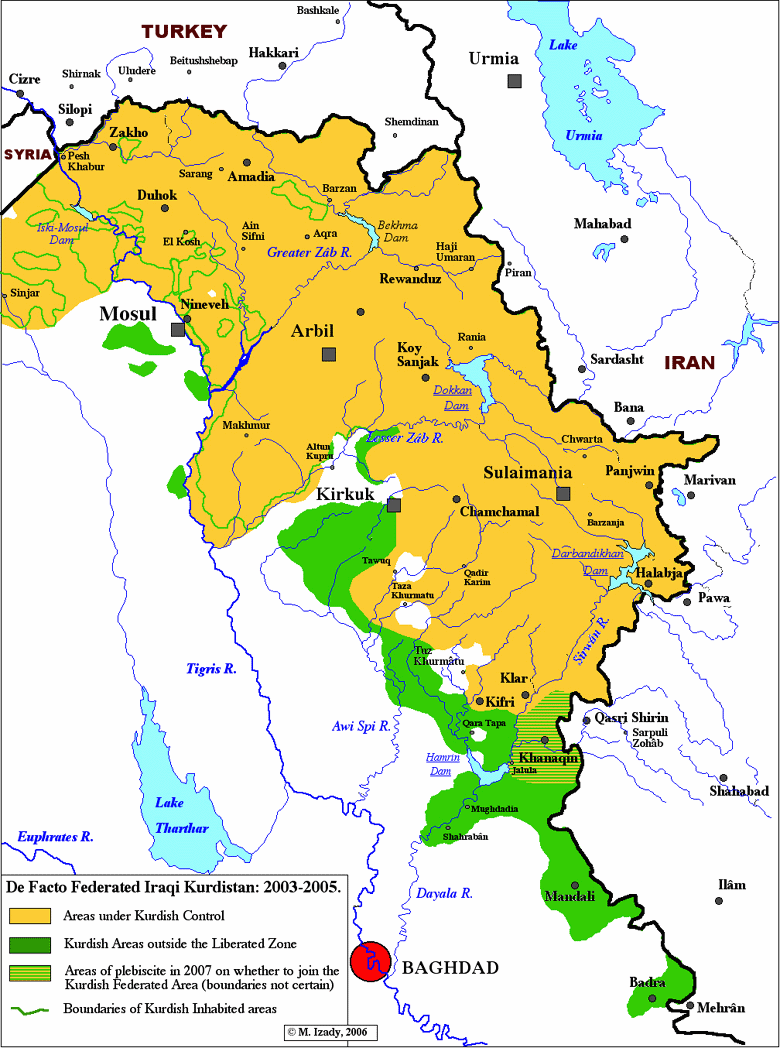
Iraqi Arabs are not happy with this arrangement. Kurds have extended their control to northeastern Mosul and Kirkuk, Iraq's 2nd- and 5th-largest cities. Mosul is a wealthy trading city and Kirkuk a wealthy oil city--and both have lots of Arabs (interestingly, Mosul also has lots of Turkomen). While the Kurds managed to keep much of their territory relatively peaceful, their fighting with Arabs and Turkomen has turned Kirkuk and Mosul into 2 of Iraq's biggest violence hotspots. Mosul, in the confusion of the fray, has become Al Qaeda's last hideout in Iraq. It's a serious security problem.
Maliki sent the Iraqi Army to take back some of the Kurds' southeastern holdings that were pretty unquestionably Arab territory. There has been no civil war yet, but this is probably due only to the persistence of the US--the Kurds' best friends--in levying pressure to negotiate. But the Kurds are frustrated. Cities like Kirkuk were supposed to have referenda on whether they wanted to be a part of the Kurdish Autonomous zone or not--and the vote is now well over a year delayed, and shows no signs of happening. The US is trying to push for a negotiated settlement between the two sides. But Mosul and Kirkuk are likely to become embroiled in fighting no matter which way they go--even if their representatives can reach a deal, Arabs and Kurds in each city believe deep down that the city is theirs and that the other side has taken unjustly what they've taken. It's a mess.
The US doesn't have too long to stay in Iraq, and needs the negotiations to happen on a reasonable timescale--Maliki wants the same, because he knows that the US will back the Baghdad government if the Peshmerga picks a fight with them. The Peshmerga know it, too--but they also know that the US is willing to look out for their interests to some extent if they don't pick a fight with Baghdad--the US and the Kurds are still close friends with a relatively long history. But this explanation predicts that the Kurds would be happy to negotiate, and so far they haven't been thrilled. As the Iraqi Army grows, they will lose bargaining power--the only two rational approachs I can think of are A) negotiating now, while Kurd power is strongest with respect to the Iraqi Army and the Coalition, or B) wait until the Coalition leaves, at which point one would presumably have a boost in advantage. The latter is a dangerous game of brinksmanship that the Kurds must avoid. The former will probably not happen until an oil deal is passed in parliament--and that deal is getting close to 2 years delayed.
The resolution of this Arab-Kurd dispute when the US leaves will likely be the final step in securing Iraq's stability into the future. But failing to do it could undermine the progress that Coalition and Iraqi governments have made. Careful and persistent work awaits US diplomats in the next 2 years.
Subscribe to:
Posts (Atom)