Showing posts with label Mosul. Show all posts

Wednesday, April 15, 2015

How the Battle Lines Against ISIS in Iraq Have Moved Over Time

To show progress against ISIS in Iraq, the Pentagon put out a graphic that is somewhat comically difficult to understand. But after the Pentagon's disastrous Powerpoint slide on Afghanistan, we've come to expect little else.

So I decided I'd work with the fine folks in Wikipedia (thanks, guys!) to make a GIF that shows how the battle lines have moved since the ISIS offensive with a few pointers about key events. It's not perfect, but I think it's a big improvement.

Enjoy, and feel free to share or put in your own content.

(Click here for an even larger size.)


And in case you want to look at the photos individually below:


Tuesday, March 31, 2015

Tikrit Falls to Iraqi Forces; US Solidifies Role as Leader Against ISIS

Tikrit has fallen.


Mop-up operations are underway, but the Iraqi national flag now flies over the city, and ISIS is broken.

Iraqi forces should be moving quickly north to secure the Baji road and oil refinery before securing, regrouping, and supporting Ramadi to make sure the ISIS advance there is halted. And then, of course, there will be a few-months' ramp-up to take Mosul.

Key Takeaways:

The advance into Tikrit was halted around March 6th as the army/Shiite militias faced heavy sniper fire and dug-in pockets of resistance.

US airstrikes started up just under a week ago after the Iraqi government requested the support to break ISIS resistance. Those airstrikes prompted most of the 20,000 Shiite militiamen--who generally don't like the US and see themselves as more closely aligned with Iranian interests--to boycott the siege and go home, leaving about 3,000 Iraqi Army troops, 1,000 Sunni fighters, and about 2,000 Shiite fighters. It left a lot of glaring holes in the siege.

But the airstrikes proved decisive.

After softening ISIS targets (which had probably thought themselves unlikely to have to face such airstrikes), the US suspended its operations and the Shiite militias quickly came back to launch the final assault.

The city fell one day after the air campaign, after 3 weeks of no progress.

The US is gloating a bit, and with good reason. US officials are taking the opportunity to show that Iran can't alone support the Iraqi advance. This is a precedent-setting kind of event: the US was "snubbed" last month when Iraq's government moved into Tikrit with Shiite militias and Iranian ground support, without informing the US or requesting support.

Giving in to request the support was a sign the Iraqis had realized they need it. The fact that the city was taken so quickly after the strikes cements the US' future role.

This means one of two things: either the US and Iran will work more closely together, or the Iranians will have a much-reduced role in the Iraqi offensives in the future.

This cementing also means that the US is going to be leading the assault on Mosul, which is about 20x larger than Tikrit and has many more ISIS fighters dug in. It's clear that the Mosul operation is a non-starter without that air support.

Shiite militias will make a lot of noise about not needing the US, but I do believe that Tikrit will be weighing heavily on their minds when they are planning the Mosul advance, and that despite the high tensions, the militias will begrudgingly go in with US air support.

It's worth noting: Tikrit probably had far more than the 2,000 ISIS fighters initially estimated--the Iraqi government cites about 13,000, but this is probably inflated. The good news is that this means the Iraqis have shown that they can win with about 2:1 odds, rather than the 10:1 or 15:1 previously thought. Mosul also has about 12,000 ISIS fighters, so the fight will not be an order-of-magnitude difference (though will obviously take much longer and be more complicated due to Mosul being about 20x larger in land mass).

But ongoing US airstrikes are making it hard for ISIS to dig in as deeply as it would like, and the ISIS governor ("Prince of Mosul") and Mosul's top ISIS military commander have both been killed by airstrikes.

Thursday, March 12, 2015

Iraqi Forces Enter Tikrit; Victory Looks Certain

Iraqi forces have Tikrit surrounded, after a week-long slog of clearing out bombs and snipers along the roads leading into the city.

They are entering the city from all sides now, attempting to squeeze out (and ideally eliminate during retreat) ISIS forces holed up inside. I believe at this point that victory is fairly inevitable, and that they'll move on next to clear ISIS forces currently combating government / Shiite troops in Baji. Expect the area below to become quite red after ISIS forces break.


The going will be slow now that they're in the city: ISIS predicted this was coming and scattered snipers and booby traps throughout the city, in the hopes of causing enough casualties to break the spirits of government troops.


(Twitter user @PetoLucem has a great chronological progression of government advances in Tikrit over the past few weeks, via Stratfor)

But it won't happen. The most important part of this offensive is that Iraqi forces do not break and run, and I suspect they won't. Iraq has hand-picked more reliable forces for this offensive, and the backing of very zealous Shiite militiamen and Iranian Quds forces is going to keep morale high as they demonstrate high morale and relative courage in the fighting. The total forces assaulting the city number a staggering 30,000, which likely outnumbers ISIS forces by about 10:1. There are just so many weapons pointed at ISIS forces that they will eventually get squeezed into defeat.

Expect the city to be cleared in 1-2 weeks as forces very slowly and carefully move house-to-house, hoping to minimize casualties. Baji will fall more quickly after that; it has many fewer ISIS fighters and government forces are already in the city, which will prevent the kind of entrenchment that ISIS was able to manage in Tikrit.

Implications
ISIS' days in Iraq are numbered, I think. Tikrit will be the victory the Iraqis need to build the morale and template for taking Mosul, which will allow them to turn their attention to Ramadi and Fallujah--those will be the hardest fights they have, but they'll have momentum on their side: Iraqi forces will inherit ISIS' air of inevitability.

ISIS' aura of inevitability and terror is starting to fizzle as they begin to lose to superior firepower, numbers, and training. That loss will hurt long-term recruiting, which means they'll actually be ground down to the point that they'll have to revert to asymmetric warfare (they set of 12 simultaneous car/suicide bombs in Ramadi and one bomb in Baghdad to try to disrupt the assault on Tikrit, for example). But because ISIS is claiming to be a caliphate, their authority erodes if they don't hold territory.

With victory coming, the most important factor in this advance is making sure that Shiite militiamen don't use this opportunity to carry out sectarian revenge killings. If they're able to keep their cool (and so far it's looking like they are, but the hard part will be after the main fighting ends) and leave Sunni civilians alone, the prospects for Fallujah and Ramadi will improve as Sunni civilians there begin to hope that government forces are a viable alternative to ISIS (they had previously probably helped ISIS to take hold there because they were so frustrated with Shiite rule in Iraq, but ISIS became more than they had bargained for).

Meanwhile, the Kurds in Syria continue a slow, steady slog towards the Tall Abyad border crossing with Turkey, which would close down a supply and reinforcement route (for foreign fighters) into Syria.


Tuesday, March 3, 2015

Quick Update: Advances Against ISIS, and What to Expect in Tikrit

Readers keep telling me they love the maps, so you get maps and a bit of "implications." We'll also touch very briefly on Tikrit.

1) Kurdish forces out of Kobane have successfully pressed ISIS out of the space west of Kobane by trapping them against the river/lake and eliminating them. They've made modest progress in the east but I think we can expect the Kurdish forces to shift a bit south, but mostly east, to capture Tall Abyad crossing and cut off a supply line for ISIS from Turkey.


2) In northeast Sryia, ISIS has totally collapsed. That huge box on the right was all formerly ISIS, right up to the southern edge of that big red blotch (government fighters). It appears the Kurds and government troops have a truce, which has allowed them to push out. There is likely a bit of a "race" to secure space around Hasakah between Peshmerga and government forces. We also see in the western box that Kurdish forces have successfully crossed a river and are assaulting villages there, likely hoping to scoop up the smattering of black just to the south.


3) From the department of "great things come in small packages," the Kurds have successfully captured the roadway and villages around the bridge where Route 1 crosses the Tigris, cutting Mosul off from its most direct western supply line. This is a form of kicking the proverbial hornet's nest that may bring ISIS fighters out of dug-in fortifications to try to take the highway back. They're going to have plenty of time--Iraqi forces will be bogged down in Tikrit for a while.


4) Iraqi forces are probably trying to encircle Ramadi by taking villages to its north (lower-left box) and have entered Tikrit. In Tikrit, government forces are similarly trying to encircle the city before moving in, and are being slowed down by roadside/car bombs and suicide bombers. The little black dot south of Tikrit is being shelled at time of writing, and the dot to the north of Tikrit is being de-bombed.

Once Tikrit is surrounded, it may take up to a month to move in and finish off ISIS forces. Iraq is sporting 25,000 troops between regulars, Shiite militias, and Sunni militias. They likely outnumber ISIS forces 10:1--but just remember that Iraqi forces had similar odds when they were overrun in Mosul last summer.


Iran is supporting this operation rather than the US, which means no air support. It's clearly not an experiment ("can Iraqi forces handle this on their own?")--now's just not the time to be having such experiments, as Tikrit is probably the junior varsity version of trying to take Mosul.

What's more likely--I think--is that Iraq and Iran are going alone, without US "permission." Iraq has been frustrated with coalition support and it's possible (though I have predicted otherwise) that the US announcement of the Mosul offensive created some distrust--Iraq may have decided that the US couldn't be trusted with the intel.

Evidence suggests the US wasn't even told about the offensive--a US general said that the offensive was "no surprise," which is very different from saying "we're in the loop."

It'll be great news if Iraq can take Tikrit without US air support, though there are huge complications with making this a "Shiite" operation--Shiite militia abuse is a big part of why ISIS was able to get traction in western Iraq in the first place.

But we'll deal with that another time.

Tuesday, February 24, 2015

Is the President's Request for Authorization of Force the Right Package? Is the Mosul Announcement Crazy?

(Total reading time: about 10 minutes)

Reader Andrew asked me for my opinion on the efficacy of the Authorization for Use of Military Force (AUMF) that President Obama requested from Congress earlier in the month.

Part of what prompted the question was an email from Andrew's representative Michael Capuano (D-MA) stating why he was against the authorization as-written. In short, his objections:

  • "Half measures are a recipe for failure and this resolution is a half measure." It doesn't allow US forces to take part in military operations necessary to win
  • The US' record in the Middle East usually includes success on the ground followed by disaster--either quagmire (Afghanistan and Iraq) or post-war collapse without us there (Libya and post-2013 Iraq); there's currently no plan on how to make this work
  • The US is not directly threatened by ISIS; we could play a support role for more directly threatened nations (Turkey, Jordan, Saudi Arabia) that lead the assault, but leading it does not make sense from a national security perspective
Presumably if Jordan/Egypt/Turkey/Saudi Arabia (along probably with the UAE, Kuwait, Bahrain, and Qatar for good measure) led a ground force, they'd be stuck with managing the aftermath--good both because the US doesn't have to get stuck in another quagmire and also because these countries will have a better chance of managing the peace (more cultural affinity and "pulse" of the situation). Spoiler alert: they probably won't.

Before I add my two cents, let's review a very brief summary of the draft sent to Congress.

Key Points of the AUMF

  • The AUMF is for 3 years (a year beyond the remainder of the President's term) and has no geographical restrictions
  • It's clear enough that it's specifically ISIS-related that it probably can't be used to go after every terrorist organization out there (I'll leave out commentary on the 2001 "Global War on Terror" AUMF and the question of constitutionality of recent operations)
  • Ground forces can advise local troops, conduct search-and-rescue operations for coalition members captured by ISIS, coordination for airstrikes and allied ground movements (think: helping coordinate airstrikes to soften targets for Kurdish advances), and "special operations" (SEALs and whatnot) to take out ISIS leaders
  • Ground forces cannot participate in "enduring" (this is probably intentionally vague) offensive ground operations...
  • The 3,000 troops in Iraq are exempt from this restriction, meaning they'll probably be participating in the Iraqi spring offensive


It's Actually Pretty Good

After reading Rep. Capuano's letter, I was feeling pretty prone to side with him on opposing the AUMF for similar reasons. I'm generally critical of the President's half-measures to deal with problems like Russia, Syrian chemical weapons usage, and other matters.

But I've changed my mind. I think this is a solid AUMF.

I do think there's a clearer plan in place than Capuano believes, but also that requiring too clear a plan before authorizing force is unreasonable. The President's military advisers need the freedom and flexibility to formulate and adjust a plan over time, and the AUMF gives them the green light to move when they're ready--it does not require that any particular action happen now.

Let's talk a bit about what might happen under the AUMF.

Offensive in Iraq

The plan for Iraq is incredibly clear and pretty sound. We've already seen that airstrike coordination in Kobane was critical in helping the outnumbered and outgunned force turn the tide (and continues to help in the counter-offensive). The 3,000 US troops should be a huge boon--both for morale and effectiveness--if they join the assault on Mosul. And they should. In fact, while it's not been announced, I suspect the wording of the AUMF makes it very clear that this would be the plan.

Mosul has about 2,000 ISIS fighters holding it right now. 25,000 Iraqi and Kurdish Peshmerga forces are going to be thrown at the city, and the big question is whether the Iraqi fighters are going to break and run as soon as ISIS troops sneeze. I believe very much that having US soldiers in the trenches--along with witnessing well-timed airstrikes just before the assault--will keep Iraqi troops confident enough to point their guns in the right direction. House-to-house fighting sucks, and ISIS is going to make it very hard for civilians to flee (making airstrikes tougher). But the Iraqis and Americans can take their time and regroup in safer areas if they get beat up in any parts of the city.

The big question is that since it's been so broadly announced, will ISIS try to shore up defenses in Mosul? Maybe. The President has gotten some funny looks from the news media and some politicians, and even the Iraqi government: "why the heck would you tell the enemy they have 2 months to fortify your primary target?" It seems totally backwards. One generally doesn't tell the enemy the time and location of one's next offensive.

Once again, I think there is some subtlety at play that is lost in the knee-jerk reaction.

One thing that we must keep in mind is that coalition forces have total air dominance. The US is hitting targets in Mosul probably as you're reading this, and probably while you're sleeping, too. So obviously the coalition has a few months to "soften" Mosul.

But what about a flood of reinforcements? Let's take a look at the region around Mosul:

Thanks for being awesome, Wikipedia

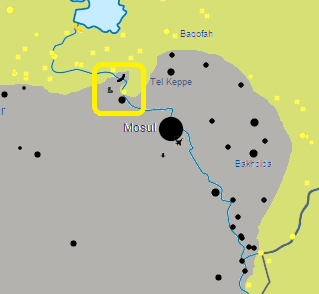
Mosul has some space around it where it could draw fighters back from the front line--I don't know how many are there, but they're actively fighting Kurdish troops in the east, so if they turned tail, the Kurds would be able to recover some territory and place heavy guns within striking distance. At a rough guess, I'd say the local villages, if abandoned, could beef up Mosul to about 4,000 troops. Remember that while these guys are zealous-and well-armed, they are not particularly expertly trained and don't have military intelligence to help at all. The intelligence gap was probably a big part of why the US was able to lead the Kurds so effectively to pick off fog-blinded pockets of ISIS resistance in Kobane.

But obviously the concern is that reserves from other places not under pressure (like ar-Raqqah or elsewhere) could send columns of these guys and turn Mosul into a bloodbath. Let's look at Mosul another way to consider this:

Thanks, Google Earth and MS Paint

Around Mosul is a whole bunch of wide open desert, and I can guarantee you that desert has a few drones circling overhead constantly (for those who have seen the movie "Zero Dark Thirty," recall the drones constantly circling over Bin Laden's hideout for a few hundred days), taking a look at those two roads coming in from the west and south in addition to scouting targets for US airstrikes.

If anyone out there has a good idea of how to sneak in hundreds of troops or dozens of heavy weapons along those highways, I'd love to know (leave thoughts in comments). But I really don't think it's possible.

And here's what I really think is going on; if I'm right, I tip my hat to the administration:

I believe the President is trying to goad ISIS into trying to reinforce Mosul. 

"Wha?"

If a huge column of trucks and heavy weapons starts rolling from more fortified positions, it will have to travel through a lot of desert and be exposed for at least 3 hours (if coming from the closest ISIS town, al-Qamishili).

Thanks, Google Maps.

American or Jordanian fighter-bombers can get where they need to go in about 30 minutes.

If the coalition doesn't totally blow it, Route 1 would become 2015's Highway of Death.
Thanks, Wikipedia

Is ISIS going to fall for it? Maybe. As we talked about in an earlier post on Kobane, ISIS' power comes from legitimacy and a sense of divine inevitability. Taking Mosul made it horrifying and seemingly irresistible. But nobody likes betting on a loser, so their recruiting (and intimidation) strategy depends in part on winning. I'd be surprised if ISIS was really willing to let Mosul go without a big fight. Furthermore, if they were able to defeat the best efforts that Iraq/the US could put up to root them out of Mosul, it would be a massive symbolic (and military) victory that would probably convince the Iraqis that resistance is just totally futile. There is a whole lot at stake, and I'd be mighty surprised if ISIS was willing to commit to a fight they're probably going to lose.

So it could work. It's even possible the Iraqi defense minister is actually in on the plan and is complaining to make ISIS think reinforcing is a good idea. If so, once again: well done.

The other option, of course, is to abandon Mosul if it looks like it's unwinnable and not suffer a humiliating military defeat. If ISIS believes Mosul is doomed, it is unlikely to cling to the city. There's some evidence it might be thinking this way: ISIS is apparently ditching the big base south of Mosul that they have held for 7 months. The announcement about the Mosul offensive may mean that ISIS would want to focus forces for a counter-attack elsewhere that is not under heavy bombardment and scrutiny, to keep the Iraqis off-balance.

Fallujah, Tikrit, and other areas along the Euphrates in Iraq will require significantly more work than Mosul. Think of Mosul as a place the Iraqis can cut their teeth and gain some confidence for the real work ahead in Sunni-dominated regions.

What about Syria?

Syria is a theater that remains somewhat impervious to anything but a massive ground invasion. I'll repeat: the government and rebel forces aren't going to do it until the civil war resolves in some way, which won't happen for years. The Kurds could pick up territory once the Iraqi Peshmerga forces get relief from the Mosul offensive.

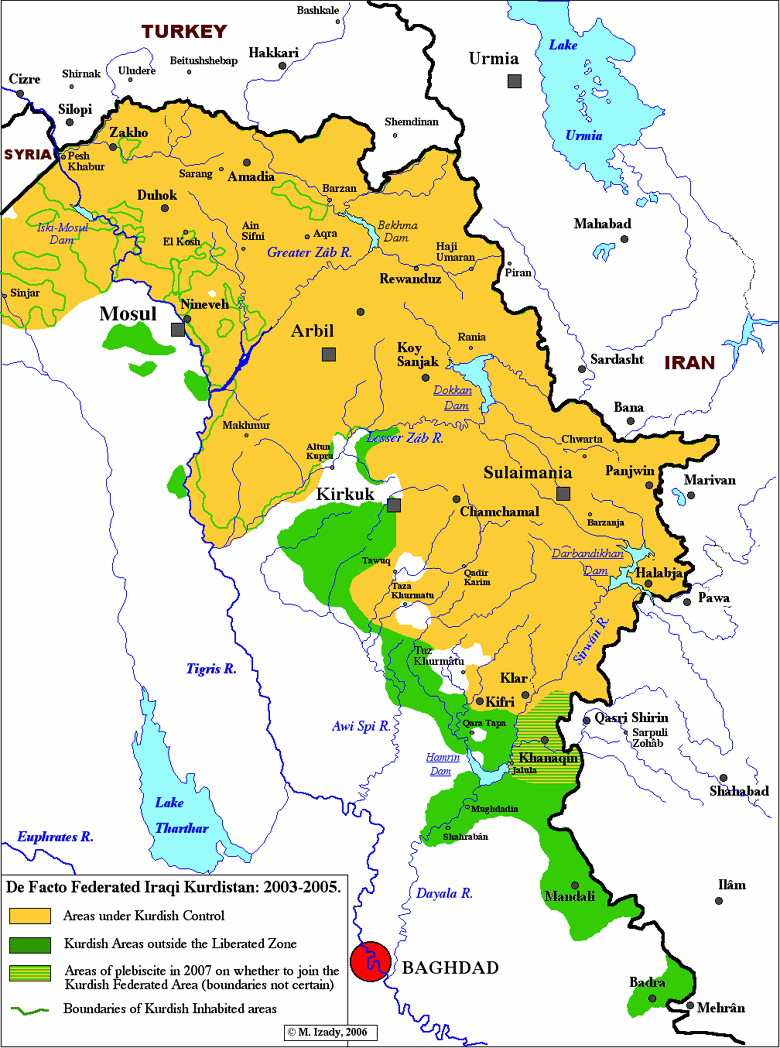
We've seen that the Kurds are perfectly willing to occupy territory outside of their primary ethnic strongholds (see the map below--they're currently occupying Kirkuk and northwest Syria) and so may push in northern Syria to create buffer space. 

CIA, via Wikipedia

But the Kurds simply have no interest in moving to the Euphrates, where ISIS is strong and rules with total impunity. I really just don't think anyone at all has a plan to deal with Syria, and the AUMF only sets up the administration to make a move if the Syrian political situation changes or Jordan/Syria/Egypt get fed up with ISIS hanging out next door and decide to go on a major ground offensive. 

It's possible that success in Iraq will be inspiring and that Jordan, which remains incredibly pissed off, and Egypt, similarly pissed off about 21 Copts being similarly brutally murdered, could decide it's just plain time to lend serious military support to Syria on top of the current airstrikes. 

But, frankly, their armies are small and their economies stretched, and they'd only enter Syria if the civil war ends and moderate forces can finally unite against ISIS.

I'll maintain that if ISIS falls in Syria, its ill-advised strategy of trying to bring Jordan and Egypt into the fight will be part of its undoing.

Libya

Libya's divided forces have opened the door for continued ISIS expansion, which now holds 3 towns (2 weeks ago, it was only Derna), having added Sirte and Nofilya. 

Seriously, Donate to Wikipedia

The grey (in Benghazi and elsewhere) is Ansar al-Sharia, who is a totally different (but ISIS-friendly) menace not covered by the AUMF. (Syria has similar pockets of these guys, though right now they're not really fighting with the "good guy" rebels, so we're making the same mistake--as with ISIS--of leaving them alone "until" the "good guy" rebels win.)

Jordan and Egypt want the UN to authorize force in Libya to nip ISIS' presence there in the bud. Egypt is already putting down airstrikes, but now that Libya is in ceasefire, it's a prime place for US special forces, trainers, and airstrike coordinators to help the Tobruk government take back Derna.

A Bit of Good News

And just because everyone likes a bit of good news: ISIS has been totally pushed out of the Baghdad environs and is getting pinned up against a river by the Kurds near Kobane. 

New territory from last week in Kobane circled in yellow.

 Still Wikipedia

New territory gained by the Iraqi government over the past 6 weeks circled in red.
I'll let you guess where I got this one

The Iraqi forces are already pushing back pretty steadily, which is a sign that, despite everyone freaking out about readiness, the Iraqis are showing they can put the fight to ISIS and win.

If you got this far, thanks for taking the time. Leave me some comments about what you want to hear about next, either about ISIS or otherwise!

Update! Kurdish Peshmerga Forces Working on Cutting Off Mosul

Reader and generally-smart-guy Shir shared with me this great article and map showing a Kurdish advance on Route 1, which ISIS is using to resupply Mosul. We discussed above the risk of sending big columns down that road, but if the Kurds can hold the area for the next few months, getting military and support resources to Mosul will be a lot harder and more dangerous--they'd be much more open to ambushes from the Kurds and airstrikes from the Americans. It makes the assault on Mosul a much more likely prospect.


The Washington Post and I seem to have some agreement on the general strategy for isolating Mosul from reinforcement in the coming counter-offensive. Exciting stuff. Expect me to be blogging obsessively about it.

Thursday, December 11, 2008

Iraq's Kurd Problem

When the Coalition invaded Iraq, it didn't bring much in the way of troops. This much we know. When looting and mayhem broke out after the invasion, the Coalition was quite relieved to not have to worry about one part of Iraq--the Kurdish north. And worry about it they did not. The Kurds, a long-time ally of the US against the Hussein regime (and target of much US sympathy) were happy to salute the US and say "don't worry, no anti-US activity will happen here." And happen it did not.

So the over-taxed, frazzled, and exhausted coalition said, "thank goodness," and let the Kurdish Peshmerga police its own territory. In the meantime, the US started taking shots at Sunni Arabs that were causing trouble (and some that weren't). Not only did this occupy many Sunni forces, but it chewed them up. This will become important.

The Kurds are a proud people that have faced a long history of oppression. After the First World War, they received vague promises from European powers that they would get a state. In the shuffle of great power politics, they managed to get themselves swept under the rug--Kurdistan never became a state. Instead, the region in which Kurds lived was broken up into parts of four countries: Syria, Turkey, Iran, and Iraq. Kurds found themselves ruled by Persians, Arabs, and Turks--none of which spoke their language and shared their culture. Attempts to gain full autonomy in one country met backlash from all four--Kurdish land is fertile and full of oil, and all four countries that contained Kurdistan knew that successful Kurdish independence from one state would lead to instability and increased nationalism at best, and momentum for a war of independence at worst. Hussein launched a war of genocidal terror against his Kurds after the Persian Gulf war, killing hundreds of thousands and prompting the US-led Operation Provide Comfort, which kept Iraqi troops from setting foot in Kurdsitan for years.


Figure 1: Kurds in the Middle East


Provide Comfort was a defining moment in the history of Iraq's Kurds. Because Iraqi forces could not set foot in Kurdish areas, the Kurds had to look after themselves. Iraqi Kurdistan had actually gained official autonomy in 1970, but its parliament was under Hussein's control until the aftermath of Provide Comfort, when Iraqi forces left the area. Official autonomy had put most of the mechanisms in place necessary for real autonomy--without Iraqi troops (and with an economic blockade by Hussein), Iraqi Kurdistan had achieved de facto autonomy. The Peshmerga, a paramilitary force of the Kurdish region, policed the region. Two opposing factions ruled. It acted much like it's own country--similar to a Taiwan or South Ossetia situation. The Kurdish autonomous region is defined in figure 2 below; some Kurds lived outside the region, and a few Arabs lived within it.

Figure 2: Kurd Populations and Autonomous Region


The green areas represent Kurdish populations, but those blobs were certainly not static. In addition to genocide by murder, Hussein made attempts to consolidate Ba'ath control of Kirkuk and Mosul, the 5th and 2nd largest cities in Iraq (and quite wealthy) by a process of "Arabization:" moving Arabs into and around the cities, something reflecting "Hanization" by the Chinese in Tibet and Xinjiang. This process will also end up being quite important.

In the 12 years between Provide Comfort and the US-led invasion, the Kurdish population became quite used to its autonomy. The Peshmerga, a paramilitary force on the autonomous region's budget, kept the peace. The new generation of Kurds mostly doesn't speak Arabic, and largely does not have much interest in the Iraqi state as a whole--they see themselves as citizens of Kurdistan.

Enter again the Americans. During the Coalition's Invasion of Iraq, troops found themselves quickly overwhelmed with looting, murders, and then an insurgency. US troops, in charge of the northern zone of Iraq, asked the Kurds to keep the peace. And keep the peace they did--Kurdish troops marched south into areas they considered "Arabized" Kurdish territory, and a bit more. The US did show up in Kurdistan eventually, but not until the violence in Baghdad and Anbar started to fall. In the four years' meantime, the Kurds ruled. Their holdings have extended to those of the figure below.


Iraqi Arabs are not happy with this arrangement. Kurds have extended their control to northeastern Mosul and Kirkuk, Iraq's 2nd- and 5th-largest cities. Mosul is a wealthy trading city and Kirkuk a wealthy oil city--and both have lots of Arabs (interestingly, Mosul also has lots of Turkomen). While the Kurds managed to keep much of their territory relatively peaceful, their fighting with Arabs and Turkomen has turned Kirkuk and Mosul into 2 of Iraq's biggest violence hotspots. Mosul, in the confusion of the fray, has become Al Qaeda's last hideout in Iraq. It's a serious security problem.

Maliki sent the Iraqi Army to take back some of the Kurds' southeastern holdings that were pretty unquestionably Arab territory. There has been no civil war yet, but this is probably due only to the persistence of the US--the Kurds' best friends--in levying pressure to negotiate. But the Kurds are frustrated. Cities like Kirkuk were supposed to have referenda on whether they wanted to be a part of the Kurdish Autonomous zone or not--and the vote is now well over a year delayed, and shows no signs of happening. The US is trying to push for a negotiated settlement between the two sides. But Mosul and Kirkuk are likely to become embroiled in fighting no matter which way they go--even if their representatives can reach a deal, Arabs and Kurds in each city believe deep down that the city is theirs and that the other side has taken unjustly what they've taken. It's a mess.

The US doesn't have too long to stay in Iraq, and needs the negotiations to happen on a reasonable timescale--Maliki wants the same, because he knows that the US will back the Baghdad government if the Peshmerga picks a fight with them. The Peshmerga know it, too--but they also know that the US is willing to look out for their interests to some extent if they don't pick a fight with Baghdad--the US and the Kurds are still close friends with a relatively long history. But this explanation predicts that the Kurds would be happy to negotiate, and so far they haven't been thrilled. As the Iraqi Army grows, they will lose bargaining power--the only two rational approachs I can think of are A) negotiating now, while Kurd power is strongest with respect to the Iraqi Army and the Coalition, or B) wait until the Coalition leaves, at which point one would presumably have a boost in advantage. The latter is a dangerous game of brinksmanship that the Kurds must avoid. The former will probably not happen until an oil deal is passed in parliament--and that deal is getting close to 2 years delayed.

The resolution of this Arab-Kurd dispute when the US leaves will likely be the final step in securing Iraq's stability into the future. But failing to do it could undermine the progress that Coalition and Iraqi governments have made. Careful and persistent work awaits US diplomats in the next 2 years.

Monday, October 13, 2008

Iraqi Muslim Sectarian Groups Put Aside Infighting, Kill Other Religions Instead

A lot of progress has been made in the past few years in trying to get the Iraqi sectarian groups to get along. More and more, the Shiites and Sunnis are grumbling their way towards working for joint development and governance. The passing of the crucial election laws means there will be a flawed--but quite improved--representation in government for Sunnis.

But amid these improvements, a new sort of religious targeting has occurred. Christians, particularly in Mosul, have been attacked and killed, driven out, or have simply fled. Mosul, which was once known for heterogeneity and tolerance, is now swarming with anti-Christian gangs, prompting the government to send 1000 extra security personnel.

There is some speculation as to what has caused this sudden ethnic cleansing. It might be because of Christian protests--local election laws in Niniveh have taken away Christian quotas in parliament, and Christians have taken to the streets on Mosul and Baghdad over it. Such protests may be angering some Muslim minorities, who are looking to consolidate as many seats this coming October as possible (for example, Sunni Kurds). Until elections actually happen, there may be perverse power plays, intimidation, bribery, and all sorts of corruption to try to game the system into giving each group a political advantage.

And therefore! I believe that this is the very reason that provincial security handovers are on a long pause, despite the fact that security is good in a few of these regions (Wasit, Babil, Ta'mim): until the election, American forces want to be as present as is reasonable, and really make sure security is strong enough to prevent intimidation and other forms of disenfranchisement. When the election is over, the crisis will recede--violence against minorities will get Iraqis in more trouble than the payoff they can expect might balance. Therefore, the US is waiting until December to handover.

If Iraq can get this situation under control until the election, the Christians might be safe--but on the other hand, there may be angry reprisals by gangs or extremist sections of political groups that are angry at a raw deal--and looking for a scapegoat. It is easier for extremist Muslims to justify violence against Christians than other Muslims, and probably a bit easier to get away with, given the questionable reliability of some of the Iraqi Security Forces. But if the government can show that it's willing to pull out all the stops to protect its minorities, it will earn a lot of much-needed security credit.