Showing posts with label War in Iraq. Show all posts

Friday, August 31, 2012

Breaking Down the "Oil War" Hypothesis


A friend recently used the term "War for Oil" when referring to the War in Iraq, and it got me to thinking: regardless of the intent (I will stay well away from that one as I have little to add and nobody wants their minds changed on the matter), did the US secure a significant, reliable source of oil by invading Iraq? Let's find out.

I first went to understand how Iraq's economy has changed since the fall of the Hussein regime. I knew that oil mining contracts went out in 2009, so this helped.

Browsing through Wikipedia brought me upon this great chart (don't worry, I checked the sources), which gives us an idea of whose companies are mining how much:


So the US and UK mine a fairly large amount of oil. Good, but there are a few things to note that change the equation:

1) The US and UK are being paid $2/bbl to mine the oil. While profitable, the oil mining companies bear most of the the costs of mining (including all operations costs) and are likely making somewhere between 1/10 and 1/20 the profit made at other offshore, well, and oilsands sites (this is speculation on my part based on some oil industry experience). So payback in petrodollars is fairly low.

2) The Iraqi government retains the right to sell much of the oil to whomever it wishes--the fact that the US is mining 16% of the oil does not mean that the US will import 1.5 MBpD.

On the other hand, the US is far and away Iraq's largest export partner, accounting for $11B of Iraqi exports in 2006 (according to US State Dept). 70% of the Iraqi economy is oil, so if we assume that oil dominates Iraqi exports, it means that the US is importing $11B in 2006, or 157MBbl at $70/BBL. Let's say that export rate has grown with Iraq, whose economy has about doubled since then. That's about 310MBbl per year or 0.85MBpD. How does this compare to the rest of the US oil economy?

As of 2009, the US imported 10 MBpD and produced 5 MBpD of crude. Assuming we're comparing apples to apples, Iraqi oil imports account for 5.6% of total US oil consumption.

So this looks like a decent amount, but not game-changing. And it's significant, but a few points about the oil market raise some ambiguity as to whether it has a significant impact on the US oil market.

Besides a few embargoes, the oil market is driven by bidding on open market (given different transport capabilities--some stuff is pipeline only, or rail only, some stuff goes out on barges and can go anywhere, which is the case with most Iraqi oil). Different importers (in our case, free-market refineries) will bid for crude oil and import it, turning it around on the gasoline or diesel market to suppliers that you pump your gas from. Iraq does not have any contractual, legal, etc agreement to guarantee the US any amount of oil or at any price (in particular, being part of OPEC means it has the bargaining power to do just about whatever it wants). At the end of the day, the post-war world increased Iraqi oil production significantly, which reduces oil costs for all importers, but the US has not secured a cheap or even necessarily reliable source of oil. The Iraqi government won't enter into any agreements that guarantee US refineries some portion of Iraqi exports--Iraq gains nothing by it. If the Iraqi embargo (from the Hussein era) had remained, the US would simply get its oil from elsewhere at a higher price. Compared to the $800B cost of the war, the cost-benefit doesn't make sense.

If the war in Iraq was designed to secure oil, it ultimately failed... or at least won't pay off monetarily. There's no doubt that world oil production has increased due to the fall of the Hussein regime and the end of the embargo, and this has lowered oil prices for the moment, but the costs of the war will likely far exceed the benefit from lower oil prices. At 15MBpD of consumption, if oil is worth $5/BBL less (which is more than generous given the size of the oil market), the US economy would save about $27B per year. Not including inflation, it would require about 30 years to pay back the cost of the war.

Hopefully, then, the war wasn't considered an oil investment. If it was, it was probably the worst investment the US ever made.

Tuesday, March 31, 2009

A Brief Iraq Update

Iraq has been quiet enough lately that the media, government, and public have all turned fully towards Afghanistan; as a country, we're now engrossed in it. And frankly, that's correct. It's trouble--Iraq is not. This quick update is to keep you informed, and help your experience with the Iraq War feel a little bit more tied up.

First, deaths continue to fall. US deaths hit a new record low of 8 in March; Iraqi violent deaths stand at 252, up from February, but still lower than any month before 2009, and represents well less than 0.01% of all Iraqis. This violent death rate is now lower than the United States, which sees about 4,200 violent deaths per month, or 0.014% of all Americans (sourced again here). And it looks like it will continue to drop. This lack of violence will give the Iraq government ample opportunity over the next 18 months to strengthen its police force, its political institutions, etc, as they prepare for the exit of the US.

Some problems persist, though they are largely civil (for the moment). Power production continues to lag demand significantly; frankly, I have no idea what the excuse for this is. Even Baghdad only has power 17 hours per day, which is enough to have a pretty full business day, but it makes it hard to run severs, keep refrigerators, have security systems, and all sorts of other pretty important stuff that a business (and thus an economy) needs. Beyond this, Iraq is facing a quiet, but significant, measles outbreak, which is likely to test its public health system.

Otherwise, things are going well. Anbar remains quiet, despite recent government crackdowns on Sunni militia leadership that has the potential to shake the delicate alliance between the Sunni Reawakening Councils and the state. So far, the Sunnis are exclusively using political channels to express their grievances--if these channels prove effective, then they will create an excellent precedent for participation.

Iraq's Kurdish regional authority is being more cooperative, though its rebels are not. Kurdish leader Talabani is backing Baghdad's call for PKK to disarm and become peaceful or face the consequences. But the PKK has shrugged the calls off. Such a scoffing may lead to a confrontation in the north between the PKK/PKK sympathizers, and the state.

But al Qaeda seems to be making its last stand in Mosul; and it's not going particularly well for them. Despite a truck bombing earlier today, violence in Mosul is slowly receding. News reports on activity in the region are minimal.


In light of all this, the US is moving out. Only five of Iraq's 18 provinces have yet to be handed over to full Iraqi security control (putting the US back in bases where it awaits a call by the Iraqi Army for help). By June, Baghdad is planned to be handed over as the last province. Compare this to the mess of 3 years ago:


I think this is rather self-explanatory.

In full, I think even the most hardcore doubters of the efficacy of the Surge/ latter US operations in Iraq are being quieted. There will probably be a few more sporadic updates on the topic by me, but it's mostly time for us all to move on to our other regional problem.

Monday, February 2, 2009

Iraqi Provincial Elections

On Sunday, Iraqis went to the polls to pick provincial leadership for the first time since 2005. Turnout hit 51%, which isn't great, but enough to avoid the problems of 2005, where mass Sunni boycotts left the Sunnis under-represented in provincial government (somehow, they did not anticipate this consequence) and fueled the civil war that followed.

The distribution of seats is incredibly weighted towards small provinces--every province starts with 25 seats, and gains only one seat for every 200,000 population over 500,000. But, because provincial government is not actually representative legislature, the effect is minimized. Because of al-Qaeda's presence in Mosul, as well as strong disagreements on how to deal with the Kurdish Autonomous Region within the federal government, elections within the 4 most Kurdish areas in Iraq have been delayed. The New York Times actually has a pretty good primer on this.

Final results won't be in for a few days, but initial results are both surprising and comforting for the United States--and appear to be a big blow to Iranian power in the region. Before this election, the Supreme Council for the Islamic Revolution in Iraq (SCIRI) had a stronghold on the Iraqi south, and great influence as a major member of al-Maliki's governing coalition. One year ago, their militias ruled Basrah. As a conduit for Tehran, Iran's influence was strong. But militia fighting turned the Shiite South into a bloodbath, despite its relatively homogeneous nature, and Iraqis began to catch on.

Recent results show huge gains for al-Maliki's State of Law, throughout all of Iraq. It appears that State of Law will overtake SCIRI in almost every Shiite province, and place second or third in all others (including Sunni and Kurd provinces--at least those that are voting). This surge in momentum is surprising even to al-Maliki, whose popularity was crashing last year. But al-Maliki has stood up to the US (and negotiated hard for a pro-Iraqi Status of Forces Agreement), stood up to Iran (and booted Iranian diplomats that interfered with Iraq's government), and stood up to various militias across the country (pressing hard against al-Sadr in Baghdad, against SCIRI militias in Basrah, and against al-Qaeda). He gained the loyalty of many Sunnis through the Sons of Iraq program, and of Iraqis all across the country for restoring Iraq to safety and functionality for the first time since the fall of Hussein.

The elections indicate a few trends that are likely to give al-Maliki a big win in December, when national parliamentary elections occur.

1) Nationalism. Most Iraqis really love their country, their democracy, their culture. For the day-to-day citizen, nationalism has grown with the relative decline of sectarianism, as could be seen during the Status of Forces debate--bitter sectarian enemies united briefly to make sure that the US would be on its way out in a timely manner. Now that Obama is planning an even faster withdrawal than Bush agreed to, the Iraqis are looking to use their newfound muscle to shove Iranians out. SCIRI lost big for not recognizing this trend, and al-Maliki won for gambling on it.

2) Anti-sectarianism. Sectarianism is seen as the biggest contributor to violence between 2003 and 2008 in Iraq. While many Iraqis clung to sectarianism during that time, it faded and then was rejected as a stable security environment began to prevail. Iraqis hope to avoid such a civil war from ever brimming up again, and they are voting in kind. SCIRI was punished for remaining relatively sectarian in its dealings, and State of Law won for its hard-fought attempts to bring unity and reconciliation among sectarian groups.

Should the Iraqi people continue to become more nationalist and less sectarian, State of Law will continue to win--unless SCIRI performs a drastic makeover in the next year. They have the opportunity to do so, and they are likely to try. Even al-Sadr is showing a cooperative stance with the unity government, which is a massive turnaround from the past.

Perhaps the most amazing part of all of this is that the elections occurred with barely a blip of violence. Elections always marked increases in bombings, shootings, mortar lobbings, etc. But this time, Iraq remained calm. Mr. Obama is indicating that Iraq has control over its security situation, and the US can pull out quickly. He may be right. This vote, should it be successfully implemented in the last 4 provinces, could signal the end of the War in Iraq, and the beginnings of a functional democracy. Ironically, while the last troops will come home under Obama, the Iraq war may be one that Bush managed to win entirely under his own administration.

Saturday, January 10, 2009

A Brief Iraq Update

Maverick that I am, I've decided to bring you all an update on a war that nobody else is really updating for you: Iraq.

It'll be just a brief overview: I've got a lot to do for work. And I'll tell you more about work later (it is very awesome).

Anyway, there's not a whole lot to tell that isn't relatively obvious by the lack of news in the country. Deaths continue a relatively steady (but slow) decline. In December, Coalition deaths totaled 17, the third-lowest month yet (the lowest being 13 deaths). Deaths of Iraqis (related to the war) were 320, higher only than August and November of 2008 (311 and 317, respectively). This month is looking to be the most peaceful yet, with only 2 Coalition deaths do date, and 119 civilian deaths, though a number of events may attract terror attacks. A whopping four provinces are scheduled to be handed over in the next 2 weeks, as detailed in a map that I have modified below:

Iraqi Government Provincial Control, Updated for Jan 2009 (US DoD)

If these handovers go smoothly (which, to be honest, they do most of the time), then deaths should stay down. Provincial elections are on January 31st for all but four provinces, and these are likely to be the target of attacks (though solid security may make this an opportunity to capture militants). After the handover, the Iraqis are in charge everywhere but Baghdad, and US deaths will drop by even more. US costs should drop, too (particularly given incoming president Obama's political need to balance some sliver of spending discipline and bailing-out--he will not be spendthrift on this war).

Iraq's Kurd problem remains, but is resolvable--especially once the last four provinces hold their elections. The more the US can put its power into negotiating between Kurds and Arabs in Iraq, the more likely it is that an agreement can be forged.

Anyway, that's really it. In short, things are mopping up nicely in Iraq, for the moment, and they show no particular signs of falling apart.

Thursday, December 18, 2008

Maliki Cleans House

Over the past few days, dozens of members of Iraq's interior ministry have been arrested by an elite Iraqi counter-terrorism unit that reports directly to Prime Minister Maliki. The claim by counter-terrorism and intelligence officials is that many of these officials were part of a resurgent Ba'ath party (called Al Awda, or "the Return") that was quietly trying to coup Maliki's government. Apparently huge sums of cash for bribes were found, as well as documents.

If these allegations are true, then Maliki faces a very tough political struggle in the next few years. It means factions within Iraq are still quite dedicated to returning the Old Order, or some different one (like an Islamic fundamentalist state, etc)--they have not yet given up. Any sign of weakness on the federal government's part may open up Ba'ath or Sadrist coups, a declaration of independence by Kurdistan, or all sorts of other problems that would undermine the Iraqi state.

Maliki has few strong allies in politics--he was a bit of a compromise candidate. His list, the United Iraqi Alliance, includes Sadrites, the Supreme Council for the Islamic Revolution in Iraq, the al-Dawa party, Hezbollah in Iraq, the Badr organization, and a number of other relatively radical and unpredictable characters that do not have a great deal of loyalty for Mr. Maliki. He's become more popular since coming into office, and a fair bit more powerful, and he's able to keep everyone together. But everyone's grumbling as they behave.

But what he does have on his side are an impressive counterterrorism and intelligence unit (that seems to have caught some serious coup-planners early in the game) and a very professional military. The military is not completely competent yet--it will require the help of the United States to train and provide logistics until (hopefully) the US leaves. But it has done a relatively excellent job of not falling apart and fighting itself as it has attacked Sunni and Shiite militias alike. It is gaining a reputation for non-partisan and non-secular dedication to duty, and this will allow Maliki to combat most coup attempts that do not directly assassinate him.

The other possibility remains that there is no coup. Provincial elections are coming up, and the US--Maliki's biggest backer--has one foot out the door. Maliki may be legitimately concerned about his ability to continue holding onto power. The US may be legitimately concerned with what will happen as it pulls out--and any groups looking for their last chance to jump and try to shake things up pull their big stunts at the same time. But, when trying to make a democracy work, using authoritarian and underhanded police-state tactics to hold it together undermines the entire ideal being sought. We must hope that Maliki is not letting the ends justify his means.

But it's unlikely he is so foolish as to make blind attacks on political rivals. More than likely, his organization has found good evidence of some sort of bribery, corruption, etc. How much of an all-seeing eye Maliki has over his government is tough to say--probably not too keen one, given the state of the government in Iraq. But the arrests do mean one of two things: either high-level ministers are trying to bring back Hussein's regime, or Maliki is on the path of slowly becoming it in order to prevent it. The next 2 years in Iraq may be more formative than previously thought.

Thursday, December 11, 2008

Iraq's Kurd Problem

When the Coalition invaded Iraq, it didn't bring much in the way of troops. This much we know. When looting and mayhem broke out after the invasion, the Coalition was quite relieved to not have to worry about one part of Iraq--the Kurdish north. And worry about it they did not. The Kurds, a long-time ally of the US against the Hussein regime (and target of much US sympathy) were happy to salute the US and say "don't worry, no anti-US activity will happen here." And happen it did not.

So the over-taxed, frazzled, and exhausted coalition said, "thank goodness," and let the Kurdish Peshmerga police its own territory. In the meantime, the US started taking shots at Sunni Arabs that were causing trouble (and some that weren't). Not only did this occupy many Sunni forces, but it chewed them up. This will become important.

The Kurds are a proud people that have faced a long history of oppression. After the First World War, they received vague promises from European powers that they would get a state. In the shuffle of great power politics, they managed to get themselves swept under the rug--Kurdistan never became a state. Instead, the region in which Kurds lived was broken up into parts of four countries: Syria, Turkey, Iran, and Iraq. Kurds found themselves ruled by Persians, Arabs, and Turks--none of which spoke their language and shared their culture. Attempts to gain full autonomy in one country met backlash from all four--Kurdish land is fertile and full of oil, and all four countries that contained Kurdistan knew that successful Kurdish independence from one state would lead to instability and increased nationalism at best, and momentum for a war of independence at worst. Hussein launched a war of genocidal terror against his Kurds after the Persian Gulf war, killing hundreds of thousands and prompting the US-led Operation Provide Comfort, which kept Iraqi troops from setting foot in Kurdsitan for years.


Figure 1: Kurds in the Middle East


Provide Comfort was a defining moment in the history of Iraq's Kurds. Because Iraqi forces could not set foot in Kurdish areas, the Kurds had to look after themselves. Iraqi Kurdistan had actually gained official autonomy in 1970, but its parliament was under Hussein's control until the aftermath of Provide Comfort, when Iraqi forces left the area. Official autonomy had put most of the mechanisms in place necessary for real autonomy--without Iraqi troops (and with an economic blockade by Hussein), Iraqi Kurdistan had achieved de facto autonomy. The Peshmerga, a paramilitary force of the Kurdish region, policed the region. Two opposing factions ruled. It acted much like it's own country--similar to a Taiwan or South Ossetia situation. The Kurdish autonomous region is defined in figure 2 below; some Kurds lived outside the region, and a few Arabs lived within it.

Figure 2: Kurd Populations and Autonomous Region


The green areas represent Kurdish populations, but those blobs were certainly not static. In addition to genocide by murder, Hussein made attempts to consolidate Ba'ath control of Kirkuk and Mosul, the 5th and 2nd largest cities in Iraq (and quite wealthy) by a process of "Arabization:" moving Arabs into and around the cities, something reflecting "Hanization" by the Chinese in Tibet and Xinjiang. This process will also end up being quite important.

In the 12 years between Provide Comfort and the US-led invasion, the Kurdish population became quite used to its autonomy. The Peshmerga, a paramilitary force on the autonomous region's budget, kept the peace. The new generation of Kurds mostly doesn't speak Arabic, and largely does not have much interest in the Iraqi state as a whole--they see themselves as citizens of Kurdistan.

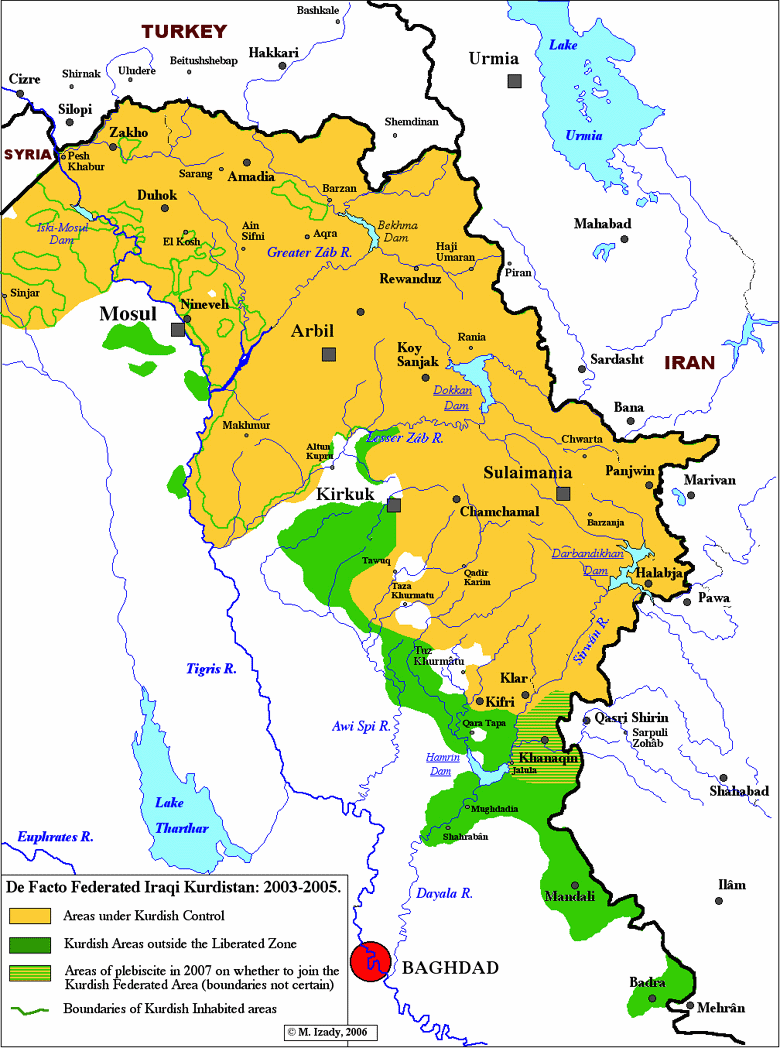
Enter again the Americans. During the Coalition's Invasion of Iraq, troops found themselves quickly overwhelmed with looting, murders, and then an insurgency. US troops, in charge of the northern zone of Iraq, asked the Kurds to keep the peace. And keep the peace they did--Kurdish troops marched south into areas they considered "Arabized" Kurdish territory, and a bit more. The US did show up in Kurdistan eventually, but not until the violence in Baghdad and Anbar started to fall. In the four years' meantime, the Kurds ruled. Their holdings have extended to those of the figure below.


Iraqi Arabs are not happy with this arrangement. Kurds have extended their control to northeastern Mosul and Kirkuk, Iraq's 2nd- and 5th-largest cities. Mosul is a wealthy trading city and Kirkuk a wealthy oil city--and both have lots of Arabs (interestingly, Mosul also has lots of Turkomen). While the Kurds managed to keep much of their territory relatively peaceful, their fighting with Arabs and Turkomen has turned Kirkuk and Mosul into 2 of Iraq's biggest violence hotspots. Mosul, in the confusion of the fray, has become Al Qaeda's last hideout in Iraq. It's a serious security problem.

Maliki sent the Iraqi Army to take back some of the Kurds' southeastern holdings that were pretty unquestionably Arab territory. There has been no civil war yet, but this is probably due only to the persistence of the US--the Kurds' best friends--in levying pressure to negotiate. But the Kurds are frustrated. Cities like Kirkuk were supposed to have referenda on whether they wanted to be a part of the Kurdish Autonomous zone or not--and the vote is now well over a year delayed, and shows no signs of happening. The US is trying to push for a negotiated settlement between the two sides. But Mosul and Kirkuk are likely to become embroiled in fighting no matter which way they go--even if their representatives can reach a deal, Arabs and Kurds in each city believe deep down that the city is theirs and that the other side has taken unjustly what they've taken. It's a mess.

The US doesn't have too long to stay in Iraq, and needs the negotiations to happen on a reasonable timescale--Maliki wants the same, because he knows that the US will back the Baghdad government if the Peshmerga picks a fight with them. The Peshmerga know it, too--but they also know that the US is willing to look out for their interests to some extent if they don't pick a fight with Baghdad--the US and the Kurds are still close friends with a relatively long history. But this explanation predicts that the Kurds would be happy to negotiate, and so far they haven't been thrilled. As the Iraqi Army grows, they will lose bargaining power--the only two rational approachs I can think of are A) negotiating now, while Kurd power is strongest with respect to the Iraqi Army and the Coalition, or B) wait until the Coalition leaves, at which point one would presumably have a boost in advantage. The latter is a dangerous game of brinksmanship that the Kurds must avoid. The former will probably not happen until an oil deal is passed in parliament--and that deal is getting close to 2 years delayed.

The resolution of this Arab-Kurd dispute when the US leaves will likely be the final step in securing Iraq's stability into the future. But failing to do it could undermine the progress that Coalition and Iraqi governments have made. Careful and persistent work awaits US diplomats in the next 2 years.

Tuesday, December 2, 2008

Gen. Petraeus to Put US Forces in Back Seat

Before Mr. Obama takes office on the 21st of January, Iraq is going to go through a fair bit of wrapping up. As the DoD map below shows, all but Baghdad (18 of 19 provinces) will have been transitioned to full Iraqi control soon: according to the DoD September Report to Congress, the ceremonies will all happen in early and mid-Jaunary. Baghdad's ceremony will be in May--though it should be noted that its ceremony has been continually pushed back from October 2008.


With Iraqi Security Forces at the front in all of these provinces, Petraeus is likely trying to train them by fire--US forces will be in the back (notably, taking far fewer casualties than when in the front) provoding logistical support and giving advice. This "school for hard-knocks" is going to get Iraqi forces pretty chewed up over the next few months, but it will mean high-speed learning. So far, only a small percentage of Iraqi military forces are capable of full independent operations--logistics, supply, planning, and execution. Most need planning help from the US. Many need US logistics or even military backup. They must wean this dependence by 2011, or they will falter when the US withdraws.

Another reason for the speedy handover is the terms of the Status of Forces Agreement (SoFA). While US forces don't leave until 2011, they have to get off the streets of Iraqi cities and villages by the end of 2009--during 2010 and 2011, US forces can only act at the behest of the Iraqi government. They will continue to train, but will only get militarily involved when the Iraqis need the cavalry to come in.

The handover involves more than military control. It also signals full administrative control on the part of the Iraqis, with the State Department playing a purely supportive role. With Gates remaining head of the DoD and Petraeus keeping his post as head of CENTCOM, Bush appointees will be at the forefront of Iraq's endgame through 2011 (barring anything strange). Obama and Clinton will have surprisingly little influence over the Iraq situation, as policies being made now (namely the SoFA and handover timetables) have mostly sealed any questions on the remaining US role. This will free up the "team of rivals" to deal with more pressing crises--Afghanistan, Pakistan, and India are the main points of worry.

Thursday, November 27, 2008

Iraq: One Fewer Worry for President Obama

The Status of Forces Agreement (SoFA) has passed Iraqi parliament, with 75% of parliament approving. This sounds like a pretty darn big number, but it's about as low a number as the US can politically get away with--a substantial majority against the bill would give a lot of legitimacy to continued anti-American resistance, continued factionalization, etc.

Iraq's fate is sealed; Petraeus and Gates (locked in for the next while at least) should be able to handle the situation quite well. And with this agreement (which must be finalized by the 3-person Iraqi Presidential Council--it will), Obama has no Iraq policy left to make. He need only say, "stick to the plan, Mr. Gates," and the troops will come home in a timeline he can appreciate. It should be a weight off the new president's shoulders.

But with Russian challenges, Somali pirates, Afghanistan falling apart, and now a major, in-progress anti-US/UK terror attack in India, Mr. Obama needs all the relief he can get.

And now, Turkey.

Saturday, October 18, 2008

The Iraq Endgame

The Iraq Endgame is on. General Petraeus has masterfully used the last 2 years to turn Iraq around from a seemingly-hopeless civil war to a functional--if highly flawed--Middle Eastern state that will soon be ready to control its own security. Mr. Petraeus has also managed to largely immunize his plan from the politics of the US Presidential Election and the US-Iraqi Security Pact, as we can see in the first figure, below.

Figure One: Iraqi Provincial Control

This picture has come a very long way from the mess that Petraeus inherited in February 07, and is right on track with his March 2008 predictions, except for Ninawah (pushed back 1 month) and Baghdad (pushed back a full 6 months). By the time the new president is in office, all provinces except for Baghdad will be under full Iraqi security control, with only minimal US support given. Petraeus is ready for even a hasty withdrawal, or some other form of unfavorable Iraq security pact.


In Iraqi polls, the number of people that feel safe in their neighborhood has shot up dramatically. This confidence is key to finally being able to report to authorities the locations and goings-on of local militias and gangs, which undermine the security of those outside one's neighborhood (which is why those poll number are so very low). If one feels very safe in his own neighborhood, he knows he'll receive protection if he is an informant, or if he stops funding the militias. Without funding or anonymity, the militias will be increasingly easy to track down and break up.

A few very interesting observations should be noted about this poll. First, Anbar is one of the most responsive provinces to the question of confidence in the Government of Iraq (GoI). This kind of poll undermines serious concerns about Anbar citizens being able to accept government hegemony. Basrah has very little confidence, but this is largely due to the power of the Al-Sadr militia there--supporters of the militia are necessarily anti-government, and non-supporters feel largely unsafe, and lack confidence in the government's ability to keep Al-Sadr in check. The very red results in Ninawah and Salad al-Din are more difficult to interpret. I will have to look into it.


Average daily electrical power remains low. Here, I am not sure why the US is not able to use its many hundreds of billions of spending to build some oil-run power plants. It seems a rather simple solution. Any insight from my readers would be appreciated.Here we see the once-infamous security incident trends graph. Particularly low here are small arms attacks--mortar, gunfire, RPGs, etc. This indicates that the Iraqi insurgents have lost their ability to operate openly--they cannot simply patrol their blocks with arms, waiting for Coalition or ISF troops to jump. Anti-government attacks remain somewhat stubborn--this is strange largely due to the fact that Sunnis have largely stopped attacking the government (think Sons of Iraq) and the Shiite extremist groups have a lot of power in the government currently. Either these attacks are by Al-Qaeda and other fundamentalists (which is very possible given the high number of IED and other bomb attacks/removals remaining in this chart), or Shiite gangs in Basrah have stopped fighting each other and have tried to take control of the city instead.


This trend graph is one of the less dramatic--the green line is Iraqi Security Forces deaths, and it's not particularly heartening. 100 or so ISF troops are still killed per month, and that number has been stubborn for months. It's an indication that the dramatic decrease in US deaths is due in large part to the fact that US troops have taken a back seat in security operations. US troop deaths cannot be used as a direct proxy for peace in Iraq. On the other hand, it means that the ISF is growing increasingly competent--if they are taking a larger and larger role in Iraq and their death toll is not increasing, then they are definitionally becoming safer per capita or per operation. Expect to see this number drop a few months after the full handover is complete (probably May). This is probably the most heartening graph in the set. Ethnosectarian deaths are 2 orders of magnitude lower today than they were in December 2006, at their peak. The civil war is just plain over, and the ISF now needs to concentrate on fundamentalist militant groups and Shiite gangs. This is a sigh of relief for the ISF. During the civil war, protecting one group meant giving it a military advantage against the other--there were no clear "victims," and the government was the enemy of most of its citizens--and thus it undermined its own support. But as it eliminates al-Qaeda, confidence in its ability to protect and serve will grow. When that confidence is high enough, it will have the political capital to pressure Al-Sadr and the Shiite gangs to disarm, or finish them once and for all. The Iraqi government is not going to tolerate having its own Hezbollah-style groups running around its southern regions.

Perhaps the most important sign of security success is civilian deaths; reducing civilian deaths (and pain and displacement, etc) is the primary job of the ISF, and deaths are probably an excellent proxy for all the bad stuff. Current monthly civilian deaths are 1/7 their peak, and are not as stubborn as the ISF death numbers--that is, they have declined int he last 6 months. This means that the ISF is improving the security of its citizens as it takes over, while simultaneously not losing more men per month.

We should note that confidence lags security significantly--and why shouldn't it? When one has lived in civil war and terror for years, one is not going to jump on reports of a quiet month and decide that everything is okay. By the time the new president is in office, though, confidence in the government's ability to keep Iraqis safe is likely to be much higher. When that happens, Iraq will be ready to run itself--it is still a highly flawed country, but when people begin to feel safe, they can return to normalcy, and the government can more easily address the non-security needs of its nation. This is the endgame. We must now see how cheaply and quickly we can take our leave.

Wednesday, September 24, 2008

Tracking Iraq's Progress

So a few things are going on (or, rather auspiciously, not going on) in Iraq that are worth mentioning.

Mention the first: Elections are coming! Parliament has given the thumbs-up to a key election law which will bring a re-shuffling of parliament and local leaders. If all goes to plan, the Kurds and Sunnis will have higher representation and slightly more autonomy, which should cool some serious worries by Sunnis and Kurds about Shiite domination. The one downside is that little is likely to get done if elections become proportional.

Mention the second: Anbar is being handed over slightly more quietly than expected. While there are some ethnic tensions and apparent abuse by Shiite police/military upon the Awakening Councils (likely in an effort to try to assert central government authority in the region), the Awakening Councils exist precisely to buy into the national system. They are likely to try to use the system itself to state their grievances, and compromise with the central government as the handover process becomes more complete.

Mention the third: Casualty rates continue to drop. Below, I've made some graphs from icasualties.org data of casualties since the start of the Surge:


In the first, we see that civilian monthly deaths are down by over an order of magnitude since the beginning of the surge, and are continuing to decline despite the fact that the Surge ended in July and most of the Surge troops went home. This is an early indication that the rate of decrease in violence is now relatively independent of numbers of American troops. This could be for a number of reasons: increased effectiveness of the Iraqi army/police (probably a big reason, in reality), political reconciliation and increased economic growth, increased civil services (like trash collection and water delivery), and a "positive spiral" of security (where now-secure people stop funding militant groups that are promising local security, thus weakening the very same militant groups that are decreasing security for others). But it's a very good sign, seeing as the Iraqis are kicking us out by 2011--we should well be able to go home and leave a very stable and prosperous Iraq; and with the election laws in place, it will even be a functional (if somewhat flawed) democracy. This would constitute a win (if an expensive one) by almost any standards.


This second graph only includes coalition casualties to make them easier to see. Deaths and wounds are both down dramatically, but wounds are decreasing much faster than deaths--in fact, in September (so far, I suppose) there have only been 40 wounds but 20 deaths, meaning that every other soldier wounded also died. In February 2007, it was only 85 out of 520, less than 1/5 of all wounded. This indicates a few things:

1) Violence is dropping faster than it appears from the most obvious metric, which is coalition deaths.
2) Attacks on Coalition troops are fewer, but more deadly, which is likely due to the fact that Coalition troops are fighting Al-Qaeda militants in higher and higher proportion--their attacks are likely more targeted and deadly than a quick squabble with sectarian militants.

I need to look more into the actual development of the Iraqi Army to be sure about the stability or this security progress, but I'll get to that later.

Monday, September 1, 2008

Anbar Handed Over


The US handed over Anbar province today, with great pomp and circumstance, in hopes of parading the success of the Sunni Awakening Councils, the Surge, and overall US efforts over the past three years. This is the 11th of 18 provinces, and was once the bloodiest.

While it is a triumphant sign of progress, worry remains in the next few months. The Sunni Councils may be used to their autonomy, and may be averse to being ruled by a Shiite-dominated central government. An influx of mostly-Shiite Iraqi troops may cause sectarian tensions in the region, that would derail the mopping up of Al-Qaeda in Iraq.

Elections are coming in October, and Sunnis are quite unlikely to make the same mistake as in 2004 when they boycotted the election. But the elections will bring a dramatic change to the Iraqi parliament--total Shiite domination will end if the election goes as planned. If Shiites get too worried about this, violence may flare beforehand, and Al-Qaeda is sure to be planning attacks for the weeks before and day of the election. The next six weeks will be pivotal.

Wednesday, July 30, 2008

Well, Maybe the Surge is Working

On today, the last day of July in Iraq, the US troop death toll has rung to 12, after
Staff Sgt. Faoa L. Apineru died of a wound suffered on July 2. If this holds (barring some terrible event today or wounded soldiers dying later), it would be a death toll less than 2/3 of the previously lowest month in Iraq (May: 19 deaths). So the by-far two lowest death tolls since the beginning of the war have been in the past 3 months, and this most recent one has come after the end of the surge.

Recorded Iraqi deaths are also at an all-time low: 393 (lower only than June, at 450, which was lower only than May, at 506). A pattern is emerging, and it's one of steadily, reliably increasing security and safety.

It is thus time to face a simple fact down a dark alley that most of us have been trying to avoid: The Surge worked, General Petraeus is not an unpatriotic, treasonous Bush lackey, and the Iraq war is winnable.

Now, Mr. Obama's campaign boat has a lot of wind behind its sails right now, because even Mr. McCain is agreeing to the sixteen-month timetable for withdrawal. This vindicates Mr. Obama, right? He was right all along?

No, not at all. Mr. Obama has spent the entire surge saying that it was not working. In July, his website was smart enough to remove his consistent, zealous opposition to the Surge from their Iraq page, but he has not come out to say that it has worked. Does he still think that it hasn't? Or is he simply as stick-to-your-guns consistent in his ideological stances as Mr. Bush?

Mr. Obama has not only opposed the surge since the beginning, but his 16-month withdrawal plan came around not because of successes in Iraq. His withdrawal plan has been the same, from the absolute worst conditions in Iraq (in 2006 when the violence was over 10 times what it is now) to today. The 16-month timetable was a strategy for easy defeat, not one for actually winning. But, quite luckily for Mr. Obama, he was wrong about the surge. His being wrong about the surge makes his 16-month timetable look entirely reasonable, as long as you are not willing to think about it too hard.

Unfortunately for the future of US foreign policy, Obama's political stars-and-moons lining up is nothing but luck, and has absolutely nothing to do with his ability to make judgments and decisions as Commander in Chief. He was wrong--and still is wrong--about the Surge, and his being wrong about the Surge is the only reason his years-old 16-month withdrawal timetable looks like anything more than a bloody white flag strategy. His policies and stances have not changed at all, regardless of wildly varying conditions in Iraq. This would mean an even more inflexible and ideological foreign policy than that of Mr. Bush, who was at least smart enough to consider Mr. Petraeus' plan for changing strategies.

But, even more unfortunately for the future of US foreign policy is that the McCain campaign camp is completely incompetent, and will not be able to capitalize on this glaring flaw in Mr. Obama's shining moment. If they can't, then Mr. Obama will win this election, and the American people will spend at least four years knowing that they truly had no idea what they meant when they spent the last 8 years complaining about idealistic and inflexible foreign policy. I have yet to see an Obama foreign policy point that shows any shred of good judgment or consideration for earthly realities, particularly in regards to military matters.

Tuesday, July 22, 2008

Iraq Goes to Obama

Months ago, McCain called on Obama to go to Iraq to educate himself on the ground situation, in a mark of criticism against his 16-month withdrawal plan. He probably hoepd to put Obama in a double-bind: if Obama did not go, he could be painted as ignoring facts. If he did, he might be painted as admitting ignorance.

Obama went with the second option, and the plan has backfired for McCain in ways he could not have previously imagined.

Contrary to my previous thoughts on the subject, it looks like Bush and al-Maliki are actually in a very deep row over the status of American troops in Iraq.

Obama has visited Iraq, and met with Gen. Petreaus and top Iraqi officials. In open acknowledgment that "the Surge worked," the Iraqis have shortened their proposed timeline from 2012 to 2010--right in line with Mr. Obama's 16-month withdrawal plan. The quick change is a bit surprising, but it's possible the Iraqi government is actually trying to use its own fate as a bolster for Obama (Mr. Obama has found himself quite a warm welcome in Iraq so far, and they may be looking forward to 8 years of working with him). In addition, a photo-op by General Petraeus' side is just what Obama needed to extend his run to the center.

The last few days have been a crippling defeat to McCain, whose Iraq policy centered on being a practical solution for Iraqi security, even if it was tough on Americans. But now, with the Iraqis siding with Mr. Obama, even McCain has to give a bit: he has admitted he could imagine US troops in Iraq for only 2 more years.

Now Mr. Obama has won the initiative on foreign policy--an area that he has seemed weak, before. Such a victory is likely to win him key undecided moderates and make Mr. McCain's bid for the White House become a long shot.

Obama's race towards the center is likely to work for him, as long as he is able to shake from his tail his involvement with the American ultra-left:

Monday, July 14, 2008

Obama and McCain's Delicate Dance with Contradiction

Obama's line about Iraq has been: It is a failure, a disaster, and the Iraqi Army will be on its feet next year, and the country will stable--we should pull out as soon as possible.

McCain's line about Iraq hs been: It is a slow, tough success, and the Iraqi Army will be on its feet next year, but it's not ready, won't be ready for a long time--let's wait to pull out.

The arguments for each of them have self-defeating qualities. For Obama, insisting that Iraq will stand and that the Iraqi Army can take over during a 16-month pullout defeats much of the punch in his claims that the war has been a disaster. He admits serious success and progress in saying that the Iraqi Army will be able to take over next year, and hampers his own ability to criticize the Republicans.

McCain, on the other hand, contradicts his own calls for an extended stay by saying the situation is good and improving, that there has been success. Why keep the troops there, if the Iraqi Army is almost ready to go? McCain's stance is a bit more "flexible--" he wants to keep troops there "based on conditions," but this largely means he is largely dodging the problem of having a position altogether.

And Obama, of course, is sticking to his timeline, even before meeting with Iraqi commanders. McCain refuses to have a solid answer, and Obama is back to refusing to alter his based on pretty much anything.

Maybe that's why the Iraqis are taking matters into their own hands.

Tuesday, July 8, 2008

Iraqi Timetable May Be More Than it Seems

The Surge is ending: The final brigade is on its way out of Iraq right now, after tremendous security success. For the next few months, we will have to hold our breaths and see if the situation keeps improving with fewer forces.

The Bush adminsitration has wanted a "long-term" US presence in Iraq, including permanent bases (like in Korea, Japan, Germany). Al-Maliki, the Prime Minister, has suggested a counter-proposal: A withdrawal timeline. At first glance, this would be a crippling defeat for George Bush, vindicating all of his political opponents that have been demanding such a thing for years.

But more likely, it is a compromise proposed by the administration itself, after realizing that permanent bases were not feasible. If Al-Maliki told Bush "we don't want permanent bases, and even if I did, I couldn't make them happen," then a withdrawal timeline is the immediate second choice.

Al-Maliki mentioned that the timeline would stretch until 2011 or 2012--2 or 3 years into the new presidency. At this point, I think most people in the administration are betting that Obama is going to win the election, and are hedging against him. That, or they could be trying to defeat him.

Stealing the initiative: If the Administration agrees to a 2012 withdrawal timeline and Obama wins the election, he will be hard-pressed to implement his 16-month withdrawal plan, given a previous treaty arrangement with the Iraqis (which he is bound by the Constitution to obey). If the Bush administration's war thinkers are worried about a speedy withdrawal, setting their own timeline with the Iraqis is the best way to prevent it.

Influencing the Election: This move has clear implications in the election that Obama will have to deal with very carefully. He could be caught in a double-bind. If this timeline agreement goes through, Obama will have to choose whether or not to dramatically change his policy. Should he obey the timeline, and try to delicately drop his 16-month withdrawal plan? He might draw serious criticism for flip-flopping, discourage his base, or lose his anti-war cred with moderates. Or should he defy the treaty, and stick to the plan? The Republicans may try to snatch moderates back by calling him out-of-touch, idealistic, unwilling to deal with reality, ignoring international treaties, etc. This timeline may make his Iraq stance an automatic liability, which is definitely a win for an administration that wants someone who is going to stick closer to its foreign policy aims into the future.

Whatever is happening, it is likely very thoroughly-thought long-term planning by the Bush administration. Al-Maliki is a close enough Bush ally that he almost certainly would not publicly request a request for a withdrawal timetable unless it had been already agreed-upon (or unless the administrations were at a deadlock, but it does not appear so at all). And, having been already agreed-upon, the intuitive thing for Bush to do is announce it himself, to show the public he is dedicated to changing his policy with changing times. But he gave the initiative to Al-Maliki, allowing the US press to call it a defeat for him. When he agrees to the timetable, it will appear as if he "caved to pressure." This is exactly what he wants. If it looks like he fought this timetable tooth-and-nail, then the Democrats will be politically forced to rejoice when he signs it, and won't be able to criticize it. Bush, once again, is going to get (almost) what he wants, despite a Democrat congressional majority. Sometimes, Bush is more clever than most give him credit for, and it is this very reputation for lacking subtlety that will allow him to outsmart the Democrats in congress once again.

Sunday, July 6, 2008

The Iraq-Afghanistan Contradiction

Most of the country still supports a withdrawal from Iraq on a very short timescale. Most of the country also has rather ambivalent leanings towards staying in Afghanistan "until the job is done." Why?

Iraq has shown serious progress for the last year--violence is more than 80% lower than when the surge started, the Sunnis in the west are our closest allies, Al-Qaeda in Iraq is being obliterated by the combined Sunni Awakening, Iraqi Security Forces, and Multinational Forces. The government is making slow political compromise progress, and more is likely to be made after the fall elections equalize representation in parliament. The Iraqi Army's stand-along capabilities are increasing... but the majority of forces still need training. The Iranians are finally starting to help curb the violence among Shiite militias. The American people support withdrawal.

But at the same time, Afghanistan is an increasing disaster. More and more American troops are dying each month--last month, 40 died, compared to 29 in Iraq. The Taliban's /Al-Qaeda's virtual safe haven in Northwest Pakistan makes it impossible for US troops to competently fight them; if the Pakistani government continues to be as unhelpful as they have been since 2001, there is little that US and Afghani troops can do to stifle the growth of the Taliban except try to invade Pakistan's northwest. Without help from Pakistan, this venture is becoming a complete waste of time, and a useless shooting ground for American troops. Americans support staying.

Do we think Pakistan is going to buck up and start fighting the Taliban soon? Or are we, as Americans, so wrapped up in our preconceived notions of morality that our military presence does not depend on results? The military situation in Afghanistan is bad, and getting worse--and there is little our military can do about it without violating Pakistan's sovereignty and possibly setting off another war. But in Iraq, our troops and General Petraeus have shown that smart leadership and good policy can lead to lasting results. Iraq's economy is booming, and its people feel increasingly safe. The end of a US presence in Iraq should come when the Iraqi Security Forces are able to operate independently to keep the security that the US has gained. The end of the US presence in Afghanistan is the one that shows "no end in sight," with a situation slowly and painfully degrading into oblivion.

So why the inconsistency?

Sunday, June 15, 2008

A Busy Week Abroad

With the US major party noiminations intact, Mr. Obama and Mr. McCain have been presented a number of opportunities in the last week in which to differentiate themselves:

The Irish rejection of the EU's complicated Lisbon Treaty suddenly means that the European Union is likely to be significantly weaker and more confused than either party could have predicted it would be in the next few years. This gives either president a much freeher hand to pick-and-choose among which EU leadership it wants to embrace. Though the very cozy relationships between Bush and Merkel, Sarkozy, and Brown mean that both Mr. Obama and Mr. McCain are likely to get along with all of Europe's power players unless they try something radical.

Karzai is threatening to send troops across the Pakistani border into the Northwest Frontier Territory, where the Taliban and allied insurgents are operating largely unmolested--far too sparse for the Pakistani Army to take head-on, and too large for government-allied Militias to decisively defeat. The Pakistani government is likely to view this with great hostility, particularly given their distrust of the Bush-Musharraf alliance, as well as anger over the accidental US bombing of 11 government-allied Militia soldiers. Pakistan is likely quite border-sensitive, and a tough-talking Afghanistan unconcerned with Pakistan's territorial sovereignty, along with a US that is bumbling diplomatically as well as militarily in its war against the Taliban, may eject Pakistan from the US informal anti-terror alliance, even if the ruling DPP hopes to eradicate the Taliban. McCain's passion for the War on Terror is likely to cause him to put on a diplomatic blitz with the DPP in Pakistan, in hopes of creating some sort of military cooperation in the northwest--Pakistan's army has been all but useless in the region. Mr. Obama is likely to take a less direct approach, hoping to create a sense of brotherhood and goodwill, hoping that military cooperations will come in time out of a friendship. Either way, both will have to choose their way of holding on to Pakistan.

In Iraq, the Iraqi Army seems to be confronting its last great security challenge: Shiite Militias, mostly Al-Sadr. In its 4th such operation in the year (the first three in Basrah, Sadr City, and Mosul), the Iraqi Army is moving troops into Amara to gain security control, though locals say the militants have already fled. While ethno-sectarian civil war is all but history, and as Al-Qaeda in Iraq continues to be ground down by American troops and government-loyal Sunni militias, Shiite militias battling for supremacy in Iraq, as well as their resistance to continued US presence in Iraq, stand as the last great pillar of unrest in the country. Petraeus' optimistic timeline for transferring the other 9 provinces of Iraq by the beginning of 2009 looks like it will be delayed by at least a few months due to violence, though Qadisiyah will be handed over in July, on schedule. Obama and McCain look to stand firm on Iraq; Obama continues to plan to pull one brigade per month until (almost) all US troops are out of the country, where Mr. McCain hopes to establish a long-term US presence in Iraq, like its presence in South Korea, Germany, and Japan. Negotiations for US bases in Iraq are faltering, though, and Bush may drop the ball completely, giving McCain few options but scrambling in this goal. The executive branch of the Iraqi government continues to support some US presence in Iraq, and worries about relapses in security in a quick American pull-out scenario.

With Chinese talks with Taiwan going extremely smoothly, a Taiwan Straits crisis is unlikely to emerge in the next presidency. In fact, the ruling Taiwanese GMD is unlikely to purchase much in the way of arms from the US, in hopes of relaxing military tensions with the Chinese. Furthermore, an earlier visit from Hu Jintao to Japan, as well as a deal on an oil dispute in waters between China and Japan, have led to greatly reduced tensions between China and the long-time American ally. With China increasingly getting along with US allies in East Asia (including South Korea, where protests to ban US beef imports are turning violent), the US is going to have few bones to pick with China besides economics.

Mr. Obama has mentioned regulation to try to stem outsourcing and the trade gap, which may hurt the Chinese market and create irritations that Mr. Obama will have to massage quite a bit. Mr. McCain's more free-trade policy is likely to keep hot economics between the US and China, but he will face increasing pressure over the trade gap, and is likely to take a tough stance against China for human rights issues, as well as spying (especially information attacks against the DoD). Both are likely to irritate China some, but China's "strategic partner" view of the United States leaves room for minor irritants if the long-term prospects look good. Hopefully, both are open to engaging a China that is likely to surpass Germany and Japan as the second-largest economy in the world by the time their first term is through.

I will write a full article on the differences in the two Senator's foreign policies, and what that means, later (when I get more time). For now, some statistics from Pollster.com on support for each candidate nationally and in swing states:

National:
Obama: 47.4%
McCain: 46.2%

Ohio:
Obama: 43.6%
McCain: 43.4%

Pennsylvania:
Obama: 45.9%
McCain: 41.3%

Virginia:
McCain: 46.5%
Obama: 43.1%

Iowa:
Obama: 44.9%
McCain: 39.9%

New Hampshire:
McCain: 45.1%
Obama: 43.3%

Florida:
McCain: 47.4%
Obama: 40.1%

Maine:
Obama: ~50%
McCain: ~38%

Michigan:
McCain: 42.5%
Obama: 42.0%

Missouri:
McCain: 44.5%
Obama: 44%

Sunday, June 1, 2008

Iraq is Very Quiet

You know what hasn't been in the news in the past many weeks? Iraq. I'm sure you can guess exactly why:

That's right, because there's nothing bad to report. Finally, today, BBC published an article (which hasn't made the front page), noting that coalition troop deaths in May were their lowest since the war began in 2003. Civilian deaths have dropped by half from the months of March and April--much of this is due to a truce signed with Al-Sadr and other Shiite Militias. I'm not sure it will hold, but every day of calm gives the Iraqi government more time to solidify its daily civil functions--power, water, trash collection, etc.

Elections in the fall will be critical--whether they lead to better power-sharing in the government (the Sunnis have been underrepresented due to their own boycott) or to voilence as Shiites try to resist losing power is unsure.

I don't have too much analysis about these figures that I haven't already given you before. But in this particular post, I just wanted to report the news as I've seen it, because CNN sure as hell won't.

As a post-script, icasualities is a pretty reliable source for death trends in Iraq, should you want it: http://icasualties.org/oif/

Wednesday, April 16, 2008

Al-Qaeda in Iraq: Resurging or Going Out with a Bang?

There are two very different fights going on in Iraq right now, in particular since the end of the Sunni-Shiite civil war a year ago: an internal Shiite struggle for dominance (largely in Basra and the Sadr City suburbs... today, fighting killed 11), and a consolidation effort to eliminate Al-Qaeda. Today, we're focusing on the second.

In my last post, we saw a promising graphic of decreasing Al-Qaeda presence in Sunni strongholds that it has held onto for years, especially in Anbar and Baghdad. But recently, suicide bombings are making a comeback in Iraq, and just two days ago, 60 were killed as coordinated car bombs ripped through the country. Does this information contradict Petraeus' report? Is Al-Qaeda making a comeback?

I must first admit that I don't actually know the answer. Al-Qaeda could in fact be making a comeback; Petraeus could be wrong or just plain deceptive. More likely, based on some circumstantial evidence, Al-Qaeda is going out with a bang. Like a star going supernova, radical groups often make the most trouble when they are desperate. And it should be noted that even an extremely weak Al-Qaeda can set of car bombs in cities; Iraq remains a place where access to old Soviet weaponry and explosives is high; a group of five dedicated individuals could certainly still create chaos in Iraq, if they were not caught beforehand. This is quite telling of the prolonged danger in Iraq even if Al-Qaeda is eliminated, but is not particularly telling of Al-Qaeda's state.

A letter found in an joint MNF/Iraqi Security raid may be telling of Al-Qaeda's struggling state. The letter speaks to the importance that Al-Qaeda militants must impart to keeping their enemy in "psychological conflict," so that they "will not all unite against us." Al-Qaeda in Iraq should surely be worried about such a unity; it would lead to an Iraq where Al-Qaeda is not welcome. But random bombings, particularly targeted against Sunnis and Shiites alike, may well have the opposite effect. The bombing of the Golden Mosque was a brilliant tactical move in trying to divide the Sunnis and Shiites (and led to a year of massive bloodletting), but the most recent bombings all over Iraq are crude, random, and have the footprint of Al-Qaeda in Iraq all over them. The Iraqi and US governments are having a very easy time identifying Al-Qaeda in Iraq as the likely culprit, and there is no way such a bombing is going to bring a "psychological conflict" to the Iraqis--it is more likely going to unite them against a common enemy that is indiscriminately killing Iraqi civilians. Such sloppy tactics are indicative of an Al-Qaeda acting desperately and rashly, hoping to simply create as much chaos as possible in hopes that it will disrupt anti-insurgent operations that seem to have increasing success.

The second very interesting part of the letter is that it urges militants to not speak to their wives or families about Al-Qaeda operations; apparently, sloppy intelligence hygiene is giving US anti-insurgent operations a leg up in finding and raiding Al-Qaeda strongholds.

The final interesting part is the emphasis on attacking American-backed Sunni militias. During the civil war, these Sunni militias were anti-American and were soft allies of Al-Qaeda, as both were bent on disrupting the government and driving out the Americans. But now that the "Sunni Awakening" or "Sunni Renaissance" has occurred, Al-Qaeda's traditional strongholds are turning into hot zones. Al-Qaeda has no hopes of winning back wide support among the Sunnis (and will certainly not get it among Shiites or Kurds), but wants to quell Sunni attacks using terror tactics. But as the Sunni-Shiite civil war shows, attacking civilians (particularly, indiscriminately) will push the Sunnis even further away. Al-Qaeda is adopting a "Full Adversary" strategy; that is, making all elements of the populace and government an enemy. Given this, its ability to find sanctuaries in Iraq is likely to only shrink with time.

Sadly, this supernova effect is going to mean continued civilian death and carnage. But it will solidify Iraq's unity against Al-Qaeda, and lead to a stronger front to drive them out.

Wednesday, April 9, 2008

Petraeus' Great Iraq Update

On April 8th and 9th (with lots of pomp and circumstance thanks to the presence of all three presidential candidates, trying to show off for the press), General David Petraeus gave his Great Iraq Update to Senate, discussing progress and future strategy. Released to the public was a handout that each Senator received, and I humbly present my analysis of some of the better graphics from it.


Because I am a geopolitical wonk, I keep coming back to the Iraq Provincial Security Transition Assessment Map (or Provincial Iraqi Control Map). As we can see, some interesting progress has been made. Half of all Iraqi provinces (9/18) have been handed over, though the handover process stalled after 2007. In July, the third-last Polish-led province of Qasidiyah, as well as the once-restive province of Anbar will be handed over. Anbar's "renaissance" will be completed in July, and the Bush Administration is likely to hold it high as a sign of success in Iraq.

Interestingly, there seems to be no politically-motivated rush on the part of Petraeus to hand over other provinces; six provinces are going to be handed over immediately after the US 2008 election, if they are handed over on time. Petraeus may have been able to stack some of these provinces in a lump October 2008 handover to try and influence US voters to elect a more pro-occupation candidate like John Mccain, but has opted not to, presumably in favor of a more militarily sensible strategy.

Interestingly, all provinces but Tam'im are scheduled to be fully handed over to Iraqi Provincial Control by the time a new president is sworn into office. In doing so, Petraeus is able to (intentionally or not) preempt any new president's Iraq strategy by sealing the United States Military's fate as a secondary force in Iraq by 2009. The post-handover provinces in Iraq have not all been perfectly peaceful--the recent violence in Basrah has been an embarrassment to the possibly-hasty full UK pullout--but ethno-sectarian violence remains low (despite a small spike), and Al-Qaeda seems to be losing ground. Continued handover, despite March's spike in violence, looks like it will progress smoothly.


The next gorgeous chart here is ethno-sectarian violence in Iraq (this measures only deaths by inter-sect rivalries, rather than Al Qaeda bombings or Al-Sadrite militia spats with the Iraqi Army). As we can see, Iraq has passed its "civil war" stage of 2005-2007, and remains in a state of tough pacification and unification. Whether ethno-sectarian violence remains quite this low after a US drawdown over the summer remains to be seen, but political progress is slowly and painfully being made. More importantly than parliamentary benchmarks, perhaps, is Petraeus-led integration of Iraqi Army and National Police units into communities, mirroring the integration the Petraeus implemented with US troops. Such an integration provides a stable security base (lowering the incentive to support militias for one's street-side security) and also a friendly and helpful grassroots face for the government (increasing civilian support of its continued success). So while critics point to a strikingly slow development of nationwide laws that are meant to bring long-term stability, the ubiquitous-police society developed, especially in Baghdad, is likely to maintain stability in urban centers as the government continues to try and reconcile political differences.

McCain called Baghdad life "more or less normal" in a recent speech, and these graphs are the best evidence we can get to support such a claim. Assuming these graphs are not designed to intentionally mislead, Baghdad now looks more or less like a large American urban center in its ethnic violence density. Nationwide ethno-sectarian deaths remain at about 200 per month, or 2400 per year, which is about 8.2 ethno-sectarian deaths per 100,000 people (the US homicide rate is 5.6 per 100,000 even though this is a pretty poor comparison). Again, this doesn't include suicide bombings or the recent Mahdi-Iraqi Army fighting. On that note:


The MNF Coalition estimates about 300 total civilian deaths last month (12.3 per 100,000 per year), and Iraqi data estimates about 750 total civilian deaths last month (projecting to about 21 per 100,000 pear year); both estimates are higher than political scientists would see as sustainable and acceptable for a stable domestic society.


Finally, the last image is the most promising, if it's accurate. Even if Iraq does not become a fully stable and and pro-American society any time soon, Al-Qaeda remains the United States' enemy number one. To leave Iraq as a safe haven for Al-Qaeda would be a total military failure of the operation, regardless of any other political or military progress in the country. It remains the United States' moral obligation to clean up the mess created in Iraq by its overthrow of the Hussein regime, but it remains the United States' primary security obligation to eliminate Al-Qaeda at all corners, and deny them all possible havens. Progress in eliminating Al-Qaeda in Iraq since the Surge strategy has been stark.

Completing a rooting-out of of Al-Qaeda looks within reach. Continued progress on bringing political reconciliation, military stability, and delivery of daily necessities to the Iraqi people will create a sustainable country in which Al-Qaeda's destabilizing presence will not be tolerated.