Showing posts with label Kurdistan. Show all posts

Monday, September 3, 2012

Blog Link: Smoke Filled Room's Take on Turkey's Kurdish Strategy

I found particularly fascinating here the insight on how Turkey is working together with the Kurdish government of Iraqi Kurdistan to try to gain influence over bordering Kurdish regions, particularly in Syria--in hopes that it will be able to better deal with the ongoing Kurdish crisis in its own south.

http://thesmokefilledroomblog.com/2012/09/03/biting-off-more-than-you-can-chew-turkey-syria-and-the-pkk/

Smoke Filled Room does not think, though, that this is necessarily the best idea.

Friday, August 17, 2012

The Syrian Uprising Part IV: Options for Foreign Intervention

Alright: time to pick up right where we left off. Luckily, the timing is good for The Syrian Uprising Part IV: Options for Foreign Intervention.

The outcome of Syria's bloody civil war has powerful implications for the regional balance of the Middle East, and the influence of great powers in the area. Besides simple humanitarian impulses, states with the power to intervene certainly have the interest to do so. Over the past 6 months since last posting, we've seen little in the way of overt action compared to the Liby aconflict, but we have seen a fair amount of diplomatic and covert movement that reveals the motivations and intentions of different states. We'll take a look by state:

Turkey:
Turkey has bet far and away the most on the victory of the Free Syrian Army, openly providing weaponry, sanctuary, and intelligence to the movement. Turkey is waging a very explicit proxy war on Damascus, and is willing to invest the capital and risk to win.

Turkey's motivation is part of a larger strategy to establish dominance over the region. After rejection by the European Union, Turkey turned back to the Middle East, an area that it dominated for hundreds of years until its defeat in the First World War. Turkey's economy and military strength have grown as it has liberalised and accepted foreign investment--at the same time, many of its traditional rivals have been torn by internal conflict and strife (Egypt, Iraq, Syria). Iran remains as its primary rival (Saudi Arabia has great influence as well, though the Sauds are currently in an uneasy alliance with the Turks against Iran), and dismantling the Iranian-backed Assad regime would be a huge blow to Iran's regional power (as an added bonus for Turkey, Iran would lose key supply lines into Lebanon to support Hezbollah). Additionally, Turkey hopes to ally closely enough with the Syrian Opposition that it is able to bake its influence into the formation of a new government.


Really, Turkey has a lot to gain and little to lose--even if the Assad regime should win, it doesn't have the means to retaliate against Turkey (it does not have the influence in the PKK or the financial/military means left to make the Kurds a more serious problem for Turkey). 

The United States:
The US is currently very aligned with Turkey's goals (dismantling Hezbollah and dealing a blow to Iran), so it's allying with the Turks when it might otherwise be quietly trying to make sure that Islamism/Jihadism doesn't take over Syria. The other note about US behavior is that it is trying to set itself up as a long-term "good guy" in the Middle East, and it sees supporting the Arab Spring as a way into the hearts of the inhabitants of the region (in particular, it was "burned" for supporting the Mubarak regime too long in Egypt and doesn't want to repeat that mistake).


Secretary of State Clinton is currently working with Turkey to determine whether it's going to use fighters in a No-Fly Zone over Syria, making US intervention in Syria extremely similar to its work in Libya and neutralizing Assad's jets and attack helicopters. The move would also allow similar scope creep to the Libya mission, in which NATO air units attacked tanks and other ground installations in Syria (under the guise of protecting their own assets). 

Currently, the US is nearly certainly using the CIA to conduct covert operations to support the rebels with advice and intelligence. The CIA is unlikely involved directly in the fighting, but would be able to coordinate airstrikes if Turkey and the US decided to launch their air power in the area. This kind of support could be a turning point in the war, just as it was in Libya. Aleppo would become the temporary "capital" of the opposition, just as Benghazi was. 

Additionally, the United States and Turkey are actively and publicly discussing the Syria "post-game," should the regime fall (which Turkey and the US are at least calling inevitable). This open discussion publicly declares that the US will be helping Turkey extend its influence into Syria in order to stabilize it and make it relatively friendly... without the US needing to get caught up in the dirtier details of the operation.

The Arab States:
The OIC (Organization of Islamic States) has booted Syria from the group over its response to the uprising, and the Arab League has called on Assad to step down. Much of the reasoning here is likely to show their own people that they don't support oppressive regimes (as this would likely spark unrest in their own states), but many of the Arab League states (Iraq, Kuwait, Saudi Arabia, Oman, Qatar, and Bahrain primarily) have a similar desire to see Iran weakened. 

Saudi Arabia and Qatar have openly declared that they are arming and funding the opposition. They have the option to become further involved if there is external military intervention. These two states represent the Arabs' most concerted efforts to be able to exert influence in a post-war Syria, in part to keep Turkish influence limited.

Iran:
Iran's motivations are made clear by the behavior of its enemies, above. Iran currently feels ganged-up-on. It is. Iran is short on "legitimate" allies and Syria is one of its last. Iran would lose almost all influence in the Mediterranean if Syria fell and was replaced by an unfriendly regime (which would be almost certain). 


Iran has stood by Syria throughout the civil war, and will continue to do so until the end. Because there is essentially no chance of an Iran-friendly regime arising in Syria, Iran does not need to hedge its bets--it is all-in with the Assad regime.

To that end, Iran is providing Syria with what weapons and funding it can to keep the regime together. Odds are good that Iran has also sent black flag militias to supplant Syria's more regular forces. Iran's best hope is a crushing victory in Aleppo that gives the government an opportunity to get its feet back under itself.

Russia:
Russia has a naval base in Syria and thus a great deal to lose if an unfriendly regime should arise--Russia's support of the Assad regime so far would make this likely should Assad fall. While Russia does not depend entirely on Syria for Mediterranean access (it has Sevastopol in Ukraine), it is a key port by which Russia remains relevant in the Middle East. 

Russia has stopped providing weapons to Syria (it was previously), but it has deployed warships to the area. These ships are unlikely an attempt to stop a No-Fly Zone--US and allied fighters would launch from Syria (rather than the sea), and any attempt at an air war with US forces would end quickly and badly for the Russian military. More likely, these ships are in part symbolic, in part designed to defend the base should it come under attack, and in part a means of evacuation for Russian troops and Syrian VIPs, if necessary. Unlike the US, Russia almost certainly cannot field forces directly in the area--while the US would be halting the sorties of an unpopular regime, Russia's only options are to attack civilian populations.

Russia's best hope to keep the Syrian regime alive is to use diplomatic pressure to prevent direct US/Turkish intervention. There is a fair chance that the Syrian government's current siege in Aleppo could break the back of the opposition, given no direct military attacks on the forces that give Assad an advantage--namely, major hardware. 

Israel:
Israel's best move in the short term is to hold onto the Golan Heights and otherwise stay out of the war. It obviously has a great interest in seeing Hezbollah lose its primary sources of support, and to see a major weakening of military strength in its north. 

The greatest risk of any Israeli movement (or comment) on the matter is diplomatic: new regimes with Islamist influence (Iraq, Egypt, Libya) are still figuring out how they'll interact with the Israeli regime, and Israel's primary strategy with these states is to give them every reason to be friendly.

In the post-game, the biggest risk for Israel will be the potential proliferation of chemical weapons into the hands of Jihadists that are part of the opposition forces. Israel is preparing to enter Syria if needed to secure them. Ideally, this would be left to Turkey or one of the Arab states, but Israel would be willing to take the diplomatic blow in order to make sure these are safe. 

China:
China's primary motivator will continue to be (as it has been since the Civil War) the preservation of the right of the state to manage its internal affairs. China has little interest in the Assad regime directly, but we'll see it continue to oppose direct foreign intervention, because China sees the conflict as internal, and therefore not something which other states have a right to interfere with. Historically, this is important for China because of its "Century of Shame," where foreign domination had China on its knees until the Communists won the civil war in 1949. China's own need to potentially deal harshly with internal unrest, as well as a simple historical sense of insecurity, make its position on the Syria matter fairly straightforward. 

International Jihadists:
Foreign fighters have flooded quickly into Syria, hoping to take down the largely secularist Baath party and influence the installation of an Islamist or Jihadist government there. Currently, despite regional and Western fears of Jihadist influence, they only have serious power in Somalia (elsewhere, they are a frustration for individual states but are not in control of any real resources), and Syria would be a win that could set up a second base of operations. Frankly, Turkey and Israel are very unlikely to stand for it, and will likely intervene further if there is a Jihadist takeover.


It's worth keeping in mind that regime change would have long-term implications that not all actors may be considering as closely as they should. If we cite George Friedman's The Next 100 Years, he predicts that Turkey will successfully expand its influence throughout the Middle East (and eventually the Balkans) to become the United States' primary rival. To support Turkey's relative takeover of Syria would hasten that--or at least make it more likely. Additionally, the promotion of the legitimacy of outside intervention in regime change may come back to haunt the West, as actors like Russia or Iran cite Western-built precedent for their own regime-change operations. There is significant risk for the US and other Western states investing in changing the Syrian regime, but certainly short-term upside in pushing back Iran's expanding influence. 

Saturday, November 14, 2009

How the EU is Handing the US a Victory in Iraq

Whether or not the US has "won" in Iraq yet is a bit unclear--it depends who you ask what the objectives are. And, frankly, I don't think that anyone quite knows the answer, even if they sit down and give you a list of said objectives. But if you imagine the most broad, liberal, and generous of objective lists, it looks like the US is a few key steps away from making Iraq a beacon of American power, determination, and values.

What are the primary obstacles? To be certain, there is corruption, major factionalism, poverty and displacement, security holes, Iranian influence, bureaucratic ineffectiveness. But, frankly, I think the linchpin here will be the Arab-Kurd negotiation process over the status (and size) of Iraqi Kurdistan. Continued ambiguity on the topic will be a major hangup for the resolution of all these other problems, and is the single most likely problem in all of Iraq to cause major destabilization of the regime.

The Arab-Kurd conflict in Iraq is a rather frustrating problem I have lamented a number of times in the past--it has been highly unclear to me exactly how Iraq was going to solve its Kurdistan problem. Kurdistan had both the power and the motive to keep pushing the central government for a greater advantage. As long as its future projections for relative power were good, a stable state could not be reached.

But the strangest of butterfly effects may be taking place. As you probably know, Turkey is hot for a bid into the EU, and has been struggling immensely to realize said bid. There are many obstacles in Turkey's way, the least of which is not racism and Islamophobia in many parts of Europe. More legitimate problems, like governmental stability and human rights questions, have kept it out, as well.

The Turks have taken their rebuffs in stride, carefully noting any concrete objections in order to try to annihilate them and (seemingly) legitimize their bid for EU ascendancy. At the top of this list of objections has been the Turkish treatment of their Kurdish minority. In a 25-year-long low-intensity war to keep the province from breaking away, the Turks have taken great measures to "Turkify" their Kurdish southeast. Banning of wearing Kurdish clothing, teaching Kurdish in school, Kurdish-language television, and Kurdish cultural/national symbols, as well as a bold official renaming of places in Kurdistan to Turkish names have been part of an overall effort that has been (somewhat fairly) called "Cultural Genocide." Frankly, it has also been a failed policy, and has more likely bolstered resistance to integration rather than eroded it.

In a rather stunning about-face, the ruling coalition in Turkey has offered a rather generous peace deal, which includes (among other things) a restoration of the Kurdish right to express a cultural identity (including television, school, clothing, etc). While certainly far from an easy fix, the overture has certainly caused the peace process to gain a great deal of momentum. In an equally stunning reply gesture, 8 PKK members from Iraq crossed the border and laid down their weapons to help cooperate with the peace process.

Obviously, there will be implications in Iraq. The decision clearly seems to be having some impact on Kurdish nationalist motivation--if the PKK (in Iraq, even!) is beginning to walk across the border and lay down arms, the organization as a whole clearly has a lot less steam to fight than it used to. Because Kurds in Iraq are probably approximately as concerned with Kurds in Turkey as other Kurds in Iraq, seeing Turkish Kurds accept a fruitful and just peace process will certainly dampen the "us versus them" mentality that has dominated ultranationalist Kurds since the early 20th century. Furthermore, if the peace process works, government control will be restored to Southeast Turkey, meaning that Iraqi Kurdish fighting groups will no longer have a porous border behind which they can rest, regroup, rearm, etc. They will have lost a key (and much larger) ally in the struggle with Iraqi Arabs, leading to decreased military power and decreased bargaining power.

With deflated motivation and ability (assuming the peace process is as rosy as everyone hopes), Iraqi Kurds are likely to realize that their future negotiating prospects are going to only be going down. This implies that today is the peak of Kurdish power in Iraq (assuming central government power will not also decrease). Any good negotiations theory says that you should (and do in fact tend to) negotiate for a settlement when at your peak of relative power. The Iraqi central government could try to drag out the negotiating process to bargain from a position of higher power later, but if they're smart, they'll want to get this done and over with without giving up too much, such that they can move on to other big problems.

Assuming that these dominoes do fall and the Kurds find a framework in which to get along with the Arab central government, a whole host of problems are going to be solved. First, Kurd-controlled and Baghdad-controlled troops will no longer be squaring off with each other--they can spend their time hunting down the remnants of al-Qaeda that (intuitively) are most dominant in the fuzzy border between the Kurdistan Autonomous Region and the rest of Iraq. Furthermore, a settlement will include election agreements, which should put a dent in factionalism and volatility in Iraqi politics, which should allow more stable ruling coalitions to actually spend political capital to tackle big problems (like corruption, power supply, IDPs, security, etc). Finally, and perhaps most tantalizingly, an agreement will likely include an oil deal, allowing Iraq's vast oil riches to finally be fully exploited--and for both governments to get significant cuts that should fund a strong Army, a strong reconstruction process, and a healthy health/education department (why this is not the case in many other oil-rich states is a very long story, but for a number of reasons I think Iraq is unlikely to fall as far into the dark pits of inefficiency, corruption, and central planning that plague many other oil states).

I don't quite mean to imply that the Turkish-Kurdish peace will will be a cure-all in Iraq. But if the dominoes fall as I think they will, it will remove what is perhaps the biggest obstacle to the Iraqi central government effectively dealing with its top domestic issues. If those can get chugging along, then the Americans can begin to feel pretty secure about having achieved even the most ambitious and extensive goal list in Iraq.

Tuesday, March 31, 2009

A Brief Iraq Update

Iraq has been quiet enough lately that the media, government, and public have all turned fully towards Afghanistan; as a country, we're now engrossed in it. And frankly, that's correct. It's trouble--Iraq is not. This quick update is to keep you informed, and help your experience with the Iraq War feel a little bit more tied up.

First, deaths continue to fall. US deaths hit a new record low of 8 in March; Iraqi violent deaths stand at 252, up from February, but still lower than any month before 2009, and represents well less than 0.01% of all Iraqis. This violent death rate is now lower than the United States, which sees about 4,200 violent deaths per month, or 0.014% of all Americans (sourced again here). And it looks like it will continue to drop. This lack of violence will give the Iraq government ample opportunity over the next 18 months to strengthen its police force, its political institutions, etc, as they prepare for the exit of the US.

Some problems persist, though they are largely civil (for the moment). Power production continues to lag demand significantly; frankly, I have no idea what the excuse for this is. Even Baghdad only has power 17 hours per day, which is enough to have a pretty full business day, but it makes it hard to run severs, keep refrigerators, have security systems, and all sorts of other pretty important stuff that a business (and thus an economy) needs. Beyond this, Iraq is facing a quiet, but significant, measles outbreak, which is likely to test its public health system.

Otherwise, things are going well. Anbar remains quiet, despite recent government crackdowns on Sunni militia leadership that has the potential to shake the delicate alliance between the Sunni Reawakening Councils and the state. So far, the Sunnis are exclusively using political channels to express their grievances--if these channels prove effective, then they will create an excellent precedent for participation.

Iraq's Kurdish regional authority is being more cooperative, though its rebels are not. Kurdish leader Talabani is backing Baghdad's call for PKK to disarm and become peaceful or face the consequences. But the PKK has shrugged the calls off. Such a scoffing may lead to a confrontation in the north between the PKK/PKK sympathizers, and the state.

But al Qaeda seems to be making its last stand in Mosul; and it's not going particularly well for them. Despite a truck bombing earlier today, violence in Mosul is slowly receding. News reports on activity in the region are minimal.


In light of all this, the US is moving out. Only five of Iraq's 18 provinces have yet to be handed over to full Iraqi security control (putting the US back in bases where it awaits a call by the Iraqi Army for help). By June, Baghdad is planned to be handed over as the last province. Compare this to the mess of 3 years ago:


I think this is rather self-explanatory.

In full, I think even the most hardcore doubters of the efficacy of the Surge/ latter US operations in Iraq are being quieted. There will probably be a few more sporadic updates on the topic by me, but it's mostly time for us all to move on to our other regional problem.

Thursday, December 11, 2008

Iraq's Kurd Problem

When the Coalition invaded Iraq, it didn't bring much in the way of troops. This much we know. When looting and mayhem broke out after the invasion, the Coalition was quite relieved to not have to worry about one part of Iraq--the Kurdish north. And worry about it they did not. The Kurds, a long-time ally of the US against the Hussein regime (and target of much US sympathy) were happy to salute the US and say "don't worry, no anti-US activity will happen here." And happen it did not.

So the over-taxed, frazzled, and exhausted coalition said, "thank goodness," and let the Kurdish Peshmerga police its own territory. In the meantime, the US started taking shots at Sunni Arabs that were causing trouble (and some that weren't). Not only did this occupy many Sunni forces, but it chewed them up. This will become important.

The Kurds are a proud people that have faced a long history of oppression. After the First World War, they received vague promises from European powers that they would get a state. In the shuffle of great power politics, they managed to get themselves swept under the rug--Kurdistan never became a state. Instead, the region in which Kurds lived was broken up into parts of four countries: Syria, Turkey, Iran, and Iraq. Kurds found themselves ruled by Persians, Arabs, and Turks--none of which spoke their language and shared their culture. Attempts to gain full autonomy in one country met backlash from all four--Kurdish land is fertile and full of oil, and all four countries that contained Kurdistan knew that successful Kurdish independence from one state would lead to instability and increased nationalism at best, and momentum for a war of independence at worst. Hussein launched a war of genocidal terror against his Kurds after the Persian Gulf war, killing hundreds of thousands and prompting the US-led Operation Provide Comfort, which kept Iraqi troops from setting foot in Kurdsitan for years.


Figure 1: Kurds in the Middle East


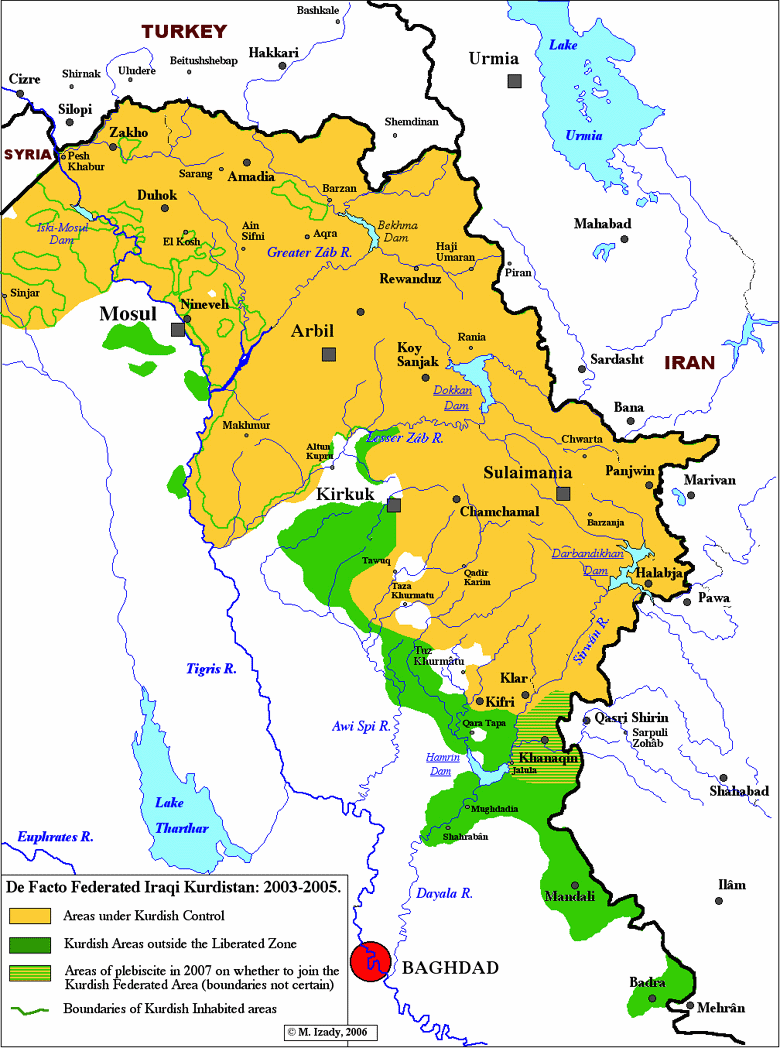
Provide Comfort was a defining moment in the history of Iraq's Kurds. Because Iraqi forces could not set foot in Kurdish areas, the Kurds had to look after themselves. Iraqi Kurdistan had actually gained official autonomy in 1970, but its parliament was under Hussein's control until the aftermath of Provide Comfort, when Iraqi forces left the area. Official autonomy had put most of the mechanisms in place necessary for real autonomy--without Iraqi troops (and with an economic blockade by Hussein), Iraqi Kurdistan had achieved de facto autonomy. The Peshmerga, a paramilitary force of the Kurdish region, policed the region. Two opposing factions ruled. It acted much like it's own country--similar to a Taiwan or South Ossetia situation. The Kurdish autonomous region is defined in figure 2 below; some Kurds lived outside the region, and a few Arabs lived within it.

Figure 2: Kurd Populations and Autonomous Region


The green areas represent Kurdish populations, but those blobs were certainly not static. In addition to genocide by murder, Hussein made attempts to consolidate Ba'ath control of Kirkuk and Mosul, the 5th and 2nd largest cities in Iraq (and quite wealthy) by a process of "Arabization:" moving Arabs into and around the cities, something reflecting "Hanization" by the Chinese in Tibet and Xinjiang. This process will also end up being quite important.

In the 12 years between Provide Comfort and the US-led invasion, the Kurdish population became quite used to its autonomy. The Peshmerga, a paramilitary force on the autonomous region's budget, kept the peace. The new generation of Kurds mostly doesn't speak Arabic, and largely does not have much interest in the Iraqi state as a whole--they see themselves as citizens of Kurdistan.

Enter again the Americans. During the Coalition's Invasion of Iraq, troops found themselves quickly overwhelmed with looting, murders, and then an insurgency. US troops, in charge of the northern zone of Iraq, asked the Kurds to keep the peace. And keep the peace they did--Kurdish troops marched south into areas they considered "Arabized" Kurdish territory, and a bit more. The US did show up in Kurdistan eventually, but not until the violence in Baghdad and Anbar started to fall. In the four years' meantime, the Kurds ruled. Their holdings have extended to those of the figure below.


Iraqi Arabs are not happy with this arrangement. Kurds have extended their control to northeastern Mosul and Kirkuk, Iraq's 2nd- and 5th-largest cities. Mosul is a wealthy trading city and Kirkuk a wealthy oil city--and both have lots of Arabs (interestingly, Mosul also has lots of Turkomen). While the Kurds managed to keep much of their territory relatively peaceful, their fighting with Arabs and Turkomen has turned Kirkuk and Mosul into 2 of Iraq's biggest violence hotspots. Mosul, in the confusion of the fray, has become Al Qaeda's last hideout in Iraq. It's a serious security problem.

Maliki sent the Iraqi Army to take back some of the Kurds' southeastern holdings that were pretty unquestionably Arab territory. There has been no civil war yet, but this is probably due only to the persistence of the US--the Kurds' best friends--in levying pressure to negotiate. But the Kurds are frustrated. Cities like Kirkuk were supposed to have referenda on whether they wanted to be a part of the Kurdish Autonomous zone or not--and the vote is now well over a year delayed, and shows no signs of happening. The US is trying to push for a negotiated settlement between the two sides. But Mosul and Kirkuk are likely to become embroiled in fighting no matter which way they go--even if their representatives can reach a deal, Arabs and Kurds in each city believe deep down that the city is theirs and that the other side has taken unjustly what they've taken. It's a mess.

The US doesn't have too long to stay in Iraq, and needs the negotiations to happen on a reasonable timescale--Maliki wants the same, because he knows that the US will back the Baghdad government if the Peshmerga picks a fight with them. The Peshmerga know it, too--but they also know that the US is willing to look out for their interests to some extent if they don't pick a fight with Baghdad--the US and the Kurds are still close friends with a relatively long history. But this explanation predicts that the Kurds would be happy to negotiate, and so far they haven't been thrilled. As the Iraqi Army grows, they will lose bargaining power--the only two rational approachs I can think of are A) negotiating now, while Kurd power is strongest with respect to the Iraqi Army and the Coalition, or B) wait until the Coalition leaves, at which point one would presumably have a boost in advantage. The latter is a dangerous game of brinksmanship that the Kurds must avoid. The former will probably not happen until an oil deal is passed in parliament--and that deal is getting close to 2 years delayed.

The resolution of this Arab-Kurd dispute when the US leaves will likely be the final step in securing Iraq's stability into the future. But failing to do it could undermine the progress that Coalition and Iraqi governments have made. Careful and persistent work awaits US diplomats in the next 2 years.

Thursday, October 16, 2008

The Power of the De Facto

The de facto can be a very powerful force in international politics--when things are a certain way, it is usually the burden of the party that wants to change it to justify that change, even if we all agree that the status quo is a bad idea. For some folks, it's a really bad deal. Others take advantage of it. Today, we'll review some of the interesting current status quo kinks in the world.

1) Abkhazia and South Ossetia. The status quo of South Ossetia and Abkhazia were tenuously against the Russians' favor one year ago--they had peacekeepers in both regions, but they were recognized as Georgian, despite the Georgians not having administrative control. But the Russians performed a masterful swap--their war was a shock, certainly, but one that they (probably) had the political capital to bear, largely due to European forgiveness of the US invasion of Iraq. Russia is insisting on the same forgiveness, particularly given the plausibility of the story that Georgia provoked them by moving (themselves unprovoked) into South Ossetia. The Europeans and Americans were not happy, but had very little to yell about. With weak justification for their anger, the EU and US mostly agreed that they'd been duped, and lost. Now, Russian de facto presence in--and support of--the breakaway states is the new status quo that the EU and US will have to fight to overcome... if they care enough.

2) Kurdistan. It's tough to dispute that the Kurds were left the short end of the stick in the post-WWI division of the Middle East; they were the largest nationality without their own state. After decades of fighting, the Turks, Iraqis, and Iranians--for all their mutual irritation--are working together to keep them suppressed. Nobody in the Middle East wants to give them independence. The fact that they don't have independence creates enough inertia that they simply won't.

3) US Attacks on Pakistan. The power of de facto has allowed the US to slowly creep up the boldness of its attacks in Pakistan--now, they're just lobbing missiles into Waziristan to take out Talibani leadership. While this is certainly the militarily sound strategy, it's risky--it is alienating a weak--but once dedicated--ally in the GWoT. And while the Pakistani leadership will continue to protest--they must, if they are to be re-elected--but ultimately tolerate it. What else can they do?

4) Taiwan. An oldie but a goodie. While the US (and every other darn country in the world) agree that there is One China, not Two Chinas, the international community would not tolerate any force on the part of the Chinese to take Taiwan back. The de facto independence of Taiwan is China's burden to overcome, even though nobody officially supports formal independence. The fact that it is the way it is continues to be compelling, even though no government argues that it's the way things should be.

When something looks odd or wrong in international politics, think whether some odd de facto force is present. It may be quite revealing.