Tuesday, June 23, 2015

The Kurds' Strategic Chokehold of ISIS

The Kurds are moving so fast that the venerable Wikipedia article map on the ISIS war hasn't caught up yet. Enjoy your well-deserved vacation, user/editor Eratosthenian.

After taking Tall Abyad, the Kurds pushed south to secure Ain Issa and the nearby Brigade 93 army base. First, I'll draw it on the Wikipedia map I've been using for some time to give general context.


Looks like a march to al-Raqqah! Don't get too excited: the Kurds have no intentions of assaulting the city. But there's still very good news afoot: the Kurds are setting up their final choking of ISIS, which will assist the war efforts in both Iraq and Syria even if the Kurds sit around doing a whole lot of not-much once they regain Kurdish territory.

Let's look at a map with some roads for context--I doodled on Google Maps to get the idea across. The lines aren't that accurate mile-by-mile, but bear with me.


In the lower-right of the map we see al-Raqqah. Route 6 goes north to Tall Abyad, which is the closest crossing out of ISIS territory, to Turkey. We know that for some time, people, goods, and arms were flowing out of Turkey into Syria from the border crossing there. Now they're not. Already ISIS-held territory is seeing a spike in the price of food and other basic goods (according to the Syrian Observatory on Human Rights), which means shortages could loom if they're not able to establish another supply line elsewhere: the Euphrates has limited agricultural capacity and most domestic food comes from the West, which is not under ISIS control (and Syria is a net importer of many staple goods, like wheat). ISIS may be facing food shortages in the future, which could cripple the regime far faster than airstrikes.

Why is Ain Issa (the red-black marker on the map north of al-Raqqah) significant? Ultimately, it blocks ISIS from having access to the M4, which means the Kurdish rear is secure for an assault on Manbij. To get West from al-Raqqah, ISIS must travel along route 4 to the south of the Euphrates. Expect the Kurds to be regrouping quickly from the Tall Abyad assault, consolidating Samin, and then racing across the Euphrates via the M4 to take Manbij and Al Bab, both of which are heavily-settled Kurdish areas. Given recent Kurdish success so close to al-Raqqah and their new-found positioning advantage from taking Ain Issa, I expect the Kurds' chances are good.

The Kurds' final push in Syria will be to link up with their forces in the northwest and establish a secure front just north of Aleppo and across the Turkish border. Once they do this, they'll control all border crossings to Turkey, cutting ISIS off completely from foreign trade or smuggling. Securing al-Hasakah will also cut ISIS off from a concentrated area of arable land.

(I've included USDA agricultural maps of Syria and Iraq below to emphasize that ISIS' holdings are largely a bunch of non-arable desert).

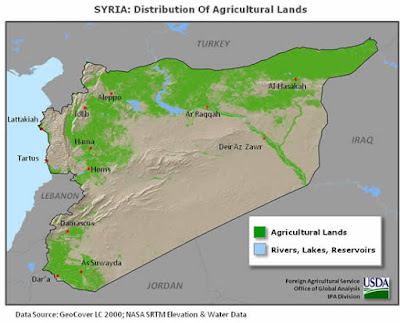


 ISIS has been funded primarily through plunder and extortion, rather than production: without places to trade, their (admittedly vast) reserves of cash will become far less valuable. It will become very hard, very quickly, to get access to foreign fighters, weapons and ammunition, and food. The Kurds completing their conquests of northwestern Syria and the areas around al-Hasakah will complete a trade, recruitment, and agricultural choke-hold of ISIS, meaning time will no longer be on ISIS' side. And that's a really, really big deal.

Tuesday, June 16, 2015

Kurds Close the Gap in the North

The Kurds have, in a few days, closed the gap around Tall Abyad and pushed south of the river in the east towards Hasakah. In a series of Middle Eastern wars that have chugged along with agonizing sluggishness, this arena has moved shockingly quickly.


In Tall Abyad, fighting continues, but Kurdish forces made sure to surround Tall Abyad from the south, creating pockets to squeeze in on and eliminate the ISIS forces there, rather than letting them flee towards all-Raqqah, which should dampen the risk of a major counter-offensive.


The Syrians will be grateful for the closing of the Tall Abyad border crossing. This will mean a bit of long-term relief from ISIS so they can focus on killing each other instead.

In the east, the offensive to the east of Hasakah will make inaccessible both Route 1 and Route 47 that head to Mosul.


This would essentially cut off Mosul from ISIS reinforcements in Syria, where they're strongest. To get to Mosul, ISIS would have to run convoys through the desert and well away from major metropolitan areas, making them easy pickings for coalition jets. The Iraqis will be grateful.

In the medium-term, if the Kurds can hold off any ISIS counter-attacks (which seems likely--Syrian ISIS are bogged down in the west), they'll move west to take Manbij and close the gap between their central forces and their forces hanging out in the northwest of Syria, which would make the Kurds in control of all predominantly Kurdish territory in both Syria and Iraq.

The Kurds are likely hoping for at least an autonomous zone in Syria, like they have in Iraq--and depending on how long/damaging the Syrian civil war is, they might just be able to break off and form their own country. They're showing a capacity to defend and govern in Syria, where the Assad and rebel governments have not. The expansion of Kurdish territory in Iraq is likely to also expand Kurdish governance in those areas in the long-term, though the Iraqi government is not so broken-apart that they'll allow the Kurds to break away entirely.

Tuesday, June 9, 2015

Iraq & Kurds on Lightning Offensive in ISIS Weak Spots

This war is a roller-coaster ride: ups-and-downs, victories and defeats. Today we get to focus on some good news.

ISIS seems to have weakened itself in some areas in order to launch offensives in others. According to CIA estimates it only has a few tens of thousands of troops (20-30k), and it's trying to fight over a vast territory. It's bound to have weak spots.

We also know that Iraq is much better at offensives than on the defense: being able to pound targets with artillery and US airstrikes and assault once they're "softened" is much easier than trying to hold out by standing around, waiting for a bunch of nearby cars to all blow up at once.

Iraqi Shiite militias are also about as tough as the Kurds, so in areas where Iraq can employ them (in the east), they also tend to have greater successes.

Such has been at the root of a recent decisive territorial gain by Iraq.

Iraq

Iraq counter-attacked not in Ramadi to try to dislodge ISIS there, but in Baiji, north of Tikrit. In about a day they were able to move in and take the city center and refinery, and are now mopping up suburbs, engaged around the entire area. If it's anything like post-Tikrit, we should expect that whole area to be red in a week.


It sets the Iraqis up to be able to push north towards Mosul, which they may do next rather than getting too entangled in Anbar in their march to break the back of ISIS.

Kurdish Syria

Over the past two weeks the Kurds have been ripping across ISIS-held territory, liberating hundreds of villages. They're looking just weeks away from closing the gap in the north and linking up at Tall Abyad.

Some quick detail on the map, from left to right:
1) The Kobane forces--hardened, reinforced, and supported by US airstrikes--are pushing east after consolidating territory to the south. 
2) Forces from the east are pushing west to link up with them, though a bit more slowly. They're showing no signs of stopping right now.
3) After being bottled up for months at the Tall Tamer river crossing, the Kurds broke through and have liberated a densely-populated Kurdish population there, securing the west side of Hasakah.
4) We can see Kurdish forces have also broken through the river at Tall Brak, and are pushing south, likely to surround ISIS forces in Hasakah and secure the border crossing into Iraq from the other side.


If the Kurds are successful, they'll make their next push west, towards Manaj, and secure a line towards Aleppo. This would cover all heavily-Kurdish territory in the north, so the Kurds would slow down (or stop expanding entirely), but very good news will stem from their success:

1) It will stop the flow of fighters and arms coming from Turkey into Syria, so it will be harder for ISIS to refill its ranks and supplies in Syria.
2) It will mean the continued killing of ISIS troops.
3) It will make it harder for ISIS to reinforce Mosul--they'll be down to one highway in the desert (they won't be able to sneak north through more populated areas) so their supply trains will be highly vulnerable to airstrikes if they attempt reinforcement and resupply during the Iraqi/US assault.

Thursday, June 4, 2015

Dark and Bright Spots on the Middle Eastern War Maps

Over the past few weeks, ISIS has made a major comeback in Iraq and has gained significant ground in all the non-Kurdish parts of Syria. They're expanding territory in eastern Libya amid the renewed civil war there, and hold almost all of eastern Yemen. It's looking bad. The American/Jordanian-led air campaigns are just not enough to keep them bottled up.

In Anbar (Iraq) and northern Syria, there are a few bright spots that are worth highlighting.

Iraq

Ramadi fell to ISIS a few weeks back, despite a significant numerical advantage on the part of Iraqi forces. US command says the Iraqi forces lost their will to fight, which is surprising, given the number of attacks they'd repelled in the previous weeks. 

Iraq is responding by sending in the Shiite militias, though right now it seems that they're working on surrounding Fallujah rather than Ramadi, which suggests that ISIS forces had been dispatched from Fallujah to take and hold Ramadi, leaving Fallujah open to attack. Shiite militias in Sunni-dominated Anbar will doubtless be a major problem, but Iraq is stuck choosing between bad options if its regular forces turn tail when attacked.


Syria

In all non-Kurdish territory, ISIS keeps pushing south and west. They've taken Palmyra and are now holding positions near both Damascus and Daraa. I'm thinking that the best hope to end the war is that ISIS threatens Damascus and other major population centers like Daraa and Homs so much that the rebels and gov't form a deal to deal with them.

The one bright spot is that the Kurds have gone on a major offensive. They finally crossed the river in the northeast to reclaim hundreds of villages that ISIS held, and they're moving fast. They've alleviated pressure on Qamishli and are surrounding Hasakah from the west. From Kobane, they're moving east towards Tall Abyad, albeit more slowly--this crossing is an important supply line from Turkey for ISIS and they'll fight for it. But the Kurds are looking poised to link up in the north. I also anticipate they'll keep moving south from Qamishli to surround Hasakah from the east... but they'll probably stop there and hold, as liberating al-Raqqah (ISIS' capital) is not on their agenda. They're looking out for their own.


Yemen

In Yemen, the government forces are so pressed by Houthi forces in the west that their eastern backyard has been almost entirely taken over by ISIS. There's little in the way of good news there, and the stalemate--like in Syria and Libya--just means more room for ISIS to maneuver. Saudi Arabia and Syria are more concerned with the Houthis than ISIS right now, so ISIS gets to roam free.


Libya

Similarly, stalemate here means ISIS gets room to play. The Tobruk government just can't bottle ISIS up in the east, and they're taking control of population centers. Ansar al-Sharia, an ISIS ally for the moment, holds parts of Benghazi. It looks like the government offensive towards Tripoli has stalled out completely. What's odd about this conflict is just how little fighting is actually happening. Looking at the Wikipedia article gives a sense of how oddly quiet the past few months have been, and how few casualties there are. I'm not sure why it's slowed down, particularly in the east (although gov't forces are still fighting in Benghazi).


Finally, a bit of good news. An ISIS member took a selfie at a big Syrian ISIS HQ, posted it with a location to the Internet, and that gave the US the intel necessary to bomb the HQ, destroying it completely. 

Tuesday, May 5, 2015

Tides Reversing in Middle Eastern Wars

Looking at maps is my way of procrastinating, so I get to find the seemingly little changes going on week-to-week in the Middle Eastern conflicts in Libya, Iraq, Syria, and Yemen.

Go check our most recent post on these wars that show progress by US-supported forces.

For clarification, the US supports:
  • In Libya: the Tobruk government (red)
  • In Syria: the "moderate" rebels (green)
  • In Iraq: the government & allies (red)
  • In Yemen: government forces (red)
Here's the update:

Libya

Libya Dawn (Tripoli government) has broken the siege of Tripoli and is pushing back. The Tobruk government's attack is floundering.

If we look to the south, we see some angry Tuaregs (who I imagine as pretty hardened mountain-fighters) have managed to capture a large swath of Libya for themselves and are challenging Tobruk's power there. I'm not sure what their goal is: maybe power-sharing, maybe independence.

Other unaffiliated local groups in Bani Walid and Tawergha have taken control from Libya Dawn--I believe they're actually old Gaddafi loyalists who are uninterested in either group. 

In general, we're seeing the fighting between Tripoli and Tobruk, meaning doors are left wide open in their own backyards for smaller groups to start some form of self-rule/splintering, which is going to be a recurring theme.

Iraq

The attempt to surround Ramadi is failing right now, and I'm not sure what the heck the Iraqi forces are doing with themselves--they should be able to outnumber and overwhelm Ramadi, but it may be the case that without Shiite militias, they're going to continue to struggle. In the past weeks, they had taken some of this territory and pushed deeper into Ramadi, along with repelling ISIS counter-attacks. But the once-imminent surrounding of Ramadi has been held up at best. Let's see if Iraqi forces reinforce further to finish off the fight. 

If Ramadi is taken, Iraqi forces would be able to comfortably cut off Fallujah for a protracted siege.

Syria

"Moderate" rebel advances in the south along the border with Israel have been pushed back. Slogging north that way would have given the rebels plausible access to Damascus that wouldn't involve taking Daraa--if they fail here, they'll be quite bottled up.

Another option for the rebel forces appears to be trying to link up between Inkhil and Tubna to cut off Daraa and besiege the city, but their forces seem to be committed to the north and in Umam Walad.

Yemen

The Houthis have made a major counter-assault in Ma'rib and Tai'zz, taking back Tai'zz and surrounding Ma'rib. They've also pushed back in Ataq and halted the southern coastal advance by government forces. It's looking increasingly bleak for government forces.

We're seeing, of course, that forces committed to red/green battle lines are allowing ISIS to make advances in ignored areas, so they've managed to pop up in the middle there, which will prove hugely frustrating (in addition to just terrible for the people of Yemen).

For the sake of beating ISIS, decisiveness--one way or another--is key in these civil wars. The continuing ambiguity is going to give them space to grow.

Thursday, April 30, 2015

Little Wars: Escalation

Even in the past few days, we've seen escalation in the Little Wars.

Russia

As things heat up near Mariupol, Russia is adding command-and-control assets, air defense, and artillery to its border with Ukraine. NATO thinks Russia is readying for a new Ukraine offensive. Russia has rightly calculated that it's going to continue to get away with its offensives; the EU and US will neither provide arms nor guarantee Ukrainian sovereignty, which is about all Russia needs to feel invited to roll in.

Russia is also sending supersonic strategic bombers to Crimea, both establishing their hold over the area and getting some pretty deadly hardware as close as they can to Kyiv, just in case.

It's not that the West isn't responding in some ways. The US and Canada are throwing a bit of money at the problem, and the US is putting money into counter-propaganda in eastern Ukraine, where Russia is currently drumming up support by alleging systematic murder of Russian ethnic people by a fascist Kyiv government.

Iran

US warships are now escorting American-flagged cargo vessels through the Strait of Hormuz to prevent Iran from nabbing any more. This means a heavier, bristling fleet presence in Iran's territorial waters, which ups the ante and is probably designed to establish status quo US presence there, with Iranian aggression as the pretense. We'll see how Iran responds--there's not much they can do directly, but like the capture of the Maersk, they may find another way to be a thorn in the side of the US. Iran's motives for capturing the vessel are still unclear (and the public statements are highly dubious).


Busting the Axis

Iran is currently close to Russia in part because Russia does not have sanctions on the country, and Russia wants to keep it that way. 

If the Iranian nuclear deal works, the West will start trading with Iran again, which would be a huge boon for the economy. Frankly, the massive US/EU markets provide a much more appetizing treat for Iran than the sluggish Russian petro-conomy. Iran has more than enough petrochemicals and doesn't want vodka.

So Russia (and China) might actually be trying to "nuke" the deal, as it were. Forbes' Russia-China expert talks about it here (thanks to reader Nathan for pointing me to this).

The US could soften/weaken the alliance between Russia and Iran with the deal, as well as finally have access to Central Asia (also under Russia' indirect control), which would be a huge boost in the Great Game. 

Could the nuclear deal happen? Sure: the US and Russia made all sorts of similar deals throughout the Cold War, even while facing off in places like Korea, Vietnam, and Afghanistan.