Friday, November 2, 2007

Update! August Transitional Assessment Released


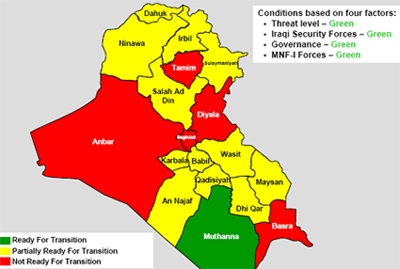
Well, looks like I was wrong about the status of the Kurdish regions of Iraq, and also wrong about which province is going to be handed over next.

The Kurdish provinces are under Iraqi Provincial Control (IPC). It's possible that IPC is the very reason the PKK has had a freer reign in the region, but they are starting to talk peaceful resolution, and the Iraqi government has shut down their recruiting offices. If the PKK issue can be resolved, the north will probably return to relative quiet.

Remember this map is from August, and Karbala has been handed over. That puts us at 8 provinces handed over, and zero "not ready for transition." Compare this to 14 months ago:


One province handed over, and four "in the red," not ready for transition. Furthermore, Iraqi forces are in the lead in many of the provinces partially ready for transition, and US forces are taking an ever-increasing support role in the war:
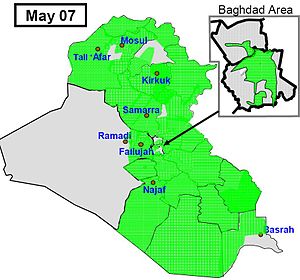


The green indicates "Iraqi Army Lead." Notice that in 3 or 4 eastern provinces not yet handed over, they are in full lead. According to the US DoD, Basra is the next province on the list to be handed over-- and they plan to do it by the year's end, making 9 of the 18 Iraqi provinces under full Iraqi control.

Note the change in the rate of handover since the surge:
From Mar 2003 - July 2006 (30 months): 1 province handed over
From August 2006 - Jan 2007 (6 months): 2 additional provinces handed over
From Feb 2007 - Oct 2007 (Surge period, 9 months): 5 additional provinces handed over
From Nov 2007 - Dec 2007 (Projected, 2 months): 1 additional province handed over

Given the violence by province in the first half of the year:


The relative peacefulness of Qadisiyah and Wasit indicates that their transition will come not after a tough putting-down of violence, but after the United States is satisfied with the functionality of the local police force and civil services. They show the potential to be handed over early next year, and Tamim and Babil have shown recent declines in violence that could make them acceptable for handover within months. This leaves the US 5 provinces to concentrate its security operations before domestic pressures bring the troops home:

1) Baghdad. Certainly the most important province in Iraq, I believe Baghdad will be the last to be handed over. Hopefully, the surge will secure Baghdad fast enough (see the first pretty picture in the previous entry) such that post-surge level troops (troop levels will begin to reduce to pre-surge levels in Feb, 2008) can keep the city under control. Baghdad will benefit most from the cascading effect of Iraqi Provincial Control, as more and more US forces in Iraq are likely to move into Baghdad to further pressure insurgent groups. But, if the US is able to hand over most provinces by the end of 2008, the new US president may only have to commit 30,000 or fewer troops in Baghdad to keep Iraq on its feet.

2) Anbar. Anbar has surely shown the most improvement over the last year, due in part to the surge, but mostly to brilliant diplomatic efforts that have brought the tribal leaders of this Sunni-majority province to support the government. Additional provincial attacks charts should illustrate Anbar's improvement well:


Just before the surge, Anbar province was suffering an average of 35 attacks per day.


In the beginning phases of the surge, other provinces showed only some or no improvement, but Anbar had dropped to 25 attacks per day, an almost 30% drop. This was due not to a large insertion of troops, but to a decision by Anbar Sunnis to begin supporting the Iraqi Government. Attacks continue to plummet: notice that in the last Provincial Security Transition Assessment, Anbar, after stubbornly staying in a "not ready for transition" state for more than 4 years, has finally made significant progress towards peace and security, and could soon turn itself from Iraq's biggest trouble spot to a leader role in unification.

3) Salah Ad Din: Home to the infamous Tikirt and Samarrah, it has remained a trouble spot for US forces. The United States must try and spread the pro-government sentiment of the Anbar Sunnis to the Sunnis in Sala Ad Din if it is to calm down. Furthermore, Salah Ad Din suffers from being a relatively large Sunni and Shiite mixing ground, especially in Samarrah. Americans are leading strong efforts to get tribal leaders to sit down and talk in this region, but unfortunately, I don't have up-to-date enough violence-by-province data to tell you whether it's working well or not.

4) Diyalah: A mixing ground of all three major ethno-religious groups of Iraq, Diyalah may be a trouble spot for some time. That said, it has been the second-least-violent of our 5 remaining "trouble" provinces, but the US does not consider the level of violence there to yet be acceptable. This province will be the truest testing ground of coalition reconciliation efforts; that is, given the sheer amount of ethnic mixing, large decreases in violence in Diyalah will truly show that ethnic groups are finally putting aside their differences.

Finally,

5) Ninewah. We don't hear much about Ninewah because, while it is a trouble spot, it has about half the number of attacks on a daily basis than Diyalah. Ninewah is an area of strong Sunni and Kurdish mixing (I think you're seeing a pattern), and contains Mosul, a high-density, high-ethnic-mixing city. Ninewah may well benefit from increased Sunni support-- with Kurds already mostly supporting the Iraqi government, Sunni realignment will likely give the two ethnic groups common ground on which to work, and common goals to work for.

Challenges remain. Al Qaeda in Iraq continues terror attacks against Iraqi civilians, but this may be a sign of leadership failure in the organization. Osama Bin Laden has urged Iraqis to work together to throw the US out, while other elements of Al Qaeda have stubbornly refused to halt terror attacks. As Iraqi tribal groups increasingly turn to crush Al Qaeda, their influence and effectiveness will falter.

Let's talk Turkey: could a Turkish invasion destabilize Iraq? Possibly. But a full-scale invasion is unlikely to happen, and even if military operations do cross the border, fighting between the Turks and Kurds will likely not have much effect on Iraq's 3 biggest trouble spots. The risk here is that either A) the Iraqi government will lose the support of its Kurdish citizens for not protecting them, or B) the Turkish government will see the Iraqi government as ambivalent or hostile to its interests, and Iraq needs all the international (especially neighbor) support it can get. Iraq has asked its neighbors for assistance in solving the matter with strong diplomacy and minimal military operations, and strong US and NATO influence with Turkey is likely to keep them from doing anything rash.

Finally, Iran: is the Iranian government funneling in weapons? Is the Revolutionary Guard conducting operations in Iraq? If so, are these significant? The answers to these are, unfortunately, unclear. But Iran seems to be on the defensive, thanks largely to US and EU sanctions and pressure. The Iranian government is almost certainly looking to expand its power, and certainly wants Iraq as an ally or even a puppet, seeing as Iraq is the only other large, Shiite-majority country in the world. But does Iran have the ability at the moment to expand its empire against the wills of the US and EU? While Russia may be a shaky ally of Iran, its power and influence are slim. If Iran wants to destabilize Iraq enough to force US troops out (as it will have to do before it can think about large-scale imperial efforts), it had better act soon, because trends seem to be in US and Iraqi favor.

Things are looking very good for Iraq at the moment. It seems the favorable trends that the surge has brought will continue through next February. If the US has properly prepared the Iraqi government, police force, and military, then these groups should well be able to take over the administration of security within Iraq, and keep violence to a low enough level that government and business can expand their functionality. If this transition works, the US can start to scale down troop commitments as early as summer of 2008, giving the citizens of the US some much-needed hope and relief, and throwing a wrench in the politics of the 2008 presidential election.

Thursday, November 1, 2007

After 9 Months, Surge Still Working

http://news.bbc.co.uk/2/hi/middle_east/7073160.stm

With US and Iraqi deaths continuing to fall, Baghdad daily looks less like a war zone and more like a particularly violent US city-- far from perfect, but increasingly entering a state where the government can operate. An operating government can start to combat the discontent and hopelessness that the Iraqi people are feeling, which will be key in convincing the Shiites and Sunnis to get along.

Al Sadr's Mahdi army remains at a stand down. But what are the cleric's long-term goals? I am somewhat skeptical that he's suddenly decided to support the US and Iraqi forces. But his motivations seem largely anti-American, so it's unlikely he's simply waiting for the US to exit before he unleashes the Mahdi army on civilians again. I am optimistic in considering that he may have decided that encouraging peace might be the best way to get US forces to pack up and go home. Hopefully, US forces have enough contact with him to keep communicating with his forces and maintain a mutual understanding.

Sunni tribes are increasingly turning their anger towards Al Qaeda, instead of against Shiite civilians. As I said in my last post, Al Qaeda may, paradoxically, become the enemy that unifies the Shiites and Sunnis into forming a strong central government. Osama Bin Laden's last tape shows his clear frustration at the fighting between terror and ethnic groups-- he had been hoping that they would unite and kick out the United States to form an Islamic Republic. It looks, day by day, like the chances of this happening are dwindling.

Hopefully, the Sunni tribes in the Anbar province have a contagious idea. If the majority of Sunnis decide to work with the Americans and Baghdad government, large swaths of all three ethnic factions will be represented, giving the government both legitimacy and functionality.

But really, if things keep going as they're going, the US could be down to a few tens of thousands of troops in Iraq by the next election, and I'm sure the Republicans are eager to see that happen. To better show these trends, I present you pretty pictures:


This shows the sharp decline in violence in Baghdad over time. Note that this only goes to July-- the rate of decline from July to October was even higher than from January to July. Remember this is Ethno-Secretarian Violence, and Al Qaeda anti-civilian terror attacks have not declined at as high a rate.

But is securing Baghdad enough to get most US troops out of Iraq? No, but securing the rest of the country, bit by bit, is. I present 3 more pretty pictures, timelining provincial handover over the last year:


So in Nov, 2006, we had handed over a mere two provinces.


By the beginning of February (the beginning of the surge), we'd only handed over 3. So this is 4 years into the war, we've handed over a whopping total of 3 provinces.


By May, we were already up to 4. In late September, we handed over Karbala-- a province at the Sunni-Shiite border, suspiciously close to both Anbar and Baghdad. An army report (that I don't have the link for, sorry) hinted that Qadisiyah might be soon.

The rate of handover has gone up: we may well hand over 3 provinces in 1 year, which is more than 4 times as fast as the first three that we handed over. Remember also, that if the handovers are smooth (and they have been so far), we get a positive feedback loop: we hand over a province to Iraqi forces, more of our troops are free to quell the violence in other provinces, the faster we hand them over. At the rate we're cleaning up Baghdad, it too could well be handed over by mid 2008.

You'll notice that the three predominantly Kurdish areas of Iraq have been "ready for transition" for at least a year, and yet have not been handed over. This may well be because the Turks have wanted a close eye on northern Kurds for the last 4-and-some years. Now that Turkey is beating its war drums and the PKK is stepping up attacks, who knows what might happen. One thing's for sure, transition to Iraqi provincial authority in the Kurdish north is unlikely to happen for some time, despite being the most peaceful region in Iraq.

So things are looking good. But I'd like to address the doubts of some of my more die-hard opposition with an argument that I've heard often (even quoted in the BBC article that this entry starts with)

Violence is predictably down because of the increased number of US boots on the ground, but will go right back up when the boots leave. I have a few answers to this. First, it's not that militant groups are simply keeping their heads down. The surge is actually killing militants at a very high rate. Despite border leakages, Iraq has a relatively finite number of people who would be willing to become insurgents and militants. While some argue that attacking militants will help their recruiting efforts, groups are unlikely to be able to recruit as fast as we have been eliminating members. Furthermore, while killing militants may cause anger, killing them at a high enough rate may convince potential militants that the risks of joining are just too high. Second, if you're saying this, you're not paying attention to political victories. What groups have caused us the most sectarian trouble in the past? The Mahdi army and the Anbar Sunnis. The Mahdi army has halted all operations in Iraq, and the Anbar Sunnis are increasingly supporting the Iraqi government and hunting terrorists. Shiite and Sunni tribal leaders are increasingly settling their differences in meetings (be they US-sponsored or not). Furthermore, increased security has allowed for increased civil functionality in and around Iraq-- more water is running, more lights are on, more trash is being picked up. A citizen whose needs are taken care of is a citizen that is increasingly likely to support the group that takes care of its needs, and the Iraqi government is beginning to take advantage of the security we are providing to win the hearts and minds of its citizens by returning functionality (to be fair, civil service functionality increase is much slower than we'd hoped, and one of the weaknesses of the surge... but it is improving). So as Sunni and Shiite tribes continually join the government, and hearts and minds of citizens are won over by an increasingly functional government, the motivation to torch an increasingly positive environment with fighting diminishes. When US troops pull out, former troublesome tribes will be cooperators, former militants will be satisfied citizens. Finally, the Iraqi police force and army have been increasing in number, and have gone through significant overhauls, and will have a larger presence when the surge ends than when it began. Not only will they be stronger, but it will simply be easier to put down budding violence as it tries to restart than to try and curb explosive violence that is already the norm of a region.

Ultimately, saying that Baghdad violence will significantly increase when the surge ends is a very similar argument to saying that provincial violence will increase after a transition to the Iraqi forces, and this has been largely empirically untrue. The US army does have the ability, given sufficient numbers, resources, and leadership, to enter an area and reduce long-term violence, and can do so in Baghdad.

My hat goes off to General Patraeus. He has commanded US forces brilliantly in Iraq, and has forged a hugely successful operation in spite of strong congressional doubt, weak political leadership in the executive, and groups of radicals trying to destroy him by calling him a betrayer of the American people.

The surge is working. Those who refuse to see it are as blind as those that refused to see that Iraq has been brought to the brink by our mismanagement in the first place. But now we've got something very good going, and an incredibly competent and capable general conducting the operation. So things are going well. But what does the United States want now? We want the troops to come home as soon as possible. But many have let their hatred for this war and this president blind their understanding of the hard truth: and the hard truth is, we cannot afford to bring the troops home without victory. We cannot allow Iraq to crumble into civil war, we cannot allow it to become a well-armed failed state, cannot allow it to become the primary base of operations for Al Qaeda. Finally, after four long years of foolish management, we have a working strategy, and our troops are bringing us each day closer to victory. Now is not the time to halt the surge, now is not the time to surrender and come home. Now is the time to take our victories and build on them, to clean up the mess we started, to secure US National Security, to turn our greatest military gaffe into a great military success, to build a new ally, to restore the world's faith in our competence and our commitment to doing the right thing. Now is the time to throw everything we've got behind the surge, to pray for our troops on the ground, and to-- dare I say it-- stay the course.

Tuesday, October 2, 2007

Summer Plans, And Some on Iraq

I've managed to get myself some funding from MIT to go to China this summer, with a few caveats:

1) I keep passing Chinese. I'm doing well so far, but we'll see.
2) I get a job. A little tougher. I've just finished my initial application to work for the State Department in the Embassy or one of the Consulates in China. I'd have a ball (I'd have to get a suit), but it's pretty competitive. I'm looking at the American Institute in Taiwan as a backup.

But, should this all work out, I'll be spending the summer in China, traveling about the country during the weekends, armed with a dictionary, a journal, and a camera. I'll improve my Chinese language and cultural knowledge, and (hopefully) have the summer of my life.

But for now, we're waiting.

Now, time to ring in on the surge, which I've been hesitant to do. It's a policy that requires a great deal of pragmatism to approach. We should ask ourselves two questions:

1) "Is it working?" Difficult to define, but we'll try.
2) "Does it matter whether it's working?" We might want to call it quits regardless of effectiveness, but that's unlikely.

I will first argue that we should weigh or judgments on the Surge as to whether it's working. If it's working, we keep doing it. If it's not, we shouldn't.

Why? Success is important. Stability in the Middle East is key to US oil and Israeli interests, and surrounding Iran with stable, democratic, liberal US allies will be a great foreign policy improvement over a chaotic ethnic cleansing region or an Iranian puppet.

Reputation is also important. It would be good for us to show that we're willing to clean up our own messes, and stick through to the end to help a state and society that our action has destabilized. We will continually deal with western-world dislike if they can be constantly reminded of a chaotic, dangerous state that reaches long-term realization if we pull out.

So, what is success? Well, most people think it means a stable, working democracy that can provide for its own security. This is a fine metric, and I think we should be striving for it, are striving for it.

But can we reach it?

Violence increased rather linearly for years after the invasion, despite the growth of the Iraqi Army. Baghdad was a literal war zone before the surge: 2/3 of 507 neighborhoods were war zones. But there has been drastic improvement. From a recent article:

"There are about 507 neighbourhoods in Baghdad and before operation Fardh al-Qanoon (Imposing Law) was launched (in February), two-thirds were controlled by terrorists and criminal gangs," the general said.

"Today, only five or six neighbourhoods can be considered hot zones," he said.

This is spectacular progress over 7 months. Iraq overall has not shown quite as much improvement (obviously; the surge has not been focused there), but violence outside of Baghdad has also dropped, despite the surge not being present in many of these areas. Violence overall is now lower than it was at any time after the Golden Mosque bombing, and linear reductions in violence continue.

So there are great improvements in security. But what of political reconciliation? These are still stalling. But I believe political reconciliation is extremely difficult without security. You can't have a functioning parliament when MP's don't show to meetings because they've been assassinated. But as Iraqi General Abud said, now "life is going normally," and we should keep our eyes out for reconciliation to occur on a national level soon.

If the parliament is unable to suck it up and try to stabilize their own country even with the efforts and successes of coalition peacemaking operations during the surge, then they're probably not worth our time. If the Iraqi government refuses to function, then there's nothing we could do. And we should pull out.

But reconciliation is happening on small levels. Sunnis and Shiites throughout Baghdad and most multi-ethnic zones in Iraq are participating in hundreds of small-scale reconciliation meetings between neighbors and local leaders. Coalition troops and diplomats are hosting these meetings, and they tend to go rather peacefully. These local Sunnis and Shiites are giving peace a chance.

But there's an even better sign, and it comes in a very odd form. While sectarian violence has dropped dramatically, Al Qaeda terrorist attacks have been more stubborn. This means, first, that we should look at the violence drop numbers knowing that Sunni-Shiite civil war violence has dropped more than the mean violence.

But Sunni and Shiite reactions to Al Qaeda have been better than we could have hoped for. When Al Qaeda killed a prominent pro-American Sunni leader, they began threatening Sunnis that cooperated with Americans. But instead of cowing to terror threats, Sunnis have vowed to seek revenge on Al Qaeda, and fight their influence.

Al Qaeda's covert meddling has been successful in causing spikes in sectarian violence (they are probably responsible for the Golden Mosque bombing), but their overt meddling may turn Sunnis and Shiites alike against them. History shows us that common enemies can act as a very strong (if temporary) adhesive. But perhaps, this temporary glue may be enough for political leaders to institute some longer-lasting solutions.

And people are primed for longer-lasting solutions. People are ready to work. In a recent article (http://ap.google.com/article/ALeqM5hyhq3ADshGO5q1Ye-U10Jlt5vcAA), we read:

"We meet with Sunnis here in public forums and in very discreet ones, and they all readily acknowledge (the 2005 election boycott) was a mistake," said Joshua Polacheck, public diplomacy officer for the U.S. State Department's provincial reconstruction team in Ninevah. "I don't know one Sunni Arab who says it wasn't a mistake to boycott those elections."

So I say: give it time. American deaths have been very low in the past few months, Iraqi violence has been falling off decisively. Iraqi Sunnis (and Shiites, but the Sunnis are new) are open to reconciliation, and are making and accepting efforts in that direction.

I think Iraq is, for the first time, winning its fight to create a stable state. This is a course I am proud to stay, as it's working. And as long as things continue to go our way, we should stay. We owe it to the Iraqi people, and to ourselves.

Monday, July 16, 2007

The End of the War on Terror

We're in the middle of an ideological war.

At least, some of us are.

The "War on Terror," in retrospect, was probably a bad policy name. "War on Al-Qaeda and its allies" would have probably been better. Really, we're not waging a war on Hamas, Hezbollah, the Basques (of Spain), Sri Lankan Tamil Tigers, Indonesian who-knows-what-they-call-themselves, etc. I'm equally unconvinced that the War on Terror is secretly a "War on Radical Islam." We surely don't like Radical Islam... nor should we. But we shouldn't be out to militarily crush the ideology, and we haven't shown signs of trying to do that. We've stayed far away from many of the most radical Islamists-- Syria, southern Lebanon, Indonesia, Somalia. Iraq was probably the least of our Radical Islam worries in the Middle East... at least until we showed up. There's certainly been no tendency in the US "War on Terror" to unilaterally fight terrorists or Radical Islamists.

We're rather confident at this point that Bush was planning on taking out the Hussein regime even before 9/11, so let's not even consider the 2003 invasion as part of the War on Terror itself (regardless of what the President claimed at the time). Given that, we've had one major military operation against a terror operation, and this has been in Afghanistan.

Even our considerations of action (military and not) against Iran are unrelated to Terror or Islam. Iran's pressing need for nuclear weapons, suspiciously combined with a pressing need to wipe Israel off the map, should reasonably make any US foreign policymaker feel some hostility. But on top of it, evidence mounts that Iran is meddling in Iraq and making Coalition lives harder in creating security for the country. Given our desperation to fix up Iraq and go home, hostility in US foreign policymakers is understandable.

So it's clear that the "War on Terror" is poorly named. But why change it?

A few reasons. First, wars on concepts tend to do poorly, and help accentuate individual failures. The War on Drugs and War on Poverty are failed policies that we're hanging on to (and spending gobs of money on) regardless of performance. We don't need another one of these. Second, and more importantly, US foreign policy needs to be clear. We need to let our allies and enemies alike know where we draw the line between tolerable and unacceptable behavior. We need to let potential adversaries know what will cause us to go to war. The "War on Terror" is a war against a tactic. If we declare that we'll go to war against anyone who uses this tactic, then we either have to follow through with it and be consistent, or the sentiment will be lost, and none of our potential adversaries will know where our line is.

This clarity of communication was key to fighting the Cold War effectively, and will be key to fighting against potential terror enemies effectively. From here, I think we should replace the "War on Terror" with, indeed, a "War on Al-Qaeda and its allies." Many countries have interpreted the former as the latter, which is excellent: Al-Qaeda is a black name, and is not given haven in any country that wishes to avoid our wrath. Since our war began, they have lost ground in most states with strong security and administration (and have gained in Iraq and Northwestern Pakistan, where there is relatively little government influence). They've also lost ideological support overall:

Defeating Al-Qaeda, and making it clear that anyone who attacks us or our allies will fall onto our black list, should be a much more clear and effective line. Middle Eastern countries will have a strong incentive to crack down on potential radical groups that should wish us harm, so that we don't have to show up and do the cracking down ourselves.

Hopefully, a less ideological administration will be elected in 2008, and may take this more pragmatic approach to our fight against Al-Qaeda and its allies. Should that occur, I will be toasting, hopefully with many of you, to the End of the War on Terror.

Future Me

The future is looking up. And the engineering title's got to go-- at this point, it's a masquerade. I'm a political scientist. More accurately, I'm working on being a defence analyst.

There's a few ways I could take it. But it's almost certainly going to start with grad school. And if I play my cards right, MIT has a program that would let me become a grad student in my senior year, and work on my master's thesis for two years. But I have to apply this fall. That means GREs and letters of rec. The latter is mostly taken care of, the former will happen in fall. Admission probability is pretty good at this point.

Prof. Fravel and I are almost done with his book, and I'm hoping to get an acknowledgment out of it. He seems to like me, and has been happy to help jump-start my career. I think I may be getting some second-authorships on papers in the fall. He's going to work on getting me to China next summer.

And that means next summer this might turn into a sentimental travel blog, but that's okay. I've been studying Chinese all summer, and am close to ready for Chinese III in the fall. If all goes to plan, I'll get an internship at a Think Tank the Professor knows, and MIT will cover travel and board.

After grad school, I'm still looking at doing a stint with the CIA for a few years, then moving either to independent contracting, a think tank, or policy-making. But I've got plenty of time to make my mind up.

From here, I'm thinking about what presidential candidate I'll be voting for in the primaries. I'd like to say someone has a good foreign policy and grand strategy... but I really don't know myself where we go from here. We're in a pickle, it's true, and I'm wondering what Congress is going to do about this pull-out business... whether they'll jump on it, or wait until the September surge report.

The surge _has_ reduced civilian and American soldier deaths/day. Does that mean we've dealt a big blow to anti-Iraqi/American insurgents, or does it mean the bad guys are in hiding? The majority of insurgent attacks are still on American soldiers, which leads some to think that a pull-out will make Iraq more peaceful. But that's probably a bit naive--an American pull-out is not going to cause Iraqi sects to get along, and it's not going to stop Al-Qaeda in Iraq from trying to overthrow the secular government and establish an oppressive Islamic Republic. Iran--or at least Ahemenijad--is likely to feel emboldened about trying to create a Shiite-dominated neighbor if we pull out, but Ahemenijad is losing a lot of ground in popularity, and having enough forces to keep the Iranians under some sort of control (until Ahemenijad is voted out in 2009) may save us a lot of headaches in the future.

It's not that Iran is going to become the next Soviet Union, but until we achieve energy independence, we're going to have to continue to give a damn about the Middle East. Frankly, I'd like to stop caring about the whole region altogether, but until we start drilling in Alaska, building some nuclear power plants, driving electric cars, or developing atomic teleportation technology, we're going to have to keep putting up with it.

What about the Terrorists? They're really not the kind of problem the administration makes them out to be. If it's that important to preserve the lives of innocent Americans, we'd be pouring a lot more effort into public safety at home. At 2 million violent crimes per year, even sustained terror attacks would account for a small fraction of the violations of our Right to Life.

That said, we've had some pretty impressive crime reductions in the 90's:


Whether it was the Republicans or Clinton or Governors or some voodoo magic that caused the drop is beyond me, and frankly I don't care (what I do care about is my mother telling me that it's more dangerous now than it was when she was a kid. Now _that's_ media mayhem). But we should still work on it.

Heck, I'm not even convinced pulling out of the region completely would cause an increase in terror attacks in the US. How many times has Al-Qaeda attacked Sweden? But if anyone tells you they really know whether attacks on American soil are likely to increase or decrease if we pull out of the region, they're smoking something illegal.

But again, before I give you a "Middle East and World Foreign Policy '09" rant, I'm going to get a better idea of what we're doing with this Iraq thing. It seems to be the crux of such a future policy.

But really, I think the future's looking up.

Tuesday, May 8, 2007

Reasserting Control

Hot off the presses, just for you, a paper I just finished for Barry Posen. It's called "Reasserting Control: Could China Conquer Taiwan?"

I decided to write it after reading a handful of academic campaign analyses on just the same thing that resoundingly concluded "no," but used a series of hogwash arguments that either lacked detail or chose assumptions and scenarios that arbitrarily favored the Taiwanese. My analysis decides that if China is able to pull off a coordinated missile, bomber, and fighter/ground-attack (FGA) attack on Taiwanese airbases and C4I centers, it can gain an advantage in the air war, and possibly establish air dominance. After that, it's a matter of using its submarines to pin Taiwanese ships in port to open up the way for an amphibious assault. Though amphibious assault landing ships are limited, China could combine its elite marines with an all-out airborne assault on a single point of attack near a port city in the north to establish a beachhead, and then reinforce the beachhead with a "Million-man swim:" an operation that would involve shipping as many as hundreds of thousands of Chinese troops on commercial fishing vessels and making them swim to shore in what amounts to a very wet airborne-style operation, which is only feasible under the protection of a secure beachhead, air superiority, and sea superiority.

After taking and reinforcing the beachhead, the Chinese would have a short march to Taipei, and with the assistance of tactical interdiction on the part of the Chinese PLA Air Force, Chinese troops could break through and race to the city, where they would fight Taiwanese troops in brutal urban warfare. The award-winning training of China's more elite small units, as well as renowned toughness and grit, would give China the advantage it needed in taking the city. With Taipei in hand, China could stop and defend its spoils, having dislodged the Republic of China government.

The full paper explains in detail each step of the hypothetical operation, and uses the conclusions of the analysis to guide future US, Taiwanese, or Chinese military policy. I encourage at least a skim-through.

http://web.mit.edu/efogg/Public/taiwan.pdf