Showing posts with label counter-insurgency. Show all posts

Saturday, June 14, 2014

A Brief on ISIS Advance in Iraq

It was pretty pathetic. ISIS took control of Mosul and Tikrit (which are pretty bloody far apart!) in 2 days with 3,000 troops. Iraq had a division of 30,000 that totally dissolved under the advance.

That's just terrifying.
They've got tanks now, too.
And a fat, fat stack of money ($430MM USD, looted from Mosul).

Now they've got control of... well, a whole lot. They have way more in Iraq than they even do in Syria, and the Syrian government has been busy fighting with rebels for over 2 years now.


Just look at how close they are to Baghdad.

There's a weird silver lining, in that their end game is a difficult one, so it may not be an existential threat. ISIS just can't take over the whole country--there are too many Kurdish and Shiite militias that would rip them apart.

So all they can really try to do is create a de-facto (and then maybe formal?) separate state in Sunni areas. This could go something like the Kurdish region, with similar headaches for neighboring countries. It wouldn't happen without a long stalemate.

So I don't think these 10,000 ISIS fighters are going to topple the Iraqi government. The Iraqis are mustering the parts of their army that aren't a humiliating mess, and making a counter-offensive (they took back Tikrit, for example). They're getting help (Iran helped with Tikrit and may help with more), and the US may help, although probably not until the most immediate crisis (Obama is putting political-reform strings on any help). They're going after Samarra next.

(By the way, I can only say "this might not be an existential threat" as of today. As of yesterday, ISIS had shot through half of Iraq unopposed and had taken over almost everything of note north of Baghdad, and Baghdad's forces were gathering to "make a stand" at an air base north of the city.)


So maybe Iran's help is absolutely critical to Iraq's survival.

Obviously the Iraqi army is going to be in need of a dire, dire shakeup. Lots of people joined the army just because it was a source of steady income. Many have strong sectarian feelings and if they're Sunni, they may not want to fire upon their Sunni brothers (same goes with Shiites). These guys just weren't hellbent on defending the Iraqi Republic. A smaller, more selective, better-trained army may end up making more sense. This will come in time.

There are a few weird silver linings here.

1) If the Iraqis are able to muster the ability and help to do a serious offensive in Anbar, it may cut off some vital shelters and supply/training depots for ISIS in Syria, and limit the likelihood that eastern Syria actually becomes a permanent terror state.

2) Iran and the US might start getting along. They both want so badly to keep a lid on this that we may see joint exercises and a general putting-aside of differences. The fact that Rouhani is willing to do this is a sign that he's a much more reasonable character, too. Iran/US cooperation would actually bring a whole lot of long-term stability to the general area.

We're not at all out of the woods yet. I'll keep you updated.

Wednesday, June 4, 2014

Eastern Ukraine in Full-Scale Civil War

Just a few snippets:

Literally hundreds of pro-Russian insurgents keep attacking bases and border posts:
http://www.usnews.com/news/world/articles/2014/06/02/ukraine-says-insurgents-attack-border-guards

Insurgents from Russia are using occupied border posts to pour through and reinforce eastern Ukrainians. Of course Russia is not really doing anything to prevent this:
http://www.cbsnews.com/news/russian-fighters-killed-along-with-insurgents-in-eastern-ukraine/

Ukrainian troops are battling insurgents for control over dozens of locations, like border posts, government buildings, and a big airport:
http://www.thewire.com/global/2014/05/hours-after-ukrainian-elections-pro-russian-separatists-seize-airport/371579/

The insurgents are well-armed: having taken some armories and (embarrassingly) APCs, they're doing more than your typical AK-47 wielding civilian. They were even able to shoot down a Ukrainian helicopter:
http://www.thewire.com/global/2014/05/ukrainian-helicopter-shot-down-by-rebels-leaving-14-dead/371789/

The military has the advantage in training and equipment, and killed 300 (probably) insurgents as they close in on Slaviansk. That's a crazy-big number for the kind of war this is:
http://time.com/2821792/ukraine-russia-slaviansk/

Putin of course making matters worse by jacking up prices on Ukrainian gas and cutting off supplies from Crimea. Ukraine refuses to pay the extra fee (but is paying at the old rate), generally considering this extortion. Now, of course, Russia is planning to cut off supplies entirely:
http://www.thewire.com/global/2014/05/putin-speech-ukraine-spief-2014/371491/

NATO's response for the moment is to fund/train Ukrainian forces, increase exercises in Russia's regional waters (Black and Baltic seas), and step up spending on its own military (particularly in Poland, which is probably due for a war with Russia within the next 20 years):
http://www.kyivpost.com/content/ukraine/nato-to-support-ukrainian-army-report-350521.html
http://www.nato.int/cps/en/natolive/news_110609.htm

Monday, October 4, 2010

The Fascinating CIA-Army Campaign in AfPak

As the US looks to spin down its campaign in Afghanistan (looking towards draw-downs in 2011), it has two current objectives towards which it is racing:

1) Eliminate and prevent the resurgence of al-Qaeda links in the AfPak region that can contribute to worldwide terror attacks.

2) Sufficiently reduce the influence of the Taliban that it cannot take hold and later become a stable harborer of terrorism / Global Jihad.

Unfortunately, these two objectives stand in some conflict, particularly where Pakistan is concerned. Pakistan largely lacks the capacity to hit al-Qaeda targets in its northwest on its own, so the United States has been sending "covert" drone attacks over the border to eliminate them. This alone seriously increases tensions, but worse was that a drone attack recently killed 3 Pakistani soldiers by mistake--US-Pakistani relations are often strained, and should they break the US would lose what intelligence and military support it has against militants in northwestern Pakistan, which serves as a "safe zone" for the Taliban to retreat, regroup, reorganize, refresh, and re-enter Afghanistan anew.

The US is pursuing its two objectives with two very interesting campaigns.

The first: Petraeus is launching a full-scale Counterinsurgency campaign, actually much different from the combined COIN/civil war stabilization/insurgent-hunting programme used in Iraq. The strategy is a full "take-and-hold" style campaign, in which the US simply "moves in" to Taliban-heavy areas and tries to install a local government and security force--area by area (rather than seeking out and killing the Taliban). The campaign has met limited force-to-force resistance so far, mostly because full battles against NATO forces fare poorly for the Taliban--they continue to use hit-and-run or booby-trap tactics to wear down NATO as NATO tries to win hearts & minds with security & handouts.

The second: The CIA (with the President's go-ahead) has stepped up drone attacks on Pakistani soil to new highs--in its most recent publicized attack, the CIA killed 5 German militants, just after news broke that European citizens were part of a planned string of Mumbai-style attacks in Europe (this particular attack not only disrupts al-Qaeda in Pakistan, but likely does well to partially shore up confidence from the US' European allies that its presence in the AfPak region has the potential to make them safer). This campaign is likely tactically very effective--it is diplomatically extremely costly, and would be an unlikely direction for the Obama administration to take if it didn't seem to have a military effect.

To be fair, Pakistan is still looking towards a full campaign into the Waziristan area (after a relatively successful campaign in the Swat area), but it is not ready. Floods throughout the country have tied up much of its military (in relief efforts) and drawn attention away from the Taliban threat. If-and-when Pakistan moves north towards the Taliban strongholds in Waziristan, the tide of the battle may turn. Sadly, I've been saying this for a long time.

Friday, November 2, 2007

Update! August Transitional Assessment Released


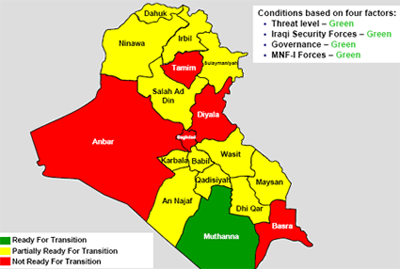
Well, looks like I was wrong about the status of the Kurdish regions of Iraq, and also wrong about which province is going to be handed over next.

The Kurdish provinces are under Iraqi Provincial Control (IPC). It's possible that IPC is the very reason the PKK has had a freer reign in the region, but they are starting to talk peaceful resolution, and the Iraqi government has shut down their recruiting offices. If the PKK issue can be resolved, the north will probably return to relative quiet.

Remember this map is from August, and Karbala has been handed over. That puts us at 8 provinces handed over, and zero "not ready for transition." Compare this to 14 months ago:


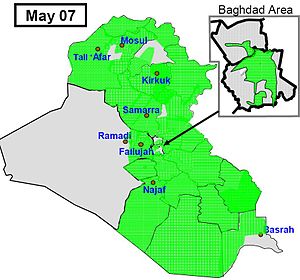
One province handed over, and four "in the red," not ready for transition. Furthermore, Iraqi forces are in the lead in many of the provinces partially ready for transition, and US forces are taking an ever-increasing support role in the war:


The green indicates "Iraqi Army Lead." Notice that in 3 or 4 eastern provinces not yet handed over, they are in full lead. According to the US DoD, Basra is the next province on the list to be handed over-- and they plan to do it by the year's end, making 9 of the 18 Iraqi provinces under full Iraqi control.

Note the change in the rate of handover since the surge:
From Mar 2003 - July 2006 (30 months): 1 province handed over
From August 2006 - Jan 2007 (6 months): 2 additional provinces handed over
From Feb 2007 - Oct 2007 (Surge period, 9 months): 5 additional provinces handed over
From Nov 2007 - Dec 2007 (Projected, 2 months): 1 additional province handed over

Given the violence by province in the first half of the year:


The relative peacefulness of Qadisiyah and Wasit indicates that their transition will come not after a tough putting-down of violence, but after the United States is satisfied with the functionality of the local police force and civil services. They show the potential to be handed over early next year, and Tamim and Babil have shown recent declines in violence that could make them acceptable for handover within months. This leaves the US 5 provinces to concentrate its security operations before domestic pressures bring the troops home:

1) Baghdad. Certainly the most important province in Iraq, I believe Baghdad will be the last to be handed over. Hopefully, the surge will secure Baghdad fast enough (see the first pretty picture in the previous entry) such that post-surge level troops (troop levels will begin to reduce to pre-surge levels in Feb, 2008) can keep the city under control. Baghdad will benefit most from the cascading effect of Iraqi Provincial Control, as more and more US forces in Iraq are likely to move into Baghdad to further pressure insurgent groups. But, if the US is able to hand over most provinces by the end of 2008, the new US president may only have to commit 30,000 or fewer troops in Baghdad to keep Iraq on its feet.

2) Anbar. Anbar has surely shown the most improvement over the last year, due in part to the surge, but mostly to brilliant diplomatic efforts that have brought the tribal leaders of this Sunni-majority province to support the government. Additional provincial attacks charts should illustrate Anbar's improvement well:


Just before the surge, Anbar province was suffering an average of 35 attacks per day.


In the beginning phases of the surge, other provinces showed only some or no improvement, but Anbar had dropped to 25 attacks per day, an almost 30% drop. This was due not to a large insertion of troops, but to a decision by Anbar Sunnis to begin supporting the Iraqi Government. Attacks continue to plummet: notice that in the last Provincial Security Transition Assessment, Anbar, after stubbornly staying in a "not ready for transition" state for more than 4 years, has finally made significant progress towards peace and security, and could soon turn itself from Iraq's biggest trouble spot to a leader role in unification.

3) Salah Ad Din: Home to the infamous Tikirt and Samarrah, it has remained a trouble spot for US forces. The United States must try and spread the pro-government sentiment of the Anbar Sunnis to the Sunnis in Sala Ad Din if it is to calm down. Furthermore, Salah Ad Din suffers from being a relatively large Sunni and Shiite mixing ground, especially in Samarrah. Americans are leading strong efforts to get tribal leaders to sit down and talk in this region, but unfortunately, I don't have up-to-date enough violence-by-province data to tell you whether it's working well or not.

4) Diyalah: A mixing ground of all three major ethno-religious groups of Iraq, Diyalah may be a trouble spot for some time. That said, it has been the second-least-violent of our 5 remaining "trouble" provinces, but the US does not consider the level of violence there to yet be acceptable. This province will be the truest testing ground of coalition reconciliation efforts; that is, given the sheer amount of ethnic mixing, large decreases in violence in Diyalah will truly show that ethnic groups are finally putting aside their differences.

Finally,

5) Ninewah. We don't hear much about Ninewah because, while it is a trouble spot, it has about half the number of attacks on a daily basis than Diyalah. Ninewah is an area of strong Sunni and Kurdish mixing (I think you're seeing a pattern), and contains Mosul, a high-density, high-ethnic-mixing city. Ninewah may well benefit from increased Sunni support-- with Kurds already mostly supporting the Iraqi government, Sunni realignment will likely give the two ethnic groups common ground on which to work, and common goals to work for.

Challenges remain. Al Qaeda in Iraq continues terror attacks against Iraqi civilians, but this may be a sign of leadership failure in the organization. Osama Bin Laden has urged Iraqis to work together to throw the US out, while other elements of Al Qaeda have stubbornly refused to halt terror attacks. As Iraqi tribal groups increasingly turn to crush Al Qaeda, their influence and effectiveness will falter.

Let's talk Turkey: could a Turkish invasion destabilize Iraq? Possibly. But a full-scale invasion is unlikely to happen, and even if military operations do cross the border, fighting between the Turks and Kurds will likely not have much effect on Iraq's 3 biggest trouble spots. The risk here is that either A) the Iraqi government will lose the support of its Kurdish citizens for not protecting them, or B) the Turkish government will see the Iraqi government as ambivalent or hostile to its interests, and Iraq needs all the international (especially neighbor) support it can get. Iraq has asked its neighbors for assistance in solving the matter with strong diplomacy and minimal military operations, and strong US and NATO influence with Turkey is likely to keep them from doing anything rash.

Finally, Iran: is the Iranian government funneling in weapons? Is the Revolutionary Guard conducting operations in Iraq? If so, are these significant? The answers to these are, unfortunately, unclear. But Iran seems to be on the defensive, thanks largely to US and EU sanctions and pressure. The Iranian government is almost certainly looking to expand its power, and certainly wants Iraq as an ally or even a puppet, seeing as Iraq is the only other large, Shiite-majority country in the world. But does Iran have the ability at the moment to expand its empire against the wills of the US and EU? While Russia may be a shaky ally of Iran, its power and influence are slim. If Iran wants to destabilize Iraq enough to force US troops out (as it will have to do before it can think about large-scale imperial efforts), it had better act soon, because trends seem to be in US and Iraqi favor.

Things are looking very good for Iraq at the moment. It seems the favorable trends that the surge has brought will continue through next February. If the US has properly prepared the Iraqi government, police force, and military, then these groups should well be able to take over the administration of security within Iraq, and keep violence to a low enough level that government and business can expand their functionality. If this transition works, the US can start to scale down troop commitments as early as summer of 2008, giving the citizens of the US some much-needed hope and relief, and throwing a wrench in the politics of the 2008 presidential election.

Thursday, November 1, 2007

After 9 Months, Surge Still Working

http://news.bbc.co.uk/2/hi/middle_east/7073160.stm

With US and Iraqi deaths continuing to fall, Baghdad daily looks less like a war zone and more like a particularly violent US city-- far from perfect, but increasingly entering a state where the government can operate. An operating government can start to combat the discontent and hopelessness that the Iraqi people are feeling, which will be key in convincing the Shiites and Sunnis to get along.

Al Sadr's Mahdi army remains at a stand down. But what are the cleric's long-term goals? I am somewhat skeptical that he's suddenly decided to support the US and Iraqi forces. But his motivations seem largely anti-American, so it's unlikely he's simply waiting for the US to exit before he unleashes the Mahdi army on civilians again. I am optimistic in considering that he may have decided that encouraging peace might be the best way to get US forces to pack up and go home. Hopefully, US forces have enough contact with him to keep communicating with his forces and maintain a mutual understanding.

Sunni tribes are increasingly turning their anger towards Al Qaeda, instead of against Shiite civilians. As I said in my last post, Al Qaeda may, paradoxically, become the enemy that unifies the Shiites and Sunnis into forming a strong central government. Osama Bin Laden's last tape shows his clear frustration at the fighting between terror and ethnic groups-- he had been hoping that they would unite and kick out the United States to form an Islamic Republic. It looks, day by day, like the chances of this happening are dwindling.

Hopefully, the Sunni tribes in the Anbar province have a contagious idea. If the majority of Sunnis decide to work with the Americans and Baghdad government, large swaths of all three ethnic factions will be represented, giving the government both legitimacy and functionality.

But really, if things keep going as they're going, the US could be down to a few tens of thousands of troops in Iraq by the next election, and I'm sure the Republicans are eager to see that happen. To better show these trends, I present you pretty pictures:


This shows the sharp decline in violence in Baghdad over time. Note that this only goes to July-- the rate of decline from July to October was even higher than from January to July. Remember this is Ethno-Secretarian Violence, and Al Qaeda anti-civilian terror attacks have not declined at as high a rate.

But is securing Baghdad enough to get most US troops out of Iraq? No, but securing the rest of the country, bit by bit, is. I present 3 more pretty pictures, timelining provincial handover over the last year:


So in Nov, 2006, we had handed over a mere two provinces.


By the beginning of February (the beginning of the surge), we'd only handed over 3. So this is 4 years into the war, we've handed over a whopping total of 3 provinces.


By May, we were already up to 4. In late September, we handed over Karbala-- a province at the Sunni-Shiite border, suspiciously close to both Anbar and Baghdad. An army report (that I don't have the link for, sorry) hinted that Qadisiyah might be soon.

The rate of handover has gone up: we may well hand over 3 provinces in 1 year, which is more than 4 times as fast as the first three that we handed over. Remember also, that if the handovers are smooth (and they have been so far), we get a positive feedback loop: we hand over a province to Iraqi forces, more of our troops are free to quell the violence in other provinces, the faster we hand them over. At the rate we're cleaning up Baghdad, it too could well be handed over by mid 2008.

You'll notice that the three predominantly Kurdish areas of Iraq have been "ready for transition" for at least a year, and yet have not been handed over. This may well be because the Turks have wanted a close eye on northern Kurds for the last 4-and-some years. Now that Turkey is beating its war drums and the PKK is stepping up attacks, who knows what might happen. One thing's for sure, transition to Iraqi provincial authority in the Kurdish north is unlikely to happen for some time, despite being the most peaceful region in Iraq.

So things are looking good. But I'd like to address the doubts of some of my more die-hard opposition with an argument that I've heard often (even quoted in the BBC article that this entry starts with)

Violence is predictably down because of the increased number of US boots on the ground, but will go right back up when the boots leave. I have a few answers to this. First, it's not that militant groups are simply keeping their heads down. The surge is actually killing militants at a very high rate. Despite border leakages, Iraq has a relatively finite number of people who would be willing to become insurgents and militants. While some argue that attacking militants will help their recruiting efforts, groups are unlikely to be able to recruit as fast as we have been eliminating members. Furthermore, while killing militants may cause anger, killing them at a high enough rate may convince potential militants that the risks of joining are just too high. Second, if you're saying this, you're not paying attention to political victories. What groups have caused us the most sectarian trouble in the past? The Mahdi army and the Anbar Sunnis. The Mahdi army has halted all operations in Iraq, and the Anbar Sunnis are increasingly supporting the Iraqi government and hunting terrorists. Shiite and Sunni tribal leaders are increasingly settling their differences in meetings (be they US-sponsored or not). Furthermore, increased security has allowed for increased civil functionality in and around Iraq-- more water is running, more lights are on, more trash is being picked up. A citizen whose needs are taken care of is a citizen that is increasingly likely to support the group that takes care of its needs, and the Iraqi government is beginning to take advantage of the security we are providing to win the hearts and minds of its citizens by returning functionality (to be fair, civil service functionality increase is much slower than we'd hoped, and one of the weaknesses of the surge... but it is improving). So as Sunni and Shiite tribes continually join the government, and hearts and minds of citizens are won over by an increasingly functional government, the motivation to torch an increasingly positive environment with fighting diminishes. When US troops pull out, former troublesome tribes will be cooperators, former militants will be satisfied citizens. Finally, the Iraqi police force and army have been increasing in number, and have gone through significant overhauls, and will have a larger presence when the surge ends than when it began. Not only will they be stronger, but it will simply be easier to put down budding violence as it tries to restart than to try and curb explosive violence that is already the norm of a region.

Ultimately, saying that Baghdad violence will significantly increase when the surge ends is a very similar argument to saying that provincial violence will increase after a transition to the Iraqi forces, and this has been largely empirically untrue. The US army does have the ability, given sufficient numbers, resources, and leadership, to enter an area and reduce long-term violence, and can do so in Baghdad.

My hat goes off to General Patraeus. He has commanded US forces brilliantly in Iraq, and has forged a hugely successful operation in spite of strong congressional doubt, weak political leadership in the executive, and groups of radicals trying to destroy him by calling him a betrayer of the American people.

The surge is working. Those who refuse to see it are as blind as those that refused to see that Iraq has been brought to the brink by our mismanagement in the first place. But now we've got something very good going, and an incredibly competent and capable general conducting the operation. So things are going well. But what does the United States want now? We want the troops to come home as soon as possible. But many have let their hatred for this war and this president blind their understanding of the hard truth: and the hard truth is, we cannot afford to bring the troops home without victory. We cannot allow Iraq to crumble into civil war, we cannot allow it to become a well-armed failed state, cannot allow it to become the primary base of operations for Al Qaeda. Finally, after four long years of foolish management, we have a working strategy, and our troops are bringing us each day closer to victory. Now is not the time to halt the surge, now is not the time to surrender and come home. Now is the time to take our victories and build on them, to clean up the mess we started, to secure US National Security, to turn our greatest military gaffe into a great military success, to build a new ally, to restore the world's faith in our competence and our commitment to doing the right thing. Now is the time to throw everything we've got behind the surge, to pray for our troops on the ground, and to-- dare I say it-- stay the course.