For your reading pleasure, a paper I wrote for a grad class this semester (Politics and Conflict in the Middle East) that goes a bit outside my normal subject material. I explore the political/economic/social feasibility of the Mediterranean Union's plan to drop down a bunch of solar thermal plants in the Middle East/ North Africa (MENA) region. The idea would have 4 potential benefits:
1) Help the EU meet its carbon reduction goals for 2020 and 2050.
2) Reduce European dependence on Russian gas and oil; The EU favors North African politics to Russian.
3) Develop the economies of North African countries.
4) Kick-start solar thermal economy by introducing economy of scale, allowing it to become competitive with fossil fuels. This would allow countries with lots of desert to start producing competitive electricity, and hedge energy needs from oil (which is volatile in price, vulnerable in transport to pirates and the like) to something more stable.
I'm not planning on publishing it, so the paper is accessible here. It is still copyrighted, and all rights are reserved. Some notes are below.
There are some serious issues with the plan, including the fact that it predicts that oil prices will stay the same or go up--if there is a sudden increase in electrical supply, then the price of oil is likely to drop--simple economics. China and India will happily slurp up this cheap oil to power their own economies, and then the EU's hopes of reducing carbon emissions might be undercut. Instead, this project is simply likely to subsidize India and China's industrial development on the backs of European taxpayers. At least it's not me.
Nonetheless, other goals are likely to be met. Europeans will indeed hedge their dependence from Russia and towards North Africa. The economy of scale is likely to allow wealthy nations like the US (with lots of desert of its own) to build its own solar thermal industry, and the EU and US can then supply to areas like the Arabian Penninsula, India, and Mexico. Finally, as long as trade deals are carefully sculpted by the EU, North African countries will likely benefit from the foreign investment. If the trade deals are poorly or sloppily formed, then solar power could become a "new oil"--a cheap source of revenue for tinpot dictators or ineffectual republics that encourages inefficiency, bureaucracy, and central planning. The trade deals will be the most important part.
Showing posts with label Mediterranean Union. Show all posts
Showing posts with label Mediterranean Union. Show all posts
Saturday, December 13, 2008


Sunday, November 2, 2008
Intrigue and Betrayal at Damascus
 The London Times has reported that the Syrian government had approved the US raid within its borders that it is now protesting--but it's a bit more complicated than that.
The Syrians allegedly gave the OK for US commandos to quietly pop in, kidnap a big al-Qaeda leader operating in Syria (that the Syrians sure as heck don't want there), leave, and interrogate him. Clearly, things didn't go to plan, and a number of Syrians died. Now there are pictures of crying family members all over Middle Eastern news.
What can the Damascus government do? They're already taking a fair amount of heat from the more conservative elements of their state for their Westernization efforts--but they've been smart. Their Westernization has been towards less-antagonizing powers like France, and their joining the MedU has allowed them to work with Israel and the European Union under the guise of economic construction. Syria's ties to the West are important mostly because the US is in Iraq--which Syria isn't terribly thrilled about, anyway.
So the operation got botched, and crying Syrian women are on the news--the Syrians, of course, are going to deny that they let such a terrible thing happen. And sure, they didn't really approve the US coming in and shooting people up, that wasn't part of the deal at all. So the Syrians have protested heavily. They've closed the US embassy--at least for now. Quietly, they are probably saying, "Sorry, there is nothing else we can do."
But they're also withdrawing troops from the Iraqi border--which is going to make the border more porous. Early in the war, Syria was quite happy to have a porous Iraqi border--their jihadists and extremists all left to fight and die in Iraq, which was quite fine with them (remember,
 they're a secular Ba'athist regime). But during the Surge and the Sunni Awakening, Western Iraq became less friendly to al-Qaeda and company--so they all started going back to Syria, so they would have a safe haven from which to conduct operations. Damascus had to finally get troops on the border to prevent arms and men from going out, so that the incentive for bad guys to hang out in Syria would be lower.
 Now that the Syrian people are up in arms against the US, the Syrian jihadists are likely to be freshly motivated to go hit the US in Iraq as retribution--so under the guise of diplomatic outrage, the Syrians are quietly letting their jihadists in once more, and they're likely to re-seal the border in a week or two, to make sure that the bad guys don't try to come back after they find that Western Iraq is, once again, not a terribly friendly place to be for terrorists.
The US, obviously, feels somewhat betrayed. Sure, they botched the operation, but to be called out for being "aggressive" or violating Syrian sovereignty, is just untrue. A frustrated Washington is facing an Iraqi parliament using this incident as a new bargaining chip in sapping more concessions from the US in the extended US-Iraqi security pact. There will certainly be some sort of pact by December--moderate Iraqis and Americans know that neither side can tolerate the pact not happening, but many factions in Iraqi parliament are much more willing to play brinksmanship with the pact and get concessions for their particular party/sectarian group--all they need is just enough diplomatic legitimacy to do it, and the Syrian raid incident has given it to them; the US military will ultimately bear the brunt of this foul-up.
But the Syrians did make one mistake. If it's clear to US allies that Damascus gave the go-ahead for the raid, then US allies that Syria depends on are likely to make Assad's life difficult. For example: The UK quickly canceled a joint conference in London with the Syrian government after the raid--a confusing move at the time, but one likely meant to show Syria that London is not as quick to sell out Washington as Damascus may be. More importantly in the long-term, the ascent of Sarkozy in France has turned Paris into a strong Washington ally (and Bush ally, even). As head of the Mediterranean Union, and the key to Syria's entry into the Western fold, Sarkozy's voice has a lot of sway in Damascus.
Nothing terribly decisive is likely to happen until Bush is out of office, and puzzle pieces can't really fall into place until the Israeli election happens, either. But the decision in Damascus to sell out the US to keep itself from facing heat domestically is likely to have unforseen diplomatic consequences, for both the US and the Syrians, independently of each other. All in all, it was probably a bad decision. The Syrians could have claimed that there was a miscommunication, and that the US had mistakenly come over the border. Clearly, Damascus can't admit that it gave the US the go-ahead to enter Syrian territory, but to put the maximum possible blame on the US was not necessary to save face. If Damascus wants to Westernize, it needs to be able to take a stand with the friends it wants to make, and not sell them out at first convenience. Friends don't always get along, and the US in particular is a friend with liabilities in the region. But it comes with the territory--one has to take it or leave it.
Sunday, July 13, 2008
The Mediterranean Union
Sarkozy is starting his presidency of the EU off with a very strange bang. His attention has  quickly turned south, away from the EU that he is supposed to be safeguarding, and towards an entirely new Union, formed just this weekend: The Mediterranean Union. Sarkozy clearly has the role of "leader" at this point: he made the negotiations for the Union, and heads the largest and most powerful country in the Union. Having primary leadership precedence over the Union would give the French a renewed international standing that they have lacked since their thrice-licking by Germany in the late 19th and 20th centuries. Syria, Israel, Lebanon, and Egypt, are of great importance to peace and stability in the Middle East. And keeping them bound by agreements for peace and cooperation in a particularly pro-Western manner (in which they have pledged their support for democracy and human rights in the Union already) will mean that Sarkozy could thrust a united front at Iran to keep it in line, and keep the Middle East stable.
Sarkozy also hopes to preside over the development of massive solar farms in North Africa. He would likely be able to achieve precedence to French alternative energy companies to begin development there, if he strikes the deal. But the implications of all this are not entirely rosy. Sarkozy is now presdident of the EU, and has a great responsibility to the largest economic bloc in the world, even if he does not have great power over it (particularly thanks to the crippling defeat of the Irish "No" vote). His warm embrace of the Mediterranean Union is not making all members of the EU happy, particularly Germany. The EU is an institution where each country has very little say in the entire operation of the bloc, and without a strong presidency, Sarkozy himself will be able to do little for the bloc besides try to influence monetary policy. EU countries see the Mediterranean Union largely as a way for France to distance itself from the possibly-failed politics of the EU and start a bloc of countries both large enough to be important and small enough that France can lead. And surely, this is part of what they are doing. But would Med.U members get access to EU markets through access to France? Would there be a leaking in, a hole through France where the economies of these two blocs start to meld? EU countries are concerned, and it depends largely on what the southern cousin of the EU plans to do with its policy. So far, it is even less powerful than ASEAN, but it hast just started. If Sarkozy can get these countries to cooperate, there may be huge economic impact. Interestingly, Turkey's acceptance to the Med.U may hurt its chances in the EU, but it may be hedging its bets.
Nonetheless, what Sarkozy has done is pretty impressive. For all his failings in his home economy, he has done wonders with Diplomacy, in that classic French style that was completely missing from the Chirac presidency. Even modest leadership power over such a region would start to largely resemble the Roman Empire--the only thing missing at this point is England and some Balkan states. But the Med.U could mean great power for France and Sarkozy in the future, and could make them the continential powerhouse of Europe once more--when there has been none since the second World War besides the Soviet Union, and then only through conquest. Furthermore, bringing Israel, Syria, Turkey, Lebanon, Egypt, Libya, Algeria, Tunisia, and Morocco into a Western-style bloc will turn them to re-focus their viewpoints and foreign policies, and leave the Middle East rifted enough that Iran will be unable to dominate it. Not only will the Med.U resist Iranian intervention, but the Union is likely very bad news for Hamas and Hezbollah, which have been Iran's tools of terror and control for decades in the western part of the Middle East. Iran's day may be coming to a close--this, along with a potential Syrian peace deal and an agreement on Iraq are likely to leave Iran a long-term small-dog on the international scene.

So in one swift stroke, Sarkozy has defied the EU, given himself a legacy and France great power, cut the legs out from under Iran, and given the Middle East the potential for peace that it has not had in millennia. Not quite the Roman Empire, but not a bad start.
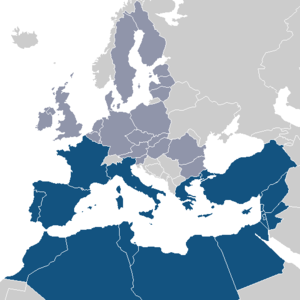 quickly turned south, away from the EU that he is supposed to be safeguarding, and towards an entirely new Union, formed just this weekend: The Mediterranean Union. Sarkozy clearly has the role of "leader" at this point: he made the negotiations for the Union, and heads the largest and most powerful country in the Union. Having primary leadership precedence over the Union would give the French a renewed international standing that they have lacked since their thrice-licking by Germany in the late 19th and 20th centuries. Syria, Israel, Lebanon, and Egypt, are of great importance to peace and stability in the Middle East. And keeping them bound by agreements for peace and cooperation in a particularly pro-Western manner (in which they have pledged their support for democracy and human rights in the Union already) will mean that Sarkozy could thrust a united front at Iran to keep it in line, and keep the Middle East stable.
Sarkozy also hopes to preside over the development of massive solar farms in North Africa. He would likely be able to achieve precedence to French alternative energy companies to begin development there, if he strikes the deal.
 But the implications of all this are not entirely rosy. Sarkozy is now presdident of the EU, and has a great responsibility to the largest economic bloc in the world, even if he does not have great power over it (particularly thanks to the crippling defeat of the Irish "No" vote). His warm embrace of the Mediterranean Union is not making all members of the EU happy, particularly Germany. The EU is an institution where each country has very little say in the entire operation of the bloc, and without a strong presidency, Sarkozy himself will be able to do little for the bloc besides try to influence monetary policy. EU countries see the Mediterranean Union largely as a way for France to distance itself from the possibly-failed politics of the EU and start a bloc of countries both large enough to be important and small enough that France can lead. And surely, this is part of what they are doing. But would Med.U members get access to EU markets through access to France? Would there be a leaking in, a hole through France where the economies of these two blocs start to meld? EU countries are concerned, and it depends largely on what the southern cousin of the EU plans to do with its policy. So far, it is even less powerful than ASEAN, but it hast just started. If Sarkozy can get these countries to cooperate, there may be huge economic impact. Interestingly, Turkey's acceptance to the Med.U may hurt its chances in the EU, but it may be hedging its bets.
Nonetheless, what Sarkozy has done is pretty impressive. For all his failings in his home economy, he has done wonders with Diplomacy, in that classic French style that was completely missing from the Chirac presidency. Even modest leadership power over such a region would start to largely resemble the Roman Empire--the only thing missing at this point is England and some Balkan states. But the Med.U could mean great power for France and Sarkozy in the future, and could make them the continential powerhouse of Europe once more--when there has been none since the second World War besides the Soviet Union, and then only through conquest. Furthermore, bringing Israel, Syria, Turkey, Lebanon, Egypt, Libya, Algeria, Tunisia, and Morocco into a Western-style bloc will turn them to re-focus their viewpoints and foreign policies, and leave the Middle East rifted enough that Iran will be unable to dominate it. Not only will the Med.U resist Iranian intervention, but the Union is likely very bad news for Hamas and Hezbollah, which have been Iran's tools of terror and control for decades in the western part of the Middle East. Iran's day may be coming to a close--this, along with a potential Syrian peace deal and an agreement on Iraq are likely to leave Iran a long-term small-dog on the international scene.

So in one swift stroke, Sarkozy has defied the EU, given himself a legacy and France great power, cut the legs out from under Iran, and given the Middle East the potential for peace that it has not had in millennia. Not quite the Roman Empire, but not a bad start.
Subscribe to:
Posts (Atom)