Showing posts with label IS. Show all posts

Tuesday, March 31, 2015

Tikrit Falls to Iraqi Forces; US Solidifies Role as Leader Against ISIS

Tikrit has fallen.


Mop-up operations are underway, but the Iraqi national flag now flies over the city, and ISIS is broken.

Iraqi forces should be moving quickly north to secure the Baji road and oil refinery before securing, regrouping, and supporting Ramadi to make sure the ISIS advance there is halted. And then, of course, there will be a few-months' ramp-up to take Mosul.

Key Takeaways:

The advance into Tikrit was halted around March 6th as the army/Shiite militias faced heavy sniper fire and dug-in pockets of resistance.

US airstrikes started up just under a week ago after the Iraqi government requested the support to break ISIS resistance. Those airstrikes prompted most of the 20,000 Shiite militiamen--who generally don't like the US and see themselves as more closely aligned with Iranian interests--to boycott the siege and go home, leaving about 3,000 Iraqi Army troops, 1,000 Sunni fighters, and about 2,000 Shiite fighters. It left a lot of glaring holes in the siege.

But the airstrikes proved decisive.

After softening ISIS targets (which had probably thought themselves unlikely to have to face such airstrikes), the US suspended its operations and the Shiite militias quickly came back to launch the final assault.

The city fell one day after the air campaign, after 3 weeks of no progress.

The US is gloating a bit, and with good reason. US officials are taking the opportunity to show that Iran can't alone support the Iraqi advance. This is a precedent-setting kind of event: the US was "snubbed" last month when Iraq's government moved into Tikrit with Shiite militias and Iranian ground support, without informing the US or requesting support.

Giving in to request the support was a sign the Iraqis had realized they need it. The fact that the city was taken so quickly after the strikes cements the US' future role.

This means one of two things: either the US and Iran will work more closely together, or the Iranians will have a much-reduced role in the Iraqi offensives in the future.

This cementing also means that the US is going to be leading the assault on Mosul, which is about 20x larger than Tikrit and has many more ISIS fighters dug in. It's clear that the Mosul operation is a non-starter without that air support.

Shiite militias will make a lot of noise about not needing the US, but I do believe that Tikrit will be weighing heavily on their minds when they are planning the Mosul advance, and that despite the high tensions, the militias will begrudgingly go in with US air support.

It's worth noting: Tikrit probably had far more than the 2,000 ISIS fighters initially estimated--the Iraqi government cites about 13,000, but this is probably inflated. The good news is that this means the Iraqis have shown that they can win with about 2:1 odds, rather than the 10:1 or 15:1 previously thought. Mosul also has about 12,000 ISIS fighters, so the fight will not be an order-of-magnitude difference (though will obviously take much longer and be more complicated due to Mosul being about 20x larger in land mass).

But ongoing US airstrikes are making it hard for ISIS to dig in as deeply as it would like, and the ISIS governor ("Prince of Mosul") and Mosul's top ISIS military commander have both been killed by airstrikes.

Thursday, March 12, 2015

Iraqi Forces Enter Tikrit; Victory Looks Certain

Iraqi forces have Tikrit surrounded, after a week-long slog of clearing out bombs and snipers along the roads leading into the city.

They are entering the city from all sides now, attempting to squeeze out (and ideally eliminate during retreat) ISIS forces holed up inside. I believe at this point that victory is fairly inevitable, and that they'll move on next to clear ISIS forces currently combating government / Shiite troops in Baji. Expect the area below to become quite red after ISIS forces break.


The going will be slow now that they're in the city: ISIS predicted this was coming and scattered snipers and booby traps throughout the city, in the hopes of causing enough casualties to break the spirits of government troops.


(Twitter user @PetoLucem has a great chronological progression of government advances in Tikrit over the past few weeks, via Stratfor)

But it won't happen. The most important part of this offensive is that Iraqi forces do not break and run, and I suspect they won't. Iraq has hand-picked more reliable forces for this offensive, and the backing of very zealous Shiite militiamen and Iranian Quds forces is going to keep morale high as they demonstrate high morale and relative courage in the fighting. The total forces assaulting the city number a staggering 30,000, which likely outnumbers ISIS forces by about 10:1. There are just so many weapons pointed at ISIS forces that they will eventually get squeezed into defeat.

Expect the city to be cleared in 1-2 weeks as forces very slowly and carefully move house-to-house, hoping to minimize casualties. Baji will fall more quickly after that; it has many fewer ISIS fighters and government forces are already in the city, which will prevent the kind of entrenchment that ISIS was able to manage in Tikrit.

Implications
ISIS' days in Iraq are numbered, I think. Tikrit will be the victory the Iraqis need to build the morale and template for taking Mosul, which will allow them to turn their attention to Ramadi and Fallujah--those will be the hardest fights they have, but they'll have momentum on their side: Iraqi forces will inherit ISIS' air of inevitability.

ISIS' aura of inevitability and terror is starting to fizzle as they begin to lose to superior firepower, numbers, and training. That loss will hurt long-term recruiting, which means they'll actually be ground down to the point that they'll have to revert to asymmetric warfare (they set of 12 simultaneous car/suicide bombs in Ramadi and one bomb in Baghdad to try to disrupt the assault on Tikrit, for example). But because ISIS is claiming to be a caliphate, their authority erodes if they don't hold territory.

With victory coming, the most important factor in this advance is making sure that Shiite militiamen don't use this opportunity to carry out sectarian revenge killings. If they're able to keep their cool (and so far it's looking like they are, but the hard part will be after the main fighting ends) and leave Sunni civilians alone, the prospects for Fallujah and Ramadi will improve as Sunni civilians there begin to hope that government forces are a viable alternative to ISIS (they had previously probably helped ISIS to take hold there because they were so frustrated with Shiite rule in Iraq, but ISIS became more than they had bargained for).

Meanwhile, the Kurds in Syria continue a slow, steady slog towards the Tall Abyad border crossing with Turkey, which would close down a supply and reinforcement route (for foreign fighters) into Syria.


Tuesday, March 3, 2015

Quick Update: Advances Against ISIS, and What to Expect in Tikrit

Readers keep telling me they love the maps, so you get maps and a bit of "implications." We'll also touch very briefly on Tikrit.

1) Kurdish forces out of Kobane have successfully pressed ISIS out of the space west of Kobane by trapping them against the river/lake and eliminating them. They've made modest progress in the east but I think we can expect the Kurdish forces to shift a bit south, but mostly east, to capture Tall Abyad crossing and cut off a supply line for ISIS from Turkey.


2) In northeast Sryia, ISIS has totally collapsed. That huge box on the right was all formerly ISIS, right up to the southern edge of that big red blotch (government fighters). It appears the Kurds and government troops have a truce, which has allowed them to push out. There is likely a bit of a "race" to secure space around Hasakah between Peshmerga and government forces. We also see in the western box that Kurdish forces have successfully crossed a river and are assaulting villages there, likely hoping to scoop up the smattering of black just to the south.


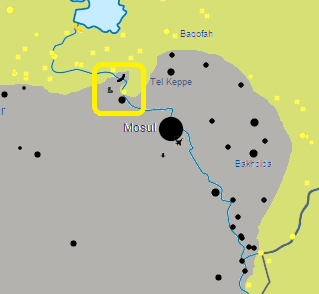
3) From the department of "great things come in small packages," the Kurds have successfully captured the roadway and villages around the bridge where Route 1 crosses the Tigris, cutting Mosul off from its most direct western supply line. This is a form of kicking the proverbial hornet's nest that may bring ISIS fighters out of dug-in fortifications to try to take the highway back. They're going to have plenty of time--Iraqi forces will be bogged down in Tikrit for a while.


4) Iraqi forces are probably trying to encircle Ramadi by taking villages to its north (lower-left box) and have entered Tikrit. In Tikrit, government forces are similarly trying to encircle the city before moving in, and are being slowed down by roadside/car bombs and suicide bombers. The little black dot south of Tikrit is being shelled at time of writing, and the dot to the north of Tikrit is being de-bombed.

Once Tikrit is surrounded, it may take up to a month to move in and finish off ISIS forces. Iraq is sporting 25,000 troops between regulars, Shiite militias, and Sunni militias. They likely outnumber ISIS forces 10:1--but just remember that Iraqi forces had similar odds when they were overrun in Mosul last summer.


Iran is supporting this operation rather than the US, which means no air support. It's clearly not an experiment ("can Iraqi forces handle this on their own?")--now's just not the time to be having such experiments, as Tikrit is probably the junior varsity version of trying to take Mosul.

What's more likely--I think--is that Iraq and Iran are going alone, without US "permission." Iraq has been frustrated with coalition support and it's possible (though I have predicted otherwise) that the US announcement of the Mosul offensive created some distrust--Iraq may have decided that the US couldn't be trusted with the intel.

Evidence suggests the US wasn't even told about the offensive--a US general said that the offensive was "no surprise," which is very different from saying "we're in the loop."

It'll be great news if Iraq can take Tikrit without US air support, though there are huge complications with making this a "Shiite" operation--Shiite militia abuse is a big part of why ISIS was able to get traction in western Iraq in the first place.

But we'll deal with that another time.

Thursday, February 26, 2015

Short: Why is Libya Important to the Islamic State?

Reader Nathan asked if I would make a Libya post and then, helpfully, gave me some truly awesome source information. Thanks, Nathan!

The big question here is: why ISIS is putting so much effort into expanding into Libya when it's losing ground in Iraq and having mixed success in Syria? (To elaborate a bit: ISIS does need to put recruiting, training, and physical resources into Libya, and foreign Jihadis going to Libya aren't going to Iraq/Syria to reinforce there, so it's definitely an investment.)

The article starts with a translation of an ISIS strategy document, which outlines to ISIS and fellow Islamic extremist groups the motivations for going to Libya.

I'll briefly sum up the main points below, but the key takeaway is that ISIS isn't looking to Libya primarily or urgently for attacks in Italy. Despite its apocalyptic machinations, ISIS' first priority is to actually establish the Caliphate: to them, that includes a very ambitious plan that is way bigger than the previous Caliphate of the dark/middle ages.


Adding to this of course are the gains that the Ottomans made in the 1200s-1400s that included areas in India, the rest of Turkey, the known Muslim areas in northern Africa, and some of the Balkans. IS wants all of this stuff and, for whatever reason, all of India. Why IS would want to rule India is not yet clear to me.


The summary of the strategic document, in short:

  • The Islamic State really does want to cover all of the Muslim World
  • Libya is a window of opportunity: the strength of militants, rise of Jihadi groups, and government division mean that IS can establish a foothold there
  • It's under less pressure than Iraq and is a pretty free operating space for regional operations (where IS is on the defensive in Iraq and still under lots of bombing/Kurdish pressure in Syria)
  • It has access to nearby states that IS wants to spread to, many of which have potential allies (particularly Niger, Mail, and Algeria)
  • It has access to battle-hardened recruits in Libya, Algeria, and Sudan [added after post]
  • Indeed it does have access to Southern Europe--there are human trafficking operations that could more easily move militants to Italy and elsewhere for expanded terror operations--probably "some 20 militants shooting up Rome for a few hours" kind of mayhem

Tuesday, February 24, 2015

Is the President's Request for Authorization of Force the Right Package? Is the Mosul Announcement Crazy?

(Total reading time: about 10 minutes)

Reader Andrew asked me for my opinion on the efficacy of the Authorization for Use of Military Force (AUMF) that President Obama requested from Congress earlier in the month.

Part of what prompted the question was an email from Andrew's representative Michael Capuano (D-MA) stating why he was against the authorization as-written. In short, his objections:

  • "Half measures are a recipe for failure and this resolution is a half measure." It doesn't allow US forces to take part in military operations necessary to win
  • The US' record in the Middle East usually includes success on the ground followed by disaster--either quagmire (Afghanistan and Iraq) or post-war collapse without us there (Libya and post-2013 Iraq); there's currently no plan on how to make this work
  • The US is not directly threatened by ISIS; we could play a support role for more directly threatened nations (Turkey, Jordan, Saudi Arabia) that lead the assault, but leading it does not make sense from a national security perspective
Presumably if Jordan/Egypt/Turkey/Saudi Arabia (along probably with the UAE, Kuwait, Bahrain, and Qatar for good measure) led a ground force, they'd be stuck with managing the aftermath--good both because the US doesn't have to get stuck in another quagmire and also because these countries will have a better chance of managing the peace (more cultural affinity and "pulse" of the situation). Spoiler alert: they probably won't.

Before I add my two cents, let's review a very brief summary of the draft sent to Congress.

Key Points of the AUMF

  • The AUMF is for 3 years (a year beyond the remainder of the President's term) and has no geographical restrictions
  • It's clear enough that it's specifically ISIS-related that it probably can't be used to go after every terrorist organization out there (I'll leave out commentary on the 2001 "Global War on Terror" AUMF and the question of constitutionality of recent operations)
  • Ground forces can advise local troops, conduct search-and-rescue operations for coalition members captured by ISIS, coordination for airstrikes and allied ground movements (think: helping coordinate airstrikes to soften targets for Kurdish advances), and "special operations" (SEALs and whatnot) to take out ISIS leaders
  • Ground forces cannot participate in "enduring" (this is probably intentionally vague) offensive ground operations...
  • The 3,000 troops in Iraq are exempt from this restriction, meaning they'll probably be participating in the Iraqi spring offensive


It's Actually Pretty Good

After reading Rep. Capuano's letter, I was feeling pretty prone to side with him on opposing the AUMF for similar reasons. I'm generally critical of the President's half-measures to deal with problems like Russia, Syrian chemical weapons usage, and other matters.

But I've changed my mind. I think this is a solid AUMF.

I do think there's a clearer plan in place than Capuano believes, but also that requiring too clear a plan before authorizing force is unreasonable. The President's military advisers need the freedom and flexibility to formulate and adjust a plan over time, and the AUMF gives them the green light to move when they're ready--it does not require that any particular action happen now.

Let's talk a bit about what might happen under the AUMF.

Offensive in Iraq

The plan for Iraq is incredibly clear and pretty sound. We've already seen that airstrike coordination in Kobane was critical in helping the outnumbered and outgunned force turn the tide (and continues to help in the counter-offensive). The 3,000 US troops should be a huge boon--both for morale and effectiveness--if they join the assault on Mosul. And they should. In fact, while it's not been announced, I suspect the wording of the AUMF makes it very clear that this would be the plan.

Mosul has about 2,000 ISIS fighters holding it right now. 25,000 Iraqi and Kurdish Peshmerga forces are going to be thrown at the city, and the big question is whether the Iraqi fighters are going to break and run as soon as ISIS troops sneeze. I believe very much that having US soldiers in the trenches--along with witnessing well-timed airstrikes just before the assault--will keep Iraqi troops confident enough to point their guns in the right direction. House-to-house fighting sucks, and ISIS is going to make it very hard for civilians to flee (making airstrikes tougher). But the Iraqis and Americans can take their time and regroup in safer areas if they get beat up in any parts of the city.

The big question is that since it's been so broadly announced, will ISIS try to shore up defenses in Mosul? Maybe. The President has gotten some funny looks from the news media and some politicians, and even the Iraqi government: "why the heck would you tell the enemy they have 2 months to fortify your primary target?" It seems totally backwards. One generally doesn't tell the enemy the time and location of one's next offensive.

Once again, I think there is some subtlety at play that is lost in the knee-jerk reaction.

One thing that we must keep in mind is that coalition forces have total air dominance. The US is hitting targets in Mosul probably as you're reading this, and probably while you're sleeping, too. So obviously the coalition has a few months to "soften" Mosul.

But what about a flood of reinforcements? Let's take a look at the region around Mosul:

Thanks for being awesome, Wikipedia

Mosul has some space around it where it could draw fighters back from the front line--I don't know how many are there, but they're actively fighting Kurdish troops in the east, so if they turned tail, the Kurds would be able to recover some territory and place heavy guns within striking distance. At a rough guess, I'd say the local villages, if abandoned, could beef up Mosul to about 4,000 troops. Remember that while these guys are zealous-and well-armed, they are not particularly expertly trained and don't have military intelligence to help at all. The intelligence gap was probably a big part of why the US was able to lead the Kurds so effectively to pick off fog-blinded pockets of ISIS resistance in Kobane.

But obviously the concern is that reserves from other places not under pressure (like ar-Raqqah or elsewhere) could send columns of these guys and turn Mosul into a bloodbath. Let's look at Mosul another way to consider this:

Thanks, Google Earth and MS Paint

Around Mosul is a whole bunch of wide open desert, and I can guarantee you that desert has a few drones circling overhead constantly (for those who have seen the movie "Zero Dark Thirty," recall the drones constantly circling over Bin Laden's hideout for a few hundred days), taking a look at those two roads coming in from the west and south in addition to scouting targets for US airstrikes.

If anyone out there has a good idea of how to sneak in hundreds of troops or dozens of heavy weapons along those highways, I'd love to know (leave thoughts in comments). But I really don't think it's possible.

And here's what I really think is going on; if I'm right, I tip my hat to the administration:

I believe the President is trying to goad ISIS into trying to reinforce Mosul. 

"Wha?"

If a huge column of trucks and heavy weapons starts rolling from more fortified positions, it will have to travel through a lot of desert and be exposed for at least 3 hours (if coming from the closest ISIS town, al-Qamishili).

Thanks, Google Maps.

American or Jordanian fighter-bombers can get where they need to go in about 30 minutes.

If the coalition doesn't totally blow it, Route 1 would become 2015's Highway of Death.
Thanks, Wikipedia

Is ISIS going to fall for it? Maybe. As we talked about in an earlier post on Kobane, ISIS' power comes from legitimacy and a sense of divine inevitability. Taking Mosul made it horrifying and seemingly irresistible. But nobody likes betting on a loser, so their recruiting (and intimidation) strategy depends in part on winning. I'd be surprised if ISIS was really willing to let Mosul go without a big fight. Furthermore, if they were able to defeat the best efforts that Iraq/the US could put up to root them out of Mosul, it would be a massive symbolic (and military) victory that would probably convince the Iraqis that resistance is just totally futile. There is a whole lot at stake, and I'd be mighty surprised if ISIS was willing to commit to a fight they're probably going to lose.

So it could work. It's even possible the Iraqi defense minister is actually in on the plan and is complaining to make ISIS think reinforcing is a good idea. If so, once again: well done.

The other option, of course, is to abandon Mosul if it looks like it's unwinnable and not suffer a humiliating military defeat. If ISIS believes Mosul is doomed, it is unlikely to cling to the city. There's some evidence it might be thinking this way: ISIS is apparently ditching the big base south of Mosul that they have held for 7 months. The announcement about the Mosul offensive may mean that ISIS would want to focus forces for a counter-attack elsewhere that is not under heavy bombardment and scrutiny, to keep the Iraqis off-balance.

Fallujah, Tikrit, and other areas along the Euphrates in Iraq will require significantly more work than Mosul. Think of Mosul as a place the Iraqis can cut their teeth and gain some confidence for the real work ahead in Sunni-dominated regions.

What about Syria?

Syria is a theater that remains somewhat impervious to anything but a massive ground invasion. I'll repeat: the government and rebel forces aren't going to do it until the civil war resolves in some way, which won't happen for years. The Kurds could pick up territory once the Iraqi Peshmerga forces get relief from the Mosul offensive.

We've seen that the Kurds are perfectly willing to occupy territory outside of their primary ethnic strongholds (see the map below--they're currently occupying Kirkuk and northwest Syria) and so may push in northern Syria to create buffer space. 

CIA, via Wikipedia

But the Kurds simply have no interest in moving to the Euphrates, where ISIS is strong and rules with total impunity. I really just don't think anyone at all has a plan to deal with Syria, and the AUMF only sets up the administration to make a move if the Syrian political situation changes or Jordan/Syria/Egypt get fed up with ISIS hanging out next door and decide to go on a major ground offensive. 

It's possible that success in Iraq will be inspiring and that Jordan, which remains incredibly pissed off, and Egypt, similarly pissed off about 21 Copts being similarly brutally murdered, could decide it's just plain time to lend serious military support to Syria on top of the current airstrikes. 

But, frankly, their armies are small and their economies stretched, and they'd only enter Syria if the civil war ends and moderate forces can finally unite against ISIS.

I'll maintain that if ISIS falls in Syria, its ill-advised strategy of trying to bring Jordan and Egypt into the fight will be part of its undoing.

Libya

Libya's divided forces have opened the door for continued ISIS expansion, which now holds 3 towns (2 weeks ago, it was only Derna), having added Sirte and Nofilya. 

Seriously, Donate to Wikipedia

The grey (in Benghazi and elsewhere) is Ansar al-Sharia, who is a totally different (but ISIS-friendly) menace not covered by the AUMF. (Syria has similar pockets of these guys, though right now they're not really fighting with the "good guy" rebels, so we're making the same mistake--as with ISIS--of leaving them alone "until" the "good guy" rebels win.)

Jordan and Egypt want the UN to authorize force in Libya to nip ISIS' presence there in the bud. Egypt is already putting down airstrikes, but now that Libya is in ceasefire, it's a prime place for US special forces, trainers, and airstrike coordinators to help the Tobruk government take back Derna.

A Bit of Good News

And just because everyone likes a bit of good news: ISIS has been totally pushed out of the Baghdad environs and is getting pinned up against a river by the Kurds near Kobane. 

New territory from last week in Kobane circled in yellow.

 Still Wikipedia

New territory gained by the Iraqi government over the past 6 weeks circled in red.
I'll let you guess where I got this one

The Iraqi forces are already pushing back pretty steadily, which is a sign that, despite everyone freaking out about readiness, the Iraqis are showing they can put the fight to ISIS and win.

If you got this far, thanks for taking the time. Leave me some comments about what you want to hear about next, either about ISIS or otherwise!

Update! Kurdish Peshmerga Forces Working on Cutting Off Mosul

Reader and generally-smart-guy Shir shared with me this great article and map showing a Kurdish advance on Route 1, which ISIS is using to resupply Mosul. We discussed above the risk of sending big columns down that road, but if the Kurds can hold the area for the next few months, getting military and support resources to Mosul will be a lot harder and more dangerous--they'd be much more open to ambushes from the Kurds and airstrikes from the Americans. It makes the assault on Mosul a much more likely prospect.


The Washington Post and I seem to have some agreement on the general strategy for isolating Mosul from reinforcement in the coming counter-offensive. Exciting stuff. Expect me to be blogging obsessively about it.

Wednesday, February 18, 2015

The Atlantic's Must-Read Article on ISIS

For all that my (and everyone else's) general disgust of ISIS tends to cause us to only see the psychotic thuggery of their movement, it is very much worth getting into the heads of these guys in order to consider how to defeat them. Tens of thousands have flocked to the "Caliphate" to wage an endless religious war of constant expansion, very much trying to mimic the expansion of the Caliphate during and after the reign of Muhammed himself. There is something terrifyingly appealing about ISIS in a way that previous extremists just did not have, and it is important to understand their appeal and purpose: these have been the reasons that ISIS has been so frighteningly successful where other attempts at creating extremist Islamic states have failed.

While I am a bit bashful at my own previous lack of curiosity around the theology behind ISIS, I was finally enlightened when a friend shared an article by The Atlantic that is, I think, the most impressive single foreign policy article that I have read in years.

Throughout, the article has a great discussion about the appeal of ISIS's extreme (but not out-of-left-field) interpretation of the Koran.

An interesting digression one could have in response is philosophical. Nietzsche predicted that the modern age (after the "death" of God) would bring about, on the one hand, a sad sort of hedonism ("just enjoy life") and on the other, incredibly destructive fanaticism as a reaction. The natural human need to be part of something bigger than having material comfort and enjoyment--as offered in the West--makes the kind of insanity that is fascism, communism, or religious extremism appealing. The desperate human craving for meaning to our lives makes us susceptible to giddily throwing our lives--and the lives of others--at the State, the People, or God, depending on the circumstance.

In these cases, flexibility is impossible: if someone else's creed is just as plausible as mine, then mine cannot be The Truth, and thus my sacrifice and effort are meaningless.

ISIS has much greater appeal than al-Qaeda: the latter is merely fighting, the former is creating the Caliphate itself and even bringing about the apocalypse of the crude and corrupt material world to finally create God's kingdom on Earth (which from any millenialist perspective is the most important of things).

There has been much writing on the topic (perhaps most famously by Samuel Huntington in A Clash of Civilizations), but I think we must be prepared for religious extremism to be a matter of extended worldwide ideological struggle in the way fascism was in the mid 20th century  and communism was later. The madness and barbarism that is ISIS, al-Qaeda, and all of its fellow affiliates plaguing almost the entire Muslim world will not be stamped out by drone strikes, and the message of "freedom" will do worse than fall on deaf ears: it will reinforce their concept of the total moral bankruptcy in the modern "just have fun" society.

Tuesday, February 10, 2015

I'll Pat My Own Back: Kurds On The Offensive Out of Kobani

As predicted, the Kurds are on full offensive after retaking Kobani.

They've taken back a bit over 1/3 of the villages around Kobani at this point, and are looking to round out all 350 or so.

Many of the villages themselves aren't particularly strategically important to ISIS, so the Kurds sometimes face limited resistance. They're getting the most resistance to the west, as Manbij (the larger town to the west) and the Tishrin bridge (to the south) are critical for ISIS to be able to resupply Aleppo from ar-Raqqah.

As far as total land area, the Kurds appear to have made modest progress so far...


But let's compare to Jan 27th--a mere 14 days ago.


I predict that in another two weeks, the Kurds will have taken back the Tall Abyad crossing, enabling them to link up with other Kurd forces in the east, reinforcing their more modest progress (but note that it is indeed positive progress; ISIS may be retreating from this area and consolidating).

This operation is, of course, being heavily supported by US airstrikes to soften each advance. It's not clear to me whether the US is able to take advantage of retreating ISIS units to hit them in open field when they retreat, but the US and Kurds have so far been very well-coordinated. The Kurds may also be more tolerant of civilian casualties from military action and less likely to be upset with the US for strikes that have collateral damage.

Jordan has also gotten deeply involved, beginning its revenge campaign against ISIS. The effort has been tremendous: 56 strikes were carried out in the first 3 days against barracks, weapons depots, fuel depots, and training centers. Jordan, after declaring "this is just the beginning," has certainly carried out more since then, even utilizing UAE fighter-bombers in the effort. Likely they are working on targets somewhat further from the action as it would be a bit tougher for them to coordinate with the Kurds as well as the US and hit targets with an equal amount of precision (both in timing and location).

Jordan makes the possibly-outrageous claim that it has killed 7,000 fighters and eliminated 20% of ISIS' capability. I am skeptical specifically because I would be surprised that the first 4 months of air campaign (with over 3,000 attack sorties) would have left that much low-hanging fruit.

But even if these numbers are inflated (and I don't know that they are), it's causing massive mayhem and disruption for ISIS, and it will struggle to effectively reinforce forces near Kobani and even those in northern Iraq--much less counter-attack--as the Kurdish assault from Kobani continues and the Iraqi offensive (with Iraqi army regulars, allied militias, and Kurdish fighters) towards Mosul begins in a few weeks.

Jordan's blistering response and moral leadership in the fight against ISIS also opens the political door for NATO to take a bigger role--frequent bombings over both Iraq and Syria are becoming the norm, and we can expect the US to try to repeat its Libya strategy of softening targets and harassing/eliminating heavy weapons (tanks, artillery, gun emplacements, etc) as the local ground forces push forward.

Things are looking somewhat hopeful for Iraq and northern Syria, but the fight will be far from over. Ar-Raqqah is still immune from takeover, as no force currently exists that can muster the forces to take it (again, the Syrian regulars and rebels are too busy fighting each other), and even if it does fall, we've learned from both Libya and Iraq that winning the war is only the beginning of bringing peace.

It's also worth noting that Jordan's response has been so decisive--and its population so supportive of the action--that ISIS' strategy to bring Jordan deeper into the war may be backfiring tremendously.

Tuesday, February 3, 2015

Why the Horrifying ISIS Murders?

ISIS is a real challenge to postmodern thinking that there aren't "good" and "evil," but simply people with differences, psychologies, and ingrained senses of groups. They are an almost comical caricature of what we consider to be evil for evil's sake. They leave no middle grey ground the way that enemies often do. Not since the Nazis has the world had such a large spectacle.

The most gruesome of ISIS' evil behaviors are its televised murders of hostages--often civilians (like reporters). British and Americans have been targets, which might seem to make sense: the message might be "stay away or we'll do gruesome things to whoever ends up in our grasp."

More recently, their behavior has seemed to deviate from that potential narrative.

ISIS recently captured 2 Japanese reporters and beheaded them after demands for a prisoner exchange.


In perhaps their most horrible publicized act, they put captured Jordanian pilot (Moaz al-Kasasbeh)  into a cage and burned him alive, televising it.

(Note that these are links to articles, not videos of the killings. I haven't seen the videos and don't recommend you see them, either.)

Jordan is vowing an "earth-shaking" response. Government officials are calling for "revenge." Even the ever-pacifist Japan may step up its involvement with assisting the anti-ISIS coalition.

Ostensibly, these killings would be meant to intimidate Japan and Jordan out of involvement in the war. The murders of the Japanese hostages came after Japan pledged $200M in non-military aid to the coalition, and Jordan has been bombing ISIS targets.

If that were true, it would show an incredible lack of sophistication on the part of ISIS. Such barbarous murders tend to strengthen the resolve of one's enemies, not break it. 9/11, of course, is the best example of how terrorism leads to a heavy response.

So why do it? Plenty of rebel organizations fighting for a state manage to stay somewhat under the radar of big militaries--not beheading their citizens is a pretty tried-and-true method.

The answer is the same answer to the "why 9/11?" question: ISIS wants to be at war with its ideological enemies. Osama Bin Laden very clearly wanted the US to invade Afghanistan, become mired there, and inspire other hardliners to action. And that's really the crux of it: marketing.

When  a radical Islamist terror group is at war with fellow Muslims, recruiting is hard. Even angry extremists don't actually lull themselves to sleep imagining butchering other Muslims for not being hard-line enough. Groups like ISIS want to subjugate these Muslims--and that does require heavy-handed butchery at times--but not destroy them.

When an organization can paint itself as fighting against invaders, particularly infidels, its image changes entirely. It starts to paint itself as the defender of Islam against a Western Crusade that is armed both with bombs and immoral culture (music, bikinis, and the like). It appeals to radicals who are frustrated that their fairly secular governments are allied with an immoral, oppressive, colonial West. This is why ISIS has so many foreign fighters--not only because they crave an Islamic State, but because it's a battleground on which they can fight the West. It's why we see ISIS being the group du jour for radicals in other countries, like Libya.

ISIS wants to publicize killing people that represent an enemy to their brand of Islam--this helps their brand. They want bombs to be dropped in Syria and Iraq from evil foreigners--this helps them galvanize radicals into picking up arms and fighting, when they might otherwise stay at home. Some Jordanians are worried--and have reason to be--that Jordanian involvement in the war is whipping up domestic extremists, and that these extremists can now see their home country as a target where previously that sense may not have been as strong.

If ISIS didn't have a very public foreign/infidel enemy, and didn't very publicly show off its resistance to that enemy, its lustre would not be as strong. If it didn't have opportunities to win against a seemingly-indomitable Western military (like it tried to in Kobani--part of why that was so important), it wouldn't seem as divinely-ordained to carry on its fight. This is why ISIS wants to provoke foreigners and find opportunities to publicly fight against Western enemies and their allies.

Does this mean ISIS would shrivel up if the West, Japan, and the Arab coalition weren't involved? Probably not. The coalition is in a bit of a damned-if-you-do, damned-if-you-don't situation if it wants to keep ISIS from taking over Syria and Iraq, and there's no crystal ball on the pros and cons of military action.

Probably the most important part is winning the messaging war. President Obama has spent 6 years doggedly making clear that the US and her allies aren't fighting a war against a religion, and has been almost comically insistent that ISIS is not  Islamic. Critics are pretty upset that Obama is not taking an ideological stand against radical Islam as a greater problem, but they miss the subtlety here. The President howling about radical Islam only gives ISIS recruiters more propaganda weapons. Much like his persistent non-response to Hugo Chavez's frothing about the American satan, Obama is refusing to play into ISIS' narrative that this is a war of ideologies, a war of civilizations.

Instead, Obama's messaging is that these guys are an isolated band of nutjobs who are the enemies of absolutely everyone. They don't represent anyone--certainly not Islam. The calm persistence of the surgeon removing a tumor, rather than the fist-pounding ideology of the religious zealot, keeps Obama from giving ISIS a weapon it is working very hard to try to extract through increasingly horrible acts of barbarism. It's not that the President doesn't think radical Islam is a problem, nor does he want others to not think it's a problem--it's that he's trying to beat it, rather than grandstand about it.

There does need to be messaging with a strong ideological opposition to counter ISIS' messaging, but let's think about the goal: we're trying to cut off ISIS' recruitment. The targets of the message are fairly radical Muslims, who probably already hate America. The best the President can do is stay above the fray, and leave that ideological messaging to the folks that will have the most influence: fellow Muslims who live in the area.

Friday, November 14, 2014

Why I Was So Damn Wrong About ISIS--Or Was I?

So I was pretty optimistic about Iraq's ability to go get ISIS after they slowed down in their march towards Baghdad.


Oops.


ISIL owns the Red and claims the Pink. Looks pretty bleak. (Wikipedia)


ISIS has held onto much of the territory it gained back then, and then started totally ripping up northern Syria. I'm sure you've all heard about Kobani, where the Kurds are about to lose their last major stronghold in the north.

A not-too-dramatized depiction of Kobani's current situation. 

It's gotten bad enough that young(ish) girls are taking up arms against ISIS. The good news about this is that ISIS superstition states that being killed by a woman means no virgins in heaven, so they're actually a little squeamish about fighting women and are apparently not quite as effective.
Kurdish women defending Kobani. (NYT)

So it looks pretty bad, and certainly the Iraqis and Syrians haven't been able to just clean up this problem like it's no big deal. I had been wondering, "how the heck did I get this so wrong? Where did ISIS' magical power come from?"
So I did some digging around, and it turns out I'm not as wrong as I thought. Let's look at things big picture, then piece-by-piece.


The Messy Situation in Iraq & Syria. Grey is ISIS, Yellow is Kurd, Purple is Iraqi gov't, Red is Syrian Gov't, Green is Syrian Opposition. Big version here.

Iraq:
Much like an American election, looking at the colors in terms of square miles really makes things look pretty lopsided. Let's look first at Iraq. See those little purple strands stretching out like fingers to the northwest? That's the Tirgis and Euphrates. Yeah, that cradle of civilization thing. Where all the people actually live because the rest is desert (see the blue dots? Those are towns). Months ago, ISIS had all that stuff. So in Iraq, most of that grey is... desert. ISIS holding Mosul, Tikrit, and Fallujah is bad news, but it's not existential if the tide is turning.

Now it's certainly not all peaches, especially just west of Baghdad. Those who have been wonking about Iraq for the past decade will immediately notice that this is Fallujah, the toughest enclave of anti-Shia/government sentiment and a perennial tough spot (to put it almost hilariously lightly) since 2003. That will be the last nut to crack in the ISIS counter-offensive. Tikrit, which is the town-of-size just north of Baghdad, will probably be much sooner.

Baghdad is actually currently working (albeit slowly) on taking a few nearby towns, including Ramadi, Haditha, and Muqdadiyah. Iraq just took Baiji today. Now that Iraq is starting to win some fights, the chances of its troops dropping their guns and fleeing at the first sight of enemy forces has dropped (at the very least, Iraq is starting to figure out which troops are relatively reliable).

So it's pretty good news in Iraq... at least by comparison (I don't want to underplay that this whole mess is a little terrifying and also an incredible human tragedy). "But why not more?" I hear you ask!

In short, the Iraqis are taking their time and making sure they're darn well prepared for a major assault. The Americans are doing a bunch of training and will likely lead the planning (and of course provide coordinated intel and air support, which will actually be a pretty big deal) in order to make the counter-assault something that's swift... when they get around do it. That's coming in 2015. For now, if you live in Mosul, "sorry."

CNN has a pretty long article that, while irritatingly unwilling to take a stand on anything, is quite informative, called "Has ISIS Peaked?" It talks about some of the other gains that Iraq is making, including interrupting supply lines, counter-siegeing, and being able to predict ISIS movements (and then call American airstrikes) that prevent them from being able to quickly take territory anymore. The blitzkreig is definitely done, and wasn't enough to break Iraq's back.

So we'll keep an eye on this but get excited for early 2015, when the Iraqi army launches its counter-offensive. We can be optimistic largely because ISIS is not like the Taliban: where the Taliban is largely an insurgent army that controls its territory by having a relatively strong support base and Kabul's capacity to assert itself is weak in its areas, ISIS is a small and hated organization that happens to have gotten its hands on a lot of money and tanks. Where the Taliban can melt away and come back, ISIS will have to hold its ground in its urban controllings and fight a conventional war, as attempting to flee will mean the loss of its hardware (either by leaving it behind or having it bombed) and money. If they come back, they'll no longer have the element of surprise and, hopefully, the Iraqi army will be trained just enough to fire a few shots back before retreating, which should be enough given the army's vastly overwhelming numerical advantage (about 10:1, and the offensive can likely concentrate that further).

Syria:
Unfortunately, Syria's prospects area not nearly so good.

In Syria, one literally has 4 groups all fighting each other: the Government, the Opposition, the Kurds, and ISIS. ISIS even recently signed an agreement with al-Qaeda there to stop fighting each other. It's bad news. The Kurds and the Opposition teamed up for a while in Aleppo, but they're now too broken apart to help each other.

As much as Assad is a bad guy, the fact that the Government, Opposition, and Kurds are all fighting each other means that ISIS will continually have opportunities to exploit wedges and move into weak points (as these groups move troops to fight each other). If, for example, the Government forces are being pressed at one side, the Opposition won't back off in order to help the Government repel ISIS--they'll take advantage of the weakness themselves and move in. It means that nobody (except maybe the Kurds, who are so cornered that they're out of the Gov/Opp civil war) can fight ISIS without worrying about being stabbed in the back.

To deal with Syria, the anti-ISIS "coalition" (really, the US) needs to play a game of containment until Iraq is handled. The Kurds have the best chance at actually seriously fighting ISIS at the moment (they seem to be taking Kobani back), and they're getting help from Iraqi and Turkish Kurds as reinforcements. The Westphalian implications of this multinational joint Kurdish effort will not be lost upon the keen student of political science, but I'll avoid digressing.

Once (if I'm right) Iraq is somewhat taken care of, the Iraqi Kurds are likely to form an offensive to help liberate northern Syria. To be fair, they're likely to stop after they liberate all of Kurdish territory, leaving the remnants of ISIS from the Kurd regions and from Iraq to focus what's left of their power on the rest of Syria.

US policy will focus on a dubious strategy of trying to arm the rebels and use airstrikes against ISIS to help the Opposition fight both ISIS and the Government at the same time. I don't think it's a fight that the Opposition can win. To achieve both a limit of bloodshed and a swifter, surer end to ISIS, the US may need to give up on the Opposition and make sure Syria is more united. But it won't happen.