Showing posts with label Jordan. Show all posts

Tuesday, February 24, 2015

Is the President's Request for Authorization of Force the Right Package? Is the Mosul Announcement Crazy?

(Total reading time: about 10 minutes)

Reader Andrew asked me for my opinion on the efficacy of the Authorization for Use of Military Force (AUMF) that President Obama requested from Congress earlier in the month.

Part of what prompted the question was an email from Andrew's representative Michael Capuano (D-MA) stating why he was against the authorization as-written. In short, his objections:

  • "Half measures are a recipe for failure and this resolution is a half measure." It doesn't allow US forces to take part in military operations necessary to win
  • The US' record in the Middle East usually includes success on the ground followed by disaster--either quagmire (Afghanistan and Iraq) or post-war collapse without us there (Libya and post-2013 Iraq); there's currently no plan on how to make this work
  • The US is not directly threatened by ISIS; we could play a support role for more directly threatened nations (Turkey, Jordan, Saudi Arabia) that lead the assault, but leading it does not make sense from a national security perspective
Presumably if Jordan/Egypt/Turkey/Saudi Arabia (along probably with the UAE, Kuwait, Bahrain, and Qatar for good measure) led a ground force, they'd be stuck with managing the aftermath--good both because the US doesn't have to get stuck in another quagmire and also because these countries will have a better chance of managing the peace (more cultural affinity and "pulse" of the situation). Spoiler alert: they probably won't.

Before I add my two cents, let's review a very brief summary of the draft sent to Congress.

Key Points of the AUMF

  • The AUMF is for 3 years (a year beyond the remainder of the President's term) and has no geographical restrictions
  • It's clear enough that it's specifically ISIS-related that it probably can't be used to go after every terrorist organization out there (I'll leave out commentary on the 2001 "Global War on Terror" AUMF and the question of constitutionality of recent operations)
  • Ground forces can advise local troops, conduct search-and-rescue operations for coalition members captured by ISIS, coordination for airstrikes and allied ground movements (think: helping coordinate airstrikes to soften targets for Kurdish advances), and "special operations" (SEALs and whatnot) to take out ISIS leaders
  • Ground forces cannot participate in "enduring" (this is probably intentionally vague) offensive ground operations...
  • The 3,000 troops in Iraq are exempt from this restriction, meaning they'll probably be participating in the Iraqi spring offensive


It's Actually Pretty Good

After reading Rep. Capuano's letter, I was feeling pretty prone to side with him on opposing the AUMF for similar reasons. I'm generally critical of the President's half-measures to deal with problems like Russia, Syrian chemical weapons usage, and other matters.

But I've changed my mind. I think this is a solid AUMF.

I do think there's a clearer plan in place than Capuano believes, but also that requiring too clear a plan before authorizing force is unreasonable. The President's military advisers need the freedom and flexibility to formulate and adjust a plan over time, and the AUMF gives them the green light to move when they're ready--it does not require that any particular action happen now.

Let's talk a bit about what might happen under the AUMF.

Offensive in Iraq

The plan for Iraq is incredibly clear and pretty sound. We've already seen that airstrike coordination in Kobane was critical in helping the outnumbered and outgunned force turn the tide (and continues to help in the counter-offensive). The 3,000 US troops should be a huge boon--both for morale and effectiveness--if they join the assault on Mosul. And they should. In fact, while it's not been announced, I suspect the wording of the AUMF makes it very clear that this would be the plan.

Mosul has about 2,000 ISIS fighters holding it right now. 25,000 Iraqi and Kurdish Peshmerga forces are going to be thrown at the city, and the big question is whether the Iraqi fighters are going to break and run as soon as ISIS troops sneeze. I believe very much that having US soldiers in the trenches--along with witnessing well-timed airstrikes just before the assault--will keep Iraqi troops confident enough to point their guns in the right direction. House-to-house fighting sucks, and ISIS is going to make it very hard for civilians to flee (making airstrikes tougher). But the Iraqis and Americans can take their time and regroup in safer areas if they get beat up in any parts of the city.

The big question is that since it's been so broadly announced, will ISIS try to shore up defenses in Mosul? Maybe. The President has gotten some funny looks from the news media and some politicians, and even the Iraqi government: "why the heck would you tell the enemy they have 2 months to fortify your primary target?" It seems totally backwards. One generally doesn't tell the enemy the time and location of one's next offensive.

Once again, I think there is some subtlety at play that is lost in the knee-jerk reaction.

One thing that we must keep in mind is that coalition forces have total air dominance. The US is hitting targets in Mosul probably as you're reading this, and probably while you're sleeping, too. So obviously the coalition has a few months to "soften" Mosul.

But what about a flood of reinforcements? Let's take a look at the region around Mosul:

Thanks for being awesome, Wikipedia

Mosul has some space around it where it could draw fighters back from the front line--I don't know how many are there, but they're actively fighting Kurdish troops in the east, so if they turned tail, the Kurds would be able to recover some territory and place heavy guns within striking distance. At a rough guess, I'd say the local villages, if abandoned, could beef up Mosul to about 4,000 troops. Remember that while these guys are zealous-and well-armed, they are not particularly expertly trained and don't have military intelligence to help at all. The intelligence gap was probably a big part of why the US was able to lead the Kurds so effectively to pick off fog-blinded pockets of ISIS resistance in Kobane.

But obviously the concern is that reserves from other places not under pressure (like ar-Raqqah or elsewhere) could send columns of these guys and turn Mosul into a bloodbath. Let's look at Mosul another way to consider this:

Thanks, Google Earth and MS Paint

Around Mosul is a whole bunch of wide open desert, and I can guarantee you that desert has a few drones circling overhead constantly (for those who have seen the movie "Zero Dark Thirty," recall the drones constantly circling over Bin Laden's hideout for a few hundred days), taking a look at those two roads coming in from the west and south in addition to scouting targets for US airstrikes.

If anyone out there has a good idea of how to sneak in hundreds of troops or dozens of heavy weapons along those highways, I'd love to know (leave thoughts in comments). But I really don't think it's possible.

And here's what I really think is going on; if I'm right, I tip my hat to the administration:

I believe the President is trying to goad ISIS into trying to reinforce Mosul. 

"Wha?"

If a huge column of trucks and heavy weapons starts rolling from more fortified positions, it will have to travel through a lot of desert and be exposed for at least 3 hours (if coming from the closest ISIS town, al-Qamishili).

Thanks, Google Maps.

American or Jordanian fighter-bombers can get where they need to go in about 30 minutes.

If the coalition doesn't totally blow it, Route 1 would become 2015's Highway of Death.
Thanks, Wikipedia

Is ISIS going to fall for it? Maybe. As we talked about in an earlier post on Kobane, ISIS' power comes from legitimacy and a sense of divine inevitability. Taking Mosul made it horrifying and seemingly irresistible. But nobody likes betting on a loser, so their recruiting (and intimidation) strategy depends in part on winning. I'd be surprised if ISIS was really willing to let Mosul go without a big fight. Furthermore, if they were able to defeat the best efforts that Iraq/the US could put up to root them out of Mosul, it would be a massive symbolic (and military) victory that would probably convince the Iraqis that resistance is just totally futile. There is a whole lot at stake, and I'd be mighty surprised if ISIS was willing to commit to a fight they're probably going to lose.

So it could work. It's even possible the Iraqi defense minister is actually in on the plan and is complaining to make ISIS think reinforcing is a good idea. If so, once again: well done.

The other option, of course, is to abandon Mosul if it looks like it's unwinnable and not suffer a humiliating military defeat. If ISIS believes Mosul is doomed, it is unlikely to cling to the city. There's some evidence it might be thinking this way: ISIS is apparently ditching the big base south of Mosul that they have held for 7 months. The announcement about the Mosul offensive may mean that ISIS would want to focus forces for a counter-attack elsewhere that is not under heavy bombardment and scrutiny, to keep the Iraqis off-balance.

Fallujah, Tikrit, and other areas along the Euphrates in Iraq will require significantly more work than Mosul. Think of Mosul as a place the Iraqis can cut their teeth and gain some confidence for the real work ahead in Sunni-dominated regions.

What about Syria?

Syria is a theater that remains somewhat impervious to anything but a massive ground invasion. I'll repeat: the government and rebel forces aren't going to do it until the civil war resolves in some way, which won't happen for years. The Kurds could pick up territory once the Iraqi Peshmerga forces get relief from the Mosul offensive.

We've seen that the Kurds are perfectly willing to occupy territory outside of their primary ethnic strongholds (see the map below--they're currently occupying Kirkuk and northwest Syria) and so may push in northern Syria to create buffer space. 

CIA, via Wikipedia

But the Kurds simply have no interest in moving to the Euphrates, where ISIS is strong and rules with total impunity. I really just don't think anyone at all has a plan to deal with Syria, and the AUMF only sets up the administration to make a move if the Syrian political situation changes or Jordan/Syria/Egypt get fed up with ISIS hanging out next door and decide to go on a major ground offensive. 

It's possible that success in Iraq will be inspiring and that Jordan, which remains incredibly pissed off, and Egypt, similarly pissed off about 21 Copts being similarly brutally murdered, could decide it's just plain time to lend serious military support to Syria on top of the current airstrikes. 

But, frankly, their armies are small and their economies stretched, and they'd only enter Syria if the civil war ends and moderate forces can finally unite against ISIS.

I'll maintain that if ISIS falls in Syria, its ill-advised strategy of trying to bring Jordan and Egypt into the fight will be part of its undoing.

Libya

Libya's divided forces have opened the door for continued ISIS expansion, which now holds 3 towns (2 weeks ago, it was only Derna), having added Sirte and Nofilya. 

Seriously, Donate to Wikipedia

The grey (in Benghazi and elsewhere) is Ansar al-Sharia, who is a totally different (but ISIS-friendly) menace not covered by the AUMF. (Syria has similar pockets of these guys, though right now they're not really fighting with the "good guy" rebels, so we're making the same mistake--as with ISIS--of leaving them alone "until" the "good guy" rebels win.)

Jordan and Egypt want the UN to authorize force in Libya to nip ISIS' presence there in the bud. Egypt is already putting down airstrikes, but now that Libya is in ceasefire, it's a prime place for US special forces, trainers, and airstrike coordinators to help the Tobruk government take back Derna.

A Bit of Good News

And just because everyone likes a bit of good news: ISIS has been totally pushed out of the Baghdad environs and is getting pinned up against a river by the Kurds near Kobane. 

New territory from last week in Kobane circled in yellow.

 Still Wikipedia

New territory gained by the Iraqi government over the past 6 weeks circled in red.
I'll let you guess where I got this one

The Iraqi forces are already pushing back pretty steadily, which is a sign that, despite everyone freaking out about readiness, the Iraqis are showing they can put the fight to ISIS and win.

If you got this far, thanks for taking the time. Leave me some comments about what you want to hear about next, either about ISIS or otherwise!

Update! Kurdish Peshmerga Forces Working on Cutting Off Mosul

Reader and generally-smart-guy Shir shared with me this great article and map showing a Kurdish advance on Route 1, which ISIS is using to resupply Mosul. We discussed above the risk of sending big columns down that road, but if the Kurds can hold the area for the next few months, getting military and support resources to Mosul will be a lot harder and more dangerous--they'd be much more open to ambushes from the Kurds and airstrikes from the Americans. It makes the assault on Mosul a much more likely prospect.


The Washington Post and I seem to have some agreement on the general strategy for isolating Mosul from reinforcement in the coming counter-offensive. Exciting stuff. Expect me to be blogging obsessively about it.

Tuesday, February 3, 2015

Why the Horrifying ISIS Murders?

ISIS is a real challenge to postmodern thinking that there aren't "good" and "evil," but simply people with differences, psychologies, and ingrained senses of groups. They are an almost comical caricature of what we consider to be evil for evil's sake. They leave no middle grey ground the way that enemies often do. Not since the Nazis has the world had such a large spectacle.

The most gruesome of ISIS' evil behaviors are its televised murders of hostages--often civilians (like reporters). British and Americans have been targets, which might seem to make sense: the message might be "stay away or we'll do gruesome things to whoever ends up in our grasp."

More recently, their behavior has seemed to deviate from that potential narrative.

ISIS recently captured 2 Japanese reporters and beheaded them after demands for a prisoner exchange.


In perhaps their most horrible publicized act, they put captured Jordanian pilot (Moaz al-Kasasbeh)  into a cage and burned him alive, televising it.

(Note that these are links to articles, not videos of the killings. I haven't seen the videos and don't recommend you see them, either.)

Jordan is vowing an "earth-shaking" response. Government officials are calling for "revenge." Even the ever-pacifist Japan may step up its involvement with assisting the anti-ISIS coalition.

Ostensibly, these killings would be meant to intimidate Japan and Jordan out of involvement in the war. The murders of the Japanese hostages came after Japan pledged $200M in non-military aid to the coalition, and Jordan has been bombing ISIS targets.

If that were true, it would show an incredible lack of sophistication on the part of ISIS. Such barbarous murders tend to strengthen the resolve of one's enemies, not break it. 9/11, of course, is the best example of how terrorism leads to a heavy response.

So why do it? Plenty of rebel organizations fighting for a state manage to stay somewhat under the radar of big militaries--not beheading their citizens is a pretty tried-and-true method.

The answer is the same answer to the "why 9/11?" question: ISIS wants to be at war with its ideological enemies. Osama Bin Laden very clearly wanted the US to invade Afghanistan, become mired there, and inspire other hardliners to action. And that's really the crux of it: marketing.

When  a radical Islamist terror group is at war with fellow Muslims, recruiting is hard. Even angry extremists don't actually lull themselves to sleep imagining butchering other Muslims for not being hard-line enough. Groups like ISIS want to subjugate these Muslims--and that does require heavy-handed butchery at times--but not destroy them.

When an organization can paint itself as fighting against invaders, particularly infidels, its image changes entirely. It starts to paint itself as the defender of Islam against a Western Crusade that is armed both with bombs and immoral culture (music, bikinis, and the like). It appeals to radicals who are frustrated that their fairly secular governments are allied with an immoral, oppressive, colonial West. This is why ISIS has so many foreign fighters--not only because they crave an Islamic State, but because it's a battleground on which they can fight the West. It's why we see ISIS being the group du jour for radicals in other countries, like Libya.

ISIS wants to publicize killing people that represent an enemy to their brand of Islam--this helps their brand. They want bombs to be dropped in Syria and Iraq from evil foreigners--this helps them galvanize radicals into picking up arms and fighting, when they might otherwise stay at home. Some Jordanians are worried--and have reason to be--that Jordanian involvement in the war is whipping up domestic extremists, and that these extremists can now see their home country as a target where previously that sense may not have been as strong.

If ISIS didn't have a very public foreign/infidel enemy, and didn't very publicly show off its resistance to that enemy, its lustre would not be as strong. If it didn't have opportunities to win against a seemingly-indomitable Western military (like it tried to in Kobani--part of why that was so important), it wouldn't seem as divinely-ordained to carry on its fight. This is why ISIS wants to provoke foreigners and find opportunities to publicly fight against Western enemies and their allies.

Does this mean ISIS would shrivel up if the West, Japan, and the Arab coalition weren't involved? Probably not. The coalition is in a bit of a damned-if-you-do, damned-if-you-don't situation if it wants to keep ISIS from taking over Syria and Iraq, and there's no crystal ball on the pros and cons of military action.

Probably the most important part is winning the messaging war. President Obama has spent 6 years doggedly making clear that the US and her allies aren't fighting a war against a religion, and has been almost comically insistent that ISIS is not  Islamic. Critics are pretty upset that Obama is not taking an ideological stand against radical Islam as a greater problem, but they miss the subtlety here. The President howling about radical Islam only gives ISIS recruiters more propaganda weapons. Much like his persistent non-response to Hugo Chavez's frothing about the American satan, Obama is refusing to play into ISIS' narrative that this is a war of ideologies, a war of civilizations.

Instead, Obama's messaging is that these guys are an isolated band of nutjobs who are the enemies of absolutely everyone. They don't represent anyone--certainly not Islam. The calm persistence of the surgeon removing a tumor, rather than the fist-pounding ideology of the religious zealot, keeps Obama from giving ISIS a weapon it is working very hard to try to extract through increasingly horrible acts of barbarism. It's not that the President doesn't think radical Islam is a problem, nor does he want others to not think it's a problem--it's that he's trying to beat it, rather than grandstand about it.

There does need to be messaging with a strong ideological opposition to counter ISIS' messaging, but let's think about the goal: we're trying to cut off ISIS' recruitment. The targets of the message are fairly radical Muslims, who probably already hate America. The best the President can do is stay above the fray, and leave that ideological messaging to the folks that will have the most influence: fellow Muslims who live in the area.

Tuesday, September 23, 2014

A Foggofwar Short: Arab (Mostly Sunni) Coalition Forming Against ISIS

US, Bahrain, Saudi Arabia, the United Arab Emirates, Jordan and Qatar all sent fighters, drones (US only) and cruise missiles (US only) to bomb ISIL/ISIS/IS/whatever-you-want-to-call-these-assholes targets in Syria. Really a show of political unity more than something particularly tactical, but holy smokes--it's actually a really big move for all of these countries to more-or-less violate the Westphalian notion of sovereignty in Syria.

http://www.voanews.com/content/us-arab-partners-air-strikes-islamic-state-syria/2459099.html

Here are the really interesting/relevant points to take away:

  • Syria probably didn't give any explicit permission for the strikes--not clear if Assad agreed in private. If not, then there is a somewhat-dangerous precedent being set of US/its allies hitting countries whose current governments aren't on board (see: Pakistan). The Westphalian model of territorial sovereignty might be breaking down, and the long-term consequences for global stability are a bit disconcerting.
  • It's Sunni-majority or Sunni-led (Bahrain) countries, exclusively, carrying out these strikes. Not too surprising, but it's a sign that the more Western-style (Westphalian, really) governments that are in the Middle East are resisting the idea of a unified Sunni state in principle. Also not surprising: those in power want to stay in power, and that general inertia means there won't be a great Arab/Islamic unity movement (a la Nasser or the Ottoman empire) any time too soon unless it's grass-roots/revolutionary (this mirrors anti-Muslim Brotherhood behavior in most of these countries).
  • Airstrikes have had mixed results in the past. It's not clear whether they're working in Pakistan/Afghanistan, but in that Pashtun region, the Taliban has major local support. It's worked better in support of competent ground forces in places like Somalia, Libya, northern Afghanistan. ISIS doesn't have a whole lot of local support in most of these places--they're just too awful. 
  • The US risks a new "quagmire." 
  • Democrats are becoming much more hawkish.
  • Obama is effectively building an Arab coalition and leading it--rather than, for example, Turkey, Russia, Egypt, or someone else.
  • Egypt and Turkey are also notably absent from this coalition.
  • NATO is probably not going to join strikes against Syria, but will stay in Iraq. This needs to look like an Arab local policing thing, rather than "Western aggression."
  • The realllllllly complicated part if figuring out what ground forces will come through after these strikes and "take over." Iraq and Syria are a terrible mess and are fracturing into more localized, non-official government groups doing the local governance. The Kurds seem to have their act together more than pretty much anyone else, and may fill a lot of the void, but they really don't want to (and shouldn't) govern outside of Kurdish territory. 
  • The US will try to support the "moderate rebels" in Syria, but they're of course fighting a war on 2 fronts, which makes the whole thing a truly terrible mess, and it will be hard helping them focus when they're being pressed by Assad. Assad is definitely looking to take advantage of getting some relief from ISIS to go after the moderate rebels. This will undermine anti-ISIS efforts.
  • In Iraq, the new prime minister Al-Abadi has to bring "reconciliable" Sunnis (the "Sunni Awakening" types) back into the fold to go after ISIS in its western areas so the army can focus on Mosul. Taking back Fallujah would happen last--it's going to be the tough nut to crack.
  • This is all going to take a very long time. 

Tuesday, March 22, 2011

Checking In on Middle East Unrest Predictions

Never let it be said that Foggofwar doesn't hold itself accountable to its predictions. Let's go back and see how we did. For now, we won't cover everything--only the interesting ones.

Libya: Certainly the most interesting case, Libya would give Foggofwar the excuse of "intervention by the world's most powerful military alliance." Ironically, we may not even need this prediction: Protests have still not reached Tripoli, and the Rebel/NATO alliance seems to be showing a serious inability to mount an assault across the long stretch of desert, and thus won't overthrow the Gaddafi regime: the West will lose interest before Gaddafi loses will or military capability. As Predicted.

Morocco and Jordan: Protests here have died down largely due to reforms enacted by the governments that have given protesters what they wanted. As Predicted.

Syria: Protests continue to rock the country, despite (or because of) Abbas' crackdowns. Abbas has the ability to keep a lid on the populous through serious security and political liberty reforms, which he may want to do in order to court the West, anyway. But Abbas has infuriated his country and squandered a strong, loyal security establishment. Increased Risk.

Yemen: Rumors fly that the Yemenese president is working with Saudi and US allies to transition out of government... and out of the country. It's been a surprisingly long, sustained fight, but it looks like this current regime is on its way out. As Predicted.

Bahrain: Bahrain has fallen out of the news sphere as of late, as the active unrest has stopped. Interestingly, the sustained crackdown continues, trying to marginalize the supporters of the protests. The regime is safe--for now. But the Shiite majority of the country has been alienated completely. Long-term, the regime will continue to face risk. As Predicted.

Briefly speaking, no other country has surprised us yet in the magnitude of risk or, more importantly, in regime change. Overall, we've done pretty well so far.

But we're happy to be proven wrong if things change.

Saturday, January 23, 2010

Last Decade Series: Middle Eastern States Fall in Line

Bear with me on this one, dear readers.

I know it looks like things in the Middle East are pretty bad. No doubt, they're certainly not rosy. 2001 was the beginning of the US-Jihadist war--at least, it was the year the US acknowledged it was fighting the war in full. Jihadists had been preparing to try to boot the US out of the Middle East and create a caliphate for a long time, and were certainly at war with us in the 1990's. Nevertheless, things seem to have gone downhill in the last decade, but I argue that, for the most part, the US is much more secure in its geopolitical aspirations in the Middle East now than it was in 2000.

In general, the United States has essentially eliminated or isolate its state-side enemies, and solidified its state-side allies. It is setting up a coalition of states to take over the "front-line" management of the Middle East, so the US can do what it does best--sit back and use military/economic spending and incentives to relatively cheaply and easily pull the right levers. Let's go bit by bit.

Enemies and Former Enemies of the United States

Iran: Once a very powerful influence in the Middle East, Iran has become largely isolated. Its influence has indeed grown in Iraq, but has greatly shrunk elsewhere. Syria, once Iran's pet ally, has asserted itself as an independent force, and is leaning Westward after a diplomatic push by Bush, Blair, and Sarkozy. Iran's hand in Hezbollah is much weaker than it used to be, as much of Hezbollah turns towards legitimate government. Its control of Hamas remains relatively strong, but Hamas appears relatively deradicalized--at least for now. There is little that Iran can do to grow its influence or break the influence of the US and Israel in the region, and this is in part why it has pushed so hard for its nuclear weapons program in a short time--if it can threaten nuclear deterrence, Iran can be more aggressive about pushing outward. Ultimately, its aggressive nuclear behavior has been used by the West to isolate it in its region. Even Russia and China, who see Iran as an opportunity to irritate the US, will stop short of allowing a nuclear weapons program to arise. Further, Iran's internal unrest is growing by the month, and the regime has, as a whole, lost a great deal of influence in its own borders. Iran will retreat into the future as it turns inward or goes progressive.

Syria: Once one of the "junior members" of the Axis of Evil, Syria was heavily courted by the West (in particular by some impressive Diplomacy by President Sarkozy). While not a doll of the West, Syria has largely ceased to be a problem. The Cedar Revolution of 2005 mostly booted Syria from its control of Lebanon, creating a state that the West is trying to turn into an ally. Syria has further divorced itself from Iran, hoping to be a part of the Western economy rather than an ideological empire run by Iran. Frankly, this was not a difficult win.

Iraq: While still riddled with problems, Iraq now stands as a relatively moderate country in the Middle East that will be able to eventually play balancing games between various Middle Eastern rivals. If the next election goes well, it will be a symbol of the effectiveness of US power and determination.

Afghanistan: While certainly much farther than Iraq, the Afghani Taliban are at least destabilized and desperate; a peace deal may yet be possible. Such a deal would make Afghanistan, if far from perfect, a much more acceptable risk.

The West Bank: While not quite its own state, the West Bank has grown much more moderate over time, despite Israeli-Gaza tensions and settlement/wall building by Israel in its territory. Such a moderate takeover is a significant gift to American foreign policymakers.

Libya: Once a major nuclear arms worry, Libya has quieted down significantly, largely in the hopes of regaining Western investment and trade, but largely in the hopes of staying off the United States' radar. For all the apparent recklessness of the war in Iraq, the invasion of Baghdad showed that the United States was (at least under Bush) willing to ignore international opinion and bring down the hammer of regime change to any state regime that seriously threatened US interests, even with shaky evidence. Qaddafi, in one of his wiser decisions as Brotherly Leader and Guide of the Revolution (yes, that is his title), decided to voluntarily give up his own WMD program and welcome polite UN weapons inspectors into his country, rather than American Marines. Once a "junior member" of the Axis of Evil, Libya is working on turning into a major Western trade partner.

Friends of the United States

Turkey, Egypt, Jordan, Kuwait, Saudi Arabia, Pakistan, Yemen:
These states, while also torn internally, remain steadfastly supportive of US interests in the Middle East (though not usually out of some twisted sense of altruism). But amazingly enough, the US has managed to keep the governments of these states distinctly pro-American despite overwhelming negative attitudes among the populous towards the US. Turkey is leading negotiations with non-state actors like the Palestinians, the Taliban, and Hezbollah (and is turning into, frankly, a strange Euro-Asian state that may have influence in both areas). Egypt, additionally, is keeping a lid on Gaza while trying to help negotiate a lasting peace. Saudi Arabia has fought in Iraq and is trying to stabilize Yemen (though its pro-Sunni meddling in Iraq was quite detrimental). Pakistan is (half-heartedly, at least) fighting the more dangerous Taliban on its side of the AfPak border, eliminating key support for the Afghan insurgency. These states will continue to contribute to a regional order that will allow the United States to move further and further back from the Middle East over time.

The UAE and Qatar: Worth special mention due to their (somewhat) successful adaptations of Western-style market economies. If Dubai can pull itself out of debt, these states are likely to be shining examples of how liberalism and Islam can live side-by-side (and they are unlikely to harbor anti-US terrorists, to boot).

Trouble Remains

There are certainly states of worry for the US in the Middle East. Afghanistan, Lebanon, Palestine, Yemen, Somalia, Sudan, Iran, and Turkmenistan all have major internal issues that could lead to long-term negative consequences for the US, and they are worth keeping one's eyes on.

All in all, the United States' geopolitical position in the Middle East is far from the sour position most Americans think it is in, even if it is indeed in a rather poor public image position. But such if how these things work. The US has managed to lever government loyalty with the right incentives, even if not public opinion with the right rhetoric and sympathy.

Friday, January 2, 2009

Israel Chooses a Gaza Strategy

Israel's former ambiguity in its Gaza strategy is gone, and has given way to a much more decisive strategy of total crippling of Hamas' offensive capabilities. Israel is attacking leadership, communications, security, weapons storage/manufacturing, and deployment sites in an effort to turn Hamas into an ineffectual flag-waving organization, rather than a militant wing with any bargaining power.
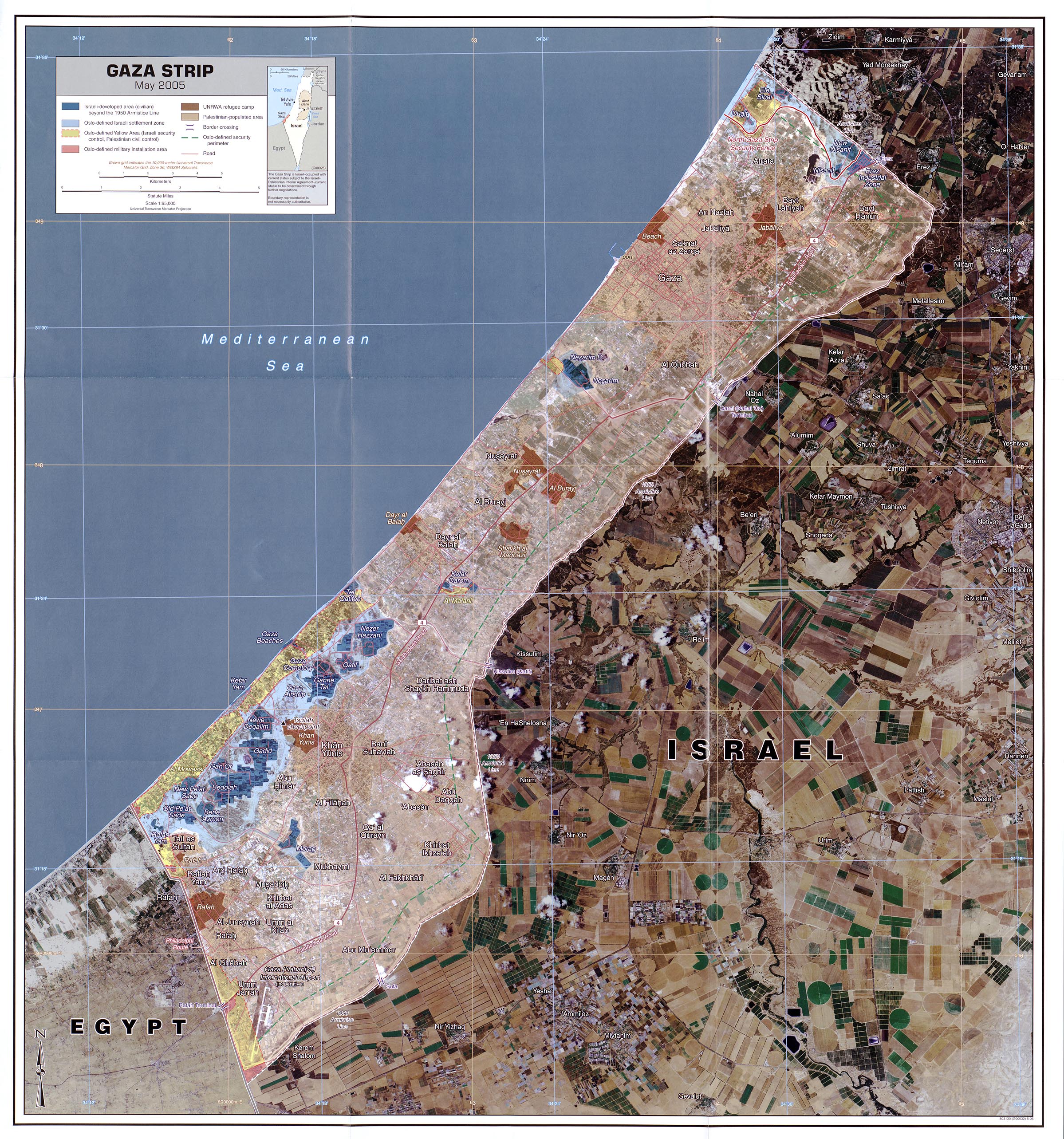
Figure 1: Gaza Strip With Urban Densities (Click for Larger Image)

The turn to decisiveness is good for Israel, who appeared to be waffling earlier over what to do. Poking at Gaza and bloodying/infuriating its civilian population without achieving any real political goals would have been not only wasteful, but counterproductive--they would have increased Hamas' will without seriously hampering its capabilities. Now, the Israelis have figured that they have already paid the political cost of the airstrikes, both in Gaza and internationally, and they might as well finish the job to their satisfaction. It will mean many more dead Gazans. It will mean billions in relief. It is a questionable decision overall, but one that appears rational once one accepts the given decision to begin serious airstrikes.

The commitment to cripple Hamas doesn't necessarily mean it will happen, despite Israel's impressive military. In the past, like the 1982 and 2006 wars in Lebanon, the Israelis have struggled to do serious damage to non-state actors. Israel's regular military, despite the state's security needs, remains largely outfitted to promptly dispatch Arab regular armies. But to be fair, nobody on earth has yet figured out how to properly deal with non-state actors, as the US in the last 7 years has demonstrated. Hamas remains resilient and confident. It is an organization that feeds politically on suffering, terror, mayhem, and death. Its support among its base is likely to harden. What makes life tougher for the Israelis is the constant decision between tactical advantage and strategic caution--Hamas has no qualms with hiding arms in Mosques, hiding terrorists in orphanages and hospitals. Israel must choose between letting them hide out, or killing children, killing the sick, killing religious observers. They seem to be going for the latter.

Figure 2: Arms Smuggling and Rocket Sites in Gaza

Israel may be preparing to invade Gaza. Reservists have been called, troops and tanks are lining up by the Gazan border, and foreign nationals are being escorted out of the country. The move may be an effort to pull Hamas security to the border and push civilians away, making it easier to more exclusively target militants, but it may be a legitimate preparation. A ground war is likely to become a mess--unless the Israelis have learned from the Summer 2006 Lebanon war, but chances are (sadly) that they haven't. The most productive thing that Israel can do in a ground war is conduct a series of raids to take down every single Hamas leader whose name registers on the Israeli radar that they can. The only way to truly get Hamas to fall apart will be to rob it so completely of leadership that it kills itself in an internal power struggle. The Mossad may have the intel the Israeli army needs to do that. It's tough to say.

For what it's worth, Israel's friends are sticking by their side. Israel's earlier diplomatic maneuvering is paying off. Egypt is keeping its border crossing closed except for inspected humanitarian relief trucks going into Gaza and inspected emergency transport trucks going out. Egypt has drawn a lot of criticism for this, from the UN and Iran, and from protesters just about everywhere, but it's sticking to its guns. The Lebanese government has come out against criticisms of Egypt, The Syrians have vowed to continue peace negotiations with Israel, and Jordan is keeping quiet despite a 50% Palestinian population. Such reactions are absolutely remarkable, and should mostly guarantee Israel a free hand in the Gaza operation. It remains likely that Livni has convinces Israel's neighbors that Hamas must go.

So with its free hand, Israel continues to pound Gaza, targeting as many Hamas critical points as they can. Hamas remains bold, but nothing Israel can do will change Hamas' rhetoric. Keep an eye out for a Gazan land war, and for more Hamas leaders to turn up dead. Israel may have a unique opportunity to eject this thorn in its side once and for all.