India recently made a significant military purchase from the UK, according to Breaking News:
"BreakingNews>
British official: India agrees to buy 57 Hawk jets worth about $800 million from Britain - AP"
The Hawk serves either as a low-cost combat aircraft or as a trainer.
India often moves back and forth between buying Russian and Western military equipment. That it continues to buy UK equipment is a good sign for Indo-Western relations, despite the tensions in the region caused by the continuing Afghan War.
Showing posts with label India. Show all posts
Showing posts with label India. Show all posts
Wednesday, July 28, 2010


Sunday, April 26, 2009
Swat Deal Going South
 As Pakistani Taliban march (mostly unopposed) closer and closer to Pakistan's capital, Pakistani leadership is starting to get jittery. While not canceling the peace deal altogether, President Zardari has given the military a go-ahead to hit the Taliban hard and push them back. Fighting has broken out already; the Pakistani military is showing its training gives it a hard edge over the Taliban in conventional battles.
 It's unclear what this particular operation is besides a knee-jerk reaction, and it--frankly--probably will not on its own be the beginning of an offensive into the northwestern frontier regions. But it may be a sign that opinion polls are starting to change. The closer the Taliban gets to the capital, the more it becomes clear to the Pakistani people that the Taliban are a threat to the security of everyone in the country and to the very existence of the Pakistani state as we know it. Until now, most Pakistanis thought that the problem would go away if the US pulled out, and that the Taliban did not have aspirations to conquer the region. It's becoming more clear that they do.
The Taliban have not held up their end of the Swat deal to lay down their arms and halt expansion. As discussed earlier, a deal with the Taliban had the strong potential to turn Swat valley into an untouchable safe haven from which to train, arm, organize, and then launch attacks elsewhere. And it looks like that's exactly what the Taliban are doing. But while breaking the Swat deal may have given the Taliban a tactical advantage, they may push the Pakistani people over a threshold of sufficient resolve to begin an all-out offensive. Such an offensive, which could be heavily funded, supported, and aided by the US, might have the potential to seriously rout Taliban leaders that have spent the past few years not having to deal with conventional warfare. More than likely, the Taliban have taken a path-of-least-resistance in the northwestern frontier regions, letting themselves operate more openly and conventionally in a region where they were not being bothered, and supporting their more guerrilla brethren in Afghanistan. If this is true, bringing to bear the might of the Pakistani army might leave them disorganized long enough for the US to be able to make an offensive in Afghanistan.
Should such a pincer maneuver work, the next step would require the hasty-but-effective deployment of indigenous local security forces loyal to the Pakistani and Afghani states. Such a task is easier said than done, but it is something that will be much easier done with a scattered and disorganized Taliban than a fully entrenched and offensive one.
Hopefully, Mr. Obama is ready to take advantage of the Swat deal going south. He needs to be able to propose a better alternative--and this alternative would include getting India to back off long enough for Pakistan to shift some troops to the north. But India is going to want attention dealt to the Kashmir region, as well, which is full of largely Pakistani Intelligence-supported insurgents and terrorists.
Saturday, December 20, 2008
The Afghanistan Surge
The US has proposed a surge in Afghanistan--almost 30,000 troops--which would double the size of the US force there. As a percentage of the overall force, it is much higher than the force sent to Iraq. And the strategy will be greatly different from Iraq, as well. Afghanistan is not suffering from an ethnosectarian civil war. The insurgency is not urban--on the contrary, the government tends to have control of cities even in otherwise heavily-Talibanized areas. Militants thrive in the mountains and villages where the government and NATO struggle to exert their control--it's all a very different beast.

The strategy lies in a point made by JCS Chairman Mike Mullen: mainly that Taliban militants typically get routed when they engage US troops directly. A few notable exceptions remain, like the Khandahar prison raid in June. But in general, the Taliban makes trouble where the US _isn't_. (This is in contrast to Anbar province of Iraq, where trouble followed the US wherever it went)
The idea is that more troops can keep the peace in the south and possibly systematically root out Taliban presence from the north. An oil spot security strategy is doable, though it requires very deep integration (or intrusion) into the lives of Afghanis. But keeping peace down is unlikely to lead to a negotiation, like it did in Iraq (along with many other factors). The Taliban say they won't negotiate with Karzai as long as US troops are on their soil. And they're decades-old extremists that ejected the Soviets after nearly a decade. They're patient, and willing to put up with a lot of punishment.
So the only reasonable strategy here is to make Afghanistan a "safe zone" with overwhelming security, and then deal with Pakistan separately. The Afghan war cannot be won without Pakistan falling into place, of course: the minute US troops leave Afghanistan, free militants in Pakistan would pour in to reconquer the country, or at least some chunk of it that the Afghan army can't handle.
India is putting massive pressure on the Pakistanis--enough that they are letting leak that they are planning their own precision strikes in Pakistan-administered Kashmir. The move is risky, and could risk war... but it is unclear whether the move on India's part would be harmful or helpful to NATO operations in Afghanistan. If there is a war, then the state falls apart and the militants thrive--unless NATO joins the war and makes it quick and decisive. Pakistan is unlikely to become an Indo-NATO joint mandate territory, but a decisive war could mean that certain parts of Pakistan's territory come under the security administration of NATO and India. China and Russia will certainly veto any resolutions to get the UN's blessing, and that will hinder such a deal from being made.
Pakistan knows it's in a lot of trouble. The US is still striking in its territory, and India is about to. The current government cannot afford to do nothing, but they also cannot afford a losing war with India. China would even be unlikely to get involved--Pakistan is an ally, but good relations with India are incredibly important. Domestically, the Pakistani government is rather doomed no matter what it does. Going after militants in-country is nearly impossible for Pakistan (due to domestic pressure, an ineffectual military, and a corrupted intelligence operation)--so ultimately, they're likely to face the wrath of India.
The Afghanistan/Pakistan situation has deteriorated to an unlivable level. General Petraeus, in charge of all of CENTCOM now, is going to try to work his magic a second time around in Afghanistan, and see if he can't save the second US-led folly in a row.

The strategy lies in a point made by JCS Chairman Mike Mullen: mainly that Taliban militants typically get routed when they engage US troops directly. A few notable exceptions remain, like the Khandahar prison raid in June. But in general, the Taliban makes trouble where the US _isn't_. (This is in contrast to Anbar province of Iraq, where trouble followed the US wherever it went)
The idea is that more troops can keep the peace in the south and possibly systematically root out Taliban presence from the north. An oil spot security strategy is doable, though it requires very deep integration (or intrusion) into the lives of Afghanis. But keeping peace down is unlikely to lead to a negotiation, like it did in Iraq (along with many other factors). The Taliban say they won't negotiate with Karzai as long as US troops are on their soil. And they're decades-old extremists that ejected the Soviets after nearly a decade. They're patient, and willing to put up with a lot of punishment.
So the only reasonable strategy here is to make Afghanistan a "safe zone" with overwhelming security, and then deal with Pakistan separately. The Afghan war cannot be won without Pakistan falling into place, of course: the minute US troops leave Afghanistan, free militants in Pakistan would pour in to reconquer the country, or at least some chunk of it that the Afghan army can't handle.
India is putting massive pressure on the Pakistanis--enough that they are letting leak that they are planning their own precision strikes in Pakistan-administered Kashmir. The move is risky, and could risk war... but it is unclear whether the move on India's part would be harmful or helpful to NATO operations in Afghanistan. If there is a war, then the state falls apart and the militants thrive--unless NATO joins the war and makes it quick and decisive. Pakistan is unlikely to become an Indo-NATO joint mandate territory, but a decisive war could mean that certain parts of Pakistan's territory come under the security administration of NATO and India. China and Russia will certainly veto any resolutions to get the UN's blessing, and that will hinder such a deal from being made.
Pakistan knows it's in a lot of trouble. The US is still striking in its territory, and India is about to. The current government cannot afford to do nothing, but they also cannot afford a losing war with India. China would even be unlikely to get involved--Pakistan is an ally, but good relations with India are incredibly important. Domestically, the Pakistani government is rather doomed no matter what it does. Going after militants in-country is nearly impossible for Pakistan (due to domestic pressure, an ineffectual military, and a corrupted intelligence operation)--so ultimately, they're likely to face the wrath of India.
The Afghanistan/Pakistan situation has deteriorated to an unlivable level. General Petraeus, in charge of all of CENTCOM now, is going to try to work his magic a second time around in Afghanistan, and see if he can't save the second US-led folly in a row.
Tuesday, December 9, 2008
Congress Hangs On in India
 Many analysts believed the Mumbai attacks would be devastating for the Indian Congress Party--the pro-business and pro-US ruling party in New Dehli. While Pakistani cells were almost certainly responsible, a number of intelligence failings on the part of Indian counterterrorists became apparent. The US had warned India of a terror attack on Mumbai through its ports.
 Such failings looked like they would vindicate BJP (the opposition leader) criticisms for years over weak terror and Pakistan policies. But Congress is holding on with surprising vigor. In recent state elections, Congress won 3 of 5--most interestingly, Dehli, which pundits thought seemed certain to go to BJP due to its close cultural ties with Mumbai. But while the bombings were clearly a black mark on Congress, the relative responses of Congress and BJP may have made the difference.
Congress has stepped up pressure on Pakistan, together with the United States. India has demanded--and to some extent, received--Pakistani help during the Mumbai investigations. Quickly, the Pakistanis responded with a number of arrests, including the alleged "mastermind" of the attacks. In addition, the government has revealed the identities of the Mumbai gunmen, giving the Pakistanis few political options besides a new wave of arrests to get to people near these published gunmen that might have been involved in conspiracy. Indians may be relatively satisfied with this cautious but firm response. It appears dynamic and well-thought-out.
BJP, on the other hand, has faced accusations of "opportunism." The Mumbai attacks were much like an Indian 9/11, and appearing to try to gain politically by the event will hurt any party. BJP may have been too aggressive. In addition, Indians may not want to encourage another bloody war with Pakistan (that might, if poorly designed, lead to even more terrorism by fracturing the Pakistani state) by electing the currently fevrishly militant BJP.
Elections in May are coming up for Congress, and they can't afford to lose. Allegations of buying votes on the US nuclear deal remain, and the Congress response to these attacks may shape their election hopes in May. They have a few months to make it work, which may be the basis of their slow, cautious approach. If Pakistan does end up declaring full-scale war on the militants, then Congress can take credit for applying enough pressure to get the job done without having so sacrifice Indian troops--such an outcome would be the best Congress can hope for.
Sunday, December 7, 2008
US Sees Opportunity in Mumbai
 After the tragic Mumbai terror attacks, Sec. State Rice traveled to India and Pakistan to urge restraint and cooperation between the two countries--the last thing the US wants right now is a war that turns Pakistan into a failed or excessively weak state.
But Rice has also spent an incredible amount of time and effort criticizing Pakistan and urging them to "act quickly." Before the Mumbai attacks, Pakistani terror was largely a bilateral issue--between NATO and Pakistan. NATO was able to lobby Pakistan to act, but Pakistan's domestic politics made it near impossible. But now that the Mumbai attacks have enraged India, and the US can use them as a tool of threat: "Look, we have restraint, but those Indians, who knows what they'll do?"
Thus, the Pakistanis lose the highground in any negotiation--the US can control its behavior, but can play the Indians like a wild card; the Pakistanis must now crack down on terror (and take a beating for it) to avoid another war with India, which would cost them far, far more.
The sheer human tragedy of the Mumbai bombings accents this loss of moral highround--Pakistan can no longer run to the UN or other global organizations and complain that they are being bullied by the US--the US and India are trying to shore up the growing world opinion that the Mumbai attacks were due in part on Pakistani negligence. Those international law precedents on control and sovereignty start to take effect here.
Some literature (which I can't find online, of course) has been calling for parts of Pakistan to become international mandate zones--places like Pakistani Kashmir and the Northwestern Frontier Regions, where Pakistan clearly does not have administrative control. If the proper international pressure can be levied upon Pakistan, they may just have to cave and accept that certain parts of their territory be internationally controlled--incurring the world's ire by sending troops to stop them would mean collapse.
If that threat is legitimately on the table, then the (albeit weak) Pakistani leadership may have no choice but to make the hard decision and start seriously fighting, and maybe invite NATO airstrikes and support to get the job done. If the latter declaration was made, it would be a huge victory for Rice's diplomatic team.
Friday, November 28, 2008
On the Mumbai Attacks
 You've read the news: Muslim extremist militants have attacked Mumbai, India with small arms. Well over 100 dead, and multiple days of carnage in some of India's wealthiest hotels.
The attack was clearly directed at Americans, Israelis, and Britons--gunmen took tourists (in multiple locations, including the Taj Mahal Hotel) hostage and started demanding the turnover of civilians with US and UK passports, and started executing them. They also attacked a Jewish house. But these terrorists were ruthless, and carelessly gunned down anyone that didn't strictly follow rules, or appeared to be a threat. They were undisciplined, highly outnumbered, and hope to instill fear into the group to behave. What happened was well over 100 deaths, mostly Indian.
The attack was clearly designed to terrify Americans and Britons. But the attack has brought little in the United States or Britain but sympathy for Indians. The terrorists largely failed to hit the large number of US and UK citizens that they were hoping, and created such lasting carnage in India that the Indians took the vast majority of the impact. Now--nutjob fundamentalist Islamists have no problems with terrifying Indians and assorted Hindus.
But Pakistani fundamentalists have now incurred the wrath of their neighbors. India and Pakistan have gone to war 3 times since 1947, and almost went to war in 2001 over a bombing then. A nasty 2006 train bombing in Mumbai was blamed on Pakistani militants, and this attack already has been blamed on them as well.
The Indians are outraged--they are calling this "India's 9/11"--but their response is not obviously clear. They are angry at the US and UK--I remember seeing a live report interrupted by a hysterical man running by and asking why Indians had to die, why it wasn't the US getting bombed. But the Indians also hate the Pakistanis, and are very used to placing blame on them.
Pakistan's Intelligence was very involved in Indian terror networks before 9/11, but those relations have strained (in part due to US pressure and in part due to Pakistan's own Islamist problems). But if this attack was coordinate in a Pakistan "safe haven," then the Indians may start sharing the same attitude the US has about Pakistan's ability to police its own territory. There is some International Law precedent that a government unable to administer and police its own territory has forfeited its sovereignty. But this will require many months of UN deliberations to happen, if it happens at all.
On the other hand, the US and India could just go ahead and drive in. But even if they were ready to take the political beating for such an attack, they would have to make it quick and decisive--a prolonged war with Pakistan would only strengthen the Islamists. But it's ultimately unlikely to happen.
Pakistan's Intelligence chief is visiting Mumbai, likely to try and keep relations from going sour. But the Indian government, which barely has a stable majority, can't afford to do nothing. If they don't blame Pakistan, then they take the blame themselves. They're unlikely to blame the US and UK for bringing the heat into India--they're so used to anti-Indian attacks that the specific target of these terrorists is mostly immaterial. The Indians will need a target to blame, and decisive action to take, probably targeting Pakistan in some way. How they'll manage their domestic politics and neighborly relations is a tough question that New Dehli will have to be quite clever to figure out.
Thursday, November 20, 2008
Sri Lanka Breaking Stalemate With Tigers
 Current civil war theory suggests that civil wars are tough to end with negotiated settlements; victory tends to stick better. Attempts to intervene from outside have largely failed to end the 25-year-old Sri Lanka civil war, in which the LTTE (popularly known as Tamil Tigers) have fought for independence from Sri Lanka.
Sri Lanka's not a big state, nor a rich one--the disruption has been devastating to its population, and quite a thorn in the side of India (who has a large Tamil minority in its southeast). The rebels, who claim a large swath of northern coastal territory in Sri Lanka as "Tamil homeland," are on the US and EU terror lists for their treatment of civilians during the conflict. But to be truly fair, the Colombo government hasn't been much nicer.
The rebels have been surprisingly well-armed during the entire ordeal, able to strike Sri Lankan military installations multiple times in the last year with a fighter-bomber wing that the Sri Lankans have struggled to destroy. But a renewed offensive, in which the Sri Lankan military has taken heavy casualties, recaptured the central-eastern part part of th
 e country and the critical Jaffna Pennensula at the northernmost part of the island. The rebels have been collapsed to a defensive pod (the pink shown in the picture to the right), and have held strong. But a recent three-day battle with heavy casualties has broken the rebel front lines on the north-facing side of the Tamil stronghold.
The territory is jungle, and thus very friendly to the local Tamils, who are likely able to move rather freely throughout the area; this will make fighting here not only tought, but a Vietnam kind of tough. The government may have to resort to seriously heavy-handed tactics througout the last phases of the operation to smoke out the Tigers once and for all--even if this will make reconstruction and reintegration more difficult.
I mean to emphasize that there will not be a quick and easy victory in store for the Sri Lankan military-- but the momentum is certainly theirs, and their casualty-acceptance has gone up significantly as morale increases. The ability of the Tigers to launch air strikes or move in major formations without being hit by Sri Lankan air power has diminished significantly, and the Sri Lankan military should begin to assume flanking operations on one side of the front if it has kept reserves properly ready. It must sieze the initiative.
If it does not, the Tamils may resort to trying to stretch the conflict out through a Maoist insurgency--of the style used by the Chinese Red Army in the 1930's, the Viet Cong in the 1960's. Such a style of asymmetric warfare has a surprisingly high rate of success against local governments when the purpose is to stretch their supply lines, decrease their morale, and generally increase costs.
That said, the likelihood that the Tigers will be able to turn the tide in full at this point is very low. They do not have a large population to continually draw fighters from, and their area of operation has shrunk so low that they will struggle to avoid decisive battles like this most recent one--Maoist-style insurgencies can only succeed if the rebels have the ability to continually retreat and regroup--hit-and-run tactics against patrols between long-term rests in relatively friendly territory are essential in being able to carry out a protracted conflict. The Tamils' ability to do that is quickly shrinking; the Sri Lankan military's superior manpower, training, and resources should bring them victory in the next few months.
Wednesday, November 19, 2008
India Takes Pirate Problems Into Own Hands
The Indians have had enough of Somali pirate hubris. After having a ship almost hijacked last week (among a slough of others), the INS Tabar, confronted a pirate "mothership," and told the men on board that the ship was going to be searched. Now if you've ever seen Waterworld, think of the undead Exxon Valdez, but all the crew have RPGs.
When the Indians tell these guys they're going to be searched, they start firing their RPGs and light arms. Now I don't know if you've ever seen a missile frigate, but if you did, I bet you would know better than trying to scare it off with light arms. They're not only armed to the teeth with surface-to-surface missiles, but have a bow and stern cannons and heavy machine guns bristling from all corners.
The Tabar was pleased to have an excuse to open fire. The details are few, but it likely tossed off a few SS missiles and hit a few weapons caches, and the "mothership" went down. A few speedboats ran off, but they likely lost their supplies and leadership.
Of course, there are many pirate factions in Somalia. The Mogadishu government is mostly... nonexistent. The Indians, Russians, Americans, Brits, and Saudis will have to start policing the waters themselves, and continue this kind of anti-pirate offensive--if they do, Somali thieves may decide the occasional oil tanker isn't worth the risk of taking SS missiles in the face.
When the Indians tell these guys they're going to be searched, they start firing their RPGs and light arms. Now I don't know if you've ever seen a missile frigate, but if you did, I bet you would know better than trying to scare it off with light arms. They're not only armed to the teeth with surface-to-surface missiles, but have a bow and stern cannons and heavy machine guns bristling from all corners.
The Tabar was pleased to have an excuse to open fire. The details are few, but it likely tossed off a few SS missiles and hit a few weapons caches, and the "mothership" went down. A few speedboats ran off, but they likely lost their supplies and leadership.
Of course, there are many pirate factions in Somalia. The Mogadishu government is mostly... nonexistent. The Indians, Russians, Americans, Brits, and Saudis will have to start policing the waters themselves, and continue this kind of anti-pirate offensive--if they do, Somali thieves may decide the occasional oil tanker isn't worth the risk of taking SS missiles in the face.
Tuesday, July 29, 2008
India, and Pakistan's Control Problems
The Pakistani civilian government is weak. It has the support of most people, but not the support of many of Pakistan's hardline military forces, and not the peace with militants in its country that it has hoped to gain. It would surely like ot have the overwhelming force to deal with its militants, but it doesn't.
One of these reasons is India. Pakistan and India have been enemies since 1947, during the first of three wars of Independence. They have quarreled over Kashmir for decades, and a ceasefire was enacted in 2003. Nonetheless, each side has had to keep large military forces on their borders, more concerned with each other than the movements of potential militants through the sparsely-populated region.
This has escalated the India problem. Bombs in Bangalore and Ahmedabad are being blamed on Pakistani militant groups, and unexploded bombs were found in Surat of similar type. If more bombs begin to rip through Indian cities, the Indian government will face growing pressures and mandates to act--but the problem lies within Pakistan's borders.
A bomb in Kabul's Indian Embassy is being blamed on the Pakistani Intelligence Service--indicating that the Pakistani government still does not have control of its military.
Furthermore, and most worryingly for the Pakistani civilian government: A twelve-hour gun battle between Indian and Pakistani troops erupted along the Line of Control in Kashmir. A few men died on each side, and it seems relatively small, in comparison to many of the other issues surrounding Pakistan, but hard-line elements in Pakistan may take this as a sign that they need to launch attacks. All this is sign to the Indians that they must beef up their border security even more--which means even more troops that could be used in counter-terror missions in Pakistan must be used to defend from India. A security spiral is forming--each side, seeing a threat in border instability, is arming itself, and in doing so, making the other side less secure.
But Pakistan has more problems from India than simply a forced shift in military resources. India is now starting to face some of the dilemma that Afghanistan has faced--if it leaves Pakistan alone, it will continue to be attacked by militants (or in India's case, even Pakistani regulars) from inside Pakistan's borders. If the Pakistani civilian military cannot control its own military, on top of not being able to stop militants, then diplomacy becomes useless. No amount of agreement with a head of state can fix a problem that he has no control over. And militants and hard-line military units don't care for diplomacy, they quite like the situation they have now.
If Pakistani-caused problems in India and Afghanistan persist, it will be very tempting for Singh and Karzai to be convinced by the Bush administration that the best option will be to send troops into Pakistan to deal. More interestingly, the weak civilian government still has a pro-Bush wild card in their midst--if the Bush administration tells Musharraf that his only chance at not losing power is to rally troops loyal to him in a NATO/Indian/Afghan alliance to drive out anyone standing between the alliance and the end of Pakistani militants, then war in Pakistan would look like the best option.
Nobody is rattling too many sabres. But when sabres are being rattled, it's a warning. Who is there to warn in Pakistan? Would threat of invasion make the hard-liners and militants any less aggressive? Certainly not. Would it give the weak civilian government more power to act? No. It would only warn them that such an invasion might be coming, which can do nothing but make that possible invasion harder--it cannot be used as a diplomatic chip.
That is the most frustrating realization in Pakistan, and maybe the reason Gilani was willing to visit Bush in DC--because he knew that he had no choice but to show he had some sort of control over his country, or else the largest military alliance in the world might decide that dealing with him is a complete waste of time. Nobody is seriously considering invasion yet, but the conditions are becoming such that the Global War on Terror coalition may have no other good options left. And if this invasion does happen, it will be the first ever invasion of an openly nuclear state. NATO uncertainty over whose finger is on the nuclear trigger in Pakistan may be the only thing between Gilani and a nightmare.
One of these reasons is India. Pakistan and India have been enemies since 1947, during the first of three wars of Independence. They have quarreled over Kashmir for
 decades, and a ceasefire was enacted in 2003. Nonetheless, each side has had to keep large military forces on their borders, more concerned with each other than the movements of potential militants through the sparsely-populated region.
This has escalated the India problem. Bombs in Bangalore and Ahmedabad are being blamed on Pakistani militant groups, and unexploded bombs were found in Surat of similar type. If more bombs begin to rip through Indian cities, the Indian government will face growing pressures and mandates to act--but the problem lies within Pakistan's borders.
A bomb in Kabul's Indian Embassy is being blamed on the Pakistani Intelligence Service--indicating that the Pakistani government still does not have control of its military.
Furthermore, and most worryingly for the Pakistani civilian government: A twelve-hour gun battle between Indian and Pakistani troops erupted along the Line of Control in Kashmir.
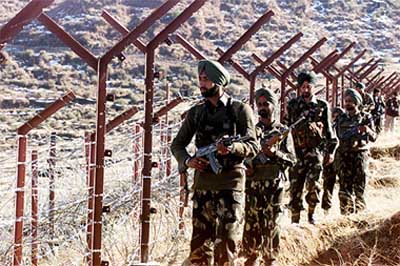 A few men died on each side, and it seems relatively small, in comparison to many of the other issues surrounding Pakistan, but hard-line elements in Pakistan may take this as a sign that they need to launch attacks. All this is sign to the Indians that they must beef up their border security even more--which means even more troops that could be used in counter-terror missions in Pakistan must be used to defend from India. A security spiral is forming--each side, seeing a threat in border instability, is arming itself, and in doing so, making the other side less secure.
But Pakistan has more problems from India than simply a forced shift in military resources. India is now starting to face some of the dilemma that Afghanistan has faced--if it leaves Pakistan alone, it will continue to be attacked by militants (or in India's case, even Pakistani regulars) from inside Pakistan's borders. If the Pakistani civilian military cannot control its own military, on top of not being able to stop militants, then diplomacy becomes useless. No amount of agreement with a head of state can fix a problem that he has no control over. And militants and hard-line military units don't care for diplomacy, they quite like the situation they have now.
If Pakistani-caused problems in India and Afghanistan persist, it will be very tempting for Singh and Karzai to be convinced by the Bush administration that the best option will be to send troops into Pakistan to deal. More interestingly, the
 weak civilian government still has a pro-Bush wild card in their midst--if the Bush administration tells Musharraf that his only chance at not losing power is to rally troops loyal to him in a NATO/Indian/Afghan alliance to drive out anyone standing between the alliance and the end of Pakistani militants, then war in Pakistan would look like the best option.
Nobody is rattling too many sabres. But when sabres are being rattled, it's a warning. Who is there to warn in Pakistan? Would threat of invasion make the hard-liners and militants any less aggressive? Certainly not. Would it give the weak civilian government more power to act? No. It would only warn them that such an invasion might be coming, which can do nothing but make that possible invasion harder--it cannot be used as a diplomatic chip.
That is the most frustrating realization in Pakistan, and maybe the reason Gilani was willing to visit Bush in DC--because he knew that he had no choice but to show he had some sort of control over his country, or else the largest military alliance in the world might decide that dealing with him is a complete waste of time. Nobody is seriously considering invasion yet, but the conditions are becoming such that the Global War on Terror coalition may have no other good options left. And if this invasion does happen, it will be the first ever invasion of an openly nuclear state. NATO uncertainty over whose finger is on the nuclear trigger in Pakistan may be the only thing between Gilani and a nightmare.
Monday, July 28, 2008
The Tamil Tigers, and a Note on Terror
Recently, the Sri Lankan government's military captured a satellite base from the Tamil Tiger rebels, prompting analysts all over the world to ask, "why the heck did the Tamil Tigers have a satellite base?"
 The US, EU, and India all put the Tigers in their lists of official terror groups, but nobody seems to care too much about the group, as they're mostly nobody's problem but Sri Lanka's (who nobody cares too much about).
Ultimately, the Tigers are a separatist movement that uses terror tactics, which makes them fundamnetally different from Islamic Extremists in a few ways (that have been sadly conflated by the wanton use of the word "terror" in the past 7 years). The first is that they have a limited and well-defined political agenda (the separation of a certain geographical area from a government), which makes them plausibly reasonable to deal with at negotiating tables. The second, is that they're a problem for a very limited number of people (in this case, Sri Lankans), so it's very easy for other countries to ignore them. This is in contrast to, say, Al-Qaeda, which seeks revenge on innocent non-Muslims for the deaths of any Mulsim at the hand of non-Muslims in history; or Hamas, which seeks to irradicate the Israeli people. "religious genocide" is not a goal that one can negotiate with.
The Tigers may be on their way out, thanks to the persistence of the Sri Lankan military and token help from a few friendly countries like India. They are definitely bad dudes that do bad things to good people. My primary worry is that cases like the Tigers are going to increase the terrorist-separatist conflation, allowing countries like China to brutally crack down on anyone in Xinjiang or Tibet thinking about waving a flag of their own.
 The US, EU, and India all put the Tigers in their lists of official terror groups, but nobody seems to care too much about the group, as they're mostly nobody's problem but Sri Lanka's (who nobody cares too much about).
 Ultimately, the Tigers are a separatist movement that uses terror tactics, which makes them fundamnetally different from Islamic Extremists in a few ways (that have been sadly conflated by the wanton use of the word "terror" in the past 7 years). The first is that they have a limited and well-defined political agenda (the separation of a certain geographical area from a government), which makes them plausibly reasonable to deal with at negotiating tables. The second, is that they're a problem for a very limited number of people (in this case, Sri Lankans), so it's very easy for other countries to ignore them. This is in contrast to, say, Al-Qaeda, which seeks revenge on innocent non-Muslims for the deaths of any Mulsim at the hand of non-Muslims in history; or Hamas, which seeks to irradicate the Israeli people. "religious genocide" is not a goal that one can negotiate with.
The Tigers may be on their way out, thanks to the persistence of the Sri Lankan military and token help from a few friendly countries like India. They are definitely bad dudes that do bad things to good people. My primary worry is that cases like the Tigers are going to increase the terrorist-separatist conflation, allowing countries like China to brutally crack down on anyone in Xinjiang or Tibet thinking about waving a flag of their own.
Wednesday, July 23, 2008
Singh-Bush's Bittersweet Victory
 Indian Prime Minister Singh and US President Bush have worked together so long on a nuclear power deal that it seemed as silly as Israeli-Palestinian peace. But recent breakthroughs--a deal that is ready for the IAEA--have shaken things up.
A confidence vote came to parliament (which could have ousted the Prime Minister and forced a new parliamentary coalition to form) when the Communist party left the coalition over the US deal (citing something about imperialism on their way out the door), and Singh's future--as well as the deal itself--hung in the balance.
Congress won by a small margin. But accusations of bribery are rampant, opened flamboyantly by a BJH
 (opposition party) march into the well of parliament, literally waving money that they claimed had been given to them as bribes... only 2 hours before the vote. Sick and imprisoned members of the ruling coalition were pulled out for the vote, and some members of the opposition abstained or failed to arrive at all. The vote was certainly fishy, and Indian papers are very displeased. Indian politics has gotten ugly, even if the vote victory has given Singh the go-ahead on the nuclear deal. Parliamentary elections happen in May, which means he has but 9 months to recover from this PR mess and try to rally the country behind the Congress party, lest a strong socialist opposition take over and derail his economic growth plans for India.
 From here, the deal has only a few months to be approved by the IAEA and the US Congress, before Bush leaves office. The move would be a jab in the opposite direction of the US' typical anti-proliferation strategy. India's development of a nuclear bomb made it--according to the Nuclear Proliferation Treaty--a nuclear rogue state (along with Pakistan, maybe Israel), and the US has not required India to give up its weapons program for help in its peacful nuclear program. Surprisingly, Europe is not making a great fuss about this--possibly because Europe's diplomatic leadership are Brown and Sarkozy, and possibly because Europe wants to see a strong India counter a strong China. If Bush keeps Europe's support, the deal is likely to sqeak through before he leaves office.
But the bitterness left in the throats of Indians will not be forgotten quickly. The Opposition will try to use bribery allegations as a sign that the US is trying to use India as a pawn. If the Indian public takes these allegations to heart, the US is going to struggle keeping India along as an ally in the near future.
That said, the way the world is taking a liking to Mr. Obama, they may quickly change their mind if he becomes president.
Tuesday, January 8, 2008
The Rise of the Pacific
Security "experts" with access to large-scale media organs have expressed concern for at least a decade over the growth of China's navy, and its increasing ability to intervene in situations that we don't want them to--Taiwan, the Spratly Islands, and a few territorial disputes with Japan and South Korea. Non-experts that I've spoken to sometimes think that the US is vulnerable to being invaded by China. With boats. Seriously?
While everyone likes to pretend they're an expert on these things at cocktail parties so they can pick up some cute music major, misinforming other freedom-loving Americans with false vague impressions of the Pacific is the kind of thing that could get the United States into a cold war mentality--and perhaps create a self-fulfilling prophecy--with China.
The US public needs to relax a bit on the China issue. I shall explain why:
1) China's military is not that awesome. It might not even currently be able to conquer Taiwan on its own, and certainly wouldn't be able to if the local US Carrier Fleet (stationed in Yokohama) intervened. It has zero aircraft carriers, compared to the 12 that the US sports.
2) The Japanese, Russians, and Indians have navies, too. Remember them? Right, them. None of them are exactly China's biggest fans, particularly the Japanese. While they may get along, none of them is going to lay back and let one of them run around the Pacific building an unchecked empire. China's navy is divided into a north, south, and east fleet specifically because it has to deal with the Russians and South Koreans in the north, the Taiwanese and Japanese in the east, and the Indians (and Vietnamese, Philippinos, Indonesians, Malaysians; small on their own, but together, enough to be a harassment) in the south.
India currently has an aircraft carrier of its own, is building another one for late this year, and expects shipment of a third from Russia this year, as well. That's 3 aircraft carriers, which is exactly 3 more than anyone in the Pacific has, besides the US. They will not be a force to be trifled with.
The Russian fleet is rebuilding extremely quickly under Putin (and, soon, his puppet), and the Pacific fleet has a number of top-of-the-line Soveremenny destroyers and an extensive logistics/supply/repair fleet to keep them moving.
The Japanese have a stock of Destroyers that rivals the Chinese, despite constitutional blocks on their Self Defense spending. If this ban is lifted, they could quickly grow even stronger.
Ultimately, the US doesn't have to worry about the Pacific too much, as long as all four of these great states keep rising at a pretty even pace. India, in particular, has the growth potential to keep China almost completely in check on its own. So the Chinese won't be invading the US any time soon--I can't say much about Taiwan, but I don't share nearly as much concern over the little island as many American security experts.
And frankly, I'm pretty excited about this naval rise in the Pacific. If the US cannot possibly dominate the region, then the incentive for the US to spend as if it could drops dramatically. We could reduce our carrier fleet number from 12 to maybe 9 or 10, and let the status-quo-loving states of the Pacific keep things peaceful on their own.
Unlike their European counterparts, the powers of the Pacific see no need to free-ride off the military of the US, and they are choosing to depend on themselves for security. And if the primary concern for the US in the Pacific is peace and prosperity (which it should be; Democracy is nice, but it tends to form after prosperity in the Pacific-- see South Korea, Taiwan, Philippines), then self-management on the parts of China, India, Russia, and Japan, is fully in our favor, even if they don't get along that well.
The US should keep a carrier fleet or two ready to move in and make a stand where it has to should it need to, but being the unquestioned superpower in East Asia seems like a dilapidated policy which the US--for the sake of its taxpayers, if nothing more--should drop.
While everyone likes to pretend they're an expert on these things at cocktail parties so they can pick up some cute music major, misinforming other freedom-loving Americans with false vague impressions of the Pacific is the kind of thing that could get the United States into a cold war mentality--and perhaps create a self-fulfilling prophecy--with China.
The US public needs to relax a bit on the China issue. I shall explain why:
1) China's military is not that awesome. It might not even currently be able to conquer Taiwan on its own, and certainly wouldn't be able to if the local US Carrier Fleet (stationed in Yokohama) intervened. It has zero aircraft carriers, compared to the 12 that the US sports.
2) The Japanese, Russians, and Indians have navies, too. Remember them? Right, them. None of them are exactly China's biggest fans, particularly the Japanese. While they may get along, none of them is going to lay back and let one of them run around the Pacific building an unchecked empire. China's navy is divided into a north, south, and east fleet specifically because it has to deal with the Russians and South Koreans in the north, the Taiwanese and Japanese in the east, and the Indians (and Vietnamese, Philippinos, Indonesians, Malaysians; small on their own, but together, enough to be a harassment) in the south.
India currently has an aircraft carrier of its own, is building another one for late this year, and expects shipment of a third from Russia this year, as well. That's 3 aircraft carriers, which is exactly 3 more than anyone in the Pacific has, besides the US. They will not be a force to be trifled with.
The Russian fleet is rebuilding extremely quickly under Putin (and, soon, his puppet), and the Pacific fleet has a number of top-of-the-line Soveremenny destroyers and an extensive logistics/supply/repair fleet to keep them moving.
The Japanese have a stock of Destroyers that rivals the Chinese, despite constitutional blocks on their Self Defense spending. If this ban is lifted, they could quickly grow even stronger.
Ultimately, the US doesn't have to worry about the Pacific too much, as long as all four of these great states keep rising at a pretty even pace. India, in particular, has the growth potential to keep China almost completely in check on its own. So the Chinese won't be invading the US any time soon--I can't say much about Taiwan, but I don't share nearly as much concern over the little island as many American security experts.
And frankly, I'm pretty excited about this naval rise in the Pacific. If the US cannot possibly dominate the region, then the incentive for the US to spend as if it could drops dramatically. We could reduce our carrier fleet number from 12 to maybe 9 or 10, and let the status-quo-loving states of the Pacific keep things peaceful on their own.
Unlike their European counterparts, the powers of the Pacific see no need to free-ride off the military of the US, and they are choosing to depend on themselves for security. And if the primary concern for the US in the Pacific is peace and prosperity (which it should be; Democracy is nice, but it tends to form after prosperity in the Pacific-- see South Korea, Taiwan, Philippines), then self-management on the parts of China, India, Russia, and Japan, is fully in our favor, even if they don't get along that well.
The US should keep a carrier fleet or two ready to move in and make a stand where it has to should it need to, but being the unquestioned superpower in East Asia seems like a dilapidated policy which the US--for the sake of its taxpayers, if nothing more--should drop.
Subscribe to:
Posts (Atom)