Showing posts with label USA. Show all posts

Tuesday, July 14, 2015

The Iran Deal is a BFD

Joe Biden was famously caught on camera calling the passing of the ACA a "BFD;" I suspect he said something similar as Secretary Kerry came back with news that a deal had been inked with Iran.

This is a pretty BFD. As you can see, Secretary Kerry certainly thinks so. (These guys are probably really, really tired.)


I read through CNN and the NYT's summaries of the deal; I then decided to skim the full-text.


Immediate Implications of the Deal:
The deal looks a lot like what was hammered out in April, and we discuss the key points in an earlier post. In the new version, Iran is actually restricted for 15 years (rather than 10), but gets a greater number of centrifuges (giving up 2/3 of them rather than 4/5 of them). It keeps its stockpile to 300kg (which is a 98% reduction of its current stock), ships out all spent material, and can't enrich beyond a pretty low number.

The deal still looks good. A look at the full-text suggests the inspection protocols are pretty solid: the IAEA gets to maintain permanent access, and can visit facilities "daily."

If Iran starts breaking the deal, the sanctions can "snap back" with a quick vote from the Western powers. The Western powers are banking somewhat on Iranian domestic support for trade with the West--Rouhani was elected president riding on promises to lift the (very painful) sanctions from Iran, and if they snapped back due to Iran breaking the deal, it could lead to more unrest (like the Green Revolution).

Could Iran still hide some activity and create a bomb? Sure. But their break-out period (amount of time required to build a bomb) for the past 2 years has been 2-3 months, and now it'll extend to 1 year. Iran's had the capacity for a long time to sneak around and build a bomb; this sets them farther back from being able to do so, and increases IAEA presence (from essentially none, currently) to look for any such clandestine activity. In short, I think any objections that this is a tacit thumbs-up for Iran to build a bomb are just unfounded. 

Credible Objections:
Probably the big credible objection is by Sunni allies worried about Iranian power. Saudi Arabia was hoping that Iran's foray into Yemen would become a quagmire that drove it into financial ruin. The Saudis have also been intentionally keeping oil prices low (by keeping supplies high) in order to strain Iran further: they're engaged in economic warfare designed to "break" Iran's capacity to project power, and the lifting of the sanctions will undermine that.

That's not untrue, but it's also unlikely that the sanctions were preventing Iran from projecting power into Iraq and Yemen. The key goal of the sanctions wasn't to grind Iran into insignificance--that was not going to happen with this package. The key goal was to hurt Iran enough to make a Western-friendly deal, and that worked.

Why This is a BFD:
If we model Iran more like a Soviet Union than a large mob of irrational terrorists (and I think the former is a more accurate model), we can think about Iran's self-interest, and what a self-interested power (even one opposed to the US) would want.

The lifting of sanctions means foreign investment and an alleviation of inflation (currently 18.2%); Iran's economy stands to gain a lot. Iran's been very clear that it wants trade with the West.

As this investment pours in, as Europe starts buying Iranian oil and Iran starts buying European food and goods, we start to see two big things happen:
1) The US and EU will become bigger trade partners for Iran than Russia and China (this will take a few years but less time than this deal's restrictions)
2) Iran will start to become a source of oil for the EU

#1 is important because Iran is going to ally with those that serve its interests. It is currently allied with Russia for that reason--not out of any weird ideological alignment. The Western powers want to steal Iran out of Russia's sphere of influence and put it in the West's. The West has many more carrots to offer Iran, and this is a key first step to being able to do that. (To anyone who believes this is impossible, I suggest a reading of the history between the US, Soviet Union, and China throughout the cold war to see how friendships shifted based on interest, despite ideology. Remember also that Saudi Arabia, a close ally, is a religiously extremist, oppressive monarchy.)

#2 Is important because it changes incentives for Iran with respect to the Strait of Hormuz: if Iran is exporting oil to Europe, it would hurt itself by closing the Strait of Hormuz and, per #1, would have less interest in doing so as a favor for Russia. This alleviates some of Europe's dependence on Russia for oil, and means they're more likely to have alternate sources from Qatar, UAE, Iran, and Iraq if conflict with Russia ever arises. And that means hamstringing Russia in Europe.

So as odd as it may sound, the reason the Iran deal is so important is that it helps the West increase its leverage over Russia, which is a much larger, scarier, more menacing, and more aggressive threat than Iran. The Great Game in Europe is back, and this move by President Obama and Secretary Kennedy may be seen by history as a truly brilliant stroke.

Thursday, August 5, 2010

US Seizing an Opportunity in Pakistan

The Pakistani floods have given the US army an opportunity to counter the Taliban's influence in the Northwest (and bring increased legitimacy to US operations in the area).

US troops are dropping emergency supplies and evacuating civilians with military helicopters--with Pakistan's blessing.

It's a good PR opportunity, and a great way for the US to work together with the Pakistani Army. Furthermore, it gets US troops in the region--no doubt spies and commandoes have been dropped into the region to learn as much valuable intel as possible.

It's unlikely the US will use the opportunity for any immediate offensive or disruptive operations, but odds are good this opportunity will influence future plans for either US commando/spy forces, or for cooperation with the Pakistani Army against the Taliban.

Friday, December 18, 2009

Geopolitical Complications at Copenhagen

The problems at the various climate summits are economically quite simple--there is both a tragedy of the commons problem (in the emitting of carbon dioxide) and a freerider problem (in the halting thereof). Even Europe has has largely decided that the moral payoff for "leading the way" in CO2 control is not sufficient to break its back alone, especially if it enables other economies to slurp up the CO2 "availability," as it were, that they create.

This, of course, is why anyone trying to control global CO2 output needs a treaty. But it is not so simple to simply forge a treaty on this and tell everyone to stop producing. Should all countries cut a portion of their CO2? Should we create a baseline CO2/capita standard which countries must meet? What, instead, of a CO2/GDP/capita standard? These different standards can be abstractly debated on their own merits, but each representative at Copenhagen is undoubtedly going to support the one that best suits their own self-interest.

Right now, one of the big hang-ups seems to be the US-Chinese rivalry, which stems far beyond simple fairness, egalitarianism, equity, whatever, into rather unsubtle geopolitical/economic warfare. The Chinese want to walk away with a "promise" to reduce CO2 output by a certain percentage, but do not want any oversight into their own in-house emissions reporting. The US, of course, is unwilling to sign anything that lets the Chinese get away with zero transparency, while the US gets constant comb-overs by the EU to make sure that it is putting in sufficient efforts to curb CO2.

And again, this goes beyond fairness, or effectiveness. Could the world at large reduce CO2 production to whatever reasonable levels it sets for itself without the Chinese getting on board until some years from now? Certainly. China may be a big contributor to world CO2 emissions, but it is not yet so big to single-handedly destroy any attempts to put caps on world emissions (where the US is certainly that big, as is the EU). This is, as usual, about long-term and arcane calculations about the relative power of the two perceived titans of world politics, the US and the People's Republic of China.

My own opinions about where the US should be aiming its sights aside (hint: Russia and Iran), the US sees a great threat to its pacific hegemony in the Chinese, and the Chinese probably see a great opportunity in this treaty, if it should come out the right way. Further, the Chinese have an advantage--for years, the Chinese have denied any aspirations of being a "world leader" or any of that claptrap. While they are concerned about their reputation in order to open trade and assuade the military fears of their neighbors, the Chinese lack the desire to be loved, admired, and followed that the US became addicted to in the Second World War (and not for entirely sentimental reasons. The relative love affair that the Western World has had for the US over the past sixty years has allowed the US to make bold moves in its own geopolitical favor and receive backing in legitimacy, money, manpower, military base placement, etc. It's been a very powerful tool, and it's far from lost, all the Bush-era apocalyptic soothsayers' opinions to the contrary. But I digress). The Chinese can legitimately look Copenhagen dead in the eye and say, "we don't care if you approve of our economic or environmental practices," as long as such disapproval
does not grow so large as to threaten boycott (which would certainly be difficult to legitimately threaten, although it would damage the Chinese and Southeast Asian economies far, far more than the economies of the US or EU, under-read cocktail-sipping fatalists' opinions to the contrary. But I digress). It's not an enviable position for the United States.

For the United States has a reputation to uphold, and it may be in a position where it is making a value judgment about that geopolitically powerful reputation and its geopoltically powerful manufacturing industry (which is still the largest and most formiddable in the world, a fact that would be more widely known if we were not so obsessed with predicting our own demise. But I digress). Should the US walk away and say, "no deal without China breaking its back as much as we do," its European allies will grow increasingly impatient and disillusioned about American exceptionalism, altruism, leadership ability, what have you. But should the US say, "the Chinese be damned, we're going to do the right thing," then it will quite disproportionately and quite significantly load a disadvantage onto its own manufacturing industry, its war machine, its economy in general--and ultimately its ability to project power into the pacific.

Manufacturing is a CO2-heavy process, even when it's not a coal-fired steel plant (of which we have precious few these days). You'd probably have nightmares over how much CO2 went into the air to make that brand new Prius you're so proud of buying (and re-buying after a mere 3 years to get the "higher effiency" model, in a misguided attempt to save the earth. But I digress). Military manufacturing is much, much worse. Military manufacturing puts a much higher emphasis on performance over price, to the point that it hits some seriously diminishing returns (to whit, the military often picks some very odd opportunities to say "only the best for our boys!" and "we need to save money," but I digress). And, until renewable technology really picks up, manufacturing price is often fairly well-correlated to CO2 usage to make it (of course, in the case of military hardware, the CO2/price ratio is higher than for most goods).

The short of it is this: A major carbon tax or cap-and-trade will be a disaster for the US military's already- enormous budget, in a country whose debt is already so horrifyingly large that both parties are balking at spending more (and the Greek debt crisis is hopefully teaching a lesson about the limits of the power of borrowing. But perhaps not. I digress). Additionally, the US will simply flat-out lose more manufacturing to China if it should impose limits on its CO2 production and China doesn't. While the US will make sure to subsidize its arms manufacturers, many other industry's won't be so lucky. The US would have to (until renewable technologies mature) be incredibly picky about just which manufacturing sectors are "Critical to national security," or it would annihilate its economy just to keep them all afloat.

And, of course, for every manufacturing plant the US loses, it's one China gains. China's ability to compete, in particular, in high-precision manufacturing would increase significantly--a prospect that US security advisors (for better or for worse) shudder to think about (the US still has rather obnoxious export limits on high-precision manufacturing equipment to China, as well as other "dual-use technology" that the US and EU currently specialise in making. But I digress). This manufacturing would, of course, make China's economic position more powerful in the Pacific, and enable its indigenous military hardware industry (which has been crawling obediently towards independence from Russian supply).

Increased tax revenues, increased manufacturing capacity, and increased trade partnerships in the Pacific would greatly increase China's geopolitical and military position in the region, where the opposite would apply to the US. This is one of the big reasons the US is so very obsessive about making sure the Treaty (that it's actually considering signing) is "fair" in the sense that it hurts the US and China equally.

I doubt, though, that the US is going to get its wish in that particular field until Chinese GDP growth starts to peter out. And if it can handle its looming demographic crisis, China is unlikely to see GDP grwoth slow for some years to come.

Wednesday, July 22, 2009

US Helmand Strategy Moves Forward Without Taliban

The US leadership in Helmand has, despite frustrations, shrugged and is pressing forward with the Helmand strategy despite a lack of a decisive victory over the Taliban that once controlled the region (and are heckling US forces now).

The primary thrust of this effort involves training local security forces to take over as the US leaves. If the Taliban have indeed largely fled the areas they once controlled, a more trained Afghan force will make it significantly more difficult for the Taliban to simply show up and start running the show again. They will certainly be prey to the Afghan Taliban's advanced insurgent tactics, but the Taliban will certainly not simply be able to walk in, and any overwhelming shows of force by a Taliban offensive will attract enough American attention that it might
spell disaster. Nonetheless, the US must make sure that the Afghan soldiers trained in this initiative are confident, bold, and hard-nosed, lest they crack to the Taliban's rather infamous tactics (usually involving public listings of targets and private letters to homes threatening torture and death of family members, followed by execution of said threats).

But the US is making further progress that is likely to help its position in Helmand. While Pashtuns of the region generally growl at Western occupation, they have already seen some improvements after less than two months: bazaars and other commerce, as well as schools (especially for girls) have re-opened, and bringing some hope for increased prosperity in a region that's been held back.

If the Taliban return to find a largely unsupportive populous, Afghan and US security forces should have little trouble in driving them back out--they will not be able to become as entrenched and solidified as they once were. Furthermore, as long as US forces stay, their lives may become increasingly easier: as normal fence-sitting Pashtuns see that life might just be better under Kabul's rule, they are less likely to willingly give it all up for return of the harsh Talibani theocracy; and thus, they may be more willing to deliver information to the US.

Therefore, such trust-building measures may lead to the clues the US needs to find hidden Talibani troops in Helmand. Furthermore, intelligence from locals may allow US troops to evade roadside bombs and other improvised insurgent attacks. In particular, massive US presence means the Taliban are unlikely to find out who leaked information--and if they do, the US can protect the informants--which means information leaks are likely to increase (especially in return for monetary incentives the US has set up). Increased intelligence will mean fewer deaths and a longer stay for US troops in Helmand--and the longer they stay, the better the long-term security situation will get, no matter how many Taliban are still around.

Finally, a secure Helmand will mean that the US can start launching offensive operations from the area. Once this is ready, Pakistan should be able to effectively launch attacks into Waziristan (as Taliban will not quite so easily be able to get support from their brethren in Afghanistan, nor so easily retreat there). My personal bet is that the Helmand Taliban managed to get across the border while the US/UK invasion force was spooling up (and world media made a big deal out of the future operation. Why this was not protected intelligence, I will never know). It is possible that with US support, the Pakistani attack into Waziristan may fray the Taliban, and not simply give them the opportunity to retreat to bases across the border. If the US can secure Helmand long enough before it leaves, it should be able to support such an operation--and if my guess about the location of formerly-Helmand Taliban is right, the Waziristan operation should, within some months' time, make the situation in Helmand quite a bit more secure.

This, as usual, sounds rather optimistic. But over-arching US/Pakistani strategy is even less-publicized than US/Iraqi stragegy; and if I can think of it, surely General Petraeus can think of something at least as clever. Despite frustrations in trying to find and destroy the hardcore Taliban, prospects for US operations in Helmand look a fair bit better than they did a week ago, and are likely to improve.

(Images courtesy of Jack Hill/ The Times Online)

Sunday, July 5, 2009

Thoughts on the Helmand Offensive

It's getting... some news. Not too much.

But it's the biggest military offensive in Afghanistan since the invasion in 2001, and the stakes are high. The outcome is important. The implications will be enormous.

The whole thing smells a bit sweetly of a General Petraeus plot. Large surge of troops, offensive against the seriously bad guys, and long-term boots on the ground to provide security and institutional organization where there is a vacuum. Petraeus trained the US army in doubling as a low-level government, and those skills will be critical in winning the long-term security of the province. Hearts-and-minds.

It is very hard, to say the least, to tell how the offensive is going. Bad guys are dying, good guys are dying. The folks in Helmand aren't sure whether they're more angered by the presence of the Taliban or the presence of foreign troops.

But if US marines and UK army troops are able to achieve victory (loosely defined as restoring peace and security to the region), then a number of benefits follow:

1) Helmand and Kandahar will be more secure areas in which the US can operate and prevent Taliban from pouring across the border during the Waziristan operation in Pakistan. This is critical. If Helmand and Kandahar remain in Taliban hands, then even a successful assault in Waziristan will be worth little to the long-term war against the Taliban. On the other hand, if the US and UK can hold the area and patrol the border, then they will pinch the largest concentration of Taliban in the entire Afpak region, and have a good shot at delivering the first crushing blow in a very long time. But these Taliban are wiser, tougher, and smarter than their brethren out in Swat, and will not go down so easily.

2) Voting in the area will be secure. Giving the Pashtun majority the ability to vote in full (where currently the only secure voting areas are in northern, non-Pashtun areas) will legitimize the election and potentially prevent post-election violence.

3) The ISAF will strike a significant psychological blow to the Taliban--and bolster the confidence of anti-Taliban citizens in Afghanistan, much like the Pakistani assault in Swat did. The ISAF needs to regain the momentum of this war; the Taliban can out-wait foreigners rather indefinitely if it is not soundly beaten.

Losing, of course, means that the momentum is very squarely in the hands of the Taliban. But, frankly, the US and UK are unlikely to simply give up this fight--they will stick around and make life rather difficult for the Taliban for a long time. Total defeat seems unlikely, and they should at least be able to operate with enough presence to support the Waziristan assault in Pakistan (at which point the US should have an easier time "mopping up" Helmand and Kandahar, as the Taliban will have no safe zones). It may be messy and long, but I believe the US is likely to turn a victory here.

But if it doesn't, serious questions will be asked about whether it is worth it to stick around much longer.

Tuesday, June 30, 2009

Speculating on US-Pakistani Cooperation

The evidence that the US and Pakistan are coordinating quietly in the tribal border regions of the Pakistani state is increasing. Increased US drone attacks suggest both permission and intelligence from the Pakistani army--these attacks provide the Army with not only a great psychological advantage (previously safe spots are no longer safe for the Taliban), but a tactical one (they frequently enough kill enemy commanders). Precision strikes by the Pakistani Army suggest US aerial and satellite intelligence in real-time, allowing jets and artillery to pinpoint their attacks.

The "softening" operation has prompted the Taliban in Waziristan to abandon a peace agreement they had with the government (which, frankly, I did not know was officially in place at all). Such an abandonment will mean more attacks on civilians--and if they come quickly, the Army will be forced to act more quickly than it might otherwise like. But with the spectre of civilian deaths hanging over the Army, they will utilize their American allies more to hit the Taliban hard and keep them off-balance as the Pakistani Army prepares for its assault in Waziristan.

The Pakistani assault is not, contrary to my expectations, caused NATO casualties to go down: this month was the worst in almost a year. But I have been reminded that casualty-counting during a surge in troop activity provides a false comparison: there are more troops more actively and aggressively deployed now than before, and casualties can sometimes be a sign of intense forward activity rather than enemy success. But the real US opportunity will come after a successful Waziristan assault, and the US is going to do anything it can to help that happen.

Tuesday, March 3, 2009

Obama's Very Quiet Olive Branch to Moscow

Obama recently sent a letter to Moscow. Presidents do this quite often. As far as I know, we even have a red phone to Moscow in the Oval Office today.

But this letter is a special one. And it was supposed to be a very quiet one. Somehow, through journalistic voodoo and heka magic, the New York Times happened across the contents. It looks, for the moment, that Mr. Obama was quietly implying that the US would halt and undo its missile defense placements in Europe in exchange for Russia making sure that Iran would not be able to build ballistic missiles.

The implications are interesting. First, about the leak--it is unclear whether the letter was supposed to be leaked or not. Intentional leaks are common, in order to let the state throw its hands up and say, "we didn't mean to publicize this," and so further questions are not pressured. This may be an intentional leak--it may be an attempt to show Eastern Europe, Russia, et al, that the missile shield is not intended as an anti-Russian initiative (even though it is). This potentially gives Obama some political traction for continuing the project, should it seem necessary.

But it also makes the shield a bargaining chip with Russia. Obama says, "we know you don't like it, but hey, it's for Iran, so if you can just make that problem go away, we won't need it anymore, and we'll stop spending money on it." It means that, if the Russians choose to (and indeed, are able to) deal with the Iranians, then Obama is willing to reprioritize on defense. The likelihood that the Russians are actually going to engage in ballistic missile brinksmanship bargaining is low... but it is not so low for the Iranians. Furthermore, the EU is actually collectively strong enough to stand up to the Russians if they are willing to get their hands dirty, where Israel is less able to do so (even if much more willing).

So Obama knows that today, one needs to sidle up to the Russians, and pressure the Iranians. Obviously, this is tough to do. Medvedev, when questioned about the leak, mostly shrugged at the situation and said that "nothing concrete" was in the letter. He knows that he is in a relatively good relative bargaining position, and is not ready to yet show his hand.

But ultimately, the missile shield in Eastern Europe is something that the Russians are willing to do a lot to get rid of. In a somewhat ironic way, Mr. Obama can thank Mr. Bush for leaving the incomplete missile shield behind so that he, in the nicest way possible, can use it as a lever to pry Moscow.

Sunday, February 22, 2009

Negotiations with Taliban Show Mixed Results

Pakistan and Afghanistan have serious, and worsening, Taliban problems. And I'll admit openly that I believe that negotiation with the Taliban is necessary for peace--they are a huge chunk of both countries and they are well left-out of the political process. I'm not entirely sure how I feel about the recent deal in Swat to grant Sharia law in two Pakistani districts for peace. The US has openly given it a hard time, but apparently privately supported it.

So far, it's off to a rocky start. The top Pakistani official in Swat has been kidnapped by the Taliban, though may have been released. This represents a serious problem with the deal that plagues many deals with non-state actors: the "group" is loosely-affiliated enough that not everybody will agree to what one negotiator says. So, even though this cleric that dealt with Pakistan is probably genuinely in favor of not continuing to fight, his promises aren't particularly credible because he does not have authoritative control over the region. So other Taliban members will largely shrug their shoulders and continue doing whatever it is they do.

The other serious problem with such an agreement is that it can create a safe haven. Even if the Swat valley dies down in violence, Taliban from other regions, including Afghanistan, may well use it for sanctuary as they gather munitions/plan attacks/spread propaganda/communicate/whatever it is they do. The Taliban is a big, diverse group of people with many diverse interests. One of those, obviously, is punting NATO. No amount of Sharia law will actually get the fighting in Afghanistan to stop, and insomuch as there is more solidarity between Pakistani Taliban and Afghani Taliban than there is between Pakistani Taliban and the West (hint: there's lots more), those Pakistani Taliban will continue to assist their Muslim brethren in attempting to boot the Western Imperialists. Such a deal might actually make the lives of the US harder.

So, how is this a mixed bag? Well, it might show that negotiating works. When you lack the capacity to win at costs acceptable to you, then you negotiate. This is something we failed to understand in Vietnam--and, frankly, as much as Western liberal media liked to link Vietnam and Iraq, Afghanistan holds the analogy much better. We're dealing with a large insurgency by a huge portion of the country that genuinely opposes 1) the guy we've put in charge (in this case, Karzai), and 2) our presence. In Iraq, most of the serious problems were between Iraqi ethnic groups. Now, it does happen that the pro-Karzai factions are largely northern ethnic groups and the Taliban are largely Pashtuni, so the analogy is not perfect, but it's closer. Currently, Afghani Taliban are unwilling to negotiate as long as NATO sticks around. But if they see their lives made easier by successful peace deals, they may reconsider.

Like Iraq, making concessions for a lull in violence is likely to allow the government to retrench itself. Pro-government forces in Talibani areas will likely be more free to promote the government's agenda, and Afghani army/police will be able to at least step into Talibani areas to improve the government presence and administration in these areas. The many tens of billions poured into the country for economic development and education will be more effective. Hearts and Minds takes over, and it can work, especially with a mastermind like General Petraeus managing the operation.

Of course, there are lots of complaints about deterrence and appeasement. But one cannot actually beat every problem into submission. From the point of view of the Taliban, the US showed up to boot them out, and one cannot "deter" them into idly sitting around and letting the West run the show when they genuinely think the West is out to get them/Muslims/Afghanistan. What negotiation (in parallel with serious security operations, obviously) will show is that the US is willing to deal reasonably with the concerns of this large chunk of the country.

Thursday, January 22, 2009

Ever Wanted to Go to Cuba?

I know I do. And some time in the next 8 years, it might happen.

The US has had a long (and somewhat inexplicable) embargo of doing anything with Cuba, including talking to their leadership, because they're Communists. I should note that we have a free trade agreement with one Communist country (Vietnam) and we at least have a relatively healthy relationship with another big one (China), but for some reason, we just can't seem to get past the fact that we don't like Castro much.

Don't You Want to Be Here?


Obama's new take on diplomacy is likely to mean a more open mind towards states we're currently not talking to--and Mr. Castro has expressed approval for Mr. Obama already. Some people have argued to me that we are being "soft" on Communism if we open up to Cuba, but this elicits a few responses. First, we are not punishing the Cubans much by not having diplomatic relations with them. The trade embargo hurts, but it sure hasn't convinced them yet to decide on Capitalism, and it's unlikely to do so in the future--therefore, it's mostly wasted effort. Second, we really shouldn't care that much if they call themselves Communists. No, they don't have elections, but (again) nor does China. Nixon and Kissinger recognized and normalized with China because they were able to face reality, not because our strategy of recognizing Chiang had suddenly worked. As it turned out then (and is even more true now), such a coming-to-grips with reality did not hurt the American image, and did not falter our deterrent reputation, but instead enhanced our ability to deal with the Communists and take advantage of splits in their camp.

Cuba isn't doing anything to actively hurt our country. Now, Mr. Obama has an opportunity to embrace the Cubans into the American sphere as friends, rather than let them fall to the resurgent Russians (remember how well that worked the first time?). Opening trade with Cuba and flooding them with American dollars will certainly be an incentive that the Russians cannot provide. And heck, I'd really love to visit some of those beaches and smoke some of those cigars.

So, Mr. President, if you are reading this blog, I ask you to do two things. First, leave a comment, so I can brag. Then second, lift the embargo on Cuba and open up diplomatic relations. It's really a good idea.

Thursday, January 15, 2009

If Mexico Failed

It's possible that Iran, or al-Qaeda, or Russia, any of them, are the biggest threat to the US in the next 8 years. That, my friends, is a luxury. That our greatest threats are all half a world away, that the worst consequence of defense failures for our civilian population was as single attack in an almost-70-year period is spectacular. We can spend all of our time worrying about whether Iran is funding a militia group with an effective operating radius of 100 miles.

That is, of course, as long as these 3 countries are our biggest threats. They might not be. I allude so cleverly, of course, to Mexico.

"Mexico?" you ask. "I vacationed there once. You can only drink bottled water, but how's that so bad?" So thought I once, as well.

I also maintained this opinion of Mexico as a rather poor but otherwise relatively inoffensive place over the past 8 years despite A) about half of the US becoming fixated on keeping Mexicans out of Texas, and B) increasingly frequent reports on America's Most Wanted (which, I admit, I watch at home during Thanksgiving and Christmas breaks) about crazy Mexican drug cartels abducting/killing Texans.

But the US Government has caught on. The Department of Defense is starting to seriously worry that the drug cartels could take down the Mexican Government.

Is it time to be terrified? Probably not. But the cartels have become extremely powerful, and momentum is on their side. For many local police, they must either accept bribes or be killed at night--"silver or lead," as it's called. Many police are still trying to crack down, and big fights are happening--generally between drug gangers and cops from calmer parts of the country. But the corruption runs pretty high, and at some point, impunity starts to take over: officials can stop pretending that they're part of the forces of order. It hasn't happened yet, but it might.

When that happens, Mexico is already a failed state. But other similarly catastrophic events could happen in this drug war: if Mexican leadership is assassinated, the rough and hectic transition period could be so ineffectual that the government would "lose its hold" of the country (which I have found in my studies to be a very elusive concept to operationalize in a country: the place to start looking is the Fund For Peace's Failed States Index). The drug war could get so bloody and miserable that people start to displace to avoid it--and the economy crashes. Any of these things could occur.

So what would happen if the Mexican state failed? For the US, a few pretty bad things. First and most obviously, there would be a huge rush of refugees to Texas, New Mexico, Arizona, and California. Oh, and given a pesky treaty on refugees that the US signed back in the 1950's, it would be obligated under international human rights law to take all these refugees in (particularly if the UN declares a certain level of crisis in the country to be present, which happens in the General Assembly, leaving the US veto useless). The US would either have to snub international human rights law in a very big way (something that would be very costly for the US' reputation, as well as an act that would undermine the world order that the US worked so hard to create for the past century), or take them in and deal. And then, the US would have to choose between shouldering this obligation itself (which would be financially ~impossible given current government debt) or swallow its pride and knock its status in the world by accepting large humanitarian aid from Western Europe (not that the Western Europeans would care much beyond jockeying and cultural competitiveness, but the Russians and Iranians would likely become quite bolstered).

The other problem, of course, would be law enforcement. The US would have to turn its southern border into a war zone, and send huge numbers of (unavailable) troops to provide law enforcement in the region and try desperately to keep the border watched and safe through the rush of refugees.

Can this be prevented? Almost certainly, but it will take some smarts. It's something Mr. Obama will have to put on his plate, right next to Gaza, the financial crisis, Iran, al-Qaeda, Afghanistan/Pakistan, and all the other plans he hopes to put through. US demand is a big contributor to this drug drade. Curtailing demand would help, but the only serious way to do that would be to legalize the production of drugs inside the US, reducing the need for foreign supplies (I say this due to overwhelming evidence that the War on Drugs isn't really going anywhere). Another way to do it would be to build a Berlin-Wall-esque station at the border to make sure the drug supply and demand are permanently separated, despite the "pressure" for goods to flow (think of trying to keep a vacuum separated from a high-pressure vessel with a membrane between the two). It seems unlikely that either solution is going to look attractive.

It's a question for which I don't think there is a clear answer. Supporting the Mexcian government with US aid/intelligence/training is likely to help some. It is certainly the cheap and low-effort solution, but it's unclear as to whether it would be enough.

Sunday, January 4, 2009

Analysing Israel's Gaza Tactics

After a day of war, Israel stand at one dead and about 40 wounded. They say they have killed "dozens" of Hamas militants, but they are struggling with their opposition using civilians as human shields in the fighting.

Let me first digress by expressing my own personal sympathies for Israel's difficult position. After returning full control of the Gaza strip to Palestine, Hamas used a civil war to wrest power, and has been using it as a safe haven to accumulate rockets from Iran and other sources to launch into Israel constantly, even during a six-month ceasefire in which Israel was relatively disciplined. Israel provided the majority of Gaza's fuel, food, electricity, and medical aid at no cost--despite access to the Mediterranean and Egypt, Gaza's Hamas leadership has held Gaza's economy back--gross mismanagement and excessive, corrupt government bureaucracy have made sure that Gaza's market has not spun up at all. Hamas hands out aid received by Israel, and takes credit--keeping its popularity high among its many poor and jobless. Hamas seems to take very little flak from its own people for storing weapons in Mosques and orphanages, or by using civilian human shields as they fight Israelis. The Arab world is starting to flare up in protest, and otherwise-moderate Arab governments have to condemn Israel's invasion to halt rocket fire--after relatively patient and persistent warnings to stop, offers to negotiate, and months of restraint--as a "war crime." Luckily for the Israelis, Egypt continues to stand by them (to what extent they can), and the Arab League is unable to spin up the momentum to actually meet over the crisis. The US will block any UN resolutions to officially condemn Israel in any way. Even US Senate Majority Leader, Harry Reid, has said that a ceasefire is impossible until Hamas offers to halt rocket fire. So even if this war lasts for a few weeks, the US will not be switching teams on a dime.

So Israel is now elbow-deep in this problem--what have they actually done? According to relatively scattered reports, Israel has already cut to the Mediterranean and has surrounded Gaza City and other urban centers, as far south as Netzarim, but the Israeli Army has been disciplined enough to avoid entering any major urban areas, where the Hamas militants likely have a great advantage (with huge numbers of civilians that the Israelis have to worry about, potential booby traps, and other "home turf" advantages like knowledge of the terrain, friendly homes, etc). A map I put together below should make it a bit more clear where the Israelis have gone.
Approximate Israeli Movement and Positions (Click for Larger)

Their staging ground was Sderot, on the northeast corner of Gaza. From there, Israel broke in during the night and cut power to most of the northern half of the strip, taking advantage of night fighting technology to strike their initial blow (and most of their advances in the last day). The Israelis are likely to continue using night to press their primary assaults in search of rockets, launch pads, and Hamas leadership. Note that with Gaza City surrounded (and certainly extremely strict policies for anyone escaping), Hamas leadership isn't going anywhere soon (for the Israelis control Gaza waters, as well). Special forces have an opportunity to use what intelligence that Mossad has gathered to take them down in the capital city if they weren't smart enough to get out early.

At this point, Israel looks like it is going to focus on a search-and-destroy mission in the north, and then perhaps move south to mop up militants that got out--it is unlikely to spread its 3 brigades so thin as to take the entire strip at once. Israel also has troops ready in Jerusalem and near Lebanon in case West Bank Palestinians or Lebanese Hezbollah militants try anything tricky to help out their brothers-in-arms.

So the easy part is over, with few casualties for the Israelis, but the hard part--search-and-destroy--is just beginning. The success of the rest of this mission will depend on Israeli tactical intelligence abilities more than brilliant ground war operational capabilities. Israeli unit tactical training will face a test, as well.

But this mission really has more substance than simply finding rockets, or even toppling Hamas leadership. After failing to meet its objectives in Summer 2006 in Lebanon--namely, preventing rockets from hitting Israel in the north--Israel is hoping to regain its deterrent capabilities with neighboring militant groups. Israel is unlikely to face a regular war with its neighbors in the near future--their willingness to negotiate has a lot to do with Israel's ability to bloody them up if they choose to fight. So far, Hezbollah has chosen to sit this one out (so far), and read (though I've lost the link) that there are rumors floating about Hamas heading to Egypt to talk potential ceasefire options. So maybe it's working.

Tuesday, November 4, 2008

Another Election Digression

I must apologize for not getting this out earlier, but I was busy watching the election.

It is clear at this point that I'm a Libertarian, so I have no shame in publishing the following picture, made by the wonderful Kathleen Clark-Adams:

Wednesday, September 24, 2008

Tracking Iraq's Progress

So a few things are going on (or, rather auspiciously, not going on) in Iraq that are worth mentioning.

Mention the first: Elections are coming! Parliament has given the thumbs-up to a key election law which will bring a re-shuffling of parliament and local leaders. If all goes to plan, the Kurds and Sunnis will have higher representation and slightly more autonomy, which should cool some serious worries by Sunnis and Kurds about Shiite domination. The one downside is that little is likely to get done if elections become proportional.

Mention the second: Anbar is being handed over slightly more quietly than expected. While there are some ethnic tensions and apparent abuse by Shiite police/military upon the Awakening Councils (likely in an effort to try to assert central government authority in the region), the Awakening Councils exist precisely to buy into the national system. They are likely to try to use the system itself to state their grievances, and compromise with the central government as the handover process becomes more complete.

Mention the third: Casualty rates continue to drop. Below, I've made some graphs from icasualties.org data of casualties since the start of the Surge:


In the first, we see that civilian monthly deaths are down by over an order of magnitude since the beginning of the surge, and are continuing to decline despite the fact that the Surge ended in July and most of the Surge troops went home. This is an early indication that the rate of decrease in violence is now relatively independent of numbers of American troops. This could be for a number of reasons: increased effectiveness of the Iraqi army/police (probably a big reason, in reality), political reconciliation and increased economic growth, increased civil services (like trash collection and water delivery), and a "positive spiral" of security (where now-secure people stop funding militant groups that are promising local security, thus weakening the very same militant groups that are decreasing security for others). But it's a very good sign, seeing as the Iraqis are kicking us out by 2011--we should well be able to go home and leave a very stable and prosperous Iraq; and with the election laws in place, it will even be a functional (if somewhat flawed) democracy. This would constitute a win (if an expensive one) by almost any standards.


This second graph only includes coalition casualties to make them easier to see. Deaths and wounds are both down dramatically, but wounds are decreasing much faster than deaths--in fact, in September (so far, I suppose) there have only been 40 wounds but 20 deaths, meaning that every other soldier wounded also died. In February 2007, it was only 85 out of 520, less than 1/5 of all wounded. This indicates a few things:

1) Violence is dropping faster than it appears from the most obvious metric, which is coalition deaths.
2) Attacks on Coalition troops are fewer, but more deadly, which is likely due to the fact that Coalition troops are fighting Al-Qaeda militants in higher and higher proportion--their attacks are likely more targeted and deadly than a quick squabble with sectarian militants.

I need to look more into the actual development of the Iraqi Army to be sure about the stability or this security progress, but I'll get to that later.

Thursday, September 4, 2008

Why Darfur Remains Untouched

Lots of people in the university world like to protest about Darfur and "raise awareness;" it's a popular means for picking up women at cocktail parties. Sadly for those taking the issue seriously, I think their efforts are futile. Awareness is already pretty high; raising it more is not going to do much to pressure Western statesment into acting. It is ultimately logistical problems are keeping anyone from doing anything. It's harder than it looks.

Any intervention into Somalia would be met hostilely. Where would one land, unless one was willing to fly in shooting? The UN has serious problems with actually killing people in peacekeeping missions, and the Darfur problem would be militarily untenable for them unless they made a deal with the Sudanese government (which the Sudanese government is uninterested in).

While in my Great Power Military Interventions class today, Professor Barry Posen brought up a few more interesting points about Darfur that I had not considered. After some thinking, I realised the following, that make Darfur largely doomed for the near future:

1) Only three countries in the world have global lift. These are France, Britain, and the US. The US outstretches the other two by far, but nobody besides these three countries can actually pick an arbitrary location on the map and sustain a conflict there. The EU is purchasing C-17's (probably about 200 in 10 years), which is great; they will soon be able to supply their own foreign peacekeeping missions. But for the past 15 years, all eyes have turned to the US, UK, and France for ever-critical logistics in these affairs, giving the three serious veto power in any kind of global foreign mission.

2) The US has all the airlift. France and the UK only have boats--and each country only has about as much sealift as the US Marine Corps. A mission without the US would mean absolutely zero rapid response, emergency supply, etc--making it unbearably risky for most European states.

3) The US is tied down. Iraq/Afghanistan obviously have US supply vessels pretty tied up, and the US can't afford to promise dozens of such vessels for a long, difficult mission in Africa.

4) The US is politically insular. After the Iraq debacle, both international and domestic pressure flared, and any international action by the US is likely to be laughed at by policymakers that have any hopes of a pension.

5) Darfur is geographically nasty. Out west, past Khartoum and other large cities in the Sudan and away from arifields, the jungles of Darfur are highly reminiscent of Vietnam--making military commanders wince at the idea of plunging back into anti-insurgent warfare in a climate they don't yet know how to handle.

So the Darfur mess is likely to stay a mess for some time. As much as we feel good by screaming "do something!" and blaming current statesmen for inaction, neither incoming presidential candidate is going to have a magic bullet to easily and cheaply go "fix" Darfur, and wacky African dictators are likely to get away with genocide for some time to come.

Wednesday, September 3, 2008

That Works, Too

The US attacked the Taliban in Pakistan "for the first time" today, by sending in commandoes with a helicopter. This probably isn't the first time the US has gone into Pakistan, but the first time they have done so without disguise or cover-up.

The village they attacked was less than a mile from the Afghani border, and a Taliban "stronghold;" a clear sign that the Taliban have such free reign in Pakistan that they mostly just camp out on the other side of the border and call the Americans' mothers names.

This was not a NATO operation, which is important: NATO can easily claim no knowledge of the incident, while the US can continue to ride on its bad reputation and say "we don't care," should anyone (the Pakistanis in particular) decide to complain. While NATO must keep a good reputation, the US doesn't have one to uphold at this point.

It's also a sign that the US is not taking my advice (in gathering the Afghanis and Indians into a coalition to threaten to invade) and just making it clear that it can enter and leave Pakistan as it pleases. The weak and squabbling Pakistani government is little-equipped to do much about it unless it does want a full-scale invasion; its political will at the moment is too weakened by domestic trouble.

Then again, given that it's less than a mile from the border, it could actually be an honest mistake.

Wednesday, July 23, 2008

More Taxpayer Dollars to Mediocre Financing Companies

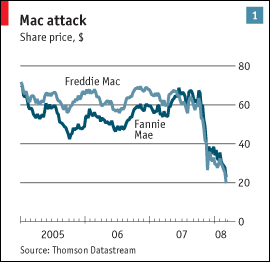
The House enthusiastically passed a bill today to bail out Freddie Mac and Fannie Mae (why do they have such similar names? That makes no sense!) using your hard-earned taxpayer dollars. It's a "loan," but cheap enough that the US Government will be losing a fair amount of money on it. Note that no reputable lending institution was willing to give them the money to keep going.

Sometimes I wonder why the economy's not doing great. Then I remember one of the reasons is we use dollars you could be saving/spending and putting them in the pockets of failed and irresponsible big business execs.

Now I'm told that a Fannie/Freddie collapse would be devastating for the US economy. That's also what I was told about Bear Stearns, somewhat passionately and loudly by a few of my fed-loving friends. But after we so enthusiastically spent US taxpayer dollars to keep Bear Sterns afloat, they still collapsed. And the world didn't end. Why?

Turns out, when a company with assets goes down, those assets become very cheap to acquire by other rival companies. Mortgages, for example, can be bought for chump change by banks or other lending institutions. We call this an "investment." If one of Fannie or Freddie collapsed, Bank of America, Wachovia, Citigroup, Morgan-Stanley, or any number of fine US money-manipulating institutions would gladly acquire those mortgages. But some of the mortgages are bad, you say? Well, they'll sell for cheaper. They would almost certainly be sold as a package deal, instead of piecemeal.

And then, these mortgages would be backed by lending instutions A) not run by fools, and B) not on the verge of collapse. I should note that one major reason cited for the collapse of the Soviet economy was the absolute refusal to let failing companies die. One of the reasons any economy works is that companies that cannot make profit don't survive. If they don't make profit, then they're either not offering anything of value or are not running efficiently enough (or some arbitrary regulation is choking off their ability to profit, but I know that's not a popular fact to admit).

And in case it wasn't clear that Congress was trying to help "Homeowners," they are trying to pass a law limiting how much money the Fannie/Freddie execs can get paid. So the Feds are financing a falling company and telling them how much to pay their employees? This sounds like an acquisition.

Ultimately, keeping failing businesses running prevents better businesses from increasing their market share over the burning hulks of the dead ones. So who hurts, ultimately? Consumers. Any talk of all these mortgages disappearing and homes being repossessed is foolishness. Who would repossess them? Fannie and Freddie owned them. If they bleep out of existence, they can't just show up and start throwing people out of their houses as a last dying breath.

If the government feels obligated to act (which it does, because election season is just around the corner!), the best thing to do would be to help manage the transfer of assets from Fannie/Freddie to institutions of less failure, like it's doing with Bear Stearns--when Fannie and Freddie finally collapse from their own poor business practice. But instead, Congress is doing what it does best: ineffectually spending the money of the middle and upper classes for all sizzle and no steak. It's not like the money in the pockets of these productive Americans would help the economy, right?

On the foreclosures: many of these foreclosures are still going to happen. Some people signed onto bad loans that they simply could not afford (you know the whole sub-prime thing by now), and keeping Freddie and Fannie afloat is not going to make them magically able to afford these mortgages. It's possible new lending institutions may be able to restructure or consolidate some of these loans so be more manageable. But if you're broke, it doesn't matter who your lender is, you're not paying him back, and you're losing your house. The bailout really won't help these folks.

Singh-Bush's Bittersweet Victory

Indian Prime Minister Singh and US President Bush have worked together so long on a nuclear power deal that it seemed as silly as Israeli-Palestinian peace. But recent breakthroughs--a deal that is ready for the IAEA--have shaken things up.

A confidence vote came to parliament (which could have ousted the Prime Minister and forced a new parliamentary coalition to form) when the Communist party left the coalition over the US deal (citing something about imperialism on their way out the door), and Singh's future--as well as the deal itself--hung in the balance.

Congress won by a small margin. But accusations of bribery are rampant, opened flamboyantly by a BJH (opposition party) march into the well of parliament, literally waving money that they claimed had been given to them as bribes... only 2 hours before the vote. Sick and imprisoned members of the ruling coalition were pulled out for the vote, and some members of the opposition abstained or failed to arrive at all. The vote was certainly fishy, and Indian papers are very displeased. Indian politics has gotten ugly, even if the vote victory has given Singh the go-ahead on the nuclear deal. Parliamentary elections happen in May, which means he has but 9 months to recover from this PR mess and try to rally the country behind the Congress party, lest a strong socialist opposition take over and derail his economic growth plans for India.

From here, the deal has only a few months to be approved by the IAEA and the US Congress, before Bush leaves office. The move would be a jab in the opposite direction of the US' typical anti-proliferation strategy. India's development of a nuclear bomb made it--according to the Nuclear Proliferation Treaty--a nuclear rogue state (along with Pakistan, maybe Israel), and the US has not required India to give up its weapons program for help in its peacful nuclear program. Surprisingly, Europe is not making a great fuss about this--possibly because Europe's diplomatic leadership are Brown and Sarkozy, and possibly because Europe wants to see a strong India counter a strong China. If Bush keeps Europe's support, the deal is likely to sqeak through before he leaves office.

But the bitterness left in the throats of Indians will not be forgotten quickly. The Opposition will try to use bribery allegations as a sign that the US is trying to use India as a pawn. If the Indian public takes these allegations to heart, the US is going to struggle keeping India along as an ally in the near future.

That said, the way the world is taking a liking to Mr. Obama, they may quickly change their mind if he becomes president.

Friday, July 18, 2008

The Detente

A detente is among us--at least, according to the rhetoric of the Iranian and American leadership. After all the hype, the dozens of news reports scremaing that a Bush attack was imminent, missile tests, Iranian flyovers, Syrian defection, UN sanctions, everything--the two sides are finally ready to hammer out a deal. The deal's not there, but the intent signals a true detente.

First: The Americans have offered to be a part of nuclear negotiations with Iran, a policy reversal that has probably come with some quiet knowledge that Iran is willing to barter with its nuclear program, rather than keep it against all costs. Such a change in policy came when the North Korean regime made the same quiet decision, and has led to the de-Axisification of Kim Jong Il. More importantly, the Iranians have agreed to the deal, and claim to be looking forward to the talks.

Second: The US is now very likely to get an interests section in Tehran--and an Iranian one would likely be placed in the US, later. Not an embassy, and not any sort of rapproachment. But, it's an open overture by both countries to their own people and the people of their adversaries that they are willing to talk, on a relatively equal level.

This is not a random policy-change by Bush. Bush sticks to his guns, and does not change his mind. He does not believe his previous policy was wrong, but that it worked. How it worked is unclear. It is likely that the Iranians either A) were willing to give a great deal on Iraq or B) quietly admitted that they could trade away their domestic nuclear program for something tempting--like Western assistance in building protected nuclear power plants (with tamper-proof centrifuges), to reach a middle-ground on the issue that has been glaringly obvious for years.

If Iran did make a sudden shift in strategy, there is a reason as well. Unlike Bush, Ahmedinejad has to worry about public opinion, and in particular about the religious leadership of his country turning on him (and essentially stripping him of his power). He's got to keep more people happy than Bush, and it's possible the psywar of the last few years, the Syrian departure, and security successes in Iraq have shaken Iranian confidence in the "brinksmanship" strategy just enough that they are going to deal, whether Ahmedinijad and Bush want to or not.

Wednesday, June 18, 2008

The Irish Vote, European Hedging, and Continued American Hegemony

The Irish "No" vote on the Lisbon Treaty has led to serious resignation among the power leadership of Europe--in particular, the French, who are slated to take over the presidency next, show little excitement or hurry for trying to recussitate the treaty, or any other pseudo-constitution.

At it happens, many countries have had very large "no" minorities in their approval votes, and the odds that one of these would not turn into a small majority (the "no" vote in Ireland was 54%) was pretty low. Many countries, particularly smaller ones, do not want to give up such a large chunk of their sovereignty--they like the free trade pact, but not being bossed around by France, Germany, and the UK. Europe must find a new path.

But the behavior of the power players in Europe shows that they have been aware of the possibility of this result for some time, and have been hedging their bets. A pseudo-state EU would create an entity as economically strong as the Untied States, though probably not yet as militarily or politically so. Either way, Europe would be able to stand up to America's ability to unilaterally act. But even as hopes for the EU peaked, Germany, France, and the UK drifted towards the United States. Merkel, Sarkozy, and Brown have all maintained and emphasized friendly ties with the US despite disagreements over the War on Terror and War in Iraq. Such behavior shows that they have been making clear attempts to avoid alienating the United States--a mere irritation if the EU became a single foreign policy bloc with the power to pressure the US, but a disaster if it failed. Given that failure, pro-US hedging on the part of these great powers has paid off.

But that hedging leaves momentum, and a direction. The collapse of the Lisbon Treaty might otherwise leave the foreign policies of many European countries adrift, and their geopolitical positions unsure. But now these countries are turning back to the institutions left behind after the cold war--US bases in Germany, the UK-US "Special Relationship," and NATO--all provide a US-led network to fall back on in a potential crisis of decision. The French are triumphantly returning to full NATO membership, the first time since 1967, and upgrading their military; further, Sarkozy has essentially mirrored Bush's foreign policy since Sarkozy entered office. The British are hanging tough in Iraq despite domestic pressure to withdraw, and Bush and Brown are making clear that they have no disagreements over future Iraq policy. Merkel and Bush have collaborated in drafting UN resolutions against Iran on its nuclear program, and Merkel has made moves to improve ties with Israel, perhaps the US' closest ally.

Without a strong EU, the looming spectre of Russia will further push Europe towards America's umbrella. The Russians are starting to exhibit a disturbing pattern of natural gas extortion, threatening its dependents (one at a time) to cut off supplies should they swing too far out of the Russian line. The Germand and French both admitted that they vetoed Ukraine's entrance into NATO, fearing such an occurence, and would accept Ukraine later when they had established greater energy independence. Eastern European states, save the Ukraine and Belarus, continue to cling to the NATO alliance as a protection from Russia, and more small Russian neighbors, like Georgia, hope to join.

This reliance on the United States for foreign policy leadership is largely unchanged since the early 1990's. The EU looked like it was going to be the force that brought Europe out of the US umbrella once and for all, but EU hopes for a strong foreign policy seem to have been dashed. Without another grand idea or direction, and a Russia that is not only growing quickly economically and militarily, but also asserting itself with increasing aggression, European heavy hitters are likely to stay in line behind the United States for a long time to come.

China's rise and East Asia's willingness to accomodate it is likely to mean an eventual end to US dominance of East and Central Asia. India remains friendly to the US, but fiercely independent. The Middle East mostly continues to tolerate the US, but is looking forward to its exit from the region. Africa is almost certain to never become a sphere of US influence, given the West's constant neglect, and China's neocolonial opportunism. South America remains closer to the US than any other region, but most states in South America have a rather poor opinion of the US, save Columbia; further, Brazil's potential economic explosion with oil finds off its coast may give most Latin American countries a new direction to look. Mexico and Canada will certainly always respect the US' hegemony over North America, but there is little that can be done with that power, and even less that the US cares about.

Ultimately, and perhaps surprisingly, Europe may become the last bastion of US hegemony. Should it ever unionize, build its military, and assert itself in foreign policy, the US would be reduced to an oversized regional power in the next century.

Tuesday, June 17, 2008

The Chinese "Get It Done" Society

Continuing my ad-hoc series on Chiense economy and society, I would like to share with you two things today:

The first is an article by Mr. PJ O'Rourke bout the US Trade Deficit with China, and why we are worrying about nothing. I should say that I disagree with him, only slightly, in two parts:

1) I think the IOU phenomenon he speaks of tends to translate into foreign ownership of US assets (right now the US assets foreigners own minus foreign assets that Americans own is about $2.4 trillion). So essentially, we are selling assets for goods, which makes our capital investment more dependent on rich foreigners... not that such a thing is necessarily significantly worse than making it dependent on domestic rich guys. That said, his argument about the Japanese export-asset purchase-bubble burst story is rather convincing.

2) If the US drops trade barriers (even slowly, as would be intelligent) without reforming its economic regulation, it will find that there's not much it can do, and that's bad. We cannot compete on the international market freely if our own internal economic operations are not relatively free--we would just be too inefficient. He doesn't address this problem well.

Otherwise, great article, including my favorite quote: "America is wrong about economic principles so basic that even a doddering old Commie with a high school education like Deng Xiaoping understood them."

The second thing I'd like to share with you is a few observations about the current state of Beijing. I have already mentioned that it's in a "frenzy" of building and motion, but I am starting to realize just how epic this is--and what it means for the Chinese economy.

Over the weekend, I walked home on south Sanlitun road, and saw some guys with shovels digging up loose shrubs along the entire street. Okay, I thought. I walked to work Monday, and the entire road had new, prettier, orderly trees and shrubs planted, and it has been cleaned. Just like that. But that's nothing.

While walking to work today, I saw the power go out along that road. Within minutes, literally minutes, police and construction workers were on the scene, directing traffic and climbing poles to assess and fix the problem. Soon later, great spools of wire came. It was not quite fixed by the time I got to work, but I would be shocked if it wasn't fixed by the time I go home--as if nothing happened.

Last night, while touring around, we saw a police building torn down. "...this was here yesterday, people were working here yesterday." But the next day, sans red-tape, bureaucracy, and waste, it was torn down to be replaced.

Cranes operate on nights and weekends (in part because labor is so cheap, it's cheaper to pay overtime than let the cranes sit idle). I'm watching buildings rise before me, in timespans of months (not years). It's like every job is a rush job.

One of my friends harkened Beijing to Snowcrash, or Firefly. Big, mean, and changing with incredible speed at all times. One truly does not know what to expect when he walks out of his building the next day. Something new will be there, or something old will be gone. The city is changing quickly, growing, staying with the times. It is progressing at break-neck speed. If only all of China could do that.

Mr. O'Rourke mentioned some of the serious hinders to progress that the Chinese government has in place--certainly, this government is very far from perfect. But my impression is that the Chinese government is less concerned about scrutinizing every private project on private property for its social/spiritual impact as much as Americans are--they are less happy with towns passing ordinances to arbitrarily block a private project on private ground because local citizens "just don't like it," or because some local PTA lobbying group doesn't want a Starbucks in their town. Their workers are not allowed to wallow in wasteful time, and slowly roll to a construction site when it is convenient. When something needs getting done, they are called to arms, and they come, and they work, because that is the only way to make money. Many Americans consider labor union workers to be somewhat lazy. My Chinese friends were shocked that this could be true.

Ultimately, China's current economy is one that just Gets It Done. Are there costs to this? Certainly. Sometimes, something Not Good gets built, sometimes people get irritated, sometimes there are environmental impacts. There may be a middle road to be reached. But I cannot criticize the Chinese for the speed at which they are allowing their city to change--besides some historical artifacts, there is no sense that something should be preserved over something newer and better just because it was there first. If someone wants to buy it, smash it, and build anew, well, that is their initiative. The US tendency to scrutinize every plan to build, every plan to spend, of its citizens, and tell them what they can and cannot do with their private property for reasons as wild as view obstruction, asthetics, etc, has created a society so terrified of doing something wrong that it cannot find the courage to do anything at all.