Showing posts with label parliament. Show all posts

Tuesday, March 17, 2015

Israeli Election Update; And Corrections

First, some corrections:

I got lazy in deciding to not translate some Hebrew and mis-named Herzog's "Zionist Union" as "Labor," which is inexcusable, though we can think of them similarly.

Second, I also failed to take into account the non-linear seat allocations of the Israeli parliament, so my numbers were way off.

But let's move forward.

With 94% of votes in, Likud has a surprise lead with 29 seats to ZU's 24. This is actually so far off of exit polls showing them both closer to 27 or 28 that I suspect there will be a bit of a change as the last 6% get counted (otherwise the exit pollers put up a disappointing effort).


Let's assume this holds.

The Arab "Joint List" will absolutely not join with Likud, and nor will Yesh Atid--even though they were with Netanyahu's coalition last time, they've insisted that they'll only join a coalition "dedicated to peace," and in Israeli terms, that means the opposition.

Likud can count on Bayit Yehudi (Jewish Home), Shas, UTJ, and Yisrael Beytenu, which means Netanyahu's current count is 57--short of the 61 needed.

Herzog's ZU can count on Yesh Atid, Meretz, and the Arab Joint List (due to its stern opposition to Lukid), putting Herzog's count at 53.

It's being said, fairly, that Kalanu (who did better than expected) is poised to play "kingmaker" by joining whatever coalition they please. They're centrist and have worked with Likud in the past, but have made it clear they're willing to go either way.

Netanyahu "has the ball" in being invited to form a coalition, but to some extent it doesn't matter: Herzog has every right to also be courting Kalanu.

Kalanu's moderating force might be very powerful when they make a deal. I'm still predicting Herzog will catch Kalanu and win, primarily because I think that Netanyahu burned too many centrist bridges by pledging to continue building settlements and avowing that Palestine would never become a state: I think it's just too extreme a position to attract Kalanu, but Netanyahu may be willing to back down: he's a shrewd politician and won't let last-minute campaigning declarations keep him out of power.

Saturday, February 28, 2009

Moderates Sidelined in Middle East Conflict

Kadima's gamble in Palestine did not pay off. It's unclear as to whether or not it backfired, but Feb. 10th elections have given Israel's right-wing a majority presence, and President Peres has asked Mr. Netanyahu to form a government, despite Likud's second-place showing in the election.

Mr. Netanyahu has hosted two rounds of negotiations with Kadima, in order to try and form a broad coalition government. But those talks appear to have collapsed, probably over Kadima's commitment to reduce settlements and pursue a US-backed two-state solution. This breakdown likely indicates that Israel is going to lean to the right in the near future.

To form a majority government in the Knesset (parliament), one needs 61 of 120 seats. We'll assume for now that Mr. Netanyahu will likely fail to woo Kadima (28 seats), the Labor Party (13 seats), United Arab List (3 seats), Balad (3 seats), or Hadash (4 seats), which together are 51 seats. To cobble 61 seats together, Mr. Netanyahu will have to appeal to the Zionist/Nationalist tendencies of many right-wing groups, including Yisrael Beytenu (15 seats), United Torah Judaism (5 seats), National Union (4 seats), The Jewish Home (3 seats). Shas (11 seats) is the wildcard--but even if Netanyahu picks them up, he has a narrow coalition indeed, and one whose weight is far to the right. Voices interested in a two-state system will be sidelined in this new government, and the Palestinian Authority will have to choose a reaction.

The PA reaction may be to entrench, but it's unclear. Mr. Abbas is having a lot of trouble forming a unity government with Hamas, largely because Hamas refuses to recognize Israel as a state. Abbas is likely to lose what ground he had in pursuing the two-state solution if Israel spends the next few years uninterested in working with him on such a plan.

Mr. Obama seems to have his work cut out for him.

Friday, December 12, 2008

Implications of a Poll in Palestine

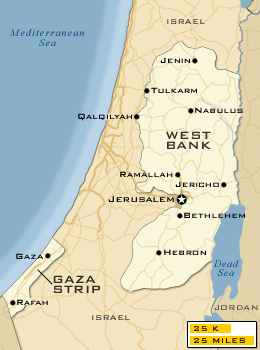
A poll was published today that described relative support for Palestinian Authority parties, Hamas and Fatah. Overall, Fatah would take 42% and Hamas 28%; in the Gaza Strip, Fatah leads 46%-32%.

The implications of this are extremely interesting for Persian Gulf and American governments. Here's why:

A few years ago, Hamas and Fatah fought a brief civil war in both the Gaza strip and West Bank. In Gaza, an aid-dependent territory, Hamas had strong local roots and a reputation for setting up schools and donation centers. They were popular, and in Gaza, they drove Fatah out. But Fatah was the elected government, and won in the West Bank, where trade and diplomacy happen through Israel and Jordan. Each section became a more homogenous, polarized region.


Israeli policy in Gaza looked for a while like it would drive Gazans to the lunatic fringe. Hamas reacted with massive propaganda efforts to Israel's attacks, blockades, etc. In a region so devoid of contact to the outside world, it seemed like such propaganda would work. But somehow, it hasn't. Gazans currently prefer Fatah--a party removed from Gaza's streets and consorting with Israel, Hamas' enemy. The implications of this are strong: Despite losing the civil war and appearing to sell out the Gaza strip, Fatah has won their loyalty. Throughout all of the Palestinian Authority, Hamas is being rejected by fairly impressive margins.

If Fatah can substantially win the upcoming January elections, then its moderate politics will reign supreme. If it can consolidate its power over Gaza, then it can begin to enforce moderate policies and suppress Hamas' anti-Israeli terror behavior. If and only if it can suppress this behavior will its 2-state policy have a chance. Israel cannot give up some control of the PA until it knows that it will not be a hotbed for terror--it cannot take it back as easily as it can simply hold on.

But the other implications are perhaps more interesting, in Israel. If the moderate Fatah party can take control of all of the Palestinian Authority, then Israeli perceptions about the PA may change. If the Israelis see hope in 2-state negotiations, if they see that such negotiations may lead to long-term peace and prosperity rather than increased terrorism and demands by radical Islamist leadership, then Israelis may be more tempted to vote Kadima and continue negotiations rather than throw their hands up and oust the government for the Likud opposition.

If Fatah and Kadima can get a new mandate and a stronger political hold over their respective territories, then the 2-state negotiations are likely to have a lot more hope in the next few years--particularly if such moderates in power allow the Israeli-Syrian peace talks to resolve. The machinations for Middle East negotiations have been shaken up significantly by the last years' actions, but they may not have fallen apart.

Tuesday, December 9, 2008

Congress Hangs On in India

Many analysts believed the Mumbai attacks would be devastating for the Indian Congress Party--the pro-business and pro-US ruling party in New Dehli. While Pakistani cells were almost certainly responsible, a number of intelligence failings on the part of Indian counterterrorists became apparent. The US had warned India of a terror attack on Mumbai through its ports.

Such failings looked like they would vindicate BJP (the opposition leader) criticisms for years over weak terror and Pakistan policies. But Congress is holding on with surprising vigor. In recent state elections, Congress won 3 of 5--most interestingly, Dehli, which pundits thought seemed certain to go to BJP due to its close cultural ties with Mumbai. But while the bombings were clearly a black mark on Congress, the relative responses of Congress and BJP may have made the difference.

Congress has stepped up pressure on Pakistan, together with the United States. India has demanded--and to some extent, received--Pakistani help during the Mumbai investigations. Quickly, the Pakistanis responded with a number of arrests, including the alleged "mastermind" of the attacks. In addition, the government has revealed the identities of the Mumbai gunmen, giving the Pakistanis few political options besides a new wave of arrests to get to people near these published gunmen that might have been involved in conspiracy. Indians may be relatively satisfied with this cautious but firm response. It appears dynamic and well-thought-out.

BJP, on the other hand, has faced accusations of "opportunism." The Mumbai attacks were much like an Indian 9/11, and appearing to try to gain politically by the event will hurt any party. BJP may have been too aggressive. In addition, Indians may not want to encourage another bloody war with Pakistan (that might, if poorly designed, lead to even more terrorism by fracturing the Pakistani state) by electing the currently fevrishly militant BJP.

Elections in May are coming up for Congress, and they can't afford to lose. Allegations of buying votes on the US nuclear deal remain, and the Congress response to these attacks may shape their election hopes in May. They have a few months to make it work, which may be the basis of their slow, cautious approach. If Pakistan does end up declaring full-scale war on the militants, then Congress can take credit for applying enough pressure to get the job done without having so sacrifice Indian troops--such an outcome would be the best Congress can hope for.

Thursday, December 4, 2008

Followup: Canadian Parliament Suspended

It was even easier than I thought. Despite being Liberal-recommended, Governor General Jean agreed to suspend Canadian parliament today. The no-confidence vote, which Harper was expected to lose, will not happen--at least in the near future.

When parliament reconvenes in late January, both sides will have had a fair amount of time to make their point to voters. If Harper is able to get Canadian citizens on his side, then the opposition coalition will dare not bring the no-confidence vote--for then, Harper could call snap elections and potentially win a majority of seats. But if the Canadian people have in fact grown tired of the Conservatives only 2 months after giving them a near-majority power, then the no-confidence vote may go ahead, forcing Harper to bow out into opposition status.

But given how quickly the opposition coalition tried to push through the no-confidence vote, they are unlikely to benefit from 2 more months of jockeying and thinking among the Canadian populous. It will be hard to keep people excited for a change in government when nothing is getting done. And with the Governor General on his side, Harper can claim that the State will benefit from a continued Conservative government with more legitimacy.

Wednesday, December 3, 2008

The Canadian Political Crisis

After a second-straight gain in elections, the Conservative Party of Canada 143 of 308 seats--nearly a majority, and things looked good for Stephen Harper and his party.

Being good Conservatives, they decided that the fiscal crisis would probably be hurt by a too-hasty hemorrhaging of taxpayer loonies all over the economy, so they took a wait-and-see approach.

But the Liberals, New Democrats, and Bloc Quebequois aren't happy about this--so unhappy, in fact, that they've signed a deal to topple Harper's Conservatives and drop a 30 billion dollar package of their own. To actually oust the government, they would need to win a vote of no-confidence, which would need 155 votes (out of 308). But the Conservatives' 143 seats are unlikely to vote for the motion, meaning that the Conservatives would only have to convince 12 out of the remaining 165 representatives in house not to shake up the government. I don't know the propensity of Canadian reps to toe the party line, but this would be a doozie for the opposition almost anywhere.

But Harper's not taking any chances. Instead of letting the vote of no confidence go forward, he's asked the Governor General to suspend parliament until late January--when the Conservatives will present their budget for a vote. The move, if he can pull it off, would be quite brilliant. The whole justification of the opposition coalition's hostile takeover is a desire to put through a quick stimulus package--but if the Conservative budget in January is politically sound (and it likely will be, if they have the next 8 weeks to think about it), there will be little that an opposition coalition could accomplish beyond it. The original purpose of the coalition would be lost, as long as the budget looks good.

As angry as they'd be about having parliament suspended during the economic crisis, they'd have to find a new political reason to topple the Conservatives--they might hold a vote of no confidence on the grounds of irresponsibility; on the grounds that Harper wanted to suspend Parliament during tough times--but the opposition coalition can't blame Harper without more deeply (though unintendedly) blaming Governor General Jean, who was recommended by the last Liberal government and appointed at the pleasure of the Queen, and is not part of any political party. The members of House would be spitting on some pretty big wigs, and almost certainly are unwilling to do that.

So, if Harper can pull off the suspension, he'll take the wind out of the opposition's sails, and likely hold onto the government for the forseeable future. If not, he may have to face a no-confidence vote or test the wind to see if he'd fare well in a snap election, marking one of the shortest election periods in Canadian history. If he does call snap elections, he'll have to blame the opposition parties for putting politics before country, which he's already trying to do. If he wins a majority out of the snap elections (unlikely), then his government is in good shape for a fair many years.

Sunday, November 16, 2008

New Pieces in Place in Iraq

Two major events have happened in the last day that are going to make Mr. Obama's life significantly easier when he enters office. The first is the passing of the Status of Forces Agreement (SoFA) in the Iraqi Cabinet. The second is the setting of a date for provincial elections in 14 of 18 provinces of Iraq.

The Status of Forces Agreement is a treaty that the US has tried to acquire for many months, granting US forces some form of extended stay in Iraq (after the UN Mandate runs out on Dec 31, 2008). The issue has been hotly debated and altered many times; US troops will have less freedom to operate, a tighter Rules of Engagement (ROE), more oversight, and more deadlines than before. Earlier, Shiites in parliament had stated that they would not agree to the previous version of the pact, which granted US troops too much leeway. Most parliament members will probably publicly oppose the pact, but vote for it anyway, and claim that there was little else they could do--ultimately, Iraqi parliament knows that it needs the US for security more than the US needs Iraq for its reputation and values. This has become very clear in the past two weeks, which have carried a rise in violence.

In its first major step towards ratification, the pact got 27 of 28 votes in cabinet to be moved on to the legislature for approval. The legislature is unlikely to be as one-sided as Maliki's hand-picked cabinet--parliament is indeed made up of many factioned parties--but the near-unanimous approval of the cabinet will be a push for any fence-sitting legislators. In addition, Maliki has managed to forge a comrpomise with Cleric Al-Sistani, the most powerful religious figure in Iraq, to avoid openly opposing the pact. This should put most Shiites on board with the Kurds in parliament and, along with pro-US Sunni forces, they should likely make up a majority.

Provincial elections are complicated. In 2005, boycotts led to very lopsided victories, which led to Sunni worries of domination, which led to bombing a few mosques here and there, which led to reprisals, which led to civil war. Today, the provincial appointments remain lopsided, but the new elections aim to change that. Currently, Tamil and the three Kurdish provinces will not be voting on January 31, when everyone else votes. There are not yet sufficient rules for Kurdish semi-autonomous provinces for parliament to be able to deal with their vote, and Tamil's status is under contention by Arabs, Turkmen, and Kurds as to whether it should be semi-autonomous or not. Because no agreement on rules for these 4 provinces could be made, the elections--originally slated for October--were pushed back. The compromise so far has been to allow for elections in 14 provinces and figure the other ones out later--probably a pretty good idea. Of the 4 left-our provinces, only Tamil has serious potential for the ethnosectarian makeup of its leadership to change--the Kurdish provinces are mostly happy with their leadership.

After the 31st of January, 2 effects should be seen: First, an increased confidence rating by local citizens about their government's ability to act fairly and effectively. Disproportionate election results have meant a sense of oppression for many Iraqis, and that is likely to change. Second, a sense of compromise is likely to take hold in Iraqi leadership. Previously, parties with a disproportionate majority had incentives to try and brute-force their interests, and disproportionate minority parties had an incentive to block anything trying to go through. With more pluralistic representation, decisions will require multi-party support, and the incentive will be to start by compromising.

Both decisions will make President Obama's life easier. The first means he has a guide to troop withdrawal, and can avoid doing anything politically risky by making serious decisions one way or the other. The second will lead to long-term political reconciliation in Iraq, which will reduce violence and leave a more functional country upon US withdrawal--and he will be able to take all the credit.

Wednesday, July 23, 2008

Singh-Bush's Bittersweet Victory

Indian Prime Minister Singh and US President Bush have worked together so long on a nuclear power deal that it seemed as silly as Israeli-Palestinian peace. But recent breakthroughs--a deal that is ready for the IAEA--have shaken things up.

A confidence vote came to parliament (which could have ousted the Prime Minister and forced a new parliamentary coalition to form) when the Communist party left the coalition over the US deal (citing something about imperialism on their way out the door), and Singh's future--as well as the deal itself--hung in the balance.

Congress won by a small margin. But accusations of bribery are rampant, opened flamboyantly by a BJH (opposition party) march into the well of parliament, literally waving money that they claimed had been given to them as bribes... only 2 hours before the vote. Sick and imprisoned members of the ruling coalition were pulled out for the vote, and some members of the opposition abstained or failed to arrive at all. The vote was certainly fishy, and Indian papers are very displeased. Indian politics has gotten ugly, even if the vote victory has given Singh the go-ahead on the nuclear deal. Parliamentary elections happen in May, which means he has but 9 months to recover from this PR mess and try to rally the country behind the Congress party, lest a strong socialist opposition take over and derail his economic growth plans for India.

From here, the deal has only a few months to be approved by the IAEA and the US Congress, before Bush leaves office. The move would be a jab in the opposite direction of the US' typical anti-proliferation strategy. India's development of a nuclear bomb made it--according to the Nuclear Proliferation Treaty--a nuclear rogue state (along with Pakistan, maybe Israel), and the US has not required India to give up its weapons program for help in its peacful nuclear program. Surprisingly, Europe is not making a great fuss about this--possibly because Europe's diplomatic leadership are Brown and Sarkozy, and possibly because Europe wants to see a strong India counter a strong China. If Bush keeps Europe's support, the deal is likely to sqeak through before he leaves office.

But the bitterness left in the throats of Indians will not be forgotten quickly. The Opposition will try to use bribery allegations as a sign that the US is trying to use India as a pawn. If the Indian public takes these allegations to heart, the US is going to struggle keeping India along as an ally in the near future.

That said, the way the world is taking a liking to Mr. Obama, they may quickly change their mind if he becomes president.

Wednesday, March 19, 2008

Dissecting the Iran Election

I am often told of a power struggle within Iran; at least the secular part of it. There is evidence of it; Iranian shifts in Iraq policy and shifts in strength of anti-Israeli and anti-American sentiment show that such is clear. Iranian students are often lauded to be more pro-Western and moderate than their parents, defying Iranian dress code law by cutting their hair close and wearing ties. In the late 1990's and early 2000s, moderate reformers swept into power, and in 2004 lost it.

After this election, the conservative/reformist split of seating seems to have not changed much, despite the fact that the cleric-led Guardian Council banned most of the reformist opposition from running due to insufficient loyalty to Islam (that same Guardian Council is calling the election a "Victory Against the West"). But among the conservatives, a fissure is growing. A faction of conservatives is rallying against Ahmadinejad's hard-line stances, which they say are bringing UN sanctions, as well as Iran's faltering economy, suffering from high inflation and unemployment.


The reformers might have done better, had President Bush not encouraged Iranians to boycott; his words likely inflamed Iran's sense of nationalism and anti-Americanism.

The EU and US have condoned the election as unfair due to the banning of reformer candidates, though the protests will go no further than that, and Iran's parliament will press on, functional, for the next four years.

Reformers are also calling this vote a victory, given that they held on to most of the seats they had despite many of the men and women who had campaigned for seats were blocked.

The interesting part will not be what the reformers do, but what the opposition conservatives do. Ahmadinejad is in for a tough next year; presidential elections occur in 2009, and a few conservatives are looking to lead their faction towards a presidential victory, beating out Ahmadinejad.

It should be noted that not all right-wing religious fanatics are the same. While not reformers, these conservatives are likely to do more looking inward, concentrating on economic reform and strengthening cultural and religious unity. What Iraq policy the anti-Ahmadinejad conservatives hold is unknown to me, but it is likely to change.

The US public won't see much in the way of immediate changes from this election, but Ahmadinejad may be forced to make foreign policy concessions; look closely for subtle changes in rhetoric and action in Iran's foreign policy in the next few months. I'll keep my eye on what's to come.

Monday, February 25, 2008

Musharraf Might be Bowing Out

We've already talked about the possibility of impeachment of Musharraf by an alliance in parliament by the People's Party and Muslim League-N in Pakistan. At this point, it appears as if Musharraf may try to preempt them and step down himself.

Musharraf has made no overt signs that he is going to resign, but different sources (particularly Stratfor) have been talking a bit about signs they have seen: The Telegraph (UK) has quoted anonymous top aides as saying that the President may be stepping down in a matter of days. Stratfor claims that some of President Bush's senior advisers are investigating the most elegant way for Musharraf to leave.

While Musharraf has seemed to fight tooth-and-nail to hold on to his power in the past, he may have not realized that there is none left for him to hold on to. If the Bush administration is successfully aiding the power transition to a Sharif-led government, Washington's relationship with Pakistan may indeed remain strong, in large part thanks to the political power of the Pakistani Army (a highly pro-Global War on Terror entity).

The US should continue helping Musharraf move out, and both welcome and support the new government, in hopes that US-supported Pakistani anti-terror operations are not hindered. In fact, as we've speculated on earlier, a more widely-supported coalition may reduce political support for the Taliban in the northwest, as they will no longer represent an anti-Musharraf institution, but instead an anti-state one.

Tuesday, February 19, 2008

Pakistan's Democracy Finally Works

I am both shocked and jubilant. In the days leading to Pakistan's parliamentary elections, I assumed (like many Pakistanis, apparently) that President Musharraf's military and political allies would successfully rig the parliamentary elections to help him stay in power. But, for some reason or another, he didn't. Perhaps he was looking to simply survive (he has even more angry militant enemies than Bhutto did), or maybe he simply has spent the last 8 years doing what he thought was right, even if, from here, his actions looked like purely personal power-grabbing. But Musharraf has shocked me (and others) in letting the elections happen in what international observers have said was accurate and fair.

In this election, 242 seats were up for contest. Of these, early returns show the Pakistan People's Party (ala Bhutto) winning ~80, Pakistan Muslim League-N (ala Sharif) winning ~66, and Pakistan Muslim League-Q (ala Musharraf) winning only 38. The outcome is promising--past Pakistani opposition has traditionally been dominated by highly religious parties, but the People's Party is secularist, and Muslim League-N is a moderate group with highly competent leadership.


People's Party and Muslim League-N have been in coalition talks for months, and are in them again already. Should such a coalition emerge, they could theoretically run a government without any other parties involved (particularly, the Muslim League-Q). They'd also be able to impeach Musharraf if their members voted in force, and I believe they are likely to do so. While Ms. Bhutto had been willing to work with Musharraf, Sharif was so opposed to the idea that he was threatening parliamentary boycott. With Ms. Bhutto dead (and her son leading her party), Sharif emerged as the single most experienced and respected politician in Pakistan, and is likely to have a great deal of influence over the People's Party's leadership. Furthermore, the coalition would have a large enough parliamentary majority that they would have no need to hold on to Mr. Musharraf, unless he can propose to them some sort of favors that a replacement president would not be able to provide. But for the most part, he is at the mercy of the new coalition.

Interestingly, these results may show that Al-Qaeda militancy in the northwest may have gained them local ground, but it has still created vast secular and moderate cohesion against them in the rest of Pakistan, even among the majority that oppose Musharraf's aggressive anti-militant activities. Pakistan avoided a religious uprising or conservative backlash--they voted out Musharraf's party and replaced it with liberal-secular options, which should long-term be beneficial to the United States, should Bush manage to not screw up the early relationship with the new government. Remember that Ms. Bhutto had said that she was willing to work with the United States in the war against Al-Qaeda in the northwest of Pakistan, and her victorious People's Party won by carrying on the bulk of her policy ideas.

New cohesion and better competence in government is going to bring great domestic change to Pakistan, and hopefully, the new government will find a way to finally deal with the northwestern frontier. I am indeed holding my breath; I believe that the Pakistani battleground is at a critical point, and could well fall to the United States' primary enemy. On the other hand, should the new government succeed in rooting out Al-Qaeda, the citizens of the United States will be safer than they have been since the early 1990's. Furthermore, if Al-Qaeda falls, restoring Afghanistan to order will become a possibility in the medium-term future. Karachi's government is in need of relief from militants; they are making gains in the business of terror.

So I am full of hope, and apprehension. If this new government cannot solve the Al-Qaeda problem, I do not know who will be able to do so.