It is clear at this point that I'm a Libertarian, so I have no shame in publishing the following picture, made by the wonderful Kathleen Clark-Adams:
Defense, National Security, and Foreign Policy Analysis in the Dynamic System of International Relations and Diplomacy
Showing posts with label McCain. Show all posts
Tuesday, November 4, 2008
Another Election Digression
I must apologize for not getting this out earlier, but I was busy watching the election.
It is clear at this point that I'm a Libertarian, so I have no shame in publishing the following picture, made by the wonderful Kathleen Clark-Adams:
Monday, November 3, 2008
Ballot Box Special: Candidate's Foreign Policies
The Washington Post provides an excellent summary.
Differences:
Trade: McCain wants more Free Trade Agreements, Obama doesn't. That said, the Democratic majority in congress wouldn't let McCain sign a free trade agreement with North Carolina, so none of that is going to happen in the near future, anyway.
Iraq: Notable differences here include rhetoric, largely, but not much else. McCain thinks Iraq is a battleground for terror, Obama thinks it's a distraction. McCain thinks the surge worked, Obama... didn't, but then quietly stopped commenting on it when he saw the polls were going the wrong way. Obama wants a 16-month withdrawal timeline, McCain... wanted to stay long-term (like South Korea, Germany, etc), but quickly voiced his support for an Iraqi-proposed 2011 deadline for withdrawal.
Iran and Russia: John McCain's unmasked hate for both countries means diplomatic relations would sour. McCain wants to even boot Russia from the G8, push hard for expansion of NATO, and
Similarities:
Afghanistan: Both want to add 2 combat brigades to Iraq, and use their fresh mandate as a new president to improve ties with Pakistan, helping build Pakistan's economy and democracy. Interestingly, both support attacks into Waziristan without consulting Pakistan, first. While I may have a lot of criticisms of such a seemingly mutually undermining policy package, I'll save that for later.
Georgia: Both supported Georgia in its war with Russia, but both are letting it fade into the background.
Energy Security: They both want it, neither will get it. Really, the way to be energy-secure in the near term is to mandate CO2 catchers on power plants and use clean coal--we've got lots of it, and it's really darn cheap. But the word "coal" terrifies people. McCain wants more drilling, but probably wouldn't get any more than he already got in this last year, so both would be pushing renewable energy, electric cars, etc. It's a bit more complicated as to exactly what tax breaks and incentives and subsidies would go where, but it'll mostly work out in the wash.
Ethics: Both want to close Guantanamo Bay, end torture as a US-sponsored practice, and repeal other nastier aspects of the Bush regime. Bravo, gentlemen.
Ground forces: Both want to increase them, but with what money, and what recruits? The Iraq war has sucked the country dry of potential warriors and has crushed demand. Maybe their charm and charisma can lure more young rural kids into the armed forces.
Climate change: Both want to fight it. Hello, Kyoto; goodbye, US manufacturing industry.
So if you're sweating foreign policy, don't. It'll mostly be the same either way. And if the Democrats get their unbreakable majority in Senate, which is possible, then the president (either way) won't do much but hold pom poms or pitchforks for whatever they decide they're doing.
Monday, September 15, 2008
What the Heck is the Bush Doctrine?
Nonetheless, after seeing the interview, watching Charlie Gibson very confidently enunciated the finer details of the Bush Doctrine (that it was "anticipatory self-defense"). I listened, and thought, "wait, really?" I know a thing or two about the Bush Doctrine, and I wasn't entirely sure I agreed with Mr. Gibson. But surely, he'd done his research, and sometimes even I am wrong. Now, I do expect the Vice President of the United States to know a bit more about foreign policy than, lo, even I do.
But then I was sent an article written by the guy that first used the term. Mr. Krauthammer gave vindication to my intuition--despite Gibson's arrogance in being smarter than Palin, he was wrong for two reasons. Reason the first is that there are four separate meanings of the Bush doctrine from four different time periods, all of which have been called the "Bush Doctrine" in literature. These are:
1) Pre-9/11 unilateralism, including withdrawing from treaties;
2) Post-9/11 "if you harbor terrorists we will consider you hostile"-ism;
3) March 2002 pre-emptive defense-ism (what Gibson cited);
4) Later "aggressively spread Democracy through the world"-ism.
The last one is the one most cited and most encompassing of all of Bush's doctrinal statements. It's no wonder Governor Palin was confused when Mr. Gibson threw the phrase out there and expected her to pick up exactly what it meant. It's not quite an excuse for the level of Palin's fumbling during the foreign policy section of that particular interview, but (like most things in politics), this is nothing as it seems. And, like most things in politics, the media has again taken the position of impatient sage, and has told you and the Governor what to think.
In truth, all this reveals about the McCain ticket is its failure to market correctly. No, of course Palin is not an expert in foreign policy. No, she hasn't met with world leaders (which Gibson asked about). Why the heck would she? She's a governor, not a diplomat. Unlike Mr.'s McCain, Obama, and Biden, she has not been custom-tailoring her position as governor as a springboard, and so doesn't yet know much about foreign policy. Will she learn? Sure; Governor Clinton did, Governor Carter did (although his foreign policy was admittedly quite naive), Governor Reagan did. And for all the clamoring about John McCain's imminent departure from the earthly world, she doesn't have to be ready to fight the war-on-terror on day one, without any mentoring.
Mr. Obama himself, while running against Clinton, said that "experience is only a proxy for judgment." Those without experience will be wild cards in their decision-making. But for all their experience in foreign policy, Mr.'s Obama, Biden, and McCain lack any executive experience whatsoever. Further, have the foreign policy experiences of Mr.'s Obama and Biden culminated in proof of sound foreign policy judgment and good understanding of how to grace America's diplomatic and military might upon the world stage? More about that, later.
Wednesday, July 30, 2008
Well, Maybe the Surge is Working
On today, the last day of July in Iraq, the US troop death toll has rung to 12, after
Staff Sgt. Faoa L. Apineru died of a wound suffered on July 2. If this holds (barring some terrible event today or wounded soldiers dying later), it would be a death toll less than 2/3 of the previously lowest month in Iraq (May: 19 deaths). So the by-far two lowest death tolls since the beginning of the war have been in the past 3 months, and this most recent one has come after the end of the surge.
Recorded Iraqi deaths are also at an all-time low: 393 (lower only than June, at 450, which was lower only than May, at 506). A pattern is emerging, and it's one of steadily, reliably increasing security and safety.
It is thus time to face a simple fact down a dark alley that most of us have been trying to avoid: The Surge worked, General Petraeus is not an unpatriotic, treasonous Bush lackey, and the Iraq war is winnable.
Now, Mr. Obama's campaign boat has a lot of wind behind its sails right now, because even Mr. McCain is agreeing to the sixteen-month timetable for withdrawal. This vindicates Mr. Obama, right? He was right all along?
No, not at all. Mr. Obama has spent the entire surge saying that it was not working. In July, his website was smart enough to remove his consistent, zealous opposition to the Surge from their Iraq
page, but he has not come out to say that it has worked. Does he still think that it hasn't? Or is he simply as stick-to-your-guns consistent in his ideological stances as Mr. Bush?
Mr. Obama has not only opposed the surge since the beginning, but his 16-month withdrawal plan came around not because of successes in Iraq. His withdrawal plan has been the same, from the absolute worst conditions in Iraq (in 2006 when the violence was over 10 times what it is now) to today. The 16-month timetable was a strategy for easy defeat, not one for actually winning. But, quite luckily for Mr. Obama, he was wrong about the surge. His being wrong about the surge makes his 16-month timetable look entirely reasonable, as long as you are not willing to think about it too hard.
Unfortunately for the future of US foreign policy, Obama's political stars-and-moons lining up is nothing but luck, and has absolutely nothing to do with his ability to make judgments and decisions as Commander in Chief. He was wrong--and still is wrong--about the Surge, and his being wrong about the Surge is the only reason his years-old 16-month withdrawal timetable looks like anything more than a bloody white flag strategy. His policies and stances have not changed at all, regardless of wildly
varying conditions in Iraq. This would mean an even more inflexible and ideological foreign policy than that of Mr. Bush, who was at least smart enough to consider Mr. Petraeus' plan for changing strategies.
But, even more unfortunately for the future of US foreign policy is that the McCain campaign camp is completely incompetent, and will not be able to capitalize on this glaring flaw in Mr. Obama's shining moment. If they can't, then Mr. Obama will win this election, and the American people will spend at least four years knowing that they truly had no idea what they meant when they spent the last 8 years complaining about idealistic and inflexible foreign policy. I have yet to see an Obama foreign policy point that shows any shred of good judgment or consideration for earthly realities, particularly in regards to military matters.
Staff Sgt. Faoa L. Apineru died of a wound suffered on July 2. If this holds (barring some terrible event today or wounded soldiers dying later), it would be a death toll less than 2/3 of the previously lowest month in Iraq (May: 19 deaths). So the by-far two lowest death tolls since the beginning of the war have been in the past 3 months, and this most recent one has come after the end of the surge.
Recorded Iraqi deaths are also at an all-time low: 393 (lower only than June, at 450, which was lower only than May, at 506). A pattern is emerging, and it's one of steadily, reliably increasing security and safety.
It is thus time to face a simple fact down a dark alley that most of us have been trying to avoid: The Surge worked, General Petraeus is not an unpatriotic, treasonous Bush lackey, and the Iraq war is winnable.
Now, Mr. Obama's campaign boat has a lot of wind behind its sails right now, because even Mr. McCain is agreeing to the sixteen-month timetable for withdrawal. This vindicates Mr. Obama, right? He was right all along?
No, not at all. Mr. Obama has spent the entire surge saying that it was not working. In July, his website was smart enough to remove his consistent, zealous opposition to the Surge from their Iraq
Mr. Obama has not only opposed the surge since the beginning, but his 16-month withdrawal plan came around not because of successes in Iraq. His withdrawal plan has been the same, from the absolute worst conditions in Iraq (in 2006 when the violence was over 10 times what it is now) to today. The 16-month timetable was a strategy for easy defeat, not one for actually winning. But, quite luckily for Mr. Obama, he was wrong about the surge. His being wrong about the surge makes his 16-month timetable look entirely reasonable, as long as you are not willing to think about it too hard.
Unfortunately for the future of US foreign policy, Obama's political stars-and-moons lining up is nothing but luck, and has absolutely nothing to do with his ability to make judgments and decisions as Commander in Chief. He was wrong--and still is wrong--about the Surge, and his being wrong about the Surge is the only reason his years-old 16-month withdrawal timetable looks like anything more than a bloody white flag strategy. His policies and stances have not changed at all, regardless of wildly
But, even more unfortunately for the future of US foreign policy is that the McCain campaign camp is completely incompetent, and will not be able to capitalize on this glaring flaw in Mr. Obama's shining moment. If they can't, then Mr. Obama will win this election, and the American people will spend at least four years knowing that they truly had no idea what they meant when they spent the last 8 years complaining about idealistic and inflexible foreign policy. I have yet to see an Obama foreign policy point that shows any shred of good judgment or consideration for earthly realities, particularly in regards to military matters.
Labels:
Election,
Iraqi Security,
McCain,
Obama,
surge,
War in Iraq
Tuesday, July 22, 2008
Iraq Goes to Obama
Months ago, McCain called on Obama to go to Iraq to educate himself on the ground situation, in a mark of criticism against his 16-month withdrawal plan. He probably hoepd to put Obama in a double-bind: if Obama did not go, he could be painted as ignoring facts. If he did, he might be painted as admitting ignorance.
Obama went with the second option, and the plan has backfired for McCain in ways he could not have previously imagined.
Contrary to my previous thoughts on the subject, it looks like Bush and al-Maliki are actually in a very deep row over the status of American troops in Iraq.
Obama has visited Iraq, and met with Gen. Petreaus and top Iraqi officials. In open acknowledgment that "the Surge worked," the Iraqis have shortened their proposed timeline from 2012 to 2010--right
in line with Mr. Obama's 16-month withdrawal plan. The quick change is a bit surprising, but it's possible the Iraqi government is actually trying to use its own fate as a bolster for Obama (Mr. Obama has found himself quite a warm welcome in Iraq so far, and they may be looking forward to 8 years of working with him). In addition, a photo-op by General Petraeus' side is just what Obama needed to extend his run to the center.
The last few days have been a crippling defeat to McCain, whose Iraq policy centered on being a practical solution for Iraqi security, even if it was tough on Americans. But now, with the Iraqis siding with Mr. Obama, even McCain has to give a bit: he has admitted he could imagine US troops in Iraq for only 2 more years.
Now Mr. Obama has won the initiative on foreign policy--an area that he has seemed weak, before. Such a victory is likely to win him key undecided moderates and make Mr. McCain's bid for the White House become a long shot.
Obama's race towards the center is likely to work for him, as long as he is able to shake from his tail his involvement with the American ultra-left:
Obama went with the second option, and the plan has backfired for McCain in ways he could not have previously imagined.
Contrary to my previous thoughts on the subject, it looks like Bush and al-Maliki are actually in a very deep row over the status of American troops in Iraq.
Obama has visited Iraq, and met with Gen. Petreaus and top Iraqi officials. In open acknowledgment that "the Surge worked," the Iraqis have shortened their proposed timeline from 2012 to 2010--right
The last few days have been a crippling defeat to McCain, whose Iraq policy centered on being a practical solution for Iraqi security, even if it was tough on Americans. But now, with the Iraqis siding with Mr. Obama, even McCain has to give a bit: he has admitted he could imagine US troops in Iraq for only 2 more years.
Now Mr. Obama has won the initiative on foreign policy--an area that he has seemed weak, before. Such a victory is likely to win him key undecided moderates and make Mr. McCain's bid for the White House become a long shot.
Obama's race towards the center is likely to work for him, as long as he is able to shake from his tail his involvement with the American ultra-left:
Monday, July 14, 2008
Obama and McCain's Delicate Dance with Contradiction
Obama's line about Iraq has been: It is a failure, a disaster, and the Iraqi Army
will be on its feet next year, and the country will stable--we should pull out as soon as possible.
McCain's line about Iraq hs been: It is a slow, tough success, and the Iraqi Army will be on its feet next year, but it's not ready, won't be ready for a long time--let's wait to pull out.
The arguments for each of them have self-defeating qualities. For Obama, insisting that Iraq will stand and that the Iraqi Army can take over during a 16-month pullout defeats much of the punch in his claims that the war has been a disaster. He admits serious success and progress in saying that the Iraqi Army will be able to take over next year, and hampers his own ability to criticize the Republicans.
McCain, on the other hand, contradicts his own calls for an extended stay by saying the situation is good and improving, that there has been success.
Why keep the troops there, if the Iraqi Army is almost ready to go? McCain's stance is a bit more "flexible--" he wants to keep troops there "based on conditions," but this largely means he is largely dodging the problem of having a position altogether.
And Obama, of course, is sticking to his timeline, even before meeting with Iraqi commanders. McCain refuses to have a solid answer, and Obama is back to refusing to alter his based on pretty much anything.
Maybe that's why the Iraqis are taking matters into their own hands.
McCain's line about Iraq hs been: It is a slow, tough success, and the Iraqi Army will be on its feet next year, but it's not ready, won't be ready for a long time--let's wait to pull out.
The arguments for each of them have self-defeating qualities. For Obama, insisting that Iraq will stand and that the Iraqi Army can take over during a 16-month pullout defeats much of the punch in his claims that the war has been a disaster. He admits serious success and progress in saying that the Iraqi Army will be able to take over next year, and hampers his own ability to criticize the Republicans.
McCain, on the other hand, contradicts his own calls for an extended stay by saying the situation is good and improving, that there has been success.
And Obama, of course, is sticking to his timeline, even before meeting with Iraqi commanders. McCain refuses to have a solid answer, and Obama is back to refusing to alter his based on pretty much anything.
Maybe that's why the Iraqis are taking matters into their own hands.
Thursday, July 3, 2008
Obama "Preparing the Battlefield" for a Good Iraq Policy
Obama's earlier remarks on Iraq have been highly political and devoid of much consideration of actual military/political force in the country. His high-speed withdrawal plans came without a single conversation with a US military commander involved in the theatre, and has had no good answer (that I can find) for media that have proposed the question that a quick withdrawal may lead to a surge in violence.
But Obama his changing his tune. He actually plans to sit down with military commanders, and might "refine" his Iraq stance in light of evidence. What a novel idea!
But an idealistic young senator running for president is not going to change his long-defended Iraq stance before the election--even if it is a good idea--unless there is a public opinion reason involved. Obama's remarks are preparing the base of the Democratic party--many of them ardently opposed to any coninued US presence in Iraq--for a shift away from telling them what they want to hear, and a shift towards some deeper thought on the subject.
Is Obama trying to make sure he does not end up on the wrong side of the Iraq debate? Maybe, but polling is currently in favor of his old stance--70% of Americans either want troops removed right away or within a year.
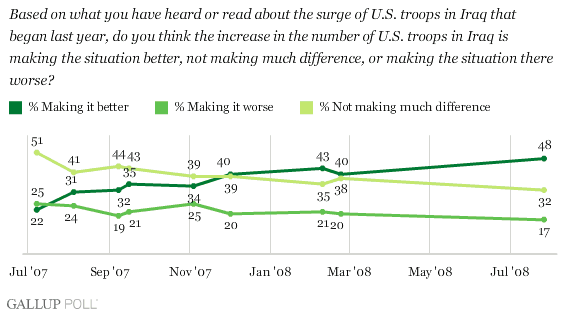
Interestingly, Americans are starting to change their idea of just how effective the surge has been:

Does this change in assessment mean a change in opinion is also coming? Why does Obama now want to soften a hard stance that has seemed to work for him so well? Is he simply looking to try to catch moderate Republicans without losing his left-wing base?
Or is he simply so confident in his victory (he shouldn't be--old "comeback McCain" still has a few tricks up his sleeve) that he can actually afford to ignore politics and pursue a more rational strategy in Iraq?
But Obama his changing his tune. He actually plans to sit down with military commanders, and might "refine" his Iraq stance in light of evidence. What a novel idea!
But an idealistic young senator running for president is not going to change his long-defended Iraq stance before the election--even if it is a good idea--unless there is a public opinion reason involved. Obama's remarks are preparing the base of the Democratic party--many of them ardently opposed to any coninued US presence in Iraq--for a shift away from telling them what they want to hear, and a shift towards some deeper thought on the subject.
Is Obama trying to make sure he does not end up on the wrong side of the Iraq debate? Maybe, but polling is currently in favor of his old stance--70% of Americans either want troops removed right away or within a year.
Interestingly, Americans are starting to change their idea of just how effective the surge has been:
Does this change in assessment mean a change in opinion is also coming? Why does Obama now want to soften a hard stance that has seemed to work for him so well? Is he simply looking to try to catch moderate Republicans without losing his left-wing base?
Or is he simply so confident in his victory (he shouldn't be--old "comeback McCain" still has a few tricks up his sleeve) that he can actually afford to ignore politics and pursue a more rational strategy in Iraq?
Labels:
defense,
Election,
foreign policy,
International Relations,
Iraq,
Iraqi Security,
McCain,
Obama,
surge,
US,
withdrawal
Sunday, June 15, 2008
A Busy Week Abroad
With the US major party noiminations intact, Mr. Obama and Mr. McCain have been presented a number of opportunities in the last week in which to differentiate themselves:
The Irish rejection of the EU's complicated Lisbon Treaty suddenly means that the European Union is likely to be significantly weaker and more confused than either party could have predicted it would be in the next few years. This gives either president a much freeher hand to pick-and-choose among which EU leadership it wants to embrace. Though the very cozy relationships between Bush and Merkel, Sarkozy, and Brown mean that both Mr. Obama and Mr. McCain are likely to get along with all of Europe's power players unless they try something radical.
Karzai is threatening to send troops across the Pakistani border into the Northwest Frontier Territory, where the Taliban and allied insurgents are operating largely unmolested--far too sparse for the Pakistani Army to take head-on, and too large for government-allied Militias to decisively defeat. The Pakistani government is likely to view this with great hostility, particularly given their distrust of the Bush-Musharraf alliance, as well as anger over the accidental US bombing of 11 government-allied Militia soldiers. Pakistan is likely quite border-sensitive, and a tough-talking Afghanistan unconcerned with Pakistan's territorial sovereignty, along with a US that is bumbling diplomatically as well as militarily in its war against the Taliban, may eject Pakistan from the US informal anti-terror alliance, even if the ruling DPP hopes to eradicate the Taliban. McCain's passion for the War on Terror is likely to cause him to put on a diplomatic blitz with the DPP in Pakistan, in hopes of creating some sort of military cooperation in the northwest--Pakistan's army has been all but useless in the region. Mr. Obama is likely to take a less direct approach, hoping to create a sense of brotherhood and goodwill, hoping that military cooperations will come in time out of a friendship. Either way, both will have to choose their way of holding on to Pakistan.
In Iraq, the Iraqi Army seems to be confronting its last great security challenge: Shiite Militias, mostly Al-Sadr. In its 4th such operation in the year (the first three in Basrah, Sadr City, and Mosul), the Iraqi Army is moving troops into Amara to gain security control, though locals say the militants have already fled. While ethno-sectarian civil war is all but history, and as Al-Qaeda in Iraq continues to be ground down by American troops and government-loyal Sunni militias, Shiite militias battling for supremacy in Iraq, as well as their resistance to continued US presence in Iraq, stand as the last great pillar of unrest in the country. Petraeus' optimistic timeline for transferring the other 9 provinces of Iraq by the beginning of 2009 looks like it will be delayed by at least a few months due to violence, though Qadisiyah will be handed over in July, on schedule. Obama and McCain look to stand firm on Iraq; Obama continues to plan to pull one brigade per month until (almost) all US troops are out of the country, where Mr. McCain hopes to establish a long-term US presence in Iraq, like its presence in South Korea, Germany, and Japan. Negotiations for US bases in Iraq are faltering, though, and Bush may drop the ball completely, giving McCain few options but scrambling in this goal. The executive branch of the Iraqi government continues to support some US presence in Iraq, and worries about relapses in security in a quick American pull-out scenario.
With Chinese talks with Taiwan going extremely smoothly, a Taiwan Straits crisis is unlikely to emerge in the next presidency. In fact, the ruling Taiwanese GMD is unlikely to purchase much in the way of arms from the US, in hopes of relaxing military tensions with the Chinese. Furthermore, an earlier visit from Hu Jintao to Japan, as well as a deal on an oil dispute in waters between China and Japan, have led to greatly reduced tensions between China and the long-time American ally. With China increasingly getting along with US allies in East Asia (including South Korea, where protests to ban US beef imports are turning violent), the US is going to have few bones to pick with China besides economics.
Mr. Obama has mentioned regulation to try to stem outsourcing and the trade gap, which may hurt the Chinese market and create irritations that Mr. Obama will have to massage quite a bit. Mr. McCain's more free-trade policy is likely to keep hot economics between the US and China, but he will face increasing pressure over the trade gap, and is likely to take a tough stance against China for human rights issues, as well as spying (especially information attacks against the DoD). Both are likely to irritate China some, but China's "strategic partner" view of the United States leaves room for minor irritants if the long-term prospects look good. Hopefully, both are open to engaging a China that is likely to surpass Germany and Japan as the second-largest economy in the world by the time their first term is through.
I will write a full article on the differences in the two Senator's foreign policies, and what that means, later (when I get more time). For now, some statistics from Pollster.com on support for each candidate nationally and in swing states:
National:
Obama: 47.4%
McCain: 46.2%
Ohio:
Obama: 43.6%
McCain: 43.4%
Pennsylvania:
Obama: 45.9%
McCain: 41.3%
Virginia:
McCain: 46.5%
Obama: 43.1%
Iowa:
Obama: 44.9%
McCain: 39.9%
New Hampshire:
McCain: 45.1%
Obama: 43.3%
Florida:
McCain: 47.4%
Obama: 40.1%
Maine:
Obama: ~50%
McCain: ~38%
Michigan:
McCain: 42.5%
Obama: 42.0%
Missouri:
McCain: 44.5%
Obama: 44%
The Irish rejection of the EU's complicated Lisbon Treaty suddenly means that the European Union is likely to be significantly weaker and more confused than either party could have predicted it would be in the next few years. This gives either president a much freeher hand to pick-and-choose among which EU leadership it wants to embrace. Though the very cozy relationships between Bush and Merkel, Sarkozy, and Brown mean that both Mr. Obama and Mr. McCain are likely to get along with all of Europe's power players unless they try something radical.
Karzai is threatening to send troops across the Pakistani border into the Northwest Frontier Territory, where the Taliban and allied insurgents are operating largely unmolested--far too sparse for the Pakistani Army to take head-on, and too large for government-allied Militias to decisively defeat. The Pakistani government is likely to view this with great hostility, particularly given their distrust of the Bush-Musharraf alliance, as well as anger over the accidental US bombing of 11 government-allied Militia soldiers. Pakistan is likely quite border-sensitive, and a tough-talking Afghanistan unconcerned with Pakistan's territorial sovereignty, along with a US that is bumbling diplomatically as well as militarily in its war against the Taliban, may eject Pakistan from the US informal anti-terror alliance, even if the ruling DPP hopes to eradicate the Taliban. McCain's passion for the War on Terror is likely to cause him to put on a diplomatic blitz with the DPP in Pakistan, in hopes of creating some sort of military cooperation in the northwest--Pakistan's army has been all but useless in the region. Mr. Obama is likely to take a less direct approach, hoping to create a sense of brotherhood and goodwill, hoping that military cooperations will come in time out of a friendship. Either way, both will have to choose their way of holding on to Pakistan.
In Iraq, the Iraqi Army seems to be confronting its last great security challenge: Shiite Militias, mostly Al-Sadr. In its 4th such operation in the year (the first three in Basrah, Sadr City, and Mosul), the Iraqi Army is moving troops into Amara to gain security control, though locals say the militants have already fled. While ethno-sectarian civil war is all but history, and as Al-Qaeda in Iraq continues to be ground down by American troops and government-loyal Sunni militias, Shiite militias battling for supremacy in Iraq, as well as their resistance to continued US presence in Iraq, stand as the last great pillar of unrest in the country. Petraeus' optimistic timeline for transferring the other 9 provinces of Iraq by the beginning of 2009 looks like it will be delayed by at least a few months due to violence, though Qadisiyah will be handed over in July, on schedule. Obama and McCain look to stand firm on Iraq; Obama continues to plan to pull one brigade per month until (almost) all US troops are out of the country, where Mr. McCain hopes to establish a long-term US presence in Iraq, like its presence in South Korea, Germany, and Japan. Negotiations for US bases in Iraq are faltering, though, and Bush may drop the ball completely, giving McCain few options but scrambling in this goal. The executive branch of the Iraqi government continues to support some US presence in Iraq, and worries about relapses in security in a quick American pull-out scenario.
With Chinese talks with Taiwan going extremely smoothly, a Taiwan Straits crisis is unlikely to emerge in the next presidency. In fact, the ruling Taiwanese GMD is unlikely to purchase much in the way of arms from the US, in hopes of relaxing military tensions with the Chinese. Furthermore, an earlier visit from Hu Jintao to Japan, as well as a deal on an oil dispute in waters between China and Japan, have led to greatly reduced tensions between China and the long-time American ally. With China increasingly getting along with US allies in East Asia (including South Korea, where protests to ban US beef imports are turning violent), the US is going to have few bones to pick with China besides economics.
Mr. Obama has mentioned regulation to try to stem outsourcing and the trade gap, which may hurt the Chinese market and create irritations that Mr. Obama will have to massage quite a bit. Mr. McCain's more free-trade policy is likely to keep hot economics between the US and China, but he will face increasing pressure over the trade gap, and is likely to take a tough stance against China for human rights issues, as well as spying (especially information attacks against the DoD). Both are likely to irritate China some, but China's "strategic partner" view of the United States leaves room for minor irritants if the long-term prospects look good. Hopefully, both are open to engaging a China that is likely to surpass Germany and Japan as the second-largest economy in the world by the time their first term is through.
I will write a full article on the differences in the two Senator's foreign policies, and what that means, later (when I get more time). For now, some statistics from Pollster.com on support for each candidate nationally and in swing states:
National:
Obama: 47.4%
McCain: 46.2%
Ohio:
Obama: 43.6%
McCain: 43.4%
Pennsylvania:
Obama: 45.9%
McCain: 41.3%
Virginia:
McCain: 46.5%
Obama: 43.1%
Iowa:
Obama: 44.9%
McCain: 39.9%
New Hampshire:
McCain: 45.1%
Obama: 43.3%
Florida:
McCain: 47.4%
Obama: 40.1%
Maine:
Obama: ~50%
McCain: ~38%
Michigan:
McCain: 42.5%
Obama: 42.0%
Missouri:
McCain: 44.5%
Obama: 44%
Labels:
Afghanistan,
Al-Qaeda,
China,
European Union,
McCain,
Obama,
Pakistan,
Taliban,
War in Iraq
Subscribe to:
Posts (Atom)