A recent Gallup Poll shows 60% of Americans think Iran is a "critical" threat to US interests, and that only 23% perceive Russia to be so.
http://www.gallup.com/poll/125996/View-Iran-Critical-Threat-Interests.aspx?CSTS=alert
Although I'm not surprised, it raises for me serious concerns about whether the United States is going to sufficiently keep Russia on its radar. While Iran has the potential to be a major irritant in Israel and exert major influence in Iraq, but Iran's ability to seriously threaten the United States in the long term is ultimately limited.
The politicians that the United States elects will ultimately at least rhetorically follow the broad strokes of public opinion. That should speak for itself.
Given that, will we elect leaders that "know better" than we do, and will keep Russia near the tops of their lists and simply try to play a rhetorical game elsewhere, or will we actually elect leaders that share our priorities on foreign policy? The thought is not terribly reassuring either way.
Showing posts with label poll. Show all posts
Showing posts with label poll. Show all posts
Sunday, February 21, 2010


Thursday, February 19, 2009
What Would You Do With a Ghost Island?
We are curious to know.
There is a small island called "Hashima," as a tiny part of Japan, once known as "battleship island," that is now abandoned. It used to be a coal mine "town," and it was a big deal (remember how few natural resources Japan has), but the switchover to petroleum made it defunct. It's fallen apart for decades now. It looks pretty nifty, to be honest.

Okay, it's creepy. But it's abandoned, and surely, something cool can be done with it. The only thing we've thought of so far is renting off to Hollywood for zombie horror films.

But let's say you're crazy and made of money. What would you do with this? Can you make it turn a profit? Would you try to barter for sovereignty and make your own utopia?

So go for it, leave us some comments.
There is a small island called "Hashima," as a tiny part of Japan, once known as "battleship island," that is now abandoned. It used to be a coal mine "town," and it was a big deal (remember how few natural resources Japan has), but the switchover to petroleum made it defunct. It's fallen apart for decades now. It looks pretty nifty, to be honest.

Okay, it's creepy. But it's abandoned, and surely, something cool can be done with it. The only thing we've thought of so far is renting off to Hollywood for zombie horror films.

But let's say you're crazy and made of money. What would you do with this? Can you make it turn a profit? Would you try to barter for sovereignty and make your own utopia?

So go for it, leave us some comments.
Friday, December 12, 2008
Implications of a Poll in Palestine
A poll was published today that described relative support for Palestinian Authority parties, Hamas and Fatah. Overall, Fatah would take 42% and Hamas 28%; in the Gaza Strip, Fatah leads 46%-32%.
The implications of this are extremely interesting for Persian Gulf and American governments. Here's why:
A few years ago, Hamas and Fatah fought a brief civil war in both the Gaza strip and West Bank. In Gaza, an aid-dependent territory, Hamas had strong local roots and a reputation for setting up schools and donation centers. They were popular, and in Gaza, they drove Fatah out. But Fatah was the elected government, and won in the West Bank, where trade and diplomacy happen through Israel and Jordan. Each section became a more homogenous, polarized region.

Israeli policy in Gaza looked for a while like it would drive Gazans to the lunatic fringe. Hamas reacted with massive propaganda efforts to Israel's attacks, blockades, etc. In a region so devoid of contact to the outside world, it seemed like such propaganda would work. But somehow, it hasn't. Gazans currently prefer Fatah--a party removed from Gaza's streets and consorting with Israel, Hamas' enemy. The implications of this are strong: Despite losing the civil war and appearing to sell out the Gaza strip, Fatah has won their loyalty. Throughout all of the Palestinian Authority, Hamas is being rejected by fairly impressive margins.
If Fatah can substantially win the upcoming January elections, then its moderate politics will reign supreme. If it can consolidate its power over Gaza, then it can begin to enforce moderate policies and suppress Hamas' anti-Israeli terror behavior. If and only if it can suppress this behavior will its 2-state policy have a chance. Israel cannot give up some control of the PA until it knows that it will not be a hotbed for terror--it cannot take it back as easily as it can simply hold on.
But the other implications are perhaps more interesting, in Israel. If the moderate Fatah party can take control of all of the Palestinian Authority, then Israeli perceptions about the PA may change. If the Israelis see hope in 2-state negotiations, if they see that such negotiations may lead to long-term peace and prosperity rather than increased terrorism and demands by radical Islamist leadership, then Israelis may be more tempted to vote Kadima and continue negotiations rather than throw their hands up and oust the government for the Likud opposition.
If Fatah and Kadima can get a new mandate and a stronger political hold over their respective territories, then the 2-state negotiations are likely to have a lot more hope in the next few years--particularly if such moderates in power allow the Israeli-Syrian peace talks to resolve. The machinations for Middle East negotiations have been shaken up significantly by the last years' actions, but they may not have fallen apart.
The implications of this are extremely interesting for Persian Gulf and American governments. Here's why:
A few years ago, Hamas and Fatah fought a brief civil war in both the Gaza strip and West Bank. In Gaza, an aid-dependent territory, Hamas had strong local roots and a reputation for setting up schools and donation centers. They were popular, and in Gaza, they drove Fatah out. But Fatah was the elected government, and won in the West Bank, where trade and diplomacy happen through Israel and Jordan. Each section became a more homogenous, polarized region.
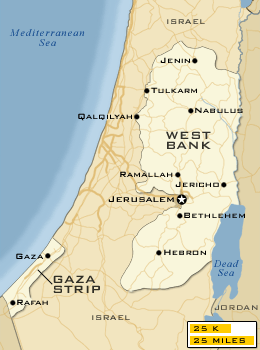
Israeli policy in Gaza looked for a while like it would drive Gazans to the lunatic fringe. Hamas reacted with massive propaganda efforts to Israel's attacks, blockades, etc. In a region so devoid of contact to the outside world, it seemed like such propaganda would work. But somehow, it hasn't. Gazans currently prefer Fatah--a party removed from Gaza's streets and consorting with Israel, Hamas' enemy. The implications of this are strong: Despite losing the civil war and appearing to sell out the Gaza strip, Fatah has won their loyalty. Throughout all of the Palestinian Authority, Hamas is being rejected by fairly impressive margins.
If Fatah can substantially win the upcoming January elections, then its moderate politics will reign supreme. If it can consolidate its power over Gaza, then it can begin to enforce moderate policies and suppress Hamas' anti-Israeli terror behavior. If and only if it can suppress this behavior will its 2-state policy have a chance. Israel cannot give up some control of the PA until it knows that it will not be a hotbed for terror--it cannot take it back as easily as it can simply hold on.
But the other implications are perhaps more interesting, in Israel. If the moderate Fatah party can take control of all of the Palestinian Authority, then Israeli perceptions about the PA may change. If the Israelis see hope in 2-state negotiations, if they see that such negotiations may lead to long-term peace and prosperity rather than increased terrorism and demands by radical Islamist leadership, then Israelis may be more tempted to vote Kadima and continue negotiations rather than throw their hands up and oust the government for the Likud opposition.
If Fatah and Kadima can get a new mandate and a stronger political hold over their respective territories, then the 2-state negotiations are likely to have a lot more hope in the next few years--particularly if such moderates in power allow the Israeli-Syrian peace talks to resolve. The machinations for Middle East negotiations have been shaken up significantly by the last years' actions, but they may not have fallen apart.
Subscribe to:
Posts (Atom)