Showing posts with label palestine. Show all posts

Thursday, March 12, 2015

Foggofwar Prediction: Labor Coalition to Narrowly Win Israeli Parliamentary Elections

Israel's next parliamentary elections happen on March 17th, and a major potential foreign policy shift could happen if Netanyahu's Likud party doesn't win.

Looking at stabilizing opinion polls, I predict that a Labor-led coalition will win, carrying somewhere in the region of 57 to 61 seats (of 120). I think the big X-factors will be whether it can/wants to pick up the communist Hadash party (likely) and the Arab Balad party (maybe?). I suspect they would not take on the Islamist UAL party.

It could be a minority government, but it's likely to hold the day nonetheless.

The Labor coalition would likely look like: Labor, Hatnuah, Yesh Atid, Meretz, Kalanu, and Hadash, which together carry 57 seats in current opinion polls. If they picked up Balad, they would hit 60 or 61 seats, enough for a slim majority.

Since UAL, Ta'al, and Balad (together with 9 seats of support) simply wouldn't join Likud due to their anti-Zionist ideologies, the Likud coalition (Likud, Yisrael Beiteinu, Jewish Home, Shas, UTJ, Otzma, and Yachad) looks primed to hold 54 seats.

The trouble for Labor's coalition is that it would be a bit unwieldy, requiring getting general agreement from socialist/labor, communist, liberal, and Arab parties. The good news is that the smaller groups are so unlikely to jump to support Likud that their bargaining power isn't too high in driving policy (unlike the Lib Dems of the UK, which got to play Kingmaker in the 2010 parliamentary elections there).

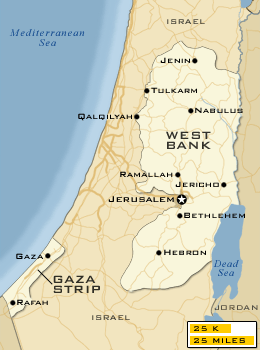
Labor might take an approach to end or roll back Israeli settlement of the West Bank, and maybe even lift the blockade on the Gaza Strip. It would be an interesting change in foreign policy, indeed.

We'll keep our eye out if the polls look to change.

Thursday, July 25, 2013

Likud Changes Stance on 2-State Solution Ahead of Peace Talks


We have had many Israeli-Palestinian peace talks in the past and they are a subject of derision much akin to the UN among more realpolitik thinkers.

We're about to have another one. SecState Kerry seems to have performed some very interesting black magic and it's worth mentioning.

When the last Israeli elections occurred, I was very excited about the possibility of Tzipi Livni winning and immediately pushing for a potentially viable two-state solution. Netanyahu managed to cobble together a coalition government, instead, by pulling in ultra-right-wing zionists, making peace talks seem more-or-less defunct as long as he was in power, particularly as his official policy was that a two-state solution wasn't happening.


Somehow not only the tone, but the official policy, has changed, going into the next talks. Israel released some dozens of Palestinian prisoners and it seems that Likud's (this being Netanyahu's party) new policy is that not only is a two-state solution the answer, but Israel will be willing to make "significant" and "painful" territorial concessions. This is a huge shift and may, again, be part of some John Kerry magic, but good sense is also going to be part of this.

There are obviously major hangups, even in the rhetoric. Likud is also making it clear that Palestine will need to also give significant and painful territorial concessions, which means that Israel will demand that many of the settlements in the West Bank remain--they're a bargaining chip in Israel's favor based on status quo, rather than on any legal or moral argument.

Likud is also saying that Jerusalem will need to keep status quo--meaning Israel gets most of it, but Palestine gets "old town" and some other parts. This on its own is already a concession but may have been necessary for talks to begin.

For a look at settlements, see this link: http://news.bbc.co.uk/2/shared/spl/hi/middle_east/03/v3_israel_palestinians/maps/html/settlements_checkpoints.stm

The settlements are pretty much everywhere throughout the West Bank--it's been akin to a very slow invasion. The blocks near Jerusalem are likely the areas that are going to be the sticking points, as Israel will likely be clear about hanging on to them. Morally I am not fond of these at all but Israel's bargaining power here after the past 30 years or so is so high that at this point it's a geopolitical reality.

Overall the chances of this working are slim, but it may be an example of a "hurting stalemate" that can cause two groups to come to peace even when neither has achieved its political outcome.

Source:
http://www.telegraph.co.uk/news/worldnews/middleeast/israel/10202854/Israel-willing-to-make-serious-territorial-concessions-to-secure-Middle-East-peace.html

Is he serious and if so, why now?

I think Netanyahu is a smart guy. He knows that the conflict has only one long-term possible ending, the two-state solution. Even the slow takeover of the West Bank via settlements would create a long-term painful apartheid, with settlements getting attacked... and he knows that apartheids don't last forever. If Israel totally absorbed the West Bank, it would eventually have to give the Palestinians there citizenship and then the Jews would be outnumbered, and this is obviously unacceptable.

I think the settlements--especially the farther-out ones--are bargaining chips. I think the ones close to Jerusalem are meant to stay and become part of Israel, and I assume that any Palestinians left are going to want to leave to the West Bank when the two-state solution happens (like when India/Pakistan broke up). If Palestine signs the peace deal, it will give Israel legitimacy to whatever territory it keeps.

So I think this has been the long-term plan: to have a two-state solution with added territory for Israel, particularly near Jerusalem. Perhaps now enough of these chips have been accumulated for him to go forward. He knows it will take a long time (maybe years), and probably wants to guarantee that if it does happen, it happens with the best possible terms for Israel, and Netanyahu's "tough guy" reputation means that the Palestinians won't try to over-stretch what they can get out of him for a state.

I think as far as timing, Netanyahu may be taking advantage of Kerry's visit to pretend it changed his mind. I do think that by dumping Shas and picking up both Yesh Atid and Hatnuah (in the 2013 legislative elections) he has to have a coalition that is looking for a two-state solution in earnest... these moderate parties (one led by Tzipi Livni herself) just wouldn't have joined otherwise. It makes him not only free to pursue a two-state solution but I think without it his coalition would fall apart and new elections might be required.


I think ultimately it's up to Netanyahu, rather than Obama/Kerry, as to whether the peace process is going to power forward. If Obama "fails" it will be because Netanyahu--who has all the power and Kerry none--wasn't willing to go forward with the terms that the Palestinians are laying out.

Wednesday, September 1, 2010

Israeli/Palestinian Talks--Maybe Not Quite Derailed


Well, my faint sliver of hope has grown a teensy bit in size with Barak's recent comments.

He's claimed (though Netanyahu hasn't yet backed up) that Palestinian-dominated parts of Jerusalem would be part of the Palestinian state, and further, that the holy sites would be governed by a special body, rather than either country.

While there will be a great deal of opposition in both countries, the balanced perspective that Barak brings to the bargaining table suggests a genuine desire for a solution, rather than simple political posturing.

That said, the vast Israeli settlements in the West Bank will be even harder to withdraw than those in Gaza. Geopolitically, a 2-state solution is far-fetched. But, as they say, "Only Nixon could open China." Netanyahu might just be the man for the job.

But don't get too excited yet.

Tuesday, August 31, 2010

Incoming Israeli/Palestinian Talks--Derailed?

There was a sliver--however slight--of a good set of talks coming up in the Middle East.

An assailant attack that killed 4 Israelis near Hebron has probably undermined that entirely. The trick here is not that it will necessarily outrage the Israelis into quitting the talks, but that it will call into serious question Abbas' credibility in promising to handle his own security situation--this happened even with Israeli troops nearby.

Security, obviously, it Israel's biggest concern in the talks, and a number of more extreme-leaning groups (including Hamas) want to make that a tougher point during the talks. The emergence of a weak Palestinian state with Israel in a comparatively strong position would be a failure to the real revolutionaries.

In short: don't get your hopes up for these talks. Frankly, they were probably mostly a political maneuver anyway.

Sunday, June 6, 2010

Israel's Risk to US Interests


If you're a reader of George Friedman (or other realist geopolitical academics), you'll tend towards the idea that one of the United States' paramount interests is to prevent a single geopolitical entity (or coalition) from amassing enough economic and military power to challenge it (this has been true since about the turn of the 20t century, when the US became the foremost power in the world). This was why World Wars I and II were important to the US (to stop Germany from conquering the continent), and why the Cold War was so critical (to prevent the Soviets from doing the same). Once a force amasses enough military power, it can potentially challenge US trade dominance, or even cross the ocean and challenge the US near its borders.

The US is further interested in preventing unity in the Middle East. If the Middle East united in a form similar to the Ottoman Empire, it might be powerful enough to potentially challenge the US. Not only would it be highly populous, but it would have vast oil resources and central trading position (between Europe & Asia). It would be a great strategic threat to US hegemony.

Israel, whether or not it has the moral upper-hand in the Middle East conflict, is becoming a risk to US interests due to Middle Eastern perceptions of its behavior as of late. For decades, the states of Egypt & Turkey (in particular), as well as Jordan, Kuwait, and Saudi Arabia, have recognized Israel and, generally, supported its existence (despite their populations' general distaste for the Israel/Palestine situation).

But the past few months have made these governments' support of Israel a politically risky gambit. Public outrage towards the deadly pre-election Gaza offensive, settlement-building in Jerusalem, and the recent raid on a supply flotilla trying to break the Gaza blockade have further soured perceptions of Israel. Its image as an aggressive, revisionist state is growing somewhat stronger.

The US must play carefully. If it comes out to support Israeli action, it may encourage the Arabs to unite to deter Israel from further action in Gaza, the West Bank, southern Lebanon, or (potentially) Iran. If these states united against Israel, they might start feeling strong enough to oppose the US (rather than begrudgingly embracing it). The United States' interest is in keeping the Middle East divided and internally distracted--not united and outward-looking.

If the Israeli government does not change the tenor of its policies, it may begin to become a liability to the US. The US, in response, would try to distance itself publicly, while placing pressure on Israel to move towards peace negotiations.

In the near future, look either for a major shift in Israeli policy towards Gaza and Jerusalem, or a gradual (but noticeable) distancing of relations between the US and Israel, as the US tries to prevent a unity coalition from arising in the Middle East.

Friday, February 5, 2010

Last Decade Series: Israel/OPT

What frustration. Certainly I was pretty geared up for the 2009 parliamentary elections in Israel, hoping Kadima would hang on to power, allowing Livni and Abbas to ride off together into the sunset and create the Palestinian state. In retrospect, this was pretty optimistic, and I don't just mean that Kadima lost power to Likud. It probably wouldn't have worked out all that well even if Kadima had taken power, as Palestine still seems to not be in a place where it can run a respectable state, especially in Gaza.

So, first thing's first: the Middle East will be a nasty and inhospitable place for US interests until Palestine gets its own state, period. And yes, I understand that such a goal is highly complex and wrought with problems, many of which are directly the faults of the Palestinian people. But ultimately, it is in the interest of the US and Israel alike to have a Palestinian state with a healthy economy. If I had my druthers (and I rarely do), we could hand Gaza to the Egyptians and merge Palestine and Jordan back into Trans-Jordan and make it the problem of some already-relatively-stable governments to keep a lid on Palestine, but that's not going to happen.

But an independent Palestinian state (and one that, in particular, is content with its borders, which is going to be pretty tough to come by) will mean relative security for its people, and a situation in which aggression on border issues or whatnot with Israel would make life sufficiently worse as to not be worth it. Palestine, as a stable and economically viable state, would have nothing-to-gain-and-everything-to-lose by fighting with Israel, and would therefore have a strong interest in keeping a tighter lid on its more fanatical rocket manufacturers.

And this last decade looked like we were making pretty good progress! The election of Abbas, who should have been seen as a godsend to the West, gave the distinct impression that the Palestinian people were tired of intifadas and ready to sit down, talk, draw some lines on the map, and move on with their lives. The moderate Labor party in Israel showed similar promise. Both sides looked ready to take the risks necessary (and probably suffer through the ensuing pain necessary) to get to that key treaty that we've all been waiting for. But what the heck happened?

The big clincher was probably the Olmert scandal. His loss of moral authority castrated him from being able to drive the necessary treaties through parliament; serious delays popped up. By the time Livni was in a position to do the negotiating, Obama had been elected and the Palestinians wanted to wait around for him (perhaps hoping to gain a strategic advantage from losing an American president that they perceived to be pro-Israel). The elections came, Netanyahu won, settlement-building ramped up, and everybody got very angry at each other again.

Not, of course, that the war in Gaza helped things any--had Israel successfully "dismantled" Hamas, life might be a bit different. But in failing to do so, they were left with only a battered reputation.

At this point, Netanyahu is barely humoring the idea of an independent Palestinian state: he wants it to be fully demilitarized, and wants Israeli settlements to grow into the West Bank "naturally," with the population (and has not made it clear as to what would happen to those settlements if a Palestinian state gets built). Further, he's insisting that all of Jerusalem would stay in Israel. It's a tough stance to negotiate with, even for Abbas. Perhaps the strategy is to try to squeeze more to the Israeli side in a compromise, but at some point, one's demands are so high that the other side is incentivized to walk away from the negotiating table at all.

And so I think that Israel and Palestine are now significantly farther from where they were in, say, 2007, as far as being close enough in official policy to negotiate a compromise and create a Palestinian state. The moderates made key mistakes that blew their opportunities to make serious headway in the 2000s, and they will probably have to wait through another relatively painful cycle before they can make another reach for some sort of steady-state solution.

Saturday, January 23, 2010

Last Decade Series: Middle Eastern States Fall in Line

Bear with me on this one, dear readers.

I know it looks like things in the Middle East are pretty bad. No doubt, they're certainly not rosy. 2001 was the beginning of the US-Jihadist war--at least, it was the year the US acknowledged it was fighting the war in full. Jihadists had been preparing to try to boot the US out of the Middle East and create a caliphate for a long time, and were certainly at war with us in the 1990's. Nevertheless, things seem to have gone downhill in the last decade, but I argue that, for the most part, the US is much more secure in its geopolitical aspirations in the Middle East now than it was in 2000.

In general, the United States has essentially eliminated or isolate its state-side enemies, and solidified its state-side allies. It is setting up a coalition of states to take over the "front-line" management of the Middle East, so the US can do what it does best--sit back and use military/economic spending and incentives to relatively cheaply and easily pull the right levers. Let's go bit by bit.

Enemies and Former Enemies of the United States

Iran: Once a very powerful influence in the Middle East, Iran has become largely isolated. Its influence has indeed grown in Iraq, but has greatly shrunk elsewhere. Syria, once Iran's pet ally, has asserted itself as an independent force, and is leaning Westward after a diplomatic push by Bush, Blair, and Sarkozy. Iran's hand in Hezbollah is much weaker than it used to be, as much of Hezbollah turns towards legitimate government. Its control of Hamas remains relatively strong, but Hamas appears relatively deradicalized--at least for now. There is little that Iran can do to grow its influence or break the influence of the US and Israel in the region, and this is in part why it has pushed so hard for its nuclear weapons program in a short time--if it can threaten nuclear deterrence, Iran can be more aggressive about pushing outward. Ultimately, its aggressive nuclear behavior has been used by the West to isolate it in its region. Even Russia and China, who see Iran as an opportunity to irritate the US, will stop short of allowing a nuclear weapons program to arise. Further, Iran's internal unrest is growing by the month, and the regime has, as a whole, lost a great deal of influence in its own borders. Iran will retreat into the future as it turns inward or goes progressive.

Syria: Once one of the "junior members" of the Axis of Evil, Syria was heavily courted by the West (in particular by some impressive Diplomacy by President Sarkozy). While not a doll of the West, Syria has largely ceased to be a problem. The Cedar Revolution of 2005 mostly booted Syria from its control of Lebanon, creating a state that the West is trying to turn into an ally. Syria has further divorced itself from Iran, hoping to be a part of the Western economy rather than an ideological empire run by Iran. Frankly, this was not a difficult win.

Iraq: While still riddled with problems, Iraq now stands as a relatively moderate country in the Middle East that will be able to eventually play balancing games between various Middle Eastern rivals. If the next election goes well, it will be a symbol of the effectiveness of US power and determination.

Afghanistan: While certainly much farther than Iraq, the Afghani Taliban are at least destabilized and desperate; a peace deal may yet be possible. Such a deal would make Afghanistan, if far from perfect, a much more acceptable risk.

The West Bank: While not quite its own state, the West Bank has grown much more moderate over time, despite Israeli-Gaza tensions and settlement/wall building by Israel in its territory. Such a moderate takeover is a significant gift to American foreign policymakers.

Libya: Once a major nuclear arms worry, Libya has quieted down significantly, largely in the hopes of regaining Western investment and trade, but largely in the hopes of staying off the United States' radar. For all the apparent recklessness of the war in Iraq, the invasion of Baghdad showed that the United States was (at least under Bush) willing to ignore international opinion and bring down the hammer of regime change to any state regime that seriously threatened US interests, even with shaky evidence. Qaddafi, in one of his wiser decisions as Brotherly Leader and Guide of the Revolution (yes, that is his title), decided to voluntarily give up his own WMD program and welcome polite UN weapons inspectors into his country, rather than American Marines. Once a "junior member" of the Axis of Evil, Libya is working on turning into a major Western trade partner.

Friends of the United States

Turkey, Egypt, Jordan, Kuwait, Saudi Arabia, Pakistan, Yemen:
These states, while also torn internally, remain steadfastly supportive of US interests in the Middle East (though not usually out of some twisted sense of altruism). But amazingly enough, the US has managed to keep the governments of these states distinctly pro-American despite overwhelming negative attitudes among the populous towards the US. Turkey is leading negotiations with non-state actors like the Palestinians, the Taliban, and Hezbollah (and is turning into, frankly, a strange Euro-Asian state that may have influence in both areas). Egypt, additionally, is keeping a lid on Gaza while trying to help negotiate a lasting peace. Saudi Arabia has fought in Iraq and is trying to stabilize Yemen (though its pro-Sunni meddling in Iraq was quite detrimental). Pakistan is (half-heartedly, at least) fighting the more dangerous Taliban on its side of the AfPak border, eliminating key support for the Afghan insurgency. These states will continue to contribute to a regional order that will allow the United States to move further and further back from the Middle East over time.

The UAE and Qatar: Worth special mention due to their (somewhat) successful adaptations of Western-style market economies. If Dubai can pull itself out of debt, these states are likely to be shining examples of how liberalism and Islam can live side-by-side (and they are unlikely to harbor anti-US terrorists, to boot).

Trouble Remains

There are certainly states of worry for the US in the Middle East. Afghanistan, Lebanon, Palestine, Yemen, Somalia, Sudan, Iran, and Turkmenistan all have major internal issues that could lead to long-term negative consequences for the US, and they are worth keeping one's eyes on.

All in all, the United States' geopolitical position in the Middle East is far from the sour position most Americans think it is in, even if it is indeed in a rather poor public image position. But such if how these things work. The US has managed to lever government loyalty with the right incentives, even if not public opinion with the right rhetoric and sympathy.

Saturday, February 28, 2009

Moderates Sidelined in Middle East Conflict

Kadima's gamble in Palestine did not pay off. It's unclear as to whether or not it backfired, but Feb. 10th elections have given Israel's right-wing a majority presence, and President Peres has asked Mr. Netanyahu to form a government, despite Likud's second-place showing in the election.

Mr. Netanyahu has hosted two rounds of negotiations with Kadima, in order to try and form a broad coalition government. But those talks appear to have collapsed, probably over Kadima's commitment to reduce settlements and pursue a US-backed two-state solution. This breakdown likely indicates that Israel is going to lean to the right in the near future.

To form a majority government in the Knesset (parliament), one needs 61 of 120 seats. We'll assume for now that Mr. Netanyahu will likely fail to woo Kadima (28 seats), the Labor Party (13 seats), United Arab List (3 seats), Balad (3 seats), or Hadash (4 seats), which together are 51 seats. To cobble 61 seats together, Mr. Netanyahu will have to appeal to the Zionist/Nationalist tendencies of many right-wing groups, including Yisrael Beytenu (15 seats), United Torah Judaism (5 seats), National Union (4 seats), The Jewish Home (3 seats). Shas (11 seats) is the wildcard--but even if Netanyahu picks them up, he has a narrow coalition indeed, and one whose weight is far to the right. Voices interested in a two-state system will be sidelined in this new government, and the Palestinian Authority will have to choose a reaction.

The PA reaction may be to entrench, but it's unclear. Mr. Abbas is having a lot of trouble forming a unity government with Hamas, largely because Hamas refuses to recognize Israel as a state. Abbas is likely to lose what ground he had in pursuing the two-state solution if Israel spends the next few years uninterested in working with him on such a plan.

Mr. Obama seems to have his work cut out for him.

Monday, January 5, 2009

Israel's Confidence is High

Israel is starting to hint that they have full intent to take down Hamas with this war in Gaza (though this has been pretty obvious for a few days now). Their confidence that they can do so is surprisingly high, as well--Israeli officials are calling Hamas "crippled" in a few ways: its physical governance infrastructure is ruined (parliament building, police buildings, etc), its leadership is dead or in hiding (having abandoned its population), and its popularity is going to drop.

Though the popularity of Hamas is currently rather high, the Israelis think it will go down significantly in the next few weeks as Palestinians wonder whether a militant anti-Israel stance is one that is going to serve them well in the future. In particular, if Hamas is unable to provide governance, order, medical supplies, etc after the war ends, then their support will erode. Pre-war, Fatah already had an edge in Gaza polls. When the Palestinians have elections, probably in April 2009, Fatah will probably have quite the edge, even in Gaza. And if it does, and if Kadima can hold on in Israel, then the whole situation in Palestine looks a lot different. Israel will probably do what it can to enforce Fatah's right to govern in Gaza Strip, and help clean the strip up before working on serious two-state talks.

Such confidence is strange, coming from an Israel that lost a 2006 war in Lebanon due to overconfidence and poorly-defined campaign goals. Israel had been showing serious conservatism in its war goals early on: the air campaign was aimed at reducing rocket attacks, not even eliminating them. While Israel is not saying that they have changed their goals to the toppling of Hamas, they are certainly saying that it's likely that they will, and that they're quite happy for it. This means one of two things:

1) Israel's government did not learn a lesson from its tough defeat, even though I was able to graft that lesson from my seat in Cambridge, or,

2) Israel is actually well and truly crushing Hamas' governance and combat capabilities.

Occam's Razor says it's probably the latter.

Despite confidence, Israel remains conservative. They have not given in to goading and luring on the part of Hamas to enter Gaza City or other urban areas for street fighting. They have kept their total military casualties to one, suffered on the first night of entry. Israel's targets have been picked with deliberate caution, as well: Palestinian medical authorities have reported only 16 children dead, despite a strong incentive to over-report. Hamas has claimed that half of the over-500 killed in Gaza are civilians, but there is a strong incentive to over-report here, as well: Hamas loses face by reporting its own fighters killed, and gains support by claiming that Israel has killed civilians. Given how informally one can join the Hamas paramilitary, it will be impossible for these figures to ever be confirmed beyond academic estimates.

So things seem to be going well for Israel so far. They have a lot of work to do, and in particular, Israel must keep up strong diplomacy with Jordan, Egypt, and Lebanon, in order to keep its free military reign in Gaza. But such support should have wavered days ago if it was going to. Israel appears to have a serious shot at crippling Hamas for good and, despite the cries of many protesters to the contrary, contribute to long-term peace in the Middle East.

Sunday, January 4, 2009

Analysing Israel's Gaza Tactics

After a day of war, Israel stand at one dead and about 40 wounded. They say they have killed "dozens" of Hamas militants, but they are struggling with their opposition using civilians as human shields in the fighting.

Let me first digress by expressing my own personal sympathies for Israel's difficult position. After returning full control of the Gaza strip to Palestine, Hamas used a civil war to wrest power, and has been using it as a safe haven to accumulate rockets from Iran and other sources to launch into Israel constantly, even during a six-month ceasefire in which Israel was relatively disciplined. Israel provided the majority of Gaza's fuel, food, electricity, and medical aid at no cost--despite access to the Mediterranean and Egypt, Gaza's Hamas leadership has held Gaza's economy back--gross mismanagement and excessive, corrupt government bureaucracy have made sure that Gaza's market has not spun up at all. Hamas hands out aid received by Israel, and takes credit--keeping its popularity high among its many poor and jobless. Hamas seems to take very little flak from its own people for storing weapons in Mosques and orphanages, or by using civilian human shields as they fight Israelis. The Arab world is starting to flare up in protest, and otherwise-moderate Arab governments have to condemn Israel's invasion to halt rocket fire--after relatively patient and persistent warnings to stop, offers to negotiate, and months of restraint--as a "war crime." Luckily for the Israelis, Egypt continues to stand by them (to what extent they can), and the Arab League is unable to spin up the momentum to actually meet over the crisis. The US will block any UN resolutions to officially condemn Israel in any way. Even US Senate Majority Leader, Harry Reid, has said that a ceasefire is impossible until Hamas offers to halt rocket fire. So even if this war lasts for a few weeks, the US will not be switching teams on a dime.

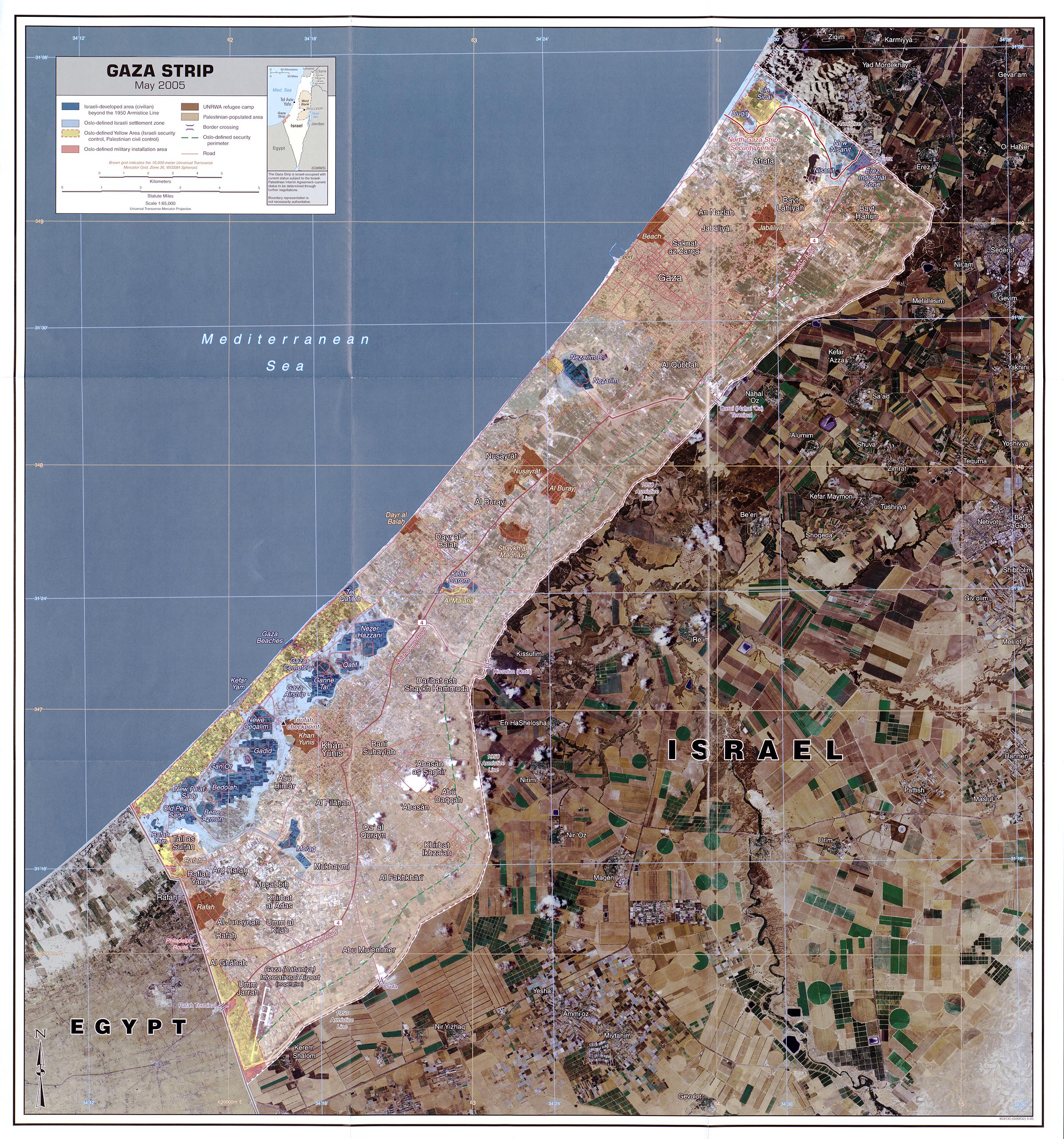
So Israel is now elbow-deep in this problem--what have they actually done? According to relatively scattered reports, Israel has already cut to the Mediterranean and has surrounded Gaza City and other urban centers, as far south as Netzarim, but the Israeli Army has been disciplined enough to avoid entering any major urban areas, where the Hamas militants likely have a great advantage (with huge numbers of civilians that the Israelis have to worry about, potential booby traps, and other "home turf" advantages like knowledge of the terrain, friendly homes, etc). A map I put together below should make it a bit more clear where the Israelis have gone.
Approximate Israeli Movement and Positions (Click for Larger)

Their staging ground was Sderot, on the northeast corner of Gaza. From there, Israel broke in during the night and cut power to most of the northern half of the strip, taking advantage of night fighting technology to strike their initial blow (and most of their advances in the last day). The Israelis are likely to continue using night to press their primary assaults in search of rockets, launch pads, and Hamas leadership. Note that with Gaza City surrounded (and certainly extremely strict policies for anyone escaping), Hamas leadership isn't going anywhere soon (for the Israelis control Gaza waters, as well). Special forces have an opportunity to use what intelligence that Mossad has gathered to take them down in the capital city if they weren't smart enough to get out early.

At this point, Israel looks like it is going to focus on a search-and-destroy mission in the north, and then perhaps move south to mop up militants that got out--it is unlikely to spread its 3 brigades so thin as to take the entire strip at once. Israel also has troops ready in Jerusalem and near Lebanon in case West Bank Palestinians or Lebanese Hezbollah militants try anything tricky to help out their brothers-in-arms.

So the easy part is over, with few casualties for the Israelis, but the hard part--search-and-destroy--is just beginning. The success of the rest of this mission will depend on Israeli tactical intelligence abilities more than brilliant ground war operational capabilities. Israeli unit tactical training will face a test, as well.

But this mission really has more substance than simply finding rockets, or even toppling Hamas leadership. After failing to meet its objectives in Summer 2006 in Lebanon--namely, preventing rockets from hitting Israel in the north--Israel is hoping to regain its deterrent capabilities with neighboring militant groups. Israel is unlikely to face a regular war with its neighbors in the near future--their willingness to negotiate has a lot to do with Israel's ability to bloody them up if they choose to fight. So far, Hezbollah has chosen to sit this one out (so far), and read (though I've lost the link) that there are rumors floating about Hamas heading to Egypt to talk potential ceasefire options. So maybe it's working.

Saturday, January 3, 2009

Gaza Land War Begins

Israel is now holding nothing back against Gaza--its tanks and infantry have entered the strip with the public intent of capturing Hamas rocket launching sites (and likely very large weapons caches nearby) and dismantling them. The Israelis are also likely sending in large numbers of special operations forces to try and take down as much Hamas leadership-in-hiding as possible.

There's little to say yet on the operation, except that it shows a real commitment for Israel to pay the necessary political costs to take down Hamas in a way that would allow Fatah to take control of Gaza if/when it wins elections that Abbas is calling. Strangely, it may be this very war that enables the Israelis and the Palestinians to make peace. A reminder is due that Hamas does not recognize Israel's right to exist--it is only interested in driving Israel out of the area, and that it took over Gaza strip in a civil war in 2006 after losing elections to Fatah--their continued presence has been a tough roadblock for the Israelis, and it seems the Israelis feel they finally have the political capital with their neighbors to finish Hamas off. And despite all the criticism coming Israel's way, it looks like they're right. But now the fate of this operation depends on the military's ability to achieve its objectives without "mission creep" or a quagmire.

Friday, January 2, 2009

Israel Chooses a Gaza Strategy

Israel's former ambiguity in its Gaza strategy is gone, and has given way to a much more decisive strategy of total crippling of Hamas' offensive capabilities. Israel is attacking leadership, communications, security, weapons storage/manufacturing, and deployment sites in an effort to turn Hamas into an ineffectual flag-waving organization, rather than a militant wing with any bargaining power.
Figure 1: Gaza Strip With Urban Densities (Click for Larger Image)

The turn to decisiveness is good for Israel, who appeared to be waffling earlier over what to do. Poking at Gaza and bloodying/infuriating its civilian population without achieving any real political goals would have been not only wasteful, but counterproductive--they would have increased Hamas' will without seriously hampering its capabilities. Now, the Israelis have figured that they have already paid the political cost of the airstrikes, both in Gaza and internationally, and they might as well finish the job to their satisfaction. It will mean many more dead Gazans. It will mean billions in relief. It is a questionable decision overall, but one that appears rational once one accepts the given decision to begin serious airstrikes.

The commitment to cripple Hamas doesn't necessarily mean it will happen, despite Israel's impressive military. In the past, like the 1982 and 2006 wars in Lebanon, the Israelis have struggled to do serious damage to non-state actors. Israel's regular military, despite the state's security needs, remains largely outfitted to promptly dispatch Arab regular armies. But to be fair, nobody on earth has yet figured out how to properly deal with non-state actors, as the US in the last 7 years has demonstrated. Hamas remains resilient and confident. It is an organization that feeds politically on suffering, terror, mayhem, and death. Its support among its base is likely to harden. What makes life tougher for the Israelis is the constant decision between tactical advantage and strategic caution--Hamas has no qualms with hiding arms in Mosques, hiding terrorists in orphanages and hospitals. Israel must choose between letting them hide out, or killing children, killing the sick, killing religious observers. They seem to be going for the latter.

Figure 2: Arms Smuggling and Rocket Sites in Gaza

Israel may be preparing to invade Gaza. Reservists have been called, troops and tanks are lining up by the Gazan border, and foreign nationals are being escorted out of the country. The move may be an effort to pull Hamas security to the border and push civilians away, making it easier to more exclusively target militants, but it may be a legitimate preparation. A ground war is likely to become a mess--unless the Israelis have learned from the Summer 2006 Lebanon war, but chances are (sadly) that they haven't. The most productive thing that Israel can do in a ground war is conduct a series of raids to take down every single Hamas leader whose name registers on the Israeli radar that they can. The only way to truly get Hamas to fall apart will be to rob it so completely of leadership that it kills itself in an internal power struggle. The Mossad may have the intel the Israeli army needs to do that. It's tough to say.

For what it's worth, Israel's friends are sticking by their side. Israel's earlier diplomatic maneuvering is paying off. Egypt is keeping its border crossing closed except for inspected humanitarian relief trucks going into Gaza and inspected emergency transport trucks going out. Egypt has drawn a lot of criticism for this, from the UN and Iran, and from protesters just about everywhere, but it's sticking to its guns. The Lebanese government has come out against criticisms of Egypt, The Syrians have vowed to continue peace negotiations with Israel, and Jordan is keeping quiet despite a 50% Palestinian population. Such reactions are absolutely remarkable, and should mostly guarantee Israel a free hand in the Gaza operation. It remains likely that Livni has convinces Israel's neighbors that Hamas must go.

So with its free hand, Israel continues to pound Gaza, targeting as many Hamas critical points as they can. Hamas remains bold, but nothing Israel can do will change Hamas' rhetoric. Keep an eye out for a Gazan land war, and for more Hamas leaders to turn up dead. Israel may have a unique opportunity to eject this thorn in its side once and for all.

Sunday, December 28, 2008

On the Gaza Air Raid

Israel hit Gaza--hard--for the second straight day today in an air raid. Short of decisive, the attacks are looking ugly, pulling Israel into a mess that they may not be willing to deal with. But diplomatic pressure remains low.

300 Gazans are dead--Hamas reports 180 of their own and the rest civilians, the Israelis, of course, claim more. 700 are wounded. Hospitals are flooded. The place is a mess. Okay, now what?

If the Israelis were trying to strike a crippling blow to Hamas, and keep them from operating, then fine. It might be worth the PR problems that are being generated, and it might be worth the resentment of their Palestinian neighbors. Any raid like this has huge political costs. But Livni has openly declared that there won't be a ground invasion, and this will not be the crippling blow to Hamas. Then what is it? What's the benefit?

This campaign looks like a deterrence/punishment operation, from its nature. It's an attempt to tell Hamas, "hurt us a little, and we'll hurt you a lot." Hamas and Israel don't recognize each other as legitimate, and Hamas isn't participating in talks with Fatah, Israel, or even an Egyptian mediator. There's little talking that can be done to Hamas.

But this mayhem may not be what Israel wants. Mayhem should be an unfortunate byproduct of a bigger operation--eliminating Hamas' rocket capabilities, or decapitating the leadership. But neither of those are happening. Israel probably won't seriously hamper Hamas' ability to throw rockets into Israel, and it's certainly unlikely to break Hamas' will--martyrdom is encouraged and sought-after among Hamas' members, and civilian deaths are an infuriating motivator in any bombing campaign (think of the London Blitz).

So Israel seems to be failing to really make a blow to Hamas' capability or will with this air raid. There is a possibility that this raid is actually a signal to Fatah and its leader, Abbas, that Israel's grievances must be taken seriously by the PA if the PA is going to be able to govern itself. Fair enough. If anyone is getting the signal that Gaza needs to be put under control, it's Mr. Abbas.

What this assault won't do is strike a blow to Hamas' popularity--if anything, its base is likely to be energized. If Israel hoped to convince Hamas supporters that their party's irresponsible behavior was the cause of the attack, they've failed.

But, Israel's options remain open. They're really not taking much in the way of diplomatic fire--the UN, EU, and Arab states are calling for "restraint" and an end of hostilities--but there's very little condemnation coming out of the region, the EU, or the UN. Obviously, the US is expressing its hope for a peaceful resolution, but has openly told the Palestinians that they had it coming.

Abbas has sent an official condemnation, but that was to be expected. Arabs throughout the region are protesting in the streets, burning Israeli flags and whatnot, but their governments are not responding strongly. International politics is trumping domestic politics in the region. It's a sign that the Israelis--particularly their Foreign Minister Livni--have prepared the diplomatic battlefield. It means that they've got options in the bag, and it means that they have, over time, earned the acceptance of their regional community. But unless they can start thinking about a new approach, and focus on what their political goals in this operation might be, the diplomatic maneuvering might all be for naught.

Friday, December 12, 2008

Implications of a Poll in Palestine

A poll was published today that described relative support for Palestinian Authority parties, Hamas and Fatah. Overall, Fatah would take 42% and Hamas 28%; in the Gaza Strip, Fatah leads 46%-32%.

The implications of this are extremely interesting for Persian Gulf and American governments. Here's why:

A few years ago, Hamas and Fatah fought a brief civil war in both the Gaza strip and West Bank. In Gaza, an aid-dependent territory, Hamas had strong local roots and a reputation for setting up schools and donation centers. They were popular, and in Gaza, they drove Fatah out. But Fatah was the elected government, and won in the West Bank, where trade and diplomacy happen through Israel and Jordan. Each section became a more homogenous, polarized region.


Israeli policy in Gaza looked for a while like it would drive Gazans to the lunatic fringe. Hamas reacted with massive propaganda efforts to Israel's attacks, blockades, etc. In a region so devoid of contact to the outside world, it seemed like such propaganda would work. But somehow, it hasn't. Gazans currently prefer Fatah--a party removed from Gaza's streets and consorting with Israel, Hamas' enemy. The implications of this are strong: Despite losing the civil war and appearing to sell out the Gaza strip, Fatah has won their loyalty. Throughout all of the Palestinian Authority, Hamas is being rejected by fairly impressive margins.

If Fatah can substantially win the upcoming January elections, then its moderate politics will reign supreme. If it can consolidate its power over Gaza, then it can begin to enforce moderate policies and suppress Hamas' anti-Israeli terror behavior. If and only if it can suppress this behavior will its 2-state policy have a chance. Israel cannot give up some control of the PA until it knows that it will not be a hotbed for terror--it cannot take it back as easily as it can simply hold on.

But the other implications are perhaps more interesting, in Israel. If the moderate Fatah party can take control of all of the Palestinian Authority, then Israeli perceptions about the PA may change. If the Israelis see hope in 2-state negotiations, if they see that such negotiations may lead to long-term peace and prosperity rather than increased terrorism and demands by radical Islamist leadership, then Israelis may be more tempted to vote Kadima and continue negotiations rather than throw their hands up and oust the government for the Likud opposition.

If Fatah and Kadima can get a new mandate and a stronger political hold over their respective territories, then the 2-state negotiations are likely to have a lot more hope in the next few years--particularly if such moderates in power allow the Israeli-Syrian peace talks to resolve. The machinations for Middle East negotiations have been shaken up significantly by the last years' actions, but they may not have fallen apart.

Sunday, October 26, 2008

The Great Middle East Limbo

The US Election is zooming in quickly, but even after Senator Obama wins (let's face it), he won't have the authority to do his own peace-brokering quiet yet. Arabs abroad love him, and would probably give him an opportunity to try his hand at mediation.

But right now, there's a more limiting factor that will keep him sidelined for even the first month or two of his presidency. Tzipi Livni, the head of the Kadima party and their candidate for Prime Minister, has failed to create a coalition government in Israel's Knesset (parliament). She's citing "political blackmail" by potential coalition partners; unable to reign in their allegedly unreasonable demands (especially because some of them stand to gain in an early election), she moved to an election.

Her decision to have an election likely means there just wasn't another option. Kadima does not want to delay the peace process with Palestine, nor does it want to open the door for Netanyahu's Likud party to gain power again. Likud is polling well, and if they won, would probably expand (not contract) Israeli settlements in the West Bank and Gaza, and probably even in the Golan heights. Peace talks with Syria and the Palestinian Authority would break down. This is not an illegitimate or summarily bad position for Israel to have, but it will unquestionably frustrate the EU and US, who have been beating their heads against brick walls to make this happen--and who saw, just before the fall of Olmert, a glimmer of hope in the open-mindedness of Palestine's Abbas and Syria's Assad to shift West. Before Olmert's fall, a fair number of international political analysts were predicting a surprisingly happy Middle East by 2011. That optimism has all but vanished.

If Kadima manages to win the election, it will have been after serious delays--delays in which a coup may take down Assad, or an assassination might take down Abbas. The Israeli election will probably occur in February, putting at least 4 more months of delay on talks. It's something that has lots of people nervous.

That said, Likud brings up some serious points to the discussion table. Israel is in a position where, after 60 short years, it has learned many times over that land-for-peace often does not work in the Arab world. If the Palestinian Authority cannot control its own people (hint: it can't), then summarily pulling out from PA territory would greatly increase the operations capabilities of the more Hamas-leaning Palestinians. Would extremism go away quickly in the PA? Certainly not. And concessions in the light of terror attacks in Israel might send the message that continued terror attacks will eventually lead to more concessions--or more thoroughly disrupt the Israeli government. Until all but a few Palestinians can either be A) convinced that Israel is there to stay, or B) suppressed by a strong Palestinian government, Israel puts its citizens at serious risk by giving up the PA territories.

The Golan Heights are less critically disastrous, but similar. In theory, if Israel gave the Golan Heights back to Syria, Syria would stop funding Hamas and Hezbollah operations in Israel, greatly increasing Israel's security. Some have mentioned that the Golan Heights are militarily advantageous, and they are--but not by much. The Israeli army is far superior to Syria's, and Syria will never again get the help of Iraq, Jordan, or Egypt if it tried to pick a fight with the Israelis. Syria would be crushed in any head-to-head battle with the Israelis. Besides--Blue Helmets would probably line the heights for a fair while after the handover, to keep it demilitarized.

But those Blue Helmets might be Israel's bane in such a handover deal. If the Syrians don't hold to their promises--and keep funding anti-Israeli terrorist organizations--then the Israelis can't do much about it. Referring to a recent post of mine, Israel has a lot of power with de facto control over the Heights, and if it agreed to a new status quo, it would face a heavy burden to overturn it--especially if UN troops would be hurt in the process. Syria might be able to do whatever it wants when Israel's bargaining chips are gone--especially if Israel couldn't afford the political cost of taking them back.

The situation's sticky. But it's about to get even stickier--hopelessly so--if Israeli elections get messy. Lame-duck and incoming presidents alike are going to be frustrated and disheartened. But it's just another day in the life of the Middle East peace process.

Friday, August 1, 2008

A Wrench in Middle East Peace?

Earlier, I had been lauding as near-inevitable a realignment in the Middle East that might lead to a lasting peace, particularly with Israel.

Sadly, one of the unspoken keys to this peace process was Prime Minister Olmert, whose moderate stances on Middle East relations have probably been a big part of the willingness of Syria to negotiate peace (and Syria's involvement, I have argued, is critical to reining in Hamas and Hezbollah).

But Mr. Olmert is going to resign, amid charges of corruption that have had the police question him four times already. Whatever happens to him afterwards, he will be leaving without a strong mandate for his current policies to be continued.

And it looks like Netanyahu, a serious tough-guy and (some have said) ultra-nationalist has got poll numbers behind him to take over in snap elections in the fall... which may or may not happen. The ruling Kadima party is weak, and Likud stands to gain a great deal.

Netanyahu is even more prickly than the typical Israeli politician, and has hard-line stances on most countries that consider Israel an enemy, including Iran. He supports keeping settlements in the West Bank, and opposes the Annapolis talks--this would completely dreail any motion towards a Palestinian state.

Netanyahu was Prime Minister already in the 1990's, and is not considered a friendly guy. Quoth Bill Clinton, after a meeting: "Who the fuck does he think he is, who's the fucking superpower here?"

On the good side, Netanyahu's understanding of geopolitics is realist and realistic. He sees Iran as a serious revisionist threat, and Hezbollah and Hamas as proxy terror groups, largely acting at Iran's whim. But does that mean he's thinking about actually using the military to deal with Iran? Israel under a moderate Olmert has certainly been making it look like it's a question on the table--and Netanyahu would support an airstrike more than anyone. This has some pretty scary consequences.

So what happens, if the US has a friendly and weak Obama presidency, and Israel has a tough-nosed Netanyahu? Besides disagreements, the US would have a hard time keeping Israel in line. If rows erupt, or if Netanyahu loses respect or patience for the American president, Israel may begin to act unilaterally against Iran--and let the US deal with the consequences in Iraq or Afghanistan.

But there is another, bizarre posibility. Netanyahu might actually become a looming stick in negotiations with Iran and Syria. While Syria declared that it would wait for US elections to continue peace negotiations, it may now change its mind and hurry up, hoping to slip in the Peace door before it closes on them. US negotiations with Iran may now include a note of saying "look, you want us on your side when Netanyahu takes office." Similar feelings will be felt by Abbas of Palestine, but his ability to control his nation is so limited that it may not matter.

So we should keep our eyes on the Middle East, and see whether Israel's pseudo-enemies are dealing with Olmert's resignation with a hastened need to act, or a resigned move back towards the hard-line geopolitics that Netanyahu wants to play. Bush, if he's smart, is going to seize this opportunity in negotiations with Iran and say "hurry up, kids, we're out of time." Assad, if he's smart, will do the same to Israel (Olmert is largely at a point where he is now incapable of initiative). But now we have to see how smart everyone is willing to be.

Thursday, February 7, 2008

Why is Gaza Broken?

My first warning on this post is I really have no idea what the answer is. But there are a few points worth noting, that bring up a few questions.

1) The Hamas Coup. Still acting like a terror cell as much as a political party, Hamas' violent purging of Fatah in the Gaza Strip (as soon as it had a big enough advantage in firepower) has shown complete disregard for the creation of a stable independent state... but this is not surprising. The party officially still insists on the dissolution of Israel before peace is possible. How do you fix a region run like this? Not sure.


2) Geography. Making a country that is split by its greatest security threat (Gaza Strip and West Bank split by Israel) seems stupid, and it is. Germany hated Poland long before 1939 because of the Danzig Corridor, and an independent Palestine would have serious trouble maintaining administration, security, and trade unless Israel was willing to allow free flow, through Israel, between the two regions. Unfortunately, because of 50 years of constant terror and military threats from the Palestinian regions, such free flow is almost certainly politically infeasible (and probably not actually a great idea).

3) The Security Dilemma. Neither side (Israel or Palestine) is willing to promise peace without security assurances, and neither side can give these assurances, largely because of Hamas and other terror organizations. Israel could try to be the "grown-up," given its military strength, give Palestine its political and security concessions, wait for peace, and then get its own concessions later, but while Olmert and Abbas might be willing to work with this plan, non-state actors in Palestine (particularly Hamas-type fanatics) are impossible for the Palestinian state to effectively control, and they would likely continue to use terror to increase their political gains, as they have done in the past. Therefore, Abbas cannot possibly make security promises to Israel, and therefore, Israel cannot (in its own interest) let Palestine yet have a free state. Again, I do not know how to fix this dilemma.

4) The Arab States' lack of help. Well, some are helping. Egypt is trying, but Gazan refugees are starting to pour into Egypt, and the Egyptian PM is literally threatening to break legs. Egypt's cooperation with the Israeli blockade is somewhat rare. Iran's Hezobllah militants in Lebanon seem to be vying for another war with Israel, and Syria has refused to help make peace in the Palestine issue until gives back the Golan Heights--a mountain range through which Syria invaded Israel multiple times.

5) Israel's Inconsistency. Israel has been inconsistent about its responses against terror attacks by Gazan militants. Israel forced its settlers from Gaza (which was, in general, the right thing to do) amid uncharacteristically high terror attacks, which may have made Hamas think such terror attacks would win political victories... even now, Israel's military responses range from lackluster to extreme, and Palestinian civilians cannot be clear on what kind of behavior will bring them peace and prosperity. Palestine is much like a colony of Israel, and Israel will have to take care of the Palestinian people or let them be free... doing neither will only create more resentment.

But we are certainly stuck. Israel and Palestine both need promises of security before political progress can be made, and this makes one think "UN Intervention," but that's unlikely to happen anytime soon (and we see it failed rather miserably in the 2006 Israeli-Lebanon war).

I would love comments from readers on creative peace-making ideas.