Showing posts with label israel. Show all posts

Tuesday, March 17, 2015

Israeli Election Update; And Corrections

First, some corrections:

I got lazy in deciding to not translate some Hebrew and mis-named Herzog's "Zionist Union" as "Labor," which is inexcusable, though we can think of them similarly.

Second, I also failed to take into account the non-linear seat allocations of the Israeli parliament, so my numbers were way off.

But let's move forward.

With 94% of votes in, Likud has a surprise lead with 29 seats to ZU's 24. This is actually so far off of exit polls showing them both closer to 27 or 28 that I suspect there will be a bit of a change as the last 6% get counted (otherwise the exit pollers put up a disappointing effort).


Let's assume this holds.

The Arab "Joint List" will absolutely not join with Likud, and nor will Yesh Atid--even though they were with Netanyahu's coalition last time, they've insisted that they'll only join a coalition "dedicated to peace," and in Israeli terms, that means the opposition.

Likud can count on Bayit Yehudi (Jewish Home), Shas, UTJ, and Yisrael Beytenu, which means Netanyahu's current count is 57--short of the 61 needed.

Herzog's ZU can count on Yesh Atid, Meretz, and the Arab Joint List (due to its stern opposition to Lukid), putting Herzog's count at 53.

It's being said, fairly, that Kalanu (who did better than expected) is poised to play "kingmaker" by joining whatever coalition they please. They're centrist and have worked with Likud in the past, but have made it clear they're willing to go either way.

Netanyahu "has the ball" in being invited to form a coalition, but to some extent it doesn't matter: Herzog has every right to also be courting Kalanu.

Kalanu's moderating force might be very powerful when they make a deal. I'm still predicting Herzog will catch Kalanu and win, primarily because I think that Netanyahu burned too many centrist bridges by pledging to continue building settlements and avowing that Palestine would never become a state: I think it's just too extreme a position to attract Kalanu, but Netanyahu may be willing to back down: he's a shrewd politician and won't let last-minute campaigning declarations keep him out of power.

Russia, Israel, Iran, and the Dark Reality of Diplomacy

All zero-sum international negotiations are shaped by the size of the guns on the table. This is the dark reality of diplomacy: when one is trying to convince someone to give up a critical behavior (stop a nuclear weapons program, stop invading Ukraine), or start a new one (less common on the modern world order), the key unspoken factor underlying the negotiations is the potential use of force.

The United States and other Western powers are in negotiations that they are struggling with:

At this point, it's unlikely that the US is going to get what it wants in any of these negotiations, due to one simple fact: it lacks the will to exert its power, and therefore has no bargaining power.

In essence, when the US is trying to compel behavioral change, the other partner asks, "what are the consequences if I refuse?" Currently, the answer is "nothing," so there is no reason to agree unless the carrots are really, really big. And the US currently has no stick available, as it is unwilling to go to interstate war. And in this, it brings no guns to the table: they're all left at home.

In Iran, Professor Muravchik suggests that the Iranians are so ideological and bent on empire that sanctions have little impact, and lifting them (to bring material prosperity) just isn't important enough for the Iranians to not also require a "stick" to change the equation. But despite the blundering letter by 47 Republican congresspeople, the US is not willing to strike Iran's nuclear facilities with aircraft. In fact, the President might have said that he'd even shoot down Israeli planes doing the same. Because the US has no appetite for war, Iran can hold out indefinitely--it gets what it wants by doing nothing, and will only be moved if the US offers something somehow better than nuclear weapons--I just struggle to imagine what that would be.


In Russia, the game is similar. I won't speak at too much length here as we mention it in a recent post, but in summary: Putin enjoys over 80% approval (compared to Obama's 47% and US Congress' 8%) domestically despite the West's sanctions and the drop of the ruble. This won't change, even with more sanctions. Until and unless the US or NATO are able to credibly threaten a military response, Russia will continue to take advantage of the relative gap in resistance to establish its status quo rule over Georgia, Ukraine and probably the Baltics.


Despite the US' ongoing frustration with Israel's settlement construction in the West Bank and suspended peace talks with Fatah, threatening to withdraw the over-$3Billion/yr military aid to Israel is simply not on the table, probably due to concerns for Israel's immediate security. It's a different example than Russia and Iran, but another place where the US is unwilling to use a threat of risk to a nation's security in negotiation.


Until this changes, the US will have no bargaining power here or with China, North Korea, the Taliban, Syria's Assad, or any other frustrating group. Whether or not some of these issues are worth military intervention is a question that should be taken on a case-by-case basis. The point of this article is to simply drive home the fact that negotiations with powers like Iran will always end in failure if the military option is totally off the table; it is unwise to expect anything else.

Thursday, March 12, 2015

Foggofwar Prediction: Labor Coalition to Narrowly Win Israeli Parliamentary Elections

Israel's next parliamentary elections happen on March 17th, and a major potential foreign policy shift could happen if Netanyahu's Likud party doesn't win.

Looking at stabilizing opinion polls, I predict that a Labor-led coalition will win, carrying somewhere in the region of 57 to 61 seats (of 120). I think the big X-factors will be whether it can/wants to pick up the communist Hadash party (likely) and the Arab Balad party (maybe?). I suspect they would not take on the Islamist UAL party.

It could be a minority government, but it's likely to hold the day nonetheless.

The Labor coalition would likely look like: Labor, Hatnuah, Yesh Atid, Meretz, Kalanu, and Hadash, which together carry 57 seats in current opinion polls. If they picked up Balad, they would hit 60 or 61 seats, enough for a slim majority.

Since UAL, Ta'al, and Balad (together with 9 seats of support) simply wouldn't join Likud due to their anti-Zionist ideologies, the Likud coalition (Likud, Yisrael Beiteinu, Jewish Home, Shas, UTJ, Otzma, and Yachad) looks primed to hold 54 seats.

The trouble for Labor's coalition is that it would be a bit unwieldy, requiring getting general agreement from socialist/labor, communist, liberal, and Arab parties. The good news is that the smaller groups are so unlikely to jump to support Likud that their bargaining power isn't too high in driving policy (unlike the Lib Dems of the UK, which got to play Kingmaker in the 2010 parliamentary elections there).

Labor might take an approach to end or roll back Israeli settlement of the West Bank, and maybe even lift the blockade on the Gaza Strip. It would be an interesting change in foreign policy, indeed.

We'll keep our eye out if the polls look to change.

Thursday, July 25, 2013

Likud Changes Stance on 2-State Solution Ahead of Peace Talks


We have had many Israeli-Palestinian peace talks in the past and they are a subject of derision much akin to the UN among more realpolitik thinkers.

We're about to have another one. SecState Kerry seems to have performed some very interesting black magic and it's worth mentioning.

When the last Israeli elections occurred, I was very excited about the possibility of Tzipi Livni winning and immediately pushing for a potentially viable two-state solution. Netanyahu managed to cobble together a coalition government, instead, by pulling in ultra-right-wing zionists, making peace talks seem more-or-less defunct as long as he was in power, particularly as his official policy was that a two-state solution wasn't happening.


Somehow not only the tone, but the official policy, has changed, going into the next talks. Israel released some dozens of Palestinian prisoners and it seems that Likud's (this being Netanyahu's party) new policy is that not only is a two-state solution the answer, but Israel will be willing to make "significant" and "painful" territorial concessions. This is a huge shift and may, again, be part of some John Kerry magic, but good sense is also going to be part of this.

There are obviously major hangups, even in the rhetoric. Likud is also making it clear that Palestine will need to also give significant and painful territorial concessions, which means that Israel will demand that many of the settlements in the West Bank remain--they're a bargaining chip in Israel's favor based on status quo, rather than on any legal or moral argument.

Likud is also saying that Jerusalem will need to keep status quo--meaning Israel gets most of it, but Palestine gets "old town" and some other parts. This on its own is already a concession but may have been necessary for talks to begin.

For a look at settlements, see this link: http://news.bbc.co.uk/2/shared/spl/hi/middle_east/03/v3_israel_palestinians/maps/html/settlements_checkpoints.stm

The settlements are pretty much everywhere throughout the West Bank--it's been akin to a very slow invasion. The blocks near Jerusalem are likely the areas that are going to be the sticking points, as Israel will likely be clear about hanging on to them. Morally I am not fond of these at all but Israel's bargaining power here after the past 30 years or so is so high that at this point it's a geopolitical reality.

Overall the chances of this working are slim, but it may be an example of a "hurting stalemate" that can cause two groups to come to peace even when neither has achieved its political outcome.

Source:
http://www.telegraph.co.uk/news/worldnews/middleeast/israel/10202854/Israel-willing-to-make-serious-territorial-concessions-to-secure-Middle-East-peace.html

Is he serious and if so, why now?

I think Netanyahu is a smart guy. He knows that the conflict has only one long-term possible ending, the two-state solution. Even the slow takeover of the West Bank via settlements would create a long-term painful apartheid, with settlements getting attacked... and he knows that apartheids don't last forever. If Israel totally absorbed the West Bank, it would eventually have to give the Palestinians there citizenship and then the Jews would be outnumbered, and this is obviously unacceptable.

I think the settlements--especially the farther-out ones--are bargaining chips. I think the ones close to Jerusalem are meant to stay and become part of Israel, and I assume that any Palestinians left are going to want to leave to the West Bank when the two-state solution happens (like when India/Pakistan broke up). If Palestine signs the peace deal, it will give Israel legitimacy to whatever territory it keeps.

So I think this has been the long-term plan: to have a two-state solution with added territory for Israel, particularly near Jerusalem. Perhaps now enough of these chips have been accumulated for him to go forward. He knows it will take a long time (maybe years), and probably wants to guarantee that if it does happen, it happens with the best possible terms for Israel, and Netanyahu's "tough guy" reputation means that the Palestinians won't try to over-stretch what they can get out of him for a state.

I think as far as timing, Netanyahu may be taking advantage of Kerry's visit to pretend it changed his mind. I do think that by dumping Shas and picking up both Yesh Atid and Hatnuah (in the 2013 legislative elections) he has to have a coalition that is looking for a two-state solution in earnest... these moderate parties (one led by Tzipi Livni herself) just wouldn't have joined otherwise. It makes him not only free to pursue a two-state solution but I think without it his coalition would fall apart and new elections might be required.


I think ultimately it's up to Netanyahu, rather than Obama/Kerry, as to whether the peace process is going to power forward. If Obama "fails" it will be because Netanyahu--who has all the power and Kerry none--wasn't willing to go forward with the terms that the Palestinians are laying out.

Wednesday, November 28, 2012

Why Did Israel & Hamas Go to War?


For better or worse, this post is likely to leave the reader with more questions than answers. I'd love any input/comments that readers have on the matter here (as always).

Before the assassination strike on Hamas' military leader Jabari, Hamas political leadership was making serious noise about a permanent truce with Israel (in fact, Jabari was literally reviewing a draft peace agreement the day he was assassinated and had been part of discussions with Israel and Hamas' political wing about making it happen), and West Bank PM Abbas mentioned he was potentially willing to waive Right of Return for Palestinians as part of a final peace deal with Israel. It seemed, politically, that Israel was largely getting its way.

Then why the assassination? Why the war?

There are potential motivations on both sides for going to war, which we'll outline below. Not clear at all to me which was the primary motivator.

HAMAS:
Hamas is, of course, far from a united organization. In particular, I must be careful in the use of the word "Hamas" when describing behavior from Gazan militants, as not all are necessarily formally associated with Hamas and may not represent Hamas' interests. In this case, Hamas extremists or other militants likely wished to disrupt the peace process, unsatisfied with its provisions and worried that it might go through if the peace process continued unabated. Hundreds of Hamas rockets were the opening salvo in this eight-day war, and so the above explanation is a reasonable one to answer the question, "why did these rockets launch _when they did?_" If the motivation was 100% on the Hamas side, then we would say that Israel simply "took the bait" and was manipulated into war that disrupted a peace process that they would otherwise be in favor of. The assassination of Japbari, in this case, would have been a strategic blunder to an Israel otherwise very interested in peace.

More legitimate wings of Hamas may have also approved of these rockets in order to sabotage the peace process themselves, in order to make sure there was a clear pretense of peace on the Hamas side without risking having to actually stick to it, in order to win the support of the Arab world, in particular Morsi. If this was the intent, it worked--Morsi was able to broker a ceasefire and very clearly backed Hamas in the war, which would be the first time Egypt supported Hamas against Israel since the 1970's.

ISRAEL:
Frankly, the Israeli defense authority is highly sophisticated and I believe it is unlikely they simply made a mistake and, in response to rocket fire, assassinated _in error_ the man most likely to be able to broker a peace deal with Hamas permanently. The reason I am particularly suspicious is that the assassination of Jabari was among Israel's first strikes, rather than simply strikes against Hamas' rocket sites. I believe, like in the case of Hamas, there are some political incentives that made parts of the Israeli government want to disrupt the process as was.

One explanation is simply that Netanyahu could not appear "soft" during negotiations. If Israel calmly/peacefully negotiated peace as rockets hit its civilian cities, it could potentially be seen as "soft" on Hamas and thus in a weak bargaining position. If Israel saw Jabari as trying to play both ends--authorizing strikes against Israel and also trying to push a peace deal--then Israel may have intended to send a message to his successor that "playing both sides" against Israel would not do. Unlike Israeli troops, Hamas rocketeers are generally woefully under-accountable in the international media for their attacks, and if Jabari intended to use this to his advantage, Israel may have felt the need to put a quick lid on it and allow Jabari's successor to restart such negotiations with more caution and restraint.

Israel could have also "read" Hamas' intent--if it was to simply gain an upper hand with the Arab world through credible noises of negotiation, rather than actually push for peace--and wanted to stop this process in its tracks before it lost leverage in the region, though Israel seemed to summarily fail in this.

Israel's current leadership may well not intend for peace with Gaza any time soon. Peace in general may simply be unacceptable to an administration that sees Gaza as an eternal threat for Iranian influence and other forces that may be out for the demise of the Jewish state. Israel may have a quiet policy of no peace with Hamas until Israel's legitimacy as a state is recognized. For various reasons, Israel may see constant war with Hamas (including a blockade of Gaza to minimize the armaments and militants that can enter) as a safer alternative to peace, as counter-intuitive as that may seem. If this is the case, it will continue to sabotage peace efforts until there is a better way to guarantee security in a free Gaza situation, or until a more short-term risk-accepting administration takes the helm.

Finally, Netanyahu may simply want to take advantage of wartime fear for his own election in January. Hamas rockets may have been just the pretense a Machiavellian-style Netanyahu (if that is actually his thinking, which is not clear) would need to have a brief flare-up with Gaza in order to convince swing voters in Israel to vote for Likud rather than Kadima or Labor, keeping Netanyahu in power for another term.

Whatever the reasoning, it is more or less evident at this point that some parts of both Israel and Hamas had interest in disrupting the peace process, and took advantage of this time period to act. To set the record straight, Hamas' rocket attacks on Israel did happen before the assassination of Jabari and seemed unprovoked--this accounting of events is not clear in all texts. But I also believe it is fairly naive to think that Israel's assassination of Jabari specifically (rather than simply a precision strike against Hamas rocket sites, which it also successfully executed) was simply part of a general defensive strategy rather than a very political move.

Such an interpretation would suggest that peace is likely to be elusive in the area for some time to come.

Thursday, October 25, 2012

A Breakdown of US Presidential Candidates' Foreign Policies

This will be our second breakdown of presidential foreign policies in as many presidential elections, making the event at this point a bit of a tradition. Our aim is to keep it simple, objective, and to the point.

So what of the candidates' foreign policies? Ultimately, despite attempts to simulate wide gaps, there are few. The president has, over the past four years, moved to a more traditionally conservative foreign policy stance, and Romney has more or less given up trying to find new ways to be even more aggressive on the international stage.

There are a few key differences, but we can mostly summarize their vision for the United States as such:

Obama, channeling Teddy Roosevelt, advocates that we "speak softly and carry a big stick."
Romney, on the other hand, differs mostly on the desire to "speak loudly and carry a bigger stick."

(Bonus points to readers who caught the Looney Tunes reference, though the comparison to Sam is not meant to be derisive of the Romney approach.)

Because they're more interesting, let's highlight the differences first.

Actual Differences:

Rhetoric: This is important to highlight because you may notice some other glaring gaps in the list of differences below. Romney and Obama obviously believe in having very different rhetoric (Romney's of a "strong America" and Obama's of a more "understanding America") behind very similar policy behavior. Romney is likely genuinely concerned that soft rhetoric is going to weaken the United States' credibility of deterrence (critical in the Pax Americana state in which the US tries to keep a lid on major warfare), where Obama believes that the United States will lose its ability to lead if it is not loved.

Both approaches have flaws. Obviously opinion of the United States crashed during the Bush administration of tough-talk, but it has also gone down since Obama took office in 2009, particularly in Muslim countries where the attempts of compassionate rhetoric have been strongest.

Russia: Romney sees Russia as a long-term threat that must be contained, where Obama sees it as a nation that can be bargained with and potentially partnered with. No doubt Russia's influence and military might are growing, and the United States must address Russia (where in the '90s it was largely able to ignore Russia completely). The two questions on the table here are whether Russia is a credible future threat and whether the US should be moving to oppose it and contain it, or whether it should be working with Russia to make it part of the wider "good guy" community. 

Israel: Short version: Romney sees Israel as an ally that can take action in the Middle East that the US simply is unable to, and can serve as the bastion of force against Iran. Obama sees it as a dangerous ally that can get the US reined into unwanted conflicts. Paraphrasing Bill Clinton on Netanhayu, "he doesn't know who the superpower is." 

Priorities in US Military Spending (and Strategic Approach): Obama's priorities in US military spending have focused on the ability to execute tactical strikes to deal with terrorist threats--more funding for drone strikes and a focus on special forces has been his focus (where Navy and Air Force spending--the big ticket items--has dropped). Romney, though unlikely to decrease this, wants to beef up the size of the US Navy with two extra Aircraft Carrier Groups in order to better position the US strategically against potential threats with more credible "hard" assets like Iran, Russia, and China. These Carrier groups would be used to protect the Strait of Hormuz, Taiwan/Japan/Korea, and the Baltics, as well as generally make sure that the US controls trade sea trade routes throughout the world.

Iraq?: There's a question mark here because it's not clear whether there will be any real change in action or just rhetoric. Romney is frustrated at the lack of the Status of Forces Agreement over the past 4 years and wants to use US troops to keep influence in Iraq and serve as a second force bastion against Iran.

Key Similarities:

While the candidates share a great deal in common, we will highlight the key--and sometimes surprising--similarities between their approaches. 

American Primacy / Exceptionalism: Despite Obama's 2008 rhetoric about the United States being a bit of a bully, his rhetoric has changed to embrace US Exceptionalism and, generally, its role in the world. Romney and Obama differ on how the US should posture itself with rhetoric and "outreach," but generally they both see the US as the force that should be running around keeping a cap on bad stuff. Both believe in "Pax Americana."

Iran: Ultimately both sides see the critical need to stop Iran from developing a nuke and want to oppose Iranian influence at all turns, which is why Obama (for example) is supporting the rebels in Syria. Romney is tougher-worded but not foolish enough to want war with Iran--both will have similar policies there.

War on Terror: Both will continue the new "precision" style War on Terror that was pivoted into around 2007 as the War in Iraq started to wind down. It will be a war of precision strike from drones and special forces as the US continues to support operations by Afghanistan, Kenya, Somalia, Egypt, Iraq, etc to eliminate terrorists locally.

Afghanistan: The War in Afghanistan is unpopular and will come to an end no matter who is president. It is unpopular as well to pull out immediately (fears of a Vietnam-style collapse remain) so the 2014 departure will be stuck to by both presidents.

China: Both will be aggressive with China about trade policy and keep the implicit threat of the Mutual Defense Treaty with Japan on the table in case there is any tricky business in the Senkakus, but neither is going to either back down on Beijing nor try to incite war. 

Author's Notes: Both candidates are going to have statements on their websites different from those above. We encourage you to take a look, and we're also writing with some interpretation and analysis (rather than simple aggregation of what's already written). Our intent is to write what we believe will be actual policy enacted (or attempted) by each candidate, rather than simply what they're declaring.

We can talk at length about why they have strong incentives to say-one-thing-and-do-another--we obviously saw a great deal of this from Obama in the 2008 campaign and how much the presidency has changed its tone since coming to office--ultimately, a state's security interest generally takes over unless something very strange happens, and there's no reason for that to happen here, which is why we'll see so many similarities going forward. 

Wednesday, September 1, 2010

Israeli/Palestinian Talks--Maybe Not Quite Derailed


Well, my faint sliver of hope has grown a teensy bit in size with Barak's recent comments.

He's claimed (though Netanyahu hasn't yet backed up) that Palestinian-dominated parts of Jerusalem would be part of the Palestinian state, and further, that the holy sites would be governed by a special body, rather than either country.

While there will be a great deal of opposition in both countries, the balanced perspective that Barak brings to the bargaining table suggests a genuine desire for a solution, rather than simple political posturing.

That said, the vast Israeli settlements in the West Bank will be even harder to withdraw than those in Gaza. Geopolitically, a 2-state solution is far-fetched. But, as they say, "Only Nixon could open China." Netanyahu might just be the man for the job.

But don't get too excited yet.

Tuesday, August 31, 2010

Incoming Israeli/Palestinian Talks--Derailed?

There was a sliver--however slight--of a good set of talks coming up in the Middle East.

An assailant attack that killed 4 Israelis near Hebron has probably undermined that entirely. The trick here is not that it will necessarily outrage the Israelis into quitting the talks, but that it will call into serious question Abbas' credibility in promising to handle his own security situation--this happened even with Israeli troops nearby.

Security, obviously, it Israel's biggest concern in the talks, and a number of more extreme-leaning groups (including Hamas) want to make that a tougher point during the talks. The emergence of a weak Palestinian state with Israel in a comparatively strong position would be a failure to the real revolutionaries.

In short: don't get your hopes up for these talks. Frankly, they were probably mostly a political maneuver anyway.

Tuesday, August 3, 2010

Possible Hezbollah Connection in Israeli-Lebanese Border Skirmish

Stratfor thinks there's a lot of good reasons that Hezbollah has its hand in the recent Israeli-Lebanese border skirmish. Quick summary:

1) Hezbollah has control of a large portion of the lower ranks of the military.
2) The UN is probably going to indict a number of high-ranking Hezbollah in the murder of the Lebanese Prime Minister.
3) Hezbollah wants to show Lebanon that it's a valuable/necessary force by making Israelis look like aggressors against Lebanon.

My worry is that it will actually work.

(Stratfor below)

STRATFOR
---------------------------
August 3, 2010


ISRAEL, LEBANON: POLITICAL MOTIVATIONS IN THE BORDER CLASH

Hezbollah Secretary-General Hassan Nasrallah said in a speech Aug. 3 that his organization will "not stand silent" on the border clash between Lebanese and Israeli troops that resulted in the deaths of three Lebanese soldiers earlier in the day. In a line reminiscent of many Iranian speeches, Nasrallah said "the Israeli hand that targets the Lebanese army will be cut off." He also offered his organization's support to the Lebanese military, saying that the "smartest thing is to behave how we behaved. We told the Lebanese military -- we are prepared, we are with you, and we will help if needed."

Rumors are circulating that Hezbollah fighters were on the scene of the border clash and intended to escalate the situation. STRATFOR sources in the Lebanese military do not believe Hezbollah fighters were directly involved in the skirmish, but there is reason to suspect the group was behind the instigation of the fighting. Hezbollah has significant influence over and an established presence in the already weak and fractured Lebanese army. The organization makes it a point to discharge a portion of its recruits after they serve two years in the military wing and then enlists them in the Lebanese army. This allows Hezbollah to both control the composition of the army's ranking officers and influence specific operations. This latest border skirmish could be an illustration of Hezbollah's influence over the Lebanese army.

Given that the Lebanese army typically refrains from confronting Israel Defense Forces (IDF) personnel during routine activities, such as maintenance and repair work on the security fence and perimeter, the decision by the Lebanese army patrol to fire on the IDF forces is anomalous, suggesting that the move was preplanned and perhaps driven by Hezbollah interests. The chief of Israel's Northern Command, Maj. Gen. Gadi Eizenkot publicly described the incident as a "deliberate ambush."

Hezbollah -- and its patrons in Iran -- have a strong interest in raising the threat of a broader military confrontation, but Hezbollah has little desire to escalate the situation further and provoke an actual fight with the IDF for fear of incurring massive losses. Hezbollah is already under fire in Lebanon over a Special Tribunal probe into the 2005 assassination of former Lebanese Prime Minister Rafik al Hariri that is expected to indict Hezbollah members. The group is attempting to deflect blame and attention away from this probe and is using the incident to justify its existence as a resistance movement since the Lebanese army is incapable of defending itself on its own. The Lebanese army chief, as one source earlier indicated, could have also welcomed the border distraction to divert attention from the crisis over the tribunal (the army has no interest in confronting Hezbollah in such a domestic crisis and would rather have the focus shift to the Israeli threat). Meanwhile, Iran is attempting to use a crisis in Lebanon as a flashpoint in its negotiations with the United States over Iraq and the nuclear issue by illustrating another hot spot in the region where it holds the cards to cause trouble should Iranian demands go unfulfilled.

Though a number of political motivations appear to be in play with this border skirmish, and Iran can be expected to continue prodding Hezbollah, there is little indication so far that either Hezbollah or Israel intends to escalate the border clash into a more serious military confrontation.


Copyright 2010 STRATFOR.

Tuesday, July 27, 2010

US & UK Split on Gaza

Cameron took a tough stance against the blockade of Gaza today in a speech calling it a "prison camp."

Not only does it signal more pressure on Israel, but a break from the US. I'm a bit surprised, given that a more Euroskeptic Conservative party should be pushing the US and UK closer together. It's something to keep our eyes on.

Sunday, June 6, 2010

Israel's Risk to US Interests


If you're a reader of George Friedman (or other realist geopolitical academics), you'll tend towards the idea that one of the United States' paramount interests is to prevent a single geopolitical entity (or coalition) from amassing enough economic and military power to challenge it (this has been true since about the turn of the 20t century, when the US became the foremost power in the world). This was why World Wars I and II were important to the US (to stop Germany from conquering the continent), and why the Cold War was so critical (to prevent the Soviets from doing the same). Once a force amasses enough military power, it can potentially challenge US trade dominance, or even cross the ocean and challenge the US near its borders.

The US is further interested in preventing unity in the Middle East. If the Middle East united in a form similar to the Ottoman Empire, it might be powerful enough to potentially challenge the US. Not only would it be highly populous, but it would have vast oil resources and central trading position (between Europe & Asia). It would be a great strategic threat to US hegemony.

Israel, whether or not it has the moral upper-hand in the Middle East conflict, is becoming a risk to US interests due to Middle Eastern perceptions of its behavior as of late. For decades, the states of Egypt & Turkey (in particular), as well as Jordan, Kuwait, and Saudi Arabia, have recognized Israel and, generally, supported its existence (despite their populations' general distaste for the Israel/Palestine situation).

But the past few months have made these governments' support of Israel a politically risky gambit. Public outrage towards the deadly pre-election Gaza offensive, settlement-building in Jerusalem, and the recent raid on a supply flotilla trying to break the Gaza blockade have further soured perceptions of Israel. Its image as an aggressive, revisionist state is growing somewhat stronger.

The US must play carefully. If it comes out to support Israeli action, it may encourage the Arabs to unite to deter Israel from further action in Gaza, the West Bank, southern Lebanon, or (potentially) Iran. If these states united against Israel, they might start feeling strong enough to oppose the US (rather than begrudgingly embracing it). The United States' interest is in keeping the Middle East divided and internally distracted--not united and outward-looking.

If the Israeli government does not change the tenor of its policies, it may begin to become a liability to the US. The US, in response, would try to distance itself publicly, while placing pressure on Israel to move towards peace negotiations.

In the near future, look either for a major shift in Israeli policy towards Gaza and Jerusalem, or a gradual (but noticeable) distancing of relations between the US and Israel, as the US tries to prevent a unity coalition from arising in the Middle East.

Friday, February 5, 2010

Last Decade Series: Israel/OPT

What frustration. Certainly I was pretty geared up for the 2009 parliamentary elections in Israel, hoping Kadima would hang on to power, allowing Livni and Abbas to ride off together into the sunset and create the Palestinian state. In retrospect, this was pretty optimistic, and I don't just mean that Kadima lost power to Likud. It probably wouldn't have worked out all that well even if Kadima had taken power, as Palestine still seems to not be in a place where it can run a respectable state, especially in Gaza.

So, first thing's first: the Middle East will be a nasty and inhospitable place for US interests until Palestine gets its own state, period. And yes, I understand that such a goal is highly complex and wrought with problems, many of which are directly the faults of the Palestinian people. But ultimately, it is in the interest of the US and Israel alike to have a Palestinian state with a healthy economy. If I had my druthers (and I rarely do), we could hand Gaza to the Egyptians and merge Palestine and Jordan back into Trans-Jordan and make it the problem of some already-relatively-stable governments to keep a lid on Palestine, but that's not going to happen.

But an independent Palestinian state (and one that, in particular, is content with its borders, which is going to be pretty tough to come by) will mean relative security for its people, and a situation in which aggression on border issues or whatnot with Israel would make life sufficiently worse as to not be worth it. Palestine, as a stable and economically viable state, would have nothing-to-gain-and-everything-to-lose by fighting with Israel, and would therefore have a strong interest in keeping a tighter lid on its more fanatical rocket manufacturers.

And this last decade looked like we were making pretty good progress! The election of Abbas, who should have been seen as a godsend to the West, gave the distinct impression that the Palestinian people were tired of intifadas and ready to sit down, talk, draw some lines on the map, and move on with their lives. The moderate Labor party in Israel showed similar promise. Both sides looked ready to take the risks necessary (and probably suffer through the ensuing pain necessary) to get to that key treaty that we've all been waiting for. But what the heck happened?

The big clincher was probably the Olmert scandal. His loss of moral authority castrated him from being able to drive the necessary treaties through parliament; serious delays popped up. By the time Livni was in a position to do the negotiating, Obama had been elected and the Palestinians wanted to wait around for him (perhaps hoping to gain a strategic advantage from losing an American president that they perceived to be pro-Israel). The elections came, Netanyahu won, settlement-building ramped up, and everybody got very angry at each other again.

Not, of course, that the war in Gaza helped things any--had Israel successfully "dismantled" Hamas, life might be a bit different. But in failing to do so, they were left with only a battered reputation.

At this point, Netanyahu is barely humoring the idea of an independent Palestinian state: he wants it to be fully demilitarized, and wants Israeli settlements to grow into the West Bank "naturally," with the population (and has not made it clear as to what would happen to those settlements if a Palestinian state gets built). Further, he's insisting that all of Jerusalem would stay in Israel. It's a tough stance to negotiate with, even for Abbas. Perhaps the strategy is to try to squeeze more to the Israeli side in a compromise, but at some point, one's demands are so high that the other side is incentivized to walk away from the negotiating table at all.

And so I think that Israel and Palestine are now significantly farther from where they were in, say, 2007, as far as being close enough in official policy to negotiate a compromise and create a Palestinian state. The moderates made key mistakes that blew their opportunities to make serious headway in the 2000s, and they will probably have to wait through another relatively painful cycle before they can make another reach for some sort of steady-state solution.

Friday, October 2, 2009

The Middle East Wrap

You'll have to accept my apologies for not writing much lately. I'll try to make up for it today by covering just about everything worth covering in the Middle East (and on Monday I'll try to update the rest of the world).

IRAN: Iran's secret nuclear facility has been exposed by intel; Iran's attempts to minimize political losses by admitting it publicly and agreeing to talks worked better than I had anticipated. Israel is currently pulling their hair out over the issue: previously, they had been mulling an airstrike on the known above-ground Iranian facility. The second, underground one has likely ruled that option out. And, as usual, Israel is not ready to depend on Western negotiations and sanctions to solve its problems.

Iran also scored a big win in getting a 2-week "deadline" for an IAEA inspection of the facility, which should allow Iran enough time to clean it up of anything obviously bomb-related (bombs require much higher-level enrichment, for example) and be ready with smiles and open doors for the IAEA inspectors. After the Iraq debacle, the West is going to be hard-pressed to listen to a US or UK insist that it has good intel about WMD operations in a Middle Eastern country without more neutral parties willing to corroborate the story. Iran is likely to manoeuvre its way out of this with limited backlash, frustrating just about everyone (Diplomacy, they say, is a bitch).

Whether that means Iran is significantly closer to the manufacture of an atom bomb is anyone's guess from outside of classified intelligence, but a declassified British report gives them a few years, where the US published a few years ago that such activities had halted in 2005. Such a disagreement in opinion is not surprising, but it does mean that public policymaking will be marred by second-guessing.

Edit: New UN report says that Iran has the "data" to make a nuclear weapon (which is not actually all that difficult, but is a significant declaration).

AFGHANISTAN: McChrystal continues to press the point of getting more troops in Afghanistan, and Obama has continued to leave the issue on the backburner, insisting on a strategic review before going ahead with the decision. As much as it frustrates me to see little action, it's probably the right move: this is key point where Obama has to decide whether to turn Afghanistan into a major hell-raising back-breaking tax-spending mess, or a defeat. Waiting on a decision is easier than reversing one (it is very hard to declare defeat without a changing of the guard--see LBJ and Nixon), but every moment of wait erodes support, as well.

I am, personally, highly torn on the decision. While I don't think there is a "Domino" style theory to be applied here, I do think surrendering Afghanistan will put Pakistan at great risk, which will be a nightmare for India, as well as the US. They do call Afghanistan the "Graveyard of Empires," but the stakes are even higher now. Will the now-well-trained, well-funded, and very spiteful Taliban continue to foster al-Qaeda to strike at the US? The likelihood of retribution the size of 2001 will be very low if NATO walks out of Afghanistan with its tail between its legs. On the other hand, Afghanistan seems more hopeless to me than ever, in particular because NATO does not have a legitimate "good guy" government to support. NATO has resigned to supporting Karzai if he stays in power, which is looking all the more likely, if for no other reason than inertia. Given clear fraud, will his win be any more legitimate than that of Mr. Ahmedinejad in Iran? Afghanis are not dumb people, and they will know and understand, especially if they voted against him. In a normal, clean election, the losing side of the electorate can say, "well, he is not who I wanted, but he is who the majority of the country wanted." If that is not something that's believed, then the bitterness of loss becomes a force for rebellion and resistance. And do you know who's the best source for such opposition? Yeah, you guessed it.

(...if you did not guess it, I am alluding here to The Taliban).

PAKISTAN: Apparently Meshud is dead, which is pretty good news for them. (If you don't know, Meshud just recently took over as head of the Pakistani Taliban, after burning a lot of bridges to do so) Without his strong arm to keep the factions (that he exacerbated) in line, might the Pakistani Taliban begin to fracture?

Swat seems to be returning to normal, but the military has not yet moved on to Waziristan, as expected. This is almost certainly due to a hasty and significant quieting of activity from the Pakistani Taliban after the Swat operation. This was likely a strategic move, designed to give the Taliban in Pakistan time to regroup and resupply from the north, all the while avoiding giving the Pakistani military the necessary public support to act.

ISRAEL/OPT: As usual, a rather hopeless-looking mess. Obama's tripatriate talks fizzled before they were even lit. Settlements continue to be built in the West Bank, and Israel has hit some tunnels and weapons facilities with airstrikes after themselves being hit by rockets. But such activity is too normal to even seriously get international attention anymore. I expect that peace talks will not resume in earnest until the next Israeli election, if then.

IRAQ: Civilian casualty numbers continue to fluctuate, though they're lower than last year. The US is taking almost zero hits, meaning that the war/occupation in Iraq is effectively over. The Arab-Kurdish split continues to grow, though, and chaos allows al-Qaeda to operate in Kiruk and Mosul even to this day. But the Iraqi Army continues to grow in size and skill; when it is powerful enough, it will become an effective bargaining tool against the Kurds, but their most-favored-minority status by the US in particular may prompt them to call victim with some gusto before giving up their bids for autonomy, power, territory, and oil.


OBAMA (in general): He is (hopefully) finding that his personality is not enough to solve the Middle East's problems, and that some serious realpolitik must be played to convince other leaders/countries to act in ways favorable to the US. After failures of overture with Iran, Russia (how many "resets" have we had since January? Seriously!?), Pakistan, and the European partners that we so desperately hoped would love us again after ushering in the new president, we're going to have to buckle down and play the game of strongmen that we apparently so very much hate ourselves for playing.

Tuesday, August 11, 2009

Impact of the Fatah Shakeup

Fatah had its first congress in 20 years over the week, in what was seen as an attempt to save the party from its quickly-deteriorating reputation (which has been, since 2004, increasingly along the veins of "corrupt," "divided," and "ineffective"). After the surprising 2006 loss to Hamas in parliamentary elections, and then its ouster from Gaza by a Hamas coup, Fatah appeared to be running out of time.

This sixth Congress was an exercise in enormous cat-herding, and the vote was severely delayed due to an apparently unexpected addition of delegates and a rather frantic worry about the outcomes. And, for the ruling powers of Fatah, worry was worth having. This "old-guard," as it's being called, lost big--of the 18 seats in Fatah's central committee, old-guarders won only 4 seats. Younger "reformists" won 14, setting the path for a new kind of party. Abbas, despite his links to the old-guard and the beginning of the movement, appears to come out of the congress strengthened, with young and energetic allies in the central committee, as well as a renewed mandate.

This "reform" sub-movement is much more a political party than a resistance movement. They support a two-state solution based on the 1967 treaty lines, and are willing to negotiate with Israel over the issue. They have not dropped the right to "resist by all means" for the independence of the Palestinian people, but doing so would have been political suicide anyway.

But this new Fatah is distinguishing itself from its violent-revolutionary cousins, Hamas, much to the relief of moderates in the US and in the Middle East, Israel included. But its leadership is younger, more popular, and probably less corrupt. The new leadership has a year to get its act together before 2010 elections, in which they hope to re-take control of the Palestinian territories, and can then negotiate with greater legitimacy on behalf of the Palestinian people for statehood.

Whether these negotiations can actually push forward in the face of continued Israeli settlement construction is daunting. Israel may require a change in regime itself before serious negotiations over the details of a two-state system re-emerge. But if the Palestinian Authority can present a moderate, reasonable alternative to the violent and inflexible Hamas, Israeli fears may be assuaged to such an extent that a more reconciliatory leadership will emerge in time. Fatah will need to remain consistently open to negotiations, and more importantly, it will have to impose credible control over all of the Palestinian Authority before the Israelis are likely to see the short-term risks of two-state solutions sink far enough below the potential long-term benefits to seriously consider that road.

Saturday, February 28, 2009

Moderates Sidelined in Middle East Conflict

Kadima's gamble in Palestine did not pay off. It's unclear as to whether or not it backfired, but Feb. 10th elections have given Israel's right-wing a majority presence, and President Peres has asked Mr. Netanyahu to form a government, despite Likud's second-place showing in the election.

Mr. Netanyahu has hosted two rounds of negotiations with Kadima, in order to try and form a broad coalition government. But those talks appear to have collapsed, probably over Kadima's commitment to reduce settlements and pursue a US-backed two-state solution. This breakdown likely indicates that Israel is going to lean to the right in the near future.

To form a majority government in the Knesset (parliament), one needs 61 of 120 seats. We'll assume for now that Mr. Netanyahu will likely fail to woo Kadima (28 seats), the Labor Party (13 seats), United Arab List (3 seats), Balad (3 seats), or Hadash (4 seats), which together are 51 seats. To cobble 61 seats together, Mr. Netanyahu will have to appeal to the Zionist/Nationalist tendencies of many right-wing groups, including Yisrael Beytenu (15 seats), United Torah Judaism (5 seats), National Union (4 seats), The Jewish Home (3 seats). Shas (11 seats) is the wildcard--but even if Netanyahu picks them up, he has a narrow coalition indeed, and one whose weight is far to the right. Voices interested in a two-state system will be sidelined in this new government, and the Palestinian Authority will have to choose a reaction.

The PA reaction may be to entrench, but it's unclear. Mr. Abbas is having a lot of trouble forming a unity government with Hamas, largely because Hamas refuses to recognize Israel as a state. Abbas is likely to lose what ground he had in pursuing the two-state solution if Israel spends the next few years uninterested in working with him on such a plan.

Mr. Obama seems to have his work cut out for him.

Monday, January 19, 2009

Israeli Timing Holds True

While Mr. Obama was busy moving his family and belongings to Pennsylvania Avenue, Israel abruptly and unilaterally declared a ceasefire in Gaza. The Gazans (undeniably more than simply Hamas), a few hours later, declared one as well. The ceasefire is holding, somewhat surprisingly. Hamas has decided that they don't want to risk another invasion (yet), and no rockets are flying. Even a day without rockets is a huge symbolic victory for Israel.

Israel's unilateral ceasefire makes two points. The first is that the Israelis do not want a lingering war when Mr. Obama takes office. Such a decision is strategically calculated to prevent Mr. Obama from having to deal with an Israeli war (under the pressure of his allies to stop the Israelis) on day one; certainly, Israel wants to be as friendly with the new American president as possible. The second point is that the Israelis do not want to be bound by the terms of an internationally-brokered peace deal: they want to be able to move into Gaza unbound if the rocket fire continues.

But for now, signs point to Hamas being beaten up enough that it has no intentions of provoking the Israelis yet. It is likely waiting to see if it can rebuild and rearm itself over the next few years of quiet to be ready to weather another Israeli storm.

Sunday, January 18, 2009

Calculated Madness


The New York Times has a fine article about the "calculated madness" of the Israeli attack, and its analogy in the Hamas circle. But I'm not going to re-hash that.

I intend to consider the validity of Israel's conclusions on its war. Israel took down a lot of Hamas infrastructure--and because Hamas is so ubiquitous in Gaza (it is pretty much everything), Israel took down many houses, schools, Mosques, etc. As far as I can tell, nothing hit wasn't either A) a legitimate Hamas target, or B) a complete mistake, but in war, intent is a very small part of the story.

Israel believes that it has taught them a lesson, as the Chinese are fond of saying in their wars. It strolled in, delivered a beating, and left. It wasn't going to destroy all of the rocket sites. It wasn't going to take down Hamas, and alas, it certainly didn't. This war was meant to show Hamas and its supporters that throwing rockets at Israel wasn't worth the risk of massive retaliation. Did that work? Indeed, can that work?

Israel's hope is that the sup;porters of Hamas, while angry at Israel, will question the wisdom of voting for Hamas. This is somewhat likely, but they may also be purple-blooded. After the Sept. 11 attacks in the US, Americans did not question their foreign policy, except perhaps in concluding that they were being too shy, too meek, too peaceful, and too generous (in conflict with pretty much the rest of the world). While the analogy between the 9/11 attacks and the Israeli war is pretty weak, it makes a strong point: can beating on people make them more calm and peaceful? The Blitz of London, the 9/11 attacks, the bombings of North Korea, the Rape of Nanking, they all say otherwise. But they were all primarily anti-civilian attacks. Can Israel make a clearer message by having almost exclusively attacked Hamas-related targets?

Perhaps. Israel has to make two messages clear: 1) Hamas got Gaza into this mess by refusing to stop launching rockets, and 2) that the Israelis were genuinely trying to avoid civilian casualties. The second will not make Gazans less angry at the Israelis for their friends and family dying from shell fire, but it will allow point #1 to have more salience. And that is the important part--if Gazans can say, "Hamas' irresponsibility is why the Israelis attacked" (whether or not it was deserved, etc), then they will back down.

A good example of this is Europe. Russia has recently been, for lack of a better term, insufferable and hyperaggressive. They have gone after Ukraine (with gas) and Georgia (with tanks) for minor provocations. But even though the Russian response was far out of line (and resembling that of a child's temper tantrum), the European Union has questioned the wisdom of continuing to agitate the Russians--particularly, it has questioned a continued policy of trying to subsume Georgia and Ukraine into NATO. Indeed, while Russia's actions have been largely unjust (particularly in Georgia), Europe has taken the posture that Russia is an entity whose disposition and behavior are both A) unlikely to change soon through any measures, and B) rational, even if unfair and disproportionate. And so the Europeans have acted just as the Russians have. So might the Gazans, if the Israelis can impart the same sense of causal linkage between the rockets and Israel's attack (as Russia did between Georgia's shelling of South Ossetia and its own assault). If that link can become salient and vivid for Gazans, then they will either pressure Hamas to change into a more reserved military entity, or they will vote them out. Either, to some extent, is a victory for Israel. But now that the 3-week assault is over, the propaganda war will only intensify.

Saturday, January 10, 2009

The Americans Stand by Israel

For any Israelis that worried about the United States' stance on Israel with the new Obama administration, worry no more: While the Obama administration is likely to push for ceasefires and diplomatic talks as much as it can, Mr. Obama will continue the US policy of defending Israel's sovereignty, safety, and actions. Allow me to elaborate.

Many have somehow worried that Obama's quiet stance on Gaza was a sign that he harbors quiet anti-Israeli tendencies. Not so, I am rather sure. More likely, Obama's quietness allows him to appear neutral coming into the negotiations, which will assist the Israelis more than anyone. The Israelis made sure to rush into this war so that they would not immediately force Mr. Obama into a difficult spot with them, and Mr. Obama has graciously responded by staying out of it for now. it was a wonderful piece of diplomacy, and something that quietly reaffirms Obama's commitment to working with Israel into the future.

The House passed a bill today affirming "Israel's right to defend itself" 395-5 (with a few abstentions, it seems)--it was sponsored by Nancy Pelosi, House majority leader. Big deal? Yes. The House, including a vast bipartisan majority and its Democratic leadership--is behind Israel, and willing to go out on a branch for it.

Senate majority leader Harry Reid also supports Israel's action in Gaza, saying (I paraphrase, sorry): "Hamas has to go." He sponsored a resolution with Senate Minority Leader Mitch McConnell supporting Israel's action, and it passed unanimously. That's right, unanimously.

So the new wave of American politicians are firmly and undeniably in the Israel camp. The tactics might be different, but the support isn't. Even if Obama does harbor some anti-Israeli-policy sentiment (which I really can't say either way, I just hear a lot of people complain about it), he certainly has no room to try to do anything about it--his party is firmly a pro-Israel party for at least the next fair while. This will be significant for the Israeli elections coming soon: American approval of the current party's action (Kadima) should raise confidence that they should keep the same horse in the race--I expect full well that Kadima is going to run away with this election and have a new mandate among the Israeli electorate.

Friday, January 9, 2009

The Gaza Rockets

So really, the big deal in this seemingly unending conflict between Israel and Hamas, the weapon of choice for igniting the fire of war again and again, is the Qassam Rocket.

You may have been wondering what the deal is with these rockets, because either the Israeli people are actually all invincible from birth, or these rockets are really not that great.

Today, we'll have a closer look at what these rockets actually look like, how they work (or don't work), and why they're being used.

To your right you should see an image of the regular Qassam Rocket. Hamas paramilitary fighters are conveniently located next to each rocket to give you a sense of scale.

There are 3 broad types of Qassam Rockets (QR) varying in length from 2 ft 7 inches - 6 ft 7 inches (Just about the height of a regular doorway).
The body of the QR is a cylinder of regular grade steel, with guide vanes placed at the bottom for guidance. The nosecone and upper section are packed with as much explosives (TNT) as possible. The rocket motor is a solid fuel type using a mixture of sugar and fertilizer for fuel.

Below is a video of the QR in action (catchy music included!). Skip ahead to the 2:00 min mark to see construction process. You can see the rocket motor being installed, the sections being welded together and the solid fuel mixture being cast (that bit where they pour the orange liquid into a mould).
During the video keep an eye out for the corkscrew rocket contrails.


So, we can see that these rockets work because they're so incredibly simple. These rockets operate using the exact same principle as those model rockets you played with as a kid. The only difference is that your rocket probably didn't have an explosive payload. All you need to make these rockets yourself is some stock steel and a welding machine. Fertilizer and sugar can be picked up at your local hardware store and chemist.

But let's face it. These rockets just...suck.
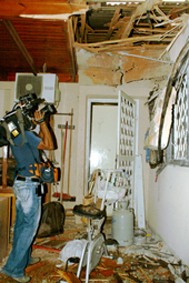
An image of a QR attack on a house in Sderot.
Yup, that is in fact a butane/gas tank surrounded by flammable material, all very much un-exploded.

The Gaza rocket attacks started in 2001. The first Israeli fatality was in March 2007 . That's a pretty poor track record. The reason for this continued poor performance is twofold: 1) Construction techniques. There's only so much targeting you can do with an unguided missile. The most important part is lining up the guide vanes. Remember those corkscrew contrails I was talking about? When you see those, you know the guy who put the rocket together did a botch up job. Corkscrew's means the rocket is wasting energy in spinning around instead of using the energy to go further which means less range. It also means you can't aim the thing worth a damn, because where you point it is not necessarily where it is going to go.
2) It is not meant to inflict large amounts of damage. It's meant to terrorize people, and it is working. The people of Sderot (the primary target for these attacks) must hate those things with a passion.

Summary: The Qassam rockets are extremely easy to manufacture, require very little technical skill to operate and are largely ineffective in terms of physical destructive potential. Poor manufacturing technique further inhibits the ability of this rocket to be a real threat to a militarized nation such as Israel. The rockets are being used to terrorize the populace and to provoke a response out of the enemy government, which can later on be pointed to as further "proof" that the attacking nation is in fact the victim of an overzealous and aggressive neighbour. Underhanded, yet apparently effective, tactics.

Wednesday, January 7, 2009

Will Israel Succeed in Gaza?

Thus far, it seems that Israeli tactics are proving to be fairly effective.

Here are some reasons for why they might actually succeed in their objectives:
  • Minimal Israeli casualties: 7 by the latest count (report here)
  • At least some Palestinians are starting to realize that poking the proverbial dragon with a pointy stick, will in fact end badly. Maybe the traditional insurgent/terrorist tactic of 1) Using the civilian population as a meat shield and 2) Blaming destruction of said meat shield on the enemy, has finally started to backfire on Hamas. There might be a trend of falling popularity. There are some vague western media reports in support of the theory but counter examples are just as easy to find (as well as the bizarre...).
  • Isreal is pretty damn good at what they do:

When the dust finally settles and reporters are given more freedom to enter the Gaza strip, maybe then we'll have a better idea of where Hamas ranks popularity wise with the Palestinians and whether Israel really did what they wanted to do: stop the rocket attacks.