Showing posts with label hamas. Show all posts

Wednesday, November 28, 2012

Why Did Israel & Hamas Go to War?


For better or worse, this post is likely to leave the reader with more questions than answers. I'd love any input/comments that readers have on the matter here (as always).

Before the assassination strike on Hamas' military leader Jabari, Hamas political leadership was making serious noise about a permanent truce with Israel (in fact, Jabari was literally reviewing a draft peace agreement the day he was assassinated and had been part of discussions with Israel and Hamas' political wing about making it happen), and West Bank PM Abbas mentioned he was potentially willing to waive Right of Return for Palestinians as part of a final peace deal with Israel. It seemed, politically, that Israel was largely getting its way.

Then why the assassination? Why the war?

There are potential motivations on both sides for going to war, which we'll outline below. Not clear at all to me which was the primary motivator.

HAMAS:
Hamas is, of course, far from a united organization. In particular, I must be careful in the use of the word "Hamas" when describing behavior from Gazan militants, as not all are necessarily formally associated with Hamas and may not represent Hamas' interests. In this case, Hamas extremists or other militants likely wished to disrupt the peace process, unsatisfied with its provisions and worried that it might go through if the peace process continued unabated. Hundreds of Hamas rockets were the opening salvo in this eight-day war, and so the above explanation is a reasonable one to answer the question, "why did these rockets launch _when they did?_" If the motivation was 100% on the Hamas side, then we would say that Israel simply "took the bait" and was manipulated into war that disrupted a peace process that they would otherwise be in favor of. The assassination of Japbari, in this case, would have been a strategic blunder to an Israel otherwise very interested in peace.

More legitimate wings of Hamas may have also approved of these rockets in order to sabotage the peace process themselves, in order to make sure there was a clear pretense of peace on the Hamas side without risking having to actually stick to it, in order to win the support of the Arab world, in particular Morsi. If this was the intent, it worked--Morsi was able to broker a ceasefire and very clearly backed Hamas in the war, which would be the first time Egypt supported Hamas against Israel since the 1970's.

ISRAEL:
Frankly, the Israeli defense authority is highly sophisticated and I believe it is unlikely they simply made a mistake and, in response to rocket fire, assassinated _in error_ the man most likely to be able to broker a peace deal with Hamas permanently. The reason I am particularly suspicious is that the assassination of Jabari was among Israel's first strikes, rather than simply strikes against Hamas' rocket sites. I believe, like in the case of Hamas, there are some political incentives that made parts of the Israeli government want to disrupt the process as was.

One explanation is simply that Netanyahu could not appear "soft" during negotiations. If Israel calmly/peacefully negotiated peace as rockets hit its civilian cities, it could potentially be seen as "soft" on Hamas and thus in a weak bargaining position. If Israel saw Jabari as trying to play both ends--authorizing strikes against Israel and also trying to push a peace deal--then Israel may have intended to send a message to his successor that "playing both sides" against Israel would not do. Unlike Israeli troops, Hamas rocketeers are generally woefully under-accountable in the international media for their attacks, and if Jabari intended to use this to his advantage, Israel may have felt the need to put a quick lid on it and allow Jabari's successor to restart such negotiations with more caution and restraint.

Israel could have also "read" Hamas' intent--if it was to simply gain an upper hand with the Arab world through credible noises of negotiation, rather than actually push for peace--and wanted to stop this process in its tracks before it lost leverage in the region, though Israel seemed to summarily fail in this.

Israel's current leadership may well not intend for peace with Gaza any time soon. Peace in general may simply be unacceptable to an administration that sees Gaza as an eternal threat for Iranian influence and other forces that may be out for the demise of the Jewish state. Israel may have a quiet policy of no peace with Hamas until Israel's legitimacy as a state is recognized. For various reasons, Israel may see constant war with Hamas (including a blockade of Gaza to minimize the armaments and militants that can enter) as a safer alternative to peace, as counter-intuitive as that may seem. If this is the case, it will continue to sabotage peace efforts until there is a better way to guarantee security in a free Gaza situation, or until a more short-term risk-accepting administration takes the helm.

Finally, Netanyahu may simply want to take advantage of wartime fear for his own election in January. Hamas rockets may have been just the pretense a Machiavellian-style Netanyahu (if that is actually his thinking, which is not clear) would need to have a brief flare-up with Gaza in order to convince swing voters in Israel to vote for Likud rather than Kadima or Labor, keeping Netanyahu in power for another term.

Whatever the reasoning, it is more or less evident at this point that some parts of both Israel and Hamas had interest in disrupting the peace process, and took advantage of this time period to act. To set the record straight, Hamas' rocket attacks on Israel did happen before the assassination of Jabari and seemed unprovoked--this accounting of events is not clear in all texts. But I also believe it is fairly naive to think that Israel's assassination of Jabari specifically (rather than simply a precision strike against Hamas rocket sites, which it also successfully executed) was simply part of a general defensive strategy rather than a very political move.

Such an interpretation would suggest that peace is likely to be elusive in the area for some time to come.

Tuesday, August 31, 2010

Incoming Israeli/Palestinian Talks--Derailed?

There was a sliver--however slight--of a good set of talks coming up in the Middle East.

An assailant attack that killed 4 Israelis near Hebron has probably undermined that entirely. The trick here is not that it will necessarily outrage the Israelis into quitting the talks, but that it will call into serious question Abbas' credibility in promising to handle his own security situation--this happened even with Israeli troops nearby.

Security, obviously, it Israel's biggest concern in the talks, and a number of more extreme-leaning groups (including Hamas) want to make that a tougher point during the talks. The emergence of a weak Palestinian state with Israel in a comparatively strong position would be a failure to the real revolutionaries.

In short: don't get your hopes up for these talks. Frankly, they were probably mostly a political maneuver anyway.

Tuesday, August 11, 2009

Impact of the Fatah Shakeup

Fatah had its first congress in 20 years over the week, in what was seen as an attempt to save the party from its quickly-deteriorating reputation (which has been, since 2004, increasingly along the veins of "corrupt," "divided," and "ineffective"). After the surprising 2006 loss to Hamas in parliamentary elections, and then its ouster from Gaza by a Hamas coup, Fatah appeared to be running out of time.

This sixth Congress was an exercise in enormous cat-herding, and the vote was severely delayed due to an apparently unexpected addition of delegates and a rather frantic worry about the outcomes. And, for the ruling powers of Fatah, worry was worth having. This "old-guard," as it's being called, lost big--of the 18 seats in Fatah's central committee, old-guarders won only 4 seats. Younger "reformists" won 14, setting the path for a new kind of party. Abbas, despite his links to the old-guard and the beginning of the movement, appears to come out of the congress strengthened, with young and energetic allies in the central committee, as well as a renewed mandate.

This "reform" sub-movement is much more a political party than a resistance movement. They support a two-state solution based on the 1967 treaty lines, and are willing to negotiate with Israel over the issue. They have not dropped the right to "resist by all means" for the independence of the Palestinian people, but doing so would have been political suicide anyway.

But this new Fatah is distinguishing itself from its violent-revolutionary cousins, Hamas, much to the relief of moderates in the US and in the Middle East, Israel included. But its leadership is younger, more popular, and probably less corrupt. The new leadership has a year to get its act together before 2010 elections, in which they hope to re-take control of the Palestinian territories, and can then negotiate with greater legitimacy on behalf of the Palestinian people for statehood.

Whether these negotiations can actually push forward in the face of continued Israeli settlement construction is daunting. Israel may require a change in regime itself before serious negotiations over the details of a two-state system re-emerge. But if the Palestinian Authority can present a moderate, reasonable alternative to the violent and inflexible Hamas, Israeli fears may be assuaged to such an extent that a more reconciliatory leadership will emerge in time. Fatah will need to remain consistently open to negotiations, and more importantly, it will have to impose credible control over all of the Palestinian Authority before the Israelis are likely to see the short-term risks of two-state solutions sink far enough below the potential long-term benefits to seriously consider that road.

Saturday, February 28, 2009

Moderates Sidelined in Middle East Conflict

Kadima's gamble in Palestine did not pay off. It's unclear as to whether or not it backfired, but Feb. 10th elections have given Israel's right-wing a majority presence, and President Peres has asked Mr. Netanyahu to form a government, despite Likud's second-place showing in the election.

Mr. Netanyahu has hosted two rounds of negotiations with Kadima, in order to try and form a broad coalition government. But those talks appear to have collapsed, probably over Kadima's commitment to reduce settlements and pursue a US-backed two-state solution. This breakdown likely indicates that Israel is going to lean to the right in the near future.

To form a majority government in the Knesset (parliament), one needs 61 of 120 seats. We'll assume for now that Mr. Netanyahu will likely fail to woo Kadima (28 seats), the Labor Party (13 seats), United Arab List (3 seats), Balad (3 seats), or Hadash (4 seats), which together are 51 seats. To cobble 61 seats together, Mr. Netanyahu will have to appeal to the Zionist/Nationalist tendencies of many right-wing groups, including Yisrael Beytenu (15 seats), United Torah Judaism (5 seats), National Union (4 seats), The Jewish Home (3 seats). Shas (11 seats) is the wildcard--but even if Netanyahu picks them up, he has a narrow coalition indeed, and one whose weight is far to the right. Voices interested in a two-state system will be sidelined in this new government, and the Palestinian Authority will have to choose a reaction.

The PA reaction may be to entrench, but it's unclear. Mr. Abbas is having a lot of trouble forming a unity government with Hamas, largely because Hamas refuses to recognize Israel as a state. Abbas is likely to lose what ground he had in pursuing the two-state solution if Israel spends the next few years uninterested in working with him on such a plan.

Mr. Obama seems to have his work cut out for him.

Monday, January 19, 2009

Israeli Timing Holds True

While Mr. Obama was busy moving his family and belongings to Pennsylvania Avenue, Israel abruptly and unilaterally declared a ceasefire in Gaza. The Gazans (undeniably more than simply Hamas), a few hours later, declared one as well. The ceasefire is holding, somewhat surprisingly. Hamas has decided that they don't want to risk another invasion (yet), and no rockets are flying. Even a day without rockets is a huge symbolic victory for Israel.

Israel's unilateral ceasefire makes two points. The first is that the Israelis do not want a lingering war when Mr. Obama takes office. Such a decision is strategically calculated to prevent Mr. Obama from having to deal with an Israeli war (under the pressure of his allies to stop the Israelis) on day one; certainly, Israel wants to be as friendly with the new American president as possible. The second point is that the Israelis do not want to be bound by the terms of an internationally-brokered peace deal: they want to be able to move into Gaza unbound if the rocket fire continues.

But for now, signs point to Hamas being beaten up enough that it has no intentions of provoking the Israelis yet. It is likely waiting to see if it can rebuild and rearm itself over the next few years of quiet to be ready to weather another Israeli storm.

Sunday, January 18, 2009

Calculated Madness


The New York Times has a fine article about the "calculated madness" of the Israeli attack, and its analogy in the Hamas circle. But I'm not going to re-hash that.

I intend to consider the validity of Israel's conclusions on its war. Israel took down a lot of Hamas infrastructure--and because Hamas is so ubiquitous in Gaza (it is pretty much everything), Israel took down many houses, schools, Mosques, etc. As far as I can tell, nothing hit wasn't either A) a legitimate Hamas target, or B) a complete mistake, but in war, intent is a very small part of the story.

Israel believes that it has taught them a lesson, as the Chinese are fond of saying in their wars. It strolled in, delivered a beating, and left. It wasn't going to destroy all of the rocket sites. It wasn't going to take down Hamas, and alas, it certainly didn't. This war was meant to show Hamas and its supporters that throwing rockets at Israel wasn't worth the risk of massive retaliation. Did that work? Indeed, can that work?

Israel's hope is that the sup;porters of Hamas, while angry at Israel, will question the wisdom of voting for Hamas. This is somewhat likely, but they may also be purple-blooded. After the Sept. 11 attacks in the US, Americans did not question their foreign policy, except perhaps in concluding that they were being too shy, too meek, too peaceful, and too generous (in conflict with pretty much the rest of the world). While the analogy between the 9/11 attacks and the Israeli war is pretty weak, it makes a strong point: can beating on people make them more calm and peaceful? The Blitz of London, the 9/11 attacks, the bombings of North Korea, the Rape of Nanking, they all say otherwise. But they were all primarily anti-civilian attacks. Can Israel make a clearer message by having almost exclusively attacked Hamas-related targets?

Perhaps. Israel has to make two messages clear: 1) Hamas got Gaza into this mess by refusing to stop launching rockets, and 2) that the Israelis were genuinely trying to avoid civilian casualties. The second will not make Gazans less angry at the Israelis for their friends and family dying from shell fire, but it will allow point #1 to have more salience. And that is the important part--if Gazans can say, "Hamas' irresponsibility is why the Israelis attacked" (whether or not it was deserved, etc), then they will back down.

A good example of this is Europe. Russia has recently been, for lack of a better term, insufferable and hyperaggressive. They have gone after Ukraine (with gas) and Georgia (with tanks) for minor provocations. But even though the Russian response was far out of line (and resembling that of a child's temper tantrum), the European Union has questioned the wisdom of continuing to agitate the Russians--particularly, it has questioned a continued policy of trying to subsume Georgia and Ukraine into NATO. Indeed, while Russia's actions have been largely unjust (particularly in Georgia), Europe has taken the posture that Russia is an entity whose disposition and behavior are both A) unlikely to change soon through any measures, and B) rational, even if unfair and disproportionate. And so the Europeans have acted just as the Russians have. So might the Gazans, if the Israelis can impart the same sense of causal linkage between the rockets and Israel's attack (as Russia did between Georgia's shelling of South Ossetia and its own assault). If that link can become salient and vivid for Gazans, then they will either pressure Hamas to change into a more reserved military entity, or they will vote them out. Either, to some extent, is a victory for Israel. But now that the 3-week assault is over, the propaganda war will only intensify.

Saturday, January 10, 2009

The Americans Stand by Israel

For any Israelis that worried about the United States' stance on Israel with the new Obama administration, worry no more: While the Obama administration is likely to push for ceasefires and diplomatic talks as much as it can, Mr. Obama will continue the US policy of defending Israel's sovereignty, safety, and actions. Allow me to elaborate.

Many have somehow worried that Obama's quiet stance on Gaza was a sign that he harbors quiet anti-Israeli tendencies. Not so, I am rather sure. More likely, Obama's quietness allows him to appear neutral coming into the negotiations, which will assist the Israelis more than anyone. The Israelis made sure to rush into this war so that they would not immediately force Mr. Obama into a difficult spot with them, and Mr. Obama has graciously responded by staying out of it for now. it was a wonderful piece of diplomacy, and something that quietly reaffirms Obama's commitment to working with Israel into the future.

The House passed a bill today affirming "Israel's right to defend itself" 395-5 (with a few abstentions, it seems)--it was sponsored by Nancy Pelosi, House majority leader. Big deal? Yes. The House, including a vast bipartisan majority and its Democratic leadership--is behind Israel, and willing to go out on a branch for it.

Senate majority leader Harry Reid also supports Israel's action in Gaza, saying (I paraphrase, sorry): "Hamas has to go." He sponsored a resolution with Senate Minority Leader Mitch McConnell supporting Israel's action, and it passed unanimously. That's right, unanimously.

So the new wave of American politicians are firmly and undeniably in the Israel camp. The tactics might be different, but the support isn't. Even if Obama does harbor some anti-Israeli-policy sentiment (which I really can't say either way, I just hear a lot of people complain about it), he certainly has no room to try to do anything about it--his party is firmly a pro-Israel party for at least the next fair while. This will be significant for the Israeli elections coming soon: American approval of the current party's action (Kadima) should raise confidence that they should keep the same horse in the race--I expect full well that Kadima is going to run away with this election and have a new mandate among the Israeli electorate.

Friday, January 9, 2009

The Gaza Rockets

So really, the big deal in this seemingly unending conflict between Israel and Hamas, the weapon of choice for igniting the fire of war again and again, is the Qassam Rocket.

You may have been wondering what the deal is with these rockets, because either the Israeli people are actually all invincible from birth, or these rockets are really not that great.

Today, we'll have a closer look at what these rockets actually look like, how they work (or don't work), and why they're being used.

To your right you should see an image of the regular Qassam Rocket. Hamas paramilitary fighters are conveniently located next to each rocket to give you a sense of scale.

There are 3 broad types of Qassam Rockets (QR) varying in length from 2 ft 7 inches - 6 ft 7 inches (Just about the height of a regular doorway).
The body of the QR is a cylinder of regular grade steel, with guide vanes placed at the bottom for guidance. The nosecone and upper section are packed with as much explosives (TNT) as possible. The rocket motor is a solid fuel type using a mixture of sugar and fertilizer for fuel.

Below is a video of the QR in action (catchy music included!). Skip ahead to the 2:00 min mark to see construction process. You can see the rocket motor being installed, the sections being welded together and the solid fuel mixture being cast (that bit where they pour the orange liquid into a mould).
During the video keep an eye out for the corkscrew rocket contrails.


So, we can see that these rockets work because they're so incredibly simple. These rockets operate using the exact same principle as those model rockets you played with as a kid. The only difference is that your rocket probably didn't have an explosive payload. All you need to make these rockets yourself is some stock steel and a welding machine. Fertilizer and sugar can be picked up at your local hardware store and chemist.

But let's face it. These rockets just...suck.
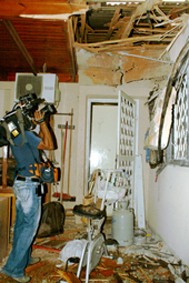
An image of a QR attack on a house in Sderot.
Yup, that is in fact a butane/gas tank surrounded by flammable material, all very much un-exploded.

The Gaza rocket attacks started in 2001. The first Israeli fatality was in March 2007 . That's a pretty poor track record. The reason for this continued poor performance is twofold: 1) Construction techniques. There's only so much targeting you can do with an unguided missile. The most important part is lining up the guide vanes. Remember those corkscrew contrails I was talking about? When you see those, you know the guy who put the rocket together did a botch up job. Corkscrew's means the rocket is wasting energy in spinning around instead of using the energy to go further which means less range. It also means you can't aim the thing worth a damn, because where you point it is not necessarily where it is going to go.
2) It is not meant to inflict large amounts of damage. It's meant to terrorize people, and it is working. The people of Sderot (the primary target for these attacks) must hate those things with a passion.

Summary: The Qassam rockets are extremely easy to manufacture, require very little technical skill to operate and are largely ineffective in terms of physical destructive potential. Poor manufacturing technique further inhibits the ability of this rocket to be a real threat to a militarized nation such as Israel. The rockets are being used to terrorize the populace and to provoke a response out of the enemy government, which can later on be pointed to as further "proof" that the attacking nation is in fact the victim of an overzealous and aggressive neighbour. Underhanded, yet apparently effective, tactics.

Wednesday, January 7, 2009

Will Israel Succeed in Gaza?

Thus far, it seems that Israeli tactics are proving to be fairly effective.

Here are some reasons for why they might actually succeed in their objectives:
  • Minimal Israeli casualties: 7 by the latest count (report here)
  • At least some Palestinians are starting to realize that poking the proverbial dragon with a pointy stick, will in fact end badly. Maybe the traditional insurgent/terrorist tactic of 1) Using the civilian population as a meat shield and 2) Blaming destruction of said meat shield on the enemy, has finally started to backfire on Hamas. There might be a trend of falling popularity. There are some vague western media reports in support of the theory but counter examples are just as easy to find (as well as the bizarre...).
  • Isreal is pretty damn good at what they do:

When the dust finally settles and reporters are given more freedom to enter the Gaza strip, maybe then we'll have a better idea of where Hamas ranks popularity wise with the Palestinians and whether Israel really did what they wanted to do: stop the rocket attacks.

Monday, January 5, 2009

Israel's Confidence is High

Israel is starting to hint that they have full intent to take down Hamas with this war in Gaza (though this has been pretty obvious for a few days now). Their confidence that they can do so is surprisingly high, as well--Israeli officials are calling Hamas "crippled" in a few ways: its physical governance infrastructure is ruined (parliament building, police buildings, etc), its leadership is dead or in hiding (having abandoned its population), and its popularity is going to drop.

Though the popularity of Hamas is currently rather high, the Israelis think it will go down significantly in the next few weeks as Palestinians wonder whether a militant anti-Israel stance is one that is going to serve them well in the future. In particular, if Hamas is unable to provide governance, order, medical supplies, etc after the war ends, then their support will erode. Pre-war, Fatah already had an edge in Gaza polls. When the Palestinians have elections, probably in April 2009, Fatah will probably have quite the edge, even in Gaza. And if it does, and if Kadima can hold on in Israel, then the whole situation in Palestine looks a lot different. Israel will probably do what it can to enforce Fatah's right to govern in Gaza Strip, and help clean the strip up before working on serious two-state talks.

Such confidence is strange, coming from an Israel that lost a 2006 war in Lebanon due to overconfidence and poorly-defined campaign goals. Israel had been showing serious conservatism in its war goals early on: the air campaign was aimed at reducing rocket attacks, not even eliminating them. While Israel is not saying that they have changed their goals to the toppling of Hamas, they are certainly saying that it's likely that they will, and that they're quite happy for it. This means one of two things:

1) Israel's government did not learn a lesson from its tough defeat, even though I was able to graft that lesson from my seat in Cambridge, or,

2) Israel is actually well and truly crushing Hamas' governance and combat capabilities.

Occam's Razor says it's probably the latter.

Despite confidence, Israel remains conservative. They have not given in to goading and luring on the part of Hamas to enter Gaza City or other urban areas for street fighting. They have kept their total military casualties to one, suffered on the first night of entry. Israel's targets have been picked with deliberate caution, as well: Palestinian medical authorities have reported only 16 children dead, despite a strong incentive to over-report. Hamas has claimed that half of the over-500 killed in Gaza are civilians, but there is a strong incentive to over-report here, as well: Hamas loses face by reporting its own fighters killed, and gains support by claiming that Israel has killed civilians. Given how informally one can join the Hamas paramilitary, it will be impossible for these figures to ever be confirmed beyond academic estimates.

So things seem to be going well for Israel so far. They have a lot of work to do, and in particular, Israel must keep up strong diplomacy with Jordan, Egypt, and Lebanon, in order to keep its free military reign in Gaza. But such support should have wavered days ago if it was going to. Israel appears to have a serious shot at crippling Hamas for good and, despite the cries of many protesters to the contrary, contribute to long-term peace in the Middle East.

Sunday, January 4, 2009

Analysing Israel's Gaza Tactics

After a day of war, Israel stand at one dead and about 40 wounded. They say they have killed "dozens" of Hamas militants, but they are struggling with their opposition using civilians as human shields in the fighting.

Let me first digress by expressing my own personal sympathies for Israel's difficult position. After returning full control of the Gaza strip to Palestine, Hamas used a civil war to wrest power, and has been using it as a safe haven to accumulate rockets from Iran and other sources to launch into Israel constantly, even during a six-month ceasefire in which Israel was relatively disciplined. Israel provided the majority of Gaza's fuel, food, electricity, and medical aid at no cost--despite access to the Mediterranean and Egypt, Gaza's Hamas leadership has held Gaza's economy back--gross mismanagement and excessive, corrupt government bureaucracy have made sure that Gaza's market has not spun up at all. Hamas hands out aid received by Israel, and takes credit--keeping its popularity high among its many poor and jobless. Hamas seems to take very little flak from its own people for storing weapons in Mosques and orphanages, or by using civilian human shields as they fight Israelis. The Arab world is starting to flare up in protest, and otherwise-moderate Arab governments have to condemn Israel's invasion to halt rocket fire--after relatively patient and persistent warnings to stop, offers to negotiate, and months of restraint--as a "war crime." Luckily for the Israelis, Egypt continues to stand by them (to what extent they can), and the Arab League is unable to spin up the momentum to actually meet over the crisis. The US will block any UN resolutions to officially condemn Israel in any way. Even US Senate Majority Leader, Harry Reid, has said that a ceasefire is impossible until Hamas offers to halt rocket fire. So even if this war lasts for a few weeks, the US will not be switching teams on a dime.

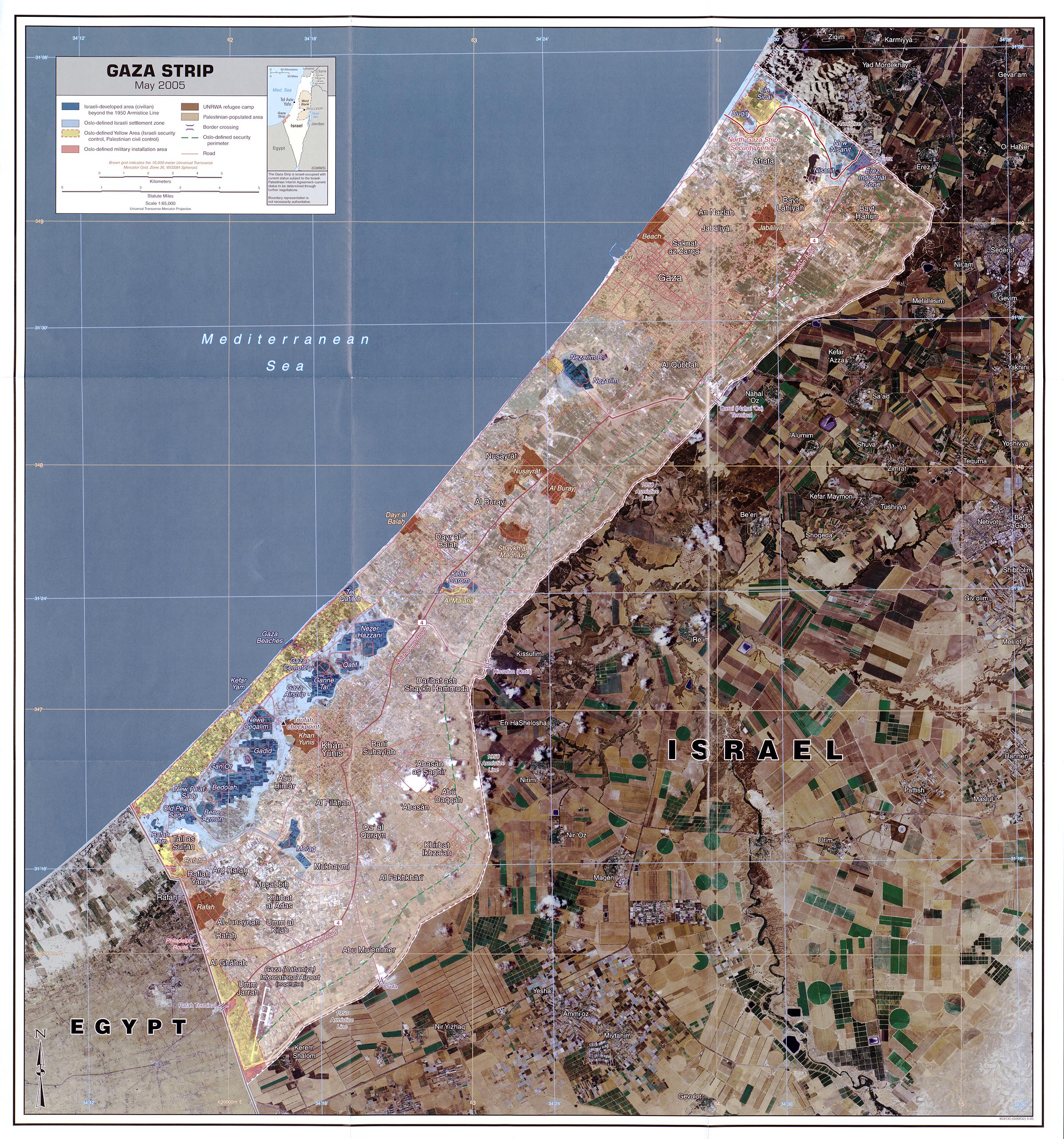
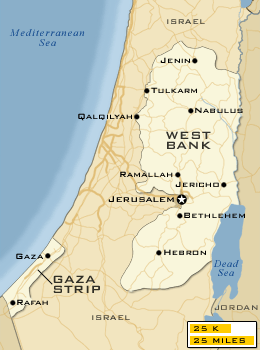
So Israel is now elbow-deep in this problem--what have they actually done? According to relatively scattered reports, Israel has already cut to the Mediterranean and has surrounded Gaza City and other urban centers, as far south as Netzarim, but the Israeli Army has been disciplined enough to avoid entering any major urban areas, where the Hamas militants likely have a great advantage (with huge numbers of civilians that the Israelis have to worry about, potential booby traps, and other "home turf" advantages like knowledge of the terrain, friendly homes, etc). A map I put together below should make it a bit more clear where the Israelis have gone.
Approximate Israeli Movement and Positions (Click for Larger)

Their staging ground was Sderot, on the northeast corner of Gaza. From there, Israel broke in during the night and cut power to most of the northern half of the strip, taking advantage of night fighting technology to strike their initial blow (and most of their advances in the last day). The Israelis are likely to continue using night to press their primary assaults in search of rockets, launch pads, and Hamas leadership. Note that with Gaza City surrounded (and certainly extremely strict policies for anyone escaping), Hamas leadership isn't going anywhere soon (for the Israelis control Gaza waters, as well). Special forces have an opportunity to use what intelligence that Mossad has gathered to take them down in the capital city if they weren't smart enough to get out early.

At this point, Israel looks like it is going to focus on a search-and-destroy mission in the north, and then perhaps move south to mop up militants that got out--it is unlikely to spread its 3 brigades so thin as to take the entire strip at once. Israel also has troops ready in Jerusalem and near Lebanon in case West Bank Palestinians or Lebanese Hezbollah militants try anything tricky to help out their brothers-in-arms.

So the easy part is over, with few casualties for the Israelis, but the hard part--search-and-destroy--is just beginning. The success of the rest of this mission will depend on Israeli tactical intelligence abilities more than brilliant ground war operational capabilities. Israeli unit tactical training will face a test, as well.

But this mission really has more substance than simply finding rockets, or even toppling Hamas leadership. After failing to meet its objectives in Summer 2006 in Lebanon--namely, preventing rockets from hitting Israel in the north--Israel is hoping to regain its deterrent capabilities with neighboring militant groups. Israel is unlikely to face a regular war with its neighbors in the near future--their willingness to negotiate has a lot to do with Israel's ability to bloody them up if they choose to fight. So far, Hezbollah has chosen to sit this one out (so far), and read (though I've lost the link) that there are rumors floating about Hamas heading to Egypt to talk potential ceasefire options. So maybe it's working.

Saturday, January 3, 2009

Gaza Land War Begins

Israel is now holding nothing back against Gaza--its tanks and infantry have entered the strip with the public intent of capturing Hamas rocket launching sites (and likely very large weapons caches nearby) and dismantling them. The Israelis are also likely sending in large numbers of special operations forces to try and take down as much Hamas leadership-in-hiding as possible.

There's little to say yet on the operation, except that it shows a real commitment for Israel to pay the necessary political costs to take down Hamas in a way that would allow Fatah to take control of Gaza if/when it wins elections that Abbas is calling. Strangely, it may be this very war that enables the Israelis and the Palestinians to make peace. A reminder is due that Hamas does not recognize Israel's right to exist--it is only interested in driving Israel out of the area, and that it took over Gaza strip in a civil war in 2006 after losing elections to Fatah--their continued presence has been a tough roadblock for the Israelis, and it seems the Israelis feel they finally have the political capital with their neighbors to finish Hamas off. And despite all the criticism coming Israel's way, it looks like they're right. But now the fate of this operation depends on the military's ability to achieve its objectives without "mission creep" or a quagmire.

Friday, January 2, 2009

Israel Chooses a Gaza Strategy

Israel's former ambiguity in its Gaza strategy is gone, and has given way to a much more decisive strategy of total crippling of Hamas' offensive capabilities. Israel is attacking leadership, communications, security, weapons storage/manufacturing, and deployment sites in an effort to turn Hamas into an ineffectual flag-waving organization, rather than a militant wing with any bargaining power.
Figure 1: Gaza Strip With Urban Densities (Click for Larger Image)

The turn to decisiveness is good for Israel, who appeared to be waffling earlier over what to do. Poking at Gaza and bloodying/infuriating its civilian population without achieving any real political goals would have been not only wasteful, but counterproductive--they would have increased Hamas' will without seriously hampering its capabilities. Now, the Israelis have figured that they have already paid the political cost of the airstrikes, both in Gaza and internationally, and they might as well finish the job to their satisfaction. It will mean many more dead Gazans. It will mean billions in relief. It is a questionable decision overall, but one that appears rational once one accepts the given decision to begin serious airstrikes.

The commitment to cripple Hamas doesn't necessarily mean it will happen, despite Israel's impressive military. In the past, like the 1982 and 2006 wars in Lebanon, the Israelis have struggled to do serious damage to non-state actors. Israel's regular military, despite the state's security needs, remains largely outfitted to promptly dispatch Arab regular armies. But to be fair, nobody on earth has yet figured out how to properly deal with non-state actors, as the US in the last 7 years has demonstrated. Hamas remains resilient and confident. It is an organization that feeds politically on suffering, terror, mayhem, and death. Its support among its base is likely to harden. What makes life tougher for the Israelis is the constant decision between tactical advantage and strategic caution--Hamas has no qualms with hiding arms in Mosques, hiding terrorists in orphanages and hospitals. Israel must choose between letting them hide out, or killing children, killing the sick, killing religious observers. They seem to be going for the latter.

Figure 2: Arms Smuggling and Rocket Sites in Gaza

Israel may be preparing to invade Gaza. Reservists have been called, troops and tanks are lining up by the Gazan border, and foreign nationals are being escorted out of the country. The move may be an effort to pull Hamas security to the border and push civilians away, making it easier to more exclusively target militants, but it may be a legitimate preparation. A ground war is likely to become a mess--unless the Israelis have learned from the Summer 2006 Lebanon war, but chances are (sadly) that they haven't. The most productive thing that Israel can do in a ground war is conduct a series of raids to take down every single Hamas leader whose name registers on the Israeli radar that they can. The only way to truly get Hamas to fall apart will be to rob it so completely of leadership that it kills itself in an internal power struggle. The Mossad may have the intel the Israeli army needs to do that. It's tough to say.

For what it's worth, Israel's friends are sticking by their side. Israel's earlier diplomatic maneuvering is paying off. Egypt is keeping its border crossing closed except for inspected humanitarian relief trucks going into Gaza and inspected emergency transport trucks going out. Egypt has drawn a lot of criticism for this, from the UN and Iran, and from protesters just about everywhere, but it's sticking to its guns. The Lebanese government has come out against criticisms of Egypt, The Syrians have vowed to continue peace negotiations with Israel, and Jordan is keeping quiet despite a 50% Palestinian population. Such reactions are absolutely remarkable, and should mostly guarantee Israel a free hand in the Gaza operation. It remains likely that Livni has convinces Israel's neighbors that Hamas must go.

So with its free hand, Israel continues to pound Gaza, targeting as many Hamas critical points as they can. Hamas remains bold, but nothing Israel can do will change Hamas' rhetoric. Keep an eye out for a Gazan land war, and for more Hamas leaders to turn up dead. Israel may have a unique opportunity to eject this thorn in its side once and for all.

Sunday, December 28, 2008

On the Gaza Air Raid

Israel hit Gaza--hard--for the second straight day today in an air raid. Short of decisive, the attacks are looking ugly, pulling Israel into a mess that they may not be willing to deal with. But diplomatic pressure remains low.

300 Gazans are dead--Hamas reports 180 of their own and the rest civilians, the Israelis, of course, claim more. 700 are wounded. Hospitals are flooded. The place is a mess. Okay, now what?

If the Israelis were trying to strike a crippling blow to Hamas, and keep them from operating, then fine. It might be worth the PR problems that are being generated, and it might be worth the resentment of their Palestinian neighbors. Any raid like this has huge political costs. But Livni has openly declared that there won't be a ground invasion, and this will not be the crippling blow to Hamas. Then what is it? What's the benefit?

This campaign looks like a deterrence/punishment operation, from its nature. It's an attempt to tell Hamas, "hurt us a little, and we'll hurt you a lot." Hamas and Israel don't recognize each other as legitimate, and Hamas isn't participating in talks with Fatah, Israel, or even an Egyptian mediator. There's little talking that can be done to Hamas.

But this mayhem may not be what Israel wants. Mayhem should be an unfortunate byproduct of a bigger operation--eliminating Hamas' rocket capabilities, or decapitating the leadership. But neither of those are happening. Israel probably won't seriously hamper Hamas' ability to throw rockets into Israel, and it's certainly unlikely to break Hamas' will--martyrdom is encouraged and sought-after among Hamas' members, and civilian deaths are an infuriating motivator in any bombing campaign (think of the London Blitz).

So Israel seems to be failing to really make a blow to Hamas' capability or will with this air raid. There is a possibility that this raid is actually a signal to Fatah and its leader, Abbas, that Israel's grievances must be taken seriously by the PA if the PA is going to be able to govern itself. Fair enough. If anyone is getting the signal that Gaza needs to be put under control, it's Mr. Abbas.

What this assault won't do is strike a blow to Hamas' popularity--if anything, its base is likely to be energized. If Israel hoped to convince Hamas supporters that their party's irresponsible behavior was the cause of the attack, they've failed.

But, Israel's options remain open. They're really not taking much in the way of diplomatic fire--the UN, EU, and Arab states are calling for "restraint" and an end of hostilities--but there's very little condemnation coming out of the region, the EU, or the UN. Obviously, the US is expressing its hope for a peaceful resolution, but has openly told the Palestinians that they had it coming.

Abbas has sent an official condemnation, but that was to be expected. Arabs throughout the region are protesting in the streets, burning Israeli flags and whatnot, but their governments are not responding strongly. International politics is trumping domestic politics in the region. It's a sign that the Israelis--particularly their Foreign Minister Livni--have prepared the diplomatic battlefield. It means that they've got options in the bag, and it means that they have, over time, earned the acceptance of their regional community. But unless they can start thinking about a new approach, and focus on what their political goals in this operation might be, the diplomatic maneuvering might all be for naught.

Thursday, December 25, 2008

Hamas' Neighbors Conspiring to Take it Down

Six days into the end of the ceasefire, rocket attacks from Gaza into Israel have gone up significantly--and not as a response in particular to any Israeli behavior. While the rockets are still not killing Israelis, they are making life for anyone nearby nearly unbearable.

These rocket attacks may have sealed Hamas' fate. Hope that Hamas can be groomed into a legitimate political party are falling apart, for even its neighbors. There is a lot of talk by relevant parties that seems to indicate that Hamas will soon be facing its doom. Even more significant, however, is who isn't talking.

Israel is sending strict warnings, and making it clear that they are preparing a massive offensive into Gaza. The operation would be aimed at toppling Hamas, and they might just have the support they need for it.

Egypt invited Foreign Minister Tzipi Livni to Cairo for talks over the issue. Egypt is urging restraint, but this is likely a mere diplomatic and political gesture. The place of the meeting has significance--Egypt usually only meets with Israelis in an out-of-town resort, but bringing Livni into Cairo is a gesture of respect and endorsement that Egypt rarely grants. It is an off-the-record way of saying, "we are on your side now."

But there's more. Al-Quds al-Arabi, a newspaper out of London, has reported that Egypt would not object to a strike by Israel to take down Hamas. This is big news. This is about as close to a full war endorsement as one can get from Arab neighbors--a light endorsement usually comes in the form of an Embassy-level protest, even if just to save face. But the Egyptians have said out loud that they're going to keep their noses out. And they'll probably keep enforcing the blockade.

The Egyptians have probably become tired of trying to be impartial mediators with Hamas after years of being snubbed and enabling bad behavior. In October, when Egypt tried to host reconciliation meetings between Hamas and Fatah, Hamas boycotted. Egypt kept suggesting to Hamas that they continue the Israeli truce and go to Cairo for peace talks, but Hamas refused. Hamas' rocket attack escalation has come against Egyptian warnings. Egypt realizes that anything short of an endorsement for war is a form of political capital for Hamas that it can use to pay for the flight of more rockets into Israel. Egypt doesn't want to be a part of it anymore.

Before now, domestic pressure kept the otherwise-moderate Egyptian government at least partially on Hamas' side. It is likely Hamas' loss of grace--rather than serious changes in the politics between Cairo and the Muslim Brotherhood--that has pushed Egypt to Israel's side. But it's there, and that's bad news for Hamas.

Abbas has taken the opportunity to declare his support of unity and democracy by vowing not to pursue a civil war to beat Hamas. Abbas gets to play good cop as more-established powers put the pressure on Hamas for him. But there's a lot to gain for him here. His popularity is on the rise, and world opinion turning against Hamas for irresponsibility and militarism, moderates in the Palestinian Authority are likely to shy away from Hamas as well. Abbas is preparing the battlefield for snap elections and a booming victory by Fatah that he will be able to hold onto for years. If Fatah can start to consolidate its political power, then an anti-Hamas operation will become much more viable an option for other world leaders.

But just as significant are those that are not talking. Iran and Syria have said little or nothing on the matter. They have not warned Israel, nor had words with Egypt over its pro-Israeli behavior. Whether this is a result of talks with Bush, Brown, and Sarkozy, or whether it's simply due to Hamas' PR gaffes of the last few years, is unclear. But by not talking, they too are giving as much of a green light to Israel as possible. The UN will complain if the Israelis invade, as will Russia; but if the regional actors here keep behaving like they are now, they will prepare the region for peace.

If Hamas' domestic popularity tumbles, then their ability to wage a messy and bloody insurgency against Israel will be limited--people will give them less funding, fewer troops, fewer places to stay. Palestinians will betray their positions to the Israelis. The war will go well, and the militant machine that keeps Hamas in place will start to weaken. Until this happens, elections will be meaningless--Hamas has already shown that its respect for democracy and peace are long trumped by its ideology and thirst for power (see: the PA civil war). But if they can be crippled, then Fatah's elections can bring a new mandate for the region to work together to clear any Hamas resistance to the new PA order. Some control over Gaza may become possible, in time. It will require patience.

As importantly, Egypt's blessing of Israel will make it an excellent supporter of the Israeli-Fatah peace talks, especially if the Syrians choose to continue to participate after election cycles are over. Israel, should it choose to pursue the two-state option, will have regional support and mediation that should make life a lot easier.

Finally, Livni seems to be showing she's got the right stuff to be Prime Minister--and she's using the opportunity to steal the spotlight from Netanyahu. This will be critical in Israel's upcoming elections--if she can use her power as Foreign Minister to keep the region on Israel's side even during an attack on Gaza Strip, then she will at lest carry an image of a great diplomat and representative of Israel. More importantly, this fight is a big test as to whether or not her two-state system can work, or whether it should be abandoned for Netanyahu's one-state system. But with Fatah and Egypt giving tacit support to Israeli operations in Hamas, Syria and Iran's non-involvement, and the continually increasing likelihood that Hamas' days as a major player in the region are coming to a close, moderate Israelis are likely to favor the two-state system, Livni's ascendancy to PM, and continued peace talks.

Monday, December 15, 2008

Gaza War to Reignite

As the truce winds down, Hamas faced two options: rev the war back up, or bide their time. Long-term, time is in their favor--Arab Muslims are outbreeding Jews by quite a bit (although they're still quite the minority). But it's very long-term. So Hamas is going with option 1.

First: rocket attacks have increased significantly. Because Hamas has no credible control over the people of Gaza, the only reputation blow it takes is for letting these rockets go is on its administrative and security abilities--a reputation it doesn't really care about anyway. But Hamas allows doubt to loom over whether it's orchestrating the attacks or not. The rockets are making living near Gaza nigh-untenable for Israelis, even though none have died. But that's the point: it's terror.

Second: Hamas has generally agreed that the cease-fire will end. They claim they will only "respond to Israeli aggression," but the cease-fire gives Israel a lot of leeway to really hammer down on the West Bank for rockets flying into Israel--if Hamas doesn't want large-scale war, it had better hope that it does have control over such rocketeers. The lack of a cease-fire will lift any veil that Hamas is actually trying to keep rockets under control--and Israel has shown that it's unlikely to cow to international pressure. Hamas probably knows it, too.

Israel probably has a plan to make a surgical strike into Hamas if they provoke it. Israel had offered to extend the truce--it was Hamas that declined, even after Israel released a few hundred Palestinian prisoners. Along with the rockets, Hamas is pretty clearly asking for it. Expect the Israelis to have something very precise in their sleeves to unleash on the Hamas leadership if they start acting up after the truce ends. Especially with Livni's declaration that Hamas has to go by force, don't expect Israel to play nice with Hamas, regardless of whether Kadima or Likud takes the polls in January.

Sunday, December 14, 2008

Livni Starts Talking Tough as Elections Loom

With elections in January, Tzipi Livni, leader of Israel's Kadima party has been thinking very hard about what to say and do, balancing her principles and her obligation to lead her party to victory. It seems she has come up with just the solution.

Many Israelis worry that an unchecked Palestinian state would be a broiling terror base. There is some evidence for this--in occupied West Bank, few terror incidents have occurred in the past few years. Despite Israeli domination, those in West Bank favor the Fatah party, and are pro-reconciliation. In Gaza, where Israel withdrew earlier in the decade, Hamas reigns supreme, and launches rocket attacks at Israeli towns almost every day. Hamas is still officially at war with Israel, holding rather ineffectually to a six-month truce that will expire on the 19th of this month. Hamas has not made it clear whether the truce will be extended. Hamas politicians are also sending mixed messages on whether they want a two-state solution--one of Hamas' underlying principles is the elimination of Israel and the creation of a Palestinian state in the territory. Hamas propaganda and speeches drip with anti-Israeli rhetoric. Naturally, leaving the Palestinians to their own devices seems like an unattractive option for Israelis.

Livni may have appeared soft earlier, willing to push for a 2-state solution despite Hamas' continued anti-Israeli stance and behavior. But Livni has taken advantage of international recognition of Hamas as a terror group--while she is willing to deal with the moderate Fatah party as a representative of the PA, Hamas has no authority in the eyes of Israel. They would not be invited to the negotiating table. But further, she's taken a stance of zero tolerance for Hamas, and declared her willingness to use military means to eject them from the Gaza Strip. Such a maneuver will be difficult, given that Hamas is a decentralized party and militia, but it's an important signal coming from Livni. She's saying to the Israeli people that she will not allow her pro-negotiation stance to grant Hamas any legitimacy, and further, that she is willing to be the candidate that gets rid of them for good.

There would even be some shred of international legitimacy in such action--Fatah is currently the ruling party of the PA, but has no control over Gaza because Hamas drove them out militarily--thus, Hamas' control of Gaza can be considered illegitimate and tyrannical. Israel is probably the most effective (if not the most politically attractive) force that could restore Fatah power over Gaza.

This new, tougher stance may win back some of the Israeli moderates that jumped the Kadima ship to Likud. But we'll have to wait a few weeks for the pundits to talk and the polls to come in before we can know.

Friday, December 12, 2008

Implications of a Poll in Palestine

A poll was published today that described relative support for Palestinian Authority parties, Hamas and Fatah. Overall, Fatah would take 42% and Hamas 28%; in the Gaza Strip, Fatah leads 46%-32%.

The implications of this are extremely interesting for Persian Gulf and American governments. Here's why:

A few years ago, Hamas and Fatah fought a brief civil war in both the Gaza strip and West Bank. In Gaza, an aid-dependent territory, Hamas had strong local roots and a reputation for setting up schools and donation centers. They were popular, and in Gaza, they drove Fatah out. But Fatah was the elected government, and won in the West Bank, where trade and diplomacy happen through Israel and Jordan. Each section became a more homogenous, polarized region.


Israeli policy in Gaza looked for a while like it would drive Gazans to the lunatic fringe. Hamas reacted with massive propaganda efforts to Israel's attacks, blockades, etc. In a region so devoid of contact to the outside world, it seemed like such propaganda would work. But somehow, it hasn't. Gazans currently prefer Fatah--a party removed from Gaza's streets and consorting with Israel, Hamas' enemy. The implications of this are strong: Despite losing the civil war and appearing to sell out the Gaza strip, Fatah has won their loyalty. Throughout all of the Palestinian Authority, Hamas is being rejected by fairly impressive margins.

If Fatah can substantially win the upcoming January elections, then its moderate politics will reign supreme. If it can consolidate its power over Gaza, then it can begin to enforce moderate policies and suppress Hamas' anti-Israeli terror behavior. If and only if it can suppress this behavior will its 2-state policy have a chance. Israel cannot give up some control of the PA until it knows that it will not be a hotbed for terror--it cannot take it back as easily as it can simply hold on.

But the other implications are perhaps more interesting, in Israel. If the moderate Fatah party can take control of all of the Palestinian Authority, then Israeli perceptions about the PA may change. If the Israelis see hope in 2-state negotiations, if they see that such negotiations may lead to long-term peace and prosperity rather than increased terrorism and demands by radical Islamist leadership, then Israelis may be more tempted to vote Kadima and continue negotiations rather than throw their hands up and oust the government for the Likud opposition.

If Fatah and Kadima can get a new mandate and a stronger political hold over their respective territories, then the 2-state negotiations are likely to have a lot more hope in the next few years--particularly if such moderates in power allow the Israeli-Syrian peace talks to resolve. The machinations for Middle East negotiations have been shaken up significantly by the last years' actions, but they may not have fallen apart.

Friday, August 1, 2008

A Wrench in Middle East Peace?

Earlier, I had been lauding as near-inevitable a realignment in the Middle East that might lead to a lasting peace, particularly with Israel.

Sadly, one of the unspoken keys to this peace process was Prime Minister Olmert, whose moderate stances on Middle East relations have probably been a big part of the willingness of Syria to negotiate peace (and Syria's involvement, I have argued, is critical to reining in Hamas and Hezbollah).

But Mr. Olmert is going to resign, amid charges of corruption that have had the police question him four times already. Whatever happens to him afterwards, he will be leaving without a strong mandate for his current policies to be continued.

And it looks like Netanyahu, a serious tough-guy and (some have said) ultra-nationalist has got poll numbers behind him to take over in snap elections in the fall... which may or may not happen. The ruling Kadima party is weak, and Likud stands to gain a great deal.

Netanyahu is even more prickly than the typical Israeli politician, and has hard-line stances on most countries that consider Israel an enemy, including Iran. He supports keeping settlements in the West Bank, and opposes the Annapolis talks--this would completely dreail any motion towards a Palestinian state.

Netanyahu was Prime Minister already in the 1990's, and is not considered a friendly guy. Quoth Bill Clinton, after a meeting: "Who the fuck does he think he is, who's the fucking superpower here?"

On the good side, Netanyahu's understanding of geopolitics is realist and realistic. He sees Iran as a serious revisionist threat, and Hezbollah and Hamas as proxy terror groups, largely acting at Iran's whim. But does that mean he's thinking about actually using the military to deal with Iran? Israel under a moderate Olmert has certainly been making it look like it's a question on the table--and Netanyahu would support an airstrike more than anyone. This has some pretty scary consequences.

So what happens, if the US has a friendly and weak Obama presidency, and Israel has a tough-nosed Netanyahu? Besides disagreements, the US would have a hard time keeping Israel in line. If rows erupt, or if Netanyahu loses respect or patience for the American president, Israel may begin to act unilaterally against Iran--and let the US deal with the consequences in Iraq or Afghanistan.

But there is another, bizarre posibility. Netanyahu might actually become a looming stick in negotiations with Iran and Syria. While Syria declared that it would wait for US elections to continue peace negotiations, it may now change its mind and hurry up, hoping to slip in the Peace door before it closes on them. US negotiations with Iran may now include a note of saying "look, you want us on your side when Netanyahu takes office." Similar feelings will be felt by Abbas of Palestine, but his ability to control his nation is so limited that it may not matter.

So we should keep our eyes on the Middle East, and see whether Israel's pseudo-enemies are dealing with Olmert's resignation with a hastened need to act, or a resigned move back towards the hard-line geopolitics that Netanyahu wants to play. Bush, if he's smart, is going to seize this opportunity in negotiations with Iran and say "hurry up, kids, we're out of time." Assad, if he's smart, will do the same to Israel (Olmert is largely at a point where he is now incapable of initiative). But now we have to see how smart everyone is willing to be.

Tuesday, July 15, 2008

The Good Cop/Bad Cop Game in the Middle East

There is a pattern to policies in the Middle East going on, and it is beginning to look like the work of not competing polities struggling for power, but a quiet agreement and cooperation that looks primed to make peace in the Middle East look like a vague possibility for the the first time in a long time. I believe that Bush, Sarkozy, and Brown are playing a Good Cop/Bad Cop game with respect to Iran and all important regional players involved, that might just get things to go their way.

We should note that Iran's most significant lever of power is through its support of regional terrorist/political organizations: In Iraq, Al-Sadr and Shiite militias. In Lebanon, Hezbollah. In Palestine, Hamas. Iran's primary polity ally in the region continues to be Syria, which still exercizes great influence over Lebanon. Iran does have long-range missiles, but Israel is their only possible target, and Israel is bristling with anti-missile interceptor technology. Iran can't afford to start an air-war with Israel--the combined Israeli-US air forces are not accessible to Iran by land or sea, and would be able to retaliate--with terrifying effects--mostly unadultered. If Iran was actually going to fire its missiles at Israel, it might have to be prepared to try to invade Iraq.

But Iran's primary lever of power has taken serious blows lately. In Iraq, Al-Sadr and other Shiite groups are at peace with the central government after months of raids and negotiations. Iran is trying to rein them in, because it is seeing it is unlikely to win the victory it wants in Iraq, so it is likely taking the victory it can get--a democratic, but Shiite-dominated state. The US and Iran are likely to open diplomatic posts in each others' countries, but mostly as signs of goodwill in their Iraq negotiations. Iraq, believe it or not, is mostly in cleanup-mode at this point.

Syria is primed to jump Iran's ship--its inclusin into Club Med, peace talks with Israel, and ambassadorial relationship with Lebanon means it is suddenly reaching in a very pro-West manner, after decades of jihadist rhetoric and isolation, not to mention support of anti-Israeli terror groups and former invasions of Israel. It looks like all of this is about to change. And that means...

Hezbollah will lose one of its primary benefactors. Syria's lack of cooperation will even make it difficult for Iran to support the southern-Lebanese terror group, and Syrian support for the current Lebanese government will likely decrease the popularity of Hezbollah as a political force.

Syria's recognition of Israel, and peace with it, will strike another blow to the legitimacy of the Hamas terror front's fight for a Palestinian state that replaces the entire Israeli one. The more that the Middle East lines up behind Abbas and the two-state strategy, the more hopeless Hamas' political goals will become, and they will be relegated to the realm of extremists in the minds of fellow Muslim Arabs, causing them to lose cash and political support.

All this means that Iran will have very little to threaten Western interests with, if it all works out. A weak Hamas, Hezbollah, and Iraq Shiite movement will mean it can't threaten to shake up Israel, Lebanon, or Iraq at a moment's notice. Without that power, Western and pro-Western states will raise eyebrows when Iran uses brinksmanship instead of cooperation as its means of convincing other states to do what it wants. This is certainly the "good" scenario of the current situation, but how did we get here?

Bad Cop: Of course, George Bush, doing what he does best, has put a lot of fear into a lot of folks that might otherwise feel comfortable. For example: although war with Iran has now become more clearly a psychological tactic to cause the Iranians to lose confidence in their president, this years-long psywar has fooled even the American media into worrying that US troops were about to leap into Iran (even though the military deployment in Iraq and carrier deployment around the world showed no evidence of that ever being the case). Conservatives and moderates in Iran, alike, have started to get very worried bout their president's brinksmanship with an American president known for making quick decisions and sending military forces against good advice. Even now, Israeli planes are flying over the mediterranean and over Iraq, making clear that they are practicing for a strike on Iran. Bush is leading calls for sanctions against Iran in the UN. Bush's hard line against anything resembling terror has lost him respect, but has made those that support terror think twice.

Good Cop: Nicholas Sarkozy, great French diplomat, president of the EU. His elaborate diplomatic blitz early in his career patched up relations with the US, UK, and Germany in a very short period of time. Even the Russians are a bit warm to him, even if the Chinese aren't. He is now courting the Syrians--who are probably the biggest remaining key to the entire situation in Israel/Lebanon/Palestine--in a truly fantastic, Romanesque way. He has invited them to Club Med, given his support to peace talks with Israel, and even held the Syrian president as a guest of honor at Bastille Day, depsite the fact that this raised a few eyebrows in his own country. Syria is responding well to Sarkozy's courting, and if Syria acts well, the dominoes may begin to fall.

Where does Brown fit into all this? By giving his goodwill. The UK's massive military and political power could be put to use here, but they are mostly being kept in check. The UK doesn't want to play bad cop, and can't afford to play good cop due to having so many troops in Iraq. Brown likely gave his permission for Club Med, and is likely exercizing his political strengh to silence people like Merkel, who are most likely to object. The Big Three are working in concert, as they had the potential to as soon as the French and British elections had happened, and each his doing his own part.

Sarkozy's carrots to Bush's sticks are making cooperation a very tempting alternative. One can imagine Assad's eyes light up during his visit to France on Bastille Day, when Sarkozy told him "This is what the cool kids get."