Showing posts with label Likud. Show all posts

Tuesday, March 17, 2015

Israeli Election Update; And Corrections

First, some corrections:

I got lazy in deciding to not translate some Hebrew and mis-named Herzog's "Zionist Union" as "Labor," which is inexcusable, though we can think of them similarly.

Second, I also failed to take into account the non-linear seat allocations of the Israeli parliament, so my numbers were way off.

But let's move forward.

With 94% of votes in, Likud has a surprise lead with 29 seats to ZU's 24. This is actually so far off of exit polls showing them both closer to 27 or 28 that I suspect there will be a bit of a change as the last 6% get counted (otherwise the exit pollers put up a disappointing effort).


Let's assume this holds.

The Arab "Joint List" will absolutely not join with Likud, and nor will Yesh Atid--even though they were with Netanyahu's coalition last time, they've insisted that they'll only join a coalition "dedicated to peace," and in Israeli terms, that means the opposition.

Likud can count on Bayit Yehudi (Jewish Home), Shas, UTJ, and Yisrael Beytenu, which means Netanyahu's current count is 57--short of the 61 needed.

Herzog's ZU can count on Yesh Atid, Meretz, and the Arab Joint List (due to its stern opposition to Lukid), putting Herzog's count at 53.

It's being said, fairly, that Kalanu (who did better than expected) is poised to play "kingmaker" by joining whatever coalition they please. They're centrist and have worked with Likud in the past, but have made it clear they're willing to go either way.

Netanyahu "has the ball" in being invited to form a coalition, but to some extent it doesn't matter: Herzog has every right to also be courting Kalanu.

Kalanu's moderating force might be very powerful when they make a deal. I'm still predicting Herzog will catch Kalanu and win, primarily because I think that Netanyahu burned too many centrist bridges by pledging to continue building settlements and avowing that Palestine would never become a state: I think it's just too extreme a position to attract Kalanu, but Netanyahu may be willing to back down: he's a shrewd politician and won't let last-minute campaigning declarations keep him out of power.

Thursday, March 12, 2015

Foggofwar Prediction: Labor Coalition to Narrowly Win Israeli Parliamentary Elections

Israel's next parliamentary elections happen on March 17th, and a major potential foreign policy shift could happen if Netanyahu's Likud party doesn't win.

Looking at stabilizing opinion polls, I predict that a Labor-led coalition will win, carrying somewhere in the region of 57 to 61 seats (of 120). I think the big X-factors will be whether it can/wants to pick up the communist Hadash party (likely) and the Arab Balad party (maybe?). I suspect they would not take on the Islamist UAL party.

It could be a minority government, but it's likely to hold the day nonetheless.

The Labor coalition would likely look like: Labor, Hatnuah, Yesh Atid, Meretz, Kalanu, and Hadash, which together carry 57 seats in current opinion polls. If they picked up Balad, they would hit 60 or 61 seats, enough for a slim majority.

Since UAL, Ta'al, and Balad (together with 9 seats of support) simply wouldn't join Likud due to their anti-Zionist ideologies, the Likud coalition (Likud, Yisrael Beiteinu, Jewish Home, Shas, UTJ, Otzma, and Yachad) looks primed to hold 54 seats.

The trouble for Labor's coalition is that it would be a bit unwieldy, requiring getting general agreement from socialist/labor, communist, liberal, and Arab parties. The good news is that the smaller groups are so unlikely to jump to support Likud that their bargaining power isn't too high in driving policy (unlike the Lib Dems of the UK, which got to play Kingmaker in the 2010 parliamentary elections there).

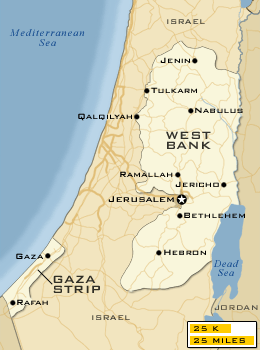
Labor might take an approach to end or roll back Israeli settlement of the West Bank, and maybe even lift the blockade on the Gaza Strip. It would be an interesting change in foreign policy, indeed.

We'll keep our eye out if the polls look to change.

Friday, February 5, 2010

Last Decade Series: Israel/OPT

What frustration. Certainly I was pretty geared up for the 2009 parliamentary elections in Israel, hoping Kadima would hang on to power, allowing Livni and Abbas to ride off together into the sunset and create the Palestinian state. In retrospect, this was pretty optimistic, and I don't just mean that Kadima lost power to Likud. It probably wouldn't have worked out all that well even if Kadima had taken power, as Palestine still seems to not be in a place where it can run a respectable state, especially in Gaza.

So, first thing's first: the Middle East will be a nasty and inhospitable place for US interests until Palestine gets its own state, period. And yes, I understand that such a goal is highly complex and wrought with problems, many of which are directly the faults of the Palestinian people. But ultimately, it is in the interest of the US and Israel alike to have a Palestinian state with a healthy economy. If I had my druthers (and I rarely do), we could hand Gaza to the Egyptians and merge Palestine and Jordan back into Trans-Jordan and make it the problem of some already-relatively-stable governments to keep a lid on Palestine, but that's not going to happen.

But an independent Palestinian state (and one that, in particular, is content with its borders, which is going to be pretty tough to come by) will mean relative security for its people, and a situation in which aggression on border issues or whatnot with Israel would make life sufficiently worse as to not be worth it. Palestine, as a stable and economically viable state, would have nothing-to-gain-and-everything-to-lose by fighting with Israel, and would therefore have a strong interest in keeping a tighter lid on its more fanatical rocket manufacturers.

And this last decade looked like we were making pretty good progress! The election of Abbas, who should have been seen as a godsend to the West, gave the distinct impression that the Palestinian people were tired of intifadas and ready to sit down, talk, draw some lines on the map, and move on with their lives. The moderate Labor party in Israel showed similar promise. Both sides looked ready to take the risks necessary (and probably suffer through the ensuing pain necessary) to get to that key treaty that we've all been waiting for. But what the heck happened?

The big clincher was probably the Olmert scandal. His loss of moral authority castrated him from being able to drive the necessary treaties through parliament; serious delays popped up. By the time Livni was in a position to do the negotiating, Obama had been elected and the Palestinians wanted to wait around for him (perhaps hoping to gain a strategic advantage from losing an American president that they perceived to be pro-Israel). The elections came, Netanyahu won, settlement-building ramped up, and everybody got very angry at each other again.

Not, of course, that the war in Gaza helped things any--had Israel successfully "dismantled" Hamas, life might be a bit different. But in failing to do so, they were left with only a battered reputation.

At this point, Netanyahu is barely humoring the idea of an independent Palestinian state: he wants it to be fully demilitarized, and wants Israeli settlements to grow into the West Bank "naturally," with the population (and has not made it clear as to what would happen to those settlements if a Palestinian state gets built). Further, he's insisting that all of Jerusalem would stay in Israel. It's a tough stance to negotiate with, even for Abbas. Perhaps the strategy is to try to squeeze more to the Israeli side in a compromise, but at some point, one's demands are so high that the other side is incentivized to walk away from the negotiating table at all.

And so I think that Israel and Palestine are now significantly farther from where they were in, say, 2007, as far as being close enough in official policy to negotiate a compromise and create a Palestinian state. The moderates made key mistakes that blew their opportunities to make serious headway in the 2000s, and they will probably have to wait through another relatively painful cycle before they can make another reach for some sort of steady-state solution.

Saturday, February 28, 2009

Moderates Sidelined in Middle East Conflict

Kadima's gamble in Palestine did not pay off. It's unclear as to whether or not it backfired, but Feb. 10th elections have given Israel's right-wing a majority presence, and President Peres has asked Mr. Netanyahu to form a government, despite Likud's second-place showing in the election.

Mr. Netanyahu has hosted two rounds of negotiations with Kadima, in order to try and form a broad coalition government. But those talks appear to have collapsed, probably over Kadima's commitment to reduce settlements and pursue a US-backed two-state solution. This breakdown likely indicates that Israel is going to lean to the right in the near future.

To form a majority government in the Knesset (parliament), one needs 61 of 120 seats. We'll assume for now that Mr. Netanyahu will likely fail to woo Kadima (28 seats), the Labor Party (13 seats), United Arab List (3 seats), Balad (3 seats), or Hadash (4 seats), which together are 51 seats. To cobble 61 seats together, Mr. Netanyahu will have to appeal to the Zionist/Nationalist tendencies of many right-wing groups, including Yisrael Beytenu (15 seats), United Torah Judaism (5 seats), National Union (4 seats), The Jewish Home (3 seats). Shas (11 seats) is the wildcard--but even if Netanyahu picks them up, he has a narrow coalition indeed, and one whose weight is far to the right. Voices interested in a two-state system will be sidelined in this new government, and the Palestinian Authority will have to choose a reaction.

The PA reaction may be to entrench, but it's unclear. Mr. Abbas is having a lot of trouble forming a unity government with Hamas, largely because Hamas refuses to recognize Israel as a state. Abbas is likely to lose what ground he had in pursuing the two-state solution if Israel spends the next few years uninterested in working with him on such a plan.

Mr. Obama seems to have his work cut out for him.

Monday, December 15, 2008

Gaza War to Reignite

As the truce winds down, Hamas faced two options: rev the war back up, or bide their time. Long-term, time is in their favor--Arab Muslims are outbreeding Jews by quite a bit (although they're still quite the minority). But it's very long-term. So Hamas is going with option 1.

First: rocket attacks have increased significantly. Because Hamas has no credible control over the people of Gaza, the only reputation blow it takes is for letting these rockets go is on its administrative and security abilities--a reputation it doesn't really care about anyway. But Hamas allows doubt to loom over whether it's orchestrating the attacks or not. The rockets are making living near Gaza nigh-untenable for Israelis, even though none have died. But that's the point: it's terror.

Second: Hamas has generally agreed that the cease-fire will end. They claim they will only "respond to Israeli aggression," but the cease-fire gives Israel a lot of leeway to really hammer down on the West Bank for rockets flying into Israel--if Hamas doesn't want large-scale war, it had better hope that it does have control over such rocketeers. The lack of a cease-fire will lift any veil that Hamas is actually trying to keep rockets under control--and Israel has shown that it's unlikely to cow to international pressure. Hamas probably knows it, too.

Israel probably has a plan to make a surgical strike into Hamas if they provoke it. Israel had offered to extend the truce--it was Hamas that declined, even after Israel released a few hundred Palestinian prisoners. Along with the rockets, Hamas is pretty clearly asking for it. Expect the Israelis to have something very precise in their sleeves to unleash on the Hamas leadership if they start acting up after the truce ends. Especially with Livni's declaration that Hamas has to go by force, don't expect Israel to play nice with Hamas, regardless of whether Kadima or Likud takes the polls in January.

Sunday, December 14, 2008

Livni Starts Talking Tough as Elections Loom

With elections in January, Tzipi Livni, leader of Israel's Kadima party has been thinking very hard about what to say and do, balancing her principles and her obligation to lead her party to victory. It seems she has come up with just the solution.

Many Israelis worry that an unchecked Palestinian state would be a broiling terror base. There is some evidence for this--in occupied West Bank, few terror incidents have occurred in the past few years. Despite Israeli domination, those in West Bank favor the Fatah party, and are pro-reconciliation. In Gaza, where Israel withdrew earlier in the decade, Hamas reigns supreme, and launches rocket attacks at Israeli towns almost every day. Hamas is still officially at war with Israel, holding rather ineffectually to a six-month truce that will expire on the 19th of this month. Hamas has not made it clear whether the truce will be extended. Hamas politicians are also sending mixed messages on whether they want a two-state solution--one of Hamas' underlying principles is the elimination of Israel and the creation of a Palestinian state in the territory. Hamas propaganda and speeches drip with anti-Israeli rhetoric. Naturally, leaving the Palestinians to their own devices seems like an unattractive option for Israelis.

Livni may have appeared soft earlier, willing to push for a 2-state solution despite Hamas' continued anti-Israeli stance and behavior. But Livni has taken advantage of international recognition of Hamas as a terror group--while she is willing to deal with the moderate Fatah party as a representative of the PA, Hamas has no authority in the eyes of Israel. They would not be invited to the negotiating table. But further, she's taken a stance of zero tolerance for Hamas, and declared her willingness to use military means to eject them from the Gaza Strip. Such a maneuver will be difficult, given that Hamas is a decentralized party and militia, but it's an important signal coming from Livni. She's saying to the Israeli people that she will not allow her pro-negotiation stance to grant Hamas any legitimacy, and further, that she is willing to be the candidate that gets rid of them for good.

There would even be some shred of international legitimacy in such action--Fatah is currently the ruling party of the PA, but has no control over Gaza because Hamas drove them out militarily--thus, Hamas' control of Gaza can be considered illegitimate and tyrannical. Israel is probably the most effective (if not the most politically attractive) force that could restore Fatah power over Gaza.

This new, tougher stance may win back some of the Israeli moderates that jumped the Kadima ship to Likud. But we'll have to wait a few weeks for the pundits to talk and the polls to come in before we can know.

Friday, December 12, 2008

Implications of a Poll in Palestine

A poll was published today that described relative support for Palestinian Authority parties, Hamas and Fatah. Overall, Fatah would take 42% and Hamas 28%; in the Gaza Strip, Fatah leads 46%-32%.

The implications of this are extremely interesting for Persian Gulf and American governments. Here's why:

A few years ago, Hamas and Fatah fought a brief civil war in both the Gaza strip and West Bank. In Gaza, an aid-dependent territory, Hamas had strong local roots and a reputation for setting up schools and donation centers. They were popular, and in Gaza, they drove Fatah out. But Fatah was the elected government, and won in the West Bank, where trade and diplomacy happen through Israel and Jordan. Each section became a more homogenous, polarized region.


Israeli policy in Gaza looked for a while like it would drive Gazans to the lunatic fringe. Hamas reacted with massive propaganda efforts to Israel's attacks, blockades, etc. In a region so devoid of contact to the outside world, it seemed like such propaganda would work. But somehow, it hasn't. Gazans currently prefer Fatah--a party removed from Gaza's streets and consorting with Israel, Hamas' enemy. The implications of this are strong: Despite losing the civil war and appearing to sell out the Gaza strip, Fatah has won their loyalty. Throughout all of the Palestinian Authority, Hamas is being rejected by fairly impressive margins.

If Fatah can substantially win the upcoming January elections, then its moderate politics will reign supreme. If it can consolidate its power over Gaza, then it can begin to enforce moderate policies and suppress Hamas' anti-Israeli terror behavior. If and only if it can suppress this behavior will its 2-state policy have a chance. Israel cannot give up some control of the PA until it knows that it will not be a hotbed for terror--it cannot take it back as easily as it can simply hold on.

But the other implications are perhaps more interesting, in Israel. If the moderate Fatah party can take control of all of the Palestinian Authority, then Israeli perceptions about the PA may change. If the Israelis see hope in 2-state negotiations, if they see that such negotiations may lead to long-term peace and prosperity rather than increased terrorism and demands by radical Islamist leadership, then Israelis may be more tempted to vote Kadima and continue negotiations rather than throw their hands up and oust the government for the Likud opposition.

If Fatah and Kadima can get a new mandate and a stronger political hold over their respective territories, then the 2-state negotiations are likely to have a lot more hope in the next few years--particularly if such moderates in power allow the Israeli-Syrian peace talks to resolve. The machinations for Middle East negotiations have been shaken up significantly by the last years' actions, but they may not have fallen apart.

Sunday, October 26, 2008

The Great Middle East Limbo

The US Election is zooming in quickly, but even after Senator Obama wins (let's face it), he won't have the authority to do his own peace-brokering quiet yet. Arabs abroad love him, and would probably give him an opportunity to try his hand at mediation.

But right now, there's a more limiting factor that will keep him sidelined for even the first month or two of his presidency. Tzipi Livni, the head of the Kadima party and their candidate for Prime Minister, has failed to create a coalition government in Israel's Knesset (parliament). She's citing "political blackmail" by potential coalition partners; unable to reign in their allegedly unreasonable demands (especially because some of them stand to gain in an early election), she moved to an election.

Her decision to have an election likely means there just wasn't another option. Kadima does not want to delay the peace process with Palestine, nor does it want to open the door for Netanyahu's Likud party to gain power again. Likud is polling well, and if they won, would probably expand (not contract) Israeli settlements in the West Bank and Gaza, and probably even in the Golan heights. Peace talks with Syria and the Palestinian Authority would break down. This is not an illegitimate or summarily bad position for Israel to have, but it will unquestionably frustrate the EU and US, who have been beating their heads against brick walls to make this happen--and who saw, just before the fall of Olmert, a glimmer of hope in the open-mindedness of Palestine's Abbas and Syria's Assad to shift West. Before Olmert's fall, a fair number of international political analysts were predicting a surprisingly happy Middle East by 2011. That optimism has all but vanished.

If Kadima manages to win the election, it will have been after serious delays--delays in which a coup may take down Assad, or an assassination might take down Abbas. The Israeli election will probably occur in February, putting at least 4 more months of delay on talks. It's something that has lots of people nervous.

That said, Likud brings up some serious points to the discussion table. Israel is in a position where, after 60 short years, it has learned many times over that land-for-peace often does not work in the Arab world. If the Palestinian Authority cannot control its own people (hint: it can't), then summarily pulling out from PA territory would greatly increase the operations capabilities of the more Hamas-leaning Palestinians. Would extremism go away quickly in the PA? Certainly not. And concessions in the light of terror attacks in Israel might send the message that continued terror attacks will eventually lead to more concessions--or more thoroughly disrupt the Israeli government. Until all but a few Palestinians can either be A) convinced that Israel is there to stay, or B) suppressed by a strong Palestinian government, Israel puts its citizens at serious risk by giving up the PA territories.

The Golan Heights are less critically disastrous, but similar. In theory, if Israel gave the Golan Heights back to Syria, Syria would stop funding Hamas and Hezbollah operations in Israel, greatly increasing Israel's security. Some have mentioned that the Golan Heights are militarily advantageous, and they are--but not by much. The Israeli army is far superior to Syria's, and Syria will never again get the help of Iraq, Jordan, or Egypt if it tried to pick a fight with the Israelis. Syria would be crushed in any head-to-head battle with the Israelis. Besides--Blue Helmets would probably line the heights for a fair while after the handover, to keep it demilitarized.

But those Blue Helmets might be Israel's bane in such a handover deal. If the Syrians don't hold to their promises--and keep funding anti-Israeli terrorist organizations--then the Israelis can't do much about it. Referring to a recent post of mine, Israel has a lot of power with de facto control over the Heights, and if it agreed to a new status quo, it would face a heavy burden to overturn it--especially if UN troops would be hurt in the process. Syria might be able to do whatever it wants when Israel's bargaining chips are gone--especially if Israel couldn't afford the political cost of taking them back.

The situation's sticky. But it's about to get even stickier--hopelessly so--if Israeli elections get messy. Lame-duck and incoming presidents alike are going to be frustrated and disheartened. But it's just another day in the life of the Middle East peace process.