Showing posts with label Cold War. Show all posts

Sunday, May 25, 2014

The Ukraine Battleground, from Russia's Perspective

So some of my readers decided they wanted to hold me to a higher standard and wrenched my arm into giving the Russian perspective on the battle for Ukraine. This I shall do.

As usual, it's a story and (as usual) a tragedy of realist international politics and the security spiral. I shall tell this story today, trying to keep my biases aside.

The first and most important element of the story comes after the fall of the Soviet Union. I start here because it was a turning point: the former Soviet Union could have stuck with Russia, become neutral somehow, or leaned towards NATO in some way.

We'll talk about why the third option was essentially unavoidable, and explore how it looked from Russia's perspective.

The map below shows the eastward expansion of NATO. Note in particular everything after 1990: a whopping 12 countries were added to NATO's portfolio, doubling its Cold War number to 24. In 2004, NATO expanded enough to completely check any Russian sea action in Europe, and put troops on the borders of its closest allies (Belarus and Moldova).

Obviously from the Russian perspective, this is at-best terrifying. After defeat, one's former enemies surround Russia bit by bit--not slowing down as the memory of the Cold War started to ease, but accelerating and even bordering the country, attempting to choke it off forever.

From NATO's perspective, it was bringing into its protective (and purely defensive) umbrella eager members, whose memory of Soviet oppression was harsh and still fresh, desperate to ensure that the Russians could never come back for them, for the Russians were never kept down for long.

From the perspective of realist international relations: central and eastern Europe are a long, flat plain with essentially no protective boundaries to create natural, safe borders between countries (look at Switzerland--have they been to war any time recently?). Ultimately, these countries are vulnerable to land attack by more powerful countries at all times--end of story. It is critical for them to be under the protection of one alliance or another. Even the Warsaw Pact provided some stability for them from the possibility of more invasion, as much as it was pushed onto their shoulders.

Because these countries are not naturally protected, they were going to join an alliance of some sort. Choosing NATO was not surprising, given their history.

But for Russia, this encroachment--whether or not one understood the natural forces driving it--meant danger and a tightening of a noose.

In 2008, NATO declared that it would be working to incorporate Ukraine and Georgia into the alliance, and that was the last straw. Georgia has access to the Caucasus mountains, and Ukraine sticks like a knife into the underbelly of Russia (and also includes major gas and grain fields, crucial to support Russia in case of a breakdown of trade with NATO). It was just too dangerous, and appeared so aggressive that there was a plausible story that Bush, Blair, Sarkozy, and co. were looking to strike a killing blow. It's even possible that they were.

Russia's 2008 invasion of Georgia was meant to remind Georgia that Russia was still in charge of the area, and it would not tolerate more encirclement (imagine if Mexico became a Russian ally and would start hosting Russian troops and missile batteries).

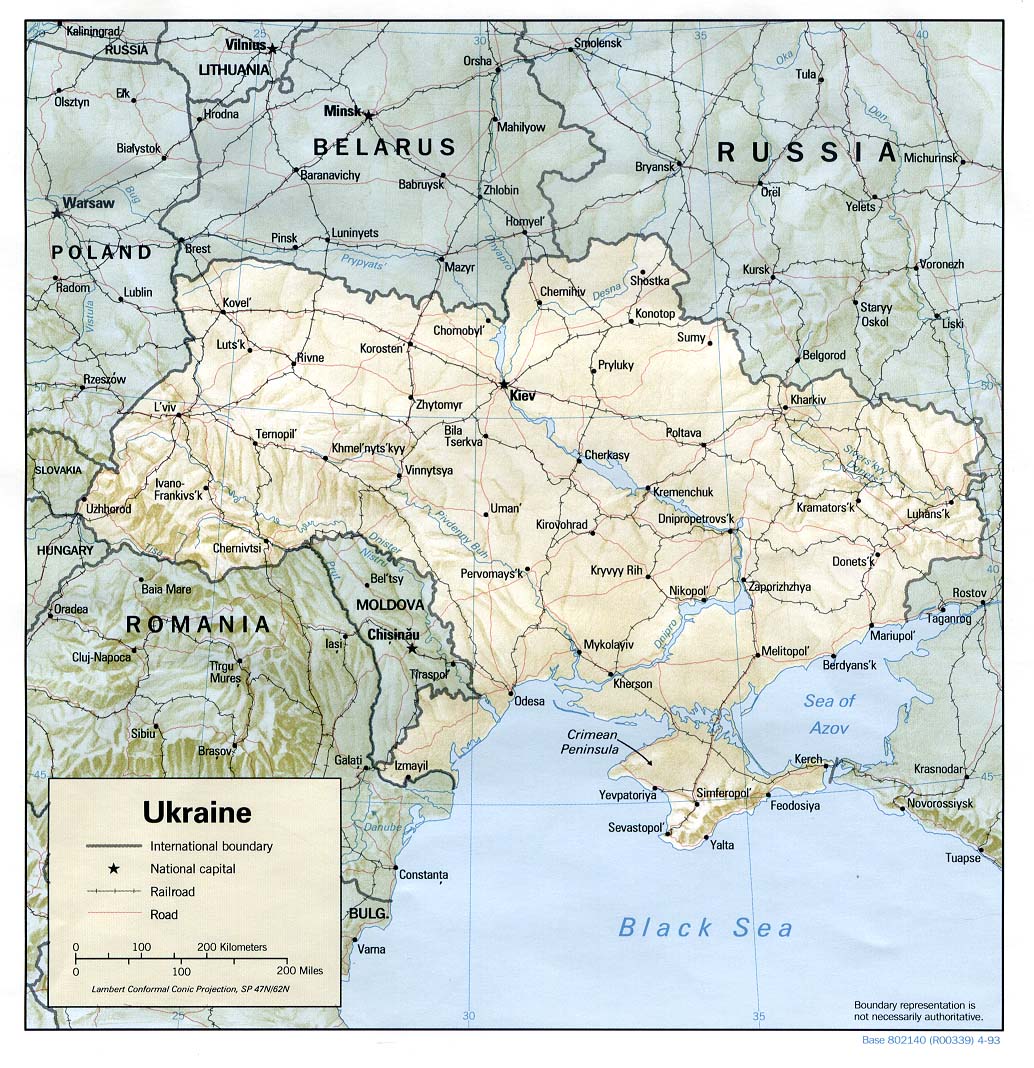
Recently in Ukraine, the West was obviously very in support of the protesters and the change they would bring. The EU is very interested in bringing Ukraine into its fold (despite the many changes Ukraine must make to get there), and Russia looked quite fearfully at the very real possibility of losing its Sevastopol warm water port (more on that in this earlier post).

It felt it had to act, European objections be damned. So act it did. It was the forces of international security at work, as always: Russia faced a nearly existential threat if it lost its Sevastopol lease.

For Russia, as with most countries, imperialism is not motivated mostly by greed, but by a desire to strengthen, consolidate, or defend its security position. It may seem ridiculous to younger generations that Europe might descend into a land war, but peace in Europe has been a strange break from 1600 years of truly endless carnage, bloodshed, and border-shifting. To pretend that nobody should be worried about such things as the warm water port--or, for my own case, the precedent set of allowing European countries to invade each other and annex territory--enough to go to war for it, is ultimately myopic.

While I will not claim that the Russians have any moral ground for their invasion, it is always worth considering everyone's perspective: for Russia, it is safety and defense, preparing itself to never again allow the invasions of the first and second World Wars to occur. But I want to emphasize that just because we understand the motivations of countries running around annexing each other, doesn't make it any morally less terrible nor less dangerous.

Monday, November 24, 2008

Winning The Second Cold War Before It Starts

Oh, the Russians. Becoming more and more terrifying, no? Moscow's domestic and international politics alike are worrying the West, and for good reason.

The Duma (Russian parliament) has backed a 6-year presidential term, almost certainly leading to a 12-year Medvedev presidency--and thus an even greater extension of Putin's power. Apparently, the bill means that Putin will be eligible to run for President again in 2012 or 2018, whenever Medvedev decides he's done... giving Putin yet another 6-12 years afterwards. He'll have ruled longer than any post-revolution leader of Russia.

And Russia's leadership is not ruling with a bunnies-and-kitties fist. Russia's habit of intimidating dissenting reporters (usually by sending the mob) has been ratcheted up by Moscow's declaration that it would close the murder trial of Politkovskaya to the public. The Kremlin is signaling that it would rather appear opaque and shadowy than let whatever terrible truth is afoot here get out. Justice for future murders is unlikely.

Internationally, he presidents of Poland and Georgia had to duck from fire at a South Ossetian checkpoint over the weekend, and the Russians are waving it off as a setup by the Poles. How the Poles might have put agents into South Ossetia to fire on their own president is unclear.

Russia's launching itself towards new superpowerdom, and quickly. It is sending a naval fleet to South America to deal with Brazil, Venezuela, and Cuba--almost certainly to boast that it can steamroll the Monroe doctrine at its pleasure, and to put pro-Russian sentiment into the back yard of the US. It's threatening to set up offensive ballistic missiles against its former satellite countries that won't cow to its will. It's trying to force Finnish paper industries to move to Russia with crippling timber tariffs. The invasion of Georgia was a clear signal to NATO to back off. Russia has threatened to cut off gas supplies to France and Germany if NATO accepts the Ukraine.

With Putin and Medvedev likely in power for approximately forever (in government terms, looking three or four administrations away is such--Could Gerald Ford plan for Bill Clinton's tenure?), they're likely to only turn the heat up as Russia's GNP and military continue to grow. Western governments likely want to (and if they don't, should want to) launch preventative measures to keep Russia from becoming big enough to actually do damage to Western interests. I have some simple (but not easy) suggestions on how to relegate Russia to being a tinpot regional power, able to terrorize only the people of the Central Asian Stans (which we Westerners don't care much about anyway):

1) Show NATO Has Guts.NATO was formed for one reason: to contain Russia. In the 1990s, Russia's internal collapse meant NATO found itself bored and poking around in the civil wars of small Balkan and African countries. In 2001, it came to bat for its largest benefactor, the US. NATO has grown aggressively throughout the 1990's and 2000's. It has shown strength, unity, and cooperation. It should make sure not to splinter, and see what it can to do supports members in most dire need of help: the Czech Republic, Poland, Turkey.

2) Subsume Georgia and the Ukraine.The Russians clearly meant to terrify NATO by smashing Georgia up so thoroughly--they hoped to make Georgia such a liability that NATO would reject it as an ally. But if NATO is going to contain Russia, it should invest in taking the blow now to keep a knife close to Russia's underbelly. But the Ukraine is even more important. The Ukraine is the Russian heartland, and provides Russia with massive supplies of grain. In addition, Sevastopol is Russia's only deep warm water port, which it rents from the Ukraine. Losing its lease would mean a deep retraction of the Russian navy, particularly in the winter. Seasonal power projection is barely better than no power projection, and Russia would lose great influence in the Eastern Mediterranean and elsewhere. If the Ukraine and Georgia enter NATO, Russia's last two European allies will be the paltry Serbia and Belarus--staunch, but ineffectual. Russia will be pushed out of Europe forever. If it goes on to develop Central Asia to give itself a sphere of influence, than all the better.

3) Come to bat for Germany and France. If Ukraine and Georgia are admitted to NATO, then Germany and France are likely to lose access to Russian oil and gas. But luckily, oil and gas are necessarily fungible, unless Russia chooses to hoard that gas and lose all the revenue, rather than sell it... but this is unlikely. Let's assume they sell it to the Chinese, instead. That means the Chinese demand less Middle Eastern hydrocarbon, and the price goes down. The Americans and British can buy up these cheaper Middle Eastern resources, and then re-sell them to the French. Now, will it all be as cheap as normal? Clearly not. But everyone can take some hit in prices to support French and German stands against Russian resource blackmail, and it will have to be temporary if the Russians don't want to lose lots of money over their own inefficiency (currently, they make the most possible money by selling to Europe). It will be temporarily costly to test Russian resolve, but the long-term savings in not having to deal with Russian weight-throwing are immense.

4) Accelerate the Mediterranean Solar Plan. Sarkozy's MedU plan to stick a bunch of thermal solar plants in North Africa to replace oil and gas dependency for power-generation has a few excellent effects for Europe in the long-term. The first is a reduction in carbon dioxide emissions, which will help them sleep at night. The second will be a less volatile source of electricity, which will keep shocks from busting up the economy. The third benefit will be relief from dependence on Russian gas and oil. Imports are fine, unless you're importing from someone who's willing to jump from a cliff just to take you down with him. Putin may be ready to do that. In the long-term, the more the Europeans reduce their dependence on Russian gas and oil, the more irrelevant the Russians will become. France's high-speed construction of nuclear power plants is a great example of these efforts--even if nuclear power is currently more expensive than the gas and oil. The French and German power grids are integrated, and if the Russians do turn the gas off, a combination of solar in North Africa, wind in Germany, and nuclear in France should soon be able to sop up enough of the slack to keep the economy from faltering as the Americans and Brits scramble to deliver the necessary hydrocarbons.

If the Russians lose Ukraine and Georgia, and also (in the long-term) lose their hydrocarbon monopoly in Europe, they will become irrelevant very quickly, unless they actually want to initiate a full-scale war with NATO. But the Russians are smarter than they used to be, and weren't foolish enough to launch such a war in the 20th century, when they owned half of Europe. If NATO claims the Ukraine and Georgia, its conquering of the Russian empire will be complete, and in the long-term, Russia will be relegated to its own icy home.

Saturday, September 13, 2008

More Russian Public Relations

Russia is perhaps starting to worry about the backlash of its actions in Georgia--whether the Russians thought them entirely justified or not, they are realising there is little they can do to convince the West of their point of view. Despite the resignation of the hard-line nationalists to trying to create a futile "Eurasian anti-American Alliance," which would include questionable states like Iran, the moderates seem to be taking a more reasonable point of view, and trying to clean up Russia's image. [nb: The "Eurasian Alliance" sounds silly, but there are a few signs: Russia is sending bombers and diplomats to Bolivia, Venezuela, and Cuba, possibly looking for an alliance, as Bolivia cozies with Iran, and both Bolivia and Venezuela expel US ambassadors. The new way to be cool in third-world Socialism is to "stand up" to the United States.]

Anyway, the Russians are at least trying to look like they're playing nice with the West. This might be to prevent an impassioned speech at NATO in December that might give the Ukraine its membership, or to prevent a staunchly anti-Russian John McCain from riding a wave of American anti-Russian sentiment. Either way:

Russian forces are starting to leave "Georgia proper" a few days before their agreed pull-out date, which is a sign by the Kremlin that they're willing to not drag their feet on their agreements.

In addition, Putin has openly predicted that US and Russian relations will improve, which is in part a self-fulfilling prophecy; if a country openly declares that it intends to have a good relationship with another, then it is easier to have such a relationship. It is Putin's way of saying, "don't worry, we're not planning for a Cold War here." Whether he's being honest or not is a whole other story, but it's at least a sign that the Kremlin is sensitive to Western pressure, and not immune to all forms of complaint. This may be a minor comfort to some, but it's better than the alternative.

Wednesday, August 13, 2008

The Georgia Game is Not Over

Western papers are bowing down to Putin's ruthless brilliance--he has shown the West that he is only to be pushed so far, that he will strike when he can, and that there is little the West can do about it short of declaring war.

The Americans are flailing a bit to show that they are not helpless, by sending aid via the US military in the Black Sea--surely they are not, in a military capability sense. But there is a willpower problem, and Russia knows it. The US public is not currently prepared to open a Caucasus front to defend Georgia, and Europe never has been. Like all thug powers before it, Russia will continue to do what it can get away with. Luckily for Russia, Putin is absolutley brilliant--much more so than a Hitler or a Khrushchev. Russia is reasserting its will over its periphery, and all that the Americans can do is condemn, all that the French can do is ask nicely, and all the rest of Europe can do is cower helplessly as the Russian bear stands up.

But this smack to the face of the West is not done--Russia has come back for the other cheek. The Russians have occupied Gori and stood by with tanks as South Ossetians looted and burned it into the ground--in defiance of a cease-fire agreement made with the EU and promised publicly by Medvedev. Why do this? Part of it is to punish Georgia, and to force their citizens to see that electing a president with too much hubris will bring them great pain. Part of it is to ensure the loyalty of the Ossetians for years to come. But mostly, it is a terrifying cackle to the West that Russia can do this if it wants to, simply because it wants to. It needs not follow cease-fires, it needs not listen to rebukes or threats, it needs listen to the West only as much as the West will listen to Russia--which, for the past 17 years, has been very little indeed. The West should indeed be shaking now, and unless Sarkozy can rally the EU out of its lethargic quagmire of indecision and white-flag politics, the Russians are going to throw temper tantrums every time they want their way--and they will get it. The US surely can't stand against the Russians with an unpopular Bush in power--McCain stands vehemently against any Russian interest, but he won't be able to do much without either ending the Middle East conflicts or inspiring the EU--the latter of which is highly unlikely, given current US popularity.

In the short-term, Russia may be turning next to the Ukraine. Losing the Ukraine to NATO would make an integral part of historical Russia an untouchable spectre, like a blade deep in its agricultural belly. Russia is making its moves to prevent NATO's final enclosure of Russia, and it couldn't come at a better time: The EU is fractured and disillusioned after the Irish "No" vote, the US executive branch has 3 full months before it can rally behind a desperately-needed new leader, and Western troops are all bogged down in the Middle East--angry words are the best the West can currently muster.

The only hope for checking Russia at this point is for NATO to put the Ukraine and Georgia on the fast-track to membership, and be prepared to deal with the consequences. The biggest problems are the Germans, who are less likely than the French executive to swallow a cut-off of Russian energy resources. But like thug powers before it, Russia will be emboldened by NATO's unwillingness to respond, and Putin will casually return from Beijing to a nervous, young Medvedev smiling, to say: "See? I told you they were worms."

Tuesday, August 12, 2008

The Devil Went Down to Georgia

You all have a pretty good idea what's going on at this point, so I will keep the summary brief:

Georgia has two provinces that have declared independence in the 1990's--South Ossetia and Abkhazia--and Russia jumped to recognize that independence (and probably wants to subsume them if they actually achieve physical indepdenence). A quick fight between Georgia and Russia left Russian "peacekeeping" troops in both breakaway regions, and a great deal of autonomy (Wikipedia considers them "de facto independent," much like Taiwan).

In the meantime, Bush's aggressive expansion of NATO hit a roadblock with the Ukraine and Georgia, because the Russians threatened to cut off French and German gas and oil supplies. Instead, the Ukraine and Georgia were offered promises of membership that were set to become action plans in December. Such an expansion would cut the Russians off from Europe for as long as the West pleased. December 2008 slowly began to creep upon a Russia whose behavior has been increasingly assertive and aggressive. Surely, plans were in the works.

Then things got complicated. Georgia's president Saakashvili has had strong but dwindling support since his 2004 victory with 96% of the vote--in 2008, he won 53% (the second place candidate won onlt 27%). He has had rather contradictory goals of improving relations with Russia, winning back control over South Ossetia and Sbkhazia, and entering NATO. He is one of President Bush's most loyal international allies.

Now: Five days ago. It should be noted that there are no independent foreign media in Georgia at all, so reports can only be taken on face. Five days ago, Georgian troops stormed into South Ossetia, claiming shelling by South Ossetian forces. This would be a claim of an unlikely and suicidal half-attempt at conflict, unless one presupposes that the Russians might have invited the South Ossetians to make such a move.

Afterwards, Georgian troops rolled in, hoping to use the incident (which may not have even happened) to reassert military control over South Ossetia. The region is connected to Russia primarily by a single tunnel, which the Georgians probably considered bombing, but they likely worried about provoking a formal Russian response.

Russian Cossacks, who are recognized as a pseudo-official security force in the Caucases by the Russian government (who often makes dubious agreements with shady characters like mobs and Chechneans to keep order in a vast Federation that it largely cannot centrally control), began flowing into Georgia through that tunnel on busses. They came (of course) from the region of North Ossetia, who shares ethnic and cultural ties with the South Ossetians, and somehow stuck with the Russian Federation during the confused and frantic early 1990's breaking-up of the USSR. The Russians did little to stop them, and we mostly thought that the Russian government was happy to let "volunteers" do its dirty work.

But, of course, Russian citizens started dying. This is due in part to the fact that the Russians have slowly been infiltrating both regions with Russian citizens and "peacekeepers" (no doubt to Russify the regions) that have been hit by shelling and bombing, and also that the poorly-armed Cossacks picked fights with Georgian tanks and airplanes. At this point, Abkhazia started fighting the Georgians as well, in hopes of helping the Ossetians deliver its army a rough defeat that would seal their de facto independence indefinitely. The Georgians struggled, but it looked as if they might even prevail, and reunite their country.

The Russians are probably looking at this problem much like the Americans would view an attack on Taiwan. While the US does not address Taiwan as an independent state, it would not quietly let the Chinese invade--just as the Russians' feathers were quite ruffled by Georgian action in Ossetia. The difference is thus: The Russian army is much, much larger than the Georgian army. And with American forces tied up in the Middle East, Western retaliatory action was unlikely. So the Russians struck, and hard.

Georgia has suffered a rout; it is barely worth speaking of orders of battle or troop numbers, the Georgians just weren't up to the fight. Russian troops have hung around the Caucaus for some time, waiting for an opportunity like this. Russian troops have not only completely occupied both breakaway regions (much to the delight of a majority of their residents), but also pushed into unambiguously Georgian territory, as far south as Gori. Bush made sharp criticisms of the Russians (though did not mention Putin), the UN called for an immediate end to fighting, and Sarkozy quickly flew to Moscow, hoping to use an increasingly legendary diplomatic charm to help Russia weigh its options.

But no threats of action have come out, except faint hints at booting Russia from the G-8 (which Mr. McCain was planning on doing anyway). Much talk abounds of the diplomatic and military weakness of the US because of Iraq, but the US would not have been able to do much besides declare war against the Russians anyway. Right now, Georgia is simply not worth it, and the Russians knew that.

Russia ordered a halt after conquering about half of the country, but is still quite willing to shoot Georgians that resist their occupation, and has made no plans to pull out. They are in negotiations with Sarkozy and the EU at the moment.

Now, this all is very interesting. Some questions arise:
1) Who started it, and why?
2) What will NATO's immediate response be?
3) What is the fate of the Georgian territories?
4) What does this mean for NATO expnasionism?
5) Will Russia's relationship with the West change in the long-term?

I will do what I can with these questions. Other questions about how this will affect US domestic politics and the November election arise, but the intuitive answer is that not much will happen--there is an unambiguously correct side for each candidate to take. I might make a later post about this anyway.

1) It remains unclear who started it, given that both sides have a fair amount of interest in starting it, given a few preconditions. The Georgians would have been happy to exploit or even fabricate Ossetian violence to reclaim the region, but only if they thought the Russians would not get involved. Is there any reason to think so? Putin's presence in Beijing might have made them think the Russians would have been impotent to respond, and they may have predicted a rapid victory. But besides that, nothing about Russian behavior shows obvious weakness or preoccupation. Why would the Georgians would not wait until they were NATO members--or at least had an expected membership date? Trying to assault Ossedia now, without a clear sign of Russian restraint, would seem foolish.

On the other hand, the Russians have a lot to lose from waiting. NATO's expansion is creeping too close for comfort. The last thing the Russians want is a second front from NATO in their south, or (perhaps more importantly) total NATO control of the Black Sea, which would be made possible by Ukranian and Georgian inclusion. If the Russians want to head off such inclusions, they have many options, and have already employed some; they may now be looking to scare the West into leaving their sphere alone--why now? Note that NATO is one of the most terrifying military alliances in the world because of a single clause in the Charter: Article 5, which states that an attack on one country would be considered an attack on all (this was used only once, in the Sept. 11th attacks on the US). But they may also be looking to lock in control over Ossedia and Abkhazia--Russia is currently a fledging-enough regional power that small influence gains are worth it. But it is rather clear from a brief topological survey that inclusion of these territories (or separation of them from Georgia) would give Russia much physical security--Russia's border with Georgia is a solid line of Caucasus mountians. The most likely explanation is that the Russians indeed encouraged a South Ossetian incident such that they might test Georgia's and NATO's resolve to fight. The result has been a great blow to Western influence in the South Caucasus region, and a new sign of US weakness in a "Cold War Lite."

I will note that the possibility remains that there was no subversive action--that a few Ossedians simply got upset at some small incident and started firing artillery, and the whole mess spiralled out of control. But it's unlikely.

2) When I first heard about this five days ago, I said "NATO should really have an emergency session over this," and indeed they have. The meeting didn't do much, but they took a stand that they really needed to: they called for a return to status quo ante (that is, Russian and Georgian troops both out of the region), condemned Russia but not Georgia, and affirmed support for Georgia's attempts to assert its recognized sovereignty over the region. NATO, far from abandoning Georgia for potentially foolish action, has stood by it (making this look perhaps like a World War I spiral scenario, which may be part of the reason the Russians were so quick to accept a cease-fire).

3) The fate of the Georgian territories is highly unclear. Even if the Russians pull back, the Georgian military has probably taken a beating, and is scared stiff. It will not be able to physically assert its authority over its breakaway provinces again. That said, if the Georgians do join NATO, the Russians will know that another stunt like this would risk a declaration of war, which they won't be able to afford if Bush manages to install anti-missile batteries in Eastern Europe. Ossetia and Abkhazia are just not worth that kind of risk. The fate of these regions depends largely on the next few weeks of diplomatic talk, and Russia's concern with trying to save its image. But its reputation is already tarnished and the West is already irritated--pulling back completely and leaving the mess alone would mean accepting diplomatic sunk costs to a foolish move that the Russians may feel they have bought too deeply into.

4) NATO expansionism is unlikely to alter its course, unless it is to speed up. The members of NATO said that their considerations of Georgia as a member have not changed. The Georgian ambassador to NATO chided them slightly by saying that this was a consequence of cowing to Russia's threats in April over a fast-track plan for membership, and Bush has suggested that NATO take a stronger stance on its acceptance of Georgia as a response to the Russian incursion, but it's likely that Georgia is likely to go through the same long and (now excruciating) process that most countries do, as is the Ukraine. Far from frightened by the Russians, NATO might be emboldened by this action into agreeing with more aggressive factions (like Bush and Sarkozy) into seeing Russia as a reemerging threat that needs to be aggressively contained.

5) The West has been using a "hedge" strategy with Russia for some time, Bush included. Warm words, joint military exercizes, and a crucial oil trade have kept relations on both sides friendly. The West has hoped to "socialize" Russia, much like they feel they have begun to "socailize" the Chinese (and, luckily for them, the Olympics are a good sign in this direction). But Russia has grown aggressive in the past few years, and Putin's iron grip over the country (which is quite happy to be so gripped) has not faltered--this trend is not going to reverse on its own. The West is likely to start to become worried enough about the Russians that a Hedge strategy will give way to full-blown containment. Unlike the Chinese, the Russians can be largely contained with trade restrictions and alliance expansion. But after such a quick turnaround from Soviet Union to Soviet Putin, the West may be scratching their heads in exasperation, wondering how they might teach the Russians to just get along.

On another interesting note, I cannot seem to find anything by the Chinese on the incident, who are probably quite grateful that they have the Olympics as an excuse to ignore completely an incident where they might otherwise be asked ot take sides between their greatest economic trading partner and their greatest military partner.

As a closing note: The situation is changing by the hour, some of this may already be out of date. But I will try to keep updated.

Thursday, February 14, 2008

Eastern Europe is Heating Up Again

Just when we thought that Europe was no longer a problem (perhaps we have been ignoring it due to the Middle East, Central Asia, Southeast Asia, Africa...), forces in Eastern Europe have started to turn it into a hot spot once more.

Perhaps some of these issues will fizzile, but for now, bitterness and tension are growing over events-about-to-happen, as well as a West vs. Russia proxy war over the loyalty of Eastern Europe States.


The first fight: Will the undecided factions of Eastern Europe end up pro-West or pro-Russia? Ukraine and Serbia are critical battlegrounds (where places like Poland, the Czech Republic, and Albania are clearly West-leaning, and Moldova and Belarus are Russian-leaning), where both sides are using propaganda and low-level political support (including criticism of opposition parties) to help coalitions loyal to them win. Yuschenko's victory in Ukraine two years ago scored a big win for the West, but his mandate has broken, and Ukraine is back up in the air. Pro-western forces barely won re-election in Albania. Why all the fighting over these states? The sense that a Cold War is returning is slowly and very reluctantly creeping back into foreign policy circles.

The second fight: Missile Shields. The US has made deals with Eastern states like Poland and Ukraine to provide (technologically questionable) anti-ballistic missile technology, and has been working for years to actually deliver--this shows a clear anti-Russian hostility (though the US State Department once insisted that it was to protect Europe from Iran) from both the US and these Eastern European states. The EU has been quiet on the subject, giving the US a silent mandate to continue. But the Russians are furious; enough so that Putin has threatened to target Eastern European states with its ballistic missiles if these states go ahead with US missile shield plans. I am not quite sure why the US is insisting on the shield, other than (now) to avoid looking like it will back down to Putin's demands.

The third fight: Kosovo. Elements of Serbia are strongly against the Kosovo secession, as is Russia, while the US and EU support it. The barely-majority government of Serbia has decided to let Kosovo go, despite its strong displeasure with the idea, and has told Serbia to brace for the fracture. The West will recognize Kosovo and give it the diplomatic legitimacy it needs to get on its feet, but all elements are hoping that this is the final fracture of the failed experiment of Yugoslavia.

As Russia grows, the West-Russia fight is likely to grow in magnitude, as well. The Russians are looking for, at the least, respect from the West. But until Russia is willing to play by the West's rules, the EU is unlikely to accept Russia into the fold, and high tensions will remain for a great deal of time to come.

The big losers out of all of this are, of course, the buffer states: former Soviet republics whose economies are only barely starting to recover from the Soviet planned economy can do little to stand up to Russia without Western support, and surely, many of them would rather work with all of their neighbors to improve their domestic economy, rather than engage in a faux Cold War, but they may be forced to choose a side. Should such coercion happen, they can only lose; siding with either coalition will hurt their economy if the losing coalition cuts them off, and leaning against Russia is likely to lead to very high security risk, unless the West is willing to fight for these nations (it's not). This is a classic bandwagoning problem, and we may see more of it in the future.