Showing posts with label Eastern Europe. Show all posts

Saturday, June 4, 2011

The Re-Emergent Russian Bloc

1) The Visegrad 4: Eastern Europe as a Major Player
2) The Re-Emergent Russian Bloc
3) Baltic Solidarity to an Emerging Russia
4) The EU Periphery: "Core" EU's Albatross
5) The Atlantics: A Return to Arms-Length Continental Management

Our series on the "Blocanization of Europe" continues with an exploration of the factors behind the rise of Russia over the past decade, and what implications it will have for the continent.

As we discussed in our last post, Russia faced imminent marginalization in 2004, as NATO planned to incorporate Georgia and Ukraine into its alliance. A Western-led push into Ukraine had formented the Orange Revolution and the election of a pro-Western Yuschenko. Georgia's strongly pro-Western government was knocking at the gates of NATO and the EU. The US had successfully coaxed Europe into accepting the Baltics, Romania, Bulgaria, and Albania into the EU in a fell swoop. Russia appeared to have an insurmountable united front poised against it.

This united front dissolved over the next 4 years. Some of it was due to Western distraction in the Middle East and complacency over Russia; some of it was the rift between the US and Europe over the Iraq war. But credit must be given to the Russian leadership, which successfully took advantage of every mistake the West made in order to shatter the united front:

-The carefully-timed invasion of Georgia highlighted Gerogia's vulnerability and the inability of NATO to come to its aide, and also turned popular support against the pro-Western elements that enraged Russia.
-Russia has engaged Iran and assisted its nuclear programme, enabling it to grow more assertive in the Middle East and largely upset Western plans for a hastier withdrawal from the region.
-Russia's intelligence forces engaged in a full-court press (both clandestine and propaganda operations) in Latvia and Ukraine, shaking Western support and mobilizing pro-Russian citizenry to become a more powerful political force.
-Russia threatened Germany and France with interruptions in oil & gas supplies, causing (in part) both countries to back off their bid for Ukraine and Georgia to enter NATO, thus kaibashing the entire attempt.

With NATO's plans successfully disrupted, Russia has been able to focus on two major geopolitical goals:
1) Solidifying its gas & oil supply dominance in Europe
2) Expanding its influence back towards the former Soviet states

Central Asia built strong ties with Russia during the Soviet Union, and they remain. The only major competitor for their support is China, which is a much more inward-looking nation.

Backlashes against the pro-NATO governments in Ukraine and Georgia have put these two states closer to the Russian bloc. Ukraine's ouster of the pro-Western government has eased ties with Russia and opened up stronger economic channels between the two countries. Russia's warm-water navy base near Sevastopol will remain in Russia's control. Moldova is currently a toss-up.

Russia has begun throwing its weight around as its power has grown. It has used Iran and Afghanistan to distract and frustrate the US, and shaken up confidence in the governments of Estonia and Latvia (while driving the Baltics closer together in defense--more on that later).

Furthermore, Russia is taking advantage of the EU's disharmony to build economic ties with key "Core" EU members--particularly Germany and France. Russia's vast natural resources and low-cost labor pool poses a great opportunity for the Core EU's largest (but slow) economies to start growing again and begin to bounce back from the weight of the falling EU Periphery.

What all of this means is that Russia is becoming a global player. Its base is sound (internal threats to the Putin regime are shaky at best), and it will continue to grow economically. It is rebuilding its military--in particular, its power-projection capabilities. It will grow to challenge the US on the global stage.

The thing that will make Russia different from the US--and the thing that will ultimately give the US a key advantage--is that Russia will spawn stronger and stronger alliances against it. The Visegrad 4 and the Baltic Bloc exist primarily to protect themselves from Russian domination. The US/UK will keep its power checked on the continent: their key interest is making sure no major power controls the resources and military of Europe. China will oppose Russia if it grows too strong.

The US, on the other hand, has scattered opposition at best. Iran, Venezuela, North Korea, and Libya form the bulk of Anti-US governments (and Russia is stuck supporting these unsavory regimes)--besides Iran, they are largely irrelevant (or are becoming less relevant quickly). If Russia can pull Ukraine into its bloc for good, it will become a relatively significant ally, but it is unlikely to grow beyond that.

But at the same time, Russia will prove a highly disruptive force in Europe, and will test the loyalty and priorities of the US/UK onthe global stage. To a great extent, Russia will be the primary driver behind the major geopolitical changes in Europe into the forseeable future.

Wednesday, May 25, 2011

The Visegrad 4: Eastern Europe as a Major Player

Our "Blocanization of Europe" series will include a number of posts, each outlining what the new bloc will look like, why the bloc is losing faith in the NATO/EU system (if it ever bought in at all), and why each country is choosing the group it's choosing. Our upcoming posts should look like this:

1) The Visegrad 4: Eastern Europe as a Major Player
2) The Re-Emergent Russian Bloc
3) Baltic Solidarity to an Emerging Russia
4) The EU Periphery: "Core" EU's Albatross
5) The Atlantics: A Return to Arms-Length Continental Management


Today, we'll be discussing the Visegrad 4, if for no other reason than we find them the most interesting and most potentially game-changing bloc of Europe.

The formation of a Visegrad 4 "Battle Group" was the original even that prompted our thinking about the blocanization of Europe; it is both a symptom of and (will be) an emerging cause of declining European solidarity.

Ultimately, NATO's inability to completely defeat the Russian Bloc (by failing to integrate Ukraine and Georgia into NATO) meant that European security could not be completely ignored; that, combined with NATO's attention locked in the Middle East (and thus not on Eastern European security: the United States has pledged only a single army brigrade to the defense of the Visegrad 4) have led to a serious security crisis for the V4. With a strong Russia and a weakened will by NATO to commit to Eastern Europe's defense, the Visegrad 4 had to take matters into its own hands.

The Visegrad 4 battle group certainly projects a strong regional commitment to a unified defense of the plains from Russia; perhaps more importantly, it will have a significant material impact on the region's ability to defend itself.

The Battle Group will allow each country to streamline its military to adopt regional command and control; sharing resources will allow each country to reduce redundancy and redirect freed resources to extra firepower or new specialization. Shared intelligence will lead to greater regional awareness, and thus better response times and effectiveness. Most importantly, the Battle Group means that the V4's entire military force could potentially focus on a single area quickly (both due to bureaucratic reductions and effective regional planning on troop mobilization and transportation), thus making it much harder to "pick off" individual countries in the region.

Historically, such "picking-off" has been a key strategy for both Germany and Russia in consolidating power in the region (Germany and the Soviet Union were both successful in such a strategy in the 20th century); the V4's Battle Group nearly guarantees such a strategy will not work, as long as the will to support it remains (which it should into the medium-term future).

Romania and Bulgaria similarly recall the harsh rule of the Soviet Union, and wish to avoid any similar arrangement. They joined the EU and NATO in order to guarantee security against any repeat incidents, but the relative aloofness of NATO and a breakdown of confidence in the EU as a supranational structure is likely to push these two countries towards the next-best alternative: the V4.

Neither Romania nor Bulgaria has yet shown commitment to join the V4; in particular, Hungary and Romania have had regional disputes over territory and mutual security. But, if Russia's regional assertiveness continues to grow, these two countries will need to seek shelter. There is potential, especially in Bulgaria, to fall into Turkey's sphere, but a European rejection of Turkey's bid for EU membership is likely to push it towards the Arab region (where it already seem sto be facing).

The Visegrad 4's strengthening has implications beyond its own interactions internally and with Russia. Eastern Europe is currently the EU's most dynamic economic region, with highest yearly GDP growth on the continent. While the region is still economically troubled, its structural advantages set it up to continue to grow over the next decade.

If the EU's financial strength continues to weaken, the V4 may become the economic stronghold of the continent--and its influence over the region will grow as many countries come to depend on its growing economic strength.

Practically-speaking, the US and UK will not abandon the V4 entirely: they see the V4 region (in particular) as a stronghold against an emerging Russia, and will support it when times become dire enough. But Middle Eastern distractions have turned the attention of the V4's major allies, and this group will wisely remember not to depend too heavily upon Western allied support against Russia--it has failed multiple times in the 20th century (during the German invasion of Poland, the Hungarian and Czech revolts against the Soviet Union), and the Visegrad 4 will not sit by to allow another such failure.

Expect, in the future, for the Visegrad 4 to grow increasingly strong and assertive as it finds its center of gravity. The region faces many risks to its long-term security, but it is likely to have the influence and weight, when the situation grows "dire," to man its own front lines and call upon the help it will need from the US and UK.

Tuesday, May 17, 2011

The Blocanization of Europe: An Introduction

I'll keep this one quick.

I've been doing some thinking about how Europe has been changing in the past decade, especially with the military rise of the Visegrad 4. It has been a dramatic change indeed.

A large portion of my next few posts will be focused on this series: The Blocanization of Europe. In short: the vision of a single unified Europe is beginning to show the signs of fray -- a "blocanization" of the continent is beginning, based on natural lines of national interest and security.

In particular, as we see NATO's commitment to European Security weaken, and the financial integrity of the European Union shaken, the ability to depend on the hope of a strong, unified Europe is diminishing.

We'll be focusing on the reasons for this, and the new blocs emerging--and what each means. As a teaser, I've attached a map of these blocs, built on my current understanding of the geopolitical makeup of the new Europe.

Sunday, June 13, 2010

The Nationalist Spike in Europe

This is more an observation than a strict analysis, but very interesting, nonetheless.

Nationalism seemed to die in much of Eastern Europe towards the end of the 20th century as Europe reeled from centuries of war. It seemed unlikely to many that it would return soon. But, of course, geopolitics marches on. Nationalism is back in Europe, and back in a big way. A few examples of interest:

Germany: The Germans have pushed for a leadership role in Europe with the onset of the Greek crisis. Rather than an isolationist nationalism, Germany seeks to exert its will over Southern Europe, lest the debt crisis bleed it dry. The Germans are likely to come out of the debt crisis with a considerable amount of power in Europe--which is the only way they can make the EU work for them. Otherwise, they will consider leaving--the EU will only be a deal the Germans will tolerate so long as it is not one that tears them down.

Hungary, Czech Republic, Slovakia, Bulgaria, Austria: Right-wing (sometimes seriously so) nationalist parties have made huge gains over the past two years. Much of this is in response to the Russian resurgence (where the options are to fight or join). But this resurgence makes for a potentially rivalrous situation in Eastern Europe. Territorial squabbles may arise and prevent Eastern European unity against Russia.

Denmark, Switzerland, France, and Holland: Right-wing and largely anti-Islamic parties have made great gains in Denmark and Holland in their last elections, signaling a reaction against growing Muslim influence in much of Europe due to massive immigration. France has banned burqas, and Switzerland has banned minarets. Anti-Islamism has become a relative European hallmark. Europe is set for a strong showdown with the Islamic world, but one very different from that of the US.

Belgium: Perhaps the most interesting of the nationalist movements, the Flemish movement has made big gains in Belgium, capturing 20% of seats (far more than any other party). Unlike previous separatist movements, this independence party is largely mainstream (rather than right-wing), and hopes to see a gradual dissolution of Belgium into Flanders (a Dutch region) and Wallonia (a French region). Belgium is probably closer to its end than ever before.

The return of Nationalism to Europe will make it a geopolitically interesting continent once again (after two decades of relative calmness, saving the Balkans).

Wednesday, January 20, 2010

Last Decade Series: NATO Wins Eastern Europe

The biggest spurt of growth that NATO experienced since its very founding in 1949 occurred during 2004, after years of intense dialogue.

This growth, while not exclusively the doing of the United States during the 90's and 00's, is one of the greatest geopolitical victories that the United States has seen in the past few decades (even if the benefits have not yet been realised).

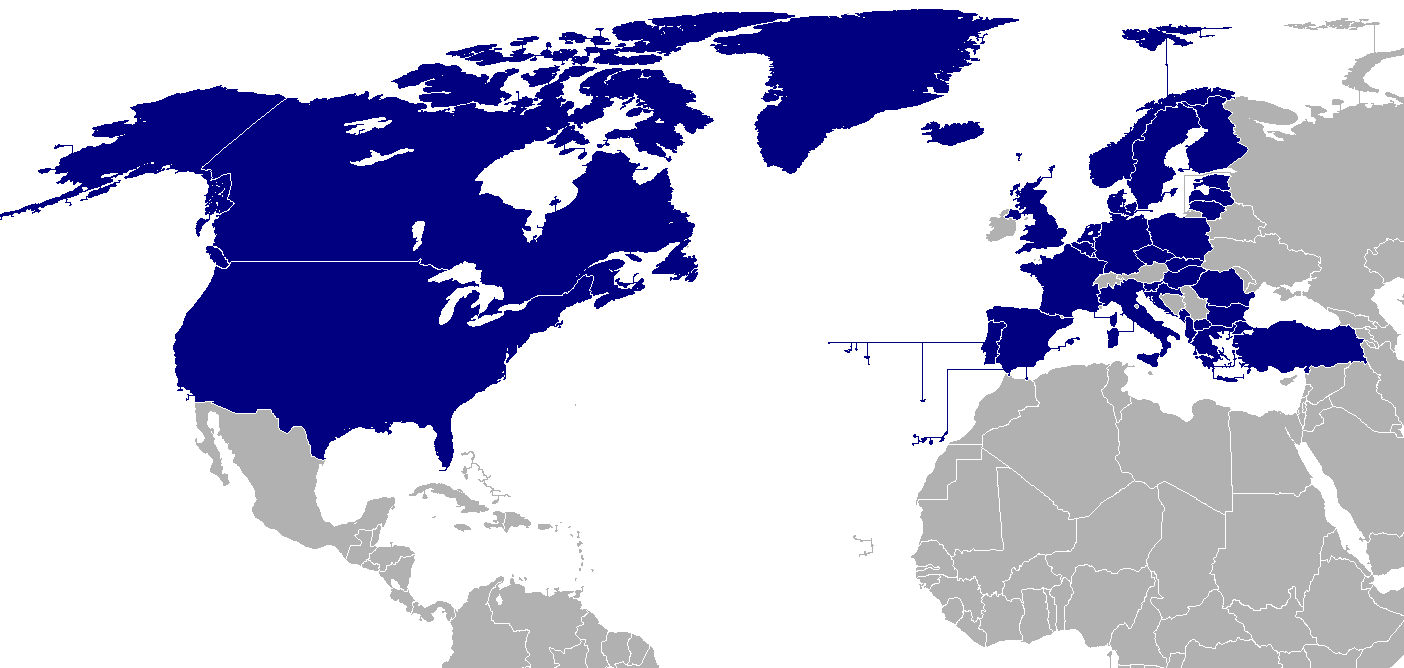
In 2004, NATO absorbed all three Baltic states (Estonia, Latvia, and Lithuania), as well as Slovakia, Romania, Bulgaria, and Slovenia. As you can see in the image to the right, NATO thrust itself towards Russia, essentially leaning right up to St. Petersburg (imagine if the Warsaw Pact had a stronghold a hundred miles from Philadelphia or Chicago).

This expansion essentially means a new, strengthening front line in what is an increasingly important and difficult effort to keep the Russians locked up. In time, these countries will likely become allies as strong as Poland or the Czech Republic, allowing the United States to think about its strategic borders on Moldova and Belarus, rather than further back. NATO also gives these countries opportunities to experience economic growth with the European and American nations with whom they have grown cozy, eliminating trade barriers and creating new markets and providers.

These strategic partners will grow as the United States' relationship with Western Europe grows cooler over time. As Western Europe more and more sees little need to be taken care of by the United States, it will continually assert itself (especially through the EU) towards a greater independence by pushing back against the US and emphasizing differences of opinion. With Eastern Europe set up as key allies in NATO, the United States' strategic focus will drift eastwards, focusing on Warsaw instead of Paris (the UK is likely to grow closer to the US as well, as it moves to assert its independence with respect to the European continent).

But these Eastern European countries, including Croatia and Albania (which joined in 2009) will be willing and enthusiastic front-line soldiers against Russia as it tries to assert itself on the European continent and undermine US machinations there. They will enable the US to hold its strategic position in Europe via its favorite and most effective strategy--to find smaller allies and spend money on their economy and military.

While folding Ukraine and Georgia into NATO would have been a nearly-fatal blow to Russian regional ambitions, the incorporation of most of Eastern Europe into NATO before Russia was strong enough to oppose it will prove to pay off major dividends into the 2020s, as Russia's military might and aggression are likely to peak. Poland and the region around it will become the key allies of the United States well into the 21st century.

Tuesday, March 3, 2009

Obama's Very Quiet Olive Branch to Moscow

Obama recently sent a letter to Moscow. Presidents do this quite often. As far as I know, we even have a red phone to Moscow in the Oval Office today.

But this letter is a special one. And it was supposed to be a very quiet one. Somehow, through journalistic voodoo and heka magic, the New York Times happened across the contents. It looks, for the moment, that Mr. Obama was quietly implying that the US would halt and undo its missile defense placements in Europe in exchange for Russia making sure that Iran would not be able to build ballistic missiles.

The implications are interesting. First, about the leak--it is unclear whether the letter was supposed to be leaked or not. Intentional leaks are common, in order to let the state throw its hands up and say, "we didn't mean to publicize this," and so further questions are not pressured. This may be an intentional leak--it may be an attempt to show Eastern Europe, Russia, et al, that the missile shield is not intended as an anti-Russian initiative (even though it is). This potentially gives Obama some political traction for continuing the project, should it seem necessary.

But it also makes the shield a bargaining chip with Russia. Obama says, "we know you don't like it, but hey, it's for Iran, so if you can just make that problem go away, we won't need it anymore, and we'll stop spending money on it." It means that, if the Russians choose to (and indeed, are able to) deal with the Iranians, then Obama is willing to reprioritize on defense. The likelihood that the Russians are actually going to engage in ballistic missile brinksmanship bargaining is low... but it is not so low for the Iranians. Furthermore, the EU is actually collectively strong enough to stand up to the Russians if they are willing to get their hands dirty, where Israel is less able to do so (even if much more willing).

So Obama knows that today, one needs to sidle up to the Russians, and pressure the Iranians. Obviously, this is tough to do. Medvedev, when questioned about the leak, mostly shrugged at the situation and said that "nothing concrete" was in the letter. He knows that he is in a relatively good relative bargaining position, and is not ready to yet show his hand.

But ultimately, the missile shield in Eastern Europe is something that the Russians are willing to do a lot to get rid of. In a somewhat ironic way, Mr. Obama can thank Mr. Bush for leaving the incomplete missile shield behind so that he, in the nicest way possible, can use it as a lever to pry Moscow.

Sunday, August 31, 2008

Back for More Cold War

The Russians announced today that they had "Spheres of Priveleged Interest" on their peripheries, including (of course) the "independent" nations of South Ossetia and Abkhazia.

This whole mess has got Eastern Europe scared stiff, and is raising tensions in the highly ethnically Russian Ukraine, which is poised to be accepted into NATO this fall. The Baltics, Czechs, Slovaks, Poles, and many Slavs have no interest in returning to the "sphere of influence" that Russia held over them between 1945 and 1989.

In addition, the Georgia offensive is looking more and more like the Prague operation of 1964, just without the offense on the capital. Russia's reassertion of its "sphere of influence" using tanks and civilian terror is a strategy that worked when Russia was strong in 1964, but really: at this point, Europe needs to stand up to them, lest the Russians learn from all of this that they can get away with doing whatever they want.

Wednesday, June 18, 2008

The Irish Vote, European Hedging, and Continued American Hegemony

The Irish "No" vote on the Lisbon Treaty has led to serious resignation among the power leadership of Europe--in particular, the French, who are slated to take over the presidency next, show little excitement or hurry for trying to recussitate the treaty, or any other pseudo-constitution.

At it happens, many countries have had very large "no" minorities in their approval votes, and the odds that one of these would not turn into a small majority (the "no" vote in Ireland was 54%) was pretty low. Many countries, particularly smaller ones, do not want to give up such a large chunk of their sovereignty--they like the free trade pact, but not being bossed around by France, Germany, and the UK. Europe must find a new path.

But the behavior of the power players in Europe shows that they have been aware of the possibility of this result for some time, and have been hedging their bets. A pseudo-state EU would create an entity as economically strong as the Untied States, though probably not yet as militarily or politically so. Either way, Europe would be able to stand up to America's ability to unilaterally act. But even as hopes for the EU peaked, Germany, France, and the UK drifted towards the United States. Merkel, Sarkozy, and Brown have all maintained and emphasized friendly ties with the US despite disagreements over the War on Terror and War in Iraq. Such behavior shows that they have been making clear attempts to avoid alienating the United States--a mere irritation if the EU became a single foreign policy bloc with the power to pressure the US, but a disaster if it failed. Given that failure, pro-US hedging on the part of these great powers has paid off.

But that hedging leaves momentum, and a direction. The collapse of the Lisbon Treaty might otherwise leave the foreign policies of many European countries adrift, and their geopolitical positions unsure. But now these countries are turning back to the institutions left behind after the cold war--US bases in Germany, the UK-US "Special Relationship," and NATO--all provide a US-led network to fall back on in a potential crisis of decision. The French are triumphantly returning to full NATO membership, the first time since 1967, and upgrading their military; further, Sarkozy has essentially mirrored Bush's foreign policy since Sarkozy entered office. The British are hanging tough in Iraq despite domestic pressure to withdraw, and Bush and Brown are making clear that they have no disagreements over future Iraq policy. Merkel and Bush have collaborated in drafting UN resolutions against Iran on its nuclear program, and Merkel has made moves to improve ties with Israel, perhaps the US' closest ally.

Without a strong EU, the looming spectre of Russia will further push Europe towards America's umbrella. The Russians are starting to exhibit a disturbing pattern of natural gas extortion, threatening its dependents (one at a time) to cut off supplies should they swing too far out of the Russian line. The Germand and French both admitted that they vetoed Ukraine's entrance into NATO, fearing such an occurence, and would accept Ukraine later when they had established greater energy independence. Eastern European states, save the Ukraine and Belarus, continue to cling to the NATO alliance as a protection from Russia, and more small Russian neighbors, like Georgia, hope to join.

This reliance on the United States for foreign policy leadership is largely unchanged since the early 1990's. The EU looked like it was going to be the force that brought Europe out of the US umbrella once and for all, but EU hopes for a strong foreign policy seem to have been dashed. Without another grand idea or direction, and a Russia that is not only growing quickly economically and militarily, but also asserting itself with increasing aggression, European heavy hitters are likely to stay in line behind the United States for a long time to come.

China's rise and East Asia's willingness to accomodate it is likely to mean an eventual end to US dominance of East and Central Asia. India remains friendly to the US, but fiercely independent. The Middle East mostly continues to tolerate the US, but is looking forward to its exit from the region. Africa is almost certain to never become a sphere of US influence, given the West's constant neglect, and China's neocolonial opportunism. South America remains closer to the US than any other region, but most states in South America have a rather poor opinion of the US, save Columbia; further, Brazil's potential economic explosion with oil finds off its coast may give most Latin American countries a new direction to look. Mexico and Canada will certainly always respect the US' hegemony over North America, but there is little that can be done with that power, and even less that the US cares about.

Ultimately, and perhaps surprisingly, Europe may become the last bastion of US hegemony. Should it ever unionize, build its military, and assert itself in foreign policy, the US would be reduced to an oversized regional power in the next century.

Sunday, April 6, 2008

Bush, Putin, and the Face of Eastern Europe to Come

Bush and Putin recently finished a press conference in Sochi (by the Black Sea), which followed a meeting between the two leaders to discuss missile defense and NATO expansion. The meeting and press conference showed an adversarial, yet highly respectful, position between both presidents that will keep growing US-Russian competition both tame and stable.

During the press conference, the two presidents spent most of their talking time complimenting each other (Putin said of "George": "I always appreciated his superior human qualities: honesty, openness and ability to hear a partner."), and looking fondly upon their seven years as statesmen and their management of difficult US-Russian relations.

Why the warm bonds? The US and Russia have much to quarrel over; Russia's human rights problems and natural gas brinksmanship worry US allies in Europe, and US plans for missile defense and ever-increasing NATO expansion threaten to successfully contain Russia into a future of dilapidated regionalism. But as he confessed in his "Person of the Year" interview with Time, Putin has a great deal of respect for Bush's dedication to his own country's strategic interests, willingness to "do what it takes," and tough-yet-respectful negotiating strategy. I suspect the two have become friends in the last seven years.

The next US president and Medvedev may not get along quite so well, unfortunately. Assuming Clinton is beaten by Obama, the Democrat candidate's "soft" foreign policy stances are likely to garner little respect from Putin's protege, and McCain's stance of removing Russia from the G-8 is not only an aggressive anti-Russian stance, but it denies Russia the respect that Bush has continued to give it, despite competition.

Pretty talk aside, Bush and Putin's meeting did little to reconcile the differences the US and Russia face on missile defense for Eastern Europe (the Czech Republic and Poland are already on board with US plans for installations in the next few years), and installations are likely to move forward.

Nonetheless, Putin scored a victory in NATO's most recent meeting in Bucharest, in which France and Germany vetoed invitations to NATO to the former Soviet republics of the Ukraine and Georgia. French and German representatives stressed they did not oppose in principle the admission of these two states, but instead urged that Russian backlash (in particular in the form of natural gas cutoffs) would make the move not worth their while yet. France and Germany may well be looking to increase their energy independence before allowing these two states in.

Unfortunately, both of them are only barely pro-Western, and only for the moment. They both have very large pro-Russian minorities that have protested vehemently becoming Western pawns against Russia. In Ukraine, the colors red and orange continue to stand divided across the Dnipro river, and are unlikely to come to terms soon; Ukraine will remain a battlefield for Western and Russian influence.

NATO did make progress at its Bucharest meeting, extending invitations to Albania, Croatia, and Macedonia (though Greece managed to put a rather silly condition of semantics into the invitation) for membership; they are all quite likely to accept. With the addition of these three nations, NATO's membership will reach a whopping 29 states, 12 of which were added after the fall of the Soviet Union.

While Russia scored a victory in keeping the Ukraine and Georgia from siding with the West, NATO's membership continues to grow, and its attempts to drive a wedge between NATO member states has failed. NATO continues to symbolize the most powerful and effective military coalition ever created, and member states have continued to respect each other's wishes and reach consensus for decisive action when needed, despite massive size. If a strong and powerful NATO is Russia's primary worry, then worry it should. NATO's drive into the once-volatile Balkans, re-integration of France, and near-victory on inviting Ukraine (Russia's most critical buffer-state) all mean that the organization's power and ambition are only growing.

Sunday, February 17, 2008

New Country Alert

Yes, Kosovo: you probably already know about it. If you don't, shame on you.

Kosovo is shamelessly pro-western, and is still grateful to NATO for its intervention in stopping Serbian ethnic cleansing of the area in the 1990's. The Serbs still hold the territory dear, and are not yet willing to recognize that it's gone. Russia is willing to back up the Serbian claim, and has been blasting the EU and US for supporting Kosovoan independence. Kosovo seems doomed to be part of the Russia v. West struggle that is arising in Eastern Europe (though I'm not sure for entirely what reason).

Kosovo is likely to turn to NATO and the EU for support; I predict they will be petitioning for membership as soon as possible. NATO seems to be looking to mop up as much of Eastern Europe as possible, giving speedy membership action plans to many Eastern European states. Seven states (Estonia, Latvia, Lithuania, Slovakia, Romania, Bulgaria, and Slovenia) joined NATO in 2004, 3 more should be joining this April (Albania, Croatia, and Macedonia), and Georgia, Ukraine, and Montenegro are on track to be inducted in a few years. Kosovo is likely to go the way of Albania in its own time, but ethnic Albanian love for the EU, the US, and the West as a whole is likely to keep NATO enthusiastic about their rapid inclusion.


Serbia's reluctance to let Kosovo go may make the region unstable (and if not, it will certainly remain hostile), but NATO peacekeeping troops and EU advisers should keep the Serbians from doing anything too rash. Inclusion into NATO means (in article V) that an attack on Kosovo would constitute an attack on every member nation of NATO; such inclusion is then likely to keep Kosovo safe from any Serbian attacks, but unfortunately, it may mean that, far in the future, Serbia remains the only Balkan state not in the alliance.

For now, good luck to the Kosovoans. I hope their adventures in self-government turn out well.

Thursday, February 14, 2008

Eastern Europe is Heating Up Again

Just when we thought that Europe was no longer a problem (perhaps we have been ignoring it due to the Middle East, Central Asia, Southeast Asia, Africa...), forces in Eastern Europe have started to turn it into a hot spot once more.

Perhaps some of these issues will fizzile, but for now, bitterness and tension are growing over events-about-to-happen, as well as a West vs. Russia proxy war over the loyalty of Eastern Europe States.


The first fight: Will the undecided factions of Eastern Europe end up pro-West or pro-Russia? Ukraine and Serbia are critical battlegrounds (where places like Poland, the Czech Republic, and Albania are clearly West-leaning, and Moldova and Belarus are Russian-leaning), where both sides are using propaganda and low-level political support (including criticism of opposition parties) to help coalitions loyal to them win. Yuschenko's victory in Ukraine two years ago scored a big win for the West, but his mandate has broken, and Ukraine is back up in the air. Pro-western forces barely won re-election in Albania. Why all the fighting over these states? The sense that a Cold War is returning is slowly and very reluctantly creeping back into foreign policy circles.

The second fight: Missile Shields. The US has made deals with Eastern states like Poland and Ukraine to provide (technologically questionable) anti-ballistic missile technology, and has been working for years to actually deliver--this shows a clear anti-Russian hostility (though the US State Department once insisted that it was to protect Europe from Iran) from both the US and these Eastern European states. The EU has been quiet on the subject, giving the US a silent mandate to continue. But the Russians are furious; enough so that Putin has threatened to target Eastern European states with its ballistic missiles if these states go ahead with US missile shield plans. I am not quite sure why the US is insisting on the shield, other than (now) to avoid looking like it will back down to Putin's demands.

The third fight: Kosovo. Elements of Serbia are strongly against the Kosovo secession, as is Russia, while the US and EU support it. The barely-majority government of Serbia has decided to let Kosovo go, despite its strong displeasure with the idea, and has told Serbia to brace for the fracture. The West will recognize Kosovo and give it the diplomatic legitimacy it needs to get on its feet, but all elements are hoping that this is the final fracture of the failed experiment of Yugoslavia.

As Russia grows, the West-Russia fight is likely to grow in magnitude, as well. The Russians are looking for, at the least, respect from the West. But until Russia is willing to play by the West's rules, the EU is unlikely to accept Russia into the fold, and high tensions will remain for a great deal of time to come.

The big losers out of all of this are, of course, the buffer states: former Soviet republics whose economies are only barely starting to recover from the Soviet planned economy can do little to stand up to Russia without Western support, and surely, many of them would rather work with all of their neighbors to improve their domestic economy, rather than engage in a faux Cold War, but they may be forced to choose a side. Should such coercion happen, they can only lose; siding with either coalition will hurt their economy if the losing coalition cuts them off, and leaning against Russia is likely to lead to very high security risk, unless the West is willing to fight for these nations (it's not). This is a classic bandwagoning problem, and we may see more of it in the future.