Showing posts with label Petraeus. Show all posts

Monday, November 8, 2010

A Petraeus-Style Plan Emerges in Afghanistan

It's being called "Inteqal," which is both Pashtu and Dari for "Transition." It's the NATO / Kabul plan (masterminded by General Petraeus) for a phased transition of military control, by province, to the Afghan military and police force.

The fact that there's a plan doesn't necessarily mean that it will work. Even if it's a good plan, it needs excellent execution to achieve "victory" (where "victory" is a very difficult and vague definition, anyway). But, holy smokes, it's a plan, which is something the Afghan War has seriously lacked for the last 8 years.

The concept very closely maps the Iraqi transition plan (my blog posts in 2008 focused largely on tracking the progress of this transition plan). Similar to Iraq, Afghanistan's map will now be colored red, orange, yellow, light green, dark green (indicating, respectfully: Not Ready for Transition, Partially Ready for Transition, Ready for Transition, Transitioning Within Six Months, and Transition Complete). The idea is that NATO develops capability internally in the "easier" provinces, transitions them, and consolidates its forces to progressively more "difficult" provinces.

This kind of plan has two advantages: first, it gives the Afghan Army and Police (as well as civil administrative) forces "practice" in these early-transition provinces, such that the kinks can be worked out in a lower-risk environment. Second, it gives NATO forces an opportunity to progressively consolidate, which allows them to maintain security forces in more hotly contested provinces, even as the troop draw-down begins. the plan has some merit.

Unfortunately for the sake of my curiosity, Petraeus is not keen on publishing the transition plan right now, lest it arm the Taliban with a document around which to develop a detailed strategy. But we can know a few of the provinces coming soon (like Herat), as well as some of those definitely not being transitioned for a while (like Helmand and Khandahar).

Small outposts and bases have already been transitioned--in part as a trial for the strategy, and in part due to the need to show progress.

The plan is good--though progress may need to be measured with some skepticism. The fact that a province is "transitioned" does not necessarily mean it's secure. With a pullout schedule looming over US forces, Petraeus will be under the gun to move quickly with the transition. The risk, of course, is that the "early" provinces are transitioned quickly in order to maximize security presence in Khandahar, Helmand, and Zabol.

Furthermore, NATO has to define the end-game. The Taliban are not going to disappear before NATO leaves. There is much talk of negotiations, but it's not clear whether those are actually happening.

In the end, this plan needs to be able to pose the following threat: "The Taliban cannot reach a sweeping victory after NATO leaves. A continued civil war will be a bloody stalemate." If such a threat is credible, negotiations can begin in earnest. Therefore, while Petraeus cannot divulge the details of the transition plan, results and progress will need to be publicized impressively, to put the Taliban in a position where it makes sense to seriously consider collaboration.

Monday, October 25, 2010

The Pessimistic View of the War in Afghanistan

General Petraeus is painting a relatively rosy picture of the path forward in Afghanistan. US intelligence agencies are saying somewhat else. It can be summed up thus (By Strafor):

"As U.S. Col. Harry Summers so clearly articulated, negotiation is achieved militarily when military power is applied in such a way as to impose upon the enemy a choice: negotiate on American terms and on American timetables, or be destroyed. Negotiation with the Taliban must be understood first and foremost as lacking that latter possibility."

If the Taliban do not actually see their position weakening over time, effective negotiations will not occur--they may be willing to humor negotiations at the last minute as NATO leaves, in order to avoid a civil war, but the NATO bargaining position at that point will be nearly zero.

The question that's not yet clear to me is this: how strategically effective is the US "Surge" in Afghanistan? How effective are the attacks on senior leadership and the counter-insurgency movements on the ground? I just don't know.

Friday, July 2, 2010

Afghan War Intensity Up--A Sign of Hope?

100 ISAF servicemen died in June--the most since the Afghanistan war began. it's a terrible number and a tragedy, absolutely.

But: there is a sign of hope in the increased intensity of the Afghan war.

The Taliban is increasingly on the offensive--bold (and sometimes reckless) attacks against American and Afghani targets are well on the upswing.

What's this mean? Why the change? The easy answer is to say, "they're getting stronger, and want to deal a finishing blow." This is, certainly, what the attacks are meant to imply.

But the story is more complicated.

The question to ask is: what is the Taliban's winning strategy?

The answer, by the way, is to wait out the US. The US will leave eventually. It will not stay there forever. If the Taliban can slowly swell its safe base of operations, it will win, as the US will eventually grow tired and fade away.

Three series of events are happening in parallel:
1) The US is stepping up drone/special operations in Taliban strongholds in Southern Afghanistan (like Helmand).
2) Pakistan is stepping up full-scale military assaults in Taliban strongholds in northern Pakistan (like Swat and Northern Waziristan).
3) The Taliban is stepping up bold offensives against the Pakistani Government, the Afghani Government, and ISAF.

I think you might be able to see where I am going.

Why the boldness, if the Taliban wants to wait for the US to leave?

The obvious guess is that the wait-it-out strategy is not currently viable.

ISAF and Pakistan are working together on an offensive. As we saw in Iraq, offensives cost lives. They hurt, the numbers look bad, and the American public grows quickly impatient.

But, potentially, they work. Certainly, a lack of offensives will fail. Preventing at all turns a stronghold for the enemy is a necessary (though not sufficient) part of COIN. It seems like this costly measure is starting to pay off: bold Taliban attacks on ISAF sites imply that there may be a desperation on the part of the Taliban to pressure NATO out of Afghanistan quickly. If that's the case, then the Taliban thinks that waiting is no longer in its favor.

The alternative hypothesis is that the Taliban is so strong that it's trying to deliver the "final blow." First, this doesn't make particular sense, strategically--the Taliban is traditionally quite terrible against ISAF in straight-up gun battles, as the past month has shown. If the waiting-game is a winning strategy, then there's no reason the Taliban would grow impatient and start putting its fighters at higher risk. It's been fighting a 25-year war for Independence. Its time horizon is much longer than a few months.

Second, the US is already scheduled to start pulling out of Afghanistan--there is no particular need or reason to try to "hurry" them. This is the perfect situation to, if possible, keep the "wait-it-out" strategy going.

If the Taliban is on the offensive, it's because it can't be on the defensive. Its strongholds and safe areas are being threatened and broken up. For sure, we know its lines of communication are being disrupted--making its attacks decreasingly coordinated and effective.

There is hope. There is a whole lot more to do than disrupting the Taliban's footing in the AfPak region to ensure victory in Afghanistan. But it is necessarily the first and most important step in winning the war (creating a stable, functional, credible central government to take its place is another story altogether).

Keep your eyes up in the next few months for Petraeus to continue to apply his modified strategy from Iraq--potentially successfully.

Tuesday, March 31, 2009

A Brief Iraq Update

Iraq has been quiet enough lately that the media, government, and public have all turned fully towards Afghanistan; as a country, we're now engrossed in it. And frankly, that's correct. It's trouble--Iraq is not. This quick update is to keep you informed, and help your experience with the Iraq War feel a little bit more tied up.

First, deaths continue to fall. US deaths hit a new record low of 8 in March; Iraqi violent deaths stand at 252, up from February, but still lower than any month before 2009, and represents well less than 0.01% of all Iraqis. This violent death rate is now lower than the United States, which sees about 4,200 violent deaths per month, or 0.014% of all Americans (sourced again here). And it looks like it will continue to drop. This lack of violence will give the Iraq government ample opportunity over the next 18 months to strengthen its police force, its political institutions, etc, as they prepare for the exit of the US.

Some problems persist, though they are largely civil (for the moment). Power production continues to lag demand significantly; frankly, I have no idea what the excuse for this is. Even Baghdad only has power 17 hours per day, which is enough to have a pretty full business day, but it makes it hard to run severs, keep refrigerators, have security systems, and all sorts of other pretty important stuff that a business (and thus an economy) needs. Beyond this, Iraq is facing a quiet, but significant, measles outbreak, which is likely to test its public health system.

Otherwise, things are going well. Anbar remains quiet, despite recent government crackdowns on Sunni militia leadership that has the potential to shake the delicate alliance between the Sunni Reawakening Councils and the state. So far, the Sunnis are exclusively using political channels to express their grievances--if these channels prove effective, then they will create an excellent precedent for participation.

Iraq's Kurdish regional authority is being more cooperative, though its rebels are not. Kurdish leader Talabani is backing Baghdad's call for PKK to disarm and become peaceful or face the consequences. But the PKK has shrugged the calls off. Such a scoffing may lead to a confrontation in the north between the PKK/PKK sympathizers, and the state.

But al Qaeda seems to be making its last stand in Mosul; and it's not going particularly well for them. Despite a truck bombing earlier today, violence in Mosul is slowly receding. News reports on activity in the region are minimal.


In light of all this, the US is moving out. Only five of Iraq's 18 provinces have yet to be handed over to full Iraqi security control (putting the US back in bases where it awaits a call by the Iraqi Army for help). By June, Baghdad is planned to be handed over as the last province. Compare this to the mess of 3 years ago:


I think this is rather self-explanatory.

In full, I think even the most hardcore doubters of the efficacy of the Surge/ latter US operations in Iraq are being quieted. There will probably be a few more sporadic updates on the topic by me, but it's mostly time for us all to move on to our other regional problem.

Sunday, February 22, 2009

Negotiations with Taliban Show Mixed Results

Pakistan and Afghanistan have serious, and worsening, Taliban problems. And I'll admit openly that I believe that negotiation with the Taliban is necessary for peace--they are a huge chunk of both countries and they are well left-out of the political process. I'm not entirely sure how I feel about the recent deal in Swat to grant Sharia law in two Pakistani districts for peace. The US has openly given it a hard time, but apparently privately supported it.

So far, it's off to a rocky start. The top Pakistani official in Swat has been kidnapped by the Taliban, though may have been released. This represents a serious problem with the deal that plagues many deals with non-state actors: the "group" is loosely-affiliated enough that not everybody will agree to what one negotiator says. So, even though this cleric that dealt with Pakistan is probably genuinely in favor of not continuing to fight, his promises aren't particularly credible because he does not have authoritative control over the region. So other Taliban members will largely shrug their shoulders and continue doing whatever it is they do.

The other serious problem with such an agreement is that it can create a safe haven. Even if the Swat valley dies down in violence, Taliban from other regions, including Afghanistan, may well use it for sanctuary as they gather munitions/plan attacks/spread propaganda/communicate/whatever it is they do. The Taliban is a big, diverse group of people with many diverse interests. One of those, obviously, is punting NATO. No amount of Sharia law will actually get the fighting in Afghanistan to stop, and insomuch as there is more solidarity between Pakistani Taliban and Afghani Taliban than there is between Pakistani Taliban and the West (hint: there's lots more), those Pakistani Taliban will continue to assist their Muslim brethren in attempting to boot the Western Imperialists. Such a deal might actually make the lives of the US harder.

So, how is this a mixed bag? Well, it might show that negotiating works. When you lack the capacity to win at costs acceptable to you, then you negotiate. This is something we failed to understand in Vietnam--and, frankly, as much as Western liberal media liked to link Vietnam and Iraq, Afghanistan holds the analogy much better. We're dealing with a large insurgency by a huge portion of the country that genuinely opposes 1) the guy we've put in charge (in this case, Karzai), and 2) our presence. In Iraq, most of the serious problems were between Iraqi ethnic groups. Now, it does happen that the pro-Karzai factions are largely northern ethnic groups and the Taliban are largely Pashtuni, so the analogy is not perfect, but it's closer. Currently, Afghani Taliban are unwilling to negotiate as long as NATO sticks around. But if they see their lives made easier by successful peace deals, they may reconsider.

Like Iraq, making concessions for a lull in violence is likely to allow the government to retrench itself. Pro-government forces in Talibani areas will likely be more free to promote the government's agenda, and Afghani army/police will be able to at least step into Talibani areas to improve the government presence and administration in these areas. The many tens of billions poured into the country for economic development and education will be more effective. Hearts and Minds takes over, and it can work, especially with a mastermind like General Petraeus managing the operation.

Of course, there are lots of complaints about deterrence and appeasement. But one cannot actually beat every problem into submission. From the point of view of the Taliban, the US showed up to boot them out, and one cannot "deter" them into idly sitting around and letting the West run the show when they genuinely think the West is out to get them/Muslims/Afghanistan. What negotiation (in parallel with serious security operations, obviously) will show is that the US is willing to deal reasonably with the concerns of this large chunk of the country.

Monday, February 9, 2009

A Primer on the Taliban

I had the opportunity this semester to take a class on Warlords and Non-State Actors this semester, and jumped on it. The first class on the Taliban was a bit of an eye-opener, at least for me. Thanks to the Iraq War (which is, frankly, over at this point), I've been relatively happy to blissfully ignore the New Quagmire for a more geopolitically interesting situation. Since Professor Christina yanked me out of my cave, I've learned a few things about Afghanistan that I want to share with you.

One of the interesting studies she presented was a survey of 42 Taliban in Kandahar (somewhat non-scientific, but rather compelling nonetheless, particularly that it was conducted by a Pashtun) that revealed a bunch of interesting tendencies about the Taliban. The first is that they're so thoroughly propagandized by Talibani leadership that literally all 42 interviewed believed that NATO was specifically designed as a Western coalition to attack Muslims. Most of these guys were also pretty bent on putting down their arms and getting back to work once the "foreginers" were driven out--sadly, this probably also includes toppling the Karzai regime, as he's seen by Talibani as a puppet of the West. The last interesting observation is that these guys really have no connection to Al-Qaeda anymore--or at least not much of one. Al-Qaeda was a client of the Taliban, but the Taliban doesn't need them, and shed them when Al-Qaeda became too costly to hold on to (a sign that some aspects of the Global War on Terror are going well).

So let's take a look at ethnicity in Afghanistan. Remember the Northern Alliance? That was a bunch of Turkmen, Tajiks, and Uzbeks. If these names sound familiar, it's because they each have a majority Central Asian country (Turkmenistan, Tajikistan, and Uzbekistan). During the invasion, they drove south, and wiped the Taliban, who were mostly Pashtun.

But they kept their heads down, and came back. Look first at the ethnic groups; the brown area...


Now, on this graphic, see the green area; this is the Pashtun-dominated area in both Afghanistan and Pakistan.

And finally, look at the dark red areas in the map below; there you see "high Taliban presence," along with the red dots that indicate their attack patterns in 2007. As you'll notice, it's pretty clearly in Pashtun areas (and Baluchi areas and some Tajik areas). But Pashtuns, the clear plurality (and they think majority) of Afghanistan are the biggest problem. They're now a bunch of militants that are trying to drive out the US and re-establish the Sharia nutjob state that ran the show until 2001. And, of course, Afghanistan is always going to have some of these guys, and one either has to deter them, kill them, or drive them out (becuase one won't convince them). But this huge proportion of the population has been convinced to at least help out the Taliban, and this is in part due to ideology, in part due to the fact that the government cannot provide administration and security, and in part because the Taliban has coerced them through terror (they are very good at sending letters with lots of creepy details that convince everyone that they are watching at all times).


For whatever reason, these guys feel marginalized by the new government. And while a bunch of folks would be happier to buy into the government and just live their lives, the Taliban has made defection so deadly (and seemingly have eyes everywhere) that a lot of people are trapped in fighting for the guys they don't want to. So how do we separate them? Well, that's tough. But, essentially, we need to do 3 things, simultaneously: 1) provide sufficient protection to our quiet supporters such tha they can support us, 2) convince the fence-sitters (with economics!) to join our side, and 3) deter/kill/beat down the "irreconciliables."

So this actually looks a lot like the Surge strategy. It's going to require (if we throw a bunch of troops at the problem) getting into every darn village in the south, and getting our chins pretty bloody for quite a while. It is going to require undercover agents, competent translators (and lots of them), and lots of training for Afghan troops to make them ready enough to join the US on missions. Joint Afghan/US missions in large numbers will not only train Afghan troops in COIN, but also help give the US some legitimacy, tact, and context in its own missions.

But Afghanistan has become more than just a fight against a few terrorists. It did years ago, but it took us a while to admit it or get our heads around it. We're dealing with a sustained militia resistance, one that is largely bent on Islamic rule and largely bent on booting foreigners. Really, we should be negotiating with the Taliban and trying to give the majority of them sufficient buy-in to jump on the Karzai boat. This requires both increasing the benefits of joining, and increasing the costs of resisting (which requires continuing to bloody them, cut off their access to money, etc).

This is all fine and well, and would likely be achieveable in Afghanistan if it weren't for the fact that some 40% of the Taliban is across the border. One simply can't solve this problem in the long term as long as the Taliban can fester unmolested in Northwest Pakistan. And really, that's the most frustrating part about Afghanistan, whenever one thinks about it. We can have a great plan, but as long as we can't march into Pakistan and work together with the local troops there, it's going to be a waste of time. I'm excited to see what Petraeus can pull out of his pocket, because the man's brilliant. But it may be an impossible task, because there are too many variables, too many people, and too many square kilometers that aren't in his control at all.

So, we'll see. Sadly, I don't have much of an answer except to go ahead with a Surge-style boots-on-the-ground strtategy, and see if we can't convince a bunch of Taliban-turned-good-guy militias to cross back into Pakistan and do our dirty work for us.

Tuesday, December 2, 2008

Gen. Petraeus to Put US Forces in Back Seat

Before Mr. Obama takes office on the 21st of January, Iraq is going to go through a fair bit of wrapping up. As the DoD map below shows, all but Baghdad (18 of 19 provinces) will have been transitioned to full Iraqi control soon: according to the DoD September Report to Congress, the ceremonies will all happen in early and mid-Jaunary. Baghdad's ceremony will be in May--though it should be noted that its ceremony has been continually pushed back from October 2008.


With Iraqi Security Forces at the front in all of these provinces, Petraeus is likely trying to train them by fire--US forces will be in the back (notably, taking far fewer casualties than when in the front) provoding logistical support and giving advice. This "school for hard-knocks" is going to get Iraqi forces pretty chewed up over the next few months, but it will mean high-speed learning. So far, only a small percentage of Iraqi military forces are capable of full independent operations--logistics, supply, planning, and execution. Most need planning help from the US. Many need US logistics or even military backup. They must wean this dependence by 2011, or they will falter when the US withdraws.

Another reason for the speedy handover is the terms of the Status of Forces Agreement (SoFA). While US forces don't leave until 2011, they have to get off the streets of Iraqi cities and villages by the end of 2009--during 2010 and 2011, US forces can only act at the behest of the Iraqi government. They will continue to train, but will only get militarily involved when the Iraqis need the cavalry to come in.

The handover involves more than military control. It also signals full administrative control on the part of the Iraqis, with the State Department playing a purely supportive role. With Gates remaining head of the DoD and Petraeus keeping his post as head of CENTCOM, Bush appointees will be at the forefront of Iraq's endgame through 2011 (barring anything strange). Obama and Clinton will have surprisingly little influence over the Iraq situation, as policies being made now (namely the SoFA and handover timetables) have mostly sealed any questions on the remaining US role. This will free up the "team of rivals" to deal with more pressing crises--Afghanistan, Pakistan, and India are the main points of worry.

Saturday, October 18, 2008

The Iraq Endgame

The Iraq Endgame is on. General Petraeus has masterfully used the last 2 years to turn Iraq around from a seemingly-hopeless civil war to a functional--if highly flawed--Middle Eastern state that will soon be ready to control its own security. Mr. Petraeus has also managed to largely immunize his plan from the politics of the US Presidential Election and the US-Iraqi Security Pact, as we can see in the first figure, below.

Figure One: Iraqi Provincial Control

This picture has come a very long way from the mess that Petraeus inherited in February 07, and is right on track with his March 2008 predictions, except for Ninawah (pushed back 1 month) and Baghdad (pushed back a full 6 months). By the time the new president is in office, all provinces except for Baghdad will be under full Iraqi security control, with only minimal US support given. Petraeus is ready for even a hasty withdrawal, or some other form of unfavorable Iraq security pact.


In Iraqi polls, the number of people that feel safe in their neighborhood has shot up dramatically. This confidence is key to finally being able to report to authorities the locations and goings-on of local militias and gangs, which undermine the security of those outside one's neighborhood (which is why those poll number are so very low). If one feels very safe in his own neighborhood, he knows he'll receive protection if he is an informant, or if he stops funding the militias. Without funding or anonymity, the militias will be increasingly easy to track down and break up.

A few very interesting observations should be noted about this poll. First, Anbar is one of the most responsive provinces to the question of confidence in the Government of Iraq (GoI). This kind of poll undermines serious concerns about Anbar citizens being able to accept government hegemony. Basrah has very little confidence, but this is largely due to the power of the Al-Sadr militia there--supporters of the militia are necessarily anti-government, and non-supporters feel largely unsafe, and lack confidence in the government's ability to keep Al-Sadr in check. The very red results in Ninawah and Salad al-Din are more difficult to interpret. I will have to look into it.


Average daily electrical power remains low. Here, I am not sure why the US is not able to use its many hundreds of billions of spending to build some oil-run power plants. It seems a rather simple solution. Any insight from my readers would be appreciated.Here we see the once-infamous security incident trends graph. Particularly low here are small arms attacks--mortar, gunfire, RPGs, etc. This indicates that the Iraqi insurgents have lost their ability to operate openly--they cannot simply patrol their blocks with arms, waiting for Coalition or ISF troops to jump. Anti-government attacks remain somewhat stubborn--this is strange largely due to the fact that Sunnis have largely stopped attacking the government (think Sons of Iraq) and the Shiite extremist groups have a lot of power in the government currently. Either these attacks are by Al-Qaeda and other fundamentalists (which is very possible given the high number of IED and other bomb attacks/removals remaining in this chart), or Shiite gangs in Basrah have stopped fighting each other and have tried to take control of the city instead.


This trend graph is one of the less dramatic--the green line is Iraqi Security Forces deaths, and it's not particularly heartening. 100 or so ISF troops are still killed per month, and that number has been stubborn for months. It's an indication that the dramatic decrease in US deaths is due in large part to the fact that US troops have taken a back seat in security operations. US troop deaths cannot be used as a direct proxy for peace in Iraq. On the other hand, it means that the ISF is growing increasingly competent--if they are taking a larger and larger role in Iraq and their death toll is not increasing, then they are definitionally becoming safer per capita or per operation. Expect to see this number drop a few months after the full handover is complete (probably May). This is probably the most heartening graph in the set. Ethnosectarian deaths are 2 orders of magnitude lower today than they were in December 2006, at their peak. The civil war is just plain over, and the ISF now needs to concentrate on fundamentalist militant groups and Shiite gangs. This is a sigh of relief for the ISF. During the civil war, protecting one group meant giving it a military advantage against the other--there were no clear "victims," and the government was the enemy of most of its citizens--and thus it undermined its own support. But as it eliminates al-Qaeda, confidence in its ability to protect and serve will grow. When that confidence is high enough, it will have the political capital to pressure Al-Sadr and the Shiite gangs to disarm, or finish them once and for all. The Iraqi government is not going to tolerate having its own Hezbollah-style groups running around its southern regions.

Perhaps the most important sign of security success is civilian deaths; reducing civilian deaths (and pain and displacement, etc) is the primary job of the ISF, and deaths are probably an excellent proxy for all the bad stuff. Current monthly civilian deaths are 1/7 their peak, and are not as stubborn as the ISF death numbers--that is, they have declined int he last 6 months. This means that the ISF is improving the security of its citizens as it takes over, while simultaneously not losing more men per month.

We should note that confidence lags security significantly--and why shouldn't it? When one has lived in civil war and terror for years, one is not going to jump on reports of a quiet month and decide that everything is okay. By the time the new president is in office, though, confidence in the government's ability to keep Iraqis safe is likely to be much higher. When that happens, Iraq will be ready to run itself--it is still a highly flawed country, but when people begin to feel safe, they can return to normalcy, and the government can more easily address the non-security needs of its nation. This is the endgame. We must now see how cheaply and quickly we can take our leave.

Wednesday, September 24, 2008

Tracking Iraq's Progress

So a few things are going on (or, rather auspiciously, not going on) in Iraq that are worth mentioning.

Mention the first: Elections are coming! Parliament has given the thumbs-up to a key election law which will bring a re-shuffling of parliament and local leaders. If all goes to plan, the Kurds and Sunnis will have higher representation and slightly more autonomy, which should cool some serious worries by Sunnis and Kurds about Shiite domination. The one downside is that little is likely to get done if elections become proportional.

Mention the second: Anbar is being handed over slightly more quietly than expected. While there are some ethnic tensions and apparent abuse by Shiite police/military upon the Awakening Councils (likely in an effort to try to assert central government authority in the region), the Awakening Councils exist precisely to buy into the national system. They are likely to try to use the system itself to state their grievances, and compromise with the central government as the handover process becomes more complete.

Mention the third: Casualty rates continue to drop. Below, I've made some graphs from icasualties.org data of casualties since the start of the Surge:


In the first, we see that civilian monthly deaths are down by over an order of magnitude since the beginning of the surge, and are continuing to decline despite the fact that the Surge ended in July and most of the Surge troops went home. This is an early indication that the rate of decrease in violence is now relatively independent of numbers of American troops. This could be for a number of reasons: increased effectiveness of the Iraqi army/police (probably a big reason, in reality), political reconciliation and increased economic growth, increased civil services (like trash collection and water delivery), and a "positive spiral" of security (where now-secure people stop funding militant groups that are promising local security, thus weakening the very same militant groups that are decreasing security for others). But it's a very good sign, seeing as the Iraqis are kicking us out by 2011--we should well be able to go home and leave a very stable and prosperous Iraq; and with the election laws in place, it will even be a functional (if somewhat flawed) democracy. This would constitute a win (if an expensive one) by almost any standards.


This second graph only includes coalition casualties to make them easier to see. Deaths and wounds are both down dramatically, but wounds are decreasing much faster than deaths--in fact, in September (so far, I suppose) there have only been 40 wounds but 20 deaths, meaning that every other soldier wounded also died. In February 2007, it was only 85 out of 520, less than 1/5 of all wounded. This indicates a few things:

1) Violence is dropping faster than it appears from the most obvious metric, which is coalition deaths.
2) Attacks on Coalition troops are fewer, but more deadly, which is likely due to the fact that Coalition troops are fighting Al-Qaeda militants in higher and higher proportion--their attacks are likely more targeted and deadly than a quick squabble with sectarian militants.

I need to look more into the actual development of the Iraqi Army to be sure about the stability or this security progress, but I'll get to that later.

Thursday, July 10, 2008

Petraeus to the Rescue Again

The Senate confirmed General Petraeus to lead Central Command (covering the entire Middle East), 95-2. His deputy General, Lt. Gen. Ray Ordierno, has been promoted to General of Iraq operations, ensuring that Petraeus will have a strong say and a competent, experienced sidekick for the US' biggest war since Vietnam.
Going to Save All Our Other Messes, Too

I'll bet that the Senate is hoping, like I am, that Petraeus has enough magic in his bag of tricks that he can pull Afghanistan out of the terrible mire it's run into, just as he did Iraq. It will be harder, much harder. For all that Bush complains of Iran's intervention in Iraq, they are a stable state with control that can rein in their own hounds--and they largely have. Pakistan has no power over the Northwest, and won't let the US operate there. The Taliban literally have an impervious fortress from which to operate in Pakistan's northwest. I don't know how Petraeus plans to deal with this.

The Superhero Cred


But Petreaus now also gets to watch over Iran. His recent successes do not prove that he knows how to manage Iran's entire repritoire of threats and irritations, but he has certainly beefed up the US Army's credibility against insurgent warfare that Iran can't depend on Hezbollah or its other Shiite puppets for free pecking of US interests any longer.

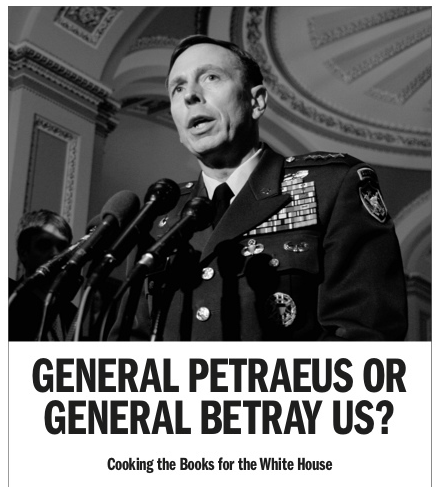
The Senate's confidence in him is well-founded, surely. And it shows a surprising ability to change opinions based on reality. I'm sure many of us remember the left-wing response to Petraeus' initial appointment:
Destroying America with Victory!


But those days might be over. Not only is this man finally getting a shred of the respect he deserves, but the US Senate is not so ideological as to shoot its own military policy in the foot to make a point. And who knows: maybe he'll come to the rescue for us once more.

Sunday, July 6, 2008

The Iraq-Afghanistan Contradiction

Most of the country still supports a withdrawal from Iraq on a very short timescale. Most of the country also has rather ambivalent leanings towards staying in Afghanistan "until the job is done." Why?

Iraq has shown serious progress for the last year--violence is more than 80% lower than when the surge started, the Sunnis in the west are our closest allies, Al-Qaeda in Iraq is being obliterated by the combined Sunni Awakening, Iraqi Security Forces, and Multinational Forces. The government is making slow political compromise progress, and more is likely to be made after the fall elections equalize representation in parliament. The Iraqi Army's stand-along capabilities are increasing... but the majority of forces still need training. The Iranians are finally starting to help curb the violence among Shiite militias. The American people support withdrawal.

But at the same time, Afghanistan is an increasing disaster. More and more American troops are dying each month--last month, 40 died, compared to 29 in Iraq. The Taliban's /Al-Qaeda's virtual safe haven in Northwest Pakistan makes it impossible for US troops to competently fight them; if the Pakistani government continues to be as unhelpful as they have been since 2001, there is little that US and Afghani troops can do to stifle the growth of the Taliban except try to invade Pakistan's northwest. Without help from Pakistan, this venture is becoming a complete waste of time, and a useless shooting ground for American troops. Americans support staying.

Do we think Pakistan is going to buck up and start fighting the Taliban soon? Or are we, as Americans, so wrapped up in our preconceived notions of morality that our military presence does not depend on results? The military situation in Afghanistan is bad, and getting worse--and there is little our military can do about it without violating Pakistan's sovereignty and possibly setting off another war. But in Iraq, our troops and General Petraeus have shown that smart leadership and good policy can lead to lasting results. Iraq's economy is booming, and its people feel increasingly safe. The end of a US presence in Iraq should come when the Iraqi Security Forces are able to operate independently to keep the security that the US has gained. The end of the US presence in Afghanistan is the one that shows "no end in sight," with a situation slowly and painfully degrading into oblivion.

So why the inconsistency?

Wednesday, April 9, 2008

Petraeus' Great Iraq Update

On April 8th and 9th (with lots of pomp and circumstance thanks to the presence of all three presidential candidates, trying to show off for the press), General David Petraeus gave his Great Iraq Update to Senate, discussing progress and future strategy. Released to the public was a handout that each Senator received, and I humbly present my analysis of some of the better graphics from it.


Because I am a geopolitical wonk, I keep coming back to the Iraq Provincial Security Transition Assessment Map (or Provincial Iraqi Control Map). As we can see, some interesting progress has been made. Half of all Iraqi provinces (9/18) have been handed over, though the handover process stalled after 2007. In July, the third-last Polish-led province of Qasidiyah, as well as the once-restive province of Anbar will be handed over. Anbar's "renaissance" will be completed in July, and the Bush Administration is likely to hold it high as a sign of success in Iraq.

Interestingly, there seems to be no politically-motivated rush on the part of Petraeus to hand over other provinces; six provinces are going to be handed over immediately after the US 2008 election, if they are handed over on time. Petraeus may have been able to stack some of these provinces in a lump October 2008 handover to try and influence US voters to elect a more pro-occupation candidate like John Mccain, but has opted not to, presumably in favor of a more militarily sensible strategy.

Interestingly, all provinces but Tam'im are scheduled to be fully handed over to Iraqi Provincial Control by the time a new president is sworn into office. In doing so, Petraeus is able to (intentionally or not) preempt any new president's Iraq strategy by sealing the United States Military's fate as a secondary force in Iraq by 2009. The post-handover provinces in Iraq have not all been perfectly peaceful--the recent violence in Basrah has been an embarrassment to the possibly-hasty full UK pullout--but ethno-sectarian violence remains low (despite a small spike), and Al-Qaeda seems to be losing ground. Continued handover, despite March's spike in violence, looks like it will progress smoothly.


The next gorgeous chart here is ethno-sectarian violence in Iraq (this measures only deaths by inter-sect rivalries, rather than Al Qaeda bombings or Al-Sadrite militia spats with the Iraqi Army). As we can see, Iraq has passed its "civil war" stage of 2005-2007, and remains in a state of tough pacification and unification. Whether ethno-sectarian violence remains quite this low after a US drawdown over the summer remains to be seen, but political progress is slowly and painfully being made. More importantly than parliamentary benchmarks, perhaps, is Petraeus-led integration of Iraqi Army and National Police units into communities, mirroring the integration the Petraeus implemented with US troops. Such an integration provides a stable security base (lowering the incentive to support militias for one's street-side security) and also a friendly and helpful grassroots face for the government (increasing civilian support of its continued success). So while critics point to a strikingly slow development of nationwide laws that are meant to bring long-term stability, the ubiquitous-police society developed, especially in Baghdad, is likely to maintain stability in urban centers as the government continues to try and reconcile political differences.

McCain called Baghdad life "more or less normal" in a recent speech, and these graphs are the best evidence we can get to support such a claim. Assuming these graphs are not designed to intentionally mislead, Baghdad now looks more or less like a large American urban center in its ethnic violence density. Nationwide ethno-sectarian deaths remain at about 200 per month, or 2400 per year, which is about 8.2 ethno-sectarian deaths per 100,000 people (the US homicide rate is 5.6 per 100,000 even though this is a pretty poor comparison). Again, this doesn't include suicide bombings or the recent Mahdi-Iraqi Army fighting. On that note:


The MNF Coalition estimates about 300 total civilian deaths last month (12.3 per 100,000 per year), and Iraqi data estimates about 750 total civilian deaths last month (projecting to about 21 per 100,000 pear year); both estimates are higher than political scientists would see as sustainable and acceptable for a stable domestic society.


Finally, the last image is the most promising, if it's accurate. Even if Iraq does not become a fully stable and and pro-American society any time soon, Al-Qaeda remains the United States' enemy number one. To leave Iraq as a safe haven for Al-Qaeda would be a total military failure of the operation, regardless of any other political or military progress in the country. It remains the United States' moral obligation to clean up the mess created in Iraq by its overthrow of the Hussein regime, but it remains the United States' primary security obligation to eliminate Al-Qaeda at all corners, and deny them all possible havens. Progress in eliminating Al-Qaeda in Iraq since the Surge strategy has been stark.

Completing a rooting-out of of Al-Qaeda looks within reach. Continued progress on bringing political reconciliation, military stability, and delivery of daily necessities to the Iraqi people will create a sustainable country in which Al-Qaeda's destabilizing presence will not be tolerated.