Showing posts with label Diplomacy. Show all posts

Tuesday, March 22, 2011

Checking In on Middle East Unrest Predictions

Never let it be said that Foggofwar doesn't hold itself accountable to its predictions. Let's go back and see how we did. For now, we won't cover everything--only the interesting ones.

Libya: Certainly the most interesting case, Libya would give Foggofwar the excuse of "intervention by the world's most powerful military alliance." Ironically, we may not even need this prediction: Protests have still not reached Tripoli, and the Rebel/NATO alliance seems to be showing a serious inability to mount an assault across the long stretch of desert, and thus won't overthrow the Gaddafi regime: the West will lose interest before Gaddafi loses will or military capability. As Predicted.

Morocco and Jordan: Protests here have died down largely due to reforms enacted by the governments that have given protesters what they wanted. As Predicted.

Syria: Protests continue to rock the country, despite (or because of) Abbas' crackdowns. Abbas has the ability to keep a lid on the populous through serious security and political liberty reforms, which he may want to do in order to court the West, anyway. But Abbas has infuriated his country and squandered a strong, loyal security establishment. Increased Risk.

Yemen: Rumors fly that the Yemenese president is working with Saudi and US allies to transition out of government... and out of the country. It's been a surprisingly long, sustained fight, but it looks like this current regime is on its way out. As Predicted.

Bahrain: Bahrain has fallen out of the news sphere as of late, as the active unrest has stopped. Interestingly, the sustained crackdown continues, trying to marginalize the supporters of the protests. The regime is safe--for now. But the Shiite majority of the country has been alienated completely. Long-term, the regime will continue to face risk. As Predicted.

Briefly speaking, no other country has surprised us yet in the magnitude of risk or, more importantly, in regime change. Overall, we've done pretty well so far.

But we're happy to be proven wrong if things change.

Implications of the Current Situation in Libya

Short summary of recent events in Libya:

* Rebel and Gaddafi forces face east/west stalemate
* Gaddafi's forces organize and rally, pushing Rebels to Benghazi
* At some point, SAS (and probably CIA) inserted into Libya
* UN approves no-fly zone and "all necessary measures" to protect civilians
* Gaddafi declares ceasefire, declares willingness to talk to opposition, meanwhile moving forces into Benghazi
* Anti-Rebel operations continue in Benghazi (in efforts to "last-minute" end the Rebel forces)
* French strikes begin on land targets (tanks, etc)
* US/UK strikes begin on anti-air, fuel, airport, communication/command sites
* Arab League condemns ground attacks

"All necessary measures" is likely a deliberately vague clause, allowing the West to justify (at least to itself) nearly any military action, while abiding by its post-Iraq rule-following sensibilities.

Of course, the protection of civilians is a political mask over the true intent: regime change in Libya. As much as the Rebels are a bit of an unknown factor (and some of them are clearly Islamist), the West is quite tired of Gaddafi.

The implications are numerous and highly variable.

West-Middle East Relations
The West certainly hopes that its pro-Rebel action will endear it to the new anti-establishment movements and regimes that seem to be sweeping the Middle East. The West gets to claim "we helped without occupying!" when the new governments of the Middle East start making serious decisions. The fact that the Rebels asked consistently for Western help is a good sign that the PR has the potential to be good.

That said, the Arab league is condemning the ground strikes, saying that the West has already gone past its mandate of protecting civilians. Indeed, the "protecting civilians" focus of the UN resolution may be a political crutch to real action. The Arab League, moving towards a popular/ democratic rhetoric, is worried that the air strikes will lead to non-insignificant civilian casualties; these governments thus do not want to be perceived as supporting more Western action in the Middle East that seems to damage Arab/Muslim people.

The two questions as to the PR outcome will be the # of civilian casualties and the outcome of the campaign. More casualties will be tolerated in the short-term if Gaddafi's brutal regime is removed and replaced by something more friendly, but only if the front-line action is driven by the Rebels themselves. The West will need to keep some of its guns in check in order to avoid looking less like humanitarians and more like imperialists.

Commitment
Part of the major risk is scope creep, though it depends on the country.

The United States has already committed to take a back seat after the Suppression of Enemy Air Defenses (SEAD) campaign ends, allowing countries like France and Italy to take over enforcing the no-fly zone and preventing ground forces from entering Benghazi en masse.

That said, the risk is creating a stalemate, in which a withdrawal of air forces will allow Gaddafi to succeed, but an endless no-fly zone campaign might quickly frustrate both domestic European opinion and Middle East opinion.

To break that stalemate and seriously cripple Gaddafi's forces (thus giving the rebels the advantage) will require action beyond the original mandate, though this can often be done with enough discretion that only minor objections will be thrown up.

The West's goal here may be to make sure a friendly country, probably Egypt, is committed to supporting the rebels and making sure they can be rearmed, fed, and regrouped during the air campaign, such that they can make a sustained push west towards Tripoli when the initial SEAD campaign ends; Western forces are likely to be able to provide key intelligence to help the Rebels find isolated pro-Gaddafi units and overtake them quickly and decisively, which would further arm the rebels with artillery and armor.

Military Outcome
Likely military outcomes here are either a stalemate or a rebel victory. Gaddafi will struggle to get the forces he needs into Benghazi (and struggle to control them well enough to effectively occupy key population centers).

As a default, military units are now hiding in heavily populated areas, though if they're otherwise paralyzed, it may give Rebel forces there an opportunity to harass the units into a state of unpreparedness for a more sustained Rebel counter-attack.

While a Rebel victory is possible, it's also unlikely. The Rebels lack military leadership, and (unlike Yemen or Egypt) have not had major elements of the armed forces defect and turn their guns against the leadership. Until that happens, the Rebels would have to completely knock out the sizable Libyan army in order to claim victory over Tripoli.


Political Outcomes
If the stalemate persists, the Rebels are likely to keep their alternative government in the east, and a de facto split of Libya would occur. The Benghazi government could garner international support; especially from Egypt (which would want influence over the large oil reserves in that area).

but whether the Rebels win or not, the big question of its political makeup remains a major concern for the West. Clearly, the Rebels are anti-despotic, but what else? Libya had a brutal campaign against extremist Islam for some time--how strong are these influences in the Rebel group? Do the Rebels desire a secular state? Will it be Western-friendly? These are all questions left unanswered, and will largely determine the amount of sustained Western support for the government.

Western Cohesion and Trans-Atlantic Relations
Perhaps most interesting is that the biggest benefit the West is likely to get is its own internal sense of dignity and goodwill. With US-led operations in the last 10 years going militarily poorly and morally questionably, there have been a lot of bad feelings and aimlessness among the West, even with respect to itself. The West's strategic direction is confused and frustrated (especially as Russia seems to be running circles around NATO's internal conflicts). If Libya goes well, the West can achieve a "feel-good" victory like it had in the early 1990s, and a renewed confidence in its ability to be an effective and relatively-welcomed police force.

Western military cohesion will not be that of the early 1990s, but it may improve. Specifically, the US will have an opportunity to act in an effective support role, both improving relations with Europe (by allowing Europe to lead the operation that's most relevant to its immediate periphery), and setting up a system in which the US can limit its engagement. The US has far and away the best logistical/transport capacity and control, as well as the best battlefield intelligence. These two factors make it a perfect candidate to support other Western nations' campaigns against less impressive forces, and the US can benefit significantly by setting up alliances in which it maintains that role.

Monday, January 10, 2011

China Continues a Stance of "Reassurance"

In my undergraduate years, I had the pleasure of working for Prof. Taylor Fravel, MIT's local Chinese foreign policy buff. I did research for a text called "Securing China," whose primary thesis was that Chinese military development pursues a single goal: securing its resource and population base by staunchly defining and defending the borders it identified in 1949 (when the Communist Party took over).

Prof. Fravel is part of a rather non-alarmist school of thought, contradicting the tone of much of modern US news media. The non-alarmist school believes that China's at-times rough-edged stance is primarily to ward off other powers (Russia, the US, etc) from encroaching on what it has asserted to be its territory (specifically, Tibet and Taiwan). Chinese behavior in the Korean peninsula is a different matter, and complicated (and can be discussed at another time).

But to be fair, while China is at times prickly, its primary communication policy on its military is one of reassurance. China has made sure to define very carefully what its arms are for (often these arms are for a hypothetical invasion of Taiwan); it has avoided building unnecessarily provocative (or otherwise globally-relevant) weapons, like aircraft carriers (this is accentuated by a Russian aircraft carrier, purchased in the early 1990s, that currently sits as a theme park). In particular, China has recently emphasized that its military is currently "decades" behind that of the US in technology and capability.

In this case, Beijing happens to be absolutely correct. Chinese troops still lack the training and tactical intelligence technology (nor its integration) that US troops have. More importantly (as the US and China would almost certainly never meet on the ground), Chinese naval vessels and air superiority fighters are, indeed, sufficiently behind in technology that a major confrontation with the US (assuming it brought two of its twelve aircraft carrier battle groups to bear) would be swift and decisive.

In particular, Beijing is emphasizing these differences in order to release some pressure from the US about the development of anti-capital ship missiles. Sophisticated anti-capital ship missiles are currently a weak spot in US (and any) naval power. Against powers like Russia and China bearing such weapons, US ships would be sufficiently exposed that they would take significant damage and losses in a pitched naval confrontation.

Secretary of Defense Gates was in China last week in order to try to push China on construction of these missiles--China did not budge. China also failed to make the progress it wanted--the US is continuing its arms sales to Taiwan. It will continue to make such sales as long as China does not offer a sufficiently enticing chip in return (and weapons development is something that one can only tenuously and temporarily offer to delay).

China will continue its stance of "reassurance" as it grows, such that it is not faced with a serious, concerted challenge until it is sufficiently modernized that it can handle it. That said, odds are low that it will become a "revisionist" or expansionist power (unlike Russia) in the near future, even if it does "catch up" with the US--there is no evidence in particular from Beijing that it wants anything different than it did in 1949--a consolidated territorial China.

Monday, November 29, 2010

A Few Interesting WikiLeaks Tidibts

As much as I'm marginally annoyed with WikiLeaks, they have leaked some relatively interesting information. A few tidbits:

-China is distancing itself from North Korea, and considering supporting a reunification under Seoul's command (calling North Korea's leadership a "spoiled child").
-Saudi Arabia asked the US to launch air strikes against Iran's nuclear programme.
-Israel conferred with Egypt and Fatah before attacking the Gaza Strip most recently.
-The US doesn't actually think a European missile defense system will bring real security to Eastern Europe.
-The UAE and Bahrain want Patriot batteries to defend against Iranian ballistic missiles.
-Saudi Arabia staunchly opposes the al-Maliki government in Iraq, worrying that it is an Iranian puppet.
-Secretary of State Clinton asked (perhaps pejoratively) whether the president of Argentina was completely mentally sound.
-Yemen asked the US to bomb Yemeni insurgents--and offered to tell the public that the strikes were carried out by the Yemeni military.

This is a sampling of 272 cables leaked so far. There are a total of over 250,000. Much more is to come--and it won't get prettier.

Wednesday, October 20, 2010

What the Afghan Endgame Looks Like

The Taliban don't want a protracted civil war in Afghanistan. This seems difficult to comprehend, given the last 30 years or so of fighting.

But it should be made clear right away--fighting an invading power is much different from fighting a full-on internal civil war. Defeating an occupying power requires great patience, but the Taliban can largely avoid losing major resources and manpower by avoiding a NATO army that is not large enough to cover the entire country.

Fighting a civil war is much different. No waiting will do--fighting against the central government and its own Warlord allies will be a knock-down drag-out war of attrition, and one the Taliban may well not win, if US intelligence and drone attacks remain on Kabul's side. Such a civil war would be devastating, even if the Taliban won.

This scenario is very unlike the complete power vacuum left when the Soviet Union withdrew--the Soviets had not conducted in massive, extensive state-building that NATO has. The central government may not have driven the Taliban out of much of the country, but it does not mean the Taliban is close to secure.

The other point worth keeping in mind right now is that a player in a war or other disagreement wants most to negotiate when its relative advantage is peaking--that is, the point that it's going to be able to squeeze the most out of the other side. After peaking, time erodes the advantage, and less can be won.

Thus, the Taliban are coming to negotiate. Not the big-wigs (like Mullah Omar), but some of the elite near the middle that are feeling the pinch and the pain. Omar himself can't afford to appear to be willing to negotiate with an occupying power for an instant--too large a proportion of his followers (as well as is Pakistani ISI patrons) oppose such negotiations, and are likely to outright kill him if he becomes a collaborator.

The same risk applies to the leaders coming to negotiate. That said, they are not nearly as safe as they used to be in Pakistan, given the uptick in the frequency and success of US drone attacks against leadership of this level.

NATO is doing an excellent job of promising and reliably giving safe transport and harbor to those coming to negotiate--it might be personally safer for many of these leaders to come to talk, rather than hide in Pakistan.

But, ultimately, the top Taliban leadership is not declaring any readiness to negotiate--even if they may be leaning towards it. But in the end, the Taliban will not be able to sweep through Afghanistan and claim victory as NATO leaves. There will either be a negotiated settlement or a crippling civil war, and the former is more likely.

The biggest deciding factor for the top Taliban leadership will be whether they actually think their advantage is going to grow into the future. If it becomes obvious that their bargaining position is declining, the hard line against negotiations from the top will begin to soften--and many of the middle-level elite leaders will already have the initiative in talks.

Tuesday, August 10, 2010

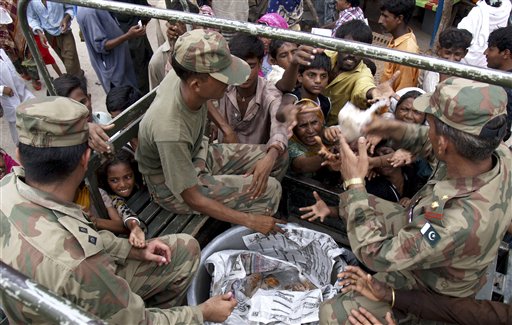
US Flood Aid to Pakistan: PR Success.

The US continues to directly aide Pakistan's flood victims (and, by the way, is expanding the operation), just as UN officials decry the rest of the world for not helping more.

It's a crucial part of the fight against the AfPak Taliban. With the Pakistani government struggling on its own to send aide, the Taliban might well be the primary provider of aide were it not for the US intervention.

Now, many northwestern Pakistanis are seeing US troops and Pakistani government officials / Army troops distributing aid and rescuing flood victims. It's going to have huge PR impact, and reduce the legitimacy of the Taliban, and win more "swing voters" over to the pro-Government side.

It'll also help perceptions of the US, which will make it much, much easier for Washington and Islamabad to work together against the Taliban in the future.

Sunday, August 1, 2010

US Attack Plan: Posturing with Iran

Joint Chiefs of Staff Chariman Adm. Mullen said today that the United States has a plan of attack for Iran in order to prevent it from acquiring nuclear weapons.

Such a declaration is an incredibly important (and unsubtle) part of a US intimidation/containment strategy with Iran in order to prevent such an acquisition from happening.

By announcing these plans, the US is publicly showing that, despite its draining presence in Afghanistan, it is willing to commit to striking Iran's nuclear infrastructure and dealing with the painful consequences. In short, it made it clear that a nuclear Iran is a worse scenario than a war with Iran.

With that clarity, of course, Tehran must try to guess whether the US is bluffing, or if it's serious. If it's serious, Tehran must seriously begin re-thinking its decision to pursue nuclear weapons.

The US air force and navy are minimally committed in Afghanistan, and have bases all around Iran (and can invade the Persian Gulf very easily). Iran's anti-air infrastructure would probably quickly crumble, allowing the US air forces to move with relative ease throughout Iran, and blockade the country from oil experts.

The most negative consequences for the US would likely be unconventional:
-The Chinese and Russians have strong economic/oil ties to Iran, and would protest furiously, if for no other reason than to make sure the oil keeps coming.
-Iran has a lot of power over Hezbollah, Hamas, and groups in Iraq and Afghanistan. No doubt, it could make life very difficult for the United States.
-There is some risk of alienating the anti-Iranian coalition, but odds are good that Saudi Arabia, Egypt, and Turkey would be, generally, in support of such action. Jordan and Syria would be the toss-ups.
-The Revolutionary Guard could actually be highly disruptive in Iraq, although if the US is able to bomb out roads heading towards Iraq, it could mitigate such issues.

Attacking Iran would be seriously costly in a number of ways, but if the US is actually committed to it (it likely is--the US has never been caught bluffing since the Bay of Pigs and the anti-Soviet Hungarian Revolution).

This could be a game-changer in the Iranian nuclear contest.

Thursday, July 29, 2010

Signs of a Balancing Force Against Iran

Syria often uses its relationship with Hezbollah to exert influence in Lebanon. It's a strange alliance, and it caused Syria to be close to Iran for a long time.

But Syria and Saudia Arabia recently jointly showed up to Lebanon to make it clear that Hezbollah would have no support during the UN investigation of the 2005 assassination of the Lebanese Prime Minister. According to STRATFOR, it's likely that a number of Hezbollah agents will be thrown to the wolves.

The Saudi-Syrian cooperation has been rare in the past few decades. But that it is starting back up (and that Syria is working with Turkey to try to make peace with Israel) is a sign that Syria is joining a small-but-growing anti-Iranian coalition.

The Iranian-Syrian relationship was always strange. Syria is primarily Sunni Arab; Iran is primarily Shiite Persian. A Saudi-Sryian-Egyptian relationship is much more natural (in the 1960's a Pan-Arab state was discussed, which would include Iraq, as well).

This is good news for the US, which wants enough pressure around Iran to keep it in check. In an Iran versus Israel/US world, the US would struggle. But if Iran is sufficiently isolated, there isn't too much it can do.

The long-term risk, of course, is a Turkish-Arab major coalition. It would start looking like the formidable Ottoman Empire. Subverting such a coalition is the primary reason the US wants Turkey to join the EU.

Sunday, July 25, 2010

North Korean Nuclear Brinksmanship

North Korea threatened nuclear war over US/South Korea wargames off the Korean peninsula. A few readers asked if this was at all legitimate.

The threats are vacuous--North Korea doesn't have any serious deployment capability. Their nuclear testing in the past has been technically successful, but not particularly impressive.

Frankly, the most damage they can currently do is rolling out a bunch of artillery and shelling Seoul into the ground. It would take a few hours at most.

This new brinksmanship is two things:
1) A litmus test to see if the US/South Korea will play more cautiously than North Korea. Turns out the answer is no, which is probably a good thing (or the precedent will be set that the US/ South Korea will retreat at threats).
2) Pump up domestic support for the nuclear program as North Koreans starve.

More interesting is the fact that Beijing's protests to wargames in the Yellow Sea caused the US & South Korea to move to the eastern shores of the peninsula. China is being particularly tough-nosed about the South Korean response to the sinking of the Cheonan, and I'm not yet sure why (unless, again, it is a part of propping up the Kim regime to keep stability strong).

Ultimately, North Korean brinksmanship will push the US and South Korea closer together. Any threats to North Korea's stability will push China and North Korea closer together. It may be the biggest foreign policy area over which China and the US will spar (barring, perhaps, American trade protectionism) now that Taiwan's Ma has taken the middle road approach to China.

Saturday, July 24, 2010

Iran's Push to Bring Legitimacy to its Nuclear Program

Iran announced today that it is working on a nuclear fusion program.

Frankly, this is probably more posturing than anything. Iran is not going to be able to seriously compete with joint Western efforts in France to develop viable fusion technology. If it starts pouring money into this endeavour, it will be a waste.

The announcement probably comes for two reasons:
1) To try to bring a sense of legitimacy to its nuclear program, and paint Iran as a brave martyr/victim of Western anti-Islamic prejudices. If it's being sanctioned for a noble and honest energy development program, then it certainly does appear the victim. This will help Ahmedinijad's popularity.

2) To make Iran look like it's modernizing. Again, this is mostly a domestic ploy. If Iran is able to appear to be modernizing and pressing forward technologically, it can alleviate some of the pain of the sanctions, which are felt by consumers. It's much easier to "sacrifice" for the state if progress is being seen.

For the West, careful PR will be the game, to try to keep the Iranian people disgruntled with their own leadership, rather than the Western Devil.

Sunday, June 6, 2010

Israel's Risk to US Interests


If you're a reader of George Friedman (or other realist geopolitical academics), you'll tend towards the idea that one of the United States' paramount interests is to prevent a single geopolitical entity (or coalition) from amassing enough economic and military power to challenge it (this has been true since about the turn of the 20t century, when the US became the foremost power in the world). This was why World Wars I and II were important to the US (to stop Germany from conquering the continent), and why the Cold War was so critical (to prevent the Soviets from doing the same). Once a force amasses enough military power, it can potentially challenge US trade dominance, or even cross the ocean and challenge the US near its borders.

The US is further interested in preventing unity in the Middle East. If the Middle East united in a form similar to the Ottoman Empire, it might be powerful enough to potentially challenge the US. Not only would it be highly populous, but it would have vast oil resources and central trading position (between Europe & Asia). It would be a great strategic threat to US hegemony.

Israel, whether or not it has the moral upper-hand in the Middle East conflict, is becoming a risk to US interests due to Middle Eastern perceptions of its behavior as of late. For decades, the states of Egypt & Turkey (in particular), as well as Jordan, Kuwait, and Saudi Arabia, have recognized Israel and, generally, supported its existence (despite their populations' general distaste for the Israel/Palestine situation).

But the past few months have made these governments' support of Israel a politically risky gambit. Public outrage towards the deadly pre-election Gaza offensive, settlement-building in Jerusalem, and the recent raid on a supply flotilla trying to break the Gaza blockade have further soured perceptions of Israel. Its image as an aggressive, revisionist state is growing somewhat stronger.

The US must play carefully. If it comes out to support Israeli action, it may encourage the Arabs to unite to deter Israel from further action in Gaza, the West Bank, southern Lebanon, or (potentially) Iran. If these states united against Israel, they might start feeling strong enough to oppose the US (rather than begrudgingly embracing it). The United States' interest is in keeping the Middle East divided and internally distracted--not united and outward-looking.

If the Israeli government does not change the tenor of its policies, it may begin to become a liability to the US. The US, in response, would try to distance itself publicly, while placing pressure on Israel to move towards peace negotiations.

In the near future, look either for a major shift in Israeli policy towards Gaza and Jerusalem, or a gradual (but noticeable) distancing of relations between the US and Israel, as the US tries to prevent a unity coalition from arising in the Middle East.

Tuesday, May 25, 2010

Untangling the Korean Peninsula Conflict


Mystery shrouds the current Korean Peninsula conflict about as much as it shrouds the North Korean government itself. A few readers have asked me, "what the heck is going on up there? Why the heck did North Korea attack South Korea?" Good question! It had me thinking & reading for a bit.

Why did the North Koreans sink the Cheoan?

There's no clear answer for this. The government officially denies doing it (which is not surprising), but it seems a relatively irrational thing to do. To understand the most likely possibility, one must understand the politics of North Korea. At least a bit.

Like most dictatorships, North Korea's government is propped up by elites (in this case, primarily military elites). And, like all governments, they faction. Long story short, Kim is old & frail, he's picked a potentially weak successor, and an opposition faction is likely trying to make a play for power. If South Korea had retaliated, chaos would ensue (North Korea would be caught unprepared for a war), and an opposition faction would have a much stronger opportunity to seize power from Kim (and likely quickly declare an end to the war by being a new regime).


As such, the coup likely failed. Whether there has been a purge is probably going to be unclear, but North Korea's lack of followup to the attack (and lack of military readiness at the time of the attack) both indicate that it was not an order from the top, but rather an order from much lower on the chain of command--likely meaning some attempt at insubordination.

What the heck are the Chinese doing in response?

Another good question! China's response seems to be arbitrarily contradictory. By inviting Kim to Beijing (and leaning towards "no" on international reprimand in the UN Security Council), China is taking a major international hit... in particular with South Korea and the United States, two of its biggest trading partners. China seems to be encouraging North Korean aggression.

But after a conference with China, Secretary of State Clinton came out speaking surprisingly rosy about China. Why?

Again, we must think of Chinese politics. In a Korean Peninsula war, what does China have to lose? It cannot and will not send troops or supplies to assist North Korea, and with the help of Japan and the United States, South Korea would rout the North Korean army (though Seoul would likely take serious damage in the meantime). China would be stuck with a collapsed North Korea, and an angry (and rather economically devastated) South Korea. The collapsed North Korea would send millions of starving, brainwashed refugees into northern China--a disaster that China is not prepared to face.

China's greatest concern in Korea is stability. It cannot afford a collapsed regime. This explains its stance--first, by inviting Kim to Beijing, China makes it clear to any opposition that Beijing will back Kim's faction, and help it keep power. Beijing was also likely able to get reassurances from Kim that he will purge the aggressive opposition, and also refrain from further provocations of South Korea... at least for the time being. China must also restrain from doing too much to anger Kim, lest Kim feel isolated and threatened. By befriending Kim, China gives Kim some security, allowing Kim to refrain from any foolish lashings out. Secretary Clinton understands this position, and thus was able to express confidence that China would effectively help prevent war in the Koreas.

What will happen from here?
South Korea cut off trade with North Korea, and North Korea followed by severing all diplomatic and communication ties with South Korea, and put its army on full readiness. South Korea further retaliated by opening up propaganda messaging into North Korea, and participating in anti-submarine drills with the United States. The Sunshine Policy is over.

For now, the conflict will drive South Korea (to some extent) away from China and towards the US/Japan. South Korea will seek stability in US strength. China will show North Korea that it is ready to defend North Korea from internal threats, but will not support it in a war against South Korea--North Korea's only rational recourse would be peace.

North Korea will desperately attempt to retain face by growing increasingly perturbed over accusations that it carried out the attack. It will accuse the South Koreans of setting up the attack themselves to provoke a war (sounds far fetched as an accusation, but many Americans think the same of the 9/11 attacks).

As far as war, I think it is unlikely. Neither country has a serious interest in it. Sino-American relations will not be particularly strained by this, but China will see any actions against North Korea as being a favor to the US (stacked on top of any favors that China does for the US with respect to Iran).

The Peninsula's best hope of a reemergence of peace might, unfortunately, be the death of Kim and a new regime leader.

Saturday, March 20, 2010

Russo-US Cooperation or Positioning?


A sudden warming of relations from Russia is stirring me a bit.

As Secretary of State Clinton visited Russia, Putin hinted that "Smart" sanctions against Iran are likely to gain support from Russia--this is a sudden turnaround from the Russian position over the last few years.

Putin further agreed with Clinton that an arms reduction treaty was in the works for early April. My impression of the treaty is that it's unlikely to change the geopolitical landscape, but nonetheless, it's a symbolic gesture of cooperation.

But Russia hasn't announced any plans to halt construction of a nuclear power plant in Iran, it isn't supporting US operations in Afghanistan, and it isn't backing off power plays in Estonia and Georgia.

It begs the question--is there serious cooperation occurring, or is Putin simply trying to put the US off-guard (or at least reduce its political mandate to act against Russian plans?). Ultimately, the Russians do not particularly wish the Iranians or Taliban well, but as long as they continue to be a thorn in America's side, Uncle Sam can do precious little to counter Russian expansion into former Soviet territory.

Wednesday, March 3, 2010

Haiti as a Proving Ground for the US Military

With a fair amount of ambivalent results and reporting about the US military's effectiveness, an opportunity to push its rapid-response and logistical expertise to the limits was just what it needed.

And succeed it did. Despite major hangups at the Port-au-Prince airport and seaport, the US military successfully acted as the largest relief and charity organization in the country (and primary logistical/structural enabler for most of the other organizations there), and averted uncountable deaths during the disaster. Ultimately, the military's story is a story best told by those who were there. I recommend an article by Popular Mechanics written by a photographer/reporter in the thick of Haiti at the time.

Why's perception so important? If the US military can show it is in top rapid-response readiness and can muster highly effective logistical wizardry at a moment's notice, then it implicitly delivers the message that, despite the resource drain of Afghanistan and Iraq, despite alleged distractions, the US military still has the capability to organize and move huge amounts of equipment and manpower away from the US continent at a moment's notice--now is not the time to make a military move in the hopes that the US is too bogged down to respond. And ultimately, this display of power (if not force) acts as a deterrent to potentially disruptive smaller nations (like Venezuela) and, at the very least, causes bigger nations (like Russia or Iran) to think twice before considering a bold move.

Wednesday, February 24, 2010

Lessons from the Coming Darfur Peace Deal

Let me first say that I'm a bit skeptical about the long-term prospects of the Darfur truce. I'm mostly not clear that the Justice and Equality Movement (JEM) and other groups in Darfur will be able to reach a sufficient common understanding that they can successfully negotiate with Khartoum as a united front.

Nonetheless.

The lesson of the day is that Realpolitik still trumps idealism in the international sphere. 7 years of grandstanding, diplomatic pressure, protests, and even International Criminal Court (ICC) action (which was largely ignored by Sudan and its neighbors) had done precious little to change the state of the war. Then why the sudden change? As far as I can understand, there are 2 key issues:

1) The Chadians are backing off. Khartoum regulars have seized sufficient ground in Darfur that Chadian action in the area is becoming more futile (and ultimately detrimental). Because of this, Chad declared an end to its proxy war with Sudan in the area, accepting a minor political defeat and retrenching in its own country. Without Chadian support, Darfurian rebels have a newly-diminished bargaining position. Sensing a potentially closing window of opportunity, Khartoum hopes to enter negotiations with the Darfurian rebels at their weakest, in order to end the war with the best-possible negotiated settlement (maximizing Khartoum's power in the area and over the country as a whole in the long-term). Such a favorably-settled peace will also boost al-Bashir's popularity, helping him secure victory in the next election.

2) Khartoum's priorities have shifted to Southern Sudan. Two big issues are coming up in Southern Sudan--the 2011 referendum on independence for Southern Sudan, and the decision on Abyei. If the referendum goes through, Southern Sudan would become an independent state (and given the current political organization proposed in the referendum, it would lead to massive political tension and possibly war). Khartoum wants its military forces to move south to be able to prepare for and deal with the fallout of an independence movement which has a great deal of popularity in the south. Furthermore, the region of Abyei is currently in dispute over where the north/south border lies. In particular, the dispute is over the location of the border with respect to a massive oil well that would either become northern or southern given its resolution (even if Southern Sudan remains part of Sudan, Khartoum ends up with more of the oil wealth than it would otherwise if the Abyei oil fields are located in the north). For Khartoum, a great deal of resource wealth is at stake in the south, where Darfur's threat is greatly diminished by Khartoum's relative control over the region.

Khartoum is ultimately moving on from the Darfur war because it largely won its political objectives and now has higher priorities in its path to political and economic consolidation. The takeaway here is that realpolitik still dominates action in the geopolitical sphere, despite the best intentions of the most powerful nations of the world. It's an important lesson to take away as we (the liberal West) continue to try to craft the world in our image.

Friday, February 5, 2010

Last Decade Series: Israel/OPT

What frustration. Certainly I was pretty geared up for the 2009 parliamentary elections in Israel, hoping Kadima would hang on to power, allowing Livni and Abbas to ride off together into the sunset and create the Palestinian state. In retrospect, this was pretty optimistic, and I don't just mean that Kadima lost power to Likud. It probably wouldn't have worked out all that well even if Kadima had taken power, as Palestine still seems to not be in a place where it can run a respectable state, especially in Gaza.

So, first thing's first: the Middle East will be a nasty and inhospitable place for US interests until Palestine gets its own state, period. And yes, I understand that such a goal is highly complex and wrought with problems, many of which are directly the faults of the Palestinian people. But ultimately, it is in the interest of the US and Israel alike to have a Palestinian state with a healthy economy. If I had my druthers (and I rarely do), we could hand Gaza to the Egyptians and merge Palestine and Jordan back into Trans-Jordan and make it the problem of some already-relatively-stable governments to keep a lid on Palestine, but that's not going to happen.

But an independent Palestinian state (and one that, in particular, is content with its borders, which is going to be pretty tough to come by) will mean relative security for its people, and a situation in which aggression on border issues or whatnot with Israel would make life sufficiently worse as to not be worth it. Palestine, as a stable and economically viable state, would have nothing-to-gain-and-everything-to-lose by fighting with Israel, and would therefore have a strong interest in keeping a tighter lid on its more fanatical rocket manufacturers.

And this last decade looked like we were making pretty good progress! The election of Abbas, who should have been seen as a godsend to the West, gave the distinct impression that the Palestinian people were tired of intifadas and ready to sit down, talk, draw some lines on the map, and move on with their lives. The moderate Labor party in Israel showed similar promise. Both sides looked ready to take the risks necessary (and probably suffer through the ensuing pain necessary) to get to that key treaty that we've all been waiting for. But what the heck happened?

The big clincher was probably the Olmert scandal. His loss of moral authority castrated him from being able to drive the necessary treaties through parliament; serious delays popped up. By the time Livni was in a position to do the negotiating, Obama had been elected and the Palestinians wanted to wait around for him (perhaps hoping to gain a strategic advantage from losing an American president that they perceived to be pro-Israel). The elections came, Netanyahu won, settlement-building ramped up, and everybody got very angry at each other again.

Not, of course, that the war in Gaza helped things any--had Israel successfully "dismantled" Hamas, life might be a bit different. But in failing to do so, they were left with only a battered reputation.

At this point, Netanyahu is barely humoring the idea of an independent Palestinian state: he wants it to be fully demilitarized, and wants Israeli settlements to grow into the West Bank "naturally," with the population (and has not made it clear as to what would happen to those settlements if a Palestinian state gets built). Further, he's insisting that all of Jerusalem would stay in Israel. It's a tough stance to negotiate with, even for Abbas. Perhaps the strategy is to try to squeeze more to the Israeli side in a compromise, but at some point, one's demands are so high that the other side is incentivized to walk away from the negotiating table at all.

And so I think that Israel and Palestine are now significantly farther from where they were in, say, 2007, as far as being close enough in official policy to negotiate a compromise and create a Palestinian state. The moderates made key mistakes that blew their opportunities to make serious headway in the 2000s, and they will probably have to wait through another relatively painful cycle before they can make another reach for some sort of steady-state solution.

Saturday, January 30, 2010

Last Decade Series: The European Union


The EU gained serious traction through the late 2000s as the Lisbon Treaty was ratified and the EU's executive and legislative branches became significantly more powerful bodies than they previously were (as I've mentioned before, they begin to rival the powers of the former Articles of Confederation).

But as we know, a unified European continent is verging on the single greatest threat to the US' security. Obviously, the US is relatively preoccupied in the Middle East, but it is not this preoccupation that has kept the US from pressing on the EU (certainly the US is pressing on China and Russia).

Ultimately, the EU is a mixed blessing for the United States. There are some downsides--with a "united" foreign policy representative, it will be "easier" to stand up to the United States on foreign policy matters as a group with collective bargaining power (think of a trade/labor union). The EU could, as a group, threaten all sorts of nasty stuff as a whole, including pulling out of Afghanistan, or otherwise not supporting a US policy, that each state on its own would not be able to credibly do. But these downsides are mitigated by the very things that caused me to use sneer quotes earlier; the EU is not actually a terribly unified place, and probably won't be for a long time, if ever (in the US, it took over 100 years for states to shed their strong unique identities). Most EU countries have a very strong unique identity that the United States lacked when they came together, and already there is a fair amount of discord within the ranks. Italy is up in arms about an EU Court ruling over crucifixes in its schools. The UK is now majority in favor of full withdrawal from the EU (in order to protect its own sovereignty). With the Tories bound to be elected by March, this may end up happening--and if it does, countries like Poland and the Czech Republic may follow.

In general, a fair chunk of EU countries would rather not give up their sovereignty and independence to the extent that the Lisbon Treaty asks them to do, even for the economic benefits entailed by the Eurozone. But in general, the idea that many countries with such disparate geopolitical interests could get along is tough to imagine. The US has the dual advantage of coasts on its east/west, and relative weakness to its north/south (a number of wars have made that the case). Unity is geopolitically sensible for the US, but the EU has very different needs on its West (where it sees relative security) and its east (where Russia looms and the Balkans remain a hotspot). Western and eastern European geopolitical interests and needs will clash in the future as Russia tests the EU, and it may fall apart as the east forms its own alliance bloc with the US and UK (NATO largely faces the same risk as western Europe decides it would rather not suffer through standing up to the Russians again).

Ultimately, the EU will remain geopolitically fractured and weak. The bureaucracy of getting anything all done in the EU is horrendous, especially so for such a new institution. The EU will remain facing inward, trying to find a hopeless balance that works for everyone, instead of looking outward to challenge the US or even Russia. It will, at least, have a strong internal trade, which will ultimately be good for the US--a richer EU will mean not only more high quality products, but a bigger market to which the US can eventually export.

The EU will be an irritation in America's side for a bit as the US and EU diverge on geopolitical topics ranging from the Middle East to Russia to global warming, but the EU's very structure largely prevents it or any other European power from becoming a major geopolitical threat to the US, something with which the US should ultimately be quite pleased.

Wednesday, January 27, 2010

Last Decade Series: The Aborted Orange Revolution

Things looked really good in Ukraine in 2004. I mean, really good. They do, at least, if you're America.

Victor Yushchenko won the Presidency of Ukraine after a poisoning attempt on his life and a fraudulent runoff that originally gave his opponent the win, prompting massive protests throughout Ukraine known as the Orange Revolution. The West was so thrilled about it that they practically bragged about having had a hand in influencing the outcome.

The West envisioned the final consolidation of the former Soviet Empire into Western hands. With Ukraine secure, Russia would lose influence over a massive population, critical breadbasket, and (most importantly), Russia's only warm-water port of Sevastopol. After the Orange Revolution, the West eyed adding it to NATO, and making the Black Sea a NATO-controlled body of water. Russia's geopolitical position would have been devastated--it would have been resigned to competing with China, India, and Pakistan for influence over Central Asia.

But poor handling of Ukranian politics both by the US and by Yushchenko himself caused him to lose control over parliament rather quickly. Such a loss of control led, of course, to a decline in effectiveness and a further loss of support within Ukraine. NATO did not strike quickly enough. And, indeed, Russia grossly out-maneuvered the West in its 2008 invasion of Georgia, brilliantly repelling both Georgia and Ukraine's incorporation into the American sphere (Georgia's incorporation would have been similarly crushing to Russia's presence in the Caucasus. Had such mismanagement not occurred, Georgia and Ukraine may well be (unpopularly) part of NATO, much as many Middle Eastern states are US allies despite their own internal politics against it. Russia would be dealt its decisive blow into the future--it would not be an influential global power. It would have spent too long focusing on its own border, population, and food security.

The inability to secure gains from pro-Western governments in Ukraine and Georgia will put the West on the defensive with respect to Russia for years to come. Russia will now look to the Baltics to further its influence and buffer--not out of malice, but simply out of geopolitical security concerns. It will be able to make Iran a continuing problem for the US, and will try to keep the US bogged down in Afghanistan. It will become the primary national challenger to the US in the next decade, rather than either collapsing irrecoverably or becoming a pro-Western liberal market country. The latter is unlikely to happen no matter its strength.

Ultimately, this mismanagement was one of the biggest losses for the US, even if not among its poorer performances. The US is in the enviable position of having lots of room to make mistakes and make a mess in its foreign policy (for example, the US wins by the Middle East being a relatively divided and messy region, rather than a united anti-US force). But the situations in Ukraine and Georgia required a precision and skill that the West was not quite able to provide, and it shall pay for that lack of capability in the medium term.

Wednesday, January 20, 2010

Last Decade Series: NATO Wins Eastern Europe

The biggest spurt of growth that NATO experienced since its very founding in 1949 occurred during 2004, after years of intense dialogue.

This growth, while not exclusively the doing of the United States during the 90's and 00's, is one of the greatest geopolitical victories that the United States has seen in the past few decades (even if the benefits have not yet been realised).

In 2004, NATO absorbed all three Baltic states (Estonia, Latvia, and Lithuania), as well as Slovakia, Romania, Bulgaria, and Slovenia. As you can see in the image to the right, NATO thrust itself towards Russia, essentially leaning right up to St. Petersburg (imagine if the Warsaw Pact had a stronghold a hundred miles from Philadelphia or Chicago).

This expansion essentially means a new, strengthening front line in what is an increasingly important and difficult effort to keep the Russians locked up. In time, these countries will likely become allies as strong as Poland or the Czech Republic, allowing the United States to think about its strategic borders on Moldova and Belarus, rather than further back. NATO also gives these countries opportunities to experience economic growth with the European and American nations with whom they have grown cozy, eliminating trade barriers and creating new markets and providers.

These strategic partners will grow as the United States' relationship with Western Europe grows cooler over time. As Western Europe more and more sees little need to be taken care of by the United States, it will continually assert itself (especially through the EU) towards a greater independence by pushing back against the US and emphasizing differences of opinion. With Eastern Europe set up as key allies in NATO, the United States' strategic focus will drift eastwards, focusing on Warsaw instead of Paris (the UK is likely to grow closer to the US as well, as it moves to assert its independence with respect to the European continent).

But these Eastern European countries, including Croatia and Albania (which joined in 2009) will be willing and enthusiastic front-line soldiers against Russia as it tries to assert itself on the European continent and undermine US machinations there. They will enable the US to hold its strategic position in Europe via its favorite and most effective strategy--to find smaller allies and spend money on their economy and military.

While folding Ukraine and Georgia into NATO would have been a nearly-fatal blow to Russian regional ambitions, the incorporation of most of Eastern Europe into NATO before Russia was strong enough to oppose it will prove to pay off major dividends into the 2020s, as Russia's military might and aggression are likely to peak. Poland and the region around it will become the key allies of the United States well into the 21st century.

Tuesday, January 19, 2010

Last Decade Series: The Taiwan Strait

The United States has been arbiter of the Taiwan Strait since the final retreat from the Chinese mainland of the Guomindang (KMT or GMD). It was not until 1971 that the United States even recognized the Communist government in Beijing as the government of China (previously, the KMT government on Taiwan was recognized as government of the entire country).

To be short, we've come a long way since then. And I believe the last decade marked what was, ultimately, the end of inter-Strait tensions as we know it. And the US has had a major hand in that.

For Taiwan to ease up to China, a few things had to happen. One was obviously the rather overwhelming economic benefits of opening up to the Mainland. But the United States had to carefully wean Taiwan off its own dependence into an economic autonomy that drove it towards China.

Similarly, the United States had to slowly decrease its military support for Taiwan, balancing a need to not scare the Taiwanese into believing they were abandoned military. And, surely, they have not been. The United States would still respond militarily to Mainland aggression across the Strait, that is clear. But the fact that Taiwan is becoming a decreasingly effective regional power has helped to assure the Mainland of its position as arbiter of all of China, whether in name or not.

Cross-strait integration may not seem like a major positive, but it is, and it has been executed well. Taiwan has moved towards the Mainland of its own accord, giving no diplomatic or political bending on the part of the United States in its stance towards China in general. The US remained firm on key issues with respect to China, including trade, human rights, spying, etc. And certainly, there is no doubt that Beijing has done little to please Washington, but I intend to drive the following point: relations with China could have been very poor, and could have dominated much of US foreign policy.

The defusing of the Taiwan strait tensions--probably for good--have led to a rather dramatic decline in hype over the Chinese military. Taiwan as a strategic stronghold for US naval power proved to be more a liability than an asset by the 2000s, and the gradual nudging towards the Mainland that the US encouraged proved a very long and elegant diplomatic maneuver that has saved, and will save, many headaches into the future as the US continues to deal with Russia and the Middle East as primary strategic threats.