Showing posts with label Shiite. Show all posts

Tuesday, February 17, 2015

Yemen Rounds Out Middle Eastern Religious Fighting in Which Extremists Win

Yemen's civil war is reaching a "turning point" of sorts as the Houthi rebels (a large Shiite militia tens of thousands strong, very Islamist and anti-American) have totally taken over the capital, dissolved parliament, and set up a revolutionary council of sorts.

They're planning to stick around: they've rejected UN's call to cede power--not surprising.

Source: Wikipedia. Yellow represents Houthi control; Red is old regime; grey is al-Qaeda/etc

As we can see, al-Qaeda has taken hold, probably in the government's back lines as they had the bulk of their troops in the northwest. Yemen's been a big al-Qaeda stronghold for a while (recall the USS Cole bombing of the 1990s). Oh, and it's worth noting that there have been separatists in the south fighting the government to secede entirely. Yemen was two countries until 1990 and (probably) the notion of jointly producing and exporting large oil reserves brought them together. 

Wikipedia


eia.gov

But this unification was during a period of time where it was looking like Shiites and Sunnis would be able to live together in more harmony than they do now. In retrospect, the fairly clear lines between Sunni and Shiite populations might have been helpful--"good fences make good neighbors."

Wikipedia

Like Iraq and Syria, this ethnosectarian civil war looks like it doesn't have a clear way of getting resolved. There's little likelihood of an agreement to just split back up--these things are often hard in general, and oil makes it way more complicated (which is part of why the Sudanese civil war went on for 25 years before it became too painful to continue).

The Houthis being in control will make the southern Sunni separatists even more motivated to get the heck out, so they're likely to keep on fighting. Meanwhile, away from the action, al-Qaeda will continue to entrench itself. The very anti-American Houthis are also quite unlikely to invite the US to strike al-Qaeda with drones (where the old regime was quite happy to have the help), so expect their power to grow in time.

If I were the US national security adviser, I'd be pulling my hair out.

Next time: we're going to go over in some detail Obama's plan for dealing with ISIS.

Wednesday, March 17, 2010

Tight Race a Test for America's Iraq

Can Iraq be a functional Democracy?

This question rests on the minds of every foreign policymaker in the United States.

So far, so good. Minimal violence marred the election, and over 60% of Iraqis turned out (this is about as good as most Western democracies).

But the big test is still coming. The race is tight. US-picked Nouri al-Maliki is in a tight race with Sunni rival Allawi--and might just lose.

But either way, neither is likely to get a majority in his alliance right away, which means that a long period of coalition-building awaits the budding Iraqi parliament. Such political grinds are typical of most parliamentary systems, but the question will be whether Iraq can handle it.

If I had to guess, I'd guess that Iraq's democracy is unlikely to collapse or even suffer a major crisis. No matter who wins, getting ethnic/religious/political minorities in their coalition will, to some extent, be necessary. Sunnis and Shiites alike will be represented in the ruling coalition of the government--the question is really only "how much?" And frankly, the Sunnis should be used to being a minority representative (but if they are a key player in the coalition, then they have virtual veto power), and the Shiites are unlikely to begin slaughtering Sunnis or Kurds if they cannot hold an election despite a 60% majority--most reports are that losing parties are likely to sit back and reconsider their election strategies.

In fact, a tough and indecisive election while US troops still remain may be an excellent low-pressure opportunity for the Iraqi political system to learn how to deal with gridlock, with toss-up. For it will, indeed, come again, and next time, nobody will be there to help sort out the cards.

But if it should succeed, then the day may be won for the United States in a more significant way than anyone imagined since the naive days of 2003. The embarrassingly premature "Mission Accomplished" banner might possibly be unfurled, correctly this time, 7 years after its original debut.

Tuesday, March 31, 2009

A Brief Iraq Update

Iraq has been quiet enough lately that the media, government, and public have all turned fully towards Afghanistan; as a country, we're now engrossed in it. And frankly, that's correct. It's trouble--Iraq is not. This quick update is to keep you informed, and help your experience with the Iraq War feel a little bit more tied up.

First, deaths continue to fall. US deaths hit a new record low of 8 in March; Iraqi violent deaths stand at 252, up from February, but still lower than any month before 2009, and represents well less than 0.01% of all Iraqis. This violent death rate is now lower than the United States, which sees about 4,200 violent deaths per month, or 0.014% of all Americans (sourced again here). And it looks like it will continue to drop. This lack of violence will give the Iraq government ample opportunity over the next 18 months to strengthen its police force, its political institutions, etc, as they prepare for the exit of the US.

Some problems persist, though they are largely civil (for the moment). Power production continues to lag demand significantly; frankly, I have no idea what the excuse for this is. Even Baghdad only has power 17 hours per day, which is enough to have a pretty full business day, but it makes it hard to run severs, keep refrigerators, have security systems, and all sorts of other pretty important stuff that a business (and thus an economy) needs. Beyond this, Iraq is facing a quiet, but significant, measles outbreak, which is likely to test its public health system.

Otherwise, things are going well. Anbar remains quiet, despite recent government crackdowns on Sunni militia leadership that has the potential to shake the delicate alliance between the Sunni Reawakening Councils and the state. So far, the Sunnis are exclusively using political channels to express their grievances--if these channels prove effective, then they will create an excellent precedent for participation.

Iraq's Kurdish regional authority is being more cooperative, though its rebels are not. Kurdish leader Talabani is backing Baghdad's call for PKK to disarm and become peaceful or face the consequences. But the PKK has shrugged the calls off. Such a scoffing may lead to a confrontation in the north between the PKK/PKK sympathizers, and the state.

But al Qaeda seems to be making its last stand in Mosul; and it's not going particularly well for them. Despite a truck bombing earlier today, violence in Mosul is slowly receding. News reports on activity in the region are minimal.


In light of all this, the US is moving out. Only five of Iraq's 18 provinces have yet to be handed over to full Iraqi security control (putting the US back in bases where it awaits a call by the Iraqi Army for help). By June, Baghdad is planned to be handed over as the last province. Compare this to the mess of 3 years ago:


I think this is rather self-explanatory.

In full, I think even the most hardcore doubters of the efficacy of the Surge/ latter US operations in Iraq are being quieted. There will probably be a few more sporadic updates on the topic by me, but it's mostly time for us all to move on to our other regional problem.

Saturday, October 18, 2008

The Iraq Endgame

The Iraq Endgame is on. General Petraeus has masterfully used the last 2 years to turn Iraq around from a seemingly-hopeless civil war to a functional--if highly flawed--Middle Eastern state that will soon be ready to control its own security. Mr. Petraeus has also managed to largely immunize his plan from the politics of the US Presidential Election and the US-Iraqi Security Pact, as we can see in the first figure, below.

Figure One: Iraqi Provincial Control

This picture has come a very long way from the mess that Petraeus inherited in February 07, and is right on track with his March 2008 predictions, except for Ninawah (pushed back 1 month) and Baghdad (pushed back a full 6 months). By the time the new president is in office, all provinces except for Baghdad will be under full Iraqi security control, with only minimal US support given. Petraeus is ready for even a hasty withdrawal, or some other form of unfavorable Iraq security pact.


In Iraqi polls, the number of people that feel safe in their neighborhood has shot up dramatically. This confidence is key to finally being able to report to authorities the locations and goings-on of local militias and gangs, which undermine the security of those outside one's neighborhood (which is why those poll number are so very low). If one feels very safe in his own neighborhood, he knows he'll receive protection if he is an informant, or if he stops funding the militias. Without funding or anonymity, the militias will be increasingly easy to track down and break up.

A few very interesting observations should be noted about this poll. First, Anbar is one of the most responsive provinces to the question of confidence in the Government of Iraq (GoI). This kind of poll undermines serious concerns about Anbar citizens being able to accept government hegemony. Basrah has very little confidence, but this is largely due to the power of the Al-Sadr militia there--supporters of the militia are necessarily anti-government, and non-supporters feel largely unsafe, and lack confidence in the government's ability to keep Al-Sadr in check. The very red results in Ninawah and Salad al-Din are more difficult to interpret. I will have to look into it.


Average daily electrical power remains low. Here, I am not sure why the US is not able to use its many hundreds of billions of spending to build some oil-run power plants. It seems a rather simple solution. Any insight from my readers would be appreciated.Here we see the once-infamous security incident trends graph. Particularly low here are small arms attacks--mortar, gunfire, RPGs, etc. This indicates that the Iraqi insurgents have lost their ability to operate openly--they cannot simply patrol their blocks with arms, waiting for Coalition or ISF troops to jump. Anti-government attacks remain somewhat stubborn--this is strange largely due to the fact that Sunnis have largely stopped attacking the government (think Sons of Iraq) and the Shiite extremist groups have a lot of power in the government currently. Either these attacks are by Al-Qaeda and other fundamentalists (which is very possible given the high number of IED and other bomb attacks/removals remaining in this chart), or Shiite gangs in Basrah have stopped fighting each other and have tried to take control of the city instead.


This trend graph is one of the less dramatic--the green line is Iraqi Security Forces deaths, and it's not particularly heartening. 100 or so ISF troops are still killed per month, and that number has been stubborn for months. It's an indication that the dramatic decrease in US deaths is due in large part to the fact that US troops have taken a back seat in security operations. US troop deaths cannot be used as a direct proxy for peace in Iraq. On the other hand, it means that the ISF is growing increasingly competent--if they are taking a larger and larger role in Iraq and their death toll is not increasing, then they are definitionally becoming safer per capita or per operation. Expect to see this number drop a few months after the full handover is complete (probably May). This is probably the most heartening graph in the set. Ethnosectarian deaths are 2 orders of magnitude lower today than they were in December 2006, at their peak. The civil war is just plain over, and the ISF now needs to concentrate on fundamentalist militant groups and Shiite gangs. This is a sigh of relief for the ISF. During the civil war, protecting one group meant giving it a military advantage against the other--there were no clear "victims," and the government was the enemy of most of its citizens--and thus it undermined its own support. But as it eliminates al-Qaeda, confidence in its ability to protect and serve will grow. When that confidence is high enough, it will have the political capital to pressure Al-Sadr and the Shiite gangs to disarm, or finish them once and for all. The Iraqi government is not going to tolerate having its own Hezbollah-style groups running around its southern regions.

Perhaps the most important sign of security success is civilian deaths; reducing civilian deaths (and pain and displacement, etc) is the primary job of the ISF, and deaths are probably an excellent proxy for all the bad stuff. Current monthly civilian deaths are 1/7 their peak, and are not as stubborn as the ISF death numbers--that is, they have declined int he last 6 months. This means that the ISF is improving the security of its citizens as it takes over, while simultaneously not losing more men per month.

We should note that confidence lags security significantly--and why shouldn't it? When one has lived in civil war and terror for years, one is not going to jump on reports of a quiet month and decide that everything is okay. By the time the new president is in office, though, confidence in the government's ability to keep Iraqis safe is likely to be much higher. When that happens, Iraq will be ready to run itself--it is still a highly flawed country, but when people begin to feel safe, they can return to normalcy, and the government can more easily address the non-security needs of its nation. This is the endgame. We must now see how cheaply and quickly we can take our leave.

Monday, October 6, 2008

Biden Reaffirms Dem Ticket Has No Idea How Islam Works

By asserting, repeating, and defending that the Sunnis and Shiites have just been killing each other off for the past 700 years. Good thing we've got such an experienced foreign policy expert on the Democrat ticket.

Turns out the Sunnis and Shiites, while not always fans of each other, have mostly gotten along for most of the last 700 years. Under the Ottoman empire, they were united against outsiders--despite not having strong or brutal leadership out of Turkey. Their primary disagreement comes in whether it is more important to follow the current religious leadership and keep societal cohesion, or to be right--the Shiites think that they have a responsibility to overthrow or at least disobey the religious leadership if they are corrupt or incorrect, where Sunnis think that is a mandate for a widespread undermining of Islamic society. That's the base of it.

They're not different religions. They're not even different like the Catholics and Protestants. All it takes to be a Muslim is the declaration that Allah is the one true god and Mohammed is his prophet. Boom, done. Islamic states don't officially differentiate between Sunnis and Shiites, even if one is a majority--they recognize that Muslim is Muslim. Even in Sharia societies, the different approaches of Sunni and Shi'a Islam lead to surprisingly similar results. Sunnis and Shiites in Iraq got along relatively well, even before Saddam took power.

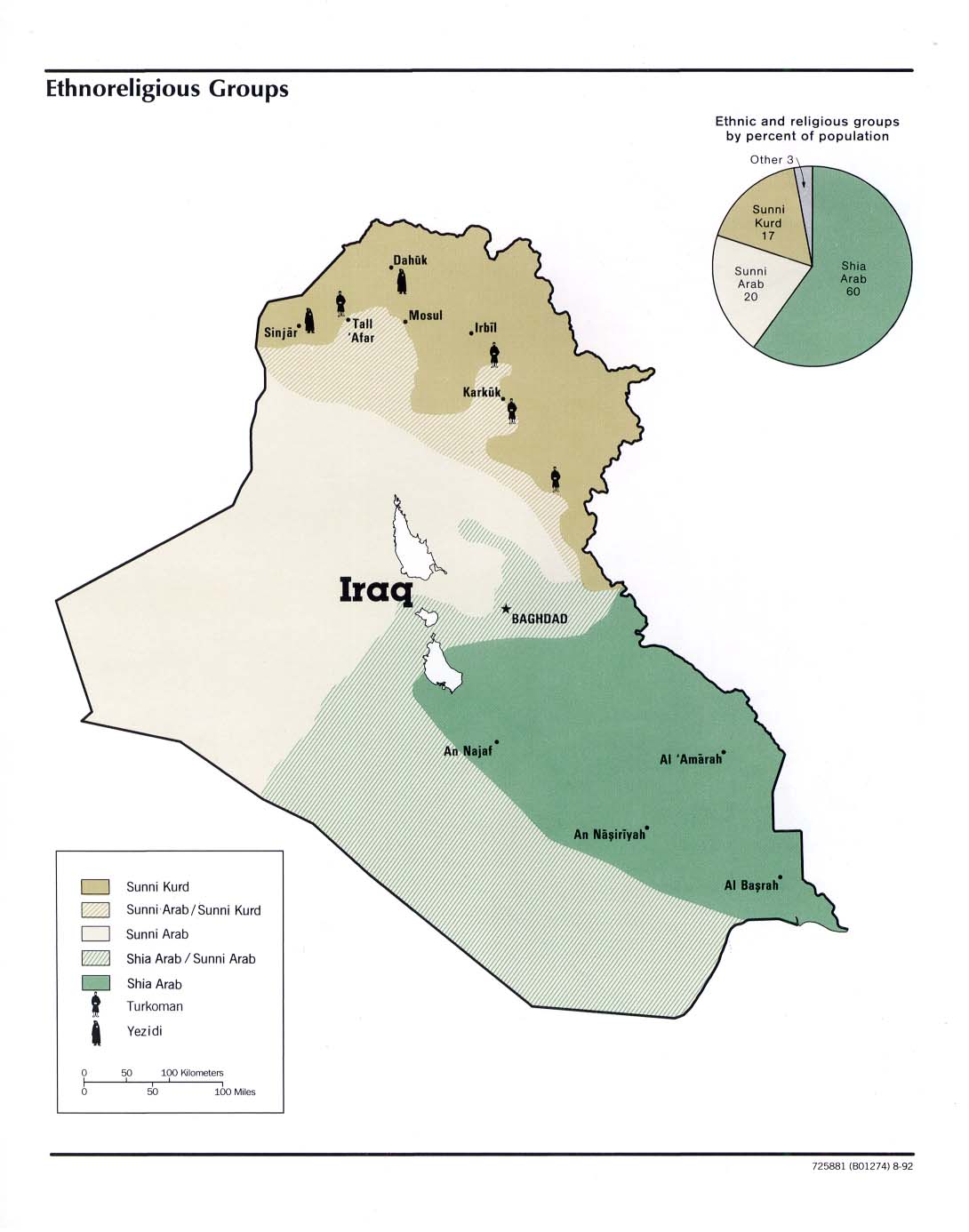
Part of the problem is that before the First World War, nation-states didn't exist in the Middle East--there were various Islamic empires, and provinces, but Islam was the organizing force in society, rather than political states. The creation of the nation-state in the Middle East made things more complicated, but most states chose whether or not to incorporate Islam (with Turkey being the only major state that didn't) into the government. But the growing strength of the nation-state meant that being a minority stuck in a bunch of arbitrary boundaries with a majority sometimes meant that the state denied you adequate protection, opportunity, or access, which led to contention. Therefore, Sunni-Shiite disparate identity led to security dilemmas. Iraq, the state with the smallest majority of either sect (in this case, Shiites hold a mere 60%) in the Middle East, has the strongest prerogative for that kind of security dilemma when the security apparatus of a country disintegrates and future resource-allocation is highly unclear.

While the Sunni-Shiite sectarian civil war should have been foreseen, that does not mean it had been happening over the past 700 years. Obama may have slipped when he said that it had, but Biden's firm repeating and defending of that position to attack McCain just simply means that he has no idea what he's talking about, despite years of experience on the Foreign Relations Committee. Luckily for Biden, being wrong has never stopped him from sticking to his guns before.

Sunday, July 6, 2008

The Iraq-Afghanistan Contradiction

Most of the country still supports a withdrawal from Iraq on a very short timescale. Most of the country also has rather ambivalent leanings towards staying in Afghanistan "until the job is done." Why?

Iraq has shown serious progress for the last year--violence is more than 80% lower than when the surge started, the Sunnis in the west are our closest allies, Al-Qaeda in Iraq is being obliterated by the combined Sunni Awakening, Iraqi Security Forces, and Multinational Forces. The government is making slow political compromise progress, and more is likely to be made after the fall elections equalize representation in parliament. The Iraqi Army's stand-along capabilities are increasing... but the majority of forces still need training. The Iranians are finally starting to help curb the violence among Shiite militias. The American people support withdrawal.

But at the same time, Afghanistan is an increasing disaster. More and more American troops are dying each month--last month, 40 died, compared to 29 in Iraq. The Taliban's /Al-Qaeda's virtual safe haven in Northwest Pakistan makes it impossible for US troops to competently fight them; if the Pakistani government continues to be as unhelpful as they have been since 2001, there is little that US and Afghani troops can do to stifle the growth of the Taliban except try to invade Pakistan's northwest. Without help from Pakistan, this venture is becoming a complete waste of time, and a useless shooting ground for American troops. Americans support staying.

Do we think Pakistan is going to buck up and start fighting the Taliban soon? Or are we, as Americans, so wrapped up in our preconceived notions of morality that our military presence does not depend on results? The military situation in Afghanistan is bad, and getting worse--and there is little our military can do about it without violating Pakistan's sovereignty and possibly setting off another war. But in Iraq, our troops and General Petraeus have shown that smart leadership and good policy can lead to lasting results. Iraq's economy is booming, and its people feel increasingly safe. The end of a US presence in Iraq should come when the Iraqi Security Forces are able to operate independently to keep the security that the US has gained. The end of the US presence in Afghanistan is the one that shows "no end in sight," with a situation slowly and painfully degrading into oblivion.

So why the inconsistency?

Thursday, May 8, 2008

The War for the Soul of the Middle East

Gunbattles have broken out in Beirut over the past few days; pro-government Sunni and pro-Hezbollah Shiite militants and partisans have come to clash, and just today, Hezbollah fighters routed pro-Government forces and took over the capital, Beirut. Lebanon is spiraling into full-fledged civil war, with Hezbollah at the advantage, and Syria or Israel may try to intervene.

Sadr City has been through a slow, draining fight for weeks as US troops have been executing an Iraqi government crackdown on militants; despite former claims of peace and cooperation, Shiite Cleric Al-Sadr is refusing to lay down arms, and his troops have laced Sadr City with guards and roadside bombs.

Iran is blaming the United States and the United Kingdom for a bomb that exploded in a Mosque that killed 14 last month. Iran has further claimed that it refuses to negotiate in its right to nuclear power, regardless of the G5 offer for a deal.

Al-Qaeda has made a chilling comeback in Afghanistan, operating from a squishy home base in the northwest of a defiant and weak Pakistan.

In happier news, Syria and Israel have admitted to secret peace talks, possibly being mediated by Turkey--Israel may be returning the Golan heights, in hopes of Syria supporting Israel's right to exist with only slightly altered borders.

But conflict in the Middle East is growing ever-more complex. Relations are highly polarized along ethno-sectarian lines, along political-religious lines; the struggle between factions along skew axes for the future of the Middle East may mean conflict long beyond--and largely irrelevant to--large-scale US presence in the region.


Below, a religious distribution of the Middle East:


One of the primary axes on which rival factions in the Middle East see each other is religious; largely, whether they are Sunni or Shiite. Within Iraq, most of the carnage between 2005 and 2007 was caused by religious-sectarian warfare, in Lebanon, Shiites are rallying behind Hezbollah forces while the Sunnis continue to back the government. Iran's interest in Iraq lies largely in ensuring Shiite dominance in the country after the United States leaves--and perhaps finding a new ally.

But the factioning is certainly more complex than religious. There are ethnic divides--largely between Arabs and Kurds or Turks and Kurds in the region--but these disputes are surprisingly straight-forward. Religious extremist terrorists certainly make up one unified faction across the Middle East; but Iranian-American power politics complicates matters significantly.

Iranian Faction: Made up of Iran, Syria, Hezbollah, many Shiite militias in Iraq, (in part) Oman, and (in part) Hamas. Strangely enough, Syria is a vast-majority Sunni country, and Hamas is almost entirely a Sunni party, but both have aligned with Iran due to power politics and security interests. Iranian weapons--including guided missiles--are prominent in the Hezbollah arsenal that it is unleashing upon government forces; Iran's continued funding of Shiite factions in both Lebanon and Iraq has the US administration convinced Iran will go to expensive and violent ends to keep pro-Western governments out of the region, and raise as many pro-Iranian ones as possible. I am inclined to agree. It should be noted that this faction makes up the vast majority of anti-Israeli forces, and Iran could try to coordinate disruption of Israel by Hezbollah and Hamas simultaneously.

US Faction: Made up of the United States, Israel, pro-government Lebanese and Iraqi forces (including the Kurds and Awakened Sunnis), (in part) Turkey, (in part) Saudi Arabia, (in part) Jordan, (in part) Kuwait, pro-government Afghani forces. While the US lacks combat partners in the Middle East, many of its Arab friends are willing to both host US forces for protracted warfare, and have recently boycotted the Arab League convention in Syria due to its interventions in neighboring countries. The United States continues to hope that its presence can not only stabilize the region, but create a preponderance of Western-leaning states to counter Iran's power and pressure Iran regionally into behaving (namely, disarming its nuclear arsenal and cutting off its terror funding). The US faction looked like it was making great gains in late 2007, but 2008 has been a series of setbacks, ending most recently with the collapse of Lebanese stability and rule of law.

Religious Extremists: Mostly Al-Qaeda and associated factions. While their presence is waning in Iraq, it remains strong in northwest Pakistan, and their ability to operate in Afghanistan is frustrating US efforts to create a stable state. Their goals are clear: total US withdrawal from the region, collapse of pro-Western governments in place of Sharia ones, the destruction of Israel, and the death of one Westerner for every Muslim killed (ever, really) by a Westerner, from the crusades to the Iraq War. While they may have silent approval to disrupt Iraq from Iran, no current Middle Eastern government wants Al-Qaeda style militants within their borders, regardless of what power faction they are on.

Al-Qaeda is unlikely to win this struggle, but it will make life extremely difficult for both factions. It may even unite rival groups to some degree (as it has the religious factions within Iraq) if for no other reason than to attack Al-Qaeda. But US opportunities to flex its muscles in Iraq are on a short timescale--after the 2008 elections, pressure to withdraw troops is likely to reach a breaking point. If the United States withdraws without creating a Middle East that can individually resist Iranian intervention, Iran is likely to make great gains. The United States leadership is likely to sacrifice political success (in the form of low death tolls) for progress in routing Shiite militias (as it has done for the past few weeks), in the hopes that it will not face new political pressure to withdraw until the end of the year, and that destruction of these militias will leave Iran much more impotent in Iraq.

Israel may take Hezbollah's hostile takeover of Beirut as an opportunity to settle a score that many analysts have predicted has been years in the making--since the Summer 2006 war. If Hezbollah becomes the government-by-coup of Lebanon, then Israel gains the legitimacy it needs to attack the country as a whole if Hezbollah forces attack its citizens. If it declares war on the government of Lebanon, it is not as likely to try and "hold back" as it did last time, but unleash the full fury of its forces for the first time since the 1970's.

For now, the war for the soul of the Middle East remains in stalemate.