Showing posts with label War. Show all posts

Wednesday, November 28, 2012

Why Did Israel & Hamas Go to War?


For better or worse, this post is likely to leave the reader with more questions than answers. I'd love any input/comments that readers have on the matter here (as always).

Before the assassination strike on Hamas' military leader Jabari, Hamas political leadership was making serious noise about a permanent truce with Israel (in fact, Jabari was literally reviewing a draft peace agreement the day he was assassinated and had been part of discussions with Israel and Hamas' political wing about making it happen), and West Bank PM Abbas mentioned he was potentially willing to waive Right of Return for Palestinians as part of a final peace deal with Israel. It seemed, politically, that Israel was largely getting its way.

Then why the assassination? Why the war?

There are potential motivations on both sides for going to war, which we'll outline below. Not clear at all to me which was the primary motivator.

HAMAS:
Hamas is, of course, far from a united organization. In particular, I must be careful in the use of the word "Hamas" when describing behavior from Gazan militants, as not all are necessarily formally associated with Hamas and may not represent Hamas' interests. In this case, Hamas extremists or other militants likely wished to disrupt the peace process, unsatisfied with its provisions and worried that it might go through if the peace process continued unabated. Hundreds of Hamas rockets were the opening salvo in this eight-day war, and so the above explanation is a reasonable one to answer the question, "why did these rockets launch _when they did?_" If the motivation was 100% on the Hamas side, then we would say that Israel simply "took the bait" and was manipulated into war that disrupted a peace process that they would otherwise be in favor of. The assassination of Japbari, in this case, would have been a strategic blunder to an Israel otherwise very interested in peace.

More legitimate wings of Hamas may have also approved of these rockets in order to sabotage the peace process themselves, in order to make sure there was a clear pretense of peace on the Hamas side without risking having to actually stick to it, in order to win the support of the Arab world, in particular Morsi. If this was the intent, it worked--Morsi was able to broker a ceasefire and very clearly backed Hamas in the war, which would be the first time Egypt supported Hamas against Israel since the 1970's.

ISRAEL:
Frankly, the Israeli defense authority is highly sophisticated and I believe it is unlikely they simply made a mistake and, in response to rocket fire, assassinated _in error_ the man most likely to be able to broker a peace deal with Hamas permanently. The reason I am particularly suspicious is that the assassination of Jabari was among Israel's first strikes, rather than simply strikes against Hamas' rocket sites. I believe, like in the case of Hamas, there are some political incentives that made parts of the Israeli government want to disrupt the process as was.

One explanation is simply that Netanyahu could not appear "soft" during negotiations. If Israel calmly/peacefully negotiated peace as rockets hit its civilian cities, it could potentially be seen as "soft" on Hamas and thus in a weak bargaining position. If Israel saw Jabari as trying to play both ends--authorizing strikes against Israel and also trying to push a peace deal--then Israel may have intended to send a message to his successor that "playing both sides" against Israel would not do. Unlike Israeli troops, Hamas rocketeers are generally woefully under-accountable in the international media for their attacks, and if Jabari intended to use this to his advantage, Israel may have felt the need to put a quick lid on it and allow Jabari's successor to restart such negotiations with more caution and restraint.

Israel could have also "read" Hamas' intent--if it was to simply gain an upper hand with the Arab world through credible noises of negotiation, rather than actually push for peace--and wanted to stop this process in its tracks before it lost leverage in the region, though Israel seemed to summarily fail in this.

Israel's current leadership may well not intend for peace with Gaza any time soon. Peace in general may simply be unacceptable to an administration that sees Gaza as an eternal threat for Iranian influence and other forces that may be out for the demise of the Jewish state. Israel may have a quiet policy of no peace with Hamas until Israel's legitimacy as a state is recognized. For various reasons, Israel may see constant war with Hamas (including a blockade of Gaza to minimize the armaments and militants that can enter) as a safer alternative to peace, as counter-intuitive as that may seem. If this is the case, it will continue to sabotage peace efforts until there is a better way to guarantee security in a free Gaza situation, or until a more short-term risk-accepting administration takes the helm.

Finally, Netanyahu may simply want to take advantage of wartime fear for his own election in January. Hamas rockets may have been just the pretense a Machiavellian-style Netanyahu (if that is actually his thinking, which is not clear) would need to have a brief flare-up with Gaza in order to convince swing voters in Israel to vote for Likud rather than Kadima or Labor, keeping Netanyahu in power for another term.

Whatever the reasoning, it is more or less evident at this point that some parts of both Israel and Hamas had interest in disrupting the peace process, and took advantage of this time period to act. To set the record straight, Hamas' rocket attacks on Israel did happen before the assassination of Jabari and seemed unprovoked--this accounting of events is not clear in all texts. But I also believe it is fairly naive to think that Israel's assassination of Jabari specifically (rather than simply a precision strike against Hamas rocket sites, which it also successfully executed) was simply part of a general defensive strategy rather than a very political move.

Such an interpretation would suggest that peace is likely to be elusive in the area for some time to come.

Friday, July 2, 2010

Afghan War Intensity Up--A Sign of Hope?

100 ISAF servicemen died in June--the most since the Afghanistan war began. it's a terrible number and a tragedy, absolutely.

But: there is a sign of hope in the increased intensity of the Afghan war.

The Taliban is increasingly on the offensive--bold (and sometimes reckless) attacks against American and Afghani targets are well on the upswing.

What's this mean? Why the change? The easy answer is to say, "they're getting stronger, and want to deal a finishing blow." This is, certainly, what the attacks are meant to imply.

But the story is more complicated.

The question to ask is: what is the Taliban's winning strategy?

The answer, by the way, is to wait out the US. The US will leave eventually. It will not stay there forever. If the Taliban can slowly swell its safe base of operations, it will win, as the US will eventually grow tired and fade away.

Three series of events are happening in parallel:
1) The US is stepping up drone/special operations in Taliban strongholds in Southern Afghanistan (like Helmand).
2) Pakistan is stepping up full-scale military assaults in Taliban strongholds in northern Pakistan (like Swat and Northern Waziristan).
3) The Taliban is stepping up bold offensives against the Pakistani Government, the Afghani Government, and ISAF.

I think you might be able to see where I am going.

Why the boldness, if the Taliban wants to wait for the US to leave?

The obvious guess is that the wait-it-out strategy is not currently viable.

ISAF and Pakistan are working together on an offensive. As we saw in Iraq, offensives cost lives. They hurt, the numbers look bad, and the American public grows quickly impatient.

But, potentially, they work. Certainly, a lack of offensives will fail. Preventing at all turns a stronghold for the enemy is a necessary (though not sufficient) part of COIN. It seems like this costly measure is starting to pay off: bold Taliban attacks on ISAF sites imply that there may be a desperation on the part of the Taliban to pressure NATO out of Afghanistan quickly. If that's the case, then the Taliban thinks that waiting is no longer in its favor.

The alternative hypothesis is that the Taliban is so strong that it's trying to deliver the "final blow." First, this doesn't make particular sense, strategically--the Taliban is traditionally quite terrible against ISAF in straight-up gun battles, as the past month has shown. If the waiting-game is a winning strategy, then there's no reason the Taliban would grow impatient and start putting its fighters at higher risk. It's been fighting a 25-year war for Independence. Its time horizon is much longer than a few months.

Second, the US is already scheduled to start pulling out of Afghanistan--there is no particular need or reason to try to "hurry" them. This is the perfect situation to, if possible, keep the "wait-it-out" strategy going.

If the Taliban is on the offensive, it's because it can't be on the defensive. Its strongholds and safe areas are being threatened and broken up. For sure, we know its lines of communication are being disrupted--making its attacks decreasingly coordinated and effective.

There is hope. There is a whole lot more to do than disrupting the Taliban's footing in the AfPak region to ensure victory in Afghanistan. But it is necessarily the first and most important step in winning the war (creating a stable, functional, credible central government to take its place is another story altogether).

Keep your eyes up in the next few months for Petraeus to continue to apply his modified strategy from Iraq--potentially successfully.

Tuesday, May 25, 2010

Untangling the Korean Peninsula Conflict


Mystery shrouds the current Korean Peninsula conflict about as much as it shrouds the North Korean government itself. A few readers have asked me, "what the heck is going on up there? Why the heck did North Korea attack South Korea?" Good question! It had me thinking & reading for a bit.

Why did the North Koreans sink the Cheoan?

There's no clear answer for this. The government officially denies doing it (which is not surprising), but it seems a relatively irrational thing to do. To understand the most likely possibility, one must understand the politics of North Korea. At least a bit.

Like most dictatorships, North Korea's government is propped up by elites (in this case, primarily military elites). And, like all governments, they faction. Long story short, Kim is old & frail, he's picked a potentially weak successor, and an opposition faction is likely trying to make a play for power. If South Korea had retaliated, chaos would ensue (North Korea would be caught unprepared for a war), and an opposition faction would have a much stronger opportunity to seize power from Kim (and likely quickly declare an end to the war by being a new regime).


As such, the coup likely failed. Whether there has been a purge is probably going to be unclear, but North Korea's lack of followup to the attack (and lack of military readiness at the time of the attack) both indicate that it was not an order from the top, but rather an order from much lower on the chain of command--likely meaning some attempt at insubordination.

What the heck are the Chinese doing in response?

Another good question! China's response seems to be arbitrarily contradictory. By inviting Kim to Beijing (and leaning towards "no" on international reprimand in the UN Security Council), China is taking a major international hit... in particular with South Korea and the United States, two of its biggest trading partners. China seems to be encouraging North Korean aggression.

But after a conference with China, Secretary of State Clinton came out speaking surprisingly rosy about China. Why?

Again, we must think of Chinese politics. In a Korean Peninsula war, what does China have to lose? It cannot and will not send troops or supplies to assist North Korea, and with the help of Japan and the United States, South Korea would rout the North Korean army (though Seoul would likely take serious damage in the meantime). China would be stuck with a collapsed North Korea, and an angry (and rather economically devastated) South Korea. The collapsed North Korea would send millions of starving, brainwashed refugees into northern China--a disaster that China is not prepared to face.

China's greatest concern in Korea is stability. It cannot afford a collapsed regime. This explains its stance--first, by inviting Kim to Beijing, China makes it clear to any opposition that Beijing will back Kim's faction, and help it keep power. Beijing was also likely able to get reassurances from Kim that he will purge the aggressive opposition, and also refrain from further provocations of South Korea... at least for the time being. China must also restrain from doing too much to anger Kim, lest Kim feel isolated and threatened. By befriending Kim, China gives Kim some security, allowing Kim to refrain from any foolish lashings out. Secretary Clinton understands this position, and thus was able to express confidence that China would effectively help prevent war in the Koreas.

What will happen from here?
South Korea cut off trade with North Korea, and North Korea followed by severing all diplomatic and communication ties with South Korea, and put its army on full readiness. South Korea further retaliated by opening up propaganda messaging into North Korea, and participating in anti-submarine drills with the United States. The Sunshine Policy is over.

For now, the conflict will drive South Korea (to some extent) away from China and towards the US/Japan. South Korea will seek stability in US strength. China will show North Korea that it is ready to defend North Korea from internal threats, but will not support it in a war against South Korea--North Korea's only rational recourse would be peace.

North Korea will desperately attempt to retain face by growing increasingly perturbed over accusations that it carried out the attack. It will accuse the South Koreans of setting up the attack themselves to provoke a war (sounds far fetched as an accusation, but many Americans think the same of the 9/11 attacks).

As far as war, I think it is unlikely. Neither country has a serious interest in it. Sino-American relations will not be particularly strained by this, but China will see any actions against North Korea as being a favor to the US (stacked on top of any favors that China does for the US with respect to Iran).

The Peninsula's best hope of a reemergence of peace might, unfortunately, be the death of Kim and a new regime leader.

Tuesday, January 12, 2010

Is Helmand Being Quietly Won?

I got up today rather early in my hotel (at a job that has thus far slayed any hope of me posting, for which I apologise. I am hoping to post more) and found a newspaper, perhaps a USAToday, that mentioned on the front page a few comments by General Mills about Helmand. I've heard little else (this limited to some poking around on Google News, CNN, BBC, and Fox).

Mills believes the Taliban have been all but driven out of Helmand. We're not "making progress," we've apparently won, and are now in a phase where we just have to hold and build. Though "just" may not be the right word, there. Offensives are always easier than defenses. And "building" may often mean "bribing effectively," which is not a sustainable practice.

Even if we're quietly winning Helmand, it means disappointingly little of the Afghani government and Army cannot get off the ground. But the US can extend its leverage using the Helmand victory in 2 ways:
1) it can use troops there to train/enforce the army and police, as well as actually build infrastructure, rather than fight Taliban;
2) it can focus its offensive attention elsewhere.

The danger ultimately lies in the Karzai government once again trying to step back and let the US fight its war as Karzai's cronies line their own pockets. The Obama administration seems to have put some pressure on Karzai with its promises of withdrawal, but the pressure will have to continue. The Helmand victory shows that the US can, given time and dedication, beat the Taliban out of any province that the US is legally allowed to operate within. Superior strategy will have to dictate how the US turns such victories into long-term results.

Wednesday, September 23, 2009

Ambivalence, Indecision, and Defeat in Afghanistan

Barack Obama is in perhaps what will be the toughest spot of his presidency.

With poll numbers slipping, independents fleeing, his touted healthcare bill staggering, the economy sputtering, and other domestic mayhem, Obama might be hoping right now he could fall back to a solid foreign policy base.

But the decision to remove the missile shield in Poland and the Czech Republic is proving more controversial than once thought. His tripartite summit with Abbas and Netanyahu was a flop. Iraq is struggling enough to make headlines, and he has no answers. The Afghanistan election was a disaster, and now, as more American boys die on the field and signs of Taliban dominance increase, Obama is faced with a nasty choice that he didn't want to make yet.

General Stanley McChrystal (head of ISAF and the US Military's lead man on the AfPak region directly under Petraeus' command over the entire Middle East) has publicly called on the president to make a choice: Go big or go home. That is, send more troops, or quit. The current path will only lead to failure. I'm inclined to agree with the General.

The General claims that the current troop count in Afghanistan is simply insufficient--the US is spread too thin and losing. Obama, despite his initial popularity with the US's allies, is finding himself without the clout to request more troops from Australia, England, Germany... certainly not former Soviet Bloc countries (who were so generous to President Bush) after the missile shield debacle (which, to its credit, is supported by the non-partisan and sage-like Secretary of Defense Robert Gates).

The General, who is trusted despite not being particularly well-known, has given Obama a great public challenge in a time when his leadership is being questioned and the risks he is currently running in policy have become much higher and much more unlikely than he was hoping. The domestic roadblocks he's hitting now (which seemed unfathomable after he swept the election) make risks in foreign policy all the more politically difficult.

But politically, the choice that Obama has to make may be a loss either way. Support for more troops in Afghanistan is less than 50%, and if he should send more and casualty rates should continue to increase, and defeat should follow, Afghanistan will become Obama's Vietnam. If he should pull out now, the United States will be overcome with a similar sense of defeat and humility, and the GOP will be able to spend years questioning his wisdom as Commander in Chief.

The risk that President Bush took by appointing Petraeus in Iraq and "doubling down" in a situation where the country wanted to pull out must be appreciated. But Bush, an idealogue, understood that his party was likely to lose the election either way, and was able to act with a strange sense of futile freedom. The risk happened to pay off, and Petraeus' military genius was given the time it needed to shine. But the problem in Iraq, in a strange way, was easier to fix, if not more simple.

In Afghanistan, a corrupt dictator has arose to replace the paladin saviour of the country--and both men go by the name Hamid Karzai. No longer can the US simply back the "legitimate" government against the evil Taliban--the government has begun to lose its legitimacy. Without any legitimacy or moral high-ground in the central government, the US has nothing to fight for, and should leave. But, in a period of domestic political turmoil, admitting defeat would be politically catastrophic.

The election is not over yet. The Independent Election Commission has not yet, in fact, declared any winners in the campaign. UN intervention could lead to a second round of voting, in which Abdullah has a chance of winning, and (hopefully) cleaning house--with Kabul's legitimacy restored, Obama can take McChrystal's advice and double-down, as Bush did in Iraq... and hope that the investment pays off before the 2010 elections, lest the struggling Democrats suffer a slaughter similar to the 1994 turnover. Obama would surely take much of the blame.

If Karzai manages to hold onto power and award the cronies that helped him clutch to it, the game may be over. But this outcome is not assured yet.

For Obama, politically, the right choice certainly seems to be to wait, under the guise of his administration conducting a "strategic review" of the situation. But how long can this wait? How long can he delay before his ambivalence turns into a very loud and public liability? Surely, he is pressing for the IEC to hurry up and make a decision, but the second vote won't happen until late October, should it happen. Strategic ambivalence must wait until then.

But unless Obama has a series of decisive decisions lined up to react to the outcome of the election, he will be stumbling into doom. His foreign policy inexperience is starting to show, as he finds that rhetoric and hope cannot alone drive success in an international anarchy of realist, idealistic, and skeptical foes.

In Afghanistan--the US's deepest foreign policy investment--indecisiveness for too long will spell disaster. The political machinations of reality are coming to a head, and a decision to go all in or cut our losses must soon be made. The decision rests on one man: expect it soon.

Saturday, May 30, 2009

Taliban Attacks Signal Desperation

The Taliban have had many recent opportunities to learn how to fight a good insurgency in both urban areas (from Baghdad/Diyala/Mosul/Basrah, etc) and rural, desert areas (Afghanistan, Anbar). There's a lot of smart stuff they've been doing in Afghanistan to keep NATO off-balance. But in Pakistan, their mistakes are starting to grow--and show.

Part of the problem is context. The Taliban are recycling some old concepts that have worked in the past, but are not particularly useful here. The two of note are its strategy in Mingora, and its attack strategy in Lahore and Peshawar.

The Taliban Mingora strategy--to sit and hold--had worked before. Ineffectual Pakistani Army attacks in the past balked at real resistance and urban warfare, dissolving before damage was seriously done. Further, such defeats crushed morale and domestic support for military operations. Doing the same seemed wise enough, but the Taliban did not estimate the ire they had caused among the Pakistani people. With domestic support, the Army was able to send a sufficiently sized and resourced force to retake Mingora rather easily (much more easily than the US took Fallujah). The Taliban were not prepared.

Perhaps as importantly, the Taliban offensive strategy is almost certainly a mistake. They're taking a few pages out of the al-Qaeda book, trying to intimidate the population into submission with attacks (although on police) in multiple cities: Lahore and Peshawar so far. Islamabad is probably next on the list of targes. The idea, of course, is to let the population know that they are not safe as long as they continue to assault--that the Taliban can hit anywhere, at any time. This isn't strictly-speaking true, but they certainly want to give off that impression.

Unfortunately for the Taliban, such attacks are likely to bolster the emerging story told in Pakistan that not only is the Taliban a major threat to Pakistan's survival, but they're an urgent threat to the individual citizens of Pakistan right now, and must be cleared sooner rather than later. When dealing with a committed enemy, minor hurts tend not to deter them--only enrage them. If the Taliban is going to try and beat Pakistan at this point, it will either require staying sufficiently below the radar that the current commitment dissolves, or require destroying their capability right now--which is highly unlikely. But after years of offensives, the Taliban may not have the patience nor the wisdom to be able to seep back into the walls and make themselves hard to hit. Hard-won territory in Swat and Waziristan will unlikely be easily given up--but by choosing to take the Pakistanis head-on and agitate their population, the Taliban show a level of desperation to keep their position that will ultimately be detrimental to their cause.

Tuesday, May 26, 2009

DPRK Abandons Armistice

Which means official, serious-business war with the ROK. More on this as soon as I know it, folks.


Sunday, January 18, 2009

Calculated Madness


The New York Times has a fine article about the "calculated madness" of the Israeli attack, and its analogy in the Hamas circle. But I'm not going to re-hash that.

I intend to consider the validity of Israel's conclusions on its war. Israel took down a lot of Hamas infrastructure--and because Hamas is so ubiquitous in Gaza (it is pretty much everything), Israel took down many houses, schools, Mosques, etc. As far as I can tell, nothing hit wasn't either A) a legitimate Hamas target, or B) a complete mistake, but in war, intent is a very small part of the story.

Israel believes that it has taught them a lesson, as the Chinese are fond of saying in their wars. It strolled in, delivered a beating, and left. It wasn't going to destroy all of the rocket sites. It wasn't going to take down Hamas, and alas, it certainly didn't. This war was meant to show Hamas and its supporters that throwing rockets at Israel wasn't worth the risk of massive retaliation. Did that work? Indeed, can that work?

Israel's hope is that the sup;porters of Hamas, while angry at Israel, will question the wisdom of voting for Hamas. This is somewhat likely, but they may also be purple-blooded. After the Sept. 11 attacks in the US, Americans did not question their foreign policy, except perhaps in concluding that they were being too shy, too meek, too peaceful, and too generous (in conflict with pretty much the rest of the world). While the analogy between the 9/11 attacks and the Israeli war is pretty weak, it makes a strong point: can beating on people make them more calm and peaceful? The Blitz of London, the 9/11 attacks, the bombings of North Korea, the Rape of Nanking, they all say otherwise. But they were all primarily anti-civilian attacks. Can Israel make a clearer message by having almost exclusively attacked Hamas-related targets?

Perhaps. Israel has to make two messages clear: 1) Hamas got Gaza into this mess by refusing to stop launching rockets, and 2) that the Israelis were genuinely trying to avoid civilian casualties. The second will not make Gazans less angry at the Israelis for their friends and family dying from shell fire, but it will allow point #1 to have more salience. And that is the important part--if Gazans can say, "Hamas' irresponsibility is why the Israelis attacked" (whether or not it was deserved, etc), then they will back down.

A good example of this is Europe. Russia has recently been, for lack of a better term, insufferable and hyperaggressive. They have gone after Ukraine (with gas) and Georgia (with tanks) for minor provocations. But even though the Russian response was far out of line (and resembling that of a child's temper tantrum), the European Union has questioned the wisdom of continuing to agitate the Russians--particularly, it has questioned a continued policy of trying to subsume Georgia and Ukraine into NATO. Indeed, while Russia's actions have been largely unjust (particularly in Georgia), Europe has taken the posture that Russia is an entity whose disposition and behavior are both A) unlikely to change soon through any measures, and B) rational, even if unfair and disproportionate. And so the Europeans have acted just as the Russians have. So might the Gazans, if the Israelis can impart the same sense of causal linkage between the rockets and Israel's attack (as Russia did between Georgia's shelling of South Ossetia and its own assault). If that link can become salient and vivid for Gazans, then they will either pressure Hamas to change into a more reserved military entity, or they will vote them out. Either, to some extent, is a victory for Israel. But now that the 3-week assault is over, the propaganda war will only intensify.

Friday, January 9, 2009

The Gaza Rockets

So really, the big deal in this seemingly unending conflict between Israel and Hamas, the weapon of choice for igniting the fire of war again and again, is the Qassam Rocket.

You may have been wondering what the deal is with these rockets, because either the Israeli people are actually all invincible from birth, or these rockets are really not that great.

Today, we'll have a closer look at what these rockets actually look like, how they work (or don't work), and why they're being used.

To your right you should see an image of the regular Qassam Rocket. Hamas paramilitary fighters are conveniently located next to each rocket to give you a sense of scale.

There are 3 broad types of Qassam Rockets (QR) varying in length from 2 ft 7 inches - 6 ft 7 inches (Just about the height of a regular doorway).
The body of the QR is a cylinder of regular grade steel, with guide vanes placed at the bottom for guidance. The nosecone and upper section are packed with as much explosives (TNT) as possible. The rocket motor is a solid fuel type using a mixture of sugar and fertilizer for fuel.

Below is a video of the QR in action (catchy music included!). Skip ahead to the 2:00 min mark to see construction process. You can see the rocket motor being installed, the sections being welded together and the solid fuel mixture being cast (that bit where they pour the orange liquid into a mould).
During the video keep an eye out for the corkscrew rocket contrails.


So, we can see that these rockets work because they're so incredibly simple. These rockets operate using the exact same principle as those model rockets you played with as a kid. The only difference is that your rocket probably didn't have an explosive payload. All you need to make these rockets yourself is some stock steel and a welding machine. Fertilizer and sugar can be picked up at your local hardware store and chemist.

But let's face it. These rockets just...suck.
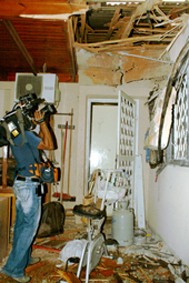
An image of a QR attack on a house in Sderot.
Yup, that is in fact a butane/gas tank surrounded by flammable material, all very much un-exploded.

The Gaza rocket attacks started in 2001. The first Israeli fatality was in March 2007 . That's a pretty poor track record. The reason for this continued poor performance is twofold: 1) Construction techniques. There's only so much targeting you can do with an unguided missile. The most important part is lining up the guide vanes. Remember those corkscrew contrails I was talking about? When you see those, you know the guy who put the rocket together did a botch up job. Corkscrew's means the rocket is wasting energy in spinning around instead of using the energy to go further which means less range. It also means you can't aim the thing worth a damn, because where you point it is not necessarily where it is going to go.
2) It is not meant to inflict large amounts of damage. It's meant to terrorize people, and it is working. The people of Sderot (the primary target for these attacks) must hate those things with a passion.

Summary: The Qassam rockets are extremely easy to manufacture, require very little technical skill to operate and are largely ineffective in terms of physical destructive potential. Poor manufacturing technique further inhibits the ability of this rocket to be a real threat to a militarized nation such as Israel. The rockets are being used to terrorize the populace and to provoke a response out of the enemy government, which can later on be pointed to as further "proof" that the attacking nation is in fact the victim of an overzealous and aggressive neighbour. Underhanded, yet apparently effective, tactics.

Wednesday, January 7, 2009

Will Israel Succeed in Gaza?

Thus far, it seems that Israeli tactics are proving to be fairly effective.

Here are some reasons for why they might actually succeed in their objectives:
  • Minimal Israeli casualties: 7 by the latest count (report here)
  • At least some Palestinians are starting to realize that poking the proverbial dragon with a pointy stick, will in fact end badly. Maybe the traditional insurgent/terrorist tactic of 1) Using the civilian population as a meat shield and 2) Blaming destruction of said meat shield on the enemy, has finally started to backfire on Hamas. There might be a trend of falling popularity. There are some vague western media reports in support of the theory but counter examples are just as easy to find (as well as the bizarre...).
  • Isreal is pretty damn good at what they do:

When the dust finally settles and reporters are given more freedom to enter the Gaza strip, maybe then we'll have a better idea of where Hamas ranks popularity wise with the Palestinians and whether Israel really did what they wanted to do: stop the rocket attacks.

Monday, January 5, 2009

Israel's Confidence is High

Israel is starting to hint that they have full intent to take down Hamas with this war in Gaza (though this has been pretty obvious for a few days now). Their confidence that they can do so is surprisingly high, as well--Israeli officials are calling Hamas "crippled" in a few ways: its physical governance infrastructure is ruined (parliament building, police buildings, etc), its leadership is dead or in hiding (having abandoned its population), and its popularity is going to drop.

Though the popularity of Hamas is currently rather high, the Israelis think it will go down significantly in the next few weeks as Palestinians wonder whether a militant anti-Israel stance is one that is going to serve them well in the future. In particular, if Hamas is unable to provide governance, order, medical supplies, etc after the war ends, then their support will erode. Pre-war, Fatah already had an edge in Gaza polls. When the Palestinians have elections, probably in April 2009, Fatah will probably have quite the edge, even in Gaza. And if it does, and if Kadima can hold on in Israel, then the whole situation in Palestine looks a lot different. Israel will probably do what it can to enforce Fatah's right to govern in Gaza Strip, and help clean the strip up before working on serious two-state talks.

Such confidence is strange, coming from an Israel that lost a 2006 war in Lebanon due to overconfidence and poorly-defined campaign goals. Israel had been showing serious conservatism in its war goals early on: the air campaign was aimed at reducing rocket attacks, not even eliminating them. While Israel is not saying that they have changed their goals to the toppling of Hamas, they are certainly saying that it's likely that they will, and that they're quite happy for it. This means one of two things:

1) Israel's government did not learn a lesson from its tough defeat, even though I was able to graft that lesson from my seat in Cambridge, or,

2) Israel is actually well and truly crushing Hamas' governance and combat capabilities.

Occam's Razor says it's probably the latter.

Despite confidence, Israel remains conservative. They have not given in to goading and luring on the part of Hamas to enter Gaza City or other urban areas for street fighting. They have kept their total military casualties to one, suffered on the first night of entry. Israel's targets have been picked with deliberate caution, as well: Palestinian medical authorities have reported only 16 children dead, despite a strong incentive to over-report. Hamas has claimed that half of the over-500 killed in Gaza are civilians, but there is a strong incentive to over-report here, as well: Hamas loses face by reporting its own fighters killed, and gains support by claiming that Israel has killed civilians. Given how informally one can join the Hamas paramilitary, it will be impossible for these figures to ever be confirmed beyond academic estimates.

So things seem to be going well for Israel so far. They have a lot of work to do, and in particular, Israel must keep up strong diplomacy with Jordan, Egypt, and Lebanon, in order to keep its free military reign in Gaza. But such support should have wavered days ago if it was going to. Israel appears to have a serious shot at crippling Hamas for good and, despite the cries of many protesters to the contrary, contribute to long-term peace in the Middle East.

Sunday, January 4, 2009

Analysing Israel's Gaza Tactics

After a day of war, Israel stand at one dead and about 40 wounded. They say they have killed "dozens" of Hamas militants, but they are struggling with their opposition using civilians as human shields in the fighting.

Let me first digress by expressing my own personal sympathies for Israel's difficult position. After returning full control of the Gaza strip to Palestine, Hamas used a civil war to wrest power, and has been using it as a safe haven to accumulate rockets from Iran and other sources to launch into Israel constantly, even during a six-month ceasefire in which Israel was relatively disciplined. Israel provided the majority of Gaza's fuel, food, electricity, and medical aid at no cost--despite access to the Mediterranean and Egypt, Gaza's Hamas leadership has held Gaza's economy back--gross mismanagement and excessive, corrupt government bureaucracy have made sure that Gaza's market has not spun up at all. Hamas hands out aid received by Israel, and takes credit--keeping its popularity high among its many poor and jobless. Hamas seems to take very little flak from its own people for storing weapons in Mosques and orphanages, or by using civilian human shields as they fight Israelis. The Arab world is starting to flare up in protest, and otherwise-moderate Arab governments have to condemn Israel's invasion to halt rocket fire--after relatively patient and persistent warnings to stop, offers to negotiate, and months of restraint--as a "war crime." Luckily for the Israelis, Egypt continues to stand by them (to what extent they can), and the Arab League is unable to spin up the momentum to actually meet over the crisis. The US will block any UN resolutions to officially condemn Israel in any way. Even US Senate Majority Leader, Harry Reid, has said that a ceasefire is impossible until Hamas offers to halt rocket fire. So even if this war lasts for a few weeks, the US will not be switching teams on a dime.

So Israel is now elbow-deep in this problem--what have they actually done? According to relatively scattered reports, Israel has already cut to the Mediterranean and has surrounded Gaza City and other urban centers, as far south as Netzarim, but the Israeli Army has been disciplined enough to avoid entering any major urban areas, where the Hamas militants likely have a great advantage (with huge numbers of civilians that the Israelis have to worry about, potential booby traps, and other "home turf" advantages like knowledge of the terrain, friendly homes, etc). A map I put together below should make it a bit more clear where the Israelis have gone.
Approximate Israeli Movement and Positions (Click for Larger)

Their staging ground was Sderot, on the northeast corner of Gaza. From there, Israel broke in during the night and cut power to most of the northern half of the strip, taking advantage of night fighting technology to strike their initial blow (and most of their advances in the last day). The Israelis are likely to continue using night to press their primary assaults in search of rockets, launch pads, and Hamas leadership. Note that with Gaza City surrounded (and certainly extremely strict policies for anyone escaping), Hamas leadership isn't going anywhere soon (for the Israelis control Gaza waters, as well). Special forces have an opportunity to use what intelligence that Mossad has gathered to take them down in the capital city if they weren't smart enough to get out early.

At this point, Israel looks like it is going to focus on a search-and-destroy mission in the north, and then perhaps move south to mop up militants that got out--it is unlikely to spread its 3 brigades so thin as to take the entire strip at once. Israel also has troops ready in Jerusalem and near Lebanon in case West Bank Palestinians or Lebanese Hezbollah militants try anything tricky to help out their brothers-in-arms.

So the easy part is over, with few casualties for the Israelis, but the hard part--search-and-destroy--is just beginning. The success of the rest of this mission will depend on Israeli tactical intelligence abilities more than brilliant ground war operational capabilities. Israeli unit tactical training will face a test, as well.

But this mission really has more substance than simply finding rockets, or even toppling Hamas leadership. After failing to meet its objectives in Summer 2006 in Lebanon--namely, preventing rockets from hitting Israel in the north--Israel is hoping to regain its deterrent capabilities with neighboring militant groups. Israel is unlikely to face a regular war with its neighbors in the near future--their willingness to negotiate has a lot to do with Israel's ability to bloody them up if they choose to fight. So far, Hezbollah has chosen to sit this one out (so far), and read (though I've lost the link) that there are rumors floating about Hamas heading to Egypt to talk potential ceasefire options. So maybe it's working.

Saturday, January 3, 2009

Gaza Land War Begins

Israel is now holding nothing back against Gaza--its tanks and infantry have entered the strip with the public intent of capturing Hamas rocket launching sites (and likely very large weapons caches nearby) and dismantling them. The Israelis are also likely sending in large numbers of special operations forces to try and take down as much Hamas leadership-in-hiding as possible.

There's little to say yet on the operation, except that it shows a real commitment for Israel to pay the necessary political costs to take down Hamas in a way that would allow Fatah to take control of Gaza if/when it wins elections that Abbas is calling. Strangely, it may be this very war that enables the Israelis and the Palestinians to make peace. A reminder is due that Hamas does not recognize Israel's right to exist--it is only interested in driving Israel out of the area, and that it took over Gaza strip in a civil war in 2006 after losing elections to Fatah--their continued presence has been a tough roadblock for the Israelis, and it seems the Israelis feel they finally have the political capital with their neighbors to finish Hamas off. And despite all the criticism coming Israel's way, it looks like they're right. But now the fate of this operation depends on the military's ability to achieve its objectives without "mission creep" or a quagmire.

Sunday, December 28, 2008

On the Gaza Air Raid

Israel hit Gaza--hard--for the second straight day today in an air raid. Short of decisive, the attacks are looking ugly, pulling Israel into a mess that they may not be willing to deal with. But diplomatic pressure remains low.

300 Gazans are dead--Hamas reports 180 of their own and the rest civilians, the Israelis, of course, claim more. 700 are wounded. Hospitals are flooded. The place is a mess. Okay, now what?

If the Israelis were trying to strike a crippling blow to Hamas, and keep them from operating, then fine. It might be worth the PR problems that are being generated, and it might be worth the resentment of their Palestinian neighbors. Any raid like this has huge political costs. But Livni has openly declared that there won't be a ground invasion, and this will not be the crippling blow to Hamas. Then what is it? What's the benefit?

This campaign looks like a deterrence/punishment operation, from its nature. It's an attempt to tell Hamas, "hurt us a little, and we'll hurt you a lot." Hamas and Israel don't recognize each other as legitimate, and Hamas isn't participating in talks with Fatah, Israel, or even an Egyptian mediator. There's little talking that can be done to Hamas.

But this mayhem may not be what Israel wants. Mayhem should be an unfortunate byproduct of a bigger operation--eliminating Hamas' rocket capabilities, or decapitating the leadership. But neither of those are happening. Israel probably won't seriously hamper Hamas' ability to throw rockets into Israel, and it's certainly unlikely to break Hamas' will--martyrdom is encouraged and sought-after among Hamas' members, and civilian deaths are an infuriating motivator in any bombing campaign (think of the London Blitz).

So Israel seems to be failing to really make a blow to Hamas' capability or will with this air raid. There is a possibility that this raid is actually a signal to Fatah and its leader, Abbas, that Israel's grievances must be taken seriously by the PA if the PA is going to be able to govern itself. Fair enough. If anyone is getting the signal that Gaza needs to be put under control, it's Mr. Abbas.

What this assault won't do is strike a blow to Hamas' popularity--if anything, its base is likely to be energized. If Israel hoped to convince Hamas supporters that their party's irresponsible behavior was the cause of the attack, they've failed.

But, Israel's options remain open. They're really not taking much in the way of diplomatic fire--the UN, EU, and Arab states are calling for "restraint" and an end of hostilities--but there's very little condemnation coming out of the region, the EU, or the UN. Obviously, the US is expressing its hope for a peaceful resolution, but has openly told the Palestinians that they had it coming.

Abbas has sent an official condemnation, but that was to be expected. Arabs throughout the region are protesting in the streets, burning Israeli flags and whatnot, but their governments are not responding strongly. International politics is trumping domestic politics in the region. It's a sign that the Israelis--particularly their Foreign Minister Livni--have prepared the diplomatic battlefield. It means that they've got options in the bag, and it means that they have, over time, earned the acceptance of their regional community. But unless they can start thinking about a new approach, and focus on what their political goals in this operation might be, the diplomatic maneuvering might all be for naught.