Tuesday, March 17, 2015

Russia, Israel, Iran, and the Dark Reality of Diplomacy

All zero-sum international negotiations are shaped by the size of the guns on the table. This is the dark reality of diplomacy: when one is trying to convince someone to give up a critical behavior (stop a nuclear weapons program, stop invading Ukraine), or start a new one (less common on the modern world order), the key unspoken factor underlying the negotiations is the potential use of force.

The United States and other Western powers are in negotiations that they are struggling with:

At this point, it's unlikely that the US is going to get what it wants in any of these negotiations, due to one simple fact: it lacks the will to exert its power, and therefore has no bargaining power.

In essence, when the US is trying to compel behavioral change, the other partner asks, "what are the consequences if I refuse?" Currently, the answer is "nothing," so there is no reason to agree unless the carrots are really, really big. And the US currently has no stick available, as it is unwilling to go to interstate war. And in this, it brings no guns to the table: they're all left at home.

In Iran, Professor Muravchik suggests that the Iranians are so ideological and bent on empire that sanctions have little impact, and lifting them (to bring material prosperity) just isn't important enough for the Iranians to not also require a "stick" to change the equation. But despite the blundering letter by 47 Republican congresspeople, the US is not willing to strike Iran's nuclear facilities with aircraft. In fact, the President might have said that he'd even shoot down Israeli planes doing the same. Because the US has no appetite for war, Iran can hold out indefinitely--it gets what it wants by doing nothing, and will only be moved if the US offers something somehow better than nuclear weapons--I just struggle to imagine what that would be.


In Russia, the game is similar. I won't speak at too much length here as we mention it in a recent post, but in summary: Putin enjoys over 80% approval (compared to Obama's 47% and US Congress' 8%) domestically despite the West's sanctions and the drop of the ruble. This won't change, even with more sanctions. Until and unless the US or NATO are able to credibly threaten a military response, Russia will continue to take advantage of the relative gap in resistance to establish its status quo rule over Georgia, Ukraine and probably the Baltics.


Despite the US' ongoing frustration with Israel's settlement construction in the West Bank and suspended peace talks with Fatah, threatening to withdraw the over-$3Billion/yr military aid to Israel is simply not on the table, probably due to concerns for Israel's immediate security. It's a different example than Russia and Iran, but another place where the US is unwilling to use a threat of risk to a nation's security in negotiation.


Until this changes, the US will have no bargaining power here or with China, North Korea, the Taliban, Syria's Assad, or any other frustrating group. Whether or not some of these issues are worth military intervention is a question that should be taken on a case-by-case basis. The point of this article is to simply drive home the fact that negotiations with powers like Iran will always end in failure if the military option is totally off the table; it is unwise to expect anything else.

Thursday, March 12, 2015

Foggofwar Prediction: Labor Coalition to Narrowly Win Israeli Parliamentary Elections

Israel's next parliamentary elections happen on March 17th, and a major potential foreign policy shift could happen if Netanyahu's Likud party doesn't win.

Looking at stabilizing opinion polls, I predict that a Labor-led coalition will win, carrying somewhere in the region of 57 to 61 seats (of 120). I think the big X-factors will be whether it can/wants to pick up the communist Hadash party (likely) and the Arab Balad party (maybe?). I suspect they would not take on the Islamist UAL party.

It could be a minority government, but it's likely to hold the day nonetheless.

The Labor coalition would likely look like: Labor, Hatnuah, Yesh Atid, Meretz, Kalanu, and Hadash, which together carry 57 seats in current opinion polls. If they picked up Balad, they would hit 60 or 61 seats, enough for a slim majority.

Since UAL, Ta'al, and Balad (together with 9 seats of support) simply wouldn't join Likud due to their anti-Zionist ideologies, the Likud coalition (Likud, Yisrael Beiteinu, Jewish Home, Shas, UTJ, Otzma, and Yachad) looks primed to hold 54 seats.

The trouble for Labor's coalition is that it would be a bit unwieldy, requiring getting general agreement from socialist/labor, communist, liberal, and Arab parties. The good news is that the smaller groups are so unlikely to jump to support Likud that their bargaining power isn't too high in driving policy (unlike the Lib Dems of the UK, which got to play Kingmaker in the 2010 parliamentary elections there).

Labor might take an approach to end or roll back Israeli settlement of the West Bank, and maybe even lift the blockade on the Gaza Strip. It would be an interesting change in foreign policy, indeed.

We'll keep our eye out if the polls look to change.

Iraqi Forces Enter Tikrit; Victory Looks Certain

Iraqi forces have Tikrit surrounded, after a week-long slog of clearing out bombs and snipers along the roads leading into the city.

They are entering the city from all sides now, attempting to squeeze out (and ideally eliminate during retreat) ISIS forces holed up inside. I believe at this point that victory is fairly inevitable, and that they'll move on next to clear ISIS forces currently combating government / Shiite troops in Baji. Expect the area below to become quite red after ISIS forces break.


The going will be slow now that they're in the city: ISIS predicted this was coming and scattered snipers and booby traps throughout the city, in the hopes of causing enough casualties to break the spirits of government troops.


(Twitter user @PetoLucem has a great chronological progression of government advances in Tikrit over the past few weeks, via Stratfor)

But it won't happen. The most important part of this offensive is that Iraqi forces do not break and run, and I suspect they won't. Iraq has hand-picked more reliable forces for this offensive, and the backing of very zealous Shiite militiamen and Iranian Quds forces is going to keep morale high as they demonstrate high morale and relative courage in the fighting. The total forces assaulting the city number a staggering 30,000, which likely outnumbers ISIS forces by about 10:1. There are just so many weapons pointed at ISIS forces that they will eventually get squeezed into defeat.

Expect the city to be cleared in 1-2 weeks as forces very slowly and carefully move house-to-house, hoping to minimize casualties. Baji will fall more quickly after that; it has many fewer ISIS fighters and government forces are already in the city, which will prevent the kind of entrenchment that ISIS was able to manage in Tikrit.

Implications
ISIS' days in Iraq are numbered, I think. Tikrit will be the victory the Iraqis need to build the morale and template for taking Mosul, which will allow them to turn their attention to Ramadi and Fallujah--those will be the hardest fights they have, but they'll have momentum on their side: Iraqi forces will inherit ISIS' air of inevitability.

ISIS' aura of inevitability and terror is starting to fizzle as they begin to lose to superior firepower, numbers, and training. That loss will hurt long-term recruiting, which means they'll actually be ground down to the point that they'll have to revert to asymmetric warfare (they set of 12 simultaneous car/suicide bombs in Ramadi and one bomb in Baghdad to try to disrupt the assault on Tikrit, for example). But because ISIS is claiming to be a caliphate, their authority erodes if they don't hold territory.

With victory coming, the most important factor in this advance is making sure that Shiite militiamen don't use this opportunity to carry out sectarian revenge killings. If they're able to keep their cool (and so far it's looking like they are, but the hard part will be after the main fighting ends) and leave Sunni civilians alone, the prospects for Fallujah and Ramadi will improve as Sunni civilians there begin to hope that government forces are a viable alternative to ISIS (they had previously probably helped ISIS to take hold there because they were so frustrated with Shiite rule in Iraq, but ISIS became more than they had bargained for).

Meanwhile, the Kurds in Syria continue a slow, steady slog towards the Tall Abyad border crossing with Turkey, which would close down a supply and reinforcement route (for foreign fighters) into Syria.


Tuesday, March 10, 2015

The Baltics as Russia's Next Target -- And Their Loss of Confidence in NATO

Thanks to reader Tom G. for the inspiration on this one.

I continue to be convinced that Putin's Russia has its sights on the Baltics as it looks to expand its "sphere of influence" back to Soviet days (The Economist has its own take on this idea). This isn't for completely arbitrary reasons: as we discussed way back in 2011 in the series (probably my favorite from my rapidly-approaching-400-posts) on the Blocanization of Europe, and again in May 2014, Russia is not doing this for arbitrary reasons.

Its natural security, according to the "realist" International Relations school, depends on its ability to keep its industry, natural resources, and population centers secure, and that means land buffers (as well as other defensive measures like tactical nuclear weapons, air defenses, etc) between NATO and its core.

And note that all this stuff is jammed right up on its western border (below is a map of population density in Russia).


We also discussed why holding Sevastopol was important: to have access to a warm water port that Russia might have lost had Ukraine gone into NATO. Putin made it all-but-clear that this was the motivation for invading Crimea when he said recently that Russia decided to annex the territory when Ukraine ousted President Yakunovych: while the propaganda was about "protecting Russian citizens" (a la the Sudetenland), the reason to focus first on Crimea was about the Sevestapol warm water port, and the risk that the new pro-EU Ukrainian government would wrest it from Russia.

Putin's declaration of a "New Russia" in eastern Ukraine is creepily akin to Hitler's "Lebensraum," particularly because it has the same motivations. Hitler did not want Eastern Europe simply to have more territory: it was about security.

But not all is secure in Russia even if it does settle with Ukraine in the way it wants (and it will, I think). St. Petersburg remains at serious risk from NATO's presence in the Baltics, and pulling the Baltics under Russia's control is arguably even more important than having eastern Ukraine. It's just not on the table yet because Russia is using Ukraine--a non-NATO country--to test NATO's will.

(And we still remember the Georgian invasion and the successful annexation of Abkhazia and South Ossetia, yes?)

But the Baltics are NATO Countries--Could He Really Take Them Over?
Sure. Putin is excellent at messaging, enough so that even today the West is still trying to make the case that Russia has sent troops into Eastern Ukraine (rather than it being so widely believed and obvious that nobody talks about whether it's true anymore). Putin is clever enough to not simply declare war and march in.

Russia has been using "cyber warfare" against Estonia and has stepped up efforts to incite unrest in its 25% Russian population (Latvia also has a 25% Russian population and is similarly worried).

In Ukraine, Russia has used non-uniformed troops (the famous "little green men") in both Crimea and eastern Ukraine, and has focused on arming annexationist rebels to keep a shroud of plausible deniability. Its efforts in both Ukraine and Georgia have been nothing short of brilliant.

But even if it did invade directly: Estonia and Latvia are tiny, and Russia could overwhelm them in hours. It's already frequently conducting military exercises on the border, any of which could turn into an invasion--Israel famously used this tactic in the six-day war. And if it does invade and deploy extensive anti-air defenses, NATO would have to commit to a bloody, protracted campaign to defeat Russia militarily in order to get them to back off. And much like Germany in 1939, Russia has good reason to believe that just won't happen. So after it wraps up Ukraine, it might just go ahead with the Baltics, after the heat has died down and the Americans have become too distracted in the Middle East to mount a credible response.

Hold On: Why Do You Keep Comparing Putin to Hitler?
Putin is obviously not a madman hellbent on committing genocide upon an entire race of people, so don't take it the wrong way.

But Putin is interested in taking over swaths of Europe, and for similar reasons as the Germans. It's worth noting that Germany had gone to war with its neighbors many times before WW2 in its short history as a unified nation, for always the same reasons: security. Putin's "testing the West" behavior is similar to Hitler's in the 1930's, and the propaganda of "protecting ethnic peoples" is similar. The West's response is note quite as weak as in Munich, but Russia is willing to deal with sanctions, and support for Putin remains over 80% even as the economy takes a major hit. His absolutely brilliant propaganda campaign is galvanizing the Russian people for an ongoing war with the West. Sanctions aren't a deterrent, and won't be: pretending they will be is probably naive.

Back to Business: Aren't NATO Countries Obligated to Act?
They're obligated to act, but as the Economist points out, Article V leaves ambiguity in the type of action member states are obligated to take. It doesn't require that NATO countries use military force, which is important. Russia has held off so far invading NATO countries, but it's running out of buffer-states to build without going to NATO countries like the Baltics for that security it craves.

The Baltics and the Visegrad 4 are both taking matters into their own hands as their confidence in NATO wanes. The V4 formed their own battle group, independent of NATO command. The Baltics are stepping up defense spending as Russia flies daily "exercises" near their borders. They're losing confidence in NATO's willingness to defend them. Sadly, the Baltics are not going to be able to resist Russia's invasion, but they may be depending on the V4 to act when NATO doesn't: Joe Biden actually went to Poland to keep Poland from leading the V4 against Russia when it invaded Crimea.

Germany wanted to station troops in the Baltics as a response. This would put NATO lives on the line, meaning that Russian attacks would risk killing NATO military personnel--increasing the impetus to go to war for NATO--essentially a form of deterrent. This was shut down in Brussels.

So What's Going to Happen?

The question, as usual, is ultimately about deterrence: does Russia believe the US and NATO will get alarmed enough to shed blood over Russia's next military move? Ultimately: did Putin see oh-so-much wormlike behavior in Minsk? If so, deterrence has failed.

On another note, the Blogger search feature is actually quite impressive. If you want to do a deeper-dive on any serious topic like Russia, Iraq, Afghanistan, ISIS, etc, I've pretty-enthusiastically tagged everything I've written, so a simple topic search will get you some rich and historical stuff. 

Friday, March 6, 2015

Why Does the US Have So Many Aircraft Carriers? And a New Project!

Readers!

Great post today that deviates significantly from my normal "analyze a cool current situation" style. It's an educational piece designed to get you thinking, in the spirit of a new project that I'm launching where I'll be putting in a lot of effort, called Something to Consider. It's a blog/forum/community designed to go after the problem of broken political dialogue, and I do the blogging (and everything else)! I'm really excited about it and would love if you took a look.

Alright, back to it.

When we discuss the US’ military spending, we can frequently see that by some measures it spends more than the next 9 countries combined (6 of which are US allies).


But even more skewed than simple spending is the US’ navy might, represented primarily by its aircraft carriers. It has a whopping 19, 10 of which are “supercarriers” that travel the world in strike groups, accompanied by destroyers, cruisers, submarines, and supply ships.

This is more than the rest of the world put together by a healthy chunk.


(Credit: Hubpages. Note 21 carriers listed here--the US decommissioned 2 in a slight sizing-down)

It’s even more stark a comparison when you see that not all aircraft carriers are made equal. The US’ 10 super-carriers are rivaled only by one each from France, Russia, and China.


This enables the US to carry about 3x the aircraft on the sea as the rest of the world (and these aircraft are far more advanced than almost anyone else’s--making most potential battles highly one-sided).


Credit: Hubpages

Holy smokes. That’s a lot. And it costs a lot.

But why?

The fundamental underlying theory is based loosely in the idea that “someone has to.” In some circles it’s known as “Leviathan” theory, which says that security stability is best preserved when a single force has credible and overwhelming power--if anyone “misbehaves,” that force can quickly dispatch with them.

(We’ll stay out of the moral “should” or “should not” here.)

Most of us are accustomed to the seas being free for trade. So accustomed to it, in fact, that we have very little concept of a world without free trade, and the incredible economic and social benefits that come from it.

Before the end of World War II, trade disruption was common, either by privateering (legitimized piracy), blockades (enforcing non-trade policies by different countries in economic “competition”), or outright naval attacks. The lost trade was measured of course not only in blocked/attacked ships, but by the innumerable ships that never made the trip because of these disruptions.

It was bad news.

At the end of World War II, the US generated a whopping 60% of the world’s GDP and had a navy larger even than the British Empire. It made a very clear policy decision to be the keeper of global free trade by having an uncontested rule of the sea.

What did the US have to gain, besides being the “good guy?”

Obviously everyone gains from having free trade routes along the sea, so the US bearing the burden itself seems like a classic “freerider” problem--one party pays, everyone benefits.

But the US is uniquely positioned geographically to benefit from free seas. It spans the continent and has easy sea access to Europe, Asia, and South America--no other country can say this (excepting maybe Mexico). Europe and Asia must travel a long and difficult route to trade with each other; the barriers to trading with the US are much lower.

In the 2nd half of the century, the American Age began, as US trade with Europe (and then Asia) skyrocketed.


The US also benefits from free trade in other countries as it has moved to being a tech and services economy: it imports many products and the prices of those products are lower when manufacturing countries have easy access to raw materials or specialized parts.

As a net hydrocarbon exporter, the US benefits greatly here, as well.

The US being cut off from trade anywhere would hurt its economy significantly. The US loses not only from being blockaded (as ridiculous a concept as that is, currently) but from being cut off in limited areas.

Consider for example piracy near Somalia in the late 2000’s. It could have highly disrupted trade through the Red Sea and Suez Canal if the US was not able to mount an effort to counter the piracy by bringing overwhelming force to the area.


Image courtesy Wikipedia

Consider also the Persian Gulf, where the US and others trade with Kuwait, Iraq, Saudi Arabia, Qatar, and the UAE. Iran has at times threatened to shut the gulf down, but overwhelming US naval strength makes that prospect unlikely (and very costly/debilitating for Iran if it gets to shooting).


The idea, then, is that while everyone else benefits without paying, the US might consider its naval carrier spending to be a good investment for its own economy anyway.

Does it pay off? Impossible to tell: one simply cannot estimate how much trade would not have happened and what kinds of disruptions would have occurred (or how investment confidence might have been lowered) if there was not a Leviathan force keeping the seas free.

So if you were wondering why the US keeps such a mighty fleet: that’s why.

For more educational and thought-provoking content, go check out the Something to Consider blog. Go sign up for RSS or email and hope to see you in the comment threads!


Tuesday, March 3, 2015

Quick Update: Advances Against ISIS, and What to Expect in Tikrit

Readers keep telling me they love the maps, so you get maps and a bit of "implications." We'll also touch very briefly on Tikrit.

1) Kurdish forces out of Kobane have successfully pressed ISIS out of the space west of Kobane by trapping them against the river/lake and eliminating them. They've made modest progress in the east but I think we can expect the Kurdish forces to shift a bit south, but mostly east, to capture Tall Abyad crossing and cut off a supply line for ISIS from Turkey.


2) In northeast Sryia, ISIS has totally collapsed. That huge box on the right was all formerly ISIS, right up to the southern edge of that big red blotch (government fighters). It appears the Kurds and government troops have a truce, which has allowed them to push out. There is likely a bit of a "race" to secure space around Hasakah between Peshmerga and government forces. We also see in the western box that Kurdish forces have successfully crossed a river and are assaulting villages there, likely hoping to scoop up the smattering of black just to the south.


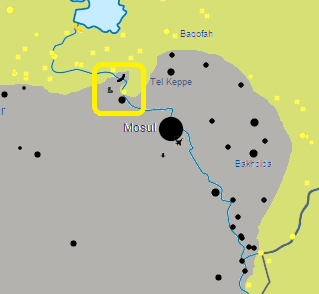
3) From the department of "great things come in small packages," the Kurds have successfully captured the roadway and villages around the bridge where Route 1 crosses the Tigris, cutting Mosul off from its most direct western supply line. This is a form of kicking the proverbial hornet's nest that may bring ISIS fighters out of dug-in fortifications to try to take the highway back. They're going to have plenty of time--Iraqi forces will be bogged down in Tikrit for a while.


4) Iraqi forces are probably trying to encircle Ramadi by taking villages to its north (lower-left box) and have entered Tikrit. In Tikrit, government forces are similarly trying to encircle the city before moving in, and are being slowed down by roadside/car bombs and suicide bombers. The little black dot south of Tikrit is being shelled at time of writing, and the dot to the north of Tikrit is being de-bombed.

Once Tikrit is surrounded, it may take up to a month to move in and finish off ISIS forces. Iraq is sporting 25,000 troops between regulars, Shiite militias, and Sunni militias. They likely outnumber ISIS forces 10:1--but just remember that Iraqi forces had similar odds when they were overrun in Mosul last summer.


Iran is supporting this operation rather than the US, which means no air support. It's clearly not an experiment ("can Iraqi forces handle this on their own?")--now's just not the time to be having such experiments, as Tikrit is probably the junior varsity version of trying to take Mosul.

What's more likely--I think--is that Iraq and Iran are going alone, without US "permission." Iraq has been frustrated with coalition support and it's possible (though I have predicted otherwise) that the US announcement of the Mosul offensive created some distrust--Iraq may have decided that the US couldn't be trusted with the intel.

Evidence suggests the US wasn't even told about the offensive--a US general said that the offensive was "no surprise," which is very different from saying "we're in the loop."

It'll be great news if Iraq can take Tikrit without US air support, though there are huge complications with making this a "Shiite" operation--Shiite militia abuse is a big part of why ISIS was able to get traction in western Iraq in the first place.

But we'll deal with that another time.