Showing posts with label Daesh. Show all posts

Tuesday, July 7, 2015

Iraq Surrounds Anbar--and Might Actually Succeed in its Offensive

I'll continue to contend that the Iraqis are much better on offense than they are on defense: even with ISIS well dug-into a city and planting bombs everywhere, the Iraqis can slowly slog forward, in part because they're confident they're unlikely to get captured and tortured by ISIS troops when the Iraqi troops have managed to surround a city and besiege it.

Ramadi will be like Tikrit: Iraqi forces have surrounded the city completely, and are working on shoring up supply/reinforcement lines, positioning troops, and training local volunteers before moving in. The Shiite militias, who might otherwise pose a major problem in the occupation of Ramadi, are staying on the outskirts to block ISIS reinforcements and prevent retreating ISIS troops from getting away to launch a counter-attack. In part, they'll stand "at the back of" Iraqi regulars and Sunni militiamen.

Unlike Tikrit, US airstrikes will be involved from the start. These airstrikes made the capture of Tall Abyad (Syria) and Baiji (north on the map below) much quicker. Recall that the airstrikes also ended the very stalled siege of Tikrit.

Note as well that Iraqi troops are holding al-Baghdadi and Haditha, which means that reinforcements from Syria would have to go through miles of Iraqi checkpoints, and retreat from Ramadi into Syria would be difficult--again, a good sign for preventing a counter-attack in the future.


The Iraqis are also working on surrounding Fallujah. The map here is actually a bit out of date: the Iraqis claim they've captured the dam and secured the river south of the city, and are "at the gates" of Fallujah. Trying to take both cities at once will be a meat grinder, but it's important: if only one was attacked and the other left open, ISIS troops could retreat from one to the other, only to counter-attack later. Besieging both means that ISIS troops in both cities are isolated (this tactic was used to great effect by the Communist Chinese forces against the Nationalists), and the Iraqis can take their time, advance slowly, and strike where ISIS has been softened up by airstrikes.

In Anbar, time is on the Iraqis' side. Because they're training local militiamen--in large part to keep the peace after the fighting as credible local forces--they may even stretch out the operation, as painful as it seems to consider. Forces from al-Baghdadi may also advance towards Hit and try to guarantee no safe haven for ISIS troops after the Ramadi and Fallujah assaults.

This is a case where Iraq's strategy is to accept the hard fight, take the American's help, and try to eliminate (rather than simply dislodge) ISIS forces in Anbar. Doing so will mean that fewer troops will have to stay behind to garrison Anbar (and many fewer will need to garrison surrounding Baghdad, which remains under threat from ISIS' presence in Fallujah), and thus that more can be committed to the final brutal push towards Mosul.

Expect fighting in both cities to start up within the week.

Thursday, March 12, 2015

Iraqi Forces Enter Tikrit; Victory Looks Certain

Iraqi forces have Tikrit surrounded, after a week-long slog of clearing out bombs and snipers along the roads leading into the city.

They are entering the city from all sides now, attempting to squeeze out (and ideally eliminate during retreat) ISIS forces holed up inside. I believe at this point that victory is fairly inevitable, and that they'll move on next to clear ISIS forces currently combating government / Shiite troops in Baji. Expect the area below to become quite red after ISIS forces break.


The going will be slow now that they're in the city: ISIS predicted this was coming and scattered snipers and booby traps throughout the city, in the hopes of causing enough casualties to break the spirits of government troops.


(Twitter user @PetoLucem has a great chronological progression of government advances in Tikrit over the past few weeks, via Stratfor)

But it won't happen. The most important part of this offensive is that Iraqi forces do not break and run, and I suspect they won't. Iraq has hand-picked more reliable forces for this offensive, and the backing of very zealous Shiite militiamen and Iranian Quds forces is going to keep morale high as they demonstrate high morale and relative courage in the fighting. The total forces assaulting the city number a staggering 30,000, which likely outnumbers ISIS forces by about 10:1. There are just so many weapons pointed at ISIS forces that they will eventually get squeezed into defeat.

Expect the city to be cleared in 1-2 weeks as forces very slowly and carefully move house-to-house, hoping to minimize casualties. Baji will fall more quickly after that; it has many fewer ISIS fighters and government forces are already in the city, which will prevent the kind of entrenchment that ISIS was able to manage in Tikrit.

Implications
ISIS' days in Iraq are numbered, I think. Tikrit will be the victory the Iraqis need to build the morale and template for taking Mosul, which will allow them to turn their attention to Ramadi and Fallujah--those will be the hardest fights they have, but they'll have momentum on their side: Iraqi forces will inherit ISIS' air of inevitability.

ISIS' aura of inevitability and terror is starting to fizzle as they begin to lose to superior firepower, numbers, and training. That loss will hurt long-term recruiting, which means they'll actually be ground down to the point that they'll have to revert to asymmetric warfare (they set of 12 simultaneous car/suicide bombs in Ramadi and one bomb in Baghdad to try to disrupt the assault on Tikrit, for example). But because ISIS is claiming to be a caliphate, their authority erodes if they don't hold territory.

With victory coming, the most important factor in this advance is making sure that Shiite militiamen don't use this opportunity to carry out sectarian revenge killings. If they're able to keep their cool (and so far it's looking like they are, but the hard part will be after the main fighting ends) and leave Sunni civilians alone, the prospects for Fallujah and Ramadi will improve as Sunni civilians there begin to hope that government forces are a viable alternative to ISIS (they had previously probably helped ISIS to take hold there because they were so frustrated with Shiite rule in Iraq, but ISIS became more than they had bargained for).

Meanwhile, the Kurds in Syria continue a slow, steady slog towards the Tall Abyad border crossing with Turkey, which would close down a supply and reinforcement route (for foreign fighters) into Syria.


Tuesday, March 3, 2015

Quick Update: Advances Against ISIS, and What to Expect in Tikrit

Readers keep telling me they love the maps, so you get maps and a bit of "implications." We'll also touch very briefly on Tikrit.

1) Kurdish forces out of Kobane have successfully pressed ISIS out of the space west of Kobane by trapping them against the river/lake and eliminating them. They've made modest progress in the east but I think we can expect the Kurdish forces to shift a bit south, but mostly east, to capture Tall Abyad crossing and cut off a supply line for ISIS from Turkey.


2) In northeast Sryia, ISIS has totally collapsed. That huge box on the right was all formerly ISIS, right up to the southern edge of that big red blotch (government fighters). It appears the Kurds and government troops have a truce, which has allowed them to push out. There is likely a bit of a "race" to secure space around Hasakah between Peshmerga and government forces. We also see in the western box that Kurdish forces have successfully crossed a river and are assaulting villages there, likely hoping to scoop up the smattering of black just to the south.


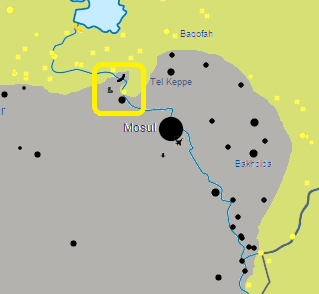
3) From the department of "great things come in small packages," the Kurds have successfully captured the roadway and villages around the bridge where Route 1 crosses the Tigris, cutting Mosul off from its most direct western supply line. This is a form of kicking the proverbial hornet's nest that may bring ISIS fighters out of dug-in fortifications to try to take the highway back. They're going to have plenty of time--Iraqi forces will be bogged down in Tikrit for a while.


4) Iraqi forces are probably trying to encircle Ramadi by taking villages to its north (lower-left box) and have entered Tikrit. In Tikrit, government forces are similarly trying to encircle the city before moving in, and are being slowed down by roadside/car bombs and suicide bombers. The little black dot south of Tikrit is being shelled at time of writing, and the dot to the north of Tikrit is being de-bombed.

Once Tikrit is surrounded, it may take up to a month to move in and finish off ISIS forces. Iraq is sporting 25,000 troops between regulars, Shiite militias, and Sunni militias. They likely outnumber ISIS forces 10:1--but just remember that Iraqi forces had similar odds when they were overrun in Mosul last summer.


Iran is supporting this operation rather than the US, which means no air support. It's clearly not an experiment ("can Iraqi forces handle this on their own?")--now's just not the time to be having such experiments, as Tikrit is probably the junior varsity version of trying to take Mosul.

What's more likely--I think--is that Iraq and Iran are going alone, without US "permission." Iraq has been frustrated with coalition support and it's possible (though I have predicted otherwise) that the US announcement of the Mosul offensive created some distrust--Iraq may have decided that the US couldn't be trusted with the intel.

Evidence suggests the US wasn't even told about the offensive--a US general said that the offensive was "no surprise," which is very different from saying "we're in the loop."

It'll be great news if Iraq can take Tikrit without US air support, though there are huge complications with making this a "Shiite" operation--Shiite militia abuse is a big part of why ISIS was able to get traction in western Iraq in the first place.

But we'll deal with that another time.

Thursday, February 26, 2015

Short: Why is Libya Important to the Islamic State?

Reader Nathan asked if I would make a Libya post and then, helpfully, gave me some truly awesome source information. Thanks, Nathan!

The big question here is: why ISIS is putting so much effort into expanding into Libya when it's losing ground in Iraq and having mixed success in Syria? (To elaborate a bit: ISIS does need to put recruiting, training, and physical resources into Libya, and foreign Jihadis going to Libya aren't going to Iraq/Syria to reinforce there, so it's definitely an investment.)

The article starts with a translation of an ISIS strategy document, which outlines to ISIS and fellow Islamic extremist groups the motivations for going to Libya.

I'll briefly sum up the main points below, but the key takeaway is that ISIS isn't looking to Libya primarily or urgently for attacks in Italy. Despite its apocalyptic machinations, ISIS' first priority is to actually establish the Caliphate: to them, that includes a very ambitious plan that is way bigger than the previous Caliphate of the dark/middle ages.


Adding to this of course are the gains that the Ottomans made in the 1200s-1400s that included areas in India, the rest of Turkey, the known Muslim areas in northern Africa, and some of the Balkans. IS wants all of this stuff and, for whatever reason, all of India. Why IS would want to rule India is not yet clear to me.


The summary of the strategic document, in short:

  • The Islamic State really does want to cover all of the Muslim World
  • Libya is a window of opportunity: the strength of militants, rise of Jihadi groups, and government division mean that IS can establish a foothold there
  • It's under less pressure than Iraq and is a pretty free operating space for regional operations (where IS is on the defensive in Iraq and still under lots of bombing/Kurdish pressure in Syria)
  • It has access to nearby states that IS wants to spread to, many of which have potential allies (particularly Niger, Mail, and Algeria)
  • It has access to battle-hardened recruits in Libya, Algeria, and Sudan [added after post]
  • Indeed it does have access to Southern Europe--there are human trafficking operations that could more easily move militants to Italy and elsewhere for expanded terror operations--probably "some 20 militants shooting up Rome for a few hours" kind of mayhem