Showing posts with label NATO. Show all posts

Tuesday, June 30, 2015

Why the US is Sending an Armored Brigade to Eastern Europe

Whether an armored brigade is "big" depends on the size of the pond it swims in.

At about 1100 armored vehicles (Abrams tanks, Bradley fighting vehicles, and some mobile artillery), such a brigade could easily overwhelm the conventional militaries of most small countries.

In the Eastern European theatre, an armored brigade is nothing close to large enough to be a game-changer. Russia's military sports about ten thousand pieces of active heavy armored equipment (tanks, fighting vehicles, and mobile artillery), most of which is dedicated to its western front.

Despite the numerical gap, the US is sending such a brigade to Eastern Europe, spread out from the Baltics all the way down to Romania. What we know is that such a brigade won't be a decisive force if Russia were to invade Sweden, the Baltic countries, Romania, or Poland (all of which it's threatened to do over the past few years). Why the effort, then?

Some analysts suggest it is a "symbolic" gesture for wary allies. I think a fifteen-second gut check suggests this hypothesis is weak: Eastern European countries are skeptical of NATO, terrified of Russia, and are smart enough to see past symbolic gestures. And US leadership is smart enough to see all of this.

I think what's really going on is that these vehicles are there to be a "positive deterrent" of sorts. That is, rather than deterring Russia by having overwhelming strength on the battlefield, this brigade deters Russia by promising that if Russia attacks one of these countries, the US will be dragged into the war: these units are mixed in with local units and have the right to defend such territory from invasion--all these countries are NATO allies. If that happened, US assets would be attacked and destroyed, with all the shock and fury on the domestic front that would come with that.

The United States' leadership would have almost no choice in the matter: they would face massive pressure to deploy more forces (probably first from Germany) in order to repel the Russians from whichever ally was attacked. For Russia the subsequent fight would be long and messy at best. If Russia lost, defeat could bankrupt the country, wreck Putin's reputation, and set the Russian military back years. Not to mention that countries like Ukraine and Sweden would likely hop on the express train to NATO and request heavy garrisoning by the US to prevent further Russian attacks.

So what this brigade does is that it embodies lessons from the errors of 2004 and 2014 that allowed Russia to invade and annex parts of Georgia and Ukraine. Russia's success in those conflicts depended on avoiding getting entangled with NATO and on pitting their forces only against the small domestic forces of their target territories, and on moving quickly enough that it won the status quo in the area. Such a strategy has worked so far, but its effectiveness would quickly end once an American battle tank was destroyed on the field. Russia could not have a quick, clean victory that way, and would no longer be able to use Europe's lethargy to its advantage.

Russia's leadership is also smart, and knows this. The US administration is putting American lives at risk, yes, but with the expectation that Putin will understand the consequences of attacking, and thus be far less likely to attack at all. It is a clever way of containing Russia in a world where Western European allies are afraid to get on Russia's bad side: the US uses its cowboy reputation to its advantage here, and deploys its own deterrent.

The final stroke of brilliance here is that it is a force that is too small to be a credible offensive threat to Russia, so Russia not only won't feel territorially threatened, but its leadership will have shaky ground on which to pretend that it feels threatened (and thus justify an arms race).

In a comparatively cheap, gentle stroke, the US has out-positioned Russia in most of Eastern Europe, putting time back on the West's side for sanctions to squeeze Russia into acquiescence. 

Thursday, April 9, 2015

Ukraine Eyeing NATO Membership -- the Ante is Upped for Putin

In 2010 Ukraine scrapped its plans to join NATO after pro-Russian Yakunovich was elected president.

Even after the Euromaidan protests that sent Yakunovich fleeing from the country, Ukraine's new government announced no plans to join NATO.

But when one is invaded repeatedly by one's large neighbor, sentiments change.

Ukraine's national security council has declared its support for joining NATO within the next 5 years, and parliament officially dropped Ukraine's "non-aligned" status. Ukrainian support for joining has jumped from 17% to over 50%. President Poroshenko is expected to approve the plan.


Russia will be furious. Russian leadership has already declared in 2014 that Finland joining NATO "could start World War 3," and they'll be even less happy about Ukraine.

The move would set up a show-down over Crimea, which Ukraine and NATO will continue to declare as sovereign to Ukraine. It's unlikely to turn into a war, but would almost certainly mean a heavy NATO troop presence in Ukraine, especially near Russia's border, and an attempt to maneuver Russia into withdrawing from Crimea in a game of soft brinksmanship, I wager.

Russia may well make moves to intimidate Ukraine the way it did Georgia in 2008--although it has already marched into Ukraine several times and seems to be having the opposite effect. Most likely, Russia will issue fairly overt military threats contingent upon Ukraine joining NATO, which will either cow Ukraine or increase its urgency for the alliance.

It's also not 100% clear that NATO will allow Ukraine's entry in the midst of the crisis. NATO's Article 10 requires unanimous consent from all current members to allow a new one to join. The US is likely hungry for Ukrainian membership, but the core European powers that are currently fairly dependent on Russian oil and gas will be more reluctant.

That said, with Russia's economy reeling, "cutting off" oil and gas would be tantamount to imposing new sanctions on itself--an economic shooting of oneself in the foot. Russia is willing to tolerate much more pain than Germany and France, but it might not be able to afford cutting off the money flow from two of its biggest customers.

What we'll keep an eye on is specifically how Putin tries to flex Russia's military muscle (as its economic muscles weaken) to try to knock Ukraine back off the NATO track.

Wednesday, March 25, 2015

Afghanistan War Update, 2015: More Fighting, But Negotiations Coming

Afghanistan has been largely forgotten (including by me) as the rest of the middle east has erupted, in large part because Afghanistan is in a surprisingly "stable" stalemate--not that the country has stabilized, but that there isn't much movement one way or another.

I decided to finally get back to writing about Afghanistan after reading that the US is now planning to keep troops in Afghanistan through 2016--right up until President Obama leaves office.

The decision seems to come in response to two things:

The good news, at least through 2013, is that the total Taliban deaths per year--as well as their percentage of total combat deaths--increased steadily...


...even as the NATO coalition pulled out and got less involved in operations (and thus its casualty rate has dropped precipitously). This means that, indeed, the Afghanistan National Army is getting comparatively stronger and more capable compared to the Taliban. Unlike the Iraqi army forces, there isn't much worry of the Afghans simply splitting and running.

The bad news is that corruption is still a major problem, and that opium production has gone through the roof since the British withdrawal--it's higher than it's ever been. This means lots of money for the Taliban and a sign of very little government control in southern Pashtun regions (Helmand/Kandahar).

In the end, I hold by my 2013 prediction (it's a bloody good article--go read it) that in 2015 the Taliban will attempt an offensive, fail to take over the country, and negotiate.

Those negotiations are coming, in large part due to Ghani's charm offensive to get Pakistan to pressure the Taliban into making the talks happen. I think this is the real reason Obama wants to keep some troops around--to apply pressure during the negotiations. I don't think it's because of just blind faith that Ghani is going to make the situation better before Obama is out of office--that would be naive in the face of recent history.

In the end, Afghanistan is a comparatively simple story of an ethnic (largely Pashtun) insurgency...

caused in large part by arbitrary colonial boundary-making (the infamous Durand Line).


This means, I think, that it'll end as most of these do: slowly, painfully, and with an awkward peace deal that'll have many hiccups down the line. The good news for the Afghan army is that even though fighting is intensifying (to be predicted as NATO troops withdraw and Taliban forces try to use the opportunity to beat up the ANA and win bargaining power), the Taliban are consistently losing in these fights 4:1 or 5:1. That continued losing means they are likely hurting and more eager for a deal.

The rest of the middle east may remain such a mess that the Taliban will be considered almost reasonable by comparison once they make a peace deal. I'm not kidding.


Some other interesting notes:

Tuesday, March 10, 2015

The Baltics as Russia's Next Target -- And Their Loss of Confidence in NATO

Thanks to reader Tom G. for the inspiration on this one.

I continue to be convinced that Putin's Russia has its sights on the Baltics as it looks to expand its "sphere of influence" back to Soviet days (The Economist has its own take on this idea). This isn't for completely arbitrary reasons: as we discussed way back in 2011 in the series (probably my favorite from my rapidly-approaching-400-posts) on the Blocanization of Europe, and again in May 2014, Russia is not doing this for arbitrary reasons.

Its natural security, according to the "realist" International Relations school, depends on its ability to keep its industry, natural resources, and population centers secure, and that means land buffers (as well as other defensive measures like tactical nuclear weapons, air defenses, etc) between NATO and its core.

And note that all this stuff is jammed right up on its western border (below is a map of population density in Russia).


We also discussed why holding Sevastopol was important: to have access to a warm water port that Russia might have lost had Ukraine gone into NATO. Putin made it all-but-clear that this was the motivation for invading Crimea when he said recently that Russia decided to annex the territory when Ukraine ousted President Yakunovych: while the propaganda was about "protecting Russian citizens" (a la the Sudetenland), the reason to focus first on Crimea was about the Sevestapol warm water port, and the risk that the new pro-EU Ukrainian government would wrest it from Russia.

Putin's declaration of a "New Russia" in eastern Ukraine is creepily akin to Hitler's "Lebensraum," particularly because it has the same motivations. Hitler did not want Eastern Europe simply to have more territory: it was about security.

But not all is secure in Russia even if it does settle with Ukraine in the way it wants (and it will, I think). St. Petersburg remains at serious risk from NATO's presence in the Baltics, and pulling the Baltics under Russia's control is arguably even more important than having eastern Ukraine. It's just not on the table yet because Russia is using Ukraine--a non-NATO country--to test NATO's will.

(And we still remember the Georgian invasion and the successful annexation of Abkhazia and South Ossetia, yes?)

But the Baltics are NATO Countries--Could He Really Take Them Over?
Sure. Putin is excellent at messaging, enough so that even today the West is still trying to make the case that Russia has sent troops into Eastern Ukraine (rather than it being so widely believed and obvious that nobody talks about whether it's true anymore). Putin is clever enough to not simply declare war and march in.

Russia has been using "cyber warfare" against Estonia and has stepped up efforts to incite unrest in its 25% Russian population (Latvia also has a 25% Russian population and is similarly worried).

In Ukraine, Russia has used non-uniformed troops (the famous "little green men") in both Crimea and eastern Ukraine, and has focused on arming annexationist rebels to keep a shroud of plausible deniability. Its efforts in both Ukraine and Georgia have been nothing short of brilliant.

But even if it did invade directly: Estonia and Latvia are tiny, and Russia could overwhelm them in hours. It's already frequently conducting military exercises on the border, any of which could turn into an invasion--Israel famously used this tactic in the six-day war. And if it does invade and deploy extensive anti-air defenses, NATO would have to commit to a bloody, protracted campaign to defeat Russia militarily in order to get them to back off. And much like Germany in 1939, Russia has good reason to believe that just won't happen. So after it wraps up Ukraine, it might just go ahead with the Baltics, after the heat has died down and the Americans have become too distracted in the Middle East to mount a credible response.

Hold On: Why Do You Keep Comparing Putin to Hitler?
Putin is obviously not a madman hellbent on committing genocide upon an entire race of people, so don't take it the wrong way.

But Putin is interested in taking over swaths of Europe, and for similar reasons as the Germans. It's worth noting that Germany had gone to war with its neighbors many times before WW2 in its short history as a unified nation, for always the same reasons: security. Putin's "testing the West" behavior is similar to Hitler's in the 1930's, and the propaganda of "protecting ethnic peoples" is similar. The West's response is note quite as weak as in Munich, but Russia is willing to deal with sanctions, and support for Putin remains over 80% even as the economy takes a major hit. His absolutely brilliant propaganda campaign is galvanizing the Russian people for an ongoing war with the West. Sanctions aren't a deterrent, and won't be: pretending they will be is probably naive.

Back to Business: Aren't NATO Countries Obligated to Act?
They're obligated to act, but as the Economist points out, Article V leaves ambiguity in the type of action member states are obligated to take. It doesn't require that NATO countries use military force, which is important. Russia has held off so far invading NATO countries, but it's running out of buffer-states to build without going to NATO countries like the Baltics for that security it craves.

The Baltics and the Visegrad 4 are both taking matters into their own hands as their confidence in NATO wanes. The V4 formed their own battle group, independent of NATO command. The Baltics are stepping up defense spending as Russia flies daily "exercises" near their borders. They're losing confidence in NATO's willingness to defend them. Sadly, the Baltics are not going to be able to resist Russia's invasion, but they may be depending on the V4 to act when NATO doesn't: Joe Biden actually went to Poland to keep Poland from leading the V4 against Russia when it invaded Crimea.

Germany wanted to station troops in the Baltics as a response. This would put NATO lives on the line, meaning that Russian attacks would risk killing NATO military personnel--increasing the impetus to go to war for NATO--essentially a form of deterrent. This was shut down in Brussels.

So What's Going to Happen?

The question, as usual, is ultimately about deterrence: does Russia believe the US and NATO will get alarmed enough to shed blood over Russia's next military move? Ultimately: did Putin see oh-so-much wormlike behavior in Minsk? If so, deterrence has failed.

On another note, the Blogger search feature is actually quite impressive. If you want to do a deeper-dive on any serious topic like Russia, Iraq, Afghanistan, ISIS, etc, I've pretty-enthusiastically tagged everything I've written, so a simple topic search will get you some rich and historical stuff. 

Sunday, May 25, 2014

The Ukraine Battleground, from Russia's Perspective

So some of my readers decided they wanted to hold me to a higher standard and wrenched my arm into giving the Russian perspective on the battle for Ukraine. This I shall do.

As usual, it's a story and (as usual) a tragedy of realist international politics and the security spiral. I shall tell this story today, trying to keep my biases aside.

The first and most important element of the story comes after the fall of the Soviet Union. I start here because it was a turning point: the former Soviet Union could have stuck with Russia, become neutral somehow, or leaned towards NATO in some way.

We'll talk about why the third option was essentially unavoidable, and explore how it looked from Russia's perspective.

The map below shows the eastward expansion of NATO. Note in particular everything after 1990: a whopping 12 countries were added to NATO's portfolio, doubling its Cold War number to 24. In 2004, NATO expanded enough to completely check any Russian sea action in Europe, and put troops on the borders of its closest allies (Belarus and Moldova).

Obviously from the Russian perspective, this is at-best terrifying. After defeat, one's former enemies surround Russia bit by bit--not slowing down as the memory of the Cold War started to ease, but accelerating and even bordering the country, attempting to choke it off forever.

From NATO's perspective, it was bringing into its protective (and purely defensive) umbrella eager members, whose memory of Soviet oppression was harsh and still fresh, desperate to ensure that the Russians could never come back for them, for the Russians were never kept down for long.

From the perspective of realist international relations: central and eastern Europe are a long, flat plain with essentially no protective boundaries to create natural, safe borders between countries (look at Switzerland--have they been to war any time recently?). Ultimately, these countries are vulnerable to land attack by more powerful countries at all times--end of story. It is critical for them to be under the protection of one alliance or another. Even the Warsaw Pact provided some stability for them from the possibility of more invasion, as much as it was pushed onto their shoulders.

Because these countries are not naturally protected, they were going to join an alliance of some sort. Choosing NATO was not surprising, given their history.

But for Russia, this encroachment--whether or not one understood the natural forces driving it--meant danger and a tightening of a noose.

In 2008, NATO declared that it would be working to incorporate Ukraine and Georgia into the alliance, and that was the last straw. Georgia has access to the Caucasus mountains, and Ukraine sticks like a knife into the underbelly of Russia (and also includes major gas and grain fields, crucial to support Russia in case of a breakdown of trade with NATO). It was just too dangerous, and appeared so aggressive that there was a plausible story that Bush, Blair, Sarkozy, and co. were looking to strike a killing blow. It's even possible that they were.

Russia's 2008 invasion of Georgia was meant to remind Georgia that Russia was still in charge of the area, and it would not tolerate more encirclement (imagine if Mexico became a Russian ally and would start hosting Russian troops and missile batteries).

Recently in Ukraine, the West was obviously very in support of the protesters and the change they would bring. The EU is very interested in bringing Ukraine into its fold (despite the many changes Ukraine must make to get there), and Russia looked quite fearfully at the very real possibility of losing its Sevastopol warm water port (more on that in this earlier post).

It felt it had to act, European objections be damned. So act it did. It was the forces of international security at work, as always: Russia faced a nearly existential threat if it lost its Sevastopol lease.

For Russia, as with most countries, imperialism is not motivated mostly by greed, but by a desire to strengthen, consolidate, or defend its security position. It may seem ridiculous to younger generations that Europe might descend into a land war, but peace in Europe has been a strange break from 1600 years of truly endless carnage, bloodshed, and border-shifting. To pretend that nobody should be worried about such things as the warm water port--or, for my own case, the precedent set of allowing European countries to invade each other and annex territory--enough to go to war for it, is ultimately myopic.

While I will not claim that the Russians have any moral ground for their invasion, it is always worth considering everyone's perspective: for Russia, it is safety and defense, preparing itself to never again allow the invasions of the first and second World Wars to occur. But I want to emphasize that just because we understand the motivations of countries running around annexing each other, doesn't make it any morally less terrible nor less dangerous.

Monday, March 3, 2014

My Prediction: War in Crimea Within 48 Hours

It sounds like Russia is actually issuing ultimatums to the bases (that they have surrounded and put under siege, by the way) that if they don't surrender, war will begin. Russian troops are digging trenches on the northern coast of Crimea and the fleet is being mobilized to control the seas, giving the Ukrainians only a tiny bottleneck to move through.


I predict that's just what's going to happen. Ukraine won't give up without a fight.


It's not a war Ukraine's going to win. They'll get beat pretty badly and Russia will use this as an excuse to march into the rest of the country. Already, a truly North-Korean-style propaganda blitz is happening within Russia now to drum up domestic support for the war.

The big question will be what the V4 does, but I think they'll get involved. Poland is mobilizing and Russia is actually readying its northern defenses (around St. Petersburg). I think both sides are getting ready to go at it.

The West is responding as weakly as Putin hoped and predicted. The EU is refusing to join the US in imposing sanctions--Russia has too much oil/gas leverage. The US is not threatening a military response, and it's frankly the only kind of response that would give Putin pause.

Sunday, March 2, 2014

Foggofwar is Back! As is the Great Game in Europe, with Ukraine the Battleground

Well, after deciding I was too busy to blog, I realized I was just talking about this stuff with my friends and repeating myself ad nauseam . I've been able to happily ignore a lot of stuff--even Syria has only been so captivating--but the Great Game in Europe has finally brought me back into the ring.

So Russia has invaded Ukraine, post-revolution. Interestingly, this revolution seemed initially to be less damaging/dangerous than the first one (The "Orange" Revolution of 2004) but it's provoked a much heavier response.

There are only three questions that are really interesting:
1) What is Russia's planned endgame?
2) How does Russia think the rest of Europe/US will respond?
3) How will they actually respond?

Russia's Planned Endgame:
Sadly I think this is actually a bit of an open question, but with a likely answer.

The most likely answer is that Russia wants to see a settlement in which Crimea (vast majority Russian descent and Russian loyalty) has enough autonomous power to maintain a treaty with Russia for Russia's use of the Sevastopol naval port without Kiev's ability to veto. This seems extremely narrow an aim, but I think it's the most "concrete" one they want to get out of it. It also seems obvious given the fact that they're specifically in Crimea and not any other part of the country (no matter how pro-Russian or not), and the geopolitical motive there (more below on that).

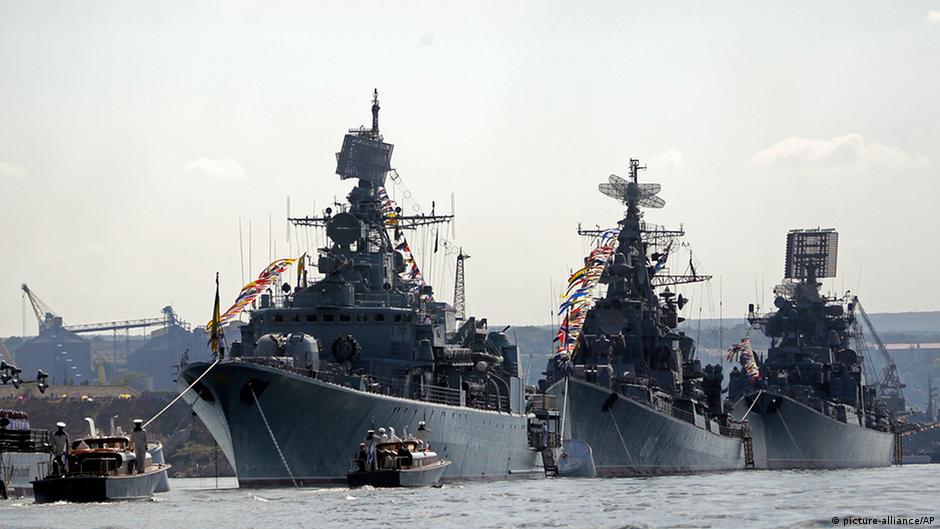
Russian navy ships at the Black Sea port of Sevastopol

Obviously Russia also wants to make clear that its periphery is not allowed to install pro-EU governments. But starting a war to demonstrate just that is risky--to get involved with military action, one has to have not only a goal, but a clear endgame--something the US and its allies utterly failed to do in both Afghanistan and Iraq, to devastating effect (though it wasn't the only mistake in both instances). The well-defined endgame, the thing that lets Russia pull its troops out and declare "victory" without having to indefinitely occupy Ukraine, is that agreement.

This is eerily similar to Georgia in 2008, by the way, in which Russia quickly invaded and asserted a stronger South Ossetia autonomous zone with Russian military presence to "protect its people."

I really do think they're doing the same darn thing here.

The reason, by the way, that "keeping the Sevastopol port" is important enough to merit a war, is that Sevastopol is the only warm-water port the Russians have left in the European theatre. If they lose Sevastopol, they have literally no place to launch ships that doesn't freeze in the winter. It essentially knocks them out as a naval power, which is actually quite significant. There's more in my old post from 2008 on why Ukraine and Georgia are so bloody important--go re-read if you want to.

So in short, they'll have the Crimean parliament (happily) sign that they'll keep the port and welcome Russian military access. They'll tell Kiev that Kiev has to relent on the issue or life will get worse, after kicking around the Ukrainian military a bit.

Importantly, they will not march on Kiev and won't try to annex Crimea completely, as even in the current US/EU political climate, it will be such a clear "crossing of the line" that it would merit a clear military response.

How Does Russia Think the US/EU Will Respond?
Not to make too many allusions to German expansionist aggression in the 1930's, Putin has seen the US and EU in Georgia in 2008, and "they are worms" to him. He played the West like a fiddle then, and the world leaders that could (and easily, given the military disparity) oppose him watched with impotence.

Putin is counting on further impotence here. Obama has proven to be not too willing to rock the boat--he seeks a very broad support base of allies before making a move (why he went to Libya but not Syria, and why he's still in Afghanistan). Russia's oil and gas chokehold on Europe will likely make Germany and France hesitate--during a war, Russia could cut gas supplies and prop up Gazprom from the federal treasury (which is fairly hefty) while Europe's lights go out. It's a major threat and the US isn't quite prepared to supply the rest of that gas given current infrastructure.

So ultimately, Obama is likely to have a lukewarm reception from Germany and France on getting NATO involved, and Putin is betting on him not pressing it.

So there will be a flurry of diplomatic activity, of course, but I think Putin honestly believes there will be no military action against Russia whatsoever from outside of Ukraine--just like in 2008.

How Will the US/EU Actually Respond?
If I actually knew the answer to this, I'd be in the War Room in the White House right now, so I have to speculate wildly on the matter.

If you remember my post about the Visegrad 4 and the Blocanization of Europe, you'll recall that the V4 (led by Poland) formed out of fear that NATO was too weak to protect it from Russia, and they'd be banking on support from the US and UK independently of the rest of the continent.

Now is absolutely the time for them to be tested. The V4 doesn't include Ukraine (it's Poland, Czech Republic, Slovakia, Hungary), but if Ukraine fell very EU (or split in two), we would probably see a V5. The V4 is going to see unchecked Russian aggression as an existential threat: if Europe won't defend Ukraine from an unprovoked invasion, would they defend the Czech Republic? Would they defend Hungary? Ultimately, EU/NATO/US inaction here would ultimately cement the V4's belief that they can depend only on each other.

If the V4 sees NATO as impotent, I actually think it's likely that the V4 will take matters into its own hands. Crazy as it sounds, I believe the Visegrad 4 is going to mobilize once Ukraine is inevitably hung out to dry by more powerful allies. In their minds, the principle of Deterrence--which has kept Europe mostly peaceful for 70 years (which is an absurd amount of time in Europe's history) must hold, and they will respond, even knowing that they will not win alone.

I think the V4 will move troops to the border and threaten war if the US/NATO don't intervene. There will be a real risk of a wider European war breaking out.

At that point... I'm just not sure. Frankly, the outcome is going to depend entirely on the will of the United States and, primarily, its president. If the US is willing to fight an air war in Russia (invasion is out of the question) and mobilize aircraft carriers to the Black Sea and occupy it there, I think Russia will pull back... and the West will score a major victory in keeping Russia contained. This move would be provoked more by the V4 (to prevent a European land war) than by Russia itself (where Obama would tend to try to "jaw jaw" before he "wars war").

But a lot of things could hold the Americans back. Obama is unpopular, debt is much higher than Americans are comfortable with. The Republican party is not only generally prone to oppose whatever Obama tries to do for the sake of being contrary, but it is becoming increasingly isolationist (something we saw in the Libyan intervention).

Wrapping Up:
So I just don't know. Russia could well get away with it and sadly I think this is most likely. I know normally I don't take particularly strong position on who is good and who is bad. But I do believe that the principle of Deterrence has kept Europe safe for a very, very long time, and I am worried to see it violated with impunity.

We will see. I would put odds on Russia getting away with it, but the US (even without the EU) has such an overwhelmingly powerful naval/air force that if it decided to get involved, Russia would pull back quickly.

It's all a matter of will.

Monday, August 22, 2011

A Complicated Libya Transition

As Gaddafi's regime ends (as now it is a mop-up exercise), "the world" must begin thinking hard about how to help Libya transition over to a functional, democratic government--and what the effect on the region will be.


The short version:
-The rebels are deeply divided about the direction they want to take post-Gaddafi.
-Gaddafi still has supporters in Sirte and other parts of Western Libya that will fear reprisals and marginalization. The rebels will struggle to bring them into the regime.
-It's unclear how much of the civil service infrastructure will be left; that is, will the civil servants that made the cogs turn pre-war keep working?

This is a great opportunity for the West to learn from its mistakes in Afghanistan and Iraq to make the transition to a new regime smoother. Mistakes not to repeat:
-Marginalizing the "old guard." They must have a reasonable place in the new regime, or they'll resist it.
-Don't declare victory too soon.
-Take a more hands-off approach: the National Transitional Council (NTC) will lose credibility if it looks like a puppet.

We'll see what the West can do. Luckily, the folks in Benghazi currently love the US to bits, so Obama has an opportunity to lead this transition well, and win back some legitimacy for the United States as a world leader.

Monday, August 15, 2011

Quick Libya Update

I know I owe everybody an update that discusses the Baltics--I promise, it's actually more interesting than you probably think it is.

It's worth a quick Libya update. For those of you rooting for the Rebels, they seem to have finally broken the stalemate.

Trained reinforcements from Benghazi and increased coordination with NATO are part of how the rebel forces have broken out from the safety of the mountain ranged and dared, successfully, the open desert. The presses from the east, while unsuccessful so far, have also taxed Gaddafi's forces and allowed the western front to be relieved, at least to some extent.

They are stretched thin, attacking multiple cities at once. But in doing so, they take advantage of the full force of NATO behind them, which is now hitting most of Gaddafi's troops in the west at once (see Wikipedia image below).


If the rebels manage to take and hold Gharyan and (most importantly) Al Zawiya, they will have successfully cut off Tripoli from any incoming supplies, including electricity, food, weapons, money. Many of Gaddafi's troops are mercenaries, and are likely to quit if the supplies and money run out.

Gaddaffi's loyalists will certainly launch a powerful, Alamo-style counter-attack, but can be hit by NATO airstrikes on the way out of Tripoli. But if the counter-attack is unsuccessful, the war will, for the most part, be over. Gaddafi lacks the command & control to coordinate effective offensives, and cannot make the long pushes that the rebels are making. He has been unable to exhaust NATO's patience (which is turning to excitement as the rebels advance), which was the only strategy he had to ultimately win back the entire country.

In the next few days, we'll see if we've entered the end game in the Libyan situation or not.

Saturday, June 4, 2011

Keeing Up with the War in Libya

A few readers have asked me about how to best keep up with the War in Libya. I can say, without shame, that the best source I've seen so far (as far as getting the facts) has been Wikipedia. Check it out.

The Re-Emergent Russian Bloc

1) The Visegrad 4: Eastern Europe as a Major Player
2) The Re-Emergent Russian Bloc
3) Baltic Solidarity to an Emerging Russia
4) The EU Periphery: "Core" EU's Albatross
5) The Atlantics: A Return to Arms-Length Continental Management

Our series on the "Blocanization of Europe" continues with an exploration of the factors behind the rise of Russia over the past decade, and what implications it will have for the continent.

As we discussed in our last post, Russia faced imminent marginalization in 2004, as NATO planned to incorporate Georgia and Ukraine into its alliance. A Western-led push into Ukraine had formented the Orange Revolution and the election of a pro-Western Yuschenko. Georgia's strongly pro-Western government was knocking at the gates of NATO and the EU. The US had successfully coaxed Europe into accepting the Baltics, Romania, Bulgaria, and Albania into the EU in a fell swoop. Russia appeared to have an insurmountable united front poised against it.

This united front dissolved over the next 4 years. Some of it was due to Western distraction in the Middle East and complacency over Russia; some of it was the rift between the US and Europe over the Iraq war. But credit must be given to the Russian leadership, which successfully took advantage of every mistake the West made in order to shatter the united front:

-The carefully-timed invasion of Georgia highlighted Gerogia's vulnerability and the inability of NATO to come to its aide, and also turned popular support against the pro-Western elements that enraged Russia.
-Russia has engaged Iran and assisted its nuclear programme, enabling it to grow more assertive in the Middle East and largely upset Western plans for a hastier withdrawal from the region.
-Russia's intelligence forces engaged in a full-court press (both clandestine and propaganda operations) in Latvia and Ukraine, shaking Western support and mobilizing pro-Russian citizenry to become a more powerful political force.
-Russia threatened Germany and France with interruptions in oil & gas supplies, causing (in part) both countries to back off their bid for Ukraine and Georgia to enter NATO, thus kaibashing the entire attempt.

With NATO's plans successfully disrupted, Russia has been able to focus on two major geopolitical goals:
1) Solidifying its gas & oil supply dominance in Europe
2) Expanding its influence back towards the former Soviet states

Central Asia built strong ties with Russia during the Soviet Union, and they remain. The only major competitor for their support is China, which is a much more inward-looking nation.

Backlashes against the pro-NATO governments in Ukraine and Georgia have put these two states closer to the Russian bloc. Ukraine's ouster of the pro-Western government has eased ties with Russia and opened up stronger economic channels between the two countries. Russia's warm-water navy base near Sevastopol will remain in Russia's control. Moldova is currently a toss-up.

Russia has begun throwing its weight around as its power has grown. It has used Iran and Afghanistan to distract and frustrate the US, and shaken up confidence in the governments of Estonia and Latvia (while driving the Baltics closer together in defense--more on that later).

Furthermore, Russia is taking advantage of the EU's disharmony to build economic ties with key "Core" EU members--particularly Germany and France. Russia's vast natural resources and low-cost labor pool poses a great opportunity for the Core EU's largest (but slow) economies to start growing again and begin to bounce back from the weight of the falling EU Periphery.

What all of this means is that Russia is becoming a global player. Its base is sound (internal threats to the Putin regime are shaky at best), and it will continue to grow economically. It is rebuilding its military--in particular, its power-projection capabilities. It will grow to challenge the US on the global stage.

The thing that will make Russia different from the US--and the thing that will ultimately give the US a key advantage--is that Russia will spawn stronger and stronger alliances against it. The Visegrad 4 and the Baltic Bloc exist primarily to protect themselves from Russian domination. The US/UK will keep its power checked on the continent: their key interest is making sure no major power controls the resources and military of Europe. China will oppose Russia if it grows too strong.

The US, on the other hand, has scattered opposition at best. Iran, Venezuela, North Korea, and Libya form the bulk of Anti-US governments (and Russia is stuck supporting these unsavory regimes)--besides Iran, they are largely irrelevant (or are becoming less relevant quickly). If Russia can pull Ukraine into its bloc for good, it will become a relatively significant ally, but it is unlikely to grow beyond that.

But at the same time, Russia will prove a highly disruptive force in Europe, and will test the loyalty and priorities of the US/UK onthe global stage. To a great extent, Russia will be the primary driver behind the major geopolitical changes in Europe into the forseeable future.

Friday, May 27, 2011

Quick Update on the V4

Timing is interesting.

The formation of the Visegrad 4 Battle Group seems to have awakened the United States to its own relative distraction from Eastern European allies.

Poland, which has been asking for American "boots on the ground" (if for no other reason than as a symbolic stand that the United States will defend Poland from Russia), finally extracted a pledge from President Obama, who will be visiting Saturday.

The US will be placing aircraft and trainers in a Polish base to beef up the Polish air force. The president has also assured the US commitment to the NATO precept: mutual defense.

The fact that President Obama needed to make this reassurance to an ally that was staunchly secure during the Bush years is a sign that the US has begun to recognize its poor attention to the area. It's also a sign that the V4 is being taken very seriously, and immediately.

Wednesday, May 25, 2011

The Visegrad 4: Eastern Europe as a Major Player

Our "Blocanization of Europe" series will include a number of posts, each outlining what the new bloc will look like, why the bloc is losing faith in the NATO/EU system (if it ever bought in at all), and why each country is choosing the group it's choosing. Our upcoming posts should look like this:

1) The Visegrad 4: Eastern Europe as a Major Player
2) The Re-Emergent Russian Bloc
3) Baltic Solidarity to an Emerging Russia
4) The EU Periphery: "Core" EU's Albatross
5) The Atlantics: A Return to Arms-Length Continental Management


Today, we'll be discussing the Visegrad 4, if for no other reason than we find them the most interesting and most potentially game-changing bloc of Europe.

The formation of a Visegrad 4 "Battle Group" was the original even that prompted our thinking about the blocanization of Europe; it is both a symptom of and (will be) an emerging cause of declining European solidarity.

Ultimately, NATO's inability to completely defeat the Russian Bloc (by failing to integrate Ukraine and Georgia into NATO) meant that European security could not be completely ignored; that, combined with NATO's attention locked in the Middle East (and thus not on Eastern European security: the United States has pledged only a single army brigrade to the defense of the Visegrad 4) have led to a serious security crisis for the V4. With a strong Russia and a weakened will by NATO to commit to Eastern Europe's defense, the Visegrad 4 had to take matters into its own hands.

The Visegrad 4 battle group certainly projects a strong regional commitment to a unified defense of the plains from Russia; perhaps more importantly, it will have a significant material impact on the region's ability to defend itself.

The Battle Group will allow each country to streamline its military to adopt regional command and control; sharing resources will allow each country to reduce redundancy and redirect freed resources to extra firepower or new specialization. Shared intelligence will lead to greater regional awareness, and thus better response times and effectiveness. Most importantly, the Battle Group means that the V4's entire military force could potentially focus on a single area quickly (both due to bureaucratic reductions and effective regional planning on troop mobilization and transportation), thus making it much harder to "pick off" individual countries in the region.

Historically, such "picking-off" has been a key strategy for both Germany and Russia in consolidating power in the region (Germany and the Soviet Union were both successful in such a strategy in the 20th century); the V4's Battle Group nearly guarantees such a strategy will not work, as long as the will to support it remains (which it should into the medium-term future).

Romania and Bulgaria similarly recall the harsh rule of the Soviet Union, and wish to avoid any similar arrangement. They joined the EU and NATO in order to guarantee security against any repeat incidents, but the relative aloofness of NATO and a breakdown of confidence in the EU as a supranational structure is likely to push these two countries towards the next-best alternative: the V4.

Neither Romania nor Bulgaria has yet shown commitment to join the V4; in particular, Hungary and Romania have had regional disputes over territory and mutual security. But, if Russia's regional assertiveness continues to grow, these two countries will need to seek shelter. There is potential, especially in Bulgaria, to fall into Turkey's sphere, but a European rejection of Turkey's bid for EU membership is likely to push it towards the Arab region (where it already seem sto be facing).

The Visegrad 4's strengthening has implications beyond its own interactions internally and with Russia. Eastern Europe is currently the EU's most dynamic economic region, with highest yearly GDP growth on the continent. While the region is still economically troubled, its structural advantages set it up to continue to grow over the next decade.

If the EU's financial strength continues to weaken, the V4 may become the economic stronghold of the continent--and its influence over the region will grow as many countries come to depend on its growing economic strength.

Practically-speaking, the US and UK will not abandon the V4 entirely: they see the V4 region (in particular) as a stronghold against an emerging Russia, and will support it when times become dire enough. But Middle Eastern distractions have turned the attention of the V4's major allies, and this group will wisely remember not to depend too heavily upon Western allied support against Russia--it has failed multiple times in the 20th century (during the German invasion of Poland, the Hungarian and Czech revolts against the Soviet Union), and the Visegrad 4 will not sit by to allow another such failure.

Expect, in the future, for the Visegrad 4 to grow increasingly strong and assertive as it finds its center of gravity. The region faces many risks to its long-term security, but it is likely to have the influence and weight, when the situation grows "dire," to man its own front lines and call upon the help it will need from the US and UK.

Tuesday, May 17, 2011

The Blocanization of Europe: An Introduction

I'll keep this one quick.

I've been doing some thinking about how Europe has been changing in the past decade, especially with the military rise of the Visegrad 4. It has been a dramatic change indeed.

A large portion of my next few posts will be focused on this series: The Blocanization of Europe. In short: the vision of a single unified Europe is beginning to show the signs of fray -- a "blocanization" of the continent is beginning, based on natural lines of national interest and security.

In particular, as we see NATO's commitment to European Security weaken, and the financial integrity of the European Union shaken, the ability to depend on the hope of a strong, unified Europe is diminishing.

We'll be focusing on the reasons for this, and the new blocs emerging--and what each means. As a teaser, I've attached a map of these blocs, built on my current understanding of the geopolitical makeup of the new Europe.

Tuesday, March 22, 2011

Implications of the Current Situation in Libya

Short summary of recent events in Libya:

* Rebel and Gaddafi forces face east/west stalemate
* Gaddafi's forces organize and rally, pushing Rebels to Benghazi
* At some point, SAS (and probably CIA) inserted into Libya
* UN approves no-fly zone and "all necessary measures" to protect civilians
* Gaddafi declares ceasefire, declares willingness to talk to opposition, meanwhile moving forces into Benghazi
* Anti-Rebel operations continue in Benghazi (in efforts to "last-minute" end the Rebel forces)
* French strikes begin on land targets (tanks, etc)
* US/UK strikes begin on anti-air, fuel, airport, communication/command sites
* Arab League condemns ground attacks

"All necessary measures" is likely a deliberately vague clause, allowing the West to justify (at least to itself) nearly any military action, while abiding by its post-Iraq rule-following sensibilities.

Of course, the protection of civilians is a political mask over the true intent: regime change in Libya. As much as the Rebels are a bit of an unknown factor (and some of them are clearly Islamist), the West is quite tired of Gaddafi.

The implications are numerous and highly variable.

West-Middle East Relations
The West certainly hopes that its pro-Rebel action will endear it to the new anti-establishment movements and regimes that seem to be sweeping the Middle East. The West gets to claim "we helped without occupying!" when the new governments of the Middle East start making serious decisions. The fact that the Rebels asked consistently for Western help is a good sign that the PR has the potential to be good.

That said, the Arab league is condemning the ground strikes, saying that the West has already gone past its mandate of protecting civilians. Indeed, the "protecting civilians" focus of the UN resolution may be a political crutch to real action. The Arab League, moving towards a popular/ democratic rhetoric, is worried that the air strikes will lead to non-insignificant civilian casualties; these governments thus do not want to be perceived as supporting more Western action in the Middle East that seems to damage Arab/Muslim people.

The two questions as to the PR outcome will be the # of civilian casualties and the outcome of the campaign. More casualties will be tolerated in the short-term if Gaddafi's brutal regime is removed and replaced by something more friendly, but only if the front-line action is driven by the Rebels themselves. The West will need to keep some of its guns in check in order to avoid looking less like humanitarians and more like imperialists.

Commitment
Part of the major risk is scope creep, though it depends on the country.

The United States has already committed to take a back seat after the Suppression of Enemy Air Defenses (SEAD) campaign ends, allowing countries like France and Italy to take over enforcing the no-fly zone and preventing ground forces from entering Benghazi en masse.

That said, the risk is creating a stalemate, in which a withdrawal of air forces will allow Gaddafi to succeed, but an endless no-fly zone campaign might quickly frustrate both domestic European opinion and Middle East opinion.

To break that stalemate and seriously cripple Gaddafi's forces (thus giving the rebels the advantage) will require action beyond the original mandate, though this can often be done with enough discretion that only minor objections will be thrown up.

The West's goal here may be to make sure a friendly country, probably Egypt, is committed to supporting the rebels and making sure they can be rearmed, fed, and regrouped during the air campaign, such that they can make a sustained push west towards Tripoli when the initial SEAD campaign ends; Western forces are likely to be able to provide key intelligence to help the Rebels find isolated pro-Gaddafi units and overtake them quickly and decisively, which would further arm the rebels with artillery and armor.

Military Outcome
Likely military outcomes here are either a stalemate or a rebel victory. Gaddafi will struggle to get the forces he needs into Benghazi (and struggle to control them well enough to effectively occupy key population centers).

As a default, military units are now hiding in heavily populated areas, though if they're otherwise paralyzed, it may give Rebel forces there an opportunity to harass the units into a state of unpreparedness for a more sustained Rebel counter-attack.

While a Rebel victory is possible, it's also unlikely. The Rebels lack military leadership, and (unlike Yemen or Egypt) have not had major elements of the armed forces defect and turn their guns against the leadership. Until that happens, the Rebels would have to completely knock out the sizable Libyan army in order to claim victory over Tripoli.


Political Outcomes
If the stalemate persists, the Rebels are likely to keep their alternative government in the east, and a de facto split of Libya would occur. The Benghazi government could garner international support; especially from Egypt (which would want influence over the large oil reserves in that area).

but whether the Rebels win or not, the big question of its political makeup remains a major concern for the West. Clearly, the Rebels are anti-despotic, but what else? Libya had a brutal campaign against extremist Islam for some time--how strong are these influences in the Rebel group? Do the Rebels desire a secular state? Will it be Western-friendly? These are all questions left unanswered, and will largely determine the amount of sustained Western support for the government.

Western Cohesion and Trans-Atlantic Relations
Perhaps most interesting is that the biggest benefit the West is likely to get is its own internal sense of dignity and goodwill. With US-led operations in the last 10 years going militarily poorly and morally questionably, there have been a lot of bad feelings and aimlessness among the West, even with respect to itself. The West's strategic direction is confused and frustrated (especially as Russia seems to be running circles around NATO's internal conflicts). If Libya goes well, the West can achieve a "feel-good" victory like it had in the early 1990s, and a renewed confidence in its ability to be an effective and relatively-welcomed police force.

Western military cohesion will not be that of the early 1990s, but it may improve. Specifically, the US will have an opportunity to act in an effective support role, both improving relations with Europe (by allowing Europe to lead the operation that's most relevant to its immediate periphery), and setting up a system in which the US can limit its engagement. The US has far and away the best logistical/transport capacity and control, as well as the best battlefield intelligence. These two factors make it a perfect candidate to support other Western nations' campaigns against less impressive forces, and the US can benefit significantly by setting up alliances in which it maintains that role.

Monday, November 8, 2010

A Petraeus-Style Plan Emerges in Afghanistan

It's being called "Inteqal," which is both Pashtu and Dari for "Transition." It's the NATO / Kabul plan (masterminded by General Petraeus) for a phased transition of military control, by province, to the Afghan military and police force.

The fact that there's a plan doesn't necessarily mean that it will work. Even if it's a good plan, it needs excellent execution to achieve "victory" (where "victory" is a very difficult and vague definition, anyway). But, holy smokes, it's a plan, which is something the Afghan War has seriously lacked for the last 8 years.

The concept very closely maps the Iraqi transition plan (my blog posts in 2008 focused largely on tracking the progress of this transition plan). Similar to Iraq, Afghanistan's map will now be colored red, orange, yellow, light green, dark green (indicating, respectfully: Not Ready for Transition, Partially Ready for Transition, Ready for Transition, Transitioning Within Six Months, and Transition Complete). The idea is that NATO develops capability internally in the "easier" provinces, transitions them, and consolidates its forces to progressively more "difficult" provinces.

This kind of plan has two advantages: first, it gives the Afghan Army and Police (as well as civil administrative) forces "practice" in these early-transition provinces, such that the kinks can be worked out in a lower-risk environment. Second, it gives NATO forces an opportunity to progressively consolidate, which allows them to maintain security forces in more hotly contested provinces, even as the troop draw-down begins. the plan has some merit.

Unfortunately for the sake of my curiosity, Petraeus is not keen on publishing the transition plan right now, lest it arm the Taliban with a document around which to develop a detailed strategy. But we can know a few of the provinces coming soon (like Herat), as well as some of those definitely not being transitioned for a while (like Helmand and Khandahar).

Small outposts and bases have already been transitioned--in part as a trial for the strategy, and in part due to the need to show progress.

The plan is good--though progress may need to be measured with some skepticism. The fact that a province is "transitioned" does not necessarily mean it's secure. With a pullout schedule looming over US forces, Petraeus will be under the gun to move quickly with the transition. The risk, of course, is that the "early" provinces are transitioned quickly in order to maximize security presence in Khandahar, Helmand, and Zabol.

Furthermore, NATO has to define the end-game. The Taliban are not going to disappear before NATO leaves. There is much talk of negotiations, but it's not clear whether those are actually happening.

In the end, this plan needs to be able to pose the following threat: "The Taliban cannot reach a sweeping victory after NATO leaves. A continued civil war will be a bloody stalemate." If such a threat is credible, negotiations can begin in earnest. Therefore, while Petraeus cannot divulge the details of the transition plan, results and progress will need to be publicized impressively, to put the Taliban in a position where it makes sense to seriously consider collaboration.

Wednesday, October 20, 2010

What the Afghan Endgame Looks Like

The Taliban don't want a protracted civil war in Afghanistan. This seems difficult to comprehend, given the last 30 years or so of fighting.

But it should be made clear right away--fighting an invading power is much different from fighting a full-on internal civil war. Defeating an occupying power requires great patience, but the Taliban can largely avoid losing major resources and manpower by avoiding a NATO army that is not large enough to cover the entire country.

Fighting a civil war is much different. No waiting will do--fighting against the central government and its own Warlord allies will be a knock-down drag-out war of attrition, and one the Taliban may well not win, if US intelligence and drone attacks remain on Kabul's side. Such a civil war would be devastating, even if the Taliban won.

This scenario is very unlike the complete power vacuum left when the Soviet Union withdrew--the Soviets had not conducted in massive, extensive state-building that NATO has. The central government may not have driven the Taliban out of much of the country, but it does not mean the Taliban is close to secure.

The other point worth keeping in mind right now is that a player in a war or other disagreement wants most to negotiate when its relative advantage is peaking--that is, the point that it's going to be able to squeeze the most out of the other side. After peaking, time erodes the advantage, and less can be won.

Thus, the Taliban are coming to negotiate. Not the big-wigs (like Mullah Omar), but some of the elite near the middle that are feeling the pinch and the pain. Omar himself can't afford to appear to be willing to negotiate with an occupying power for an instant--too large a proportion of his followers (as well as is Pakistani ISI patrons) oppose such negotiations, and are likely to outright kill him if he becomes a collaborator.

The same risk applies to the leaders coming to negotiate. That said, they are not nearly as safe as they used to be in Pakistan, given the uptick in the frequency and success of US drone attacks against leadership of this level.

NATO is doing an excellent job of promising and reliably giving safe transport and harbor to those coming to negotiate--it might be personally safer for many of these leaders to come to talk, rather than hide in Pakistan.

But, ultimately, the top Taliban leadership is not declaring any readiness to negotiate--even if they may be leaning towards it. But in the end, the Taliban will not be able to sweep through Afghanistan and claim victory as NATO leaves. There will either be a negotiated settlement or a crippling civil war, and the former is more likely.

The biggest deciding factor for the top Taliban leadership will be whether they actually think their advantage is going to grow into the future. If it becomes obvious that their bargaining position is declining, the hard line against negotiations from the top will begin to soften--and many of the middle-level elite leaders will already have the initiative in talks.

Monday, October 4, 2010

The Fascinating CIA-Army Campaign in AfPak

As the US looks to spin down its campaign in Afghanistan (looking towards draw-downs in 2011), it has two current objectives towards which it is racing:

1) Eliminate and prevent the resurgence of al-Qaeda links in the AfPak region that can contribute to worldwide terror attacks.

2) Sufficiently reduce the influence of the Taliban that it cannot take hold and later become a stable harborer of terrorism / Global Jihad.

Unfortunately, these two objectives stand in some conflict, particularly where Pakistan is concerned. Pakistan largely lacks the capacity to hit al-Qaeda targets in its northwest on its own, so the United States has been sending "covert" drone attacks over the border to eliminate them. This alone seriously increases tensions, but worse was that a drone attack recently killed 3 Pakistani soldiers by mistake--US-Pakistani relations are often strained, and should they break the US would lose what intelligence and military support it has against militants in northwestern Pakistan, which serves as a "safe zone" for the Taliban to retreat, regroup, reorganize, refresh, and re-enter Afghanistan anew.

The US is pursuing its two objectives with two very interesting campaigns.

The first: Petraeus is launching a full-scale Counterinsurgency campaign, actually much different from the combined COIN/civil war stabilization/insurgent-hunting programme used in Iraq. The strategy is a full "take-and-hold" style campaign, in which the US simply "moves in" to Taliban-heavy areas and tries to install a local government and security force--area by area (rather than seeking out and killing the Taliban). The campaign has met limited force-to-force resistance so far, mostly because full battles against NATO forces fare poorly for the Taliban--they continue to use hit-and-run or booby-trap tactics to wear down NATO as NATO tries to win hearts & minds with security & handouts.

The second: The CIA (with the President's go-ahead) has stepped up drone attacks on Pakistani soil to new highs--in its most recent publicized attack, the CIA killed 5 German militants, just after news broke that European citizens were part of a planned string of Mumbai-style attacks in Europe (this particular attack not only disrupts al-Qaeda in Pakistan, but likely does well to partially shore up confidence from the US' European allies that its presence in the AfPak region has the potential to make them safer). This campaign is likely tactically very effective--it is diplomatically extremely costly, and would be an unlikely direction for the Obama administration to take if it didn't seem to have a military effect.

To be fair, Pakistan is still looking towards a full campaign into the Waziristan area (after a relatively successful campaign in the Swat area), but it is not ready. Floods throughout the country have tied up much of its military (in relief efforts) and drawn attention away from the Taliban threat. If-and-when Pakistan moves north towards the Taliban strongholds in Waziristan, the tide of the battle may turn. Sadly, I've been saying this for a long time.

Tuesday, July 20, 2010

An Afghan Exit Strategy

A conference in Kabul was held today about the international exit strategy from Afghanistan. A few things came out of it:

1) There's a goal date for Afghan Army leadership of every province in the country for 2014. Karzai and international forces are agreed on it (though it's non-binding).
2) The US will still keep drawing down forces in 2011. It will probably start slow--it's not the optimal time to draw down, but Obama has domestic promises he'll need to keep.

That said, let's think about the strategy itself.

First, what's the minimum goal of ISAF? To prevent an al-Qaeda (or other anti-Western international terror force) from taking hold. Certainly, if the Taliban takes over Afghanistan (or controls a large portion of it in a stable way), the risks of this will be very high--the war will be a failure.

The more control that the Kabul government has over Afghanistan, and the weaker the Taliban is, the higher the chances a pro-Western stable equilibrium will arise. Thus all the focus on state-building.

But at the end of the day, Afghanistan does not even have to be as strong and stable as Iraq to be a "success." That said, they're very different situations--Iraq was mostly a sectarian civil war, and Afghanistan is mostly an ideological insurgency (a la Vietnam, as much as that's a scary thought).

The strategy suddenly sounds a lot like the Petraeus strategy in Iraq. It includes:
1) Get the troops out onto the ground. Have them standing side-by-side with Afghani soldiers as patrollers in the streets. This not only trains the Afghani soldiers, but helps keep NATO soldiers looking like the good guys.
2) Focus on handing over one province at a time. Kabul will need to slowly and gradually develop its statecraft. Readers from 2006/2007 may remember Foggofwar's close tracking of the progress of province handover. I continue to believe this will be an important performance indicator. The strategy will allow NATO to continually consolidate troops into more and more troublesome provinces, as "easier" provinces are taken by Afghani troops. The "easier" provinces will provide areas to build experience for the Afghani Army, so that veterans can be cycled to "tougher" provinces that fall under Afghani control after stints in these "easier" provinces.
3) A focus on aggressive raids. The trick here will be to continually deny safe haven to the Taliban. Special forces should be employed at night to make it as scary for the Taliban to sleep as it is for pro-Western collaborators. Constant raids in Iraq against al-Qaeda and other insurgent groups went a long way in eliminating the actual insurgent part of the war.

Some new parts of the strategy:
1) A high reliance on Pakistan. The US needs to continue to be very diplomatic with the Pakistani people. Luckily for the US, it has managed to make drone bombings in northwest Pakistan enough of a status quo that it doesn't seem to be making the Pakistani people angrier. The US will almost certainly be sending special ops to assist Pakistan in offensives in Northern Waziristan and other hot spots to deny the Taliban cross-border support and organization. We'll continue to stress here at Foggofwar the importance of making sure there aren't "safe zones" for the Taliban to fall back, regroup, heal, resupply, organize, command, communicate, etc. It must be made into a fractured and confused force if it can be broken.
Pakistan also has a fair amount of success in breaking the Pakistani Taliban, though the Pakistani Taliban is generally considered to be "softer" and less experienced than its Afghani counterparts (who have been fighting a tough guerrilla war for most of the last 25 years). That said, lessons can be learned by the thoroughness of the Pakistani offensives.
2) Dealing with supply problems. Iraq really had few supply problems for the US. Basrah, Kuwait, and Saudi Arabia all provided easy entry points for supplies. As news of attacks on NATO supply convoys in Pakistan/Afghanistan suggests, NATO must sometimes operate with fewer supplies than it would like. This can easily hamper offensive efforts.

That said, conditions in Afghanistan are currently terrible. Roadside bombings in Q1 2010 are double those in Q1 2009. June was the deadliest month in the 9-year war for ISAF forces. A previous post of mine suggests that this may be a better sign thatn one would immediately think, but it does indeed still risk running ISAF (or parts of it) out of Afghanistan. For every country that breaks and peels away, the Taliban strikes a victory.

They also have control of most of the southwest of the country--it's a big territory with a fair number of people. Getting potential sympathisers to work with the Afghan government will require such a massive and sustained disruption of Taliban operations there that they cannot hunt and kill the sympathisers at night--one of their most effective terror tactics.

Going forward, NATO will have to keep drone missiles, special ops, and the occasional small offensive in the Pashtun region (along with brilliant cooperation with Pakistan into the north) as it consolidates northern provinces under Afghani government control, in order to prevent the Taliban from mobilizing into a full offensive itself. As the Afghani Army grows, NATO will need to prepare a full invasion force--prepped by special operations, spearheaded by the Marines & Army, and then garrison by massive numbers of Afghani police and army, to take control of the Pashtun region. It will need to be huge, swift, and incredibly costly.

The exit strategy is a tough one. This is a much more difficult war than Iraq ever was. Ultimately, it will depend on being able to win over parts of the Taliban, and breaking the top-level leadership to prevent sufficient collaboration by the various Taliban factions for a full takeover.

Saturday, January 30, 2010

Last Decade Series: The European Union


The EU gained serious traction through the late 2000s as the Lisbon Treaty was ratified and the EU's executive and legislative branches became significantly more powerful bodies than they previously were (as I've mentioned before, they begin to rival the powers of the former Articles of Confederation).

But as we know, a unified European continent is verging on the single greatest threat to the US' security. Obviously, the US is relatively preoccupied in the Middle East, but it is not this preoccupation that has kept the US from pressing on the EU (certainly the US is pressing on China and Russia).

Ultimately, the EU is a mixed blessing for the United States. There are some downsides--with a "united" foreign policy representative, it will be "easier" to stand up to the United States on foreign policy matters as a group with collective bargaining power (think of a trade/labor union). The EU could, as a group, threaten all sorts of nasty stuff as a whole, including pulling out of Afghanistan, or otherwise not supporting a US policy, that each state on its own would not be able to credibly do. But these downsides are mitigated by the very things that caused me to use sneer quotes earlier; the EU is not actually a terribly unified place, and probably won't be for a long time, if ever (in the US, it took over 100 years for states to shed their strong unique identities). Most EU countries have a very strong unique identity that the United States lacked when they came together, and already there is a fair amount of discord within the ranks. Italy is up in arms about an EU Court ruling over crucifixes in its schools. The UK is now majority in favor of full withdrawal from the EU (in order to protect its own sovereignty). With the Tories bound to be elected by March, this may end up happening--and if it does, countries like Poland and the Czech Republic may follow.

In general, a fair chunk of EU countries would rather not give up their sovereignty and independence to the extent that the Lisbon Treaty asks them to do, even for the economic benefits entailed by the Eurozone. But in general, the idea that many countries with such disparate geopolitical interests could get along is tough to imagine. The US has the dual advantage of coasts on its east/west, and relative weakness to its north/south (a number of wars have made that the case). Unity is geopolitically sensible for the US, but the EU has very different needs on its West (where it sees relative security) and its east (where Russia looms and the Balkans remain a hotspot). Western and eastern European geopolitical interests and needs will clash in the future as Russia tests the EU, and it may fall apart as the east forms its own alliance bloc with the US and UK (NATO largely faces the same risk as western Europe decides it would rather not suffer through standing up to the Russians again).

Ultimately, the EU will remain geopolitically fractured and weak. The bureaucracy of getting anything all done in the EU is horrendous, especially so for such a new institution. The EU will remain facing inward, trying to find a hopeless balance that works for everyone, instead of looking outward to challenge the US or even Russia. It will, at least, have a strong internal trade, which will ultimately be good for the US--a richer EU will mean not only more high quality products, but a bigger market to which the US can eventually export.

The EU will be an irritation in America's side for a bit as the US and EU diverge on geopolitical topics ranging from the Middle East to Russia to global warming, but the EU's very structure largely prevents it or any other European power from becoming a major geopolitical threat to the US, something with which the US should ultimately be quite pleased.