One of these reasons is India. Pakistan and India have been enemies since 1947, during the first of three wars of Independence. They have quarreled over Kashmir for
 decades, and a ceasefire was enacted in 2003. Nonetheless, each side has had to keep large military forces on their borders, more concerned with each other than the movements of potential militants through the sparsely-populated region.
This has escalated the India problem. Bombs in Bangalore and Ahmedabad are being blamed on Pakistani militant groups, and unexploded bombs were found in Surat of similar type. If more bombs begin to rip through Indian cities, the Indian government will face growing pressures and mandates to act--but the problem lies within Pakistan's borders.
A bomb in Kabul's Indian Embassy is being blamed on the Pakistani Intelligence Service--indicating that the Pakistani government still does not have control of its military.
Furthermore, and most worryingly for the Pakistani civilian government: A twelve-hour gun battle between Indian and Pakistani troops erupted along the Line of Control in Kashmir.
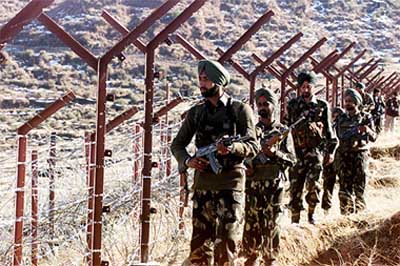 A few men died on each side, and it seems relatively small, in comparison to many of the other issues surrounding Pakistan, but hard-line elements in Pakistan may take this as a sign that they need to launch attacks. All this is sign to the Indians that they must beef up their border security even more--which means even more troops that could be used in counter-terror missions in Pakistan must be used to defend from India. A security spiral is forming--each side, seeing a threat in border instability, is arming itself, and in doing so, making the other side less secure.
But Pakistan has more problems from India than simply a forced shift in military resources. India is now starting to face some of the dilemma that Afghanistan has faced--if it leaves Pakistan alone, it will continue to be attacked by militants (or in India's case, even Pakistani regulars) from inside Pakistan's borders. If the Pakistani civilian military cannot control its own military, on top of not being able to stop militants, then diplomacy becomes useless. No amount of agreement with a head of state can fix a problem that he has no control over. And militants and hard-line military units don't care for diplomacy, they quite like the situation they have now.
If Pakistani-caused problems in India and Afghanistan persist, it will be very tempting for Singh and Karzai to be convinced by the Bush administration that the best option will be to send troops into Pakistan to deal. More interestingly, the
 weak civilian government still has a pro-Bush wild card in their midst--if the Bush administration tells Musharraf that his only chance at not losing power is to rally troops loyal to him in a NATO/Indian/Afghan alliance to drive out anyone standing between the alliance and the end of Pakistani militants, then war in Pakistan would look like the best option.
Nobody is rattling too many sabres. But when sabres are being rattled, it's a warning. Who is there to warn in Pakistan? Would threat of invasion make the hard-liners and militants any less aggressive? Certainly not. Would it give the weak civilian government more power to act? No. It would only warn them that such an invasion might be coming, which can do nothing but make that possible invasion harder--it cannot be used as a diplomatic chip.
That is the most frustrating realization in Pakistan, and maybe the reason Gilani was willing to visit Bush in DC--because he knew that he had no choice but to show he had some sort of control over his country, or else the largest military alliance in the world might decide that dealing with him is a complete waste of time. Nobody is seriously considering invasion yet, but the conditions are becoming such that the Global War on Terror coalition may have no other good options left. And if this invasion does happen, it will be the first ever invasion of an openly nuclear state. NATO uncertainty over whose finger is on the nuclear trigger in Pakistan may be the only thing between Gilani and a nightmare.


