Showing posts with label terrorism. Show all posts

Saturday, April 3, 2010

NATO's Persistent Karzai Problem

It's tough propping up a government when said government seems to want to fight you every step of the way.

Hamid Karzai has gone on a recent bender of accusations against, in particular, the United States, but also the UN and NATO in general. The particular meat of the accusations is that Western powers have "meddled" unjustly in Afghan elections, undermining the legitimacy of said elections and giving the Taliban a political talking point (specifically, the most recent rants mention the throwing out of 1/3 of the votes for Karzai in the first round of presidential elections).

The accusation is probably rather preposterous, but I might be wrong. Either way, the lower house of the Afghan parliament unanimously (that being everyone) voted against Karzai's decree that the UN can no longer hold 3/5 majority of the electoral fraud commission--instead, Karzai would himself appoint the entire body. Unfortunately, the upper house (1/3 of which are hand-picked by Karzai) decided that, procedurally, they could not vote on the matter within a year of the elections. Unfortunately, this means the decree will stand. for the indefinite future.

This isn't the first worrisome think Karzai has said about his relationship with the West. Recently, a visit by Ahmedinejad prompted Karzai to call him a "brother" and otherwise generally cozy up to Tehran. Karzai occasionally has fits about throwing out the Western occupiers, despite his dependence on them to keep his government afloat.

Karzai is, no doubt, a very frustrating character for the West. Somehow, the US has managed to build a relatively rosy relationship with a country that it is illegally invading and drone-missile-attacking to squash a Taliban force that said country has some interest in maintaining (this, of course, being Pakistan), but has not managed to keep on good terms with the tinpot dictator it's trying to support. I'm not quite sure whether Clinton has muttered the words, "Well, if you really don't want us..." but Karzai might just understand that the US (and in particular, the administration) has so much to lose that unilateral withdrawal is just not an option--and if that's the case, Karzai has a great bargaining position, despite his relatively flaky power.

It's not actually all that uncommon for a propping state to have trouble keeping its client state's leadership in line. al-Maliki has been a mostly excellent partner to work with, but this is the exception. The US and UK often fight bitterly with Israel; the US leadership groaned famously over the Saigon government in Vietnam, the KMT/GMD in the Chinese Civil War, etc.

But the question that comes to mind is this: why should Karzai be such a darn pain the butt? What incentive does he have to make the lives of the US leadership as difficult as he does? Wouldn't his life be easier if he wasn't publicly ripping into his supporters? Can't we all just get along?

Well, as you probably know, Karzai's in a pretty tricky position. As much as he loathes the Taliban at a very personal level, Afghanistan is obviously a very long way from being a Taliban vs. anti-Taliban kind of show. All those pesky warlords, tribes, ethnic groups, and what have you make Iraq look like Disneyland in terms of being able to reach a unified consensus and build a unified state.

At the end of the day, Karzai's got to make a lot of rather unsavory people happy enough that they won't directly challenge his claim to power. He's also got to build legitimacy with the general population, so they'll throw support behind him directly (meaning that the other power players in Afghanistan also have to side with Karzai to keep their own popularity and legitimacy). Karzai's in a rather precarious position.

And so, of course he's going to be rather cross when a little election fraud here and there (which he may not have even ordered personally) gets dragged out of the gutter and displayed for all to see--it's going to cast a whole lot of doubt on his personal legitimacy that he probably believes would not be cast if everything looked peachy. At the same time, of course he's going to get friendly with the Iranians--Iran and Afghanistan share a border, and Afghanistan's got a non-trivial Farsi-speaking minority that Karzai needs in his opus-coalition in order to keep power.

And it makes sense that Karzai would call Clinton right after to apologise--there may be a frustrated understanding that Karzai has to look tough against the US in order to try to build legitimacy among (the winnable) tougher nationalists or Islamists, and to show that he isn't implicitly condoning the prevailing impression of election fraud (without selling out the ground-level loyalists that worked so hard to stuff ballots and intimidate voters--such a rebuke would seem like an implicit betrayal).

So the guy's in a pretty tough position. Combine said position with a truly maniacal obsession with defeating the Taliban, a slightly-bigger-than-healthy paranoia, and a penchant for micromanaging that verges on power-obsession, and you've got the Karzai we know and groan today.

But what can be done about it? Well, this is the tough part. Ultimately, the leadership positions of Afghanistan need to be shored up without turning them into tyrants in order to do so.

The big win is probably going to come in developing the Afghan army. When regular folks in Afghanistan see the friendly neighborhood soldier keeping them safe and helping them out, there will be a lot more state buy-in. This can, in theory, be done in time (the New Iraqi Army was mostly built from scratch after the US de-Ba'athification... but it was tough). Furthermore, said army will make the local warlords a decreasingly viable alternative and decreasingly important force in the new Afghanistan.

Second, NATO has to show that the Taliban is a losing alternative. To this end, first, NATO needs big, flashy, high-profile victories in places like Marjah (which haven't yet been delivered, because they are militarily difficult). Second, NATO needs to win the PR war by showing that the Taliban are actually baby-killing extremist nutbags, and won't make life better for the average Afghani. Somehow, this is easier said than done.

Finally, the local police & administration need to be developed. This will be toughest of all. As you've probably heard a bunch, Afghanistan is not used to having any sort of serious central authority. Current administration is underpaid and corrupt, either selling out the central government for cash (usually from the Taliban) or thugging on locals to help prop up their warlord, or even the state. (Step one here is clearly to use our vast sums of wealth to start paying police officers more, and hire cross-functional accountability officers).

But it's going to be tough. Karzai's going to continue to be a problem for the West, and the West is going to have to live with it and work with it, or lose Afghanistan. But the friction between Washington and Kabul shows that we've got a very, very long way to go.

Wednesday, March 31, 2010

Implications of Russia's Caucasus Troubles

Russia's outward and aggressive international posturing in Eastern Europe and the Caucasus may be calming a bit... at least for a bit.

A two-bomb terrorist attack hit Moscow's subways a week ago, killing over 30, and injuring well over a hundred more. The attack was sophisticated in its timing and its execution, catching Russian security services completely off-guard; they could only clean up after the disaster.

Other attacks hit Dagestan, a restive region in Russia where a large chunk of the population wants independence.

Before I continue, I will say that I'm not 100% sure of the culprits--many signs point to separatists in the Caucasus, but a few rumors and reports indicate that Russian intelligence services may have been involved. A human rights lawyer/writer claimed that, after the attack, a man stepped out of the shadows, yelled, "you're supposed to be dead!" and hit her upon the head, before fleeing. That said, this may simply be a furious opposition writer taking an opportunity to blame the state for human rights abuses. Anyway, I digress.

Assuming this was a terrorist act, a few questions obviously arise:
1) Why now, in particular?
2) Did they have outside help?

The first question may be an exercise left to the reader(perhaps you've read some news I haven't). The separatist regions are intermittently active, but their actions usually prompt a relatively brutal Russian response--in this case, Medvedev has said that Russian authorities need to show "more cruelty" in the Russian Caucasus regions in order to root out and break these terrorists. The Russian response is furious and, indeed, it is uniting the Russian people behind the state (in a time when popular opinion was starting to go against Putin and Medvedev). These attacks are unlikely to seriously further any bid for independence, but many militant groups are often prone to high-risk operations in hopes of creating a "quagmire"-style situation that ultimately weakens the central state's control over the area (even if there is not a formal relinquishing). Russia had left much of its separatist republics alone for some time in the 1990s, but it must be obvious to the Caucasus separatists that this is not the Russia of the 1990s. I therefore see dubious benefit to the separatists coming from this attack.

The second question runs the risk of turning us into 9/11-style conspiracy theorists. At the end of the day, militants might not need much in the way of help to make these well-timed attacks. Months of planning, combined with easily-accessed arms and bomb-making materials from a number of central Asian former Soviet states, further coupled with a rather profound lack of communications infrastructure (great for internal spying and policing) would give them the time and freedom they potentially needed to pull the attack off.

That said, it would not be at all shocking if they got help. If they did get help, the question is, from whom did they get help? Do Russian security services have an interest (especially in the light of declining popularity for United Russia) to try to boost poll numbers, unite the populous, or potentially win themselves more internal security powers? Do outside powers (like the CIA, the Georgians, or some sort of threatened Eastern Europeans) have an interest in forcing Russia's eyes inwards, in order to free up "space" to perform their own moves close to the Russian periphery? Both ideas seem dubious, but not completely out of the question.

That said, how will Russia react? Is Russia's response to domestic terror going to be an insular one, where public opinion and Kremlin leadership alike decide to put a delay on expanding the sphere of influence? Or is the rise in unity and state popularity (which is almost inevitable, frankly) going to give the Putin/Medvedev duo a freer hand with which to rattle sabres near Russia's periphery?

Ultimately, it depends on how quickly the Russians are to "get over" the tragedy. If they recover quickly, a legacy of higher polling numbers and "unity" will allow the Kremlin to get gutsy. If the pain should last, an outward stance would appear to be an ignoring of the real problems in Russia's periphery, and create a sense of the Kremlin being "out of touch" with the common Russian.

Sadly, I don't think I have an answer on this one.

Friday, October 2, 2009

The Middle East Wrap

You'll have to accept my apologies for not writing much lately. I'll try to make up for it today by covering just about everything worth covering in the Middle East (and on Monday I'll try to update the rest of the world).

IRAN: Iran's secret nuclear facility has been exposed by intel; Iran's attempts to minimize political losses by admitting it publicly and agreeing to talks worked better than I had anticipated. Israel is currently pulling their hair out over the issue: previously, they had been mulling an airstrike on the known above-ground Iranian facility. The second, underground one has likely ruled that option out. And, as usual, Israel is not ready to depend on Western negotiations and sanctions to solve its problems.

Iran also scored a big win in getting a 2-week "deadline" for an IAEA inspection of the facility, which should allow Iran enough time to clean it up of anything obviously bomb-related (bombs require much higher-level enrichment, for example) and be ready with smiles and open doors for the IAEA inspectors. After the Iraq debacle, the West is going to be hard-pressed to listen to a US or UK insist that it has good intel about WMD operations in a Middle Eastern country without more neutral parties willing to corroborate the story. Iran is likely to manoeuvre its way out of this with limited backlash, frustrating just about everyone (Diplomacy, they say, is a bitch).

Whether that means Iran is significantly closer to the manufacture of an atom bomb is anyone's guess from outside of classified intelligence, but a declassified British report gives them a few years, where the US published a few years ago that such activities had halted in 2005. Such a disagreement in opinion is not surprising, but it does mean that public policymaking will be marred by second-guessing.

Edit: New UN report says that Iran has the "data" to make a nuclear weapon (which is not actually all that difficult, but is a significant declaration).

AFGHANISTAN: McChrystal continues to press the point of getting more troops in Afghanistan, and Obama has continued to leave the issue on the backburner, insisting on a strategic review before going ahead with the decision. As much as it frustrates me to see little action, it's probably the right move: this is key point where Obama has to decide whether to turn Afghanistan into a major hell-raising back-breaking tax-spending mess, or a defeat. Waiting on a decision is easier than reversing one (it is very hard to declare defeat without a changing of the guard--see LBJ and Nixon), but every moment of wait erodes support, as well.

I am, personally, highly torn on the decision. While I don't think there is a "Domino" style theory to be applied here, I do think surrendering Afghanistan will put Pakistan at great risk, which will be a nightmare for India, as well as the US. They do call Afghanistan the "Graveyard of Empires," but the stakes are even higher now. Will the now-well-trained, well-funded, and very spiteful Taliban continue to foster al-Qaeda to strike at the US? The likelihood of retribution the size of 2001 will be very low if NATO walks out of Afghanistan with its tail between its legs. On the other hand, Afghanistan seems more hopeless to me than ever, in particular because NATO does not have a legitimate "good guy" government to support. NATO has resigned to supporting Karzai if he stays in power, which is looking all the more likely, if for no other reason than inertia. Given clear fraud, will his win be any more legitimate than that of Mr. Ahmedinejad in Iran? Afghanis are not dumb people, and they will know and understand, especially if they voted against him. In a normal, clean election, the losing side of the electorate can say, "well, he is not who I wanted, but he is who the majority of the country wanted." If that is not something that's believed, then the bitterness of loss becomes a force for rebellion and resistance. And do you know who's the best source for such opposition? Yeah, you guessed it.

(...if you did not guess it, I am alluding here to The Taliban).

PAKISTAN: Apparently Meshud is dead, which is pretty good news for them. (If you don't know, Meshud just recently took over as head of the Pakistani Taliban, after burning a lot of bridges to do so) Without his strong arm to keep the factions (that he exacerbated) in line, might the Pakistani Taliban begin to fracture?

Swat seems to be returning to normal, but the military has not yet moved on to Waziristan, as expected. This is almost certainly due to a hasty and significant quieting of activity from the Pakistani Taliban after the Swat operation. This was likely a strategic move, designed to give the Taliban in Pakistan time to regroup and resupply from the north, all the while avoiding giving the Pakistani military the necessary public support to act.

ISRAEL/OPT: As usual, a rather hopeless-looking mess. Obama's tripatriate talks fizzled before they were even lit. Settlements continue to be built in the West Bank, and Israel has hit some tunnels and weapons facilities with airstrikes after themselves being hit by rockets. But such activity is too normal to even seriously get international attention anymore. I expect that peace talks will not resume in earnest until the next Israeli election, if then.

IRAQ: Civilian casualty numbers continue to fluctuate, though they're lower than last year. The US is taking almost zero hits, meaning that the war/occupation in Iraq is effectively over. The Arab-Kurdish split continues to grow, though, and chaos allows al-Qaeda to operate in Kiruk and Mosul even to this day. But the Iraqi Army continues to grow in size and skill; when it is powerful enough, it will become an effective bargaining tool against the Kurds, but their most-favored-minority status by the US in particular may prompt them to call victim with some gusto before giving up their bids for autonomy, power, territory, and oil.


OBAMA (in general): He is (hopefully) finding that his personality is not enough to solve the Middle East's problems, and that some serious realpolitik must be played to convince other leaders/countries to act in ways favorable to the US. After failures of overture with Iran, Russia (how many "resets" have we had since January? Seriously!?), Pakistan, and the European partners that we so desperately hoped would love us again after ushering in the new president, we're going to have to buckle down and play the game of strongmen that we apparently so very much hate ourselves for playing.

Wednesday, September 23, 2009

Ambivalence, Indecision, and Defeat in Afghanistan

Barack Obama is in perhaps what will be the toughest spot of his presidency.

With poll numbers slipping, independents fleeing, his touted healthcare bill staggering, the economy sputtering, and other domestic mayhem, Obama might be hoping right now he could fall back to a solid foreign policy base.

But the decision to remove the missile shield in Poland and the Czech Republic is proving more controversial than once thought. His tripartite summit with Abbas and Netanyahu was a flop. Iraq is struggling enough to make headlines, and he has no answers. The Afghanistan election was a disaster, and now, as more American boys die on the field and signs of Taliban dominance increase, Obama is faced with a nasty choice that he didn't want to make yet.

General Stanley McChrystal (head of ISAF and the US Military's lead man on the AfPak region directly under Petraeus' command over the entire Middle East) has publicly called on the president to make a choice: Go big or go home. That is, send more troops, or quit. The current path will only lead to failure. I'm inclined to agree with the General.

The General claims that the current troop count in Afghanistan is simply insufficient--the US is spread too thin and losing. Obama, despite his initial popularity with the US's allies, is finding himself without the clout to request more troops from Australia, England, Germany... certainly not former Soviet Bloc countries (who were so generous to President Bush) after the missile shield debacle (which, to its credit, is supported by the non-partisan and sage-like Secretary of Defense Robert Gates).

The General, who is trusted despite not being particularly well-known, has given Obama a great public challenge in a time when his leadership is being questioned and the risks he is currently running in policy have become much higher and much more unlikely than he was hoping. The domestic roadblocks he's hitting now (which seemed unfathomable after he swept the election) make risks in foreign policy all the more politically difficult.

But politically, the choice that Obama has to make may be a loss either way. Support for more troops in Afghanistan is less than 50%, and if he should send more and casualty rates should continue to increase, and defeat should follow, Afghanistan will become Obama's Vietnam. If he should pull out now, the United States will be overcome with a similar sense of defeat and humility, and the GOP will be able to spend years questioning his wisdom as Commander in Chief.

The risk that President Bush took by appointing Petraeus in Iraq and "doubling down" in a situation where the country wanted to pull out must be appreciated. But Bush, an idealogue, understood that his party was likely to lose the election either way, and was able to act with a strange sense of futile freedom. The risk happened to pay off, and Petraeus' military genius was given the time it needed to shine. But the problem in Iraq, in a strange way, was easier to fix, if not more simple.

In Afghanistan, a corrupt dictator has arose to replace the paladin saviour of the country--and both men go by the name Hamid Karzai. No longer can the US simply back the "legitimate" government against the evil Taliban--the government has begun to lose its legitimacy. Without any legitimacy or moral high-ground in the central government, the US has nothing to fight for, and should leave. But, in a period of domestic political turmoil, admitting defeat would be politically catastrophic.

The election is not over yet. The Independent Election Commission has not yet, in fact, declared any winners in the campaign. UN intervention could lead to a second round of voting, in which Abdullah has a chance of winning, and (hopefully) cleaning house--with Kabul's legitimacy restored, Obama can take McChrystal's advice and double-down, as Bush did in Iraq... and hope that the investment pays off before the 2010 elections, lest the struggling Democrats suffer a slaughter similar to the 1994 turnover. Obama would surely take much of the blame.

If Karzai manages to hold onto power and award the cronies that helped him clutch to it, the game may be over. But this outcome is not assured yet.

For Obama, politically, the right choice certainly seems to be to wait, under the guise of his administration conducting a "strategic review" of the situation. But how long can this wait? How long can he delay before his ambivalence turns into a very loud and public liability? Surely, he is pressing for the IEC to hurry up and make a decision, but the second vote won't happen until late October, should it happen. Strategic ambivalence must wait until then.

But unless Obama has a series of decisive decisions lined up to react to the outcome of the election, he will be stumbling into doom. His foreign policy inexperience is starting to show, as he finds that rhetoric and hope cannot alone drive success in an international anarchy of realist, idealistic, and skeptical foes.

In Afghanistan--the US's deepest foreign policy investment--indecisiveness for too long will spell disaster. The political machinations of reality are coming to a head, and a decision to go all in or cut our losses must soon be made. The decision rests on one man: expect it soon.

Sunday, April 26, 2009

Swat Deal Going South

As Pakistani Taliban march (mostly unopposed) closer and closer to Pakistan's capital, Pakistani leadership is starting to get jittery. While not canceling the peace deal altogether, President Zardari has given the military a go-ahead to hit the Taliban hard and push them back. Fighting has broken out already; the Pakistani military is showing its training gives it a hard edge over the Taliban in conventional battles.

It's unclear what this particular operation is besides a knee-jerk reaction, and it--frankly--probably will not on its own be the beginning of an offensive into the northwestern frontier regions. But it may be a sign that opinion polls are starting to change. The closer the Taliban gets to the capital, the more it becomes clear to the Pakistani people that the Taliban are a threat to the security of everyone in the country and to the very existence of the Pakistani state as we know it. Until now, most Pakistanis thought that the problem would go away if the US pulled out, and that the Taliban did not have aspirations to conquer the region. It's becoming more clear that they do.

The Taliban have not held up their end of the Swat deal to lay down their arms and halt expansion. As discussed earlier, a deal with the Taliban had the strong potential to turn Swat valley into an untouchable safe haven from which to train, arm, organize, and then launch attacks elsewhere. And it looks like that's exactly what the Taliban are doing. But while breaking the Swat deal may have given the Taliban a tactical advantage, they may push the Pakistani people over a threshold of sufficient resolve to begin an all-out offensive. Such an offensive, which could be heavily funded, supported, and aided by the US, might have the potential to seriously rout Taliban leaders that have spent the past few years not having to deal with conventional warfare. More than likely, the Taliban have taken a path-of-least-resistance in the northwestern frontier regions, letting themselves operate more openly and conventionally in a region where they were not being bothered, and supporting their more guerrilla brethren in Afghanistan. If this is true, bringing to bear the might of the Pakistani army might leave them disorganized long enough for the US to be able to make an offensive in Afghanistan.

Should such a pincer maneuver work, the next step would require the hasty-but-effective deployment of indigenous local security forces loyal to the Pakistani and Afghani states. Such a task is easier said than done, but it is something that will be much easier done with a scattered and disorganized Taliban than a fully entrenched and offensive one.

Hopefully, Mr. Obama is ready to take advantage of the Swat deal going south. He needs to be able to propose a better alternative--and this alternative would include getting India to back off long enough for Pakistan to shift some troops to the north. But India is going to want attention dealt to the Kashmir region, as well, which is full of largely Pakistani Intelligence-supported insurgents and terrorists.

Sunday, January 18, 2009

Calculated Madness


The New York Times has a fine article about the "calculated madness" of the Israeli attack, and its analogy in the Hamas circle. But I'm not going to re-hash that.

I intend to consider the validity of Israel's conclusions on its war. Israel took down a lot of Hamas infrastructure--and because Hamas is so ubiquitous in Gaza (it is pretty much everything), Israel took down many houses, schools, Mosques, etc. As far as I can tell, nothing hit wasn't either A) a legitimate Hamas target, or B) a complete mistake, but in war, intent is a very small part of the story.

Israel believes that it has taught them a lesson, as the Chinese are fond of saying in their wars. It strolled in, delivered a beating, and left. It wasn't going to destroy all of the rocket sites. It wasn't going to take down Hamas, and alas, it certainly didn't. This war was meant to show Hamas and its supporters that throwing rockets at Israel wasn't worth the risk of massive retaliation. Did that work? Indeed, can that work?

Israel's hope is that the sup;porters of Hamas, while angry at Israel, will question the wisdom of voting for Hamas. This is somewhat likely, but they may also be purple-blooded. After the Sept. 11 attacks in the US, Americans did not question their foreign policy, except perhaps in concluding that they were being too shy, too meek, too peaceful, and too generous (in conflict with pretty much the rest of the world). While the analogy between the 9/11 attacks and the Israeli war is pretty weak, it makes a strong point: can beating on people make them more calm and peaceful? The Blitz of London, the 9/11 attacks, the bombings of North Korea, the Rape of Nanking, they all say otherwise. But they were all primarily anti-civilian attacks. Can Israel make a clearer message by having almost exclusively attacked Hamas-related targets?

Perhaps. Israel has to make two messages clear: 1) Hamas got Gaza into this mess by refusing to stop launching rockets, and 2) that the Israelis were genuinely trying to avoid civilian casualties. The second will not make Gazans less angry at the Israelis for their friends and family dying from shell fire, but it will allow point #1 to have more salience. And that is the important part--if Gazans can say, "Hamas' irresponsibility is why the Israelis attacked" (whether or not it was deserved, etc), then they will back down.

A good example of this is Europe. Russia has recently been, for lack of a better term, insufferable and hyperaggressive. They have gone after Ukraine (with gas) and Georgia (with tanks) for minor provocations. But even though the Russian response was far out of line (and resembling that of a child's temper tantrum), the European Union has questioned the wisdom of continuing to agitate the Russians--particularly, it has questioned a continued policy of trying to subsume Georgia and Ukraine into NATO. Indeed, while Russia's actions have been largely unjust (particularly in Georgia), Europe has taken the posture that Russia is an entity whose disposition and behavior are both A) unlikely to change soon through any measures, and B) rational, even if unfair and disproportionate. And so the Europeans have acted just as the Russians have. So might the Gazans, if the Israelis can impart the same sense of causal linkage between the rockets and Israel's attack (as Russia did between Georgia's shelling of South Ossetia and its own assault). If that link can become salient and vivid for Gazans, then they will either pressure Hamas to change into a more reserved military entity, or they will vote them out. Either, to some extent, is a victory for Israel. But now that the 3-week assault is over, the propaganda war will only intensify.

Monday, January 5, 2009

Israel's Confidence is High

Israel is starting to hint that they have full intent to take down Hamas with this war in Gaza (though this has been pretty obvious for a few days now). Their confidence that they can do so is surprisingly high, as well--Israeli officials are calling Hamas "crippled" in a few ways: its physical governance infrastructure is ruined (parliament building, police buildings, etc), its leadership is dead or in hiding (having abandoned its population), and its popularity is going to drop.

Though the popularity of Hamas is currently rather high, the Israelis think it will go down significantly in the next few weeks as Palestinians wonder whether a militant anti-Israel stance is one that is going to serve them well in the future. In particular, if Hamas is unable to provide governance, order, medical supplies, etc after the war ends, then their support will erode. Pre-war, Fatah already had an edge in Gaza polls. When the Palestinians have elections, probably in April 2009, Fatah will probably have quite the edge, even in Gaza. And if it does, and if Kadima can hold on in Israel, then the whole situation in Palestine looks a lot different. Israel will probably do what it can to enforce Fatah's right to govern in Gaza Strip, and help clean the strip up before working on serious two-state talks.

Such confidence is strange, coming from an Israel that lost a 2006 war in Lebanon due to overconfidence and poorly-defined campaign goals. Israel had been showing serious conservatism in its war goals early on: the air campaign was aimed at reducing rocket attacks, not even eliminating them. While Israel is not saying that they have changed their goals to the toppling of Hamas, they are certainly saying that it's likely that they will, and that they're quite happy for it. This means one of two things:

1) Israel's government did not learn a lesson from its tough defeat, even though I was able to graft that lesson from my seat in Cambridge, or,

2) Israel is actually well and truly crushing Hamas' governance and combat capabilities.

Occam's Razor says it's probably the latter.

Despite confidence, Israel remains conservative. They have not given in to goading and luring on the part of Hamas to enter Gaza City or other urban areas for street fighting. They have kept their total military casualties to one, suffered on the first night of entry. Israel's targets have been picked with deliberate caution, as well: Palestinian medical authorities have reported only 16 children dead, despite a strong incentive to over-report. Hamas has claimed that half of the over-500 killed in Gaza are civilians, but there is a strong incentive to over-report here, as well: Hamas loses face by reporting its own fighters killed, and gains support by claiming that Israel has killed civilians. Given how informally one can join the Hamas paramilitary, it will be impossible for these figures to ever be confirmed beyond academic estimates.

So things seem to be going well for Israel so far. They have a lot of work to do, and in particular, Israel must keep up strong diplomacy with Jordan, Egypt, and Lebanon, in order to keep its free military reign in Gaza. But such support should have wavered days ago if it was going to. Israel appears to have a serious shot at crippling Hamas for good and, despite the cries of many protesters to the contrary, contribute to long-term peace in the Middle East.

Sunday, January 4, 2009

Analysing Israel's Gaza Tactics

After a day of war, Israel stand at one dead and about 40 wounded. They say they have killed "dozens" of Hamas militants, but they are struggling with their opposition using civilians as human shields in the fighting.

Let me first digress by expressing my own personal sympathies for Israel's difficult position. After returning full control of the Gaza strip to Palestine, Hamas used a civil war to wrest power, and has been using it as a safe haven to accumulate rockets from Iran and other sources to launch into Israel constantly, even during a six-month ceasefire in which Israel was relatively disciplined. Israel provided the majority of Gaza's fuel, food, electricity, and medical aid at no cost--despite access to the Mediterranean and Egypt, Gaza's Hamas leadership has held Gaza's economy back--gross mismanagement and excessive, corrupt government bureaucracy have made sure that Gaza's market has not spun up at all. Hamas hands out aid received by Israel, and takes credit--keeping its popularity high among its many poor and jobless. Hamas seems to take very little flak from its own people for storing weapons in Mosques and orphanages, or by using civilian human shields as they fight Israelis. The Arab world is starting to flare up in protest, and otherwise-moderate Arab governments have to condemn Israel's invasion to halt rocket fire--after relatively patient and persistent warnings to stop, offers to negotiate, and months of restraint--as a "war crime." Luckily for the Israelis, Egypt continues to stand by them (to what extent they can), and the Arab League is unable to spin up the momentum to actually meet over the crisis. The US will block any UN resolutions to officially condemn Israel in any way. Even US Senate Majority Leader, Harry Reid, has said that a ceasefire is impossible until Hamas offers to halt rocket fire. So even if this war lasts for a few weeks, the US will not be switching teams on a dime.

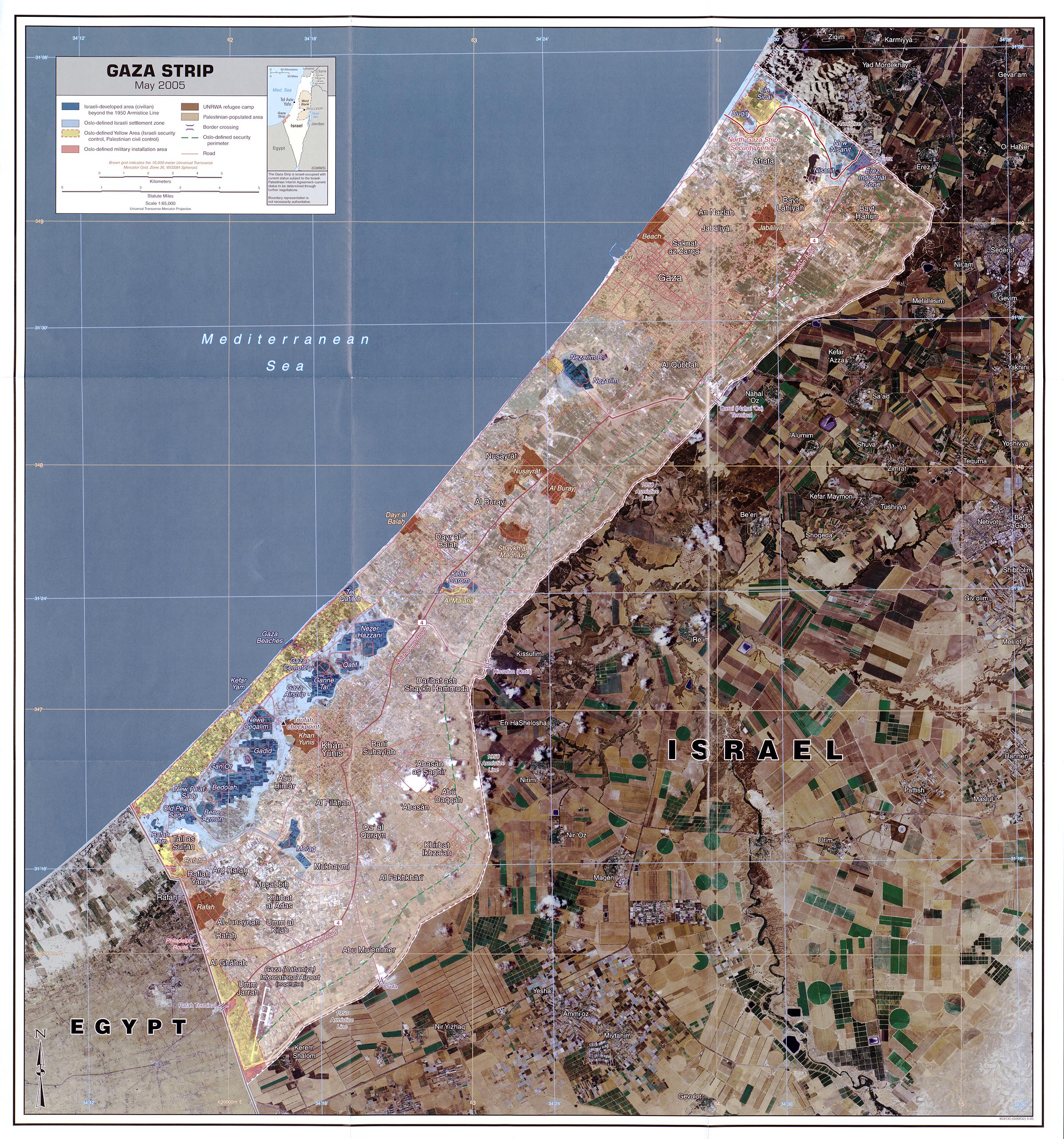
So Israel is now elbow-deep in this problem--what have they actually done? According to relatively scattered reports, Israel has already cut to the Mediterranean and has surrounded Gaza City and other urban centers, as far south as Netzarim, but the Israeli Army has been disciplined enough to avoid entering any major urban areas, where the Hamas militants likely have a great advantage (with huge numbers of civilians that the Israelis have to worry about, potential booby traps, and other "home turf" advantages like knowledge of the terrain, friendly homes, etc). A map I put together below should make it a bit more clear where the Israelis have gone.
Approximate Israeli Movement and Positions (Click for Larger)

Their staging ground was Sderot, on the northeast corner of Gaza. From there, Israel broke in during the night and cut power to most of the northern half of the strip, taking advantage of night fighting technology to strike their initial blow (and most of their advances in the last day). The Israelis are likely to continue using night to press their primary assaults in search of rockets, launch pads, and Hamas leadership. Note that with Gaza City surrounded (and certainly extremely strict policies for anyone escaping), Hamas leadership isn't going anywhere soon (for the Israelis control Gaza waters, as well). Special forces have an opportunity to use what intelligence that Mossad has gathered to take them down in the capital city if they weren't smart enough to get out early.

At this point, Israel looks like it is going to focus on a search-and-destroy mission in the north, and then perhaps move south to mop up militants that got out--it is unlikely to spread its 3 brigades so thin as to take the entire strip at once. Israel also has troops ready in Jerusalem and near Lebanon in case West Bank Palestinians or Lebanese Hezbollah militants try anything tricky to help out their brothers-in-arms.

So the easy part is over, with few casualties for the Israelis, but the hard part--search-and-destroy--is just beginning. The success of the rest of this mission will depend on Israeli tactical intelligence abilities more than brilliant ground war operational capabilities. Israeli unit tactical training will face a test, as well.

But this mission really has more substance than simply finding rockets, or even toppling Hamas leadership. After failing to meet its objectives in Summer 2006 in Lebanon--namely, preventing rockets from hitting Israel in the north--Israel is hoping to regain its deterrent capabilities with neighboring militant groups. Israel is unlikely to face a regular war with its neighbors in the near future--their willingness to negotiate has a lot to do with Israel's ability to bloody them up if they choose to fight. So far, Hezbollah has chosen to sit this one out (so far), and read (though I've lost the link) that there are rumors floating about Hamas heading to Egypt to talk potential ceasefire options. So maybe it's working.

Saturday, January 3, 2009

Gaza Land War Begins

Israel is now holding nothing back against Gaza--its tanks and infantry have entered the strip with the public intent of capturing Hamas rocket launching sites (and likely very large weapons caches nearby) and dismantling them. The Israelis are also likely sending in large numbers of special operations forces to try and take down as much Hamas leadership-in-hiding as possible.

There's little to say yet on the operation, except that it shows a real commitment for Israel to pay the necessary political costs to take down Hamas in a way that would allow Fatah to take control of Gaza if/when it wins elections that Abbas is calling. Strangely, it may be this very war that enables the Israelis and the Palestinians to make peace. A reminder is due that Hamas does not recognize Israel's right to exist--it is only interested in driving Israel out of the area, and that it took over Gaza strip in a civil war in 2006 after losing elections to Fatah--their continued presence has been a tough roadblock for the Israelis, and it seems the Israelis feel they finally have the political capital with their neighbors to finish Hamas off. And despite all the criticism coming Israel's way, it looks like they're right. But now the fate of this operation depends on the military's ability to achieve its objectives without "mission creep" or a quagmire.

Friday, January 2, 2009

Israel Chooses a Gaza Strategy

Israel's former ambiguity in its Gaza strategy is gone, and has given way to a much more decisive strategy of total crippling of Hamas' offensive capabilities. Israel is attacking leadership, communications, security, weapons storage/manufacturing, and deployment sites in an effort to turn Hamas into an ineffectual flag-waving organization, rather than a militant wing with any bargaining power.
Figure 1: Gaza Strip With Urban Densities (Click for Larger Image)

The turn to decisiveness is good for Israel, who appeared to be waffling earlier over what to do. Poking at Gaza and bloodying/infuriating its civilian population without achieving any real political goals would have been not only wasteful, but counterproductive--they would have increased Hamas' will without seriously hampering its capabilities. Now, the Israelis have figured that they have already paid the political cost of the airstrikes, both in Gaza and internationally, and they might as well finish the job to their satisfaction. It will mean many more dead Gazans. It will mean billions in relief. It is a questionable decision overall, but one that appears rational once one accepts the given decision to begin serious airstrikes.

The commitment to cripple Hamas doesn't necessarily mean it will happen, despite Israel's impressive military. In the past, like the 1982 and 2006 wars in Lebanon, the Israelis have struggled to do serious damage to non-state actors. Israel's regular military, despite the state's security needs, remains largely outfitted to promptly dispatch Arab regular armies. But to be fair, nobody on earth has yet figured out how to properly deal with non-state actors, as the US in the last 7 years has demonstrated. Hamas remains resilient and confident. It is an organization that feeds politically on suffering, terror, mayhem, and death. Its support among its base is likely to harden. What makes life tougher for the Israelis is the constant decision between tactical advantage and strategic caution--Hamas has no qualms with hiding arms in Mosques, hiding terrorists in orphanages and hospitals. Israel must choose between letting them hide out, or killing children, killing the sick, killing religious observers. They seem to be going for the latter.

Figure 2: Arms Smuggling and Rocket Sites in Gaza

Israel may be preparing to invade Gaza. Reservists have been called, troops and tanks are lining up by the Gazan border, and foreign nationals are being escorted out of the country. The move may be an effort to pull Hamas security to the border and push civilians away, making it easier to more exclusively target militants, but it may be a legitimate preparation. A ground war is likely to become a mess--unless the Israelis have learned from the Summer 2006 Lebanon war, but chances are (sadly) that they haven't. The most productive thing that Israel can do in a ground war is conduct a series of raids to take down every single Hamas leader whose name registers on the Israeli radar that they can. The only way to truly get Hamas to fall apart will be to rob it so completely of leadership that it kills itself in an internal power struggle. The Mossad may have the intel the Israeli army needs to do that. It's tough to say.

For what it's worth, Israel's friends are sticking by their side. Israel's earlier diplomatic maneuvering is paying off. Egypt is keeping its border crossing closed except for inspected humanitarian relief trucks going into Gaza and inspected emergency transport trucks going out. Egypt has drawn a lot of criticism for this, from the UN and Iran, and from protesters just about everywhere, but it's sticking to its guns. The Lebanese government has come out against criticisms of Egypt, The Syrians have vowed to continue peace negotiations with Israel, and Jordan is keeping quiet despite a 50% Palestinian population. Such reactions are absolutely remarkable, and should mostly guarantee Israel a free hand in the Gaza operation. It remains likely that Livni has convinces Israel's neighbors that Hamas must go.

So with its free hand, Israel continues to pound Gaza, targeting as many Hamas critical points as they can. Hamas remains bold, but nothing Israel can do will change Hamas' rhetoric. Keep an eye out for a Gazan land war, and for more Hamas leaders to turn up dead. Israel may have a unique opportunity to eject this thorn in its side once and for all.

Saturday, December 20, 2008

The Afghanistan Surge

The US has proposed a surge in Afghanistan--almost 30,000 troops--which would double the size of the US force there. As a percentage of the overall force, it is much higher than the force sent to Iraq. And the strategy will be greatly different from Iraq, as well. Afghanistan is not suffering from an ethnosectarian civil war. The insurgency is not urban--on the contrary, the government tends to have control of cities even in otherwise heavily-Talibanized areas. Militants thrive in the mountains and villages where the government and NATO struggle to exert their control--it's all a very different beast.


The strategy lies in a point made by JCS Chairman Mike Mullen: mainly that Taliban militants typically get routed when they engage US troops directly. A few notable exceptions remain, like the Khandahar prison raid in June. But in general, the Taliban makes trouble where the US _isn't_. (This is in contrast to Anbar province of Iraq, where trouble followed the US wherever it went)

The idea is that more troops can keep the peace in the south and possibly systematically root out Taliban presence from the north. An oil spot security strategy is doable, though it requires very deep integration (or intrusion) into the lives of Afghanis. But keeping peace down is unlikely to lead to a negotiation, like it did in Iraq (along with many other factors). The Taliban say they won't negotiate with Karzai as long as US troops are on their soil. And they're decades-old extremists that ejected the Soviets after nearly a decade. They're patient, and willing to put up with a lot of punishment.

So the only reasonable strategy here is to make Afghanistan a "safe zone" with overwhelming security, and then deal with Pakistan separately. The Afghan war cannot be won without Pakistan falling into place, of course: the minute US troops leave Afghanistan, free militants in Pakistan would pour in to reconquer the country, or at least some chunk of it that the Afghan army can't handle.

India is putting massive pressure on the Pakistanis--enough that they are letting leak that they are planning their own precision strikes in Pakistan-administered Kashmir. The move is risky, and could risk war... but it is unclear whether the move on India's part would be harmful or helpful to NATO operations in Afghanistan. If there is a war, then the state falls apart and the militants thrive--unless NATO joins the war and makes it quick and decisive. Pakistan is unlikely to become an Indo-NATO joint mandate territory, but a decisive war could mean that certain parts of Pakistan's territory come under the security administration of NATO and India. China and Russia will certainly veto any resolutions to get the UN's blessing, and that will hinder such a deal from being made.

Pakistan knows it's in a lot of trouble. The US is still striking in its territory, and India is about to. The current government cannot afford to do nothing, but they also cannot afford a losing war with India. China would even be unlikely to get involved--Pakistan is an ally, but good relations with India are incredibly important. Domestically, the Pakistani government is rather doomed no matter what it does. Going after militants in-country is nearly impossible for Pakistan (due to domestic pressure, an ineffectual military, and a corrupted intelligence operation)--so ultimately, they're likely to face the wrath of India.

The Afghanistan/Pakistan situation has deteriorated to an unlivable level. General Petraeus, in charge of all of CENTCOM now, is going to try to work his magic a second time around in Afghanistan, and see if he can't save the second US-led folly in a row.

Thursday, December 18, 2008

Maliki Cleans House

Over the past few days, dozens of members of Iraq's interior ministry have been arrested by an elite Iraqi counter-terrorism unit that reports directly to Prime Minister Maliki. The claim by counter-terrorism and intelligence officials is that many of these officials were part of a resurgent Ba'ath party (called Al Awda, or "the Return") that was quietly trying to coup Maliki's government. Apparently huge sums of cash for bribes were found, as well as documents.

If these allegations are true, then Maliki faces a very tough political struggle in the next few years. It means factions within Iraq are still quite dedicated to returning the Old Order, or some different one (like an Islamic fundamentalist state, etc)--they have not yet given up. Any sign of weakness on the federal government's part may open up Ba'ath or Sadrist coups, a declaration of independence by Kurdistan, or all sorts of other problems that would undermine the Iraqi state.

Maliki has few strong allies in politics--he was a bit of a compromise candidate. His list, the United Iraqi Alliance, includes Sadrites, the Supreme Council for the Islamic Revolution in Iraq, the al-Dawa party, Hezbollah in Iraq, the Badr organization, and a number of other relatively radical and unpredictable characters that do not have a great deal of loyalty for Mr. Maliki. He's become more popular since coming into office, and a fair bit more powerful, and he's able to keep everyone together. But everyone's grumbling as they behave.

But what he does have on his side are an impressive counterterrorism and intelligence unit (that seems to have caught some serious coup-planners early in the game) and a very professional military. The military is not completely competent yet--it will require the help of the United States to train and provide logistics until (hopefully) the US leaves. But it has done a relatively excellent job of not falling apart and fighting itself as it has attacked Sunni and Shiite militias alike. It is gaining a reputation for non-partisan and non-secular dedication to duty, and this will allow Maliki to combat most coup attempts that do not directly assassinate him.

The other possibility remains that there is no coup. Provincial elections are coming up, and the US--Maliki's biggest backer--has one foot out the door. Maliki may be legitimately concerned about his ability to continue holding onto power. The US may be legitimately concerned with what will happen as it pulls out--and any groups looking for their last chance to jump and try to shake things up pull their big stunts at the same time. But, when trying to make a democracy work, using authoritarian and underhanded police-state tactics to hold it together undermines the entire ideal being sought. We must hope that Maliki is not letting the ends justify his means.

But it's unlikely he is so foolish as to make blind attacks on political rivals. More than likely, his organization has found good evidence of some sort of bribery, corruption, etc. How much of an all-seeing eye Maliki has over his government is tough to say--probably not too keen one, given the state of the government in Iraq. But the arrests do mean one of two things: either high-level ministers are trying to bring back Hussein's regime, or Maliki is on the path of slowly becoming it in order to prevent it. The next 2 years in Iraq may be more formative than previously thought.

Monday, December 15, 2008

Gaza War to Reignite

As the truce winds down, Hamas faced two options: rev the war back up, or bide their time. Long-term, time is in their favor--Arab Muslims are outbreeding Jews by quite a bit (although they're still quite the minority). But it's very long-term. So Hamas is going with option 1.

First: rocket attacks have increased significantly. Because Hamas has no credible control over the people of Gaza, the only reputation blow it takes is for letting these rockets go is on its administrative and security abilities--a reputation it doesn't really care about anyway. But Hamas allows doubt to loom over whether it's orchestrating the attacks or not. The rockets are making living near Gaza nigh-untenable for Israelis, even though none have died. But that's the point: it's terror.

Second: Hamas has generally agreed that the cease-fire will end. They claim they will only "respond to Israeli aggression," but the cease-fire gives Israel a lot of leeway to really hammer down on the West Bank for rockets flying into Israel--if Hamas doesn't want large-scale war, it had better hope that it does have control over such rocketeers. The lack of a cease-fire will lift any veil that Hamas is actually trying to keep rockets under control--and Israel has shown that it's unlikely to cow to international pressure. Hamas probably knows it, too.

Israel probably has a plan to make a surgical strike into Hamas if they provoke it. Israel had offered to extend the truce--it was Hamas that declined, even after Israel released a few hundred Palestinian prisoners. Along with the rockets, Hamas is pretty clearly asking for it. Expect the Israelis to have something very precise in their sleeves to unleash on the Hamas leadership if they start acting up after the truce ends. Especially with Livni's declaration that Hamas has to go by force, don't expect Israel to play nice with Hamas, regardless of whether Kadima or Likud takes the polls in January.

Sunday, December 14, 2008

Livni Starts Talking Tough as Elections Loom

With elections in January, Tzipi Livni, leader of Israel's Kadima party has been thinking very hard about what to say and do, balancing her principles and her obligation to lead her party to victory. It seems she has come up with just the solution.

Many Israelis worry that an unchecked Palestinian state would be a broiling terror base. There is some evidence for this--in occupied West Bank, few terror incidents have occurred in the past few years. Despite Israeli domination, those in West Bank favor the Fatah party, and are pro-reconciliation. In Gaza, where Israel withdrew earlier in the decade, Hamas reigns supreme, and launches rocket attacks at Israeli towns almost every day. Hamas is still officially at war with Israel, holding rather ineffectually to a six-month truce that will expire on the 19th of this month. Hamas has not made it clear whether the truce will be extended. Hamas politicians are also sending mixed messages on whether they want a two-state solution--one of Hamas' underlying principles is the elimination of Israel and the creation of a Palestinian state in the territory. Hamas propaganda and speeches drip with anti-Israeli rhetoric. Naturally, leaving the Palestinians to their own devices seems like an unattractive option for Israelis.

Livni may have appeared soft earlier, willing to push for a 2-state solution despite Hamas' continued anti-Israeli stance and behavior. But Livni has taken advantage of international recognition of Hamas as a terror group--while she is willing to deal with the moderate Fatah party as a representative of the PA, Hamas has no authority in the eyes of Israel. They would not be invited to the negotiating table. But further, she's taken a stance of zero tolerance for Hamas, and declared her willingness to use military means to eject them from the Gaza Strip. Such a maneuver will be difficult, given that Hamas is a decentralized party and militia, but it's an important signal coming from Livni. She's saying to the Israeli people that she will not allow her pro-negotiation stance to grant Hamas any legitimacy, and further, that she is willing to be the candidate that gets rid of them for good.

There would even be some shred of international legitimacy in such action--Fatah is currently the ruling party of the PA, but has no control over Gaza because Hamas drove them out militarily--thus, Hamas' control of Gaza can be considered illegitimate and tyrannical. Israel is probably the most effective (if not the most politically attractive) force that could restore Fatah power over Gaza.

This new, tougher stance may win back some of the Israeli moderates that jumped the Kadima ship to Likud. But we'll have to wait a few weeks for the pundits to talk and the polls to come in before we can know.

Tuesday, December 9, 2008

Congress Hangs On in India

Many analysts believed the Mumbai attacks would be devastating for the Indian Congress Party--the pro-business and pro-US ruling party in New Dehli. While Pakistani cells were almost certainly responsible, a number of intelligence failings on the part of Indian counterterrorists became apparent. The US had warned India of a terror attack on Mumbai through its ports.

Such failings looked like they would vindicate BJP (the opposition leader) criticisms for years over weak terror and Pakistan policies. But Congress is holding on with surprising vigor. In recent state elections, Congress won 3 of 5--most interestingly, Dehli, which pundits thought seemed certain to go to BJP due to its close cultural ties with Mumbai. But while the bombings were clearly a black mark on Congress, the relative responses of Congress and BJP may have made the difference.

Congress has stepped up pressure on Pakistan, together with the United States. India has demanded--and to some extent, received--Pakistani help during the Mumbai investigations. Quickly, the Pakistanis responded with a number of arrests, including the alleged "mastermind" of the attacks. In addition, the government has revealed the identities of the Mumbai gunmen, giving the Pakistanis few political options besides a new wave of arrests to get to people near these published gunmen that might have been involved in conspiracy. Indians may be relatively satisfied with this cautious but firm response. It appears dynamic and well-thought-out.

BJP, on the other hand, has faced accusations of "opportunism." The Mumbai attacks were much like an Indian 9/11, and appearing to try to gain politically by the event will hurt any party. BJP may have been too aggressive. In addition, Indians may not want to encourage another bloody war with Pakistan (that might, if poorly designed, lead to even more terrorism by fracturing the Pakistani state) by electing the currently fevrishly militant BJP.

Elections in May are coming up for Congress, and they can't afford to lose. Allegations of buying votes on the US nuclear deal remain, and the Congress response to these attacks may shape their election hopes in May. They have a few months to make it work, which may be the basis of their slow, cautious approach. If Pakistan does end up declaring full-scale war on the militants, then Congress can take credit for applying enough pressure to get the job done without having so sacrifice Indian troops--such an outcome would be the best Congress can hope for.

Friday, November 28, 2008

On the Mumbai Attacks

You've read the news: Muslim extremist militants have attacked Mumbai, India with small arms. Well over 100 dead, and multiple days of carnage in some of India's wealthiest hotels.

The attack was clearly directed at Americans, Israelis, and Britons--gunmen took tourists (in multiple locations, including the Taj Mahal Hotel) hostage and started demanding the turnover of civilians with US and UK passports, and started executing them. They also attacked a Jewish house. But these terrorists were ruthless, and carelessly gunned down anyone that didn't strictly follow rules, or appeared to be a threat. They were undisciplined, highly outnumbered, and hope to instill fear into the group to behave. What happened was well over 100 deaths, mostly Indian.

The attack was clearly designed to terrify Americans and Britons. But the attack has brought little in the United States or Britain but sympathy for Indians. The terrorists largely failed to hit the large number of US and UK citizens that they were hoping, and created such lasting carnage in India that the Indians took the vast majority of the impact. Now--nutjob fundamentalist Islamists have no problems with terrifying Indians and assorted Hindus.

But Pakistani fundamentalists have now incurred the wrath of their neighbors. India and Pakistan have gone to war 3 times since 1947, and almost went to war in 2001 over a bombing then. A nasty 2006 train bombing in Mumbai was blamed on Pakistani militants, and this attack already has been blamed on them as well.

The Indians are outraged--they are calling this "India's 9/11"--but their response is not obviously clear. They are angry at the US and UK--I remember seeing a live report interrupted by a hysterical man running by and asking why Indians had to die, why it wasn't the US getting bombed. But the Indians also hate the Pakistanis, and are very used to placing blame on them.

Pakistan's Intelligence was very involved in Indian terror networks before 9/11, but those relations have strained (in part due to US pressure and in part due to Pakistan's own Islamist problems). But if this attack was coordinate in a Pakistan "safe haven," then the Indians may start sharing the same attitude the US has about Pakistan's ability to police its own territory. There is some International Law precedent that a government unable to administer and police its own territory has forfeited its sovereignty. But this will require many months of UN deliberations to happen, if it happens at all.

On the other hand, the US and India could just go ahead and drive in. But even if they were ready to take the political beating for such an attack, they would have to make it quick and decisive--a prolonged war with Pakistan would only strengthen the Islamists. But it's ultimately unlikely to happen.

Pakistan's Intelligence chief is visiting Mumbai, likely to try and keep relations from going sour. But the Indian government, which barely has a stable majority, can't afford to do nothing. If they don't blame Pakistan, then they take the blame themselves. They're unlikely to blame the US and UK for bringing the heat into India--they're so used to anti-Indian attacks that the specific target of these terrorists is mostly immaterial. The Indians will need a target to blame, and decisive action to take, probably targeting Pakistan in some way. How they'll manage their domestic politics and neighborly relations is a tough question that New Dehli will have to be quite clever to figure out.

Tuesday, October 28, 2008

Tactical Knee-Jerks Undermining Long-Term Strategy

The US is crushing its own Middle Eastern policy with foolish tactical maneuvers. In Syria and Pakistan, the US is launching strikes to try to solve some of its cross-border problems, killing insurgent leaders and trying to create an atmosphere of fear for insurgents across the border--the US is trying to convince them that 3 miles across the border is no longer a safe zone where they can operate freely.


But the short-sightedness of these operations is frustrating. In Pakistan, anti-American sentiment is high and growing. Any hope for NATO-Pakistani military collaboration against the Taliban (particularly now, as Pakistan finally launches an assault against militants in its northwest) has been crushed. The US is going to be sticking around a very long time in Afghanistan, whether we like it or not. When its biggest problems are in Pakistan, it must either work with the Pakistanis or send the entire army in--but a halfway policy is foolish; it neither gains much military advantage, nor does it foster collaboration that would be critical to victory. If we were collaborating, we could make airstrikes in Pakistani territory with Pakistani ground intelligence--it would be hailed by the government as an effort conductive to stabilizing its regime. But attacks without permission force the government into an anti-US stance, because its sovereignty has been violated repeatedly.


Attacks on Syria are even more foolish. Syria is not a weak state, and its influence matters. The US is right that Syria can't completely control its border, but nor can the US control its own with Mexico. After more than a year of Westernization by Syria, this attack is hurting that process seriously. Syria is likely to be more skeptical of such Westernization, due to a lack of trust in Western powers. The US can't afford to radicalize Syria by violating its sovereignty--and if it does, it should at least make some PR efforts by apologizing.

In particular, while the US is negotiating its stay beyond December with Iraq, it does not help itself by showing Iraqis that the US will use Iraq as a staging ground for attacks on its neighbors. The US is not just justifying current anti-American sentiment, but bringing loyalty to question among Iraqi parliament members that are thinking of voting for the security pact.

Life is going to get a lot tougher for the US in the Middle East unless it quickly tries to revere the trend in perceptions.

Tuesday, October 21, 2008

Saudi Arabia Cleans House

991 Saudis have been simultaneously indicted for terrorism (technically, "acts of rebellion" or "acts of war" against the state) over the past 5 years by the Riyadh government. Recall first that many Saudis were involved in the 9/11 attacks, and that foreigners in Saudi Arabia have been attacked with bothersome frequency by Wahhabi terrorists. Americans mostly perceive the Saud royal family of spending more time bathing in petrodollars than doing anything to help, despite being an alleged "friend" of the Bush regime.

It's a bit different than that. The Saudi government doesn't really like the Wahhabis or Al-Qaeda or other fundamentalist nutjob terrorists, despite their own fundamentalist leanings, and despite their support of very questionable Sunni militants in Iraq. Al-Qaeda and the Wahhabis don't really like Saudi royal rule, and often make trouble for the population. Terrorism in Saudi Arabia has killed 160 citizens and wounded hundreds more.

Why hadn't the Sauds dealt with it yet? Part of it is that they have a surprisingly tenuous grasp on power. They're not about to fall, but they don't have much in the way of representative legitimacy, and Wahhabism is pretty darn powerful in Saudi Arabia. The Saud government certainly wanted to avoid an all-out war with its own Wahhab people; it was happier to leave them alone.

But why now? Well, the unhappiness by the Sauds with the Wahhabis didn't go away--the Saud family was not thrilled to have them around. The huge number of simultaneous indictments indicates that this was a "one swift stroke" kind of motion--the Saud government is making a power grab. It's a risky move--if it's not intimidating enough, Wahhabis may rebel en masse--creating a messy internal war (much like the one that Pakistan is trying to fight now). But if the show of force is sufficient--if it can disrupt, demoralize, and decapitate the Al-Qaeda and Wahhabi organization, then they've got a good shot at nearly permanently weakening their extremist groups.

The timing may also have to do with Iraq--they may have decided that the civil war is over, and they no longer need to stay friendly with their own Sunni insurgents/extremists to keep funding the militias in Iraq. The Iraqi factor may have been holding them back for the last 5 years, and may finally be over.

Tuesday, September 30, 2008

Updates on African Hostage-Taking

While the stock market may be captivating our attention, we may have missed some recent hostage crises in Africa that are almost over, but have some interesting implications.

The first is an Egyptian hostage crisis, in which European tourists and Egyptian guides were kidnapped by African kidnappers that were demanding a ransom. They were let go (story from the hostages here) recently, but with some odd international events. There are rumors that the Italian government paid a ransom for the hostages' release, but the Italian government denies this, saying that they and Egyptian commandos freed the hostages in a raid; the hostages claim they know nothing of any raid, that they were simply told to go.

This is not necessarily a contradiction--it could be that the hostages were let go while the raid was coming (and the kidnappers had advance warning), and then the shootout happened. It's unlikely that no shootout happened at all, but if the commandos didn't find any hostages, one would think that they'd mention it in their reports about the alleged raid. Something is fishy here, but it may simply be an overly-optimistic PR campaign by the involved governments, trying to repeat the success of Columbia/US against FARC a few months back. Sadly, if it turns out there are inaccuracies here, it may have backlash PR repercussions against counter-terror campaigns.

The second interesting piece comes from Somalia: a Ukrainian ship full of Russian tanks was hijacked for a $20 million ransom off the coast of Eastern Africa. The US and Russians both sent ships, and have surrounded the ship. In short, it looks like the standoff is close to being over--shots have been heard on the ship, and three of the pirates are dead. This shows a clear breakdown of leadership on the vessel--some pirates are probably trying to hedge their bets and get out now, while others want to play brinksmanship. The fighting means that pressure is mounting for the pirates, and that they are unlikely to hold together.

But internationally, it shows the Russian and American navies working together in the interest of arms control--something that will go a long way towards healing the rifts from the Georgian invasion. Russia's PR game continues with this latest deployment of ships, and people are likely to calm down about Russia in the future if they continue such cooperative measures.

Sunday, September 28, 2008

Syria's Trouble with Liberalization

Syria's recent warming up to the West--including joining the Mediterranean Union, working on serious peace talks with Israel, establishing diplomatic ties with Lebanon and agreeing to demarcated borders, and visiting Europe to talk about security problems in the Middle East--has started to show evidence of serious consequences.

The most recent is a bombing in Damascus that killed 17--a very rare event in Syria, which keeps control with ubiquitous security and sometimes-brutal repression.

But Syria doesn't have control over the entire desert to the east of Damascus, where a large number of Sunni extremists sit around steaming about Syria's relationship with Shiite Iran. But these Sunni extremists also happen to really like the Sunni extremists in the north of Lebanon that benefited from Syrian control, and both groups are now upset that the Syrians are supporting the elected Lebanese government.

But this comes with a drift away from Iran and a lowering of support for Shiite Hezbollah. Normally, I would suspect the Sunni extremists to write such a policy off as a bit of a wash, realizing that the Syrians are breaking with the Shiites much more than anyone else. The Sunni militants' biggest beef is probably that the Syrians have tightened security in their Iraqi border, which would prevent such militants from pushing manpower and weapons into the fight.

But there are other culprits. Syria has a lot of powerful security forces that are intense rivals of each other, and may be locked in a power struggle. They were responsible for a number of coups during the Cold War, but there is some evidence that Assad's decision to liberalize may be causing one coalition of security groups to flare up and the other to try to protect the current government.

The best example of this kind of circumstantial evidence is the bombing of a prominent Hezbollah leader in Damascus back in February. While Hezbollah and Iran were quick to blame Israel (for which I'm sure the Mossad is quite flattered), it's unlikely Israeli security has the kind of operational freedom in Damascus to get away with such an assassination. The bomb was entirely possibly placed by a pro-Western faction of the Syrian security forces, possibly in hopes of causing strains in the Syria-Hezbollah relationship. This could be the work of anti-West security forces trying and failing to hit someone in specific.

The evidence for this bomb being the doing of Sunni militants is that in the last few weeks, Syria has put a bunch of troops along the Lebanese border--this looked like it was primed to go back on its promises to Lebanon earlier, but the Syrians had voiced no reason why they might. In retrospect, it looks like they were trying to prevent northern Sunni militants from flooding in and trying to conduct operations in Syria. Their success was possibly not complete.

Either way, this kind of bombing is likely to worry Syrian civilians, but probably won't cause them to take an appeasement route with respect to extremists and terrorists. Syria has the will and the capability to deal with these guys, and simply needs to execute another crackdown. If it can manage to control its borders with Iraq and Lebanon, then it can even try a systematic in-house cleaning operation--though getting rid of militants forever is unlikely to happen.