There was a sliver--however slight--of a good set of talks coming up in the Middle East.
An assailant attack that killed 4 Israelis near Hebron has probably undermined that entirely. The trick here is not that it will necessarily outrage the Israelis into quitting the talks, but that it will call into serious question Abbas' credibility in promising to handle his own security situation--this happened even with Israeli troops nearby.
Security, obviously, it Israel's biggest concern in the talks, and a number of more extreme-leaning groups (including Hamas) want to make that a tougher point during the talks. The emergence of a weak Palestinian state with Israel in a comparatively strong position would be a failure to the real revolutionaries.
In short: don't get your hopes up for these talks. Frankly, they were probably mostly a political maneuver anyway.
Showing posts with label fatah. Show all posts
Showing posts with label fatah. Show all posts
Tuesday, August 31, 2010


Tuesday, August 11, 2009
Impact of the Fatah Shakeup
 Fatah had its first congress in 20 years over the week, in what was seen as an attempt to save the party from its quickly-deteriorating reputation (which has been, since 2004, increasingly along the veins of "corrupt," "divided," and "ineffective"). After the surprising 2006 loss to Hamas in parliamentary elections, and then its ouster from Gaza by a Hamas coup, Fatah appeared to be running out of time.
This sixth Congress was an exercise in enormous cat-herding, and the vote was severely delayed due to an apparently unexpected addition of delegates and a rather frantic worry about the outcomes. And, for the ruling powers of Fatah, worry was worth having. This "old-guard," as it's being called, lost big--of the 18 seats in Fatah's central committee, old-guarders won only 4 seats. Younger "reformists" won 14, setting the path for a new kind of party. Abbas, despite his links to the old-guard and the beginning of the movement, appears to come out of the congress strengthened, with young and energetic allies in the central committee, as well as a renewed mandate.
This "reform" sub-movement is much more a political party than a resistance movement. They support a two-state solution based on the 1967 treaty lines, and are willing to negotiate with Israel over the issue. They have not dropped the right to "resist by all means" for the independence of the Palestinian people, but doing so would have been political suicide anyway.
But this new Fatah is distinguishing itself from its violent-revolutionary cousins, Hamas, much to the relief of moderates in the US and in the Middle East, Israel included. But its leadership is younger, more popular, and probably less corrupt. The new leadership has a year to get its act together before 2010 elections, in which they hope to re-take control of the Palestinian territories, and can then negotiate with greater legitimacy on behalf of the Palestinian people for statehood.
Whether these negotiations can actually push forward in the face of continued Israeli settlement construction is daunting. Israel may require a change in regime itself before serious negotiations over the details of a two-state system re-emerge. But if the Palestinian Authority can present a moderate, reasonable alternative to the violent and inflexible Hamas, Israeli fears may be assuaged to such an extent that a more reconciliatory leadership will emerge in time. Fatah will need to remain consistently open to negotiations, and more importantly, it will have to impose credible control over all of the Palestinian Authority before the Israelis are likely to see the short-term risks of two-state solutions sink far enough below the potential long-term benefits to seriously consider that road.
Saturday, February 28, 2009
Moderates Sidelined in Middle East Conflict
 Kadima's gamble in Palestine did not pay off. It's unclear as to whether or not it backfired, but Feb. 10th elections have given Israel's right-wing a majority presence, and President Peres has asked Mr. Netanyahu to form a government, despite Likud's second-place showing in the election.
Mr. Netanyahu has hosted two rounds of negotiations with Kadima, in order to try and form a broad coalition government. But those talks appear to have collapsed, probably over Kadima's commitment to reduce settlements and pursue a US-backed two-state solution. This breakdown likely indicates that Israel is going to lean to the right in the near future.
To form a majority government in the Knesset (parliament), one needs 61 of 120 seats. We'll assume for now that Mr. Netanyahu will likely fail to woo Kadima (28 seats), the Labor Party (13 seats), United Arab List (3 seats), Balad (3 seats), or Hadash (4 seats), which together are 51 seats. To cobble 61 seats together, Mr.
 Netanyahu will have to appeal to the Zionist/Nationalist tendencies of many right-wing groups, including Yisrael Beytenu (15 seats), United Torah Judaism (5 seats), National Union (4 seats), The Jewish Home (3 seats). Shas (11 seats) is the wildcard--but even if Netanyahu picks them up, he has a narrow coalition indeed, and one whose weight is far to the right. Voices interested in a two-state system will be sidelined in this new government, and the Palestinian Authority will have to choose a reaction.
The PA reaction may be to entrench, but it's unclear. Mr. Abbas is having a lot of trouble forming a unity government with Hamas, largely because Hamas refuses to recognize Israel as a state. Abbas is likely to lose what ground he had in pursuing the two-state solution if Israel spends the next few years uninterested in working with him on such a plan.
Mr. Obama seems to have his work cut out for him.
Monday, January 5, 2009
Israel's Confidence is High
Israel is starting to hint that they have full intent to take down Hamas with this war in Gaza (though this has been pretty obvious for a few days now). Their confidence that they can do so is surprisingly high, as well--Israeli officials are calling Hamas "crippled" in a few ways: its physical governance infrastructure is ruined (parliament building, police buildings, etc), its leadership is dead or in hiding (having abandoned its population), and its popularity is going to drop.
Though the popularity of Hamas is currently rather high, the Israelis think it will go down significantly in the next few weeks as Palestinians wonder whether a militant anti-Israel stance is one that is going to serve them well in the future. In particular, if Hamas is unable to provide governance, order, medical supplies, etc after the war ends, then their support will erode. Pre-war, Fatah already had an edge in Gaza polls. When the Palestinians have elections, probably in April 2009, Fatah will probably have quite the edge, even in Gaza. And if it does, and if Kadima can hold on in Israel, then the whole situation in Palestine looks a lot different. Israel will probably do what it can to enforce Fatah's right to govern in Gaza Strip, and help clean the strip up before working on serious two-state talks.
Such confidence is strange, coming from an Israel that lost a 2006 war in Lebanon due to overconfidence and poorly-defined campaign goals. Israel had been showing serious conservatism in its war goals early on: the air campaign was aimed at reducing rocket attacks, not even eliminating them. While Israel is not saying that they have changed their goals to the toppling of Hamas, they are certainly saying that it's likely that they will, and that they're quite happy for it. This means one of two things:
1) Israel's government did not learn a lesson from its tough defeat, even though I was able to graft that lesson from my seat in Cambridge, or,
2) Israel is actually well and truly crushing Hamas' governance and combat capabilities.
Occam's Razor says it's probably the latter.
Despite confidence, Israel remains conservative. They have not given in to goading and luring on the part of Hamas to enter Gaza City or other urban areas for street fighting. They have kept their total military casualties to one, suffered on the first night of entry. Israel's targets have been picked with deliberate caution, as well: Palestinian medical authorities have reported only 16 children dead, despite a strong incentive to over-report. Hamas has claimed that half of the over-500 killed in Gaza are civilians, but there is a strong incentive to over-report here, as well: Hamas loses face by reporting its own fighters killed, and gains support by claiming that Israel has killed civilians. Given how informally one can join the Hamas paramilitary, it will be impossible for these figures to ever be confirmed beyond academic estimates.
So things seem to be going well for Israel so far. They have a lot of work to do, and in particular, Israel must keep up strong diplomacy with Jordan, Egypt, and Lebanon, in order to keep its free military reign in Gaza. But such support should have wavered days ago if it was going to. Israel appears to have a serious shot at crippling Hamas for good and, despite the cries of many protesters to the contrary, contribute to long-term peace in the Middle East.
Though the popularity of Hamas is currently rather high, the Israelis think it will go down significantly in the next few weeks as Palestinians wonder whether a militant anti-Israel stance is one that is going to serve them well in the future. In particular, if Hamas is unable to provide governance, order, medical supplies, etc after the war ends, then their support will erode. Pre-war, Fatah already had an edge in Gaza polls. When the Palestinians have elections, probably in April 2009, Fatah will probably have quite the edge, even in Gaza. And if it does, and if Kadima can hold on in Israel, then the whole situation in Palestine looks a lot different. Israel will probably do what it can to enforce Fatah's right to govern in Gaza Strip, and help clean the strip up before working on serious two-state talks.
Such confidence is strange, coming from an Israel that lost a 2006 war in Lebanon due to overconfidence and poorly-defined campaign goals. Israel had been showing serious conservatism in its war goals early on: the air campaign was aimed at reducing rocket attacks, not even eliminating them. While Israel is not saying that they have changed their goals to the toppling of Hamas, they are certainly saying that it's likely that they will, and that they're quite happy for it. This means one of two things:
1) Israel's government did not learn a lesson from its tough defeat, even though I was able to graft that lesson from my seat in Cambridge, or,
2) Israel is actually well and truly crushing Hamas' governance and combat capabilities.
Occam's Razor says it's probably the latter.
Despite confidence, Israel remains conservative. They have not given in to goading and luring on the part of Hamas to enter Gaza City or other urban areas for street fighting. They have kept their total military casualties to one, suffered on the first night of entry. Israel's targets have been picked with deliberate caution, as well: Palestinian medical authorities have reported only 16 children dead, despite a strong incentive to over-report. Hamas has claimed that half of the over-500 killed in Gaza are civilians, but there is a strong incentive to over-report here, as well: Hamas loses face by reporting its own fighters killed, and gains support by claiming that Israel has killed civilians. Given how informally one can join the Hamas paramilitary, it will be impossible for these figures to ever be confirmed beyond academic estimates.
So things seem to be going well for Israel so far. They have a lot of work to do, and in particular, Israel must keep up strong diplomacy with Jordan, Egypt, and Lebanon, in order to keep its free military reign in Gaza. But such support should have wavered days ago if it was going to. Israel appears to have a serious shot at crippling Hamas for good and, despite the cries of many protesters to the contrary, contribute to long-term peace in the Middle East.
Saturday, January 3, 2009
Gaza Land War Begins
 Israel is now holding nothing back against Gaza--its tanks and infantry have entered the strip with the public intent of capturing Hamas rocket launching sites (and likely very large weapons caches nearby) and dismantling them. The Israelis are also likely sending in large numbers of special operations forces to try and take down as much Hamas leadership-in-hiding as possible.
There's little to say yet on the operation, except that it shows a real commitment for Israel to pay the necessary political costs to take down Hamas in a way that would allow Fatah to take control of Gaza if/when it wins elections that Abbas is
 calling. Strangely, it may be this very war that enables the Israelis and the Palestinians to make peace. A reminder is due that Hamas does not recognize Israel's right to exist--it is only interested in driving Israel out of the area, and that it took over Gaza strip in a civil war in 2006 after losing elections to Fatah--their continued presence has been a tough roadblock for the Israelis, and it seems the Israelis feel they finally have the political capital with their neighbors to finish Hamas off. And despite all the criticism coming Israel's way, it looks like they're right. But now the fate of this operation depends on the military's ability to achieve its objectives without "mission creep" or a quagmire.
Sunday, December 28, 2008
On the Gaza Air Raid
Israel hit Gaza--hard--for the second straight day today in an air raid. Short of decisive, the attacks are looking ugly, pulling Israel into a mess that they may not be willing to deal with. But diplomatic pressure remains low.
300 Gazans are dead--Hamas reports 180 of their own and the rest civilians, the Israelis, of course, claim more. 700 are wounded. Hospitals are flooded. The place is a mess. Okay, now what?
If the Israelis were trying to strike a crippling blow to Hamas, and keep them from operating, then fine. It might be worth the PR problems that are being generated, and it might be worth the resentment of their Palestinian neighbors. Any raid like this has huge political costs. But Livni has openly declared that there won't be a ground invasion, and this will not be the crippling blow to Hamas. Then what is it? What's the benefit?
This campaign looks like a deterrence/punishment operation, from its nature. It's an attempt to tell Hamas, "hurt us a little, and we'll hurt you a lot." Hamas and Israel don't recognize each other as legitimate, and Hamas isn't participating in talks with Fatah, Israel, or even an Egyptian mediator. There's little talking that can be done to Hamas.
But this mayhem may not be what Israel wants. Mayhem should be an unfortunate byproduct of a bigger operation--eliminating Hamas' rocket capabilities, or decapitating the leadership. But neither of those are happening. Israel probably won't seriously hamper Hamas' ability to throw rockets into Israel, and it's certainly unlikely to break Hamas' will--martyrdom is encouraged and sought-after among Hamas' members, and civilian deaths are an infuriating motivator in any bombing campaign (think of the London Blitz).
So Israel seems to be failing to really make a blow to Hamas' capability or will with this air raid. There is a possibility that this raid is actually a signal to Fatah and its leader, Abbas, that Israel's grievances must be taken seriously by the PA if the PA is going to be able to govern itself. Fair enough. If anyone is getting the signal that Gaza needs to be put under control, it's Mr. Abbas.
What this assault won't do is strike a blow to Hamas' popularity--if anything, its base is likely to be energized. If Israel hoped to convince Hamas supporters that their party's irresponsible behavior was the cause of the attack, they've failed.
But, Israel's options remain open. They're really not taking much in the way of diplomatic fire--the UN, EU, and Arab states are calling for "restraint" and an end of hostilities--but there's very little condemnation coming out of the region, the EU, or the UN. Obviously, the US is expressing its hope for a peaceful resolution, but has openly told the Palestinians that they had it coming.
Abbas has sent an official condemnation, but that was to be expected. Arabs throughout the region are protesting in the streets, burning Israeli flags and whatnot, but their governments are not responding strongly. International politics is trumping domestic politics in the region. It's a sign that the Israelis--particularly their Foreign Minister Livni--have prepared the diplomatic battlefield. It means that they've got options in the bag, and it means that they have, over time, earned the acceptance of their regional community. But unless they can start thinking about a new approach, and focus on what their political goals in this operation might be, the diplomatic maneuvering might all be for naught.
300 Gazans are dead--Hamas reports 180 of their own and the rest civilians, the Israelis, of course, claim more. 700 are wounded. Hospitals are flooded. The place is a mess. Okay, now what?
If the Israelis were trying to strike a crippling blow to Hamas, and keep them from operating, then fine. It might be worth the PR problems that are being generated, and it might be worth the resentment of their Palestinian neighbors. Any raid like this has huge political costs. But Livni has openly declared that there won't be a ground invasion, and this will not be the crippling blow to Hamas. Then what is it? What's the benefit?
This campaign looks like a deterrence/punishment operation, from its nature. It's an attempt to tell Hamas, "hurt us a little, and we'll hurt you a lot." Hamas and Israel don't recognize each other as legitimate, and Hamas isn't participating in talks with Fatah, Israel, or even an Egyptian mediator. There's little talking that can be done to Hamas.
But this mayhem may not be what Israel wants. Mayhem should be an unfortunate byproduct of a bigger operation--eliminating Hamas' rocket capabilities, or decapitating the leadership. But neither of those are happening. Israel probably won't seriously hamper Hamas' ability to throw rockets into Israel, and it's certainly unlikely to break Hamas' will--martyrdom is encouraged and sought-after among Hamas' members, and civilian deaths are an infuriating motivator in any bombing campaign (think of the London Blitz).
So Israel seems to be failing to really make a blow to Hamas' capability or will with this air raid. There is a possibility that this raid is actually a signal to Fatah and its leader, Abbas, that Israel's grievances must be taken seriously by the PA if the PA is going to be able to govern itself. Fair enough. If anyone is getting the signal that Gaza needs to be put under control, it's Mr. Abbas.
What this assault won't do is strike a blow to Hamas' popularity--if anything, its base is likely to be energized. If Israel hoped to convince Hamas supporters that their party's irresponsible behavior was the cause of the attack, they've failed.
But, Israel's options remain open. They're really not taking much in the way of diplomatic fire--the UN, EU, and Arab states are calling for "restraint" and an end of hostilities--but there's very little condemnation coming out of the region, the EU, or the UN. Obviously, the US is expressing its hope for a peaceful resolution, but has openly told the Palestinians that they had it coming.
Abbas has sent an official condemnation, but that was to be expected. Arabs throughout the region are protesting in the streets, burning Israeli flags and whatnot, but their governments are not responding strongly. International politics is trumping domestic politics in the region. It's a sign that the Israelis--particularly their Foreign Minister Livni--have prepared the diplomatic battlefield. It means that they've got options in the bag, and it means that they have, over time, earned the acceptance of their regional community. But unless they can start thinking about a new approach, and focus on what their political goals in this operation might be, the diplomatic maneuvering might all be for naught.
Thursday, December 25, 2008
Hamas' Neighbors Conspiring to Take it Down
Six days into the end of the ceasefire, rocket attacks from Gaza into Israel have gone up significantly--and not as a response in particular to any Israeli behavior. While the rockets are still not killing Israelis, they are making life for anyone nearby nearly unbearable.
These rocket attacks may have sealed Hamas' fate. Hope that Hamas can be groomed into a legitimate political party are falling apart, for even its neighbors. There is a lot of talk by relevant parties that seems to indicate that Hamas will soon be facing its doom. Even more significant, however, is who isn't talking.
Israel is sending strict warnings, and making it clear that they are preparing a massive offensive into Gaza. The operation would be aimed at toppling Hamas, and they might just have the support they need for it.
Egypt invited Foreign Minister Tzipi Livni to Cairo for talks over the issue. Egypt is urging restraint, but this is likely a mere diplomatic and political gesture. The place of the meeting has significance--Egypt usually only meets with Israelis in an out-of-town resort, but bringing Livni into Cairo is a gesture of respect and endorsement that Egypt rarely grants. It is an off-the-record way of saying, "we are on your side now."
But there's more. Al-Quds al-Arabi, a newspaper out of London, has reported that Egypt would not object to a strike by Israel to take down Hamas. This is big news. This is about as close to a full war endorsement as one can get from Arab neighbors--a light endorsement usually comes in the form of an Embassy-level protest, even if just to save face. But the Egyptians have said out loud that they're going to keep their noses out. And they'll probably keep enforcing the blockade.
The Egyptians have probably become tired of trying to be impartial mediators with Hamas after years of being snubbed and enabling bad behavior. In October, when Egypt tried to host reconciliation meetings between Hamas and Fatah, Hamas boycotted. Egypt kept suggesting to Hamas that they continue the Israeli truce and go to Cairo for peace talks, but Hamas refused. Hamas' rocket attack escalation has come against Egyptian warnings. Egypt realizes that anything short of an endorsement for war is a form of political capital for Hamas that it can use to pay for the flight of more rockets into Israel. Egypt doesn't want to be a part of it anymore.
Before now, domestic pressure kept the otherwise-moderate Egyptian government at least partially on Hamas' side. It is likely Hamas' loss of grace--rather than serious changes in the politics between Cairo and the Muslim Brotherhood--that has pushed Egypt to Israel's side. But it's there, and that's bad news for Hamas.
Abbas has taken the opportunity to declare his support of unity and democracy by vowing not to pursue a civil war to beat Hamas. Abbas gets to play good cop as more-established powers put the pressure on Hamas for him. But there's a lot to gain for him here. His popularity is on the rise, and world opinion turning against Hamas for irresponsibility and militarism, moderates in the Palestinian Authority are likely to shy away from Hamas as well. Abbas is preparing the battlefield for snap elections and a booming victory by Fatah that he will be able to hold onto for years. If Fatah can start to consolidate its political power, then an anti-Hamas operation will become much more viable an option for other world leaders.
But just as significant are those that are not talking. Iran and Syria have said little or nothing on the matter. They have not warned Israel, nor had words with Egypt over its pro-Israeli behavior. Whether this is a result of talks with Bush, Brown, and Sarkozy, or whether it's simply due to Hamas' PR gaffes of the last few years, is unclear. But by not talking, they too are giving as much of a green light to Israel as possible. The UN will complain if the Israelis invade, as will Russia; but if the regional actors here keep behaving like they are now, they will prepare the region for peace.
If Hamas' domestic popularity tumbles, then their ability to wage a messy and bloody insurgency against Israel will be limited--people will give them less funding, fewer troops, fewer places to stay. Palestinians will betray their positions to the Israelis. The war will go well, and the militant machine that keeps Hamas in place will start to weaken. Until this happens, elections will be meaningless--Hamas has already shown that its respect for democracy and peace are long trumped by its ideology and thirst for power (see: the PA civil war). But if they can be crippled, then Fatah's elections can bring a new mandate for the region to work together to clear any Hamas resistance to the new PA order. Some control over Gaza may become possible, in time. It will require patience.
As importantly, Egypt's blessing of Israel will make it an excellent supporter of the Israeli-Fatah peace talks, especially if the Syrians choose to continue to participate after election cycles are over. Israel, should it choose to pursue the two-state option, will have regional support and mediation that should make life a lot easier.
Finally, Livni seems to be showing she's got the right stuff to be Prime Minister--and she's using the opportunity to steal the spotlight from Netanyahu. This will be critical in Israel's upcoming elections--if she can use her power as Foreign Minister to keep the region on Israel's side even during an attack on Gaza Strip, then she will at lest carry an image of a great diplomat and representative of Israel. More importantly, this fight is a big test as to whether or not her two-state system can work, or whether it should be abandoned for Netanyahu's one-state system. But with Fatah and Egypt giving tacit support to Israeli operations in Hamas, Syria and Iran's non-involvement, and the continually increasing likelihood that Hamas' days as a major player in the region are coming to a close, moderate Israelis are likely to favor the two-state system, Livni's ascendancy to PM, and continued peace talks.
These rocket attacks may have sealed Hamas' fate. Hope that Hamas can be groomed into a legitimate political party are falling apart, for even its neighbors. There is a lot of talk by relevant parties that seems to indicate that Hamas will soon be facing its doom. Even more significant, however, is who isn't talking.
Israel is sending strict warnings, and making it clear that they are preparing a massive offensive into Gaza. The operation would be aimed at toppling Hamas, and they might just have the support they need for it.
Egypt invited Foreign Minister Tzipi Livni to Cairo for talks over the issue. Egypt is urging restraint, but this is likely a mere diplomatic and political gesture. The place of the meeting has significance--Egypt usually only meets with Israelis in an out-of-town resort, but bringing Livni into Cairo is a gesture of respect and endorsement that Egypt rarely grants. It is an off-the-record way of saying, "we are on your side now."
But there's more. Al-Quds al-Arabi, a newspaper out of London, has reported that Egypt would not object to a strike by Israel to take down Hamas. This is big news. This is about as close to a full war endorsement as one can get from Arab neighbors--a light endorsement usually comes in the form of an Embassy-level protest, even if just to save face. But the Egyptians have said out loud that they're going to keep their noses out. And they'll probably keep enforcing the blockade.
The Egyptians have probably become tired of trying to be impartial mediators with Hamas after years of being snubbed and enabling bad behavior. In October, when Egypt tried to host reconciliation meetings between Hamas and Fatah, Hamas boycotted. Egypt kept suggesting to Hamas that they continue the Israeli truce and go to Cairo for peace talks, but Hamas refused. Hamas' rocket attack escalation has come against Egyptian warnings. Egypt realizes that anything short of an endorsement for war is a form of political capital for Hamas that it can use to pay for the flight of more rockets into Israel. Egypt doesn't want to be a part of it anymore.
Before now, domestic pressure kept the otherwise-moderate Egyptian government at least partially on Hamas' side. It is likely Hamas' loss of grace--rather than serious changes in the politics between Cairo and the Muslim Brotherhood--that has pushed Egypt to Israel's side. But it's there, and that's bad news for Hamas.
Abbas has taken the opportunity to declare his support of unity and democracy by vowing not to pursue a civil war to beat Hamas. Abbas gets to play good cop as more-established powers put the pressure on Hamas for him. But there's a lot to gain for him here. His popularity is on the rise, and world opinion turning against Hamas for irresponsibility and militarism, moderates in the Palestinian Authority are likely to shy away from Hamas as well. Abbas is preparing the battlefield for snap elections and a booming victory by Fatah that he will be able to hold onto for years. If Fatah can start to consolidate its political power, then an anti-Hamas operation will become much more viable an option for other world leaders.
But just as significant are those that are not talking. Iran and Syria have said little or nothing on the matter. They have not warned Israel, nor had words with Egypt over its pro-Israeli behavior. Whether this is a result of talks with Bush, Brown, and Sarkozy, or whether it's simply due to Hamas' PR gaffes of the last few years, is unclear. But by not talking, they too are giving as much of a green light to Israel as possible. The UN will complain if the Israelis invade, as will Russia; but if the regional actors here keep behaving like they are now, they will prepare the region for peace.
If Hamas' domestic popularity tumbles, then their ability to wage a messy and bloody insurgency against Israel will be limited--people will give them less funding, fewer troops, fewer places to stay. Palestinians will betray their positions to the Israelis. The war will go well, and the militant machine that keeps Hamas in place will start to weaken. Until this happens, elections will be meaningless--Hamas has already shown that its respect for democracy and peace are long trumped by its ideology and thirst for power (see: the PA civil war). But if they can be crippled, then Fatah's elections can bring a new mandate for the region to work together to clear any Hamas resistance to the new PA order. Some control over Gaza may become possible, in time. It will require patience.
As importantly, Egypt's blessing of Israel will make it an excellent supporter of the Israeli-Fatah peace talks, especially if the Syrians choose to continue to participate after election cycles are over. Israel, should it choose to pursue the two-state option, will have regional support and mediation that should make life a lot easier.
Finally, Livni seems to be showing she's got the right stuff to be Prime Minister--and she's using the opportunity to steal the spotlight from Netanyahu. This will be critical in Israel's upcoming elections--if she can use her power as Foreign Minister to keep the region on Israel's side even during an attack on Gaza Strip, then she will at lest carry an image of a great diplomat and representative of Israel. More importantly, this fight is a big test as to whether or not her two-state system can work, or whether it should be abandoned for Netanyahu's one-state system. But with Fatah and Egypt giving tacit support to Israeli operations in Hamas, Syria and Iran's non-involvement, and the continually increasing likelihood that Hamas' days as a major player in the region are coming to a close, moderate Israelis are likely to favor the two-state system, Livni's ascendancy to PM, and continued peace talks.
Sunday, December 14, 2008
Livni Starts Talking Tough as Elections Loom
With elections in January, Tzipi Livni, leader of Israel's Kadima party has been thinking very hard about what to say and do, balancing her principles and her obligation to lead her party to victory. It seems she has come up with just the solution.
Many Israelis worry that an unchecked Palestinian state would be a broiling terror base. There is some evidence for this--in occupied West Bank, few terror incidents have occurred in the past few years. Despite Israeli domination, those in West Bank favor the Fatah party, and are pro-reconciliation. In Gaza, where Israel withdrew earlier in the decade, Hamas reigns supreme, and launches rocket attacks at Israeli towns almost every day. Hamas is still officially at war with Israel, holding rather ineffectually to a six-month truce that will expire on the 19th of this month. Hamas has not made it clear whether the truce will be extended. Hamas politicians are also sending mixed messages on whether they want a two-state solution--one of Hamas' underlying principles is the elimination of Israel and the creation of a Palestinian state in the territory. Hamas propaganda and speeches drip with anti-Israeli rhetoric. Naturally, leaving the Palestinians to their own devices seems like an unattractive option for Israelis.
Livni may have appeared soft earlier, willing to push for a 2-state solution despite Hamas' continued anti-Israeli stance and behavior. But Livni has taken advantage of international recognition of Hamas as a terror group--while she is willing to deal with the moderate Fatah party as a representative of the PA, Hamas has no authority in the eyes of Israel. They would not be invited to the negotiating table. But further, she's taken a stance of zero tolerance for Hamas, and declared her willingness to use military means to eject them from the Gaza Strip. Such a maneuver will be difficult, given that Hamas is a decentralized party and militia, but it's an important signal coming from Livni. She's saying to the Israeli people that she will not allow her pro-negotiation stance to grant Hamas any legitimacy, and further, that she is willing to be the candidate that gets rid of them for good.
There would even be some shred of international legitimacy in such action--Fatah is currently the ruling party of the PA, but has no control over Gaza because Hamas drove them out militarily--thus, Hamas' control of Gaza can be considered illegitimate and tyrannical. Israel is probably the most effective (if not the most politically attractive) force that could restore Fatah power over Gaza.
This new, tougher stance may win back some of the Israeli moderates that jumped the Kadima ship to Likud. But we'll have to wait a few weeks for the pundits to talk and the polls to come in before we can know.
Many Israelis worry that an unchecked Palestinian state would be a broiling terror base. There is some evidence for this--in occupied West Bank, few terror incidents have occurred in the past few years. Despite Israeli domination, those in West Bank favor the Fatah party, and are pro-reconciliation. In Gaza, where Israel withdrew earlier in the decade, Hamas reigns supreme, and launches rocket attacks at Israeli towns almost every day. Hamas is still officially at war with Israel, holding rather ineffectually to a six-month truce that will expire on the 19th of this month. Hamas has not made it clear whether the truce will be extended. Hamas politicians are also sending mixed messages on whether they want a two-state solution--one of Hamas' underlying principles is the elimination of Israel and the creation of a Palestinian state in the territory. Hamas propaganda and speeches drip with anti-Israeli rhetoric. Naturally, leaving the Palestinians to their own devices seems like an unattractive option for Israelis.
Livni may have appeared soft earlier, willing to push for a 2-state solution despite Hamas' continued anti-Israeli stance and behavior. But Livni has taken advantage of international recognition of Hamas as a terror group--while she is willing to deal with the moderate Fatah party as a representative of the PA, Hamas has no authority in the eyes of Israel. They would not be invited to the negotiating table. But further, she's taken a stance of zero tolerance for Hamas, and declared her willingness to use military means to eject them from the Gaza Strip. Such a maneuver will be difficult, given that Hamas is a decentralized party and militia, but it's an important signal coming from Livni. She's saying to the Israeli people that she will not allow her pro-negotiation stance to grant Hamas any legitimacy, and further, that she is willing to be the candidate that gets rid of them for good.
There would even be some shred of international legitimacy in such action--Fatah is currently the ruling party of the PA, but has no control over Gaza because Hamas drove them out militarily--thus, Hamas' control of Gaza can be considered illegitimate and tyrannical. Israel is probably the most effective (if not the most politically attractive) force that could restore Fatah power over Gaza.
This new, tougher stance may win back some of the Israeli moderates that jumped the Kadima ship to Likud. But we'll have to wait a few weeks for the pundits to talk and the polls to come in before we can know.
Friday, December 12, 2008
Implications of a Poll in Palestine
A poll was published today that described relative support for Palestinian Authority parties, Hamas and Fatah. Overall, Fatah would take 42% and Hamas 28%; in the Gaza Strip, Fatah leads 46%-32%.
The implications of this are extremely interesting for Persian Gulf and American governments. Here's why:
A few years ago, Hamas and Fatah fought a brief civil war in both the Gaza strip and West Bank. In Gaza, an aid-dependent territory, Hamas had strong local roots and a reputation for setting up schools and donation centers. They were popular, and in Gaza, they drove Fatah out. But Fatah was the elected government, and won in the West Bank, where trade and diplomacy happen through Israel and Jordan. Each section became a more homogenous, polarized region.
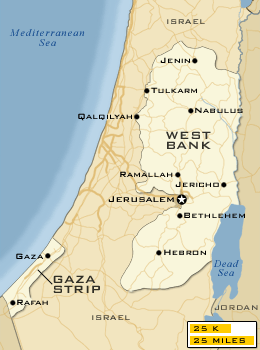
Israeli policy in Gaza looked for a while like it would drive Gazans to the lunatic fringe. Hamas reacted with massive propaganda efforts to Israel's attacks, blockades, etc. In a region so devoid of contact to the outside world, it seemed like such propaganda would work. But somehow, it hasn't. Gazans currently prefer Fatah--a party removed from Gaza's streets and consorting with Israel, Hamas' enemy. The implications of this are strong: Despite losing the civil war and appearing to sell out the Gaza strip, Fatah has won their loyalty. Throughout all of the Palestinian Authority, Hamas is being rejected by fairly impressive margins.
If Fatah can substantially win the upcoming January elections, then its moderate politics will reign supreme. If it can consolidate its power over Gaza, then it can begin to enforce moderate policies and suppress Hamas' anti-Israeli terror behavior. If and only if it can suppress this behavior will its 2-state policy have a chance. Israel cannot give up some control of the PA until it knows that it will not be a hotbed for terror--it cannot take it back as easily as it can simply hold on.
But the other implications are perhaps more interesting, in Israel. If the moderate Fatah party can take control of all of the Palestinian Authority, then Israeli perceptions about the PA may change. If the Israelis see hope in 2-state negotiations, if they see that such negotiations may lead to long-term peace and prosperity rather than increased terrorism and demands by radical Islamist leadership, then Israelis may be more tempted to vote Kadima and continue negotiations rather than throw their hands up and oust the government for the Likud opposition.
If Fatah and Kadima can get a new mandate and a stronger political hold over their respective territories, then the 2-state negotiations are likely to have a lot more hope in the next few years--particularly if such moderates in power allow the Israeli-Syrian peace talks to resolve. The machinations for Middle East negotiations have been shaken up significantly by the last years' actions, but they may not have fallen apart.
The implications of this are extremely interesting for Persian Gulf and American governments. Here's why:
A few years ago, Hamas and Fatah fought a brief civil war in both the Gaza strip and West Bank. In Gaza, an aid-dependent territory, Hamas had strong local roots and a reputation for setting up schools and donation centers. They were popular, and in Gaza, they drove Fatah out. But Fatah was the elected government, and won in the West Bank, where trade and diplomacy happen through Israel and Jordan. Each section became a more homogenous, polarized region.
Israeli policy in Gaza looked for a while like it would drive Gazans to the lunatic fringe. Hamas reacted with massive propaganda efforts to Israel's attacks, blockades, etc. In a region so devoid of contact to the outside world, it seemed like such propaganda would work. But somehow, it hasn't. Gazans currently prefer Fatah--a party removed from Gaza's streets and consorting with Israel, Hamas' enemy. The implications of this are strong: Despite losing the civil war and appearing to sell out the Gaza strip, Fatah has won their loyalty. Throughout all of the Palestinian Authority, Hamas is being rejected by fairly impressive margins.
If Fatah can substantially win the upcoming January elections, then its moderate politics will reign supreme. If it can consolidate its power over Gaza, then it can begin to enforce moderate policies and suppress Hamas' anti-Israeli terror behavior. If and only if it can suppress this behavior will its 2-state policy have a chance. Israel cannot give up some control of the PA until it knows that it will not be a hotbed for terror--it cannot take it back as easily as it can simply hold on.
But the other implications are perhaps more interesting, in Israel. If the moderate Fatah party can take control of all of the Palestinian Authority, then Israeli perceptions about the PA may change. If the Israelis see hope in 2-state negotiations, if they see that such negotiations may lead to long-term peace and prosperity rather than increased terrorism and demands by radical Islamist leadership, then Israelis may be more tempted to vote Kadima and continue negotiations rather than throw their hands up and oust the government for the Likud opposition.
If Fatah and Kadima can get a new mandate and a stronger political hold over their respective territories, then the 2-state negotiations are likely to have a lot more hope in the next few years--particularly if such moderates in power allow the Israeli-Syrian peace talks to resolve. The machinations for Middle East negotiations have been shaken up significantly by the last years' actions, but they may not have fallen apart.
Thursday, February 7, 2008
Why is Gaza Broken?
My first warning on this post is I really have no idea what the answer is. But there are a few points worth noting, that bring up a few questions.
1) The Hamas Coup. Still acting like a terror cell as much as a political party, Hamas' violent purging of Fatah in the Gaza Strip (as soon as it had a big enough advantage in firepower) has shown complete disregard for the creation of a stable independent state... but this is not surprising. The party officially still insists on the dissolution of Israel before peace is possible. How do you fix a region run like this? Not sure.
2) Geography. Making a country that is split by its greatest security threat (Gaza Strip and West Bank split by Israel) seems stupid, and it is. Germany hated Poland long before 1939 because of the Danzig Corridor, and an independent Palestine would have serious trouble maintaining administration, security, and trade unless Israel was willing to allow free flow, through Israel, between the two regions. Unfortunately, because of 50 years of constant terror and military threats from the Palestinian regions, such free flow is almost certainly politically infeasible (and probably not actually a great idea).
3) The Security Dilemma. Neither side (Israel or Palestine) is willing to promise peace without security assurances, and neither side can give these assurances, largely because of Hamas and other terror organizations. Israel could try to be the "grown-up," given its military strength, give Palestine its political and security concessions, wait for peace, and then get its own concessions later, but while Olmert and Abbas might be willing to work with this plan, non-state actors in Palestine (particularly Hamas-type fanatics) are impossible for the Palestinian state to effectively control, and they would likely continue to use terror to increase their political gains, as they have done in the past. Therefore, Abbas cannot possibly make security promises to Israel, and therefore, Israel cannot (in its own interest) let Palestine yet have a free state. Again, I do not know how to fix this dilemma.
4) The Arab States' lack of help. Well, some are helping. Egypt is trying, but Gazan refugees are starting to pour into Egypt, and the Egyptian PM is literally threatening to break legs. Egypt's cooperation with the Israeli blockade is somewhat rare. Iran's Hezobllah militants in Lebanon seem to be vying for another war with Israel, and Syria has refused to help make peace in the Palestine issue until gives back the Golan Heights--a mountain range through which Syria invaded Israel multiple times.
5) Israel's Inconsistency. Israel has been inconsistent about its responses against terror attacks by Gazan militants. Israel forced its settlers from Gaza (which was, in general, the right thing to do) amid uncharacteristically high terror attacks, which may have made Hamas think such terror attacks would win political victories... even now, Israel's military responses range from lackluster to extreme, and Palestinian civilians cannot be clear on what kind of behavior will bring them peace and prosperity. Palestine is much like a colony of Israel, and Israel will have to take care of the Palestinian people or let them be free... doing neither will only create more resentment.
But we are certainly stuck. Israel and Palestine both need promises of security before political progress can be made, and this makes one think "UN Intervention," but that's unlikely to happen anytime soon (and we see it failed rather miserably in the 2006 Israeli-Lebanon war).
I would love comments from readers on creative peace-making ideas.
1) The Hamas Coup. Still acting like a terror cell as much as a political party, Hamas' violent purging of Fatah in the Gaza Strip (as soon as it had a big enough advantage in firepower) has shown complete disregard for the creation of a stable independent state... but this is not surprising. The party officially still insists on the dissolution of Israel before peace is possible. How do you fix a region run like this? Not sure.
2) Geography. Making a country that is split by its greatest security threat (Gaza Strip and West Bank split by Israel) seems stupid, and it is. Germany hated Poland long before 1939 because of the Danzig Corridor, and an independent Palestine would have serious trouble maintaining administration, security, and trade unless Israel was willing to allow free flow, through Israel, between the two regions. Unfortunately, because of 50 years of constant terror and military threats from the Palestinian regions, such free flow is almost certainly politically infeasible (and probably not actually a great idea).
3) The Security Dilemma. Neither side (Israel or Palestine) is willing to promise peace without security assurances, and neither side can give these assurances, largely because of Hamas and other terror organizations. Israel could try to be the "grown-up," given its military strength, give Palestine its political and security concessions, wait for peace, and then get its own concessions later, but while Olmert and Abbas might be willing to work with this plan, non-state actors in Palestine (particularly Hamas-type fanatics) are impossible for the Palestinian state to effectively control, and they would likely continue to use terror to increase their political gains, as they have done in the past. Therefore, Abbas cannot possibly make security promises to Israel, and therefore, Israel cannot (in its own interest) let Palestine yet have a free state. Again, I do not know how to fix this dilemma.
4) The Arab States' lack of help. Well, some are helping. Egypt is trying, but Gazan refugees are starting to pour into Egypt, and the Egyptian PM is literally threatening to break legs. Egypt's cooperation with the Israeli blockade is somewhat rare. Iran's Hezobllah militants in Lebanon seem to be vying for another war with Israel, and Syria has refused to help make peace in the Palestine issue until gives back the Golan Heights--a mountain range through which Syria invaded Israel multiple times.
5) Israel's Inconsistency. Israel has been inconsistent about its responses against terror attacks by Gazan militants. Israel forced its settlers from Gaza (which was, in general, the right thing to do) amid uncharacteristically high terror attacks, which may have made Hamas think such terror attacks would win political victories... even now, Israel's military responses range from lackluster to extreme, and Palestinian civilians cannot be clear on what kind of behavior will bring them peace and prosperity. Palestine is much like a colony of Israel, and Israel will have to take care of the Palestinian people or let them be free... doing neither will only create more resentment.
But we are certainly stuck. Israel and Palestine both need promises of security before political progress can be made, and this makes one think "UN Intervention," but that's unlikely to happen anytime soon (and we see it failed rather miserably in the 2006 Israeli-Lebanon war).
I would love comments from readers on creative peace-making ideas.
Subscribe to:
Posts (Atom)